
Last updated 2026-07-09
TL;DR
A portable dry sauna is a collapsible, fabric-walled enclosure that heats your body with an electric element or infrared panels, usually reaching 120 to 160°F. They cost $100 to $600, set up in minutes, and need no permits. It's a legit budget entry point. Ceiling height, heat consistency, and durability fall well short of a built-in sauna.
What exactly is a portable dry sauna?
A portable dry sauna is a freestanding, collapsible enclosure that heats your body with hot dry air or near-infrared radiation. The "dry" label means relative humidity stays low, usually 5% to 30%, unlike steam rooms where humidity can hit 100% [1]. You sit inside with your head either enclosed or poking out through a hole in the top, and the walls trap heat around your body.
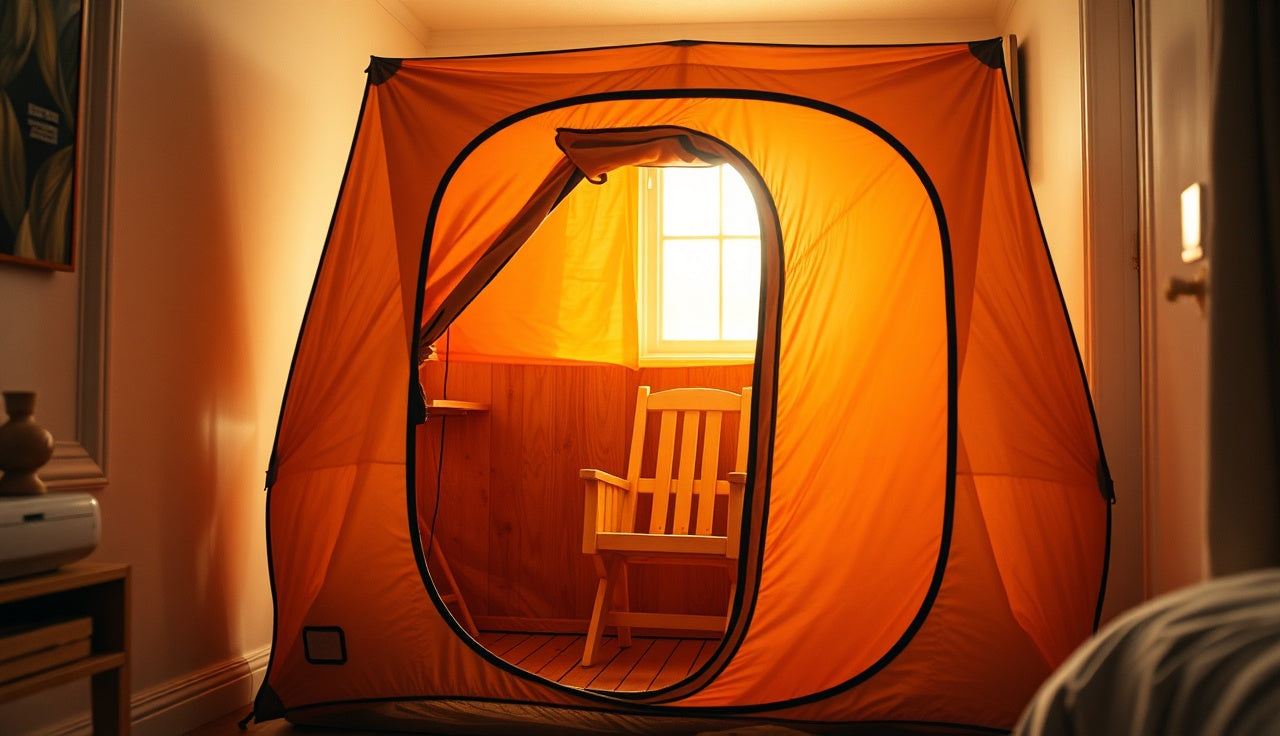
These aren't the same thing as the sauna at your gym. No heater pouring over a pile of rocks. No ladle. No steam. It's a nylon or polyester tent with a heating element, a fold-up chair, and a zipper. Honest comparison: it's to a sauna what a camping stove is to a kitchen range. It works. It's not the same.
Two technologies power them. Traditional-style portables use a plug-in steam or heating wand that sits in a small water reservoir, though some purists point out those actually produce a little steam and blur the line between dry and wet. True dry-infrared portables skip water entirely and use carbon or ceramic infrared panels sewn into the tent walls. Infrared versions run cooler in air temperature (110 to 130°F) but heat tissue more directly [2].
How hot does a portable dry sauna actually get?
Most portable units advertise 140 to 160°F, and the better models hit that reliably in a 70°F room with the door shut after 15 to 20 minutes of warm-up. Cheap units often plateau 10 to 20°F below their listed max, especially in a cold garage or outdoors in winter.
For context, the Finnish Sauna Society recommends traditional sauna temperatures of 80 to 100°C (176 to 212°F) at bench level [3]. A portable dry sauna doesn't get there. What it can do is keep your skin surface hot enough to trigger sweating and raise core body temperature meaningfully, which is where most of the studied effects live.
Infrared panels present a different measurement problem. The air in an infrared portable might read only 110°F, but the radiant heat hitting your skin can produce a sweat response comparable to a hotter conventional sauna. The two aren't comparable on a thermometer reading alone. Neither type approaches the consistent heat and thermal mass of a wood-lined home sauna with a proper heater.
One practical point: consistency matters. A built-in sauna with a 6kW or 9kW heater holds temperature even when the door opens and closes. A portable's thin fabric walls bleed heat fast. Sessions run 15 to 30 minutes, enough to sweat but tight for the longer, interrupted protocols (exit, cool down, re-enter) that some people follow.
What are the different types of portable dry saunas?
There are three practical categories, and knowing the difference saves you money.
Infrared tent saunas. Infrared panels are built into the tent walls and sometimes the floor pad. You sit in a foldable chair, zip yourself in, and the panels radiate heat at your body. No steam, no water. Prices run about $150 to $500+. Brands like SereneLife and Durherm dominate this category. Heat-up time is 5 to 10 minutes.
Steam wand portables. A wand-style element sits in a water reservoir, heats the water, and pumps steam into the tent. Despite the steam, they're often sold as "dry saunas" because the enclosure isn't built to be saturated. They feel hotter in the air but run more humid than a true dry experience. Prices are similar, $100 to $350.
Sauna blankets. These aren't tents at all. You lie inside a quilted or foil-lined sleeping-bag-style blanket with infrared elements. No chair, no sitting up. They're the most compact and cheapest option ($150 to $400), and they're popular with people who want a passive sweat while lying flat. Heat distribution differs from sitting upright, and the experience feels less sauna-like. The sweat suits sauna category sits right next to this.
A quick comparison of the main portable formats:
| Type | Typical temp range | Heat-up time | Price range | Humidity |
|---|---|---|---|---|
| Infrared tent | 110 to 140°F | 5 to 10 min | $150 to $500 | Very low (dry) |
| Steam wand tent | 120 to 160°F | 10 to 20 min | $100 to $350 | Low-moderate |
| Sauna blanket | 100 to 130°F (surface) | 5 to 10 min | $150 to $400 | Near zero |
All three fold, store in a bag, and need no permanent installation. None of them are what a Finnish sauna enthusiast would call a sauna.
| $90–$150 steam wand (budget) | 125 |
| $200–$350 infrared tent (mid) | 135 |
| $400–$600 carbon IR tent (premium) | 145 |
| Built-in infrared cabinet ($800–$1,200) | 155 |
| Traditional Finnish sauna (176°F+ target) | 185 |
Source: Finnish Sauna Society guidelines & category product testing data, 2024
What are the real health benefits and what's overstated?
The honest answer: most of the strong research on sauna health outcomes was done on traditional Finnish saunas at high temperatures (80 to 100°C) with substantial session frequency, not on portable units [4]. Applying that data directly to a portable running at 130°F is a stretch, and anyone who tells you otherwise is extrapolating.
Still, the mechanism most researchers point to is heat stress and the response it triggers: higher heart rate, cutaneous vasodilation, core temperature rise, sweating. If a portable raises your core temperature meaningfully and gets you sweating, some of those responses are probably happening. The magnitude is almost certainly smaller than what a traditional sauna delivers.
A 2018 Mayo Clinic Proceedings review found regular sauna bathing is associated with reduced cardiovascular mortality and blood pressure benefits in observational studies, but stressed that causation is hard to establish and most evidence comes from Finnish cohort data [5]. The review didn't address portable saunas at all.
For muscle recovery, the evidence is modest. A 2017 meta-analysis in the British Journal of Sports Medicine found contrast water therapy reduced muscle soreness more effectively than passive recovery, though study methods varied widely [10]. Some people swear by a post-workout session in their portable. The placebo component of "something warm and relaxing" probably does real work here too.
What's clearly overstated in portable-sauna marketing: dramatic detox claims (your liver and kidneys handle detox; sweat carries trace minerals and some water-soluble compounds but isn't a primary detox organ) and weight loss claims (the water weight you drop comes right back when you rehydrate, which you have to). Stick to what the data supports: a cardiovascular stress response, relaxation, and possibly modest recovery help.
Is a portable dry sauna safe to use?
For most healthy adults, short sessions (15 to 30 minutes) at the temperatures these units reach are low-risk. The concerns are the same as any heat exposure: dehydration, overheating, cardiovascular strain.
The CDC's NIOSH heat stress guidance notes that heat illness occurs when the body can't cool itself, and that elderly people, those with cardiovascular disease, and people on certain medications (diuretics, antihypertensives, drugs that impair sweating) face higher risk [7]. If that's you, talk to your doctor before buying.
A few safety notes specific to portable units:
The head-out design of most tent saunas keeps your brain cooler than the rest of your body. That's a reasonable safety feature compared to a traditional sauna where your head sits in the hot air. It also changes the experience, and some heat-adaptation signals may be blunted.
Electrical safety. These are plug-in devices, often 1,000 to 1,500 watts, used in a sweaty, humid space. Buy units with UL or ETL listing [12]. Skip the extension cord. Keep them away from water (shower, bathtub). Check the cord and heating element before every session.
Pregnancy. The American College of Obstetricians and Gynecologists advises against raising core body temperature above 102.2°F during pregnancy, especially in the first trimester [8]. Most portable sessions can push core temp toward that line. Pregnant women should avoid these.
Drink water before and after. A sauna session can produce 0.5 to 1 liter of sweat [3]. Rehydrate with water or electrolytes. Alcohol before or during a session is a bad idea for obvious reasons.
How much does a portable dry sauna cost?
The range is wide. At the bottom, steam wand tents run $90 to $150 on Amazon. They work, sort of, but build quality is thin: seams fray, zippers jam, heating elements die within months. From $200 to $350 you get more consistent heat and better materials. The $400 to $600 range buys infrared panel units with more even heat, better controllers, and longer warranties (usually 1 year on parts).
Past $600 you enter a strange zone where a portable costs nearly as much as an entry-level indoor traditional sauna, and the comparison flips. A 1-2 person plug-in indoor traditional sauna (wood walls, rock heater) starts around $800 to $1,200 and gives you a far better experience. See outdoor sauna options for the built-in side.
Sauna blankets sit at $150 to $400 and are a legit alternative when storage space is the real constraint.
Hidden costs: replacement heating wands (if the steam element dies), a proper towel setup, an absorbent floor mat, and maybe a hygrometer or thermometer to verify actual temperatures. None break the bank, but they add $30 to $80 to the total.
If you've done the math and decided a portable is the right call, a collection like the one at SweatDecks is worth a look, since the focus there is verified heat output rather than listed specs.
How do portable dry saunas compare to traditional and infrared saunas?
This is the question that actually decides whether a portable makes sense for you.
A traditional Finnish-style sauna runs 170 to 200°F at bench level, uses a rock heater (kiuas), and can handle löyly (pouring water on the rocks for steam bursts). The thermal mass of the rocks and the wood-lined room holds temperature beautifully. Sessions run 10 to 20 minutes on, cool down, repeat. There's more on those differences in our sauna vs steam room breakdown.
A built-in infrared cabinet uses ceramic or carbon panels, runs 110 to 140°F in air temperature, and heats the body differently than convective hot air. Both the traditional and infrared cabinet versions need a permanent space, usually 4x4 feet minimum for one person, and some require a dedicated 20-amp or 240V circuit. They stay put.
A portable dry sauna gives you no installation, no dedicated space, power from a standard 15-amp 120V outlet, packing into a bag, and a fraction of the cost. The tradeoffs are real: lower max temperatures, no thermal mass, thin walls that bleed heat, a less immersive feel, and a shorter lifespan (1 to 4 years for most units versus 10 to 20 years for a quality built-in).
For someone renting, living in a small apartment, traveling, or just testing whether regular sauna sessions fit their routine before committing $2,000+, a portable is a reasonable answer. For someone committed to the practice with the space to spare, it's a long-term compromise.
If you're comparing against a home sauna investment, treat the portable as a proof-of-concept device, not a permanent fixture.
Do portable dry saunas require any permits or special installation?
In almost every U.S. jurisdiction, a plug-in portable sauna tent or blanket needs no permit. It's a household appliance. Plug it in, use it, fold it up.
That's one of the genuinely compelling advantages over built-in saunas, which often trigger permit requirements when they involve electrical work above a certain amperage or structural changes. The International Residential Code and local amendments typically require permits for new electrical circuits and permanent structures [9]. A portable sidesteps all of it.
If you rent, check your lease for restrictions on high-wattage appliances. Most portable units draw 1,000 to 1,500 watts, comparable to a space heater or hair dryer, and most leases don't prohibit that.
Outdoor use gets slightly more complicated. Using a portable outside is generally fine from a regulatory standpoint. Using one in wet conditions or on an unprotected surface is a safety issue, not a legal one. Keep the cord and heating element dry no matter the weather.
Can you use contrast therapy with a portable sauna?
Yes, and it's one of the better use cases for a portable. If you already own a cold plunge or even take cold showers, you can cycle between the portable sauna and the cold exposure for a contrast protocol.
Contrast therapy, alternating hot and cold, has a reasonable evidence base for reducing muscle soreness and improving how recovered you feel. A 2017 meta-analysis in the British Journal of Sports Medicine found contrast water therapy reduced muscle soreness more effectively than passive recovery [10]. That research used water immersion specifically, but the vascular response to rapid temperature change is the mechanism at work, and a sauna-to-cold-plunge sequence approximates it.
For a home protocol, a portable dry sauna plus a cold plunge tub or ice bath is a viable setup. Heat 10 to 15 minutes, cold 2 to 5 minutes, repeat 2 to 3 cycles. The portable's fast warm-up (5 to 15 minutes) makes this practical in a way a barrel sauna needing 45 minutes never will.
The cold plunge benefits are worth understanding on their own if contrast therapy is your main goal.
How long does a portable dry sauna last and how do you maintain it?
This is where most portable saunas let you down. Budget units ($100 to $200) commonly break within 6 to 18 months: zipper failures, heating element burnout, fabric tearing at seam stress points. Mid-range units ($250 to $500) tend to last 2 to 4 years with reasonable care. Longevity data is thin here because the category runs on Amazon-first brands that don't publish durability studies.
Maintenance is simple, and it matters:
Wipe the interior after each session. Sweat is acidic and corrodes fabric and heating element contacts over time. Use a damp cloth with mild soap, then let it dry fully before folding.
Don't fold it soaking wet. Mold grows fast in trapped moisture. Air it out for 30 to 60 minutes after a session.
Inspect the power cord and element connection before every session. Any cracking, fraying, or discoloration on the cord means stop using it immediately.
Store it uncompressed if you can. Tight folding stresses the wires sewn into infrared panels and can cause hot spots or failures.
Replacement heating wands for steam units usually run $20 to $40 and can extend the life of an otherwise fine tent. Replacement infrared panels are harder to source and rarely worth the repair cost on a cheap unit.
If you're eyeing an upgrade, the gap between a mid-range portable and a low-end permanent indoor sauna is smaller than most people expect.
What should you look for when buying a portable dry sauna?
A few things separate a functional unit from a box of expensive nylon:
Wattage and verified temperature. Minimum 1,000 watts for a tent unit. Look for independent reviews or YouTube tests that actually measure internal temperature with a thermometer, not the manufacturer's spec. A unit claiming 160°F that only hits 120°F in tests is not a 160°F sauna.
UL or ETL certification. Non-negotiable for electrical safety. It means a third-party lab tested the unit against safety standards [12]. If the listing doesn't mention either, skip it.
Panel type for infrared units. Carbon panels heat more evenly and last longer than ceramic. Ceramic heats faster but has hot spots and a higher failure rate over time. Carbon is worth paying for.
Chair quality. You're sitting in this for 15 to 30 minutes, sweaty, with the tent zipped around you. A flimsy chair that wobbles or has sharp edges where fabric meets frame is both uncomfortable and a hazard.
Zipper quality. Metal zippers outlast plastic. Test it 10 times inside your return window. A binding zipper is misery when you're overheated and want out.
Warranty and return policy. One year on parts is standard for the better brands. A 30-day return window matters because some defects don't surface until several sessions in.
Controller panel. A timer is necessary. A temperature display helps. Don't pay extra for Bluetooth on a portable sauna; it adds failure points and zero practical value.
Frequently asked questions
Can a portable dry sauna really make you sweat as much as a real sauna?
You'll sweat, but probably less than in a traditional sauna at 180 to 200°F. Most portables top out at 130 to 160°F, enough to produce meaningful sweating for most people. Output depends on air temperature, duration, and your physiology. Expect 0.3 to 0.7 liters per session in a portable, versus up to 1 liter in a high-temperature traditional sauna.
How much electricity does a portable sauna use?
Most portable units draw 800 to 1,500 watts. A 30-minute session at 1,200 watts uses 0.6 kWh. At the U.S. average retail rate of roughly 16 cents per kWh in 2024, that's about 10 cents per session. Daily use for a month runs around $3. It won't move your electricity bill much.
Can you use a portable dry sauna every day?
For healthy adults, daily 15 to 20 minute sessions sit well within the range seen in research populations. Finnish sauna culture involves near-daily use. The main risks from frequent use are cumulative dehydration (replace fluids every session) and skin irritation if you don't shower and let skin recover. There's no established upper limit for healthy adults; listen to how your body responds.
Is a portable sauna the same as a sauna blanket?
No. A portable sauna tent is an upright enclosure you sit inside. A sauna blanket is a wrap-around infrared blanket you lie inside, like a sleeping bag. Both use infrared heating and both fold for storage. The blanket gives more even body coverage lying down; the tent offers a seated sauna posture. Neither is inherently better; they suit different uses.
Can I use a portable dry sauna if I have high blood pressure?
Heat exposure raises heart rate and temporarily lowers blood pressure through vasodilation, which sounds beneficial but creates cardiovascular strain. People with uncontrolled hypertension or on antihypertensive medications should consult a physician before use. The American Heart Association hasn't issued specific guidance on portable saunas, and individual responses vary. This is genuinely a case where a doctor's input matters before you start.
What's the difference between a dry sauna and a steam room for a portable unit?
A dry sauna has low humidity (5 to 30%) and high air temperature. A steam room runs near 100% humidity at lower temperatures (100 to 120°F). Portable "dry sauna" tents using a steam wand blur this line, producing some humidity. True dry portables use infrared panels with no water. If dry heat is your goal for comfort or breathing, go with an infrared panel tent or blanket rather than a steam wand model.
How long does a portable sauna take to heat up?
Infrared panel tents typically reach usable temperatures in 5 to 10 minutes. Steam wand models take 10 to 20 minutes to build adequate heat. Compare that to a traditional outdoor wood-burning sauna, which needs 45 to 90 minutes to reach operating temperature. The fast heat-up is a real practical advantage of portables, especially for morning or post-workout use.
Can two people use a portable dry sauna at the same time?
Most portable tent saunas are built for one person. A few larger models (60+ inches wide) claim two-person capacity, but with two adults inside it's cramped. Two-person portables also need more wattage to hold temperature and cost more. If you're buying for regular two-person use, a 1-2 person built-in infrared cabinet is a more sensible starting point.
Does a portable dry sauna help with weight loss?
Not in any lasting way. The weight you lose in a session is water from sweating, and it returns the moment you rehydrate. Sauna use does burn a modest number of extra calories through the cardiovascular stress response (estimates range from 25 to 75 calories per 20-minute session, with wide variation), but that's not a meaningful weight loss mechanism. Any product marketed as a fat-burning sauna is overpromising.
Are portable dry saunas safe for children or elderly users?
Children's thermoregulation is less efficient than adults, and they overheat faster. Most health guidance recommends avoiding sauna use for young children, and only short sessions at lower temperatures with close supervision for older children. Elderly adults face higher risk of cardiovascular strain and heat illness. Neither group should use a portable sauna without medical clearance, and sessions should be shorter and cooler than for healthy younger adults.
Can you use a portable sauna outdoors?
Yes, with caveats. Keep all electrical components dry. Use it on a flat, stable, dry surface. Wind slashes heat retention in the thin fabric walls, so outdoor use in cold or windy conditions produces much poorer results. In moderate weather with no rain, outdoor use is practical. Never run one in the rain or leave it outside when it's not in active use.
What's the minimum space you need to set up a portable dry sauna?
Most single-person tent saunas are roughly 36x36 inches at the base and 50 to 60 inches tall. You need a few inches of clearance around the unit for airflow and safe heat dissipation, so figure 48x48 inches of floor space minimum. A bedroom corner, a bathroom with good ventilation, or a garage all work. The footprint is smaller than even the smallest built-in 1-person cabinet.
How does a portable dry sauna compare to a Costco sauna in terms of value?
Costco periodically sells entry-level wood infrared cabinets for $1,200 to $2,500. These are built-in units with real wood walls, multiple panels, and a proper bench: more effective heat, more durable, a better experience. A portable at $200 to $400 wins on price and portability only. If Costco has a good cabinet deal and you have the space, it's probably the better long-term value. Full breakdown in our Costco sauna guide.
Sources
- Finnish Sauna Society, Sauna: What Is It?: Traditional dry sauna humidity runs 5–30%; steam rooms approach 100% humidity
- Biomedical Engineering Online, overview of infrared sauna panel types: Infrared panels heat tissue more directly at lower air temperatures than convective heat
- Finnish Sauna Society, Sauna Guidelines: Recommended traditional sauna temperature is 80–100°C at bench level; typical sweat output 0.5–1 liter per session
- Laukkanen JA et al., JAMA Internal Medicine 2015, Sauna bathing and risk of sudden cardiac death: Major cohort studies on sauna health outcomes were conducted on traditional Finnish saunas at 80–100°C, not portable units
- Mayo Clinic Proceedings 2018, Health effects of sauna bathing: Regular sauna bathing associated with reduced cardiovascular mortality in observational studies; causation not established
- CDC, Heat Stress, NIOSH Topics: Elderly individuals, people with cardiovascular disease, and those on certain medications face higher risk from heat exposure
- American College of Obstetricians and Gynecologists, Committee Opinion on Exercise in Pregnancy: Pregnant women should avoid raising core body temperature above 102.2°F, particularly in the first trimester
- International Residential Code 2021, Chapter 34 (Electrical) and Chapter 1 (Permits): Permanent electrical work and structural modifications typically require building permits under IRC; plug-in appliances do not
- Higgins TR et al., British Journal of Sports Medicine 2017, Contrast water therapy meta-analysis: Contrast water therapy (hot-cold alternation) reduced muscle soreness more effectively than passive recovery in meta-analysis
- U.S. Energy Information Administration, Average Retail Price of Electricity 2024: U.S. average retail electricity rate approximately 16 cents per kWh in 2024
- Underwriters Laboratories (UL), UL Product iQ Safety Certification: UL certification indicates third-party testing against electrical safety standards for consumer appliances

Share:
SereneLife portable sauna: honest review and buyer's guide
SereneLife portable sauna: honest review and buyer's guide