
Last updated 2026-07-09
TL;DR
SereneLife portable infrared saunas cost roughly $130 to $200, use carbon fiber far-infrared panels, and reach around 130 to 140°F inside a zip-up fabric enclosure. They are the cheapest way into home sauna use. The limits are real: thin walls bleed heat fast, sessions feel less immersive than a barrel or cabin sauna, and durability past 18 months is inconsistent based on owner reports.
What exactly is the SereneLife portable infrared sauna?
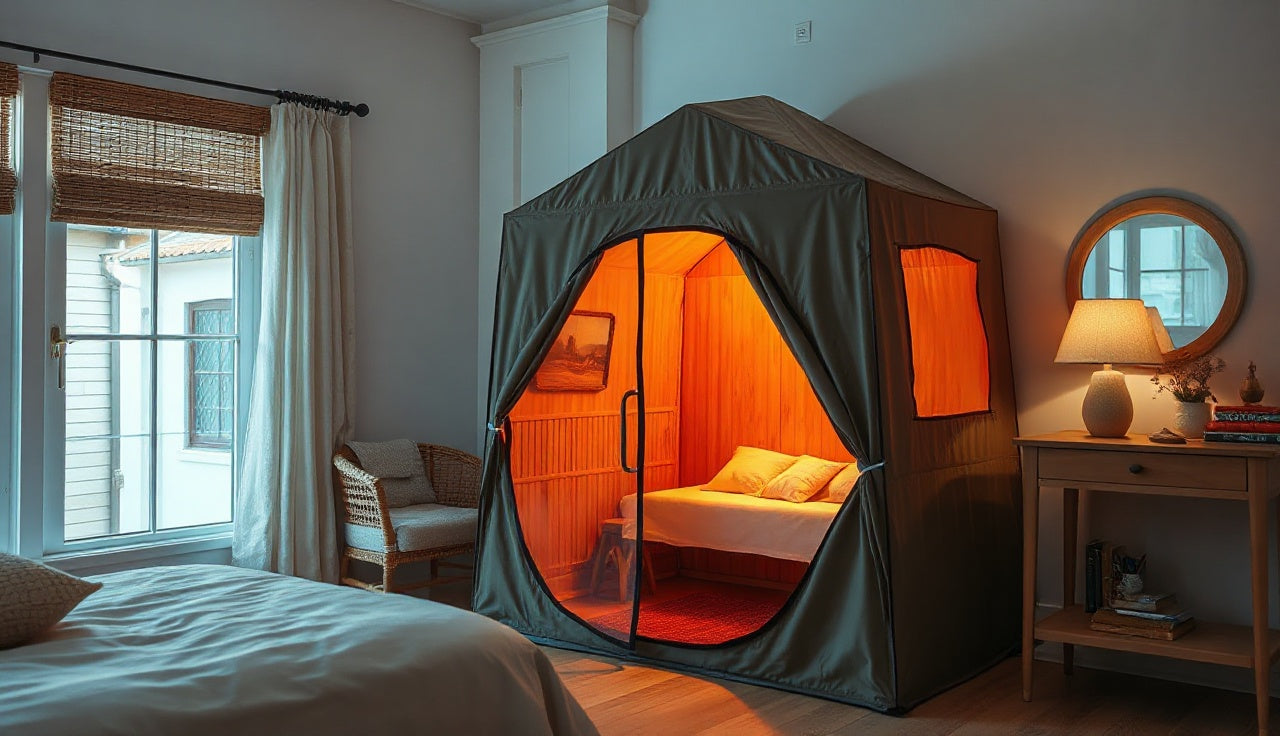
SereneLife is a brand under PYLE Audio, a consumer electronics company that sells a broad lineup of budget products. Their portable infrared saunas are fabric-walled, zip-up enclosures with a built-in seat, a hand controller, and carbon fiber far-infrared heating panels sewn into the sides, back, and foot area. You climb in, zip it to your neck, and sit inside while your head and hands stay out. That hands-free posture is the main selling point.
The enclosures are small. Most models measure roughly 35 x 35 x 47 inches, enough for one adult sitting upright but not enough to stretch out or shift around. The controller sets temperature up to around 140°F and time up to 60 minutes. Setup takes under five minutes and needs no tools. You plug it into a standard 120V outlet, and it pulls about 1,000 to 1,100 watts [1].
This is not a Finnish sauna and it is not a full-cabin infrared unit. Think personal heat tent, using dry infrared instead of steam. If you want the wider context on how it fits the portable sauna category, read that first. It changes how you judge the price.
How much does a SereneLife portable infrared sauna cost?
Most SereneLife portable infrared sauna models sell for $130 to $200 on Amazon and other major retailers as of mid-2025. The common listing, usually titled something like "SereneLife Portable Full-Size Infrared Home Spa" (the SLISPA series), floats around $149 to $169 with Prime shipping. Sale prices sometimes dip to $119.
That is the lowest price in the infrared sauna category, full stop. A full-panel home infrared cabin starts around $800 to $1,200 on the low end, and a quality barrel outdoor sauna runs $3,000 to $8,000 or more [2]. So the SereneLife does not compete with those. It competes with other blanket and tent-style portables, where HigherDOSE, Therasage, and SaunaSpace each start at $500 to $700 and climb.
For the $150 bracket, you are not getting equal heat output, build quality, or infrared consistency. You are paying for convenience and a low barrier to entry. That trade is fine if you know you are making it.
What do real owner reviews say about SereneLife portable saunas?
Across Amazon listings for the SLISPA series, the aggregate rating usually lands between 4.0 and 4.3 out of 5 stars over several thousand reviews. Positive on its face, but the distribution is bimodal: a big cluster of 5-star reviews from people who love the idea, and a smaller but loud cluster of 1 and 2-star reviews about durability.
What owners like:
- Heat arrives fast, usually usable warmth within 10 to 15 minutes.
- Setup and teardown take minutes, so it stores in a closet between uses.
- The sweat is real. Most reviewers report heavy perspiration by 15 to 20 minutes at 130°F and up.
- The neck collar traps heat better than people expect.
What owners complain about:
- The zipper fails. Reviews going back years mention the zipper track degrading after several months of regular use.
- The fabric wears thin and sometimes develops hot spots or loses its shape.
- Heating panels in cheaper units warm unevenly, leaving the foot panel cooler than the torso.
- Customer service is hit or miss, according to owner reports.
One pattern worth flagging: verified-purchase reviews tend to skew more critical than unverified ones, which is typical for any product tied to incentivized review programs. Weight the ratings accordingly.
For a broader look at sauna benefits that hold regardless of sauna type, the research does support heat exposure for cardiovascular and mood effects. Most of that work used traditional saunas at 80 to 100°C, not far-infrared enclosures at lower temperatures [3].
| SereneLife SLISPA tent | $160 |
| Therasage 360 Plus tent | $649 |
| HigherDOSE sauna blanket | $599 |
| SaunaSpace Luminati | $2,999 |
| Entry cabin infrared (Dynamic/JNH) | $1,100 |
Source: Retailer listings and product documentation, 2025
Does a SereneLife infrared sauna actually work for heat therapy?
Short answer: yes, it makes real heat and real sweat. The mechanism and the intensity just differ from what most sauna research covers.
Far-infrared radiation sits in the 7 to 14 micron wavelength range and reaches surface skin tissue more directly than convected hot air [4]. The theory is that lower air temperatures (100 to 140°F versus 160 to 200°F in a Finnish sauna) can still raise core temperature because the infrared energy acts on tissue rather than just warming the air. Some small studies show elevated core temperature and heart rate in far-infrared sessions, though the effect sizes are generally smaller than with high-temperature traditional saunas [3].
The SereneLife uses carbon fiber panels, the baseline standard for far-infrared emitters. Carbon fiber puts out far-infrared wavelengths reasonably well. It is not the strongest option (ceramic rods emit more intensely, full-spectrum panels add near and mid infrared), but it works.
What the fabric cannot do is hold and re-radiate heat the way wood walls do. A wood cabin stores heat in its mass and gives it back from every surface. A fabric tent lets heat escape fast, so the session feels less enveloping. You will sweat. You will feel warm. You probably will not hit the deep, settled state that 30 minutes in a proper home sauna cabin gives you.
Nobody has good head-to-head data comparing fabric-tent infrared to cabin infrared on physiological outcomes. The closest relevant work uses cabin-style far-infrared units.
How does SereneLife compare to other portable infrared saunas?
Here is how the main entry-level infrared options stack up on the things that decide whether you keep using one:
| Model | Type | Price | Max Temp | Wattage | Build | Warranty |
|---|---|---|---|---|---|---|
| SereneLife SLISPA series | Tent/enclosure | $130, $200 | ~140°F | ~1,000W | Fabric | 1 year |
| HigherDOSE Infrared Sauna Blanket | Blanket | $599 | ~158°F | ~1,000W | Layered fabric | 1 year |
| Therasage 360 Plus | Tent/enclosure | $599, $699 | ~140°F | ~1,200W | Thicker fabric | 1 year |
| SaunaSpace Luminati | Panel + tent | $2,999+ | varies | ~1,000W | Organic cotton | 5 years |
| Entry cabin infrared (e.g., Dynamic, JNH) | Wood cabin | $800, $1,500 | ~140 to 150°F | 1,200 to 1,750W | Cedar/hemlock | 1 to 5 years |
The SereneLife wins on price. Every other measure, from build to heat consistency to how immersive a session feels, favors the pricier options. The HigherDOSE blanket at $599 uses layered construction that wraps your body more completely, but the posture is different (you lie down). Therasage at $599 gives the same tent-style experience with noticeably thicker panels and a better service record per owner reports.
If your budget is truly $200 or under, SereneLife is your main option in the tent category. Stretch to $400 or $500 and there are better products. Stretch to $800 and up, and a wood cabin infrared unit is the smarter long-term buy.
What are the safety considerations for using an infrared sauna tent at home?
A few things matter here, and they are worth taking seriously.
Electrical safety: SereneLife units pull around 1,000 watts on a standard 120V circuit. That is about 8.3 amps, well inside what a 15-amp household circuit handles. The units are UL or ETL listed, so look for that mark on the unit before you use it. Do not run it on an extension cord. Plug directly into a wall outlet [5].
Hydration: Infrared sessions cost you real fluid. Research on Finnish sauna sessions of 15 to 30 minutes documents sweat losses of roughly 0.5 to 1 liter per session [6]. Drink water before and after. Skip the sauna if you have been drinking alcohol, which impairs your ability to regulate temperature.
Medical conditions: People with cardiovascular disease, pregnancy, low blood pressure, or certain skin conditions should check with a physician before using any sauna. The American College of Cardiology notes that sauna bathing appears safe for most stable cardiovascular patients, with individual guidance still applying [7].
Overheating: Because the fabric traps heat unevenly, some spots run hotter than others. If you feel lightheaded, dizzy, or your heart is pounding uncomfortably, get out. Fifteen to 20 minutes is plenty for beginners.
Children: Do not let kids use the unit unsupervised. Their thermoregulation differs from adults and their heat tolerance is lower.
What is EMF exposure like in the SereneLife sauna?
EMF (electromagnetic field) exposure from infrared panels is a real concern that comes up constantly in this category. Carbon fiber panels generally emit lower EMF than older ceramic rod designs, but SereneLife does not publish specific EMF readings in its product documentation. That gap is the problem.
For comparison, low-EMF certification in the infrared sauna industry usually means readings below 3 milligauss (mG) at body-contact distance. Therasage and JNH Lifestyles publish third-party test reports showing sub-3 mG readings. SereneLife does not appear to publish equivalent data as of mid-2025.
The World Health Organization's International EMF Project says health effects from the low-frequency EMF typical of household appliances have not been established at current exposure guidelines, and that this remains an active research area [8]. If EMF is a priority for you, pick a brand that publishes third-party test data.
Here the SereneLife's budget positioning shows up as a lack of transparency, not necessarily a flaw in the panels themselves.
How long do SereneLife portable saunas last?
The durability picture is mixed, and I will not pretend otherwise. The product ships with a one-year limited warranty. Based on the pattern in owner reviews, the most common failure point is the zipper, which takes stress every single session. People who use it daily often report zipper problems within 6 to 18 months.
The heating panels hold up better than the shell. Plenty of owners say the panels still work fine after the enclosure itself has worn out. Replacement enclosures are not sold separately as of mid-2025, so a zipper failure usually means the whole unit is done.
For occasional use (one to three times per week), a SereneLife may last two to three years without a major issue, judging by the review patterns. For daily use, plan on replacing it within 12 to 18 months or spend more upfront on something better built.
At $150, even replacing it every two years costs less per year than a gym membership with sauna access. That is a fair way to think about the value.
Is a SereneLife sauna worth buying, or should you spend more?
Here is my actual take.
If you have never used infrared heat therapy and want to test it without a real financial commitment, the SereneLife is a reasonable experiment. At $150, you will find out fast whether you use a sauna regularly and whether far-infrared does anything useful for your recovery or your head. Most people know within 30 days whether a habit is going to stick.
If you already know you want a sauna and plan to use it consistently, skip it. Put the extra $200 to $500 toward a Therasage or a similarly better-built tent, or save up for an entry-level wood cabin infrared unit. The difference in session quality is real, and the durability difference pays you back over time.
If you travel a lot or have no dedicated space, the portability genuinely helps. A 35-inch fabric cube that folds into a bag is something a wood cabin will never be.
The worst way to buy this: as a permanent health fixture you expect to perform like a real sauna cabin. It will let you down. The best way: as a gateway to figuring out whether sauna habits are for you before you commit to a proper home sauna.
When you are ready to move up from the tent category, SweatDecks carries a curated selection of infrared and traditional home saunas. Worth bookmarking for that stage.
Can you use a SereneLife sauna for contrast therapy or cold plunge pairing?
Contrast therapy (alternating heat and cold) is popular in recovery circles, and the reasoning holds up. Research on cold water immersion after exercise supports reduced muscle soreness and a better sense of recovery [9]. Pairing sauna heat with cold adds a real cardiovascular demand: heat drives vasodilation, cold drives vasoconstriction, and switching between them makes your circulation work.
The SereneLife can be part of a contrast protocol. Heat for 15 to 20 minutes, exit, cold shower or cold plunge for 2 to 3 minutes, repeat once or twice. The catch is ramp-up time. The unit takes 15 to 20 minutes to reach usable temperature, so for multiple heat rounds you either leave it running between rounds (fine electrically, but the chair inside gets very hot) or you wait for reheat.
A purpose-built infrared cabin reheats faster because it holds temperature better between rounds. The SereneLife protocol still works, just with more downtime. For the cold side of the equation, the cold plunge benefits and ice bath guides cover the research in detail.
One honest note: there is no strong clinical evidence for far-infrared tent contrast protocols specifically. The supporting research uses traditional saunas or infrared cabins. The principle is sound. The product-specific evidence is thin.
What setup space and power requirements does a SereneLife sauna need?
The enclosure footprint is roughly 35 x 35 inches (about 3 x 3 feet) and around 47 inches tall. Add a foot or two on each side for getting in and out, and a 6 x 6 foot floor area is the practical minimum. It fits in a bedroom, bathroom, garage, or basement with no construction needed.
Power is a standard 120V outlet at 1,000 to 1,100 watts. No special wiring. The cord on most models runs about 5 to 6 feet.
The included chair is a basic folding stool, rated to 265 pounds on most models (check the specific listing). Tall users above 6'2" may find the neck opening tight, since the enclosure height is fixed.
Ventilation: no combustion, no steam, so indoor air quality is not a concern. Some owners notice a mild plastic or fabric smell in the first few sessions that fades with use. Run it in a ventilated room for the first two or three sessions and it clears up.
Storage: the whole thing folds into the included carry bag, roughly 24 x 18 x 8 inches collapsed. Closet storage is genuinely realistic.
How does far-infrared heat compare to traditional sauna heat for health benefits?
This deserves specifics, because the research bases are not interchangeable.
The large Finnish population studies (notably the Kuopio Ischemic Heart Disease Risk Factor Study, which followed over 2,000 men) found links between sauna frequency and lower cardiovascular and all-cause mortality [10]. Those studies used traditional Finnish saunas at 80 to 100°C (176 to 212°F), not far-infrared at 50 to 60°C.
Far-infrared research is smaller in volume and generally shows positive results for blood pressure, muscle recovery, and fatigue, but the study populations are small and the designs less rigorous. A 2018 review in Complementary Medicine Research concluded that far-infrared sauna therapy "may have beneficial health effects" while noting most trials had small sample sizes and lacked controls [3].
So the honest position: traditional sauna has stronger research behind its cardiovascular benefits, and far-infrared has plausible mechanisms plus some supporting data but fewer large trials. The SereneLife, as a lower-power far-infrared unit, sits further from the research base than a full-cabin far-infrared sauna does.
None of this means the SereneLife does nothing. It means the health claims in the marketing run ahead of the direct evidence for this product type. Use it for enjoyment and mild recovery support. Do not use it as a medical treatment.
Frequently asked questions
What is the highest temperature a SereneLife portable infrared sauna reaches?
Most SereneLife SLISPA series models advertise a maximum of 140°F (60°C) at the controller. Real measured air temperature inside the enclosure typically runs 10 to 15 degrees lower than the set point because the fabric walls bleed heat. At the body surface, where the far-infrared panels face your skin directly, the perceived warmth is higher than the air temperature suggests.
How long does it take a SereneLife sauna to heat up?
Most owners report usable warmth (around 110 to 120°F air temperature) in 10 to 15 minutes. To reach the maximum 140°F set point, plan for 20 to 25 minutes in a room-temperature space. Cold rooms below 65°F stretch the preheat noticeably, because the thin fabric walls give almost no insulation against the surrounding air.
Is the SereneLife infrared sauna safe to use every day?
For healthy adults, daily far-infrared sessions of 15 to 30 minutes appear safe based on available research, though most studies use three to seven sessions per week rather than strict daily use. The main risks are dehydration and overheating, both manageable with enough water and attention to how you feel. Check with your doctor if you have cardiovascular or blood pressure conditions.
Does the SereneLife portable sauna help with weight loss?
The sweat you lose in a session is water weight that comes back once you rehydrate. Any scale drop right after is temporary fluid loss, not fat. Sauna use burns modestly more calories than rest (one small estimate put it near 73 extra calories per 30-minute session), but that is not a meaningful weight loss mechanism. Anyone selling the SereneLife mainly as a weight loss tool is overstating the evidence.
Can I use a SereneLife sauna if I am pregnant?
No. Elevated core body temperature during pregnancy, especially in the first trimester, carries documented risks to fetal development. The American College of Obstetricians and Gynecologists advises avoiding hot tubs and saunas during pregnancy [11]. That guidance applies to far-infrared saunas too. Talk to your OB-GYN before any heat therapy while pregnant.
What is the warranty on SereneLife portable infrared saunas?
SereneLife offers a one-year limited warranty on most portable models in the SLISPA line. It covers manufacturer defects but not normal wear, zipper damage from use, or physical damage. Based on owner reports, claims go through SereneLife/PYLE customer service, with mixed reviews on response speed. Keep your receipt and order number handy.
How do I clean a SereneLife portable sauna after use?
Wipe the interior fabric with a damp cloth after each session. For the folding seat and hard surfaces, a mild diluted cleaner (diluted white vinegar or a gentle all-purpose cleaner) works well. Do not submerge any part of the unit or spray liquid directly on the heating panels. Let the interior air dry with the zipper open before folding it for storage, which prevents mildew.
Can a larger person fit in a SereneLife sauna?
The maximum weight capacity on most SereneLife models is 265 pounds as listed by the manufacturer. The interior width of roughly 35 inches fits most body types when seated. The main limit for larger or taller users is the neck opening height, fixed around 47 inches, which can feel restrictive above 6'1" or 6'2". Check the specific model dimensions before buying if this matters to you.
Can I use my phone or read inside the SereneLife sauna?
Yes. The hands-free design is one of the product's real advantages over sauna blankets. Your head and hands stay outside the enclosure, so reading, watching a tablet, or using a phone works fine during a session. That makes a 15 to 20 minute session easier to fill if you find passive sitting hard. Just keep electronics away from the zipper area, where heat and moisture concentrate.
Does SereneLife offer a model with chromotherapy (color light therapy)?
Some SereneLife listings include a chromotherapy LED light strip as a listed feature. Chromotherapy (colored light during sessions) is a common marketing add-on across the portable sauna category. The clinical evidence for it as a therapeutic tool is thin. If it comes included, treat it as a bonus, not a reason to choose a model. Do not pay a real premium for it.
How does the SereneLife sauna compare to a sauna blanket like the HigherDOSE blanket?
The SereneLife tent keeps your head in ambient air while heating your body in an upright enclosure. The HigherDOSE blanket wraps your whole body (except your head) while you lie down. The blanket may give more consistent skin-surface infrared contact. The tent is better for people who feel claustrophobic lying down. The HigherDOSE costs roughly $599 against $150 for SereneLife and has a stronger quality track record.
Where is the best place to put a SereneLife sauna in my home?
A bedroom, bathroom, or finished basement works well. You need a 6 x 6 foot floor area minimum, a standard 120V outlet within 6 feet, and a surface that shrugs off minor moisture (sweat and condensation can drip when you exit). Hardwood or tile cleans up easier than carpet. Skip unheated garages in winter, since cold ambient air makes the unit struggle to reach temperature.
What should I do before and after a SereneLife sauna session?
Before: drink 8 to 16 ounces of water, skip a heavy meal in the hour prior, and avoid alcohol. Shower or rinse so the panels contact clean skin instead of topical products. After: towel off, rehydrate with water or an electrolyte drink, and let your body cool naturally for 10 to 15 minutes before showering. A cold shower or cold plunge after the heat is optional, but many people enjoy the contrast.
Sources
- SereneLife / PYLE Audio, SLISPA20 product specifications: SereneLife SLISPA series draws approximately 1,000 to 1,100 watts on a standard 120V outlet
- U.S. Consumer Product Safety Commission, home sauna product category: Reference point for home sauna product safety standards and general price context for cabin versus portable categories
- Complementary Medicine Research, 2018: Far-Infrared Sauna Therapy and Health Effects: A 2018 review concluded far-infrared sauna therapy 'may have beneficial health effects' while noting most trials had small sample sizes and lacked controls
- National Institutes of Health, National Cancer Institute: Infrared Radiation definition: Far-infrared radiation sits in the 7 to 14 micron wavelength range and penetrates superficial skin tissue
- U.S. National Electrical Code (NFPA 70), Article 422: Appliances: Portable appliances drawing under 12 amps on a 15-amp household circuit do not require special wiring; direct wall outlet connection is recommended over extension cords
- Finnish Sauna Society, sauna health and bathing guidance: Finnish sauna sessions of 15 to 30 minutes produce sweat losses of roughly 0.5 to 1 liter per session
- American College of Cardiology, 2018: Sauna Bathing and Cardiovascular Health: The ACC noted that sauna bathing appears safe for most stable cardiovascular patients but individual guidance applies
- World Health Organization, International EMF Project: WHO notes health effects from low-frequency EMF levels typical of household appliances have not been established at current exposure guidelines
- Cochrane Database of Systematic Reviews, 2012: Cold-water immersion for preventing and treating muscle soreness after exercise: Research on cold water immersion after exercise supports reduced muscle soreness and improved perception of recovery
- JAMA Internal Medicine, 2015: Association Between Sauna Bathing and Fatal Cardiovascular and All-Cause Mortality (Kuopio Ischemic Heart Disease Risk Factor Study): The Kuopio study of over 2,000 Finnish men found associations between sauna frequency and reduced cardiovascular and all-cause mortality using traditional saunas at 80 to 100 degrees Celsius
- American College of Obstetricians and Gynecologists, Hot Tub Use During Pregnancy FAQ: ACOG advises avoiding hot tubs and saunas during pregnancy due to elevated core temperature risks to fetal development

Share:
SaunaBox Pulse Pro portable infrared sauna: honest review and buyer's guide
SaunaBox Pulse Pro portable infrared sauna: honest review and buyer's guide