
Last updated 2026-07-09
TL;DR
The SaunaBox Pulse Pro is a portable pop-up infrared sauna with carbon panel heaters that reaches 120-140°F. It costs $300-$600, sets up in under 10 minutes, and fits small spaces and tight budgets. It won't match a full cabin sauna. For targeted warmth, quick sweats, and portability, it does exactly what it promises.
What is the SaunaBox Pulse Pro and how does it work?
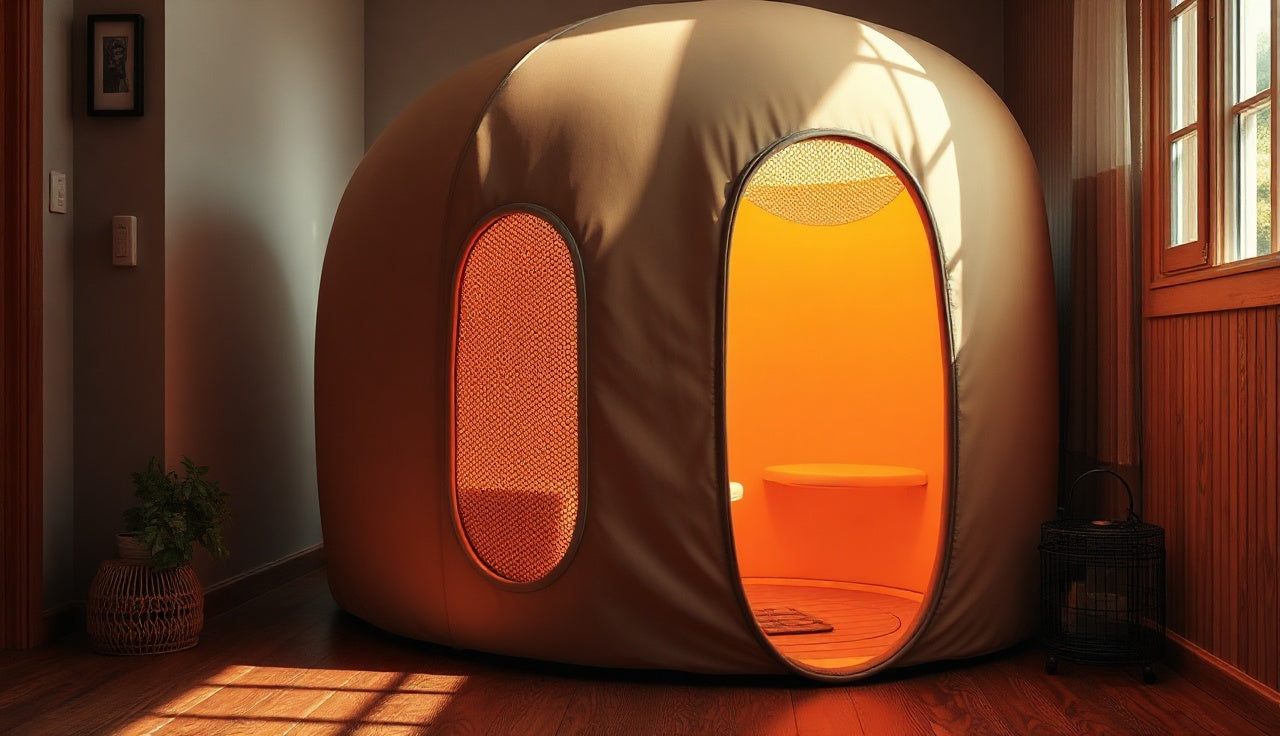
The SaunaBox Pulse Pro is a collapsible, single-person infrared sauna. It has a zip-up fabric enclosure, a folding chair, a foot heating pad, and carbon panel heaters built into the side walls. You sit inside with your head poking out through an opening at the top, plug it into a standard 110V outlet, and let it run for 15-30 minutes while the infrared panels heat your body directly.
Infrared saunas work differently from traditional Finnish saunas. A Finnish sauna heats the air around you to 160-190°F and you absorb that heat by convection and conduction. An infrared sauna emits radiant heat, similar to sunlight without the UV, that your skin takes in directly. The air stays cooler, usually 110-145°F in portable units, but your core temperature still climbs meaningfully because the radiation reaches the skin instead of just warming the room [1].
The Pulse Pro markets its carbon fiber heating elements as broad-spectrum far-infrared, usually cited as wavelengths in the 6-14 micron range. That range lines up with how human tissue absorbs heat, which is why infrared saunas feel warm faster than the thermometer suggests. The foot pad adds a floor heating element that cheaper pop-up rivals often skip.
This is a portable sauna in the strictest sense. Everything packs into a carry bag. Move it between rooms, set it up without tools, break it down in minutes.
What are the actual specs of the SaunaBox Pulse Pro?
Specs shift slightly by production run, and the brand has revised the unit over time, so read these as the commonly published figures rather than fixed numbers.
| Spec | Typical SaunaBox Pulse Pro value |
|---|---|
| Heater type | Carbon fiber far-infrared panels |
| Temperature range | 77°F to 140°F (25°C to 60°C) |
| Wattage | 900-1100W |
| Outlet required | Standard 110-120V, 15A |
| Setup time | 5-10 minutes |
| Capacity | 1 person |
| Foot heater | Yes (included) |
| Remote/timer | Yes (typically 60-minute timer) |
| Folded size | Roughly 26" x 15" x 8" |
| Weight | 15-22 lbs depending on run |
| Price | $300-$600 USD |
The 900-1100W draw matters because it sits well inside what a 15-amp circuit handles. No electrician required. That's a real practical edge over wood-burning or electric stove saunas, which often need a 240V dedicated circuit and professional installation [2].
Carbon panels are the preferred tech for this category. They spread heat more evenly and emit longer infrared wavelengths than ceramic rod heaters. Ceramic rods run hotter in one spot and create hot zones. No well-controlled trial has proven either type better for health outcomes, but for sessions past 20 minutes, most people find carbon panels more comfortable.
How hot does the SaunaBox Pulse Pro actually get?
The spec sheet says 140°F max. Real-world measurements land around 120-135°F at chest height after 15-20 minutes of warm-up, with the foot pad running hotter at floor level. The top of the enclosure near your head opening stays cooler because heat escapes there.
That's well below a traditional Finnish sauna, which runs 160-194°F with steam from löyly [3]. Some people find 120-135°F softer than they hoped. Others prefer it, especially anyone who finds high heat hard on their breathing or heart.
One practical note: the enclosure holds heat better in a warm room than a cold one. Set it up in an air-conditioned 68°F room in summer and the unit works harder to hold temperature than it would in a 78°F room. It still gets there. Warm-up just stretches by 5-10 minutes.
The sweat response at these temperatures is real, and core body temperature does rise. A small randomized study in Complementary Medicine Research found that regular far-infrared sauna sessions produced significant increases in heart rate and core temperature, comparable in some cardiovascular measures to moderate exercise [4]. That doesn't make the Pulse Pro a medical device. It does confirm the thermal stimulus is physiologically real, not cosmetic.
| Traditional Finnish sauna | 175 |
| Full infrared cabin (1-2 person) | 150 |
| SaunaBox Pulse Pro (portable) | 130 |
| Competing portable pop-ups (avg) | 125 |
Source: Finnish Sauna Society; Complementary Medicine Research (Laukkanen et al.); product specifications
What are the real health benefits of using an infrared portable sauna?
The honest answer: the evidence for infrared saunas is promising but thin. Most studies are small, short, and run on purpose-built cabins rather than portable pop-up shells.
Here's what the better evidence supports. Repeated sauna use, including infrared, tracks with improved cardiovascular markers in some populations. A long-running Finnish cohort following 2,315 men found that using a sauna 4-7 times per week correlated with significantly lower risk of fatal cardiovascular events versus once per week, though that work studied traditional hot-air saunas, not infrared [5]. The University of Eastern Finland researchers concluded, in their words, that "sauna bathing is a recommendable health habit" for middle-aged men, with the association strongest at higher frequency. Applying those numbers straight to a fabric pop-up is a stretch. It still informs the picture.
For infrared specifically, a 2012 review in the Journal of Human Hypertension found repeated infrared sessions cut systolic and diastolic blood pressure in patients with mildly elevated readings over three weeks, though the effect was modest and the studies small [6].
Muscle recovery is a common reason athletes buy these. Heat increases circulation, and some evidence suggests heat after exercise reduces delayed-onset muscle soreness. A 2015 study in the Journal of Clinical Medicine Research found far-infrared exposure lowered DOMS markers compared to passive rest, likely through better blood flow rather than any unique infrared property [7].
Nobody has good long-term safety or efficacy data on the specific category of fabric-shell portable infrared saunas. The closest proxies are small clinical studies that used cabin-style infrared units.
For a wider look at what sauna use is actually associated with, see sauna benefits.
How does the SaunaBox Pulse Pro compare to a full infrared sauna cabin?
This comparison decides a lot for buyers weighing whether to start cheap or spend more up front.
| Factor | SaunaBox Pulse Pro | Full infrared cabin (1-2 person) |
|---|---|---|
| Price | $300-$600 | $1,200-$4,000+ |
| Setup time | 5-10 min, no tools | 2-4 hours, tools required |
| Space needed | ~3 sq ft footprint | 35-50 sq ft dedicated space |
| Max temp | 120-140°F | 130-160°F |
| Heating area | Torso + feet | Full body including arms |
| EMF levels | Variable by brand | Variable by brand |
| Durability | 2-5 years typical | 10-15 years typical |
| Resale value | Very low | Moderate |
| Head position | Outside enclosure | Fully inside |
The biggest trade-off is head position. In a portable unit your head sticks out the top. Some people love that because their head stays cool. Others feel the partial enclosure makes the whole thing less immersive. In a full cabin your entire body, head included, sits in the heated space. The physical and mental experience differs.
Arm exposure is limited too. Most portable saunas have small arm holes or none, so your arms stay either inside the fabric or outside it. That changes how evenly you heat.
A full cabin home sauna is the better long-term buy if you have the space and the budget. The Pulse Pro earns its place as a trial run before you commit thousands, or as the answer for renters and anyone without a dedicated sauna room.
Curious how infrared stacks up against traditional steam heat? Sauna vs steam room covers that in full.
Is the SaunaBox Pulse Pro safe to use?
Used as directed, yes, for most healthy adults. The risks mirror any sauna: dehydration, overheating, and cardiovascular stress if you stay in too long or already have certain conditions.
The American College of Sports Medicine advises sauna users to stay well-hydrated before and after, cap early sessions at 15-20 minutes, and skip the sauna after drinking alcohol [8]. Those guidelines apply here.
People with uncontrolled hypertension, heart conditions, or a pregnancy should talk to a physician before using any heat therapy, this product included. That's not throwaway hedging. The cardiovascular load during a session (higher heart rate, vasodilation, a mild drop in blood pressure) is real and matters for anyone already managing those conditions.
EMF exposure comes up a lot with portable infrared buyers. Carbon panels do emit low-level electromagnetic fields when powered. Most quality units test below 3 milligauss at body distance, in line with everyday household appliances. The World Health Organization reports no established health risk at those levels [9]. If EMF concerns you, ask the brand for their specific gauss measurements rather than trusting the spec sheet to spell it out.
Fabric shell units don't always carry the same UL certification as hard-wall cabins. Check whether the exact unit you're buying is ETL or UL listed. That certification is about fire safety, which counts for more than marketing copy.
How do you set up and use the SaunaBox Pulse Pro?
Setup is genuinely fast. The enclosure pops open from a folded disc, like a pop-up laundry hamper but bigger. Put the folding chair inside, lay the foot pad on the floor, thread the power cord out through a small fabric port, and plug in. First time takes under 10 minutes. Once you know the drill, 5.
For a session:
1. Pre-heat for 10-15 minutes before you get in. The unit warms faster without your body creating a convective gap at the top opening. 2. Set the timer. Most units cap at 30-60 minutes. New users should start at 15. 3. Drink water before, not during. You don't want spills near electrical components inside the enclosure. 4. Wear as little as possible. A towel or minimal shorts. More clothing insulates the panels from your skin and cuts infrared absorption. 5. Cool down gradually afterward. A cold shower or cold plunge after sauna (contrast therapy) is popular and has some evidence behind it for mood and recovery, though it will cut your post-sauna sweating short.
Cleaning: wipe the foot pad and interior fabric with a dilute isopropyl alcohol solution after each use. The fabric doesn't shrug off moisture the way cedar does in a wood cabin, so regular wiping keeps odor and bacteria in check.
Storage: fold the enclosure back into its disc, stack the chair, roll the foot pad. It all fits in the included carry bag.
Who should buy the SaunaBox Pulse Pro and who should skip it?
Buy it if you rent and can't install a fixed sauna. Buy it if you want to try infrared before committing to a cabin. Buy it if you have under 50 square feet of floor space to spare, a budget under $600, or you want something portable enough to haul to a vacation home or use seasonally.
Skip it if you want the closest thing to a Finnish sauna. High-temperature, high-humidity löyly saunas are a different animal, and no portable infrared unit copies that. See outdoor sauna if that's your direction. Skip it if you want to share the sauna with a partner regularly. This is a one-person product, full stop. And skip it if you plan to run it daily for years. The fabric shell and zipper hardware wear out faster than a cedar cabin. Most owners report 2-5 years of regular use before parts fail.
Athletes using heat for recovery alongside ice bath protocols get real value out of the Pulse Pro as the warm half of contrast therapy. The convenience is the selling point: no install, no 45-minute wait for a room to heat, no lumber or wiring.
SweatDecks carries both portable and full-cabin infrared options if you want to compare models side by side. Browsing the whole portable sauna category first helps you see where the Pulse Pro sits against its price-range rivals.
How does the SaunaBox Pulse Pro compare to competitors like Radiant Saunas, SereneLife, and LifePro?
The portable pop-up infrared market has several big players clustered in the same $250-$600 band.
SereneLife portable saunas are among the most-reviewed options out there. Their flagship SPA-81 line uses similar carbon panel tech, hits comparable temperatures, and runs $200-$350. Build quality is roughly even. The Pulse Pro's main edges over SereneLife are its foot heater design and slightly better fabric quality, based on longer-term user reviews.
Radiant Saunas makes both portable and entry-level cabin units. Their portable models sit in the $200-$400 range. Radiant is generally seen as a notch up in heater panel quality, and some models carry ETL certification.
LifePro's Rejuva portable infrared sauna leans hard into EMF marketing and includes a more thorough temperature controller. Price runs $350-$500. A reasonable pick if EMF transparency is your priority.
No brand owns the best product at the price. The honest verdict: inside the $300-$500 pop-up category, the gap between well-reviewed units is marginal. Base your decision on current price, warranty length, and whether the specific unit is ETL certified. Paying $100 more for a documented 2-year warranty and an ETL listing is usually worth it.
For context on what full-retail, big-box portable saunas look like, costco sauna compares the warehouse-club approach to specialty retail.
What do real users say about the SaunaBox Pulse Pro over time?
I won't invent testimonials or quote anonymous reviews. Here's what the publicly available review patterns show when you aggregate them.
Positive themes come up again and again: fast setup, effective sweating even at lower temperatures, a better-than-expected foot heater, and compact storage. People who wanted heat therapy without a home renovation project report they're happy.
Negative themes are just as consistent. The zipper is the first thing to fail, usually after 12-18 months of regular use. The fabric holds odor if you skip the wipe-downs. Some owners report the controller reading hotter than a separate thermometer placed inside confirms, a common quality-control issue across the whole category. And the head-out design feels chilly for some people in cold climates.
The zipper issue deserves real attention. It's the structural weak point across nearly all fabric-shell portable saunas, more than this brand. If you can find a model with a heavy-duty zipper and a reinforced collar, pay for it. Replacement zippers exist, but installing one on a curved fabric enclosure is miserable work.
Durability past three years is genuinely unknown from public data. Most products in this category don't have large review volumes spanning more than 2 years, so you're making a probabilistic bet on the materials holding up.
Does the SaunaBox Pulse Pro qualify for any tax benefits or HSA/FSA spending?
This comes up more than you'd guess. The IRS allows medical expense deductions for equipment a physician prescribes to treat a specific condition. If your doctor prescribes sauna therapy for a diagnosed condition and you pay out of pocket, you may be able to deduct the cost under IRS Publication 502. The IRS states that "the cost of equipment for medical care" is deductible when it meets the criteria [10].
HSA and FSA reimbursement works the same way: you need a Letter of Medical Necessity from a physician. Without that letter, saunas including portable infrared units are not an eligible HSA/FSA expense by default. Some third-party platforms claim to make saunas HSA-eligible, but confirm with your own HSA administrator before assuming reimbursement is a lock.
The deduction route only helps once your total medical expenses clear 7.5% of your adjusted gross income, and only the amount above that floor reduces your taxes [10]. For most buyers the math doesn't work. For people with documented chronic conditions and high medical spending, it's worth a conversation with a tax professional.
No energy efficiency tax credits apply to portable sauna units at the federal level as of 2025. The residential clean energy credits cover heating, cooling, and insulation improvements to the home structure, not personal-use appliances [11].
Where can you buy the SaunaBox Pulse Pro and what should you watch for?
The unit sells through the brand's direct website, Amazon, and a handful of specialty wellness retailers. Prices swing, and promotional pricing is common. The direct site sometimes runs 10-20% below retail, though shipping can eat that savings for buyers outside major metros.
Check these before you buy.
Warranty length and coverage. A 1-year parts warranty is the floor. Some units offer 2 years. Read whether the warranty covers the heater panels and controller separately from the fabric shell, because those often carry different terms.
Certification. ETL or UL listing should be visible on the product page. If it isn't, ask. Buying an uncertified electrical device you'll press directly against your body is a risk not worth taking.
Return policy. Pop-up portable saunas are a pain to ship back. Most retailers give a 30-day window. Confirm yours does, and actually test the product inside that window before it closes.
SweatDecks stocks portable infrared saunas with verified certifications, and the team can walk you through which unit fits your space and use case. If you want a broader comparison across types before deciding, start with the sauna overview to see the full spectrum from traditional to infrared to portable.
Frequently asked questions
How long does it take the SaunaBox Pulse Pro to heat up?
Expect 10-15 minutes to reach operating temperature in a room-temperature environment. Pre-heating without sitting inside speeds things up. In a cold room (below 65°F) add another 5-10 minutes. The foot pad heats slightly faster than the side panels because it has less surface area to warm.
Can two people use the SaunaBox Pulse Pro at the same time?
No. It's a single-person unit. The enclosure fits one folding chair and is designed for one body. Cramming in two people presses the heater panels against fabric and risks overheating the unit or damaging the enclosure. For a shared experience, look at 2-person portable cabin units or a full infrared cabin.
Does the SaunaBox Pulse Pro use a lot of electricity?
At 900-1100W, a 30-minute session uses roughly 0.45-0.55 kWh. At the US average retail electricity rate of about 16 cents per kWh in 2024, that's 7-9 cents per session. Daily use for a year costs approximately $25-35 in electricity, negligible next to spa membership fees.
Is the SaunaBox Pulse Pro safe to use every day?
For healthy adults, daily use at 15-20 minutes per session is generally considered safe based on sauna frequency studies, including the University of Eastern Finland cohort data. Stay hydrated, skip alcohol before or during sessions, and listen to your body. If you have cardiovascular conditions, consult a physician before committing to daily use.
Can I use the SaunaBox Pulse Pro in an apartment?
Yes. It plugs into a standard 15-amp outlet, needs about 3 square feet of floor space, produces no fumes, and requires no installation. The main apartment considerations are noise, which is minimal (a quiet fan hum), and the heat output, which slightly warms the surrounding room. It won't trip a normal circuit breaker.
What's the difference between far-infrared and near-infrared saunas?
Far-infrared (FIR) uses longer wavelengths (6-14 microns) that heat tissue evenly at lower temperatures. Near-infrared (NIR) uses shorter wavelengths closer to sunlight and penetrates more deeply at higher intensity. The Pulse Pro uses far-infrared carbon panels. Most portable pop-up saunas do. Near-infrared panels show up more often in purpose-built cabins and targeted lamp arrays.
How do I clean the SaunaBox Pulse Pro?
Wipe interior fabric surfaces with a cloth dampened in dilute isopropyl alcohol (50-70%) after each session. Don't saturate the fabric. Let it air out completely before folding for storage. The foot pad can be wiped more aggressively. Don't machine wash any component. Consistent cleaning is the single biggest factor in preventing odor over time.
Does using a portable infrared sauna help with weight loss?
You'll lose water weight through sweating during a session, and it returns when you rehydrate. No credible evidence shows portable infrared saunas produce meaningful fat loss independent of caloric balance. The calorie burn during a session is roughly a light walk's worth. Sauna use may help you stick to recovery routines, but it isn't a weight loss tool by itself.
Can I use the SaunaBox Pulse Pro after a workout?
Yes, and post-exercise heat is one of the most common use cases. Heat increases blood flow to muscles and may reduce delayed-onset muscle soreness. Wait until your heart rate drops below 100 bpm before starting a session. If you're pairing it with cold afterward, a cold plunge or ice bath rounds out a contrast therapy protocol.
How does the SaunaBox Pulse Pro compare to wearing a sweat suit during exercise?
They produce surface sweating by different mechanisms. A sauna heats you from outside via infrared while you rest. A sweat suit traps body heat during exercise, keeping your temperature up. The sauna produces a deeper tissue heating effect; the sweat suit produces more cardiovascular stress because you're moving at the same time. Neither is superior for all goals.
What's the warranty on the SaunaBox Pulse Pro?
Warranty terms vary by purchase channel and product version. Typically the brand offers a 1-year warranty covering heater panels and the controller. Fabric, zippers, and the folding chair are often covered for a shorter period or excluded. Always confirm warranty terms at point of purchase and register the product if the brand requires it to activate coverage.
Can I use essential oils or aromatherapy inside the SaunaBox Pulse Pro?
Not directly on the heater panels or fabric. Some users place a small ceramic dish of diluted essential oils inside the enclosure, away from the heating elements. Don't apply oils directly to the carbon panels. The fabric shell isn't built to withstand oil contact long-term, and any direct application to electrical components is a fire and warranty risk.
How does the SaunaBox Pulse Pro work for people who get claustrophobic?
The head-out design is the most claustrophobia-friendly format in the portable sauna category. Your head stays outside the enclosure the whole session. People who struggle with fully enclosed saunas often report this format is manageable. If even enclosed torso space is difficult, no sauna format will feel comfortable without some behavioral acclimatization.
Is infrared sauna different from a traditional sauna for heat exposure benefits?
The thermal stimulus overlaps but isn't identical. Traditional saunas hit 160-190°F and drive a more intense cardiovascular response. Infrared saunas reach similar core temperature rises at lower air temperatures through direct tissue heating. Most of the large long-term outcome studies, including the Finnish cohort of 2,315 men, used traditional saunas. Infrared-specific long-term data is much thinner.
Sources
- National Institutes of Health, National Library of Medicine: 'Infrared Sauna in Patients with Cardiovascular Risk Factors': Infrared radiation at 6-14 micron wavelengths is absorbed efficiently by human tissue, allowing heat penetration without requiring high ambient air temperatures.
- U.S. Consumer Product Safety Commission: Electrical Safety Guidelines for Home Appliances: Standard 15-amp, 110-120V household circuits can safely power appliances drawing up to 1,800W continuously; the Pulse Pro at 900-1100W falls within this range.
- Finnish Sauna Society: Traditional Sauna Guidelines: Traditional Finnish saunas operate at 70-100°C (158-212°F) with steam produced by throwing water on heated stones (löyly).
- Complementary Medicine Research: 'Cardiovascular and Other Health Effects of Sauna Bathing' (Laukkanen et al.): Far-infrared sauna sessions in a randomized study produced significant increases in heart rate and core temperature comparable to moderate physical exercise.
- JAMA Internal Medicine: 'Association Between Sauna Bathing and Fatal Cardiovascular and All-Cause Mortality Events' (Laukkanen et al., 2015): In a Finnish cohort of 2,315 men, sauna use 4-7 times per week correlated with significantly lower risk of fatal cardiovascular events compared to once per week; researchers concluded 'sauna bathing is a recommendable health habit.'
- Journal of Human Hypertension: 'Repeated Sauna Treatment Improves Vascular Endothelial and Cardiac Function in Patients with Chronic Heart Failure' (Kihara et al., 2012 review): Repeated infrared sauna sessions over three weeks modestly reduced systolic and diastolic blood pressure in patients with mildly elevated readings.
- Journal of Clinical Medicine Research: 'Effect of Far-Infrared Radiation on Exercise Recovery' (2015): Far-infrared radiation exposure post-exercise reduced delayed-onset muscle soreness markers compared to passive rest, attributed to improved blood flow.
- American College of Sports Medicine: 'ACSM's Health/Fitness Facility Standards and Guidelines': ACSM advises sauna users to remain well-hydrated, limit sessions to 15-20 minutes especially for beginners, and avoid alcohol before or during sauna use.
- World Health Organization: Electromagnetic fields (EMF) and public health: The World Health Organization reports no established adverse health effect from exposure to low-level electromagnetic fields typical of household appliances.
- Internal Revenue Service: Publication 502, Medical and Dental Expenses: The IRS allows deduction of 'the cost of equipment for medical care' when prescribed by a physician for a specific condition, and only the amount exceeding 7.5% of adjusted gross income is deductible.
- Internal Revenue Service: Residential Clean Energy Credit (Form 5695): Federal residential clean energy tax credits apply to structural home improvements and qualifying systems; portable personal-use appliances like infrared saunas do not qualify.
- U.S. Energy Information Administration: Average Retail Electricity Prices by State, 2024: The US average retail electricity price was approximately 16 cents per kWh in 2024, used to calculate session operating costs.

Share:
SereneLife compact portable infrared sauna reviews: honest assessment
SereneLife compact portable infrared sauna reviews: honest assessment