
Last updated 2026-07-11
TL;DR
A two-person prefab sauna kit takes most homeowners 4 to 8 hours with two people and basic tools. Larger four-person barrel or cabin kits run 8 to 16 hours. Site prep, electrical rough-in, and freight delivery add calendar time the box instructions never mention. Budget one full weekend for assembly and 6 to 12 weeks from order to first session.
What is a prefab sauna kit and how does it differ from a custom build?
A prefab sauna kit ships from the factory as pre-cut, pre-notched panels, frames, or barrel staves that fit together without a saw or custom joinery. You're assembling a large, insulated puzzle. The alternative is stick-framing a sauna room from scratch, which takes a licensed contractor two to four days minimum and costs a lot more in labor.
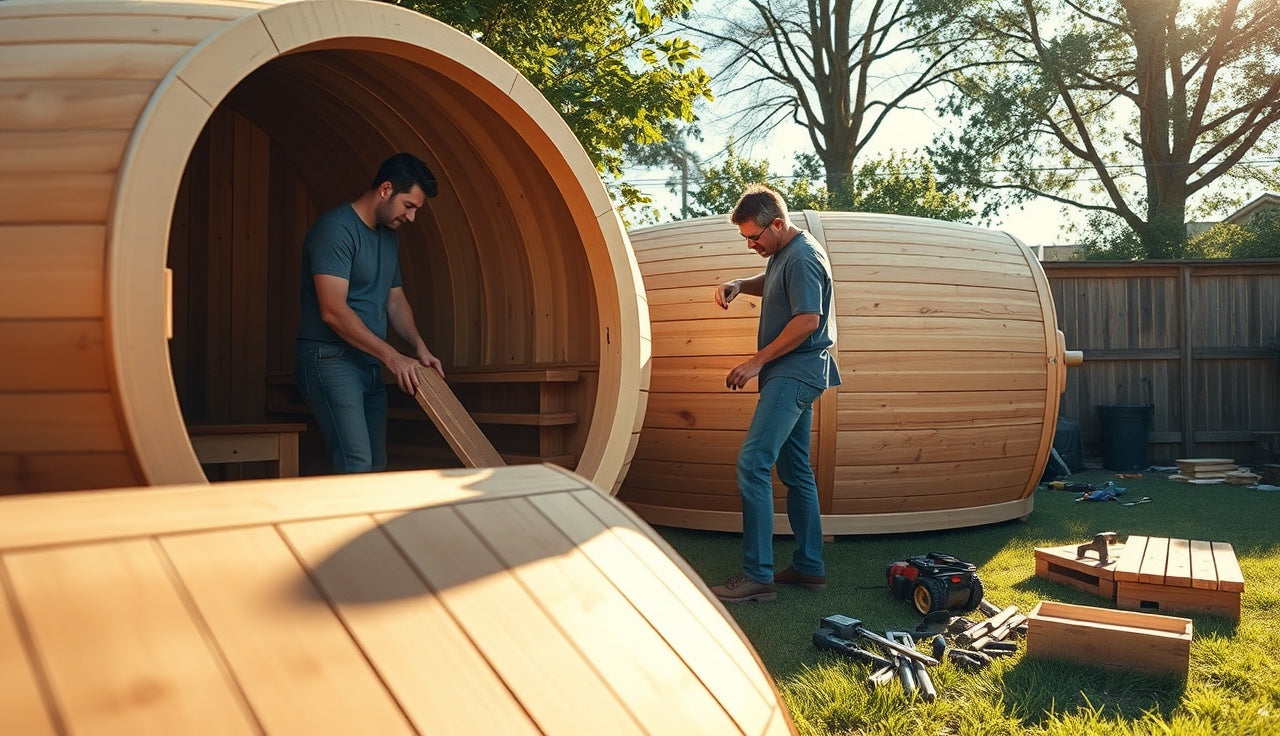
The form of the kit matters enormously for assembly time. Panel kits use tongue-and-groove wall panels that slot into a metal or wood frame. Barrel kits use curved staves held together by galvanized steel bands. Cabin-style kits arrive as pre-assembled wall sections you bolt together on site. Each type has its own learning curve and its own failure points.
Still deciding which format fits your space? The home sauna guide covers the main categories in more detail. For outdoor installations, the outdoor sauna article walks through site and weatherproofing steps that shape your prep timeline.
How long does it actually take to assemble a prefab sauna kit?
The honest range is 4 to 16 hours of active assembly, not counting site prep or electrical work. Here's how that breaks down by kit type and crew size.
| Kit type | Typical size | 2-person crew | Solo |
|---|---|---|---|
| Compact panel kit | 1 to 2 person | 4 to 6 hrs | 7 to 10 hrs |
| Standard panel kit | 3 to 4 person | 6 to 10 hrs | 10 to 16 hrs |
| Barrel sauna | 2 to 4 person | 5 to 9 hrs | 8 to 14 hrs |
| Cabin-style prefab | 4 to 6 person | 8 to 14 hrs | Not realistic |
| Indoor room conversion kit | 1 to 2 person | 3 to 5 hrs | 5 to 8 hrs |
These numbers come from manufacturer assembly guides and owner build threads, not the headline times in marketing copy. Most manufacturers quote 4 to 8 hours for kits that take 8 to 12 hours once you read the instructions, sort the hardware, and fix the alignment. Double the manufacturer's estimate until you know better. The gap is that consistent.
The two biggest variables aren't the kit. They're the number of hands helping you and the quality of your base. A barrel sauna that claims a 4-hour build assumes two people working fast on a flat, level surface with every tool staged. Solo on an unlevel concrete pad, with instructions written for someone who has done this before? That's a full day.
What is the biggest thing that slows down sauna kit assembly?
Site prep. By a wide margin.
Manufacturer instructions almost always open with something like "place unit on level surface." They never tell you how long it takes to create that surface. Fresh concrete gains most of its strength over about 28 days of moist curing, per Portland Cement Association guidance [1], so a new pad is not ready for a loaded sauna the week you pour it. If you're using pavers or deck boards, getting them level enough for a barrel sauna that must sit plumb is surprisingly fussy work.
The second time sink is electrical. Most home saunas need a 240-volt, 40-amp or 60-amp dedicated circuit. The heater connects to that circuit, and in most U.S. jurisdictions a licensed electrician has to do that work under the National Electrical Code [2]. Scheduling the electrician, pulling a permit, and passing inspection can add one to three weeks even when the actual electrical labor is two hours. The box itself may take half a day while the permit crawls through three weeks.
Delivery is the third thief. Prefab kits ship heavy, usually on pallets via freight carrier. A standard four-person barrel kit weighs 600 to 1,200 pounds on the pallet. Freight carriers typically deliver to the curb and nothing more. Moving those staves from the curb to the backyard, especially through a gate or around the house, eats two to four hours and needs at least two extra people or a pallet jack.
| Indoor room conversion kit (1–2 person) | 4 |
| Compact panel kit (1–2 person) | 6 |
| Barrel sauna (2–4 person) | 7 |
| Standard panel kit (3–4 person) | 9 |
| Cabin-style prefab (4–6 person) | 12 |
Source: Manufacturer assembly guides and North American Sauna Society installation guidelines
Does a barrel sauna take longer to build than a panel kit?
They're different, not clearly longer or shorter. Barrel saunas have fewer total pieces, but the stave-and-band assembly needs careful sequencing and a partner to hold staves while you tighten bands. Panel kits have more pieces, and each step is more intuitive if you've ever built flat-pack furniture.
For a two-person crew on a first build, a standard 6-foot diameter, 7-foot length barrel runs 5 to 9 hours. The same crew usually finishes a comparable panel kit in 6 to 10 hours. Experience narrows the gap fast.
Barrel kits save real time on finishing. No interior paneling to install, no ceiling to frame, no corner trim to wrestle. The staves are the structure and the finish surface at once. Panel kits make you install the wall panels, then often a separate ceiling panel system, then trim. That finishing phase alone adds two to three hours.
Barrel kits also forgive slightly uneven ground better, because the curved base spreads load differently, and some barrel bases include adjustable feet.
What tools do you actually need to assemble a prefab sauna kit?
Most kits genuinely go together with basic hand tools. The right power tools cut the time dramatically anyway.
The standard kit needs a rubber mallet, a level (4-foot minimum), a tape measure, an adjustable wrench or socket set, a cordless drill with driver bits, and a ladder for ceiling work. Some barrel kits also want a torque wrench for the band bolts.
You'll be glad you also have a reciprocating saw or jigsaw for cutting ventilation holes that almost always need field adjustment, a caulk gun for sealant around the heater penetration, and a laser level if the floor isn't obviously flat.
Tools the instructions pretend you don't need but you do: a pry bar for coaxing stubborn tongue-and-groove joints, extra clamps for holding panels while a second person drives screws, and a headlamp for working the corners of a half-dark box.
For the electrical connection, stop at the junction box. That's where the electrician takes over. NEC 2023 Article 680 covers sauna electrical requirements, and unpermitted work can affect your homeowner's insurance coverage [2].
How much does site prep actually add to the total time?
For a simple backyard install on an existing patio, site prep might be 30 to 60 minutes of cleaning, leveling, and staging materials. For a ground-level install that needs a new pad, site prep can total 20 to 40 hours of work spread over several weeks, most of it spent waiting for concrete to cure.
Here's a realistic breakdown of site prep time by scenario:
| Scenario | Site prep time (labor hours) | Wait time |
|---|---|---|
| Existing level concrete patio | 0.5 to 1 hr | None |
| Existing deck (structural check needed) | 1 to 3 hrs | Varies |
| New gravel pad | 4 to 8 hrs | 24 to 48 hrs settle time |
| New concrete pad | 4 to 10 hrs labor | 28 days cure |
| Ground-level wood frame base | 3 to 6 hrs | None after build |
Deck installations deserve special mention. Plenty of homeowners want a barrel or cabin sauna on an existing deck. Get a structural engineer or experienced contractor to check the load capacity first. A fully loaded four-person sauna (unit plus four adults plus water weight) can top 3,000 pounds on a small footprint. Residential decks are typically designed for a 40 pounds per square foot live load under the International Residential Code [3]. A concentrated sauna base load can exceed that without the deck failing, but verify it before you learn the hard way.
What do experienced builders say went wrong on their first sauna kit build?
The most common theme in owner forums and the honest review threads (the ones people post after the fact) is not reading all the instructions before starting. Step 12 references a detail that was supposed to happen at step 3, and by the time you find out, something is fastened that has to come back off.
The second repeat issue is over-torquing band bolts on barrel kits. Barrel saunas use tension in those galvanized bands to seal the staves. Cranking them down hard on day one ignores the wood swelling and shifting through its first heat cycles. Manufacturers usually recommend a snug-plus-a-quarter-turn approach, then a re-check after the first three or four sessions. Many owners who reported cracked staves had tightened the bands well past spec.
Missed ventilation is the third. Saunas need both a low intake vent and a high exhaust vent. Some kits include them, some don't, and the instructions can be vague about sizing. A properly sized sauna needs about one square inch of vent area per cubic foot of room volume, per North American Sauna Society installation guidelines [4]. Skipping or undersizing vents hurts performance from day one and invites moisture damage over time.
And almost universally: people buy a portable sauna or entry-level kit to save time, then find those kits skimp on panel thickness, which costs them heat retention and long-term durability.
Does a two-person crew actually finish faster than one person?
Yes, and by more than you'd guess. Two hands isn't the whole story. Some steps are structurally impossible or genuinely unsafe solo.
Holding a 50-pound ceiling panel while driving screws from a ladder is one. Positioning and tensioning barrel staves without someone bracing the opposite side is another. Getting a 400-pound assembled wall section off the ground and onto a foundation takes at least two people and ideally three.
In practice, a two-person crew finishes a standard panel kit in roughly 60 to 70 percent of the time a solo builder takes, not 50 percent, because some steps stay sequential no matter how many hands you have. A third person rarely helps on most kits, since the workspace inside a partially assembled sauna only fits so many bodies.
Building solo? Plan two days with a real rest between them. Solo builders who push through a 12-hour single-day build make far more errors in the final four hours than the first four.
How long does the electrical connection and heater setup take?
The heater itself takes 30 to 60 minutes to mount, connect internal wiring to the control unit, and load the stones. You can do that yourself in most jurisdictions by following the heater manufacturer's wiring diagram.
The part that eats calendar time is the 240-volt circuit. Running a new dedicated circuit from your breaker panel to the sauna takes a licensed electrician two to four hours of labor. Add permitting (which varies by jurisdiction but often costs $50 to $200 and takes one to three weeks for approval), a required inspection, and scheduling delays, and you're looking at two to four weeks of calendar time for a physical half-day job.
Some homeowners in loosely enforced areas skip the permit. Each person makes that call for themselves, but the practical consequence is that many homeowner's insurance policies exclude coverage for unpermitted electrical work. Sauna heaters run hot, and the insurance exposure on a total loss is real, so most people who think it through pull the permit.
For heater sizing, the general rule is 1 kilowatt per 45 cubic feet of room volume, though manufacturers vary. A 6x8 foot indoor sauna at 7 feet high (336 cubic feet) needs roughly a 6 to 8 kW heater. Most residential heaters in that range draw 240 volts at 30 to 40 amps [5].
What's the realistic total calendar time from purchase to first session?
This is the question most people wish they'd asked before ordering. The answer is almost never the same as assembly time.
Best case (existing level concrete patio, circuit already in place, two-person crew, kit delivered on time): you can go from delivery to first session in two to three days.
Average case (outdoor install needing a new base, new electrical circuit, standard freight delivery): four to eight weeks. That covers site prep, concrete cure, electrician scheduling, permit approval, and a weekend of assembly.
Worst case (new ground-level install, permit delays, difficult delivery access, solo build): people on builder forums report six months from order to first session. That's the extreme, but it happens.
A realistic planning timeline looks like this:
| Phase | Calendar time |
|---|---|
| Research, order, and delivery lead time | 1 to 6 weeks |
| Site prep (new pad or base) | 1 to 4 weeks (includes cure) |
| Electrical permit and rough-in | 1 to 3 weeks |
| Kit assembly | 1 to 2 days |
| Electrical final connection + inspection | 1 to 2 weeks |
| First heat-up and stone curing | 1 to 2 days |
| Total calendar (realistic average) | 6 to 12 weeks |
The first heat-up matters too. New heater stones should be heated and cooled several times before you add water, to prevent cracking. Most manufacturers recommend two to three dry sessions before adding löyly [6].
Are there prefab kits that genuinely go together in a day?
Yes. Indoor conversion kits built for a spare room or garage corner are the most realistic candidates for a true same-day build. They use thinner panels (often 1.5 to 1.75 inches of hemlock or cedar) that two people can manage easily, and the interior dimensions are small enough that ceiling work doesn't need staging.
Some manufacturers design their compact two-person kits for a 4-to-6-hour build. Several Finnish-sourced kit brands market exactly that claim. The honest caveat: those timelines assume you already have a 240-volt circuit at the location, the floor is dead level, and neither person spends time re-reading instructions.
Barrel kits in the 4-foot-diameter, 6-foot-length range (a solo or couples unit) are the other category that realistically hits an 8-hour build with two people, especially on a second build. First-timers add 30 to 50 percent.
If a same-day build is a hard requirement, look for kits labeled pre-assembled or modular with keyed connections rather than traditional fastener assembly. Those pre-engineered joints do cut time by removing alignment guesswork.
What should you do after assembly before using the sauna?
Before you ever sweat in it, run a slow heat-up sequence. Hold the heater at low to medium for 30 minutes, then shut it off and let it cool completely. Repeat two to three times. This break-in, sometimes called seasoning, lets the wood acclimatize to heat and moisture stress gradually, which reduces warping and cracking in the first weeks [6].
During those break-in sessions, check every joint and fastener. Wood expands with heat and humidity. Some screws will need tightening. Band bolts on barrel kits almost always need re-tensioning after the first session.
Inspect the heater guard. Many kits include a guard rail around the heater. The U.S. Consumer Product Safety Commission publishes guidance on residential product and electrical safety [7]. Know where your power disconnect is before that first session.
Check for any smell of burning dust or off-gassing from finishes. A mild wood scent is normal. Anything sharp, chemical, or acrid means you should ventilate the sauna and confirm no materials were painted or treated with something not rated for high heat.
Once the sauna runs well, many owners pair it with cold water recovery. If contrast therapy interests you, the cold plunge and ice bath guides are worth reading alongside the sauna benefits research.
Is it worth hiring someone to assemble a prefab sauna kit?
For most people, honestly, yes. Especially for anything larger than a compact two-person unit.
Handyman or general contractor assembly rates typically run $50 to $100 per hour. A pro who has built sauna kits before can do in four hours what takes two first-timers all weekend. Total cost for professional assembly on a standard kit runs $400 to $1,200 in most markets, depending on kit complexity and local labor rates.
The math is simple. If your time is worth anything near that rate, and you want to skip the first-time learning curve, hiring out the assembly makes sense. If you enjoy the build and have a patient helper, doing it yourself is a legitimate choice.
Where DIY almost always wins is on ongoing adjustments. Owners who built their own kit know exactly where every fastener sits, how tight the bands should be, and which panel has the quirky alignment. That knowledge pays off when something needs a tweak six months later.
SweatDecks carries kits with detailed assembly documentation, so you know what you're getting into before you buy, not after the freight pallet lands on your driveway. Check the sauna collection if you're still comparing kit types.
Frequently asked questions
How long does a two-person barrel sauna kit take to assemble?
A standard two-person barrel sauna (roughly 4 feet diameter, 6 feet long) takes two people 5 to 8 hours for a first build. Experienced builders report 3 to 5 hours on a second unit. Solo assembly is possible but adds 50 to 80 percent more time and makes a few steps genuinely difficult. Have a level foundation ready before you start or you'll add another 1 to 3 hours.
Do you need a permit to install a prefab sauna kit?
It depends on your jurisdiction, but most areas require at minimum an electrical permit for the 240-volt circuit. Some cities also require a building permit if the sauna is an outdoor structure over a certain square footage (commonly 120 sq ft, though this varies). Check with your local building department before ordering. Unpermitted electrical work can void homeowner's insurance coverage.
What foundation do I need before assembling a prefab sauna kit?
A flat, level, moisture-resistant surface. Options include an existing concrete patio, a new concrete pad (allow 28 days to cure), compacted gravel with a pressure-treated wood frame, or a purpose-built deck section sized for the sauna footprint. The surface must be within about 1/4 inch of level across the entire base, or you'll fight alignment problems throughout the rest of the assembly.
Can one person assemble a prefab sauna kit alone?
Technically yes for compact indoor kits. For anything with ceiling panels, exterior cabin sections, or barrel stave tensioning, solo assembly is frustrating and for some steps genuinely unsafe. Most manufacturers list two people as the minimum crew. If you must go solo, plan for 10 to 16 hours on a standard kit and have clamps or temporary props ready to hold pieces in position while you fasten them.
How long does it take to heat up a prefab sauna for the first time?
After the break-in seasoning sessions (two to three dry heat cycles at medium setting), most prefab sauna kits reach operating temperature of 160 to 195 degrees Fahrenheit in 30 to 45 minutes. Poorly insulated or thin-panel kits can take 60 minutes or more. An electric heater sized correctly for the room volume (roughly 1 kW per 45 cubic feet) is the biggest factor in heat-up speed.
What's the difference in assembly time between indoor and outdoor sauna kits?
Indoor kits are generally faster because site prep is simpler (existing level floor, electrical usually closer), and you're working in a controlled environment. A compact indoor conversion kit can realistically be assembled in 3 to 6 hours by two people. Outdoor kits add site prep, foundation work, and weatherproofing steps that often double the total time even if the box assembly is similar.
How long does it take to assemble a Costco or big-box store sauna kit?
Big-box store kits (including those sold at Costco in seasonal rotation) are typically compact panel units designed for 1 to 2 people. Assembly time with two people runs 4 to 8 hours for the unit itself. The electrical connection still requires a licensed electrician and a permit in most jurisdictions, which is the same regardless of where you bought the kit. See more on the costco sauna page for specific models.
Do prefab sauna kits come with all the hardware you need?
Most reputable kits include all structural fasteners, bands (for barrel kits), and bench hardware. What they frequently don't include: the heater stones (sometimes), the electrical wire and conduit, a door handle, a thermometer/hygrometer, and bucket and ladle. Budget an additional $100 to $300 for those accessories. Read the included hardware list in the product description carefully before assuming it's all there.
How long do prefab sauna kits last compared to custom-built saunas?
A quality prefab kit built from clear cedar or Nordic spruce with proper ventilation and maintenance can last 15 to 30 years. Custom builds using the same wood species and similar heater quality have similar lifespans. The longevity difference comes mainly from wood thickness (prefab panels are often thinner) and joint quality. Barrel kits may need band re-tensioning and stave replacement over time.
What's the hardest part of assembling a prefab sauna kit?
For panel kits, it's getting the first corner perfectly square and plumb. Every subsequent panel references that first corner, so errors compound. For barrel kits, it's achieving even tension across all bands without over-torquing. For both kit types, ceiling installation is physically the most awkward step. Experienced owners consistently recommend building the bench frames before the ceiling goes on.
How does assembly time change for a 4-person versus a 2-person sauna kit?
A 4-person kit roughly doubles the assembly time of a 2-person kit, not because the steps are more complex but because there are more panels, more ceiling area, more bench sections, and more interior trim. Two people building a 4-person cabin-style kit should plan 8 to 14 hours. The electrical requirements also scale up: a larger sauna typically needs a higher-amperage circuit, often 60 amps instead of 40.
Is sauna assembly something a general handyman can do, or does it need a sauna specialist?
A competent general handyman can assemble most prefab sauna kits without prior sauna-specific experience. The assembly is closer to furniture construction than finish carpentry. The one exception is the 240-volt electrical connection, which legally requires a licensed electrician in most U.S. states. If you're hiring help, someone who has assembled one kit before will be noticeably faster than a first-timer, even a skilled one.
Can I assemble a prefab sauna kit in winter?
Yes, with conditions. Indoor kit assembly is unaffected by season. Outdoor assembly in freezing temperatures creates two problems: wood is more brittle and prone to cracking during handling, and concrete cannot be properly poured or cured below about 40 degrees Fahrenheit without additives. If your foundation is already in place and you're assembling a barrel or cabin kit in cold weather, work methodically and avoid forcing stubborn joints.
Sources
- Portland Cement Association, "Curing Concrete": Concrete gains most of its strength over roughly 28 days of moist curing before applying full structural loads
- National Fire Protection Association, NFPA 70 National Electrical Code 2023, Article 680 (covering sauna and hydromassage equipment): Sauna heater electrical circuits require a dedicated 240-volt branch circuit and must comply with the NEC; licensed electrician required in most jurisdictions
- International Code Council, International Residential Code (IRC), Section R507 Exterior Decks: Residential decks are typically designed for a 40 pounds per square foot live load under the IRC
- North American Sauna Society, Sauna Ventilation and Installation Guidelines: A properly sized sauna needs roughly one square inch of vent area per cubic foot of room volume
- U.S. Department of Energy, Home Electricity and Appliance Guidance: Residential electric sauna heaters in the 6 to 8 kW range operate at 240 volts and draw 30 to 40 amps
- Finnish Sauna Society, Sauna Usage and Maintenance Recommendations: New sauna heater stones should be seasoned through two to three dry heat cycles before water is added to prevent cracking
- U.S. Consumer Product Safety Commission: CPSC publishes consumer guidance on residential product and electrical safety relevant to sauna heater installation
- U.S. Occupational Safety and Health Administration, Materials Handling and Lifting Guidance: Manual handling of heavy loads such as freight pallets and wall sections carries injury risk; OSHA recommends team lifting and mechanical aids like pallet jacks
- National Fire Protection Association, NFPA 70 permit and inspection guidance: Electrical work on new branch circuits generally requires a permit and inspection before energizing, timelines vary by local authority having jurisdiction

Share:
How to add a sauna to an existing detached garage
Sauna stove heat shield and wall clearance: the complete guide