
Last updated 2026-07-11
TL;DR
A sauna door must never lock from the outside in a way that traps the person inside. Most building and fire codes require sauna doors to swing outward and stay operable from inside at all times. An outside latch is fine only if the occupant can release it independently. Ignore this and you have a genuine life-safety hazard.
Why does sauna door direction and locking matter for safety?
Heat stress is real, and it moves fast. Core body temperature climbs quicker than most people expect inside a hot room, and a person who passes out, gets disoriented, or has a cardiac event behind a locked or inward-opening door has almost no way to rescue themselves. That single fact is the reason every sauna door safety rule exists.
The International Building Code (IBC) and the International Residential Code (IRC), both from the International Code Council, set baseline rules for interior rooms that reach high temperatures [1]. Many states adopt these codes as written. Others amend them. The core idea never changes: occupants must be able to get out without waiting for someone outside to open the door.
This is not a paperwork problem. The Finnish Sauna Society, which has tracked sauna safety for decades, reports that most sauna deaths involve cardiovascular events, alcohol, or both [2]. An unlockable, outward-swinging door gives an incapacitated person their one real chance. They may be able to lean or fall against a door that swings out. They cannot pull open a door that swings in while lying on the floor.
Shopping for a home sauna or checking out a pre-built unit? The door is not trim. It is the first safety question you ask.
What do building codes actually say about sauna doors?
Codes are blunt on this. IBC Section 411 and IRC Section R309 both address sauna design, and IBC Section 411.2 states that sauna room doors "shall swing outward" and that the door latch "shall not be capable of being locked from the outside so as to prevent egress from the sauna" [1]. That is a requirement in every jurisdiction that has adopted the 2021 IBC without amendment, not a suggestion.
The IRC carries similar language for residential builds. Some states go further. Minnesota, with its large Finnish-American population, has state-level sauna rules that spell out temperature controls, ventilation, and door hardware in detail [3].
Here is what the code does and does not ban:
| Door feature | Code status (IBC 411 / typical state codes) |
|---|---|
| Door swings outward | Required |
| Inside-operable latch or push bar | Required |
| Outside deadbolt that traps occupant | Prohibited |
| Outside turn-knob if inside can also release | Generally allowed |
| Magnetic latch releasable from inside | Generally allowed |
| Glass panel in door | Recommended (visibility) |
| Inward-swinging door | Prohibited in commercial; strongly discouraged in residential |
Here is the nuance people miss. You can put a latch, or even a keyed lock, on the outside, as long as the person inside can release it on their own. The ban is on trapping the occupant, not on privacy hardware.
Check with your local authority having jurisdiction (AHJ). If you are building an outdoor sauna as an accessory structure, some jurisdictions treat it like a shed and apply lighter rules. The life-safety logic still holds.
What kind of lock or latch is actually safe to use on a sauna?
Use hardware the occupant can release from inside with no tool, no key, and no help from outside. That single rule covers everything else.
The common compliant options:
1. A simple slide bolt on the inside only. Full privacy, full control. Nobody outside can lock them in.
2. An inside thumb-turn knob paired with an outside key cylinder. The person inside turns the thumb knob to lock for privacy and turns it back to leave. Compliant because inside always controls egress.
3. A magnetic latch or push-to-open mechanism. Popular on barrel saunas and cabin units because they seal against heat loss without a traditional lock. No key on either side.
4. A lever-style passage latch with no lock at all. Simplest and cheapest. The door stays shut without locking anyone in.
What to skip: any sliding bar, padlock hasp, hook-and-eye, or bolt that only releases from outside. These show up on cheap imported kits and on DIY builds where the builder was thinking about keeping kids or animals out of an empty sauna, not about getting an adult out of a hot one. They fail code, and they are dangerous.
Commercial gyms, spas, and fitness facilities also answer to the Americans with Disabilities Act (ADA). The ADA Standards for Accessible Design require operable parts to work with one hand and without tight grasping, pinching, or twisting of the wrist [4]. A lever or push-pad clears that bar. A round knob usually does not.
Can you lock a sauna from outside when the sauna is not in use?
Yes. This is where common sense and the safety rule finally agree. When the sauna is empty and you want to keep out kids, pets, or unauthorized users, locking from outside is reasonable. A padlock on a hasp, a deadbolt, a keyed knob: all fine for an empty room.
The danger starts the moment that same mechanism is engaged while someone is inside. A padlock hasp on the outside of a cabinet is a hazard precisely because a second person can trip it, by accident or on purpose, while the first person is still in there.
If children or unsupervised guests can reach an exterior lock, go with a keypad or key-controlled exterior lock paired with an interior thumb turn, so egress is always possible. A lock that needs a key from outside works too, since children rarely have the key.
Portable sauna users need to think this through carefully. Many fabric or pop-up units close with a zipper, and a zipper can be pulled shut from outside, trapping someone who is dizzy or overheated. Keep scissors or a spare zipper pull inside, and keep another person nearby.
What are the real risks if a sauna door can lock from outside?
The main risk is hyperthermia, the clinical name for dangerous overheating. A Finnish-style sauna runs 80 to 100 degrees Celsius (176 to 212 Fahrenheit) [2]. A healthy body handles short exposures at those temperatures, but stay locked in too long and the danger climbs fast.
Core temperature above 40 degrees Celsius (104 Fahrenheit) causes heat exhaustion. Above roughly 41.5 degrees Celsius (about 107 Fahrenheit), it becomes heat stroke, which can cause organ failure and death [5]. In a full-temperature sauna, a person who cannot exit or call for help could hit dangerous core temperatures in 15 to 30 minutes, depending on health, hydration, and whether anyone is around.
Cardiovascular risk sits on top of that. A 2015 study in JAMA Internal Medicine followed 2,315 Finnish men and found that frequent sauna use, four to seven times per week, was linked to a 63 percent lower risk of sudden cardiac death compared to once-weekly use. The authors also noted that combining sauna bathing with alcohol or other cardiovascular stressors raised the risk [6]. Sauna users are not a zero-risk group. A door that removes their ability to exit stacks risk on top of risk.
Fire is the last piece. A wood-burning kiuas or an electrical fault can start a fire, and a door that will not open from inside takes away the occupant's escape route.
| Typical sauna temp range (°C) | 90 |
| Core temp for heat stroke risk (°C) | 41.5 |
| Reduction in sudden cardiac death risk with frequent sauna use (%) | 63 |
| Recommended max solo session length (minutes) | 20 |
Source: IBC Section 411; UL 875; Laukkanen et al., JAMA Internal Medicine, 2015; CDC Extreme Heat
Does a sauna door have to swing outward, or can it swing inward?
For commercial and public facilities, the IBC is clear: sauna doors must swing outward [1]. For residential saunas under the IRC, outward swing is the standard too, though enforcement varies by jurisdiction.
The reason is physics. A person who collapses against an inward-swinging door blocks it with their own body weight. Rescuers cannot push it open without pushing against the victim. An outward-swinging door pulls open from outside without moving anyone, and a half-conscious person may be able to lean or fall against it to get out.
Some older installs, common in Nordic countries and in pre-1990s American saunas, used inward-swinging doors because the builder cared about heat retention. Inward swing does seal a little better under positive pressure. No amount of heat retention is worth losing your escape route.
Retrofitting an inward-swinging door to swing out is usually the highest-value safety upgrade you can make. The job re-routes the hinges and adjusts the door stop, and a carpenter can do it in a few hours.
What other safety features should a sauna have alongside the right door?
The door matters most, but a well-built sauna has several features working together.
Temperature cutoff. Most modern electric heaters (kiuas) have a built-in thermal cutoff that shuts the unit off past a set threshold, usually around 90 to 110 degrees Celsius depending on the model. UL listing standards for heaters sold in the US require this [7]. Confirm your heater has it before you install anything.
Timer. An automatic shutoff timer stops the heater from running forever if someone loses track of time or falls asleep. Many codes recommend maximum session timers of 30 to 60 minutes for unattended operation. This matters most for home sauna owners who use the room alone.
Ventilation. A sauna needs an intake vent (low, near the heater) and an exhaust vent (high, on the opposite wall or ceiling). Good airflow keeps oxygen stable and clears steam and combustion byproducts in wood-burning units [3].
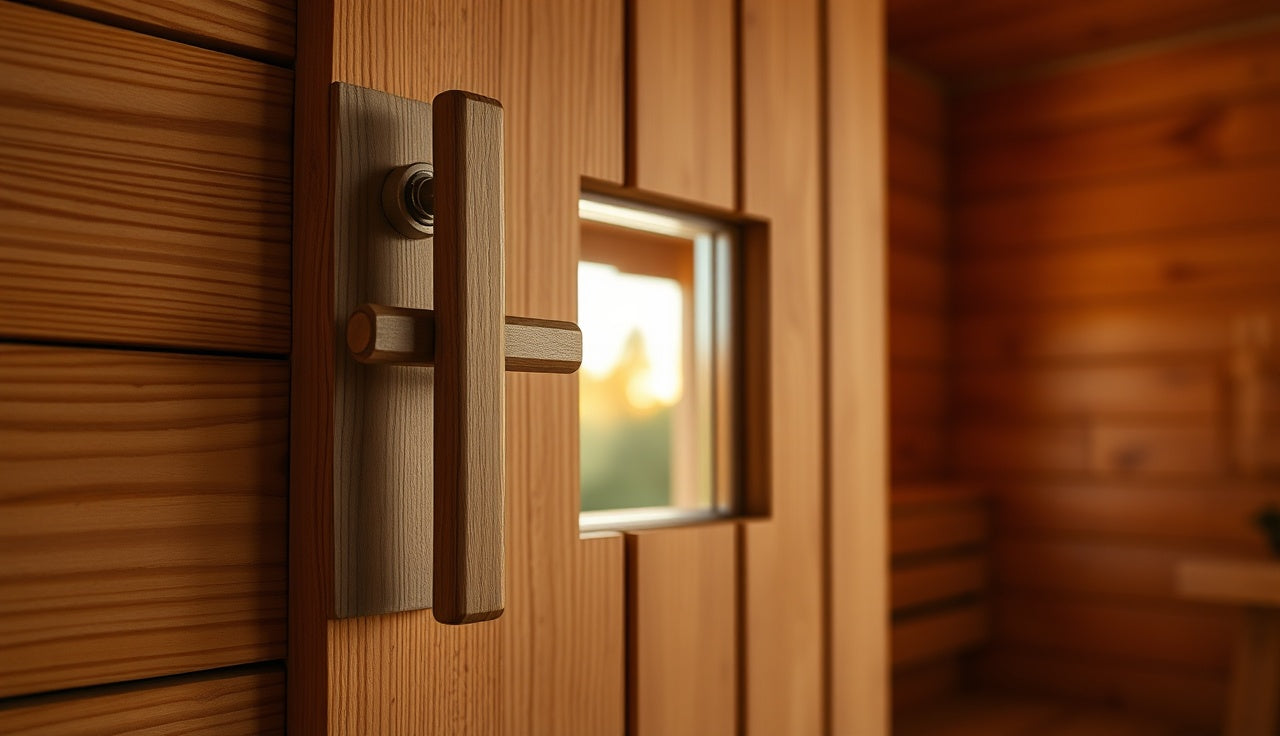
Glass panel. A small window lets someone outside spot an occupant in distress. It costs almost nothing and can let a bystander recognize an emergency before opening the door.
Carbon monoxide detector. Mandatory for any wood-burning sauna or one sharing an enclosure with combustion appliances. The Consumer Product Safety Commission recommends CO detectors in any space where combustion happens [8].
Emergency signal. A bell, a phone hook, or a loud knock-panel gives an incapacitated person a way to call for help without opening the door. This counts most where users go alone.
Want more on what separates a good unit from a bad one? See our sauna benefits overview and general sauna buying guidance.
Are there specific rules for commercial gym or spa saunas versus home saunas?
Yes, and the gap is large. Commercial and public saunas carry the full weight of the IBC, local fire codes, state health department rules, and often the ADA [1][4]. Residential saunas answer mostly to the IRC and local amendments, which run less prescriptive in some areas.
A home sauna inside your primary residence usually means a building permit and an inspection by the local AHJ. The inspector checks electrical work (heater circuit, GFCI protection), framing, and sometimes ventilation. Door hardware may or may not get a close look, depending on the jurisdiction and the inspector.
Commercial saunas raise the stakes. Fire marshals can shut a facility down over non-compliant egress hardware. Liability after a guest injury or death runs far higher. NFPA 101, the Life Safety Code from the National Fire Protection Association, is adopted for commercial occupancies in many states and governs means of egress including door hardware [9].
Here is where home buyers get a pass they should not. Barrel saunas and outdoor cabin saunas sold as prefab kits often ship with inward-swinging doors or hardware that would flunk commercial code. The manufacturer assumes the buyer will install and use them responsibly. That assumption does not always hold.
Buying a prefab unit? Ask the supplier straight out: does the door swing outward, and can it open from inside without a key or outside help? If the answer is no, demand different hardware before you accept delivery. SweatDecks curates units that meet these basic criteria, and any reputable outdoor sauna retailer should answer this in one sentence.
How do you retrofit a sauna door that does not meet safety standards?
Got an existing sauna with an inward swing, an outside-only lock, or no inside release? Here is the fix order, cheapest and most urgent first.
First, remove or disable any outside lock that blocks egress. Five minutes, no cost. If you need exterior security when the sauna is empty, use a padlock hasp that you physically remove before anyone enters.
Second, if the door swings inward, re-hang it to swing outward. This is the biggest job and the most important one. A carpenter or handyman can usually do it in two to four hours. The door slab stays the same. Only the hinge placement and door stop change.
Third, swap round doorknobs for lever handles, inside and outside if you can. Levers help anyone with reduced hand strength and meet ADA hardware standards [4].
Fourth, if the door has no window, add a small tempered glass panel. Even a four-inch by four-inch insert gives someone outside a sightline to the occupant.
Fifth, add a door stop or magnetic catch so the door swings the correct way and stays put. Minor, but worth doing while the tools are out.
None of these means replacing the whole sauna. They are hardware changes, and they cut the odds of a door-related emergency in a real way.
What should you ask before buying a sauna to confirm the door is safe?
Ask any manufacturer, retailer, or contractor these questions before you commit.
1. Which direction does the door swing? The answer you want: outward.
2. Can the door open from inside without a key or tool? The answer you want: yes, always.
3. Is the hardware operable with one hand and without tight grasping? (Matters a lot if any user has arthritis, weak grip, or mobility issues.)
4. What is the heater's maximum operating temperature, and does it have a thermal cutoff? Ask for the UL or ETL listing number.
5. Does the unit include a timer, and what is the longest session it supports?
6. Is there a ventilation system, and where are the intake and exhaust vents?
7. What permits does my jurisdiction require, and will the unit pass a standard residential inspection?
If a seller cannot answer questions one and two clearly and right away, walk. This is not obscure technical detail. Any manufacturer who has thought about the product answers in a single sentence.
Comparing formats? The sauna vs steam room guide covers how steam rooms handle ventilation and egress differently, which shapes the door question in its own way.
Where can you find the official codes and standards that govern sauna safety?
The core documents are publicly accessible, though some sit behind a purchase through the publishing body.
The International Building Code (IBC) and International Residential Code (IRC) come from the International Code Council (ICC). Many states post their adopted versions free online through the state legislature or building department [1].
NFPA 101, the Life Safety Code, comes from the National Fire Protection Association and is free to read online on the NFPA site [9].
The ADA Standards for Accessible Design come from the US Department of Justice and are free at ADA.gov [4].
UL 875 covers electric dry-bath heaters, meaning the kiuas units in most electric saunas [7]. It sets maximum surface temperatures, thermal cutoffs, and electrical safety rules.
Minnesota's sauna rules, probably the most detailed state-level sauna code in the US, are published through the Minnesota Department of Labor and Industry [3].
For the physiology of sauna risks and benefits, go to the peer-reviewed literature. The 2015 JAMA Internal Medicine study by Laukkanen and colleagues on sauna frequency and cardiovascular outcomes is one of the most-cited sources in the field [6]. Reading primary sources instead of wellness blogs gives you a far clearer picture of what is actually known.
Frequently asked questions
Is it illegal to lock a sauna from the outside?
Under IBC Section 411, a sauna door latch cannot lock from outside in a way that prevents egress. This applies to commercial and public facilities in jurisdictions that adopt the IBC, and the IRC carries similar language for residential builds. Locking an empty sauna from outside is generally fine. Locking it while someone is inside violates code in most jurisdictions and is a serious hazard.
Why do sauna doors have to open outward?
If a person collapses against an inward-swinging door, their body weight blocks it, and rescuers cannot push it open without moving the victim. An outward-swinging door pulls open from outside without disturbing the person inside, and a half-conscious person may be able to lean against it to push it open. IBC Section 411 requires outward-swinging doors in commercial saunas for exactly this reason.
Can a sauna have a lock at all, or does it have to be completely unlocked?
A sauna can have a lock. The requirement is that it must always be operable from inside without a key or outside help. An inside thumb-turn knob paired with a keyed outside cylinder is fully compliant. What is prohibited is any mechanism that engages from outside while someone is inside and cannot be released from inside.
What happens if you pass out in a locked sauna?
If the door will not open from inside and nobody outside is watching, the risk of fatal hyperthermia is real. A sauna at 90 degrees Celsius can push an incapacitated person's core temperature to dangerous levels within 15 to 30 minutes. This is exactly why outward-swinging doors, inside-operable latches, and glass panels are treated as life-safety requirements, not optional extras.
Do portable sauna tent zippers count as a locking mechanism?
Zipper closures on portable fabric saunas can be pulled shut from outside, effectively trapping a user who is dizzy or incapacitated. No code explicitly governs portable tents the way the IBC governs built saunas, but the hazard is the same. Keep scissors accessible inside, and always use a portable sauna with someone nearby who can open the zipper from outside.
What kind of latch should I put on a home sauna door?
An inside slide bolt, a magnetic push-to-open latch, or a lever passage latch with no lock at all are all good choices. Any hardware where the person inside fully controls egress is compliant. Avoid hook-and-eye latches that only release from outside, and avoid any hasp built solely for a padlock.
Do electric and wood-burning saunas have different door requirements?
The door egress requirements are the same regardless of heat source. Wood-burning saunas add one concern: combustion byproducts, including carbon monoxide. The Consumer Product Safety Commission recommends CO detectors in any space with combustion appliances. Wood-burning units also need a properly sealed and inspected flue, which affects how the door and ventilation work together.
Can a child accidentally lock someone inside a sauna?
Yes, if the sauna has a hasp, slide bolt, or any exterior lock a child can reach and engage. This is a real scenario in family homes. The safest design removes every outside-engageable lock that cannot be released from inside. If you need to secure an empty sauna around children, use a keyed lock mounted high and out of reach, and always remove it before anyone enters.
Does the ADA apply to sauna doors in gyms and spas?
Yes. ADA Standards for Accessible Design require operable parts, including door hardware, to work with one hand and without tight grasping, pinching, or twisting of the wrist. Round knobs typically fail this test. Lever handles, push bars, or loop pulls pass. Commercial facilities that offer saunas as accessible amenity spaces must meet these hardware requirements.
Are there temperature limits tied to sauna safety codes?
Yes, though they vary by jurisdiction. UL 875 sets safety requirements for electric sauna heater design, including thermal cutoffs. Some state codes specify maximum allowable sauna temperatures, typically 90 to 110 degrees Celsius. Minnesota's state sauna code is among the most detailed in the US and includes temperature control requirements alongside structural and ventilation rules.
Should a sauna have a window or glass panel in the door?
It is not universally required by code, but it is strongly recommended. A glass panel lets someone outside see a user in distress without opening the door. In commercial settings it is nearly standard. In a home sauna it costs little and provides real peace of mind, especially if anyone using it has cardiovascular risk factors or goes in alone.
What is the safest session length to avoid needing emergency exit?
Most sauna safety guidance suggests 10 to 20 minutes per session for healthy adults, with rest breaks in between. The 2015 Laukkanen study in JAMA Internal Medicine tracked men who used saunas four to seven times per week and found cardiovascular benefit, but sessions included cooling periods. Unlimited session length with no timer is a risk factor, which is why automatic shutoff timers are recommended.
Where can I find my local sauna building code requirements?
Start with your local building department or AHJ (authority having jurisdiction). Most jurisdictions adopt the IBC or IRC with local amendments. Many states post their adopted codes free online through the state legislature or building department website. If your state has a large Nordic-heritage population (Minnesota is the clearest example), check for state-specific sauna rules published by the department of labor and industry.
Sources
- International Code Council, International Building Code Section 411 (Saunas): IBC Section 411.2 requires sauna doors to swing outward and prohibits outside locks that prevent egress
- Finnish Sauna Society, sauna safety and usage guidance: Most sauna fatalities involve cardiovascular events; typical Finnish sauna temperature range is 80 to 100 degrees Celsius
- Minnesota Department of Labor and Industry, Minnesota State Building Code: Minnesota has state-specific sauna code requirements covering temperature controls, ventilation, and door hardware
- U.S. Department of Justice, ADA Standards for Accessible Design: ADA operable parts standards require door hardware usable with one hand without tight grasping, pinching, or twisting
- Centers for Disease Control and Prevention, Extreme Heat and Your Health: Core body temperature above 40 degrees Celsius causes heat exhaustion; above 41.5 degrees Celsius is classified as heat stroke with risk of organ failure
- Laukkanen JA et al., JAMA Internal Medicine, 2015. Association Between Sauna Bathing and Fatal Cardiovascular and All-Cause Mortality Events: Frequent sauna use (4-7 times per week) was associated with 63% lower risk of sudden cardiac death vs once-weekly use; sauna bathing combined with alcohol raised risk
- UL Standards, UL 875 Standard for Electric Dry-Bath Heaters: UL 875 sets maximum surface temperatures, thermal cutoff requirements, and electrical safety standards for electric sauna heaters
- U.S. Consumer Product Safety Commission, Carbon Monoxide Safety: CPSC recommends CO detectors in any space where combustion appliances are used
- National Fire Protection Association, NFPA 101 Life Safety Code: NFPA 101 is widely adopted for commercial occupancies and governs means of egress requirements including door hardware
- International Code Council, International Residential Code: IRC carries sauna door egress requirements applicable to residential sauna construction

Share:
How to childproof a sauna door: every option explained
Cold plunge fencing safety codes: what every homeowner needs to know