
Last updated 2026-07-11
TL;DR
A safe sauna door swings outward, latches from the outside where a child can't reach, and always opens from the inside without a key. Add an alarm or a room barrier for when the sauna sits idle. A small child can overheat to the danger point in under 10 minutes at normal sauna temperatures. One gadget won't do it. You need layered hardware, firm household rules, and a clear way out.
Why is a sauna door specifically dangerous for children?
A sauna door is the hottest, most accessible surface in the room, and it guards a space that can hurt a child fast. Most home saunas run between 150°F and 195°F (65°C to 90°C) [1]. At that heat a small child's core temperature can climb into heat stroke territory within minutes. Adults handle it because they carry more mass per unit of skin and their thermoregulation is fully developed. Kids have neither advantage.
The door adds a second hazard. Traditional sauna doors swing outward on purpose, which helps anyone escape. But some budget barrel saunas and older prefab units use inward-swinging or sliding doors that can jam, or that a curious child can pull shut from outside and trap someone in. The Consumer Product Safety Commission tracks incidents involving children and hot enclosed spaces, including saunas and steam rooms, under its entrapment and thermal-injury categories [2].
Then there is the lock inversion problem. Standard interior door hardware locks from the inside. Sauna hardware has to do the opposite. It should stop a child from locking themselves in and must always let a person out from inside without a key. Homeowners retrofit generic hardware all the time without thinking this through, and they build a trap by accident.
Glass panels are the last piece. The glass on many modern sauna doors reaches surface temperatures that burn on contact in under a second. So the door is more than the way in. It is the part of the room most likely to injure a child who reaches it.
What does the law or any safety standard actually require?
No single federal law in the United States requires childproofing on a privately owned residential sauna door. The rules that do apply come from a few directions, and none of them was written with toddlers in mind.
The International Residential Code (IRC), which most U.S. jurisdictions adopt in some form, requires sauna room doors to open outward and to open from the inside without a key or special knowledge [3]. That is a life-safety floor, not a childproofing standard. Your local building department can add requirements on top, especially if the sauna sits in a room children can reach.
Commercial settings are stricter. For pools, gyms, and spas, ANSI/APSP-11 and local health codes usually require lockable doors and posted age minimums, commonly 16 or 18 years old [4]. Residential installs are left almost entirely to the homeowner.
CPSC's NEISS injury data confirms that thermal and entrapment injuries in saunas and steam rooms happen to children, but the numbers are not broken out cleanly enough to give a precise annual count for home units [2]. The absence of a mandate is not evidence the risk is low. It means the rules haven't caught up with how common home saunas have become.
Here is the practical read: meet the IRC outward-swing and always-operable-from-inside rule as your baseline, then go past it on your own.
Which types of sauna door locks actually work for childproofing?
Four hardware approaches are worth your money, and they are not equal. Here is what each one does and where it fails.
High-mounted sliding bolt (exterior only) A plain sliding bolt mounted at 60 to 66 inches on the outside of the door, above the reach of a child under about eight, is the cheapest reliable way to keep kids out when the sauna is off. It costs $8 to $25 at any hardware store. The weakness: it does nothing if a child slips in while an adult is inside and the door sits unlatched.
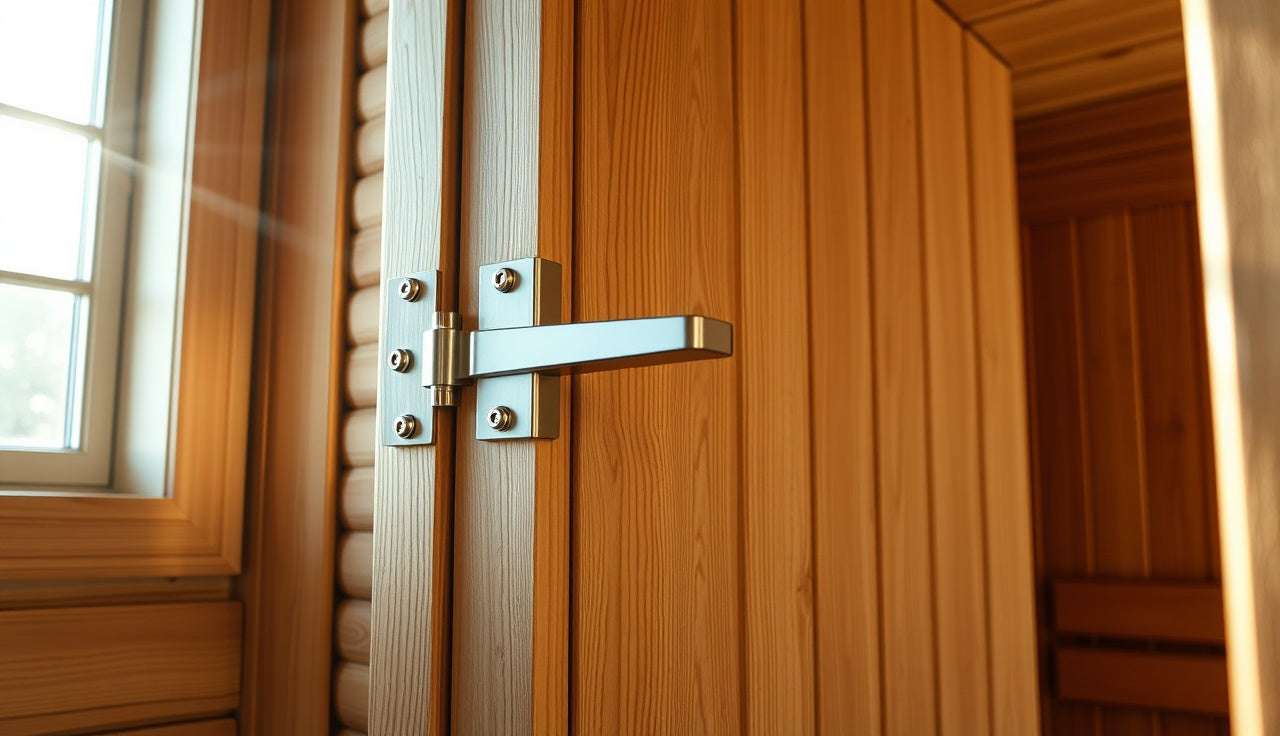
Keyed exterior lock A keyed cylinder on the outside, with no lock function on the inside so anyone inside can always leave, is the cleaner residential answer. It stays locked when the sauna is idle and a child can't defeat it. Confirm the product or locksmith installs a passage function on the interior side, never a privacy or keyed function. Expect $40 to $120 for a decent cylindrical or mortise lock with the right function.
Magnetic cabinet-style locks These release with a magnetic key and were built for kitchen cabinets. Some people add one as a secondary latch on a sauna door. They stop a toddler. A determined seven-year-old defeats them. Use them as a supplement, never as the main lock.
Electronic keypad or smart lock A PIN or app-controlled lock on the exterior is the easiest to manage, because you can change the code the day a kid learns it. A Schlage BE365 or a similar Grade 2 keypad lock adapts to sauna doors. Heat is the catch. Mount the lock on the exterior face only, never inside the hot room, and check that the body isn't exposed to steam or radiant heat above its rating [5]. Most electronic locks are rated for 32°F to 120°F (0°C to 49°C), so interior mounting cooks them within weeks.
| Lock type | Approx. cost | Defeats toddler | Defeats 6-10 yr old | Safe for always-exit from inside |
|---|---|---|---|---|
| High sliding bolt (exterior) | $8-$25 | Yes | Mostly | Yes |
| Keyed exterior cylinder | $40-$120 | Yes | Yes | Yes (if interior is passage) |
| Magnetic cabinet lock | $15-$40 | Yes | No | Yes |
| Electronic keypad (exterior) | $80-$200 | Yes | Yes | Yes |
How should the door itself be configured for safety?
The lock is one piece. How the door hangs and opens matters just as much.
Outward swing is non-negotiable. If your sauna door opens inward, fix that before you touch any lock. A person who collapses inside a sauna with an inward-opening door can block their own exit with their body. The IRC requires outward-opening sauna doors for exactly this reason [3]. Older unit with the wrong swing? Rehang the door or replace it.
The interior needs a heat-resistant pull handle a child can reach. If a child does get inside, their ability to get back out is the whole ballgame. Many manufacturers mount hardware only at adult height. Add a lower secondary pull at 24 to 30 inches if young kids live in the house.
Gaps and seals count too. Sauna doors usually use a wood-to-wood seal with no gasket, so the wood swells and sticks in humid conditions. Check the door each season and plane or sand any edge that binds. A door that takes real force to open from inside is dangerous for anyone, and worse for a child.
Glass door panel? It should be tempered safety glass per ANSI Z97.1 [6]. Good manufacturers use it, but verify on a budget unit or a replacement panel. Standard float glass shatters into large sharp shards. Tempered glass breaks into small blunt pieces that are far less likely to cut.
For more on what a quality setup looks like, our home sauna guide covers door specs and unit construction in detail.
What barriers or alarms can add a second layer of protection?
Hardware on the door is layer one. A barrier or alert before a child ever reaches the door is layer two, and it buys you the seconds that matter.
Put a door alarm on the entry to the sauna room, meaning the room or hallway door leading to the sauna rather than the sauna door itself. It tells you the instant a child crosses into that space. Simple chime alarms sold for pool gates work fine and run $15 to $40. Mount them high enough that the child can't just switch them off.
California's pool safety law, the Swimming Pool Safety Act, requires enclosure barriers at least 60 inches high with self-latching, self-closing gates [7]. Those rules cover pools, not saunas. But the compliance hardware they created, self-closing latches and high-mounted releases, drops right onto a sauna anteroom door and is easy to buy off the shelf.
A temperature sensor inside the sauna can ping your phone if the room starts heating when you didn't expect it. Govee, Inkbird, and similar brands sell Bluetooth or Wi-Fi sensors for under $30. If your sauna is Wi-Fi enabled, units from makers like Harvia and Almost Heaven show whether the heater is running through their apps.
Visual indicators are underrated. A red/green light on the outside of the sauna door or room, wired to the heater power circuit, tells anyone walking past whether the room is hot. An electrician can add one in an afternoon for $50 to $150 in parts and labor. Some heater control panels already include a relay output for exactly this.
Are there age-specific recommendations for children around saunas?
The evidence is thin and mostly Finnish, where sauna has been part of daily life for generations. The Finnish Sauna Society and Finnish physicians publish general guidance that children can join supervised family sessions from early childhood, but only with strict limits on heat and time [8].
Finnish pediatric guidance runs roughly like this. Children under three should not be in a sauna at all. Children three to six can join for short spells on lower benches (around 160°F or below) with an adult watching the whole time. Older children can take part more like adults but still need close monitoring for overheating: stopping sweating, dizziness, and flushing are the warning signs.
The American Academy of Pediatrics has not published a sauna-specific guideline as of this writing. Its hyperthermia work notes that children's bodies heat up three to five times faster than adults during exertion in the heat, which maps directly onto sauna exposure [9]. Smaller body, faster core rise. The physiology isn't in dispute.
None of this changes the hardware question. Even if your eight-year-old is welcome in the sauna alongside you, childproofing the door is about the unsupervised case: the kid who wanders in alone, or the toddler who trails an older sibling.
| Child under 3 | 5 |
| Child age 3-6 | 8 |
| Child age 7-12 | 13 |
| Teenager | 18 |
| Healthy adult | 25 |
Source: American Academy of Pediatrics, Clinical Report on Hyperthermia; NIOSH Hot Environments guidance
How do you childproof an outdoor sauna door specifically?
Outdoor saunas bring extra problems. Weather, UV, and temperature swings wear out hardware faster. A keyed lock that runs smoothly indoors can freeze, swell, or corrode within one season outside if it isn't rated for exterior use.
Use hardware built for the outdoors: stainless steel or brass with a weather-resistant finish. Zinc die-cast locks, standard on cheap hardware, corrode fast in wet climates. The high-mounted sliding bolt shines here, because a stainless bolt and staple shrugs off weather and has no electronics to fail.
If your outdoor sauna sits in a fenced yard, applying pool-fence logic to the whole yard perimeter is worth a look. One barrier then keeps children away from the sauna, the wood-heater fuel, and any electrical connections at the same time.
Barrel saunas need the most attention. Many ship with a basic wooden cam latch that a three-year-old can flip open. Swap it for a proper keyed or high-mounted bolt before anyone uses the unit.
And confirm the structure meets your local setback and permit rules. An unpermitted build can complicate an insurance claim if someone gets hurt [10].
What habits and rules matter as much as hardware?
No lock survives careless habits. Hardware is a backstop, not a substitute for household rules.
The biggest habit is simple. Lock the sauna every time you finish, even when you're only stepping out for a minute. That urge to leave it unlatched while you grab a towel is exactly how these incidents start.
Set an explicit rule: no child enters the sauna room without an adult, and say why in words that fit their age. Research on child drowning prevention consistently finds that verbal rules alone don't protect children under seven, which is why hardware carries the load for the little ones [11]. For older kids, understanding the real risk changes behavior in a way a lock can't.
Keep sauna remotes and smart controls out of reach or in a locked drawer. A child who can't open the door might still fire up the heater from outside and turn the room into a hazard for whoever does get in.
When guests bring children, walk the space with them. Point out the sauna, confirm the lock is set, and don't assume the visiting parent has already thought it through. Most adults don't treat a sauna like a pool hazard, even though the thermal risk is comparable.
Know the emergency steps. For a child showing signs of heat stroke, rapid cooling comes first: cold water immersion or wet towels with a fan, and call 911 right away [12]. Keeping a charged phone within reach during sauna use isn't paranoid. It's basic.
What is the easiest childproofing setup you can install this weekend?
Here is the budget setup I'd actually put in, and you can finish it in an afternoon. It covers the two failure modes that hurt kids: wandering in undetected, and getting stuck inside.
Step one: confirm the door swings outward. If it doesn't, fix that before anything else.
Step two: mount a stainless steel surface bolt at 64 inches on the exterior face of the door. Use the longest bolt available (usually 6 inches) so it seats deep in the strike. This runs $12 to $20 and takes 20 minutes with a drill.
Step three: add a door chime alarm to the room entry, or to the sauna door itself, so you hear it open when the sauna is running. These peel and stick in seconds.
Step four: check the interior handle is easy to reach from the floor, because a child who gets in has to be able to get out. If it's too high, add a low pull handle.
Total cost: under $50. Total time: under two hours.
Want to go further? Add a keyed lock as the primary latch and keep the surface bolt as backup. That drops the unsupervised-entry risk close to zero.
SweatDecks lists hardware specs on its home saunas, which makes it easier to know what you're working with before you buy and plan the childproofing.
Does childproofing a sauna door affect your homeowner's insurance?
Probably yes, and almost certainly in your favor. Insurers treat pools, trampolines, and hot tubs as attractive nuisances, meaning things that draw children and carry foreseeable injury risk. Some carriers now put saunas in the same bucket, especially as home sauna ownership has grown sharply since 2020 [13].
A few things to know. Disclose the sauna to your insurer if you haven't. Failing to report a major addition can void a claim. Ask specifically whether your policy covers a sauna injury to a non-resident child, because the answer varies by policy. And document your childproofing: photograph the hardware with dates and keep the receipts. That paper trail shows you took reasonable precautions.
Some insurers will ask whether the sauna is permitted. A pulled permit that passed inspection is strong evidence of code compliance. If the unit went in without one, correct that before you have a coverage conversation, because an unpermitted structure is a legitimate reason for a carrier to fight a claim [10].
Consider an umbrella policy if you have a sauna plus a pool or other attractive-nuisance features. A $1 million umbrella typically adds $150 to $300 a year to your total insurance cost and covers liability gaps a homeowner's policy may leave open.
Frequently asked questions
What is the minimum age for a child to use a sauna safely?
Finnish pediatric guidance, the most detailed available, suggests children under three should not use a sauna at all. Children three to six can join brief, supervised sessions at lower temperatures. U.S. pediatric groups have not set a sauna age cutoff, but AAP hyperthermia data shows children's core temperatures rise three to five times faster than adults in heat, so any unsupervised exposure is high-risk regardless of age.
Can a child get locked inside a sauna by accident?
Yes, if the hardware is wrong. Any sauna door must open from the inside without a key or special tool, per the International Residential Code. A lock that needs a key from both sides is a code violation and a serious hazard. Check your interior hardware. It should turn or push freely from inside with no key required.
What type of lock works best on a sauna door for child safety?
A keyed exterior cylinder with a passage function on the interior side is the most reliable option. It blocks unsupervised entry and always allows exit from inside without a key. A high-mounted sliding bolt at 64 inches is the cheapest backup. Electronic keypad locks work well if mounted on the exterior only, away from heat. Never lock from the inside in a way that could trap someone.
How hot does a sauna door glass get, and can it burn a child?
Glass panels on sauna doors can top 130°F to 150°F during a full session. Contact burns can happen in under a second at those temperatures. The glass should be tempered safety glass per ANSI Z97.1. Keep children off the door surface even while the sauna cools, since glass holds heat for 20 to 40 minutes after the heater shuts off.
Do I need a permit to install childproofing hardware on my sauna door?
Adding a lock or bolt to an existing door needs no permit in most jurisdictions. But if the sauna itself went in without a permit, fixing that matters before any insurance or liability discussion. Check with your local building department if you're making structural changes to the door or frame, like reversing the swing direction.
How do I stop a child from turning on the sauna heater remotely?
Store any handheld remote or wall-panel key in a locked drawer or out of reach. For Wi-Fi saunas, set up the app with parental controls or a separate PIN. Some control panels have a physical key switch on the heater itself. Engaging that key lock means the heater won't fire without the key, no matter what a remote or timer does.
Is a sauna door treated differently than a pool for home insurance purposes?
More insurers now treat saunas as attractive nuisances, much like pools. Disclose the sauna to your carrier, document your childproofing with photos and receipts, and ask specifically about liability coverage for non-resident children. If the sauna was built without a permit, a carrier may dispute a claim. An umbrella policy typically costs $150 to $300 a year and covers gaps in standard homeowner's coverage.
What should I do if a child is found inside a hot sauna?
Get the child out at once and start rapid cooling: move to a cool space, apply wet towels, and run a fan if you have one. Don't put ice directly on a young child's skin. Call 911 immediately if the child is confused, not sweating despite the heat, or unconscious. Those are heat stroke signs and a medical emergency. Don't wait to see if they improve on their own.
Does an outdoor barrel sauna need different childproofing than an indoor unit?
Yes. Outdoor barrel saunas often ship with basic wooden toggle latches a toddler can open. Replace stock hardware with stainless steel surface bolts or a keyed exterior lock rated for outdoor use. Zinc and standard steel corrode quickly outside. If the sauna sits in a fenced yard, applying pool-fence-style access control to the perimeter adds a practical outer barrier.
Are there sauna alarms that can alert me if a child enters?
Yes. Door chime alarms made for pool gates and home security work well on sauna room doors and cost $15 to $40. Wi-Fi temperature sensors from brands like Govee or Inkbird alert your phone if the interior temperature rises unexpectedly, which flags a heater running when it shouldn't be. Some connected sauna heaters have native app alerts for heater activation.
What handle height is safe for a child to exit a sauna from the inside?
Most sauna handles sit at adult height, around 36 to 42 inches. For homes with young children, add a secondary pull at 24 to 30 inches on the interior side. A child who wanders in or gets trapped needs to reach and work the exit without help. It's a low-cost addition that takes under 30 minutes.
Can I use a standard childproof cabinet lock on a sauna door?
Magnetic cabinet locks can serve as a secondary latch for toddlers but shouldn't be your primary childproofing. Children over six often defeat them. Sauna heat and humidity also degrade the adhesive mounting over time. Use a properly installed mechanical lock as the main barrier and keep cabinet locks as backup only.
Sources
- National Institute for Occupational Safety and Health (NIOSH), Occupational Exposure to Hot Environments: Sauna temperatures typically range from 150°F to 195°F (65°C to 90°C)
- U.S. Consumer Product Safety Commission, NEISS database: CPSC logs thermal and entrapment injuries involving children in hot enclosed spaces including sauna and steam rooms
- International Residential Code (IRC), Chapter 13, Sauna Requirements: IRC requires sauna room doors to open outward and be operable from the inside without a key or special knowledge
- ANSI/APSP-11 American National Standard for Water Quality in Public Pools and Spas: Commercial sauna and spa standards typically require lockable doors and posted minimum age limits of 16 to 18 years
- Schlage Commercial Hardware Installation and Product Specifications: Standard electronic locks are rated for 32°F to 120°F (0°C to 49°C) operating temperature range
- ANSI Z97.1 Safety Glazing Materials Used in Buildings, American National Standards Institute: Tempered safety glass requirements for building glazing under ANSI Z97.1
- California Swimming Pool Safety Act, California Health and Safety Code: California requires pool enclosure barriers at least 60 inches high with self-latching, self-closing gates
- Finnish Sauna Society, Health Guidelines for Sauna Use: Finnish guidance suggests children under three should not use a sauna; older children can participate briefly with adult supervision at lower temperatures
- American Academy of Pediatrics, Clinical Report on Hyperthermia in Children: Children's bodies heat up three to five times faster than adults during heat exposure
- Insurance Information Institute, Home Insurance and Permitted Structures: Unpermitted structures can be a legitimate basis for an insurer to dispute or deny a related claim
- Centers for Disease Control and Prevention, Drowning Prevention Research: Verbal rules alone are insufficient to prevent unsupervised access by children under seven; physical barriers are required
- Centers for Disease Control and Prevention, Heat Stroke Treatment Guidelines: Cold water immersion or rapid evaporative cooling is first-line treatment for heat stroke; call 911 immediately for a child with symptoms
- Pool & Hot Tub Alliance (PHTA), Industry Data Report: Home sauna ownership has grown sharply since 2020, increasing insurance exposure for residential thermal injury claims

Share:
Sauna smoke detectors: why you need a heat-activated type
Sauna lock from outside: the safety feature every owner should know