
Last updated 2026-07-09
TL;DR
A sauna house is a dedicated structure built for heat bathing, either a standalone outdoor building or a converted interior room. Costs run from roughly $3,000 for a basic barrel kit to $50,000 or more for a custom timber structure. The right choice depends on your lot, your budget, and whether you want dry heat, steam, or contrast therapy with a cold plunge.
What exactly is a sauna house?
A sauna house is a building whose entire purpose is heat bathing. That is it. The whole structure exists to get you hot, keep the heat contained, and give you somewhere to cool down afterward.
This separates it from an indoor sauna room, which is a converted closet or basement corner. A sauna house is its own building, usually in a backyard, often with a changing area, a bench room with a heater, and sometimes a cold plunge or shower just outside the door.
The concept goes back centuries in Finnish culture. The oldest form is the "savusauna" (smoke sauna), heated by a fire pit with no chimney. Modern sauna houses use electric, wood-burning, or gas heaters instead. The tradition of building a separate outbuilding for bathing survived because it works: heat, wood, and water are messy, and keeping that mess away from your living space makes sense.
Today in North America, "sauna house" can mean anything from a $3,500 prefab barrel dropped in a backyard to a custom post-and-beam structure with radiant floor heat, a wet room, and a cold plunge pool. The price range is enormous. So is the quality range. Figuring out which type fits your life is the whole point of this article.
What are the different types of sauna houses?
There are five main types, and they are not interchangeable.
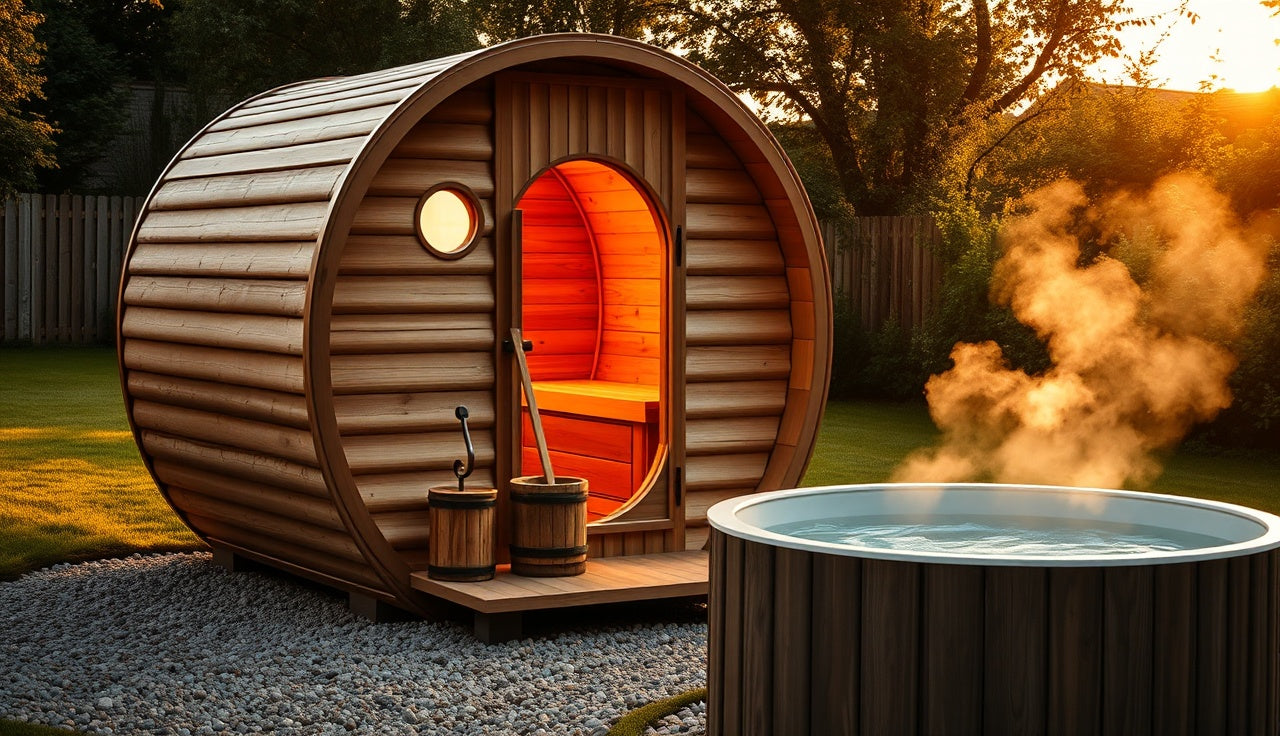
Barrel sauna. A cylinder of cedar or hemlock, usually 6 to 8 feet in diameter and 6 to 10 feet long, set on cradles outdoors. It heats up fast (30 to 45 minutes), costs the least, and looks good without much landscaping work. The curved shape concentrates heat at bench level, which is genuinely useful. Downsides: limited headroom, no changing room unless you buy an extended model, and the wood grays and checks over years of outdoor exposure if you skip the annual sealing.
Prefab cube or pod sauna. A rectangular insulated box, usually with large glass panels on one or two walls. These ship as a kit and go together in a day with basic tools. Better headroom than a barrel, a more modern look, and some models include a small changing area. Prices run $5,000 to $20,000 depending on size and glass area [1].
Traditional Finnish-style outbuilding. A wood-framed or log structure built to look like a small cabin. This is the real thing: thick insulated walls, a separate dressing room ("pukuhuone" in Finnish), a wood-burning kiuas (heater), and a ladle-and-bucket water setup. Build costs from a contractor range from $15,000 to $50,000+ depending on size, finishes, and site work [2].
Converted shed or accessory structure. Some homeowners gut an existing outbuilding, line it with sauna-grade cedar or thermally modified wood, add a heater, and call it done. This can be cost-effective if you already have a solid structure. The risk is that most garden sheds are not insulated properly, and retrofitting vapor barriers and ventilation correctly takes real skill.
Smoke sauna (savusauna). Rare in North America, common in Finland. No chimney, the fire heats rocks directly, smoke fills the room, then vents before you enter. The heat is extraordinarily soft and the smell is unforgettable. It takes skill to operate safely and is not practical for most suburban lots.
First-timers should start with a prefab cube or a quality barrel. A custom Finnish outbuilding is a multi-year commitment that pays off once you know you use the sauna four or five times a week and want something that lasts 30 years.
How much does a sauna house cost?
Here is the honest breakdown. These are 2024 to 2025 North American price ranges pulled from manufacturer pricing, contractor estimates, and published remodeling cost data [1][2][3].
| Type | DIY/Kit Cost | Installed Total (est.) |
|---|---|---|
| Barrel sauna (6x7 ft) | $3,000 to $7,000 | $4,500 to $10,000 |
| Prefab pod/cube | $6,000 to $20,000 | $9,000 to $28,000 |
| Custom Finnish outbuilding | N/A (custom) | $20,000 to $60,000+ |
| Converted shed | $2,000 to $6,000 materials | $8,000 to $18,000 installed |
| Indoor home sauna room | $3,000 to $10,000 materials | $6,000 to $20,000 installed |
A few things drive costs up fast. Electrical work for a 240V heater runs $500 to $2,000 depending on how far your panel sits from the structure [2]. A concrete pad or deck foundation adds $1,500 to $5,000. If you want a wood-burning heater inside city limits, you may need a smoke permit and a Class A chimney assembly, which adds $800 to $3,000.
Adding a cold plunge or outdoor shower to the footprint adds $1,500 to $15,000, depending on whether you go with a stock tank, a purpose-built cold plunge, or a plumbed shower. If contrast therapy is your main goal, budget for both from the start rather than retrofitting later.
Permitting costs vary enormously. More on that below.
The number people forget is operating cost. A 6 kW electric heater running 90 minutes costs roughly $0.60 to $1.80 per session depending on your local electricity rate [4]. A wood-burning sauna costs almost nothing to run if you have cheap wood access, but takes 45 to 90 minutes to reach temperature and needs more attention.
| Barrel sauna (installed) | $7,250 |
| Prefab pod/cube (installed) | $18,500 |
| Converted shed (installed) | $13,000 |
| Indoor home sauna room (installed) | $13,000 |
| Custom Finnish outbuilding | $40,000 |
Source: HomeAdvisor Sauna Cost Guide, Almost Heaven Saunas pricing, 2024
Do you need a permit to build a sauna house?
Almost certainly yes, if it is a permanent structure. The specific rules come from your local jurisdiction, not the state or federal government, but the framework is consistent.
In most U.S. municipalities, any detached structure over 120 to 200 square feet requires a building permit [5]. Some jurisdictions set the threshold at 100 square feet. A typical 8x10 foot sauna house (80 sq ft) may slip under the limit in some areas, but a full Finnish outbuilding with a changing room will not.
Electrical permits are separate from building permits and are almost always required for a 240V circuit, regardless of structure size [5].
Zoning rules matter too. Setback requirements (minimum distance from property lines and the primary dwelling) typically run 5 to 10 feet for accessory structures, but can be more in dense neighborhoods. HOA rules layer on top of local zoning and can be stricter than local code.
Call your local building department before you buy anything. Ask three specific questions. First, does a structure of this square footage require a building permit? Second, what are the setback requirements for accessory structures on my zoning lot? Third, are there fire code restrictions on wood-burning appliances in my district?
Pulling permits is more than red tape. An unpermitted sauna house can create real problems when you sell your home, and if it burns, an unpermitted electrical installation may affect your homeowner's insurance claim.
For reference, Durham, North Carolina (a city where sauna culture is growing alongside its wellness scene, with facilities like Sauna House Durham drawing real interest) follows the North Carolina State Building Code and requires permits for permanent structures and for electrical work above 120V [6]. If you are researching a sauna house in that area, the Durham City-County Inspections Department is the right first call.
What wood and materials should a sauna house be built from?
The interior is the most important decision, and the wrong wood makes a bad sauna.
Nordic white spruce and Nordic white aspen are the Finnish standards. They have low resin content, so they do not drip sticky pitch on you when they get hot, and they stay relatively cool to the touch at sauna temperatures. Western red cedar is the North American default, and it is excellent: aromatic, naturally rot-resistant, dimensionally stable. Hemlock is a step down in price and slightly less aromatic. Thermally modified aspen (heat-treated to stabilize and harden the wood) is gaining ground as a premium option that will not discolor under heavy sweat exposure.
Avoid pressure-treated wood entirely inside any sauna. The preservative chemicals off-gas at heat.
For the exterior of a dedicated sauna house, the rules match any outbuilding: LP SmartSide, cedar siding, or board-and-batten all work fine. The detail that matters is the vapor barrier and insulation assembly. The sauna room needs a vapor barrier on the hot side (toward the heater) with insulation behind it, then a ventilated air gap, then the exterior sheathing. Get this wrong and the structure rots from the inside.
Foundation options: concrete slab, concrete piers, or a pressure-treated skid frame on compacted gravel. A skid frame keeps the structure classified as non-permanent in some jurisdictions, which may help with permits, but verify locally before making that assumption [5].
For heaters, the choice is electric versus wood-burning. Electric heaters are easier to install, produce consistent heat, and can be switched on remotely through an app. Wood-burning heaters produce a different quality of heat (higher radiant component, less convective), take longer to reach temperature, and are the traditional choice. Building in a forest clearing with wood on hand? A wood-burning kiuas is worth considering. For a suburban backyard, electric is easier.
What are the health benefits of regular sauna use?
The research on sauna bathing is more developed than most people realize, and it helps to know what is actually supported versus what is enthusiast speculation.
Cardiovascular health is the best-studied outcome. A large Finnish cohort study published in JAMA Internal Medicine followed 2,315 middle-aged men for 20 years and found that men who used a sauna 4 to 7 times per week had a 50% lower risk of fatal cardiovascular disease compared to once-weekly users [7]. The study authors stated their conclusion plainly: "Increased frequency of sauna bathing is associated with a reduced risk of sudden cardiac death." This is observational data, not a randomized trial, and the Finnish population is specific, but the size of the association is hard to dismiss.
Core body temperature rises to 38 to 40°C (100 to 104°F) during a typical session [7]. Heart rate climbs to 100 to 150 beats per minute, similar to moderate aerobic exercise. Blood vessels dilate. These effects are real and measurable.
Mental health data is thinner but consistent in direction. A 2016 study in Complementary Medicine Research found associations between sauna use and reduced risk of psychosis, and several small studies report that sauna bathing lowers self-reported anxiety and depression symptoms [8]. Nobody has good randomized trial data on this yet. The closest mechanistic explanation is that heat stress triggers endorphin and norepinephrine release, similar to exercise.
Muscle recovery is another common claim. Heat increases blood flow to muscle tissue and may speed clearance of lactate after exercise, though the trial data is small and mixed. If you follow a sauna session with a cold plunge, there is some evidence that contrast therapy reduces delayed-onset muscle soreness [9], but the protocols across studies vary enough that specific timing recommendations are still imprecise.
One honest caveat: most sauna studies used Finnish-style dry saunas at 80 to 100°C (176 to 212°F). Infrared saunas, which run at 45 to 60°C, have less research behind them. They may produce comparable heat stress over longer sessions, but the evidence base is thinner.
For a closer look at what the research actually shows, the sauna benefits guide goes deeper on study methodology.
Should you add a cold plunge to your sauna house?
If the budget allows, yes. The combination beats either one alone for recovery and for the daily ritual of it.
Contrast therapy, alternating between heat and cold, has been practiced in Scandinavian and Russian bathhouse culture for centuries. The mechanism makes sense: heat dilates blood vessels and raises core temperature, cold constricts them and triggers norepinephrine release. Swinging between the two states feels genuinely different from just heat or just cold.
A 2021 review in the European Journal of Applied Physiology found that contrast water therapy reduced post-exercise muscle soreness more effectively than passive rest, though the effect sizes were modest and heavily dependent on protocol [9]. The research is not definitive. The user experience is strong enough that most people who build a sauna house and add a cold plunge use it more, not less.
The cheapest addition is a stock tank cold plunge ($200 to $500 for the tank, plus $500 to $2,000 for a chiller unit if you want reliable cold temperatures). A purpose-built cold plunge with temperature control and filtration runs $3,000 to $15,000. To go deeper on that decision, the cold plunge and ice bath guides cover the options.
Siting matters. Put the cold plunge within 10 to 15 feet of the sauna house door so you do not lose too much body heat walking between them. A small deck or gravel pad between the two makes the transition pleasant in any weather.
Plan the plumbing early. A cold plunge needs drainage, and that is far easier to rough in during construction than to add later.
How long does it take to build a sauna house?
It depends on whether you are assembling a kit or building from scratch, and how fast your permit office moves.
A prefab barrel or cube kit, once it is on site with a foundation ready, takes one to three days to assemble for a confident DIYer. Add a week or two if you are doing the electrical yourself and waiting on an inspection. Total elapsed time from order to first heat, assuming normal shipping: four to eight weeks [1].
A custom build from a contractor takes longer. Site work (clearing, grading, foundation) usually takes one to three days. Framing a simple sauna house takes two to four days. Interior work (vapor barrier, insulation, cedar lining, bench building, heater installation) takes another three to five days. Electrical inspection and final sign-off adds a week in most jurisdictions. Realistic total: six to twelve weeks from permit approval to first use.
The permit process itself is the wild card. Some municipalities process accessory structure permits in two weeks. Others take two to three months. In high-demand areas with backlogged building departments, four to six months is not unusual. Start the permit application before you order materials.
Seasonality matters in a cold climate. Pouring concrete when ground temperatures drop below 40°F requires additives and blankets, and that adds cost. Most sauna house builders in northern climates break ground in spring or early summer for a fall completion.
Does a sauna house add value to your home?
Probably yes, but it is hard to quantify cleanly, and the effect depends heavily on your market.
A properly permitted, well-built sauna house is a permanent improvement to the property. Remodeling Magazine's annual Cost vs. Value report does not break out sauna houses as a separate category, but outdoor living improvements broadly recoup 50 to 80% of cost at resale in most markets [3]. A sauna house in a Nordic-influenced market (Minnesota, the Pacific Northwest, the upper Midwest) likely performs better than one where buyers have never seen the concept.
The key word is "permitted." An unpermitted structure can actually cut your home's value by creating a disclosure problem and repair liability for the buyer. Pull the permit.
A sauna house is a lifestyle purchase first. Use it four or five times a week and the daily value is obvious regardless of resale. Build it purely as a value-add before selling and the math is harder to justify against kitchen or bathroom work.
One honest note: appraisers treat sauna houses differently by market. In some areas they add comparable square footage value. In others they count as sheds with amenity status. If the investment is significant, ask a local real estate agent about buyer reception to outdoor sauna structures in your price range before you build.
What are the best sauna house brands and where do you buy them?
The prefab sauna market has grown a lot since 2020, and there are more options now than most people realize.
For barrel saunas, Almost Heaven Saunas (a West Virginia manufacturer), Dundalk Leisurecraft (Canadian, distributed widely in the U.S.), and Harvia (a Finnish brand, widely available in North American retail) are the most established. Almost Heaven barrels start around $3,500. Dundalk's larger heated models with changing rooms run $6,000 to $12,000.
For cube and pod saunas, HUUM (Estonian) and Kirami (Finnish) make premium glass-fronted units. Northern Lights Cedar Barrels and SaunaLife make well-regarded mid-market options in the $5,000 to $15,000 range.
For heaters specifically, Harvia and HUUM are the Finnish benchmarks for electric units. Narvi and Tulikivi make respected wood-burning kiuas options. Heater sizing is straightforward: roughly 1 kW per 45 to 50 cubic feet of sauna room volume, with adjustments for glass walls or poor insulation [1].
To see curated sauna and cold plunge options in one place, SweatDecks carries a range of units that work for sauna house builds, including heaters and contrast therapy setups.
For a full outdoor sauna comparison, including which kits hold up best in cold climates, that guide covers brand-by-brand specifics.
One thing to know about buying online: lead times for prefab sauna kits have improved since the supply chain delays of 2021 to 2023, but premium Finnish-made units can still take eight to fourteen weeks to ship. Order early.
How do you maintain a sauna house?
Less than you think, but specific things matter.
Interior wood does not need to be sealed or finished. Sand it lightly after the first season and leave it bare. Oils and stains trap heat and off-gas chemicals. The wood self-conditions with use.
Ventilation is the main maintenance concern. A properly designed sauna has an adjustable vent low on one wall (inlet) and one high on the opposite wall (outlet). Keep them functional and clean. Poor ventilation lets humidity stagnate and the wood rots from the inside, which can happen faster than you expect in a humid climate.
Exterior wood needs annual inspection and treatment. Cedar siding left untreated grays, which many people prefer, but check for soft spots around the foundation and at any horizontal surface that holds water. A semi-transparent water repellent on exterior cedar every two to three years extends the life significantly.
The heater needs a yearly inspection. For electric units, check the element and stones annually and replace stones every three to five years as they crack and lose heat retention. For wood-burning units, inspect the flue and creosote buildup each season and clean as needed.
The biggest mistake people make: leaving standing water on the floor after sessions. A teak or cedar floor mat, a squeegee after each use, and leaving the door cracked open for 30 minutes post-session will prevent most mold and rot issues indefinitely.
In very cold climates, if the sauna house sits unused for long winter stretches, drain any water lines and leave the door cracked to prevent freeze-thaw damage to the interior. A wood-burning sauna can be fired up occasionally during those periods to warm the space, which helps.
What is the sauna house in Durham, NC, and what can you learn from it?
Sauna House in Durham, North Carolina is one of the better-known public sauna facilities in the American South. It runs as a commercial bathhouse offering Finnish-style dry sauna, cold plunge pools, and contrast therapy in a social setting, similar to the Nordic spa model common in Scandinavia and in cities like Montreal and New York.
The Durham location is a useful case study for anyone considering a private build because it shows what a well-considered sauna house layout looks like in practice: separate hot rooms at different temperatures, cold plunge pools of varying depth and temperature, rest areas with good airflow, and a transitional space between heat and cold exposures.
Visiting a public facility before you build privately is genuinely good research. You learn what bench height feels right, how much headroom you actually want, whether you prefer the social experience or a private backyard setup, and what temperature range you actually enjoy. Most people who have used a Finnish sauna find the 80 to 95°C range is different enough from a gym steam room that it changes their sense of what to build.
In the Triangle area of North Carolina and researching a home sauna? An afternoon at a facility like this teaches you more than any spec sheet. It is worth the trip before you commit.
For broader context on what a home sauna build involves, that guide goes into room conversion versus dedicated structure decisions in more detail.
Frequently asked questions
How much space do I need in my backyard for a sauna house?
A barrel sauna needs roughly a 10x10 foot footprint including clearance around it. A small Finnish-style outbuilding with a changing room needs at least 12x16 feet. Factor in setback requirements from property lines, which typically run 5 to 10 feet in most U.S. jurisdictions. A cold plunge addition needs another 8 to 10 feet of space next to the sauna door.
Can I build a sauna house myself, or do I need a contractor?
A prefab kit (barrel or cube) is genuinely DIY-friendly for someone comfortable with basic carpentry who can hire a licensed electrician for the 240V circuit. A custom outbuilding with framing, vapor barriers, and proper ventilation is best done by a contractor who has built saunas before. Generic contractors often get the vapor barrier placement wrong, which causes rot inside the wall assembly within a few years.
What temperature should a sauna house run at?
Traditional Finnish saunas run at 80 to 100°C (176 to 212°F) at bench level. Most people find 85 to 90°C comfortable for 10 to 20 minute sessions. The Finnish JAMA cohort study noted that core body temperature rises to roughly 38 to 40°C during a typical session. Infrared saunas run cooler (45 to 60°C) and need longer sessions to produce comparable physiological effects.
How long does a sauna session in a sauna house last?
Most people do two to three rounds of 10 to 20 minutes at temperature, with 5 to 10 minute cooling breaks between rounds, for a total session of 45 to 90 minutes. The Finnish tradition is to finish with a cold rinse or plunge, then rest. The large Finnish cohort study that tracked cardiovascular outcomes used sessions of about 15 minutes or longer as the baseline for benefit measurement.
Is a sauna house safe for people with heart conditions?
People with uncontrolled hypertension, unstable angina, or recent cardiac events should consult a physician before using any sauna. For healthy adults, the research is reassuring: the 20-year Finnish cohort study found frequent sauna use associated with reduced, not increased, cardiovascular mortality. The American Heart Association advises caution and hydration but has not issued a blanket restriction. Specific medical advice requires a doctor who knows your history.
What is the difference between a sauna house and a steam room?
A sauna house uses dry heat with low humidity (typically 10 to 20% relative humidity) at 80 to 100°C. A steam room uses wet heat at 100% humidity but lower air temperature (around 40 to 50°C). The heat stress on the body is similar but not identical. Most people tolerate dry sauna heat at higher temperatures because low humidity lets sweat evaporate and cool the skin.
Can I use a sauna house year-round in a cold climate?
Yes, and many Finnish traditionalists consider winter the best time. A well-insulated sauna house takes a little longer to reach temperature in very cold weather, and the contrast between stepping out into snow and back into the heat is the point. Protect any exterior wood with a water repellent, keep the door cracked slightly after use for ventilation, and drain any exterior water lines before sustained freezing temperatures.
How much does electricity cost to run a sauna house heater?
A 6 kW electric heater running for 90 minutes (30 minutes preheat plus a 60-minute session) uses roughly 9 kWh. At the U.S. average residential rate of about $0.17 per kWh, that is about $1.53 per session. Rates vary widely by state, from under $0.12 in the South to over $0.25 in New England and Hawaii, so actual costs run from about $0.60 to $2.25 per session.
What permits do I need to build a sauna house in North Carolina?
In North Carolina, including Durham, permanent accessory structures require a building permit from the local jurisdiction. Electrical work for a 240V heater circuit requires a separate electrical permit and a licensed electrician. North Carolina follows the NC State Building Code, and jurisdictions like Durham administer permits through their City-County Inspections Department. Setback and zoning rules vary by lot classification, so confirm with your local office before starting.
Does a sauna house increase home value?
A permitted, well-built sauna house likely adds value in markets where buyers recognize it, especially the Midwest, the Pacific Northwest, and markets with active wellness culture. Outdoor living improvements broadly recoup 50 to 80% of cost at resale according to Remodeling Magazine's Cost vs. Value data. An unpermitted structure can reduce value by creating disclosure and liability issues. Treat it as a lifestyle investment first, resale upside second.
How is a sauna house different from a home sauna room?
A sauna house is a dedicated standalone structure, separate from the main house. A home sauna room is a converted interior space (a basement corner, a bathroom, or a closet). The sauna house experience is more immersive and traditional, and easier to build with proper ventilation and vapor management from scratch. A home sauna room costs less and adds convenience but has more constraints on insulation and moisture management.
What size sauna house is right for one to four people?
A 6x8 foot interior sauna room comfortably fits two to three people on benches. An 8x10 foot room fits four to five. If you want a separate changing area, add 4 to 6 feet of depth to the structure. The Finnish rule of thumb is roughly 2 to 2.5 linear feet of bench per person. Heater sizing follows: 1 kW per 45 to 50 cubic feet of room volume is the standard starting point.
How do I choose between a wood-burning and electric sauna heater?
Electric heaters are easier to install, produce consistent and controllable heat, and are legal in any jurisdiction. Wood-burning heaters produce a softer, more radiant heat that traditionalists favor, take 45 to 90 minutes to reach temperature, and need a properly rated chimney plus possibly a burning permit in some municipalities. In a city or suburb with HOA rules or smoke ordinances, electric is the practical choice. With land and wood access, wood-burning is worth considering.
What is contrast therapy and how does it work with a sauna house?
Contrast therapy alternates heat in the sauna (10 to 20 minutes at 80 to 100°C) with cold in a plunge pool or shower (1 to 5 minutes at 10 to 15°C), repeated two to three times. The effects include alternating vasodilation and vasoconstriction, elevated norepinephrine from cold exposure, and elevated endorphins from heat. A 2021 European Journal of Applied Physiology review found contrast therapy reduced post-exercise muscle soreness more than passive rest.
Sources
- HomeAdvisor, Sauna Installation Cost Guide: Electrical work for 240V sauna circuit costs $500 to $2,000; custom sauna outbuilding installation $15,000 to $50,000+
- Remodeling Magazine, Cost vs. Value Report 2024: Outdoor living improvements broadly recoup 50 to 80% of cost at resale
- U.S. Energy Information Administration, Electric Power Monthly, Average Retail Price of Electricity: U.S. average residential electricity rate approximately $0.17 per kWh used to calculate per-session operating cost
- International Code Council, Residential Code for One and Two-Family Dwellings (IRC): Accessory structures over 200 square feet typically require a building permit; electrical permits required for 240V circuits regardless of structure size
- Durham City-County Inspections Department, North Carolina: Durham, NC requires permits for permanent accessory structures and electrical work above 120V under NC State Building Code
- Laukkanen et al., JAMA Internal Medicine, 2015, 'Association Between Sauna Bathing and Fatal Cardiovascular and All-Cause Mortality Events': Men using sauna 4-7 times per week had 50% lower risk of fatal cardiovascular disease vs once-weekly users; core temperature rises to 38-40°C during sessions
- Kunutsor et al., Complementary Medicine Research, 2016, sauna bathing and psychosis risk: Associations found between sauna use and reduced risk of psychosis; several small studies found reduced self-reported anxiety and depression
- Higgins et al., European Journal of Applied Physiology, 2021, contrast water therapy and exercise induced muscle damage: Contrast water therapy reduced post-exercise muscle soreness more effectively than passive rest in 2021 review
- North Carolina Office of State Fire Marshal, Residential Building Code: North Carolina State Building Code requirements for permanent structures and smoke appliances applicable to Durham sauna house builds
- Finnish Sauna Society, sauna tradition and construction guidelines: Traditional Finnish sauna temperature ranges of 80-100°C and construction standards for kiuas heaters and ventilation
- American Heart Association, patient education on heat exposure: AHA recommends caution and hydration for sauna use; no blanket restriction for healthy adults but advises consultation for cardiovascular conditions

Share:
What does a sauna actually do? benefits, science, and types
Traditional sauna: what it is, how it works, and whether it beats infrared