
Last updated 2026-07-11
TL;DR
For most home saunas, mount a 2.5 lb ABC dry-chemical extinguisher just outside the sauna door. It handles wood, electrical, and grease fires in one unit. CO2 and wet-chemical types both have real drawbacks in a hot, wood-lined room. NFPA 10 sets the baseline; your local fire marshal may demand more.
Why does the type of fire extinguisher matter in a sauna?
Grab the wrong extinguisher for a sauna fire and you can make things worse. A sauna is not a normal room. A Finnish dry sauna runs 150°F to 195°F, and wood benches, a live heat source, and electrical wiring all crowd into a tight box [1].
Extinguishers are rated by the class of fire they fight. Class A covers ordinary combustibles like wood and cloth. Class B covers flammable liquids. Class C covers energized electrical equipment. A unit labeled ABC carries all three ratings and handles every realistic ignition scenario in a sauna.
A mismatch has consequences. A CO2 extinguisher rated for Class B and C will not reliably put out a burning cedar bench. A water or wet-chemical unit is dangerous near the electrical guts of an electric heater. That is why fire safety pros reach for ABC dry chemical in residential sauna spaces.
One more wrinkle: heat degrades an extinguisher stored inside the sauna itself. The agent and propellant in a dry-chemical unit are typically rated for -65°F to 120°F [2]. A sauna blows past 120°F every time you fire it up. Mount the extinguisher outside the room, within reach of the door, and it stays functional and grabbable when a fire actually starts.
Which fire extinguisher classes apply to sauna fires?
Three classes matter for a sauna: A for wood, C for electrical, and B for the occasional flammable liquid. An ABC dry-chemical unit covers all three, which is why it is the default recommendation. Here is how the classes map to what actually burns in a sauna.
| Fire Class | What it covers | Typical sauna source | Right extinguisher agent |
|---|---|---|---|
| A | Wood, fabric, paper | Cedar/hemlock benches, walls | Water, ABC dry chemical |
| B | Flammable liquids | Sauna oils, lighter fluid | CO2, ABC dry chemical |
| C | Energized electrical | Electric heater, wiring | CO2, ABC dry chemical |
| K | Cooking oils/fats | Not typical in saunas | Wet chemical |
Saunas are a Class A hazard by design. The structure is mostly kiln-dried softwood, and a dry sauna at 185°F has almost no ambient moisture to slow a flame. Class C hazards come from the heater element, the thermostat, or the control panel. Class B risk is rarer but shows up if someone stashes essential oils next to the heater.
The active agent in a standard ABC unit is monoammonium phosphate. It leaves a yellow powder that is corrosive to metal over time, so you clean up thoroughly after any discharge to protect a heater [3]. That trade-off is easy math. Put the fire out first, scrub later.
Class K wet-chemical extinguishers are built for commercial kitchens and have no place in a sauna. Pure CO2 units cover Class B and C but leave a wood fire under-suppressed. Clean-agent BC units cost a fortune and are usually overkill at home.
What size fire extinguisher do you need for a home sauna?
A 2.5 lb ABC dry-chemical unit rated 2-A:10-B:C is the minimum a home sauna needs, and it is the most common size on any hardware store shelf. NFPA 10, the standard for portable fire extinguishers, sets that 2-A:10-B:C rating as the floor for light-hazard occupancies, which is where a residential sauna lands [4].
A 5 lb unit rated 3-A:40-B:C is a smart upgrade. It gives you more agent if the fire reaches adjacent wood framing before you can grab the extinguisher. The price bump is usually under $20, and the extra capacity means something in a room lined with dry softwood.
Do not go smaller than 2.5 lb. Those 1 lb aerosol cans are better than nothing, but they empty in about 8 seconds and may not knock down a fire that has caught the bench or wall lining.
A commercial or club sauna moves into a higher hazard class under NFPA 10 and often needs a 5 lb or 10 lb unit plus a second extinguisher within travel distance [4]. Check with your local authority having jurisdiction (AHJ) before you open the doors.
| 2.5 lb ABC dry chemical (min. code) | $35 |
| 5 lb ABC dry chemical (recommended) | $50 |
| 2.5 lb CO2 (BC only, not recommended) | $55 |
| 2.5 lb Halotron clean agent (ABC) | $150 |
| 1 lb mini aerosol (undersized) | $20 |
Source: NFPA 10; retailer pricing data
Where should you mount a fire extinguisher near a sauna?
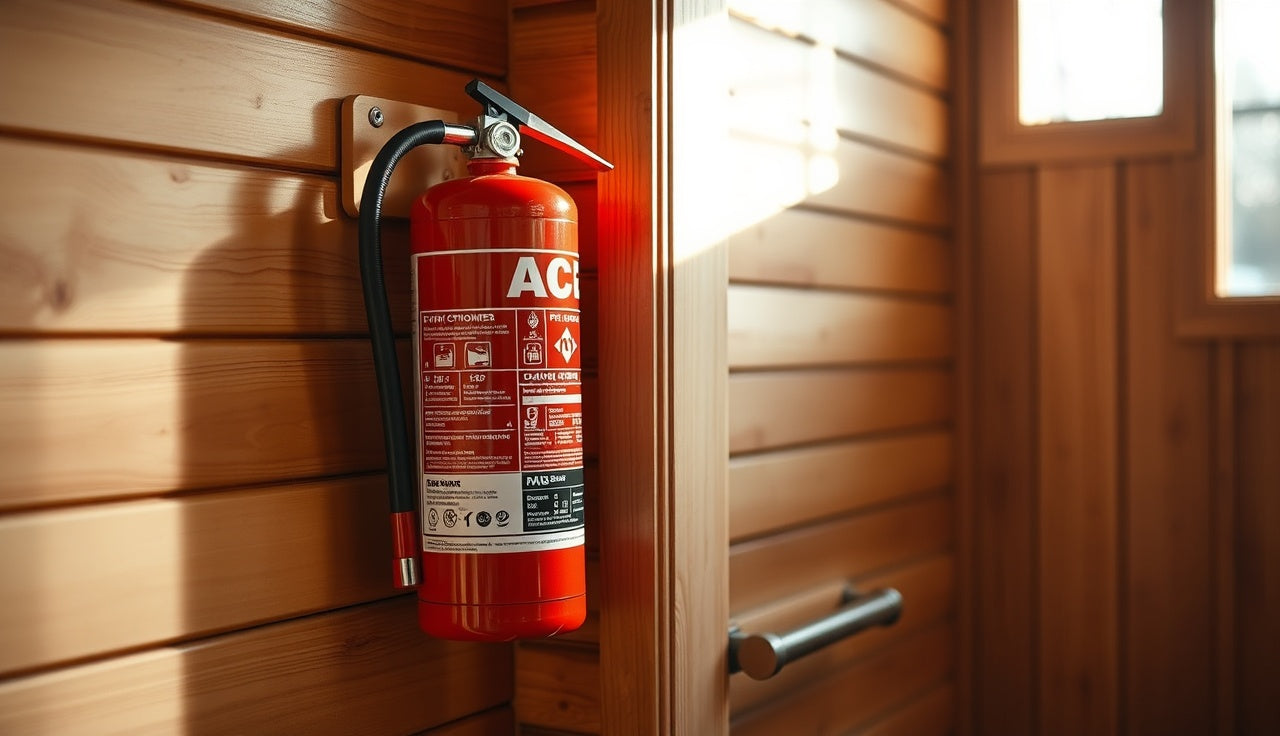
Mount it on the outside wall, within arm's reach of the sauna door, at a handle height of 3.5 to 5 feet. NFPA 10 caps the maximum travel distance to a Class A extinguisher in a light-hazard occupancy at 75 feet [4], but that is the code floor, not a target. Common sense puts it right beside the door.
Never mount the extinguisher inside the sauna. High heat and humidity chew through the pressure seal and the agent faster than normal service intervals account for. The unit also has to be reachable by someone who is not already inside the room and panicking.
An outdoor sauna needs a weatherproof cabinet rated for the extinguisher. Dry-chemical units shrug off temperature swings better than water-based ones, but moisture creeping in around the valve is a real failure mode. Put the cabinet on the exterior wall, shaded if you can manage it.
For a home sauna in a garage or basement, the bracket goes on the wall right next to the sauna door, not across the room by the main exit. You want to grab the extinguisher without putting the fire between you and the tool.
Label the spot. If guests or family use the sauna when you are not around, a simple printed sign pointing to the extinguisher can shave real seconds off the response.
Are there any codes or standards that specify sauna fire extinguisher requirements?
NFPA 10 is the primary U.S. standard for portable fire extinguisher selection, placement, and maintenance [4]. It has no dedicated sauna chapter, but saunas fall under its general occupancy classes. Most home saunas are light-hazard. Most commercial saunas are ordinary-hazard.
The International Fire Code (IFC), adopted in some version by most U.S. jurisdictions, points back to NFPA 10 for extinguisher rules and adds inspection duties for commercial facilities [5]. Your local fire marshal interprets all of it and gets the final word on your specific building.
Some states pile on extra rules. California requires annual inspection of portable extinguishers by a licensed servicing company at commercial properties [6]. Homeowners get held to a self-inspection standard instead: eyeball the pressure gauge monthly, confirm the pin is seated, and book a professional inspection once a year.
A building permit for a new sauna can trigger a fire-safety review. Pull a permit for an outdoor sauna or an interior build and the inspector may ask about extinguisher placement at final sign-off. Have the unit mounted and visible before the walk-through.
NFPA 10 spells out the mounting requirement plainly. Its section 6.1.3.2 states that portable fire extinguishers "shall be installed on the hanger or in the bracket supplied, mounted in a cabinet, or set on a shelf unless the extinguisher is of the wheeled type" [4]. That bracket line gets skipped in home setups all the time, and it is worth honoring.
Does a sauna need a fire extinguisher by law?
For a home sauna, no federal law forces you to have one. But plenty of local fire codes require it, and some homeowner insurance policies effectively push you toward one whether the code does or not.
For a commercial sauna in a gym, spa, or hotel, the answer is almost always yes. The IFC and local amendments require extinguishers in occupied commercial spaces, and a sauna room counts [5]. Skip it and you risk fines or a lost certificate of occupancy.
Even where no home code requires one, going without is a bad bet. A sauna fire can jump to adjacent framing in minutes. The NFPA reports that heating equipment (a category that includes sauna heaters) caused an estimated 14% of reported home fires over 2014 to 2018, with heating listed among the leading causes of home fire property damage [7]. An extinguisher costs $30 to $60. The math writes itself.
If you run a portable sauna, the risk profile shifts but does not vanish, especially with tent-style units and an external steam generator. Keep a small ABC extinguisher within reach during sessions no matter what any code says.
Can you use a CO2 extinguisher in a sauna instead of dry chemical?
You can, but you should not. A CO2 unit rated BC will handle an electrical fire at the heater, but it will not reliably kill a wood fire on the benches or walls. CO2 smothers by displacing oxygen instead of cooling the fuel, and dry wood re-ignites once the CO2 clears.
There is a nastier problem. Discharge CO2 in a tight sauna (many run under 50 square feet) and it strips oxygen out of the room fast. Anyone still inside faces suffocation on top of the fire. This is not hand-waving. Per OSHA, CO2 at concentrations of 10% or more can cause unconsciousness, and its Technical Manual notes that high concentrations "can lead to loss of consciousness and death" [8].
Dry chemical does not create that asphyxiation risk in a ventilated space. It is messier and hard on metal, but it is safer for the person in the room and better on the Class A wood fires a sauna is most likely to throw at you.
Clean-agent units (Halotron, FE-36) rated ABC sit in an expensive middle. They leave no residue, which helps if you want to save a nice heater, and they do not dump enough gas to displace oxygen at the volumes you would discharge. A 2.5 lb Halotron 1 unit runs $100 to $250 against $25 to $50 for comparable dry chemical. For most homeowners, dry chemical wins on price and performance.
How often should you inspect and replace a sauna fire extinguisher?
Check it yourself every 30 days and have a pro inspect it once a year. NFPA 10 sets both intervals [4]. The monthly check takes 60 seconds: confirm the pressure needle sits in the green zone, verify the safety pin is intact, and make sure the unit is mounted and unobstructed.
Dry-chemical units also need a 6-year internal maintenance check (empty, inspect, recharge) and a hydrostatic pressure test at 12 years [4]. Past those dates, replacing a standard 2.5 lb unit usually beats servicing it on cost.
Heat and humidity speed up decay. A unit near a steam source corrodes faster than one in climate-controlled air. Since your sauna extinguisher lives outside the room but often in a damp environment (bathhouse, pool deck, gym), check it more often than the 30-day minimum. Every two weeks is not overkill.
After any discharge, even a quick partial one, the unit needs a professional recharge or a replacement. A partially discharged extinguisher can bleed pressure and will not perform as rated the next time you reach for it.
What about wood-burning sauna stoves: do they change the fire extinguisher requirements?
Yes, and meaningfully. A wood-burning kiuas (the Finnish word for a wood-fired sauna stove) brings a continuous open flame and hot ash, which pushes the hazard up a notch. A stray ember catching the wall or floor is a live risk, especially in older builds where clearances have slipped.
NFPA 211 covers chimneys and solid-fuel appliances and sets clearance rules for wood-burning heaters [9]. A properly installed stove with correct clearances and a fire-rated hearth pad cuts ignition risk hard, but it does not zero it out.
For a wood-burning sauna, most fire safety practitioners want a 5 lb ABC dry-chemical unit minimum, mounted right outside the door. Some add a second smaller unit just inside the door, secured away from the heat, though keeping any extinguisher inside a wood-fired sauna fights the temperatures involved.
Ash handling matters as much as the extinguisher. Hot ash goes in a lidded metal bucket, full stop. Ash dumped in a combustible container or left on a wood floor is a classic ignition source. No extinguisher replaces sound fuel and ash discipline.
If you are weighing the whole sauna experience, the sauna benefits guide covers what regular sessions give you. Knowing both the payoff and the safety setup is part of owning one responsibly.
What else should be in your sauna fire safety setup beyond the extinguisher?
The extinguisher is one piece. A full setup adds a few cheap things people skip.
A smoke detector mounted outside the sauna door (not inside, where heat triggers constant false alarms) gives early warning before a fire grows. Interconnected alarms that sound through the whole house earn their extra cost. The U.S. Fire Administration advises smoke alarms on every level of the home and inside each bedroom [10].
A heat detector, which trips on a fast temperature rise rather than smoke, can sit closer to or inside the sauna for early ignition detection without the false-alarm headache. Commercial installs use these routinely.
Heater clearances are non-negotiable. Electric sauna heater makers specify minimum distances from combustible surfaces, often 4 to 6 inches at the top and sides, but always read your model's documentation [1]. Blown clearances are the most common cause of sauna fires.
Keep a clear path from the sauna to the nearest exit. In a home gym or basement, equipment piles up between the sauna and the door before you notice. That clutter turns dangerous the moment you need to get out fast.
At SweatDecks we field a lot of sauna-setup questions that go past heater specs and bench dimensions. The fire safety conversation is the one to settle before anything else gets bolted to a wall.
For how sauna types compare on general safety and installation, the sauna vs steam room breakdown covers the structural and heat differences that also shape fire risk.
What is the best overall fire extinguisher choice for a home sauna?
A 2.5 lb or 5 lb ABC dry-chemical extinguisher, mounted on the exterior wall right beside the sauna door, is the right answer for nearly every home sauna. It meets NFPA 10, it handles wood, electrical, and liquid fires, and it costs $25 to $60 at any hardware store.
Want a cleaner discharge for a nicer build? A 2.5 lb Halotron clean-agent unit rated ABC is a fair upgrade. It leaves no yellow powder on your heater rocks or cedar, and it is safer in a confined space. Budget $100 to $200 for a good one.
For a wood-burning sauna or a commercial install, step up to a 5 lb ABC unit at minimum, confirm your local AHJ requirements, and book annual professional maintenance.
The one move to avoid is skipping the extinguisher because the sauna feels too small to bother, or because you plan to be careful. Fires do not schedule themselves for convenient moments. A $40 extinguisher is the cheapest insurance you will ever buy for a sauna.
Frequently asked questions
Can I use a water fire extinguisher in a sauna?
No. A water (Class A only) extinguisher is dangerous near the electrical components of a sauna heater. Water conducts electricity and can cause electrocution or equipment damage. Use an ABC dry-chemical unit, which handles wood fires without the electrical hazard. Water extinguishers carry no Class C rating for energized electrical fires, which is exactly what you might face at a sauna heater.
Where exactly should I mount the fire extinguisher for an outdoor sauna?
On the exterior wall of the sauna, right beside the door, at a height of 3.5 to 5 feet. Use a weatherproof cabinet or bracket rated for outdoor use. Keep it shaded from direct sun when possible, since heat accelerates pressure loss. The unit should stay visible and reachable without entering the sauna. Check the pressure gauge monthly, especially after winter temperature swings.
Does a barrel sauna or pod sauna need a fire extinguisher?
Yes, especially with a wood-burning stove. A barrel sauna is an all-wood structure wrapped around an open fire source, a meaningful ignition hazard. Mount a 2.5 lb or 5 lb ABC extinguisher on the exterior, right outside the door. Local fire codes apply regardless of the sauna's shape. Many barrel sauna makers print a fire safety note in their manuals recommending exactly this.
Will the heat inside a sauna damage a fire extinguisher stored there?
Yes. Most dry-chemical extinguishers are rated for storage up to about 120°F, and sauna interiors hit 150°F to 195°F regularly. Storing a unit inside will degrade the pressure seal, which can cause slow pressure loss and a unit that fails when you need it. Always mount the extinguisher outside the sauna, within easy reach of the door.
How do I know what rating an ABC extinguisher has?
Read the label on the cylinder. The rating appears as a number-letter code such as '2-A:10-B:C'. The number before A indicates effectiveness on wood fires (higher is better). The number before B rates flammable-liquid capacity. The C confirms it is safe on electrical fires. For a home sauna, buy at minimum 1-A:10-B:C; 2-A:10-B:C or higher is better.
Does my homeowner's insurance require a fire extinguisher in my sauna?
Many policies do not require it outright, but some list it as a condition for insuring specialty structures or additions. More practically, missing basic fire safety equipment can hurt a claim if a fire happens. Check your policy's 'special structures' or 'outbuilding' rider. Some insurers offer a small premium discount for documented equipment. Call your agent before installation.
Is a 1 lb mini fire extinguisher enough for a small home sauna?
No. A 1 lb aerosol-style unit empties in roughly 8 seconds and does not meet the NFPA 10 minimum of 2-A:10-B:C for light-hazard occupancies. It might smother a tiny ignition if you catch it in the first seconds, but it is undersized for any real wood fire in a sauna. Buy at least a 2.5 lb unit. The price gap is small; the performance gap is large.
Do sauna manufacturers specify which fire extinguisher to use?
Most reputable manufacturers include a fire safety section in their installation documentation. They typically recommend an ABC dry-chemical extinguisher near the door and specify clearance distances from the heater to combustible surfaces. Follow both the manufacturer's guidance and your local fire code; where they differ, the stricter requirement wins. If your manual is silent on it, treat that as an oversight and follow NFPA 10.
What fire extinguisher is right for a sauna in a gym or spa?
Commercial spaces fall under NFPA 10's ordinary-hazard category, which usually requires a higher-rated unit (at least 2-A:10-B:C, often more) and may require multiple extinguishers based on floor area and travel distance. The IFC and local amendments apply. Have a licensed fire protection contractor assess the space and sign off on placement. Annual professional inspection is legally required in most states for commercial properties.
How much does a good fire extinguisher for a sauna cost?
A standard 2.5 lb ABC dry-chemical unit costs $25 to $45 at most hardware stores. A 5 lb version runs $35 to $65. A clean-agent (Halotron) unit in 2.5 lb size costs $100 to $200. A weatherproof outdoor cabinet adds $20 to $40. Annual professional inspection runs $15 to $30 per unit. First-year cost for a solid home setup lands around $60 to $120.
Can a dry-chemical extinguisher damage my sauna heater if discharged?
Yes. Monoammonium phosphate, the agent in most ABC dry-chemical units, is mildly acidic and corrosive to metal. If it hits a sauna heater or the rocks, clean it up promptly and thoroughly. Residue left on metal accelerates corrosion. It is a real trade-off, but the right one: put the fire out first, then clean. Clean-agent units like Halotron leave no residue and are worth considering for higher-end installations.
Do I need a fire extinguisher for a steam room as well?
Yes, for the same reasons, though the risk profile shifts. A steam room is usually tile and drywall rather than dry wood, which lowers the Class A fuel load, but the electrical steam generator is a Class C hazard. An ABC dry-chemical unit outside the steam room door fits. See the steam room guide for more on how steam rooms differ structurally from dry saunas.
Sources
- Finnleo (manufacturer) sauna heater installation and safety guidelines: Sauna operating temperatures of 150°F to 195°F and heater clearance requirements from combustible surfaces
- Kidde Fire Safety, portable extinguisher product specifications: Dry-chemical extinguisher storage temperature range of -65°F to 120°F
- National Fire Protection Association (NFPA): Monoammonium phosphate in ABC dry-chemical units is corrosive to metal and requires thorough post-discharge cleanup
- NFPA 10: Standard for Portable Fire Extinguishers: Minimum 2-A:10-B:C rating for light-hazard occupancies; 75-foot maximum travel distance; 30-day inspection and annual maintenance requirements; bracket mounting requirement section 6.1.3.2; 6-year internal maintenance and 12-year hydrostatic test intervals
- International Code Council, International Fire Code (IFC): IFC references NFPA 10 for portable extinguisher requirements and adds inspection obligations for commercial facilities
- California Office of the State Fire Marshal: California requires annual inspection of portable fire extinguishers by a licensed company for commercial properties
- NFPA research reports on home heating equipment fires: Heating equipment is a leading cause of home fires and property damage, accounting for roughly one in seven reported home fires in NFPA's 2014-2018 analysis
- OSHA Technical Manual, Section on Carbon Dioxide: High CO2 concentrations displace oxygen and can cause loss of consciousness and death
- NFPA 211: Standard for Chimneys, Fireplaces, Vents, and Solid Fuel-Burning Appliances: Sets clearance requirements for wood-burning and solid-fuel heating appliances including sauna stoves
- U.S. Fire Administration (FEMA), home smoke alarm guidance: USFA recommends smoke alarms on every level of the home and inside each sleeping room

Share:
Residential sauna fire safety requirements: what every owner needs to know
Sauna carbon monoxide detector placement: the complete guide