
Last updated 2026-07-11
TL;DR
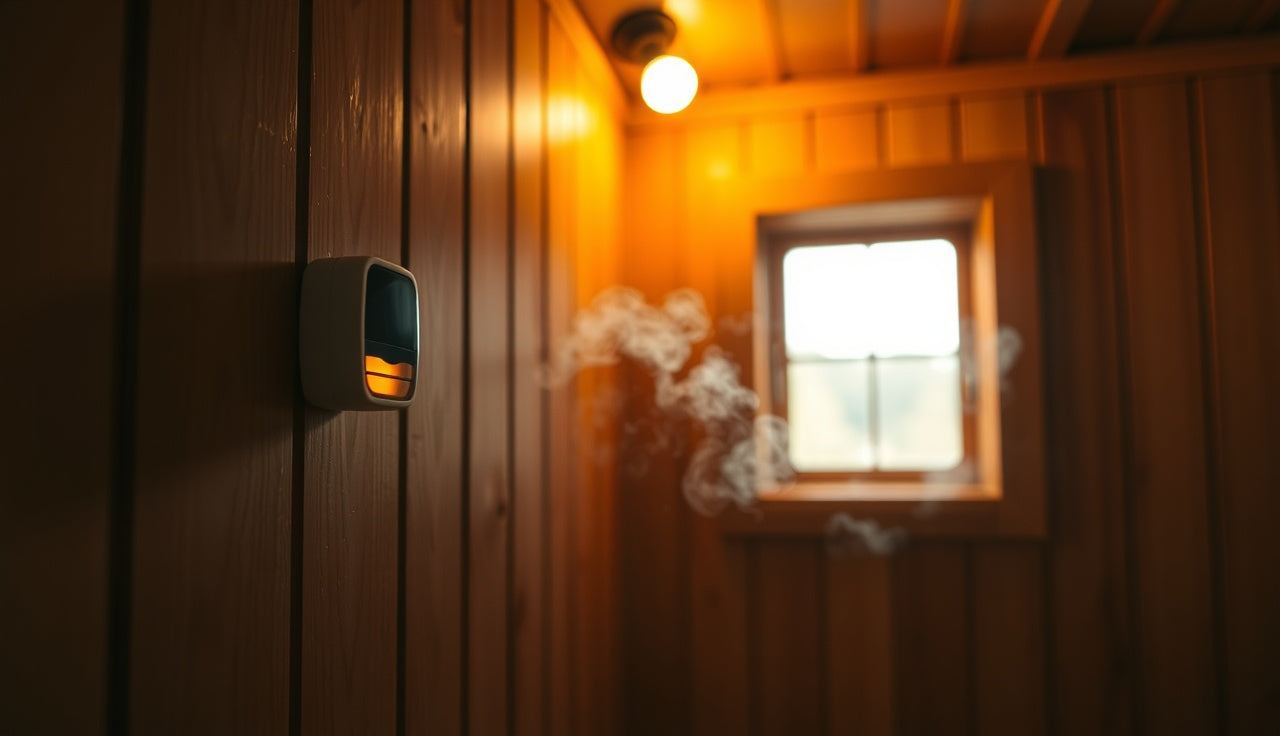
Most household CO detectors are rated only to 90-100°F and will fail or alarm falsely inside a sauna. Mount a high-temperature CO sensor on the wall 5 feet above the floor, away from direct heater blast. For wood-burning saunas this is essential safety gear. For electric saunas it is still worth having if the unit is enclosed or has poor ventilation.
Do you actually need a CO detector in a sauna?
The short answer is: yes, if your sauna uses any kind of combustion. Wood-burning sauna stoves, wood-fired barrel saunas, gas-heated saunas, and saunas with propane backup heaters all produce carbon monoxide. CO is colorless and odorless, and it accumulates fastest in small, well-sealed rooms exactly like a sauna.
The Consumer Product Safety Commission reports that CO poisoning kills roughly 400 people per year in the United States, with non-fire-related CO exposure accounting for the largest share of those deaths [1]. Enclosed combustion in a small structure is one of the highest-risk scenarios they flag.
Electric saunas do not produce CO from the heater itself. But if your electric sauna is inside a garage, an outbuilding, or any space that shares air with a combustion source (cars, generators, gas appliances), CO can migrate in. A detector is cheap insurance in those situations.
Steam saunas and infrared cabins running on electricity have essentially no CO pathway, assuming they are not inside a space with outside combustion. For those setups, a CO detector is optional but does not hurt anything.
Why do standard CO detectors fail inside a sauna?
This is the part most people miss. Conventional household CO detectors are tested and rated to operate between roughly 40°F and 100°F (4°C to 38°C) [2]. Traditional Finnish saunas run 160°F to 195°F (70°C to 90°C). Even a mild sauna session runs well above the maximum rated temperature for any standard detector you buy at a hardware store.
At those temperatures, two bad things happen. First, the electrochemical sensor cell that detects CO can give false alarms or, worse, stop responding entirely. The sensor is calibrated at room temperature; heat changes its baseline chemistry. Second, the plastic housing and circuit board face accelerated degradation that shortens the device's usable life dramatically.
The UL 2034 standard governs residential CO alarms in the United States [3]. It covers alarms for residential use at normal indoor temperatures. There is no UL listing specifically for high-temperature sauna environments, which means no off-the-shelf residential CO detector is certified for sauna use. You need an industrial or specialty sensor rated for the actual temperatures your sauna reaches.
For wood-burning saunas specifically, you also need to think about smoke and combustion gases beyond CO alone. A combination CO and smoke detector designed for high temperatures covers more of the risk profile, though again, you need a unit rated for the environment.
What temperature rating do you need for a sauna CO detector?
For a traditional Finnish-style sauna, you need a sensor rated to at least 200°F (93°C), and ideally 220°F to 250°F (105°C to 121°C) if you ever run the stove hot or if the sensor will sit near the ceiling where temperatures are highest.
For a lower-temperature sauna, like an infrared cabin that runs 120°F to 140°F, you have more options. Some commercial-grade electrochemical CO sensors are rated to 140°F (60°C) and would work in that environment.
Industrial CO sensors for mining, boiler rooms, and marine applications often carry ratings of 140°F to 230°F depending on the manufacturer. These are sold through industrial safety suppliers rather than home improvement stores. They are more expensive (often $80-$300+ depending on the unit and whether it has a digital readout), but they will actually work.
One specific product category to look for: fixed-point gas detectors with electrochemical cells rated for high-temperature operation. These are the same type used in industrial kitchens and boiler rooms. They require 120V wiring or a hardwired low-voltage loop, so factor in installation cost if you are not doing it yourself.
| Sauna type | Typical temp range | Minimum sensor rating needed |
|---|---|---|
| Traditional Finnish (wood or electric) | 160-195°F (70-90°C) | 200°F (93°C) minimum |
| Infrared cabin | 120-145°F (49-63°C) | 150°F (66°C) minimum |
| Steam room | 100-120°F (38-49°C) | Standard rated to 100°F may just work, but verify |
| Outdoor barrel sauna (wood-fired) | 160-200°F (70-93°C) | 220°F (104°C) preferred |
| Garage-adjacent electric sauna | 160-195°F (70-90°C) | 200°F (93°C) for inside; standard unit outside the sauna door |
Where exactly should you mount a CO detector in a sauna?
CO is slightly lighter than air (molecular weight of 28 vs. air at about 29), so it distributes fairly evenly in a room rather than pooling at the floor or ceiling the way propane or natural gas do [4]. That means placement height is less critical for CO than for other gases, but it is still not irrelevant.
The recommended placement for a sauna CO detector is on the wall, 4 to 5 feet above the floor (roughly breathing height when seated on the lower bench). This puts it where you would actually inhale the air. It also keeps it away from the ceiling zone, which runs hotter and would stress any sensor more.
Avoid mounting directly above or immediately beside the heater. The blast of radiant heat will elevate the sensor's local temperature above the rated maximum faster than the room average, and it shortens sensor life. Give the heater at least 18 to 24 inches of clearance.
If you have a wood-burning stove, do not mount the sensor behind it or in a corner that traps smoke before it circulates. You want the sensor in the breathing zone of the main seating area.
For outdoor barrel saunas, consider a second sensor or alarm head just outside the sauna door if the barrel has poor draft and you want early warning before you go in. That outside unit can be a standard residential CO alarm because it stays at ambient temperature.
The NFPA 720 standard (which covers CO detection in residential buildings) recommends installing CO alarms outside each sleeping area and on every level of a home [5]. Saunas are not residential sleeping areas, so NFPA 720 does not directly govern sauna placement. But the principle, put the alarm where people actually breathe, applies exactly the same way.
What CO level is dangerous and how fast does it build in an enclosed sauna?
OSHA sets the permissible exposure limit (PEL) for CO at 50 parts per million (ppm) as an 8-hour time-weighted average [6]. NIOSH sets a ceiling of 200 ppm for short-term exposure and considers 1,200 ppm immediately dangerous to life and health (IDLH) [11]. The UL 2034 standard requires residential alarms to activate within 15 minutes at 400 ppm, within 4 minutes at 150 ppm (if prolonged), and not alarm at all below 30 ppm to reduce nuisance trips [3].
In an enclosed wood-burning sauna with poor draft, CO can climb to dangerous levels faster than you expect. A case report in the Scandinavian Journal of Work, Environment & Health documented CO poisoning in sauna users from a malfunctioning wood stove, where levels reached symptomatic exposure ranges within a single session [7]. The sealed, insulated environment that makes a sauna thermally efficient also makes it an efficient trap for combustion gases.
Symptoms of mild CO poisoning (headache, dizziness, nausea) overlap with normal sauna effects. That is the real danger: you might read early CO poisoning as just being too hot and stay in rather than getting out. A detector removes that ambiguity entirely.
The alarm threshold matters too. Industrial CO detectors often let you set a low alarm (say 25-50 ppm) and a high alarm (100-200 ppm). For a sauna, a low alarm at 35 ppm makes sense given that you are already in a physiologically stressed state from heat. Do not wait for a 400 ppm alarm.
| UL 2034: no-alarm zone (below 30 ppm) | 30 |
| OSHA 8-hr permissible limit (50 ppm) | 50 |
| NIOSH short-term ceiling (200 ppm) | 200 |
| UL 2034: alarm within 15 min (400 ppm) | 400 |
| NIOSH immediately dangerous (1,200 ppm) | 1,200 |
Source: UL 2034, OSHA, NIOSH (citations 2, 6, 11)
Does sauna humidity affect CO detector accuracy?
Yes, and this is another reason standard household units fail in saunas. Traditional Finnish saunas pour water on the rocks to create bursts of steam, with relative humidity swinging from 10% to 30% normally and spiking to 100% for moments when löyly is thrown [8]. Electrochemical CO sensors are sensitive to humidity because the sensor electrolyte can absorb or lose water, shifting the baseline reading.
Industrial-grade sensors designed for high-humidity environments (rated to 90-95% RH, non-condensing) handle sauna conditions better than consumer-grade units. If your sauna is a steam room or you throw a lot of water, check the humidity rating in the product spec sheet, more than the temperature rating. Both matter.
Some high-temperature CO sensors use metal oxide semiconductor (MOS) technology instead of electrochemical cells. MOS sensors are generally more tolerant of temperature and humidity extremes but can be less accurate at low CO concentrations and are more prone to cross-sensitivity with other combustion gases (like alcohol vapor). For a sauna application where you want a reliable alarm, look for sensors that spec both good high-temperature tolerance and low cross-sensitivity.
What about CO detectors for outdoor saunas and barrel saunas?
Outdoor barrel saunas are usually wood-fired, which makes CO risk higher, and they are often less airtight than an indoor sauna room, which provides some natural dilution. But "some dilution" is not the same as "safe." A barrel sauna with a tight door, small ventilation gap, and a green wood fire is a real CO risk.
For an outdoor barrel sauna, the most practical setup is a high-temperature CO sensor inside the barrel (rated 200°F+, wall-mounted at bench height) paired with a wireless alarm transmitter that triggers an audible alarm outside. Some industrial sensors include a relay output that can trigger an external sounder.
If wiring a sensor inside the barrel is not practical, at minimum keep a standard battery-powered CO alarm just outside the door and check it before every session. This does not protect you from a CO spike while you are inside, but it tells you if the previous session built up CO that has not cleared.
For a home sauna built into a garage or basement, the risk profile changes. Attached garages are already a major source of residential CO events; a sauna that shares that air is a compounding risk. In that case, install a high-temperature sensor inside the sauna room and a standard residential CO alarm in the garage proper, per your local code.
If you are shopping for or already own an outdoor sauna, the combustion type is the single biggest variable in whether you need active CO monitoring.
Are there building codes that require CO detectors in saunas?
There is no federal building code in the United States that specifically mandates CO detectors inside sauna rooms. Building codes are adopted and enforced at the state and local level, and requirements vary significantly.
The International Residential Code (IRC) requires CO alarms in all new dwelling units and in dwelling units undergoing alterations or repairs if the dwelling has fuel-burning appliances, attached garages, or fuel-burning heating systems [9]. The IRC's scope is the dwelling unit, not a specific room. Whether a sauna addition or outbuilding triggers an IRC CO requirement depends on how your local jurisdiction interprets the code and what work permit you pull.
Many states have adopted versions of the IRC with amendments. California's Title 24, for example, requires CO detectors in all new dwellings with attached garages or internal combustion sources [10]. If your sauna is a permitted addition with a wood-burning stove, a California building inspector may well require CO detection.
The practical advice: check with your local building department before installation, especially if you are pulling a permit for a new sauna. Even where it is not legally required, a high-temperature CO sensor inside a wood-burning sauna is the correct move. The cost of the sensor is trivial compared to the risk of not having one.
Some home insurance policies also have language about fuel-burning appliances and required safety devices. Worth a quick call to your insurer, especially for a wood-burning portable sauna or a barrel sauna on your property.
How do you install and maintain a high-temperature CO detector in a sauna?
Most industrial CO sensor heads are hardwired. They run on 12V or 24V DC (from a central control panel) or directly on 120V AC. If you are comfortable with electrical work, adding a conduit run to a wall-mounted sensor head is straightforward. If not, hire an electrician. Running live wiring into a high-temperature, high-humidity environment requires using the right wire gauge, the right conduit (or listed high-temp cable), and appropriate weatherproof or damp-location boxes even inside a sauna.
Sensor placement mechanics: mount the sensor head on the wall at 4-5 feet. Use the screws or mounting bracket that comes with the unit. Keep the sensor face clear of direct water splash if you pour water on rocks near the sensor location.
Maintenance is where people drop the ball. Electrochemical CO sensor cells have a finite life, typically 2 to 5 years depending on operating temperature (heat ages them faster). Many industrial units display a fault code or low-sensor warning when the cell degrades. Know your sensor's replacement schedule and set a calendar reminder.
Test the sensor per the manufacturer's instructions. For most electrochemical sensors, the test button only confirms the alarm circuit works, not that the sensor cell is still chemically active. A bump test with calibration gas (a small spray can of known CO concentration) is the only way to confirm the sensor actually responds to CO. Industrial safety supply companies sell small bump-test kits. Do this at least once a year.
SweatDecks carries a range of sauna accessories and safety equipment. When planning your sauna setup, factor in safety devices alongside the heater and benches, not as an afterthought.
Replace the sensor cell or the entire unit on schedule. A CO sensor that is past its service life but shows no obvious signs of failure is worse than no detector, because it gives false confidence.
Can you use a combination smoke and CO detector in a sauna?
Combination units are appealing because a wood-burning sauna has both smoke and CO risk. The problem is that smoke detectors have their own temperature and humidity limits, and most are even more restrictive than CO sensors. Ionization smoke detectors are generally rated to 100°F (38°C). Photoelectric units may have slightly higher ratings but still top out well below sauna temperatures.
High-temperature combination smoke and CO detectors do exist, primarily in industrial and marine categories. A marine-rated combination detector (designed for engine rooms) might handle 140°F to 160°F, which covers low-temperature sauna use but not a hot Finnish sauna. Check the specifications carefully.
For a traditional hot sauna with a wood stove, the most reliable approach is a dedicated high-temperature CO sensor for inside the sauna room, plus a standard smoke/CO detector just outside the sauna door in the changing room or anteroom (where temperatures are normal). The outside unit catches any smoke that escapes through the door and doubles as a backup CO alarm if the inside sensor has any issue.
If you want one device to do both jobs inside a hot sauna, you currently have limited options that are properly rated. The technology is more mature in marine safety than in sauna-specific consumer products.
What are the biggest mistakes people make with sauna CO detection?
The most common mistake is installing a standard big-box-store CO alarm inside the sauna room. It fails silently from heat, you think you are protected, and you are not. The second most common mistake is putting the detector too close to the ceiling, where temperatures in a hot sauna can run 30 to 50 degrees higher than bench height, accelerating sensor degradation.
A third mistake is relying on ventilation alone. Traditional sauna design does include ventilation (a low intake vent and a high exhaust vent), and good draft from a wood stove helps exhaust combustion gases. But ventilation is not a substitute for a detector. A flue damper accidentally closed, green wood causing incomplete combustion, a chimney bird nest blocking draft, any of these can spike CO faster than ventilation can clear it.
Forgetting to maintain the sensor is the last big one. A CO detector with a 3-year-old electrochemical cell in a hot sauna has probably degraded significantly. If you cannot remember when you installed it, replace it.
If you have a wood sauna stove or any combustion heat source, treat CO detection with the same seriousness as the electrical panel or the chimney inspection. It is not a set-and-forget item.
Frequently asked questions
Can I use a regular home CO detector inside my sauna?
No. Standard residential CO detectors are rated to about 90-100°F (38°C) per UL 2034 testing conditions. Traditional saunas run 160-195°F. A regular unit will fail, give false alarms, or simply stop working in that heat. You need an industrial-grade sensor rated to at least 200°F for a hot sauna environment.
Where is the best place to mount a CO detector in a sauna room?
Mount it on the wall at 4 to 5 feet above the floor, roughly seated breathing height, in the main seating area. Keep it at least 18-24 inches away from the heater to avoid localized heat stress on the sensor. Avoid the ceiling, where temperatures peak. The goal is to monitor the air where occupants actually breathe.
Do electric saunas produce carbon monoxide?
Electric sauna heaters do not produce CO. But if your electric sauna is inside a garage, basement, or any structure that shares air with combustion sources (cars, generators, gas appliances), CO can still enter the sauna. A detector inside or just outside the sauna room is still worthwhile in those situations.
What CO level should my sauna detector alarm at?
Industrial sensors often let you set a low alarm (25-50 ppm) and a high alarm (100-200 ppm). For a sauna, setting the low alarm at 35 ppm makes sense because heat stress and CO poisoning share early symptoms (dizziness, nausea), making it harder to self-diagnose. You want early warning, not a high-concentration alarm when you are already impaired.
How often should I replace the CO sensor in my sauna?
Electrochemical CO sensor cells typically last 2 to 5 years under normal conditions, but high operating temperatures accelerate aging. A sensor running at 170-190°F regularly may degrade at the low end of that range. Check the manufacturer's rated life, set a calendar reminder, and do an annual bump test with calibration gas to confirm the cell still responds to CO.
Does building code require a CO detector in a sauna?
No federal code specifically mandates CO detectors inside sauna rooms. State and local codes vary. The International Residential Code requires CO alarms in dwellings with fuel-burning appliances, which could apply to a sauna addition depending on local interpretation and whether you pull a permit. Check with your local building department before installing a wood-burning sauna.
Can I use a combination smoke and CO detector inside a hot sauna?
Most combination units are not rated for sauna temperatures. Ionization smoke detectors typically max out at 100°F. Some marine-grade combination units handle up to 140-160°F. For a hot traditional sauna, the better approach is a high-temperature CO sensor inside and a standard combination smoke/CO alarm just outside the sauna door in the changing area.
How does sauna humidity affect CO detector performance?
Humidity swings in a traditional sauna, especially from throwing water on rocks, can push relative humidity to 100% briefly. Electrochemical CO sensors absorb or lose water from their electrolyte in high humidity, which can shift the baseline reading. Look for sensors rated to 90-95% RH non-condensing and consider metal oxide semiconductor sensors if humidity is your primary concern.
Do I need a CO detector in an outdoor barrel sauna?
Yes, if it is wood-fired. Outdoor barrel saunas are typically well-sealed for thermal efficiency, and a wood stove with poor draft or green wood can produce significant CO. Mount a high-temperature sensor (200°F+) inside at bench height. Pair it with a wireless sounder outside so the alarm is audible if you are going to and from the sauna.
What is the difference between a CO detector and a CO monitor for a sauna?
A CO detector alarms when CO crosses a set threshold. A CO monitor displays a continuous ppm reading, often with both a visual readout and an alarm. For a sauna, a monitor with a digital display is more useful: you can glance at the reading before and during a session. Industrial fixed-point gas monitors do both jobs and are the right category to shop.
Can ventilation replace a CO detector in a wood-burning sauna?
No. Traditional sauna design includes intake and exhaust vents, and a good chimney draft helps clear combustion gases. But blocked flues, closed dampers, poor-quality wood, and chimney obstructions can spike CO faster than any passive ventilation can clear it. Ventilation reduces baseline risk but does not replace active monitoring.
How is a sauna CO detector different from what I need for a steam room?
Steam rooms run 100-120°F with very high humidity, close to the operational limit of some higher-rated residential CO alarms. If the steam room uses an electric steam generator with no combustion source, CO risk is low, and a standard humidity-resistant CO alarm just outside the room may suffice. For any combustion-heated steam room, the same high-temperature industrial sensor rules apply.
Sources
- U.S. Consumer Product Safety Commission, Carbon Monoxide Questions and Answers: CO poisoning kills roughly 400 people per year in the U.S. from non-fire-related causes, with enclosed combustion in small structures flagged as high-risk
- Underwriters Laboratories, UL 2034 Standard for Single and Multiple Station Carbon Monoxide Alarms: Standard residential CO alarms are rated to operate between approximately 40°F and 100°F (4°C to 38°C)
- Underwriters Laboratories, UL 2034 alarm activation thresholds: UL 2034 requires residential CO alarms to activate within 15 minutes at 400 ppm, within 4 minutes at 150 ppm, and not alarm below 30 ppm
- U.S. Centers for Disease Control and Prevention, Carbon Monoxide Poisoning Prevention: CO has a molecular weight of 28, close to air at 29, so it distributes relatively evenly in a room rather than pooling at floor or ceiling
- National Fire Protection Association, NFPA 720 Standard for the Installation of Carbon Monoxide Detection and Warning Equipment: NFPA 720 recommends CO alarms outside each sleeping area and on every level of a residence
- U.S. Occupational Safety and Health Administration, Carbon Monoxide permissible exposure limit: OSHA sets the CO permissible exposure limit at 50 ppm as an 8-hour time-weighted average
- Scandinavian Journal of Work, Environment & Health, case series on CO poisoning in sauna users: CO levels in an enclosed sauna with a malfunctioning wood stove reached symptomatic exposure ranges within a single session
- Finnish Sauna Society, Sauna traditions and technical guidelines: Traditional Finnish saunas run 70-90°C (160-195°F) with relative humidity swinging from approximately 10-30% baseline, spiking to near 100% when water is thrown on the rocks
- International Code Council, International Residential Code Section R315, Carbon Monoxide Alarms: IRC Section R315 requires CO alarms in new dwelling units and units undergoing alterations with fuel-burning appliances or attached garages
- California Department of Housing and Community Development, Title 24 Carbon Monoxide Requirements: California Title 24 requires CO detectors in all new dwellings with attached garages or internal combustion sources
- National Institute for Occupational Safety and Health, CO Immediately Dangerous to Life and Health values: NIOSH sets a ceiling of 200 ppm for short-term CO exposure and classifies 1,200 ppm as immediately dangerous to life and health

Share:
What type of fire extinguisher should you use in a sauna?
Sauna smoke detectors: why you need a heat-activated type