
Last updated 2026-07-09
TL;DR
A sauna cold plunge combo alternates hot sauna sessions (170-195°F) with cold water immersion (50-59°F). The practice is called contrast therapy, and it has centuries of use behind it. Research shows it may reduce muscle soreness and support recovery. A basic home setup runs $3,000-$12,000. Most people do 2-4 rounds of 10-15 minutes hot, then 2-3 minutes cold.
What is a sauna cold plunge combo and how does it work?
A sauna cold plunge combo is what it sounds like. You alternate between a hot sauna and a cold plunge tub, usually doing several rounds back to back. The practice has a proper name, contrast therapy, and it goes back centuries. Finnish sauna culture, Russian banya tradition, and Scandinavian winter bathing all run some version of it.
The mechanism is simple. Heat causes vasodilation: blood vessels open, heart rate rises, skin temperature climbs, and blood gets pushed toward the surface. Cold does the reverse, vasoconstriction, pulling blood back toward your core. Going back and forth creates what researchers sometimes call a "vascular pump" effect, where blood gets flushed repeatedly through your muscles and organs [1].
This is a different animal than sitting in a sauna alone or doing a cold plunge alone. Run them in sequence and the physiological response shifts in ways neither one produces by itself. The thermal contrast is the whole point.
The sauna side is most often a traditional Finnish dry sauna, electric or wood-fired. Infrared saunas, steam rooms, and even hot tubs get used in contrast protocols too. The cold side can be a dedicated plunge tub, a chest freezer conversion, a big stock tank, or just a cold shower if you are starting out.
What does the research actually say about contrast therapy benefits?
The research is real but messier than the wellness industry lets on. Muscle recovery has the strongest evidence. A 2022 systematic review and meta-analysis in the British Journal of Sports Medicine analyzed 32 randomized controlled trials and found cold water immersion beat passive rest for reducing delayed-onset muscle soreness in the 24-96 hours after exercise [2]. Contrast water therapy, the alternating hot and cold approach, showed similar benefits.
That same review flagged the effect sizes as moderate, not dramatic. Cold water immersion lowered soreness ratings. Nobody should expect to train twice as hard because they own a plunge tub. The researchers also warned that frequent cold immersion right after strength training might blunt some muscle growth, because the inflammatory response cold suppresses is part of how muscles rebuild. If size is your main goal, plunging straight after lifting may work against you [3].
Cardiovascular data is promising but preliminary. Regular sauna use was linked to lower cardiovascular mortality in a large Finnish cohort study (Laukkanen et al., 2018, JAMA Internal Medicine): men who used a sauna 4-7 times per week had a 50% lower risk of fatal cardiovascular events than once-a-week users [4]. That study looks at sauna alone, not the combo, and it is observational, so it cannot prove cause.
On mood, a 2023 study in Biology found a single contrast therapy session lowered anxiety scores and improved mood, though the sample was small [5]. The cold piece drives a noticeable norepinephrine spike, which several labs have discussed, though most of that specific mechanism work in humans is still early.
Recovery from hard training is the best-supported use. Cardiovascular and mood benefits from regular sauna hold up well. The contrast piece specifically still needs more controlled work.
What temperature and time should you use for a sauna cold plunge protocol?
Here is where you find a pile of confident advice sitting on very little agreement. What the evidence and common practice suggest:
Traditional Finnish saunas run 170-195°F (77-90°C) at bench level. Infrared saunas run cooler, usually 120-150°F (49-65°C), and work differently because they heat your body directly instead of heating the air. Most studied contrast protocols used traditional sauna temperatures.
For the plunge, cold water immersion recovery studies most often use 50°F to 59°F (10-15°C) [2]. Below 50°F feels intense and carries more risk for beginners. Above 60°F starts to weaken the vasoconstrictive effect in a way you can measure.
A protocol structure used across several studies looks like this:
| Phase | Temperature | Duration | Rounds |
|---|---|---|---|
| Sauna (heat) | 170-195°F (77-90°C) | 10-15 min | 2-4 |
| Cold plunge | 50-59°F (10-15°C) | 2-3 min | 2-4 |
| Rest between rounds | Room temp | 5-10 min | Optional |
Start with 2-3 rounds and work up to 4. The rest phase between hot and cold is optional, but it gives your cardiovascular system a moment to settle. Some protocols skip it and go straight from hot to cold.
Beginners should start with shorter cold exposures (60-90 seconds) and warmer water (58-62°F) before working down. There is no award for suffering faster than your body adapts.
End on cold if recovery is the goal. Ending on heat may soften the post-exercise inflammatory dampening you are after. If relaxation is the goal, ending on heat is fine.
| 1x per week (baseline) | 0% |
| 2-3x per week | 24% |
| 4-7x per week | 50% |
Source: JAMA Internal Medicine, Laukkanen et al., 2018
How much does a home sauna cold plunge combo cost?
Cost swings a lot depending on the sauna you buy, the plunge unit you choose, and whether you need any structural work. A realistic breakdown:
On the sauna side:
- A portable sauna (pop-up or barrel tent style) runs $200-$800. Not great for contrast therapy because it is hard to pair with a separate plunge.
- A prefab indoor or outdoor sauna (2-person barrel or cabin) with an electric heater runs $2,500-$8,000 installed.
- A custom-built room sauna runs $8,000-$30,000 or more, depending on size and materials.
On the cold plunge side:
- A stock tank or chest freezer conversion costs $400-$1,200 in parts and time.
- A mid-range dedicated plunge tub with a chiller runs $2,000-$5,000.
- High-end units with precise temperature control and filtration run $5,000-$15,000.
For a home setup that actually works well, most people spend $5,000-$12,000 total. That is a real number, not a lowball. You can go cheaper with a stock tank and a used barrel sauna, and some people land at $3,000-$4,500.
Electricity is an ongoing cost. A standard 6kW sauna heater running one hour uses about 6 kWh. At the US average residential rate of roughly $0.16/kWh (EIA, 2024), that is about $0.96 per session [6]. Chillers are the bigger draw, often pulling 500-1,500 watts continuously to hold temperature.
Electrical work (240V circuits for the heater and possibly the chiller) typically adds $300-$800, depending on your panel and location.
What are the best sauna types to pair with a cold plunge?
Traditional Finnish dry saunas are the strongest match. They get hot enough (170-195°F) to produce the deep tissue warming and cardiovascular response that makes the contrast with cold water mean something. You can get that as a home sauna barrel, an outdoor cabin, or an indoor room build.
Infrared saunas work too, with a tradeoff you should understand. They run at lower air temperatures (120-150°F), so the ambient heat feels different. The claimed edge is deeper tissue penetration from infrared wavelengths, though the evidence for that specific claim in contrast therapy is thin. Already own an infrared sauna and like it? Pair it with a plunge and don't overthink it. Just know the protocol may need tweaking since you may not sweat as hard.
Steam rooms (100% humidity, around 110-120°F) are a third option. They feel brutally hot even at lower temperatures because humidity blocks evaporative cooling. Some banya traditions lean on steam rooms, with birch branch beating (venik) to stir up circulation before the plunge. If that sounds appealing, the sauna vs steam room comparison is worth reading first.
On the cold side, a purpose-built plunge with a chiller stays the most consistent because it holds temperature precisely without you hauling ice. A well-insulated stock tank with ice added before each session is genuinely functional, and it is what most people start with.
Is a sauna cold plunge combo safe, and who should avoid it?
For most healthy adults, contrast therapy is safe when you practice it sensibly. The main risks are orthostatic hypotension (blood pressure dropping when you stand up after the plunge), cardiac stress from fast temperature swings, and cold shock in the first seconds of immersion.
The American Heart Association has not issued specific guidance on home contrast therapy protocols. Its general guidance advises caution with sauna for people with unstable angina, recent heart attack, or poorly controlled blood pressure [7]. Cold water immersion carries its own cardiac stress, especially in the first 30 seconds, when the cold shock response can trigger an involuntary gasp and a heart rate spike.
Groups who should talk to a doctor first:
- Anyone with a history of cardiovascular disease, arrhythmia, or hypertension
- People who are pregnant
- Anyone on blood pressure medications that affect vascular response
- People with Raynaud's phenomenon or other circulation disorders
Safety rules everyone should follow:
- Never use the sauna or plunge alone if you are a beginner
- No alcohol before or during a session
- Hydrate first. 16-20 oz of water is a reasonable baseline
- Get out of the plunge slowly and sit on the edge before standing
- Do not push through feeling faint or nauseated
The Finns have a phrase worth knowing: "sauna is the poor man's pharmacy." It captures how ordinary this practice is in daily life, not some extreme sport. Treated that way, most healthy people find the risks very manageable.
How do you set up a sauna and cold plunge at home?
Layout matters more than people expect. You want hot and cold close together, ideally within 30-60 seconds of walking. Crossing a yard or climbing stairs between rounds is annoying enough that plenty of people just stop doing contrast therapy.
Indoor setups: A bathroom or utility room with room for a 2-person sauna cabinet and a plunge tub (roughly 6x8 feet minimum, with clearance) works well. Plan the drain. Plunge tubs need a drain path, and if you rinse between rounds, that water needs somewhere to go.
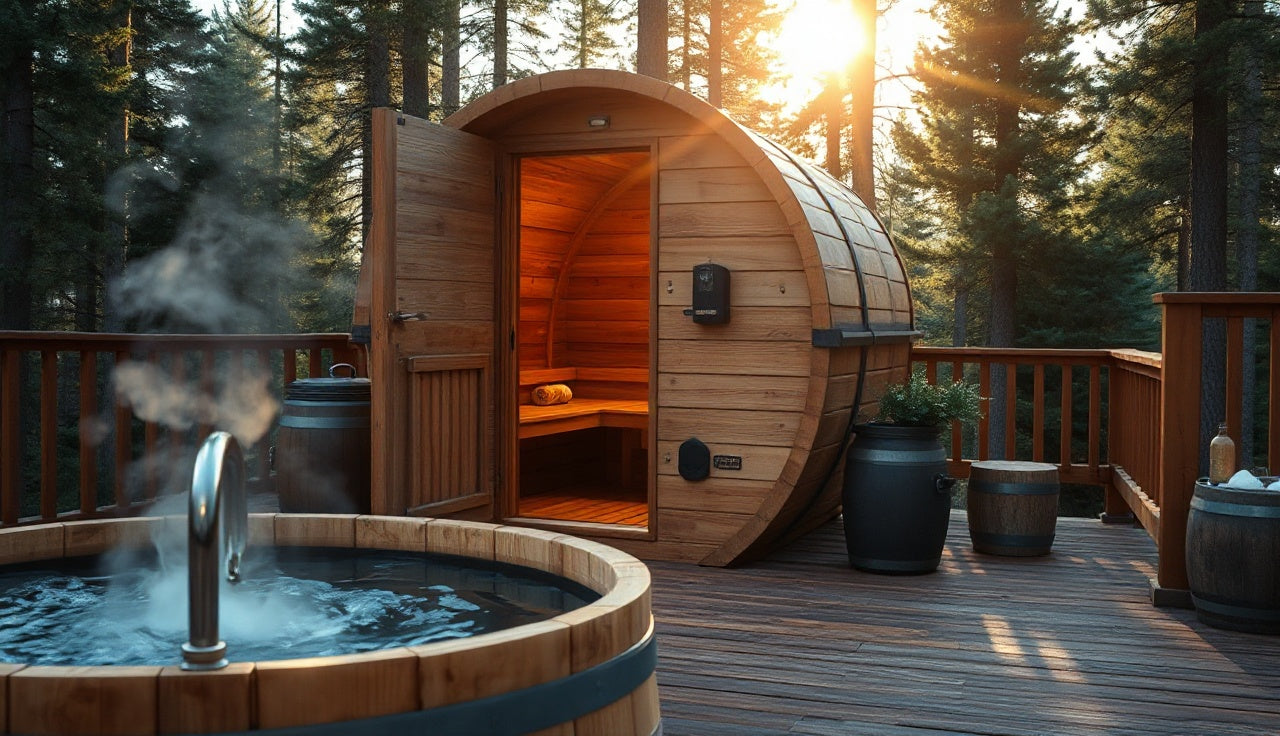
Outdoor setups: A deck, patio, or backyard is the most popular option for home installs. Put an outdoor sauna cabin next to a plunge tub, add a privacy screen or pergola, and you get a genuinely pleasant space. Many people prefer outdoor contrast therapy for the air and light between rounds.
Electrical requirements: A typical 6kW sauna heater needs a 240V/30A dedicated circuit. Larger heaters need 240V/40-60A. Chillers vary. Smaller ones run on 110V, larger ones need 240V. Budget for an electrician and check your panel capacity before you buy.
Water and drainage: The plunge needs filling (a garden hose works) and draining periodically. With a chiller and proper filtration, water changes run about every 4-6 weeks. Without filtration, change it more often.
If you are researching an outdoor build, the outdoor sauna guide covers placement, permits, and electrical in more detail. Sweat Decks also carries combo-friendly plunge and sauna pairings if you want to see a matched setup before you start measuring your yard.
Permitting: In most US jurisdictions, a prefab outdoor sauna skips a building permit if it sits below a certain square footage threshold (often 120-200 sq ft, but this varies by municipality). Electrical work almost always requires a permit and inspection. Check your local building department before you start [8].
What is the banya tradition and how does it compare to a modern cold plunge combo?
The banya is Russia's answer to the Finnish sauna, and its contrast therapy tradition runs older and more elaborate than most people realize. A traditional Russian banya uses a high-humidity steam room (parnya) heated with stones, where water mixed with herbs or beer gets poured over the hot rocks to create dense steam bursts called "pary."
After sweating, banya users plunge into a cold pool, jump into a river or lake, or roll in snow. The ritual also involves beating the body with bundles of leafy branches (venik), usually birch, oak, or eucalyptus, which is thought to open the pores and stir up circulation. Whether or not the venik adds measurable benefit beyond the thermal contrast, it feels great, and anyone building a serious sauna culture at home might borrow it.
The modern cold plunge sauna combo descends straight from this tradition, just with better temperature control and no river. The underlying physiology is the same. If you want the broader history and types of sauna, that context shows why contrast therapy is not a fitness fad. It is a practice with centuries of steady use across multiple cultures.
The practical difference: a backyard banya or outdoor sauna setup can genuinely recreate the banya experience at home, especially with a high-humidity steam function (possible on some heaters with a water ladle) and a dedicated plunge tank.
Does a sauna cold plunge combo help with weight loss?
This comes up constantly. The honest answer: not much by itself. You do burn calories in a sauna, roughly 1.5-2x your resting metabolic rate, but a 20-minute session at rest adds maybe 40-60 extra calories, about the same as a slow walk. The weight you drop is water, and you gain it back when you drink.
Cold exposure has a more interesting metabolic angle. Cold can activate brown adipose tissue (brown fat), a tissue that burns calories to make heat. A 2022 study in Cell Metabolism found mild cold exposure raised brown fat activity and total energy expenditure in human subjects [9]. The effect is real but modest. Estimates land at an extra 100-300 calories per day with sustained cold adaptation, and hitting that ceiling requires regular, prolonged exposure, not a 2-minute plunge.
Contrast therapy's real link to body composition is probably indirect. Recover better and you train harder. Lower your stress and sleep more, and your hormone profile (cortisol, leptin, ghrelin) may improve. Those second-order effects can shift body composition over time. That is a different claim than the plunge burning fat.
Buy a cold plunge mainly for weight loss and you will likely be disappointed. Buy it for recovery, sleep, and the plain pleasure of the practice, and you are more likely to keep it.
How does contrast therapy affect sleep?
This is one of the more plausible benefit claims, with decent mechanistic support. A drop in core body temperature in the evening is one of the triggers for sleep onset. Sauna raises core temperature sharply, and the cooling that follows once you exit may amplify that natural evening drop and make falling asleep easier.
A 2019 meta-analysis in Sleep Medicine Reviews found that passive body heating (warm baths or showers taken 1-2 hours before bed) cut sleep onset latency by about 10 minutes and improved sleep efficiency [10]. The sauna side of a contrast session dumps a larger thermal load than a bath, so the effect may run stronger, though the research has not specifically tested sauna-then-plunge as a pre-sleep protocol.
The cold plunge at the end of a session drives a norepinephrine release that fades over the next 1-2 hours. Some people find this leaves them calm and clear-headed in a way that helps sleep. This is subjective. Others find an evening plunge leaves them too wired to sleep.
Timing matters. An evening sauna session ending 1-2 hours before bed looks like the sweet spot based on the body temperature literature. If you want more sauna benefits beyond recovery, sleep is one of the better-supported ones.
What equipment do you actually need to start a home contrast therapy practice?
You do not need to spend $12,000 to start. Here is what matters and what is optional.
The minimum viable setup:
- A heat source that gets you to at least 150°F. A small home sauna, even a one-person unit, works. A hot bath is a poor substitute because you cannot get the air temperature high enough for the full cardiovascular response.
- A cold water vessel big enough to submerge your torso. A 100-gallon stock tank costs $100-$200. Bags of ice from a gas station or grocery store run $2-$4 each, and you need 2-4 bags to hit 50-59°F in warm weather.
- A thermometer. A cheap digital instant-read model ($10-$15) tells you exactly where your water sits so you stop guessing.
- Water, extra towels, and a spot to rest between rounds.
Nice to have but optional:
- A dedicated chiller so you skip the ice
- A sauna bucket and ladle for adding moisture (standard in traditional saunas)
- Good outdoor lighting and seating between rounds
- A timer (your phone works fine)
If you are comparing the ice bath approach (ice in a container) against a powered plunge, ice is cheaper upfront but more work per session. A chiller costs more upfront and gives you zero friction once it is running. Most people who do contrast therapy consistently drift toward a chiller, because buying and hauling ice is enough hassle to make sessions feel like a chore.
The cold plunge benefits page is worth a read before you settle on the cold side, since the type of immersion shapes which benefits you actually get.
Frequently asked questions
How long should you stay in the cold plunge after a sauna?
Most recovery research uses 2-3 minutes at 50-59°F (10-15°C). Beginners should start at 60-90 seconds and work up. There is no strong evidence that staying past 3-4 minutes adds recovery benefit, and cold shock risk peaks in the first 30 seconds. Get control of your breathing before you worry about the clock.
Do you do the sauna or cold plunge first?
Start with the sauna. The traditional contrast sequence is heat first, then cold. Going cold first can work as a warm-up, but the contrast effect, the vascular pump you want, comes from heat opening vessels and cold forcing them shut. Most protocols end on cold for recovery or on heat for relaxation.
How many rounds of hot and cold should you do per session?
Two to four rounds is the range most studies and practitioners use. A beginner doing two rounds of 10 minutes sauna and 2 minutes plunge gets the core benefit without overdoing it. Advanced users often run three to four. Past four rounds, the marginal benefit drops off and you are mostly extending the session for enjoyment, not physiology.
Can you do a sauna cold plunge combo every day?
Daily contrast therapy is practiced across Finnish and Scandinavian cultures with no documented harm in healthy adults. The main concern with daily cold immersion is blunting strength adaptations if you plunge right after every resistance session. A common approach: daily sauna, cold plunge on recovery days or after cardio, and skip the plunge in the 4-hour window after heavy lifting.
What is the best water temperature for a cold plunge after a sauna?
50-59°F (10-15°C) is the range most used in recovery research. It is cold enough to trigger real vasoconstriction and the cold shock response, but manageable for most healthy adults. Below 50°F raises risk without clear evidence of added benefit. Above 65°F, the contrast effect weakens considerably. A reliable thermometer earns its keep here.
Does a sauna cold plunge combo help with muscle soreness?
Yes, this is the best-supported benefit. A 2022 systematic review in the British Journal of Sports Medicine found cold water immersion and contrast water therapy both reduced delayed-onset muscle soreness versus passive rest across 32 randomized controlled trials. The effect is moderate, not dramatic. It works best in the 24-96 hour window after intense training and helps endurance athletes more than strength athletes.
How much space do you need for a home sauna cold plunge combo?
A functional two-person setup needs roughly 80-120 square feet of usable space, including clearance around both units. A one-person barrel sauna plus a standard plunge tub fits in a smaller footprint, around 50-60 square feet. Outdoor setups on a deck or patio are often easier to arrange than indoor ones, since you are not boxed in by interior walls or flooring.
Is a cold plunge safe after a sauna for people with high blood pressure?
People with high blood pressure should talk to their doctor before starting. The cold transition causes a rapid rise in blood pressure as vessels constrict, stacking on top of the cardiovascular stress from the sauna. The American Heart Association's general sauna guidance advises caution for anyone with poorly controlled hypertension. People on antihypertensive medications should also check, since those drugs affect vascular response.
What is a banya sauna cold plunge setup?
A banya is the Russian steam bath tradition. The classic banya cold plunge setup uses a high-humidity steam room (parnya) heated with rocks, followed by a cold pool, river, or snow roll. Modern home versions replicate this with a sauna that has steam capability (pouring water on hot rocks) paired with a plunge tub. Add birch or eucalyptus venik (branch bundles) for the full experience. Functionally it is the same physiology as Western contrast therapy.
Can you build a DIY sauna cold plunge combo on a budget?
Yes. A used or entry-level barrel sauna ($1,500-$3,000) paired with a 100-gallon stock tank ($150-$250) and ice per session ($8-$16) gets you a fully functional setup for $2,000-$3,500. The tradeoff is the effort of buying and hauling ice. Add a basic chiller later ($1,500-$2,500) and the friction disappears. This is how most people start before upgrading.
Does a sauna cold plunge combo burn fat or help with weight loss?
The direct calorie effect is small. A 20-minute sauna session burns roughly 40-60 extra calories beyond resting metabolism. Cold exposure can activate brown adipose tissue and raise energy expenditure modestly. A 2022 Cell Metabolism study found mild cold raised total energy expenditure, but estimates run 100-300 extra calories per day with sustained adaptation. Contrast therapy is not a weight loss tool. Its value is recovery, mood, and cardiovascular wellness.
Do you need a chiller for a cold plunge or can you use ice?
Both work. Ice is cheap upfront ($8-$16 per session with a stock tank) and cools water fast. A chiller ($1,500-$5,000) runs continuously and holds your target temperature with no effort per session. If you plan to do contrast therapy more than three times a week, the chiller pays for itself in convenience within a year or two. If you go once a week, ice is perfectly fine.
What are the risks of a sauna cold plunge combo?
The main risks are orthostatic hypotension (dizziness when standing after the plunge), cardiac stress from fast temperature swings, and cold shock in the first 30 seconds of immersion. People with cardiovascular disease, arrhythmia, or poorly controlled blood pressure face higher risk. Reduce it: do not go alone as a beginner, avoid alcohol, hydrate before sessions, exit the plunge slowly, and stop if you feel faint or nauseated.
How does contrast therapy affect mental health and mood?
A 2023 study in Biology found a single contrast therapy session reduced anxiety scores and improved mood, though the sample was small. Cold immersion drives a norepinephrine release that leaves many people calm and alert. Regular sauna use has been linked to fewer depression symptoms in observational research. The evidence is promising but not strong enough to support using contrast therapy as a treatment for diagnosed mental health conditions.
Sources
- PubMed, Cochrane Database: contrast water therapy vascular physiology review: Alternating hot and cold water immersion creates repeated vasodilation and vasoconstriction, described as a vascular pumping effect in contrast therapy literature
- British Journal of Sports Medicine, Moore et al. 2022, systematic review of cold water immersion for recovery: A 2022 systematic review of 32 RCTs found cold water immersion and contrast water therapy more effective than passive rest for reducing delayed-onset muscle soreness 24-96 hours post-exercise; optimal temperature range 10-15°C (50-59°F)
- Journal of Physiology, Roberts et al. 2015, cold water immersion and muscle hypertrophy: Cold water immersion after resistance training may attenuate muscle hypertrophy by blunting the inflammatory and satellite cell response needed for adaptation
- JAMA Internal Medicine, Laukkanen et al. 2018, sauna bathing and cardiovascular mortality: Men who used a sauna 4-7 times per week had a 50% lower risk of fatal cardiovascular events compared to once-a-week users in a large Finnish cohort
- Biology (MDPI), contrast therapy and psychological outcomes 2023: A single session of contrast therapy significantly reduced anxiety scores and improved mood ratings in study participants
- U.S. Energy Information Administration, average retail electricity prices 2024: Average US residential electricity price is approximately $0.16/kWh as of 2024
- American Heart Association, sauna safety guidance: The AHA advises caution with sauna for people with unstable angina, recent heart attack, or poorly controlled blood pressure
- U.S. Department of Housing and Urban Development, residential permit requirements overview: Electrical work for residential sauna and plunge installations typically requires a local building permit and inspection; permit thresholds for accessory structures vary by municipality
- Cell Metabolism, Leitner et al. 2022, cold exposure and brown adipose tissue energy expenditure: Mild cold exposure activated brown adipose tissue and increased total energy expenditure in human subjects; estimated increase of 100-300 calories per day with sustained cold adaptation
- Sleep Medicine Reviews, Haghayegh et al. 2019, passive body heating and sleep quality meta-analysis: A meta-analysis found passive body heating (warm bath or shower) 1-2 hours before bed reduced sleep onset latency by approximately 10 minutes and improved sleep efficiency

Share:
Cold plunge for sale: how to find the right tub at the right price
Sauna benefits for skin: what the research actually shows