
Last updated 2026-07-09
TL;DR
Cold plunges for sale range from around $200 for basic barrel-style or inflatable tubs to $15,000 or more for freestanding units with active chilling and filtration. The sweet spot for most home buyers is $1,500 to $5,000. Key factors: does it hold temperature without ice, how many gallons does it hold, and what does filtration look like long-term?
What does a cold plunge actually cost in 2025?
The range is almost embarrassingly wide. You can spend $200 on a rigid stock tank or soft-sided portable tub, or $15,000 on a stainless-steel unit with a built-in chiller, ozone filtration, and a touchscreen. Most people land somewhere between $1,500 and $5,000, and that range covers a legitimate selection of quality units.
Here is a rough breakdown of what price tiers actually buy you:
| Price Range | What You Get |
|---|---|
| Under $500 | Stock tanks, inflatable tubs, barrel tubs without chilling; you add ice |
| $500, $1,500 | Soft-sided portable tubs, basic fiberglass shells; some with simple insulation |
| $1,500, $3,500 | Entry-level chiller units, better insulation, basic filtration; decent for home use |
| $3,500, $7,000 | Mid-range chillers, UV or ozone filtration, stainless or acrylic shells |
| $7,000, $15,000+ | Commercial-grade chilling, advanced filtration, custom finishes, app control |
The number that matters most is not the purchase price. It is the cost to hold water temperature. An ice-only setup might cost $10 to $30 per session in ice, which adds up to $300 to $900 per month if you plunge daily. A mid-range electric chiller runs your electricity bill up somewhere between $30 and $100 per month depending on your local rate and how cold you set it [1]. Do that math before deciding ice is the budget option.
One more thing: shipping. Large cold plunge tubs weigh 200 to 600 pounds, and freight shipping often runs $150 to $500 and is not always included in the listed price. Always confirm total delivered cost before you buy.
What are the different types of cold plunge tubs for sale?
There are five real categories, and they work quite differently from each other.
Ice baths and stock tanks. The most basic option. A stock tank (think livestock watering trough) runs $100 to $400 and holds water perfectly fine. You cool it with ice or bags of frozen water. No electricity required. Zero filtration unless you rig something up. For someone who wants to test cold water immersion before spending real money, this is where to start. For more on the underlying practice, see our guide to ice baths.
Portable cold plunge tubs. Soft-sided, inflatable, or folding-frame tubs that you fill with a garden hose. Usually 80 to 120 gallons. Most do not include a chiller, so you add ice or pair them with an external chiller unit. They pack down for storage or travel. Price range: $200 to $1,200.
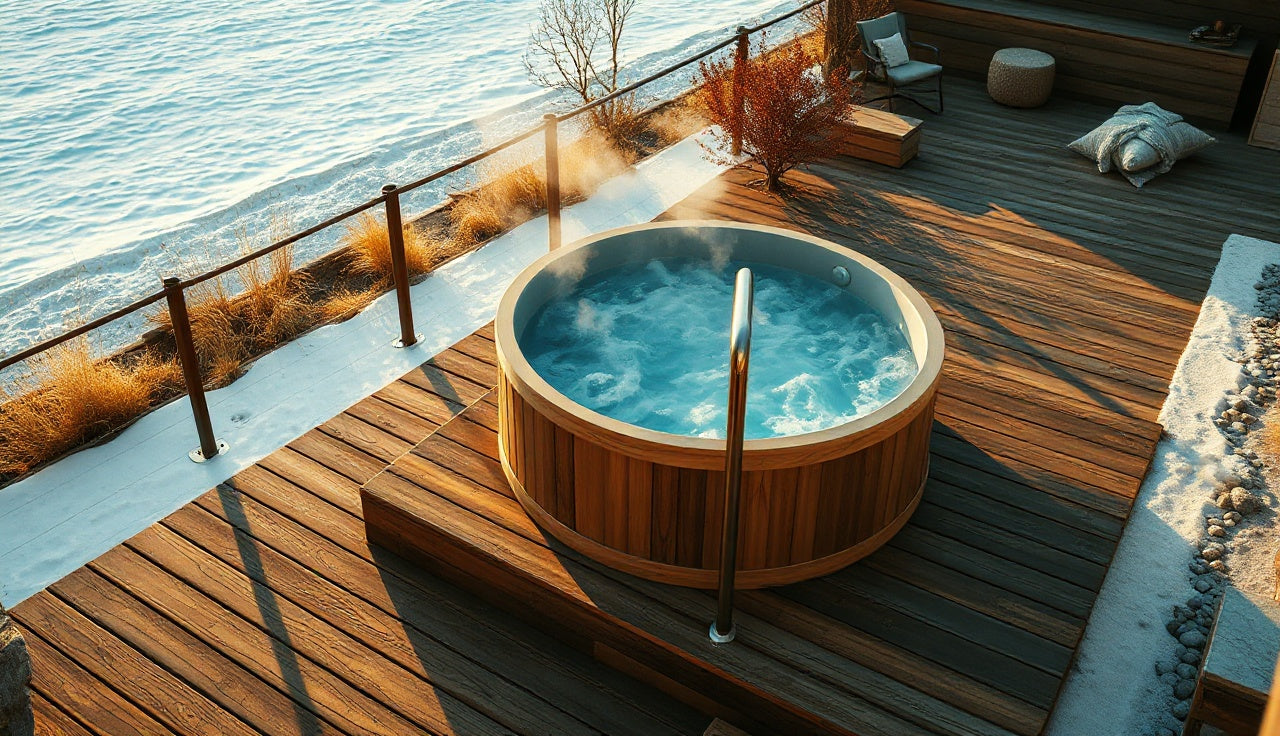
Barrel-style cold plunges. Cedar or fir barrels with a plug, usually 80 to 150 gallons. They look good on a deck and insulate reasonably well in mild climates. Most are sold without chillers, though some companies offer external chiller attachments. Price range: $500 to $2,500.
Freestanding cold plunge tubs with integrated chillers. This is the mainstream home upgrade category. A rigid shell (fiberglass, acrylic, or stainless) with a built-in refrigeration unit that actively holds water at a set temperature, usually down to 39 to 50 degrees Fahrenheit. Most include basic filtration. This is what most serious home users buy. Price range: $1,800 to $8,000.
Commercial and luxury cold plunge pools. Larger capacity (150 to 300+ gallons), industrial chillers, multi-stage filtration, and sometimes custom dimensions. These are what wellness centers and gyms install. For home buyers, they are overkill unless you have a large family or budget is genuinely not an issue. Price range: $8,000 to $20,000 and beyond.
If you are pairing a cold plunge with a sauna for contrast therapy, see our cold plunge overview to understand how the two work together.
Where can you find cold plunges for sale?
You have more places to buy than you probably expect, and each channel has real trade-offs.
Direct from the manufacturer. Companies like Plunge, Blue Cube, Renu Therapy, ColdTub, and Ice Barrel sell direct from their own websites. You get warranty support, return policies, and sometimes financing. Prices are full MSRP. This is generally the safest channel for high-ticket units.
Specialty retailers. Stores that focus on recovery and wellness equipment, like SweatDecks, carry curated selections and can give you buying guidance across multiple brands in one place. Useful if you want to compare options without visiting six different brand websites.
Amazon and big-box online. Plenty of cold plunge tubs for sale on Amazon, typically in the portable and barrel categories. Read the filter specs carefully. Many budget units have no real filtration, which means you are dumping and refilling water every few days or growing algae.
Costco and wholesale clubs. Costco occasionally carries cold plunge units, usually seasonally and in limited quantities. Pricing can be competitive, though selection is thin and stock disappears fast.
Cold plunge tub clearance sales. Manufacturers and retailers periodically clear out prior-year models, floor samples, or discontinued colorways. These are real deals. You might find a unit that retailed for $3,500 at $2,200. Clearance stock is usually first-come, first-served and does not include model customization. Sign up for email lists from brands you are watching if clearance pricing matters to you.
Facebook Marketplace and Craigslist. Used cold plunges show up here regularly, especially in cities with dense wellness communities. Inspect the chiller compressor carefully. Compressors are the expensive component to replace, and a failing one may not show obvious symptoms on a short test.
| Stock tank / inflatable (no chiller) | $350 |
| Barrel or portable tub (no chiller) | $1,000 |
| Entry-level chiller unit | $2,500 |
| Mid-range chiller with filtration | $5,000 |
| Commercial / luxury unit | $12,000 |
Source: Compiled from manufacturer pricing (Plunge, Ice Barrel, Blue Cube, Renu Therapy); U.S. EIA residential electricity rates
Should you buy a refurbished cold plunge tub?
Refurbished cold plunge tubs can be genuinely good value, and they can also be a headache. The difference usually comes down to who did the refurbishing and what warranty comes with it.
Manufacturer-certified refurbished units are the safest bet. The company has inspected the chiller, replaced worn parts, and stands behind it with at least a limited warranty. Some brands sell these directly through a dedicated section of their website or through authorized dealers. Expect pricing 20 to 35 percent below new MSRP for a comparable unit.
Third-party refurbished or "seller refurbished" units from platforms like eBay deserve more skepticism. The refurbishment process varies wildly. Ask specifically: what parts were replaced, what is the compressor's history, is there any warranty, and can you see service records?
For shells and tubs without mechanical components (stock tanks, barrel tubs, fiberglass shells), buying used is lower risk. A cracked or pitted shell is obvious. A failing compressor is not.
One honest note: the cold plunge market has grown fast enough that there are a lot of barely-used units on the secondary market from people who bought enthusiastically and then used their plunge three times. Those can be real finds if you vet the mechanical components.
What size cold plunge tub do you actually need?
For a single adult, 60 to 100 gallons is enough. Most people can sit comfortably immersed to the shoulders in a tub that is roughly 48 to 60 inches long. Taller people (above 6 feet 2 inches) should look for a large cold plunge tub for sale with at least 65 inches of interior length or a deeper design that lets you submerge without cramming your knees.
Couple or household use changes the math. If two people want to plunge daily, you are probably looking at sequential use rather than simultaneous plunging unless you buy a commercial-scale unit. Sequential use does not require more volume, but it does require a chiller powerful enough to recover temperature between sessions. Look for units that can cool back to your target temperature within 30 to 60 minutes.
Width matters more than people realize. A tub that is 26 inches wide is genuinely cramped for most adults. 28 to 30 inches of interior width is comfortable. Some premium units are 34 inches wide, which feels much more natural for sitting immersed.
Depth is the often-overlooked dimension. You want water depth of at least 26 to 28 inches to achieve shoulder-depth immersion while seated. Some portable tubs are shallower and only immerse you to chest level, which reduces the cold exposure to your upper body significantly.
For outdoor setups, also think about whether the unit needs to sit on a level surface (almost all of them do) and whether your deck can handle the weight. A 100-gallon tub full of water weighs roughly 830 to 850 pounds plus the shell weight [10]. Check your deck's load rating before you order.
What temperature should a cold plunge be, and can budget tubs get there?
Most cold water immersion research uses water temperatures between 50 and 59 degrees Fahrenheit (10 to 15 degrees Celsius) [2]. Some practitioners go colder, down to 39 or 40 degrees, but the research on meaningful additional benefit below 50 degrees is thin. A 2022 meta-analysis in PLOS ONE found cold water immersion effective for muscle soreness recovery, but did not identify a single optimal temperature across protocols [2].
Plunge recommends their units at 39 to 50 degrees Fahrenheit, which their chiller handles without issue. Most mid-range chillers are rated to 39 to 45 degrees in ambient temperatures up to about 75 to 80 degrees Fahrenheit. That last part matters: if your unit sits outside in summer heat, the chiller has to work much harder and may not reach target temperature on very hot days.
Ice-only setups can absolutely get water cold enough. A mix of ice and cold tap water can easily hit 50 degrees. The problem is maintenance. A well-insulated tub with ice warms several degrees per hour depending on ambient temperature, sun exposure, and insulation quality. You are resetting the temperature every session or two.
Budget tubs with included chillers (the $400 to $900 price point on Amazon) often use small refrigeration units that are not really sized for the tank volume. They can get water down to the target range, but recovery time after a session can be 2 to 4 hours, and in hot weather they may struggle to hold temperature at all. Read the BTU rating of the chiller relative to the gallon capacity before buying in this price tier.
For context on what the research actually supports, see our cold plunge benefits breakdown.
What features matter most in a cold plunge tub?
Not all specs are equally important. Here is the honest ranking.
Chiller quality. This is the heart of the unit. A properly sized chiller with good components (look for brands using Embraco or similar compressor brands) lasts years. An undersized or cheap compressor fails, and replacement compressors can cost $500 to $2,000 alone. If a brand does not tell you their compressor manufacturer, that is a yellow flag.
Filtration. Water that sits at 50 to 60 degrees for days is not exactly a petri dish, but without filtration it will still degrade. Look for: UV or ozone filtration (kills pathogens without heavy chemical use), a circulation pump, and some form of mechanical filter. Units with good filtration let you change water monthly instead of weekly. Without it, you are dumping and refilling constantly or adding significant amounts of chlorine or bromine.
Insulation. A well-insulated shell reduces the work the chiller has to do, which cuts electricity cost and extends compressor life. Foam-core walls and an insulated lid make a measurable difference. Ask for the R-value or the manufacturer's stated temperature retention spec (how many degrees does the water warm per hour without the chiller running?).
Shell material. Fiberglass and acrylic are the most common. Both are durable and easy to clean. Stainless steel looks premium and is extremely durable but costs more and can feel colder to the touch. Polyethylene (stock tanks) is nearly indestructible and cheap. Soft-sided fabric tubs are fine for light use but not ideal for daily long-term use.
Lid and cover. An insulated, tight-fitting lid cuts both heat gain and evaporation. Evaporation is a surprisingly big factor in both temperature loss and water chemistry drift. This should not be an afterthought.
Interior seating or floor grip. A non-slip surface and a comfortable way to sit at depth are worth caring about. Some units have molded seats. Others are flat-bottomed with no support. If you plan on sitting for 3 to 10 minutes at a time, your spine will have opinions.
Are there cold plunge deals worth waiting for, or are sales mostly marketing?
Mostly marketing, with real exceptions.
The cold plunge market behaves a lot like the mattress market a decade ago. "Sale" pricing is often just the standard price relabeled. If a unit is always 20 percent off MSRP, then 20 percent off is the real price.
That said, there are legitimate buying windows. Black Friday and Cyber Monday deals from direct-to-consumer brands have historically been real reductions, sometimes $300 to $800 off mid-range units. End-of-fiscal-year clearance (September to October for many brands) sometimes produces genuine cold plunge tub clearance sales on prior-model inventory. And when a brand launches a new model, the previous generation often drops meaningfully.
The best approach: know the base price of the specific unit you want by tracking it for 4 to 6 weeks. Set a Google Shopping alert. If you see a reduction of more than 15 percent off the price you have been watching, it is probably real. Under 10 percent is usually just noise.
Financing is increasingly common from brands like Plunge and Blue Cube. APR varies widely, from 0 percent promotional offers to 15 percent or higher through third-party lenders. Read the financing terms as carefully as you would a car loan. A $3,500 unit at 18 percent APR over 36 months costs you roughly $5,000 total.
What do you need to install a home cold plunge?
Less than most people expect, for most units.
A standard 110V/15-amp outlet handles most cold plunge units in the $1,500 to $4,000 range. Some higher-powered chillers (particularly commercial units and some large-format home units) require 220V/20-amp service. Confirm this before ordering. Running a new dedicated circuit costs $200 to $500 depending on distance from your panel and your electrician's rates [3].
You need a water source close enough to fill the tub (a standard garden hose works) and ideally a drain nearby. Some people put their cold plunge on a deck and run a hose to the nearest outdoor spigot. Others install theirs in a garage with a floor drain. Both work. What you want to avoid is dragging a hose 80 feet and draining onto a lawn every month.
For outdoor installation, think about freezing temperatures. Most chillers should not be left outside when ambient temperatures drop below freezing. Some brands rate their units for cold weather use; most do not. If you live in a climate with real winters, either plan to bring the unit inside, winterize it (drain completely, run antifreeze through the chiller lines per manufacturer instructions), or buy a model specifically rated for outdoor winter use.
For context on pairing your cold plunge with a sauna setup outdoors, see our outdoor sauna guide.
Permits are rarely required for a standalone cold plunge, as opposed to an in-ground cold pool. But if you are building a deck to support one, that structure may require a permit. The Consumer Product Safety Commission publishes safety guidance on spa and immersion installations worth reviewing before you set up [8]. Check with your local building department too.
How do you evaluate whether a cold plunge brand is trustworthy?
The cold plunge market has exploded since roughly 2021, and not all brands that entered the market will be around in five years. Buying a $4,000 unit from a brand that folds means your warranty is worthless.
Signs of a credible brand: they have been operating for at least 3 years with verifiable customer reviews on third-party platforms (more than their own site), they can name the source of their chiller compressor, they publish actual BTU ratings and gallon capacity specs rather than vague marketing language, and they have a real physical address and accessible customer support.
Red flags: a brand that launched in the last 12 months with no history, one that only shows influencer content and no real product specs, "limited time" countdowns that reset every time you visit the page, and warranties that only cover the shell (not the chiller mechanics).
Warranty terms matter. Look for: at minimum 1 year on electronics and compressor, 2 to 5 years on the shell. Some premium brands offer 3 to 5 years on the full unit. That is worth something.
SweatDecks carries a curated selection of cold plunge units and vets brands before listing them, which removes some of this research burden if you want a shorter path to a trusted purchase.
For the full picture on what cold exposure actually does physiologically, the research base from PLOS ONE [2] and work from researchers at Maastricht University [4] is worth reading. The honest answer is that some benefits (muscle soreness recovery, mood, alertness) have decent support in the literature. Others (fat loss, longevity claims) are much more speculative.
What are the health benefits of cold plunging, and what does the research actually say?
Cold water immersion has a real research base, though it is shorter and thinner than the marketing around most products suggests. Here is what holds up and what does not.
Muscle recovery. The strongest evidence. A 2022 meta-analysis in PLOS ONE reviewed 52 studies and found cold water immersion significantly reduced delayed-onset muscle soreness (DOMS) compared to passive recovery [2]. The effect was meaningful, more than statistical. This is why athletes have used ice baths for decades.
Mood and alertness. Cold water immersion causes a noticeable spike in norepinephrine and dopamine. A study published in the European Journal of Applied Physiology found norepinephrine increases of up to 300 percent following cold water immersion [5]. Whether this translates to lasting mood improvement with repeated exposure is less clear. The acute effect is real and is what most regular users describe.
Fat adaptation. The idea that cold exposure activates brown adipose tissue (BAT) and increases metabolic rate is real in principle. Research from the Maastricht University Medical Centre found regular cold acclimation increased BAT activity [4]. Whether this produces meaningful changes in body composition for most people is a separate question, and the evidence is not strong enough to call it a weight loss tool.
Hypertension and cardiovascular. Cold plunging causes an acute rise in blood pressure and heart rate during the plunge. People with uncontrolled hypertension, cardiac arrhythmias, or Raynaud's disease should consult a physician before using cold plunges. The National Library of Medicine notes that cold water immersion can trigger cardiovascular stress responses, particularly in older adults [6].
Conservative bottom line: if you want a real recovery tool with documented evidence for muscle soreness and a reliable mood boost, cold plunging is worth your time. Do not buy it as a weight loss device or a medical treatment.
How does a cold plunge compare to a sauna for home wellness?
They do different things, and the comparison only makes sense if you are choosing between the two rather than pairing them.
A sauna delivers passive heat stress: elevated heart rate, sweating, and documented effects on cardiovascular health, particularly from long-term Finnish sauna studies. A 2018 paper from the University of Eastern Finland following over 2,300 men found that frequent sauna use (4 to 7 times per week) was associated with significantly lower cardiovascular mortality over a 20-year follow-up [7]. That is a long-term observational finding, not a randomized trial, but it is one of the strongest datasets in the space.
A cold plunge delivers cold stress: vasoconstriction, norepinephrine spike, and the muscle recovery effects noted above. The psychological component is also different. Most people find the mental challenge of cold immersion (committing to stepping in, controlling the breath) to be a meaningful part of the practice.
Contrast therapy, alternating between heat and cold, is common in Nordic and athletic recovery traditions. The evidence base for contrast therapy specifically is mixed. Some studies find it superior to either alone for recovery; others find no significant additive effect. Practically speaking, many people who own both report preferring to use them together because it feels good and provides structure to a recovery session.
For a detailed look at heat exposure's own documented benefits, see our sauna benefits guide. And if you are building a home wellness space, our home sauna guide covers what sauna installation actually involves.
Cost comparison: a quality home sauna runs $2,000 to $10,000 installed depending on type. A quality cold plunge runs $1,500 to $8,000. If budget forces a choice, pick whichever one you will actually use consistently.
Frequently asked questions
What is the cheapest cold plunge worth buying?
A basic stock tank (livestock trough) from a farm supply store costs $100 to $400 and works perfectly as an ice bath. For a purpose-built option with better insulation, the Ice Barrel and similar units run $500 to $900 and are genuinely functional without a chiller. Below $300 for purpose-built cold plunge tubs, quality drops fast and you often get poor insulation and no filtration.
How much does it cost to run a cold plunge chiller per month?
Most home cold plunge chillers draw 500 to 1,200 watts when running. At the U.S. average residential electricity rate of roughly $0.16 per kWh (2024 EIA average), a well-insulated unit running 6 to 8 hours per day costs approximately $30 to $70 per month. Poorly insulated units or those in hot outdoor environments cost more, sometimes $80 to $120 per month.
Are there cold plunge tubs on sale at Costco?
Yes, occasionally. Costco has carried cold plunge units from brands like Plunge and Viking Therapeutics, typically in spring and fall. Stock is limited, rotates frequently, and often sells out quickly. Pricing is sometimes $200 to $500 below direct-to-consumer prices for comparable units. Check Costco's website directly, as in-store and online availability differ.
Can a cold plunge be used outdoors year-round?
It depends on your climate and the unit. Most electric chiller units should not be exposed to freezing temperatures. Some brands, particularly those using stainless steel shells and heavier-duty chillers, are rated for outdoor use down to specific ambient temperatures. In climates with hard winters, plan to either bring the unit inside or drain and winterize it completely according to the manufacturer's guide.
How often should you change the water in a cold plunge tub?
Units with UV or ozone filtration and a good cover can go 4 to 8 weeks between full water changes with proper maintenance (checking pH, adding minimal sanitizer). Units without filtration need water changes every 1 to 2 weeks for a single daily user. More frequent use, or multiple users, shortens the interval. Monitoring pH (target 7.2 to 7.8) and sanitizer levels weekly is the baseline habit.
What size cold plunge do I need for two people to use daily?
For two people using the tub sequentially, the size requirements are similar to a single-person unit (60 to 100 gallons), but you need a chiller with enough recovery capacity to return to target temperature within 30 to 60 minutes between sessions. For simultaneous use, look for a large cold plunge tub for sale with 150 gallons or more and a commercial-grade chiller rated for that volume.
Is a refurbished cold plunge tub a good deal?
Manufacturer-certified refurbished units are generally safe buys, usually priced 20 to 35 percent below new with a limited warranty intact. Third-party refurbished units from marketplaces carry more risk, particularly around compressor condition. For tubs and shells without electronic components, used is much lower risk. Always ask what was replaced, who serviced it, and whether any warranty transfers.
What is the ideal temperature for a cold plunge?
Most cold water immersion research uses 50 to 59 degrees Fahrenheit (10 to 15 degrees Celsius). A 2022 PLOS ONE meta-analysis of 52 studies found this range effective for muscle soreness recovery. Many practitioners prefer 50 to 55 degrees for daily use. Going colder is possible but the evidence for additional benefit below 50 degrees is thin, and hypothermia risk increases meaningfully below 40 degrees Fahrenheit.
Do I need a permit to install a cold plunge at home?
A freestanding cold plunge tub generally does not require a permit, similar to a hot tub placed on an existing deck or pad. If you need new electrical service (a 220V circuit), that electrical work typically requires a permit and inspection in most jurisdictions. If you are building a new deck to support the unit, that structure will likely require a permit. Check with your local building department.
How long should you stay in a cold plunge?
Most research protocols use 10 to 15 minutes. For beginners, 1 to 3 minutes at 55 to 60 degrees Fahrenheit is a reasonable starting point. The Wim Hof method and various athlete protocols use 2 to 10 minutes. There is no strong evidence that longer sessions (beyond 15 minutes) provide meaningfully greater benefit, and the risk of hypothermia increases with duration at colder temperatures.
What is the difference between a cold plunge and an ice bath?
Functionally they are the same: full or partial cold water immersion for recovery or wellness. The difference is the setup. An ice bath means filling a tub or container with ice and water, which is cheap but requires ongoing ice cost and has no temperature control. A cold plunge typically refers to a purpose-built unit with a chiller that maintains temperature automatically. Both deliver the same cold stress stimulus at the same temperature.
Are cold plunge tubs safe for people with heart conditions?
Cold water immersion causes an acute rise in blood pressure and heart rate and triggers the cold shock response, which can stress the cardiovascular system. The National Library of Medicine notes this can be significant particularly in older adults or those with existing cardiac conditions. People with hypertension, arrhythmia, heart disease, or Raynaud's phenomenon should consult a physician before using a cold plunge. This is not a product marketed as a medical device.
What brands make the best cold plunge tubs for home use?
Plunge (formerly The Cold Plunge) is one of the most established direct-to-consumer brands with a strong track record. Blue Cube, Renu Therapy, Ice Barrel, and ColdTub are other names with verifiable histories. Look for brands that publish actual BTU and gallon capacity specs, name their chiller compressor manufacturer, and have real third-party reviews. Avoid brands with no track record beyond 12 months or those hiding key specs.
Can I build a DIY cold plunge?
Yes, and many people do. The most common approach: a chest freezer converted to a cold plunge by adding a pond pump for circulation and a simple filter. Cost runs $200 to $600 depending on the freezer size and components. The limitation is water quality management, since you are rigging filtration rather than using an engineered system. Chest freezer conversions are well-documented in the DIY community and work reliably with proper maintenance.
Sources
- U.S. Energy Information Administration, Electric Power Monthly: U.S. average residential electricity rate approximately $0.16 per kWh in 2024
- PLOS ONE, 'Effects of cold water immersion on muscle recovery' meta-analysis (2022): Meta-analysis of 52 studies finding cold water immersion significantly reduced delayed-onset muscle soreness compared to passive recovery
- U.S. Department of Energy, Home Energy Saver: Electrical System Costs: Running a new dedicated electrical circuit costs $200 to $500 depending on distance from the panel
- Maastricht University Medical Centre, Hanssen et al., Journal of Clinical Investigation (2015): brown adipose tissue and cold acclimation: Regular cold acclimation increased brown adipose tissue activity in human subjects
- European Journal of Applied Physiology, Srámek et al. (2000): cardiovascular and hormonal response to cold water immersion: Norepinephrine increases of up to 300 percent following cold water immersion
- National Library of Medicine / PubMed, review of cold water immersion cardiovascular stress: Cold water immersion can trigger cardiovascular stress responses, particularly in older adults
- University of Eastern Finland / JAMA Internal Medicine, Laukkanen et al. (2018): sauna bathing and cardiovascular mortality: Frequent sauna use 4 to 7 times per week associated with significantly lower cardiovascular mortality over 20-year follow-up in Finnish men
- U.S. Consumer Product Safety Commission, spa and hot tub safety guidelines: Federal safety guidance on hot tub and immersion pool installations relevant to cold plunge setup
- Centers for Disease Control and Prevention, Healthy Swimming: Pool Water Quality: Recommended pH range of 7.2 to 7.8 for immersion pool water quality
- National Institute of Standards and Technology, weights and measures: water density: One gallon of water weighs approximately 8.34 pounds; 100 gallons equals approximately 834 pounds

Share:
Why sauna is good for health: what the research actually shows
Sauna cold plunge combo: the complete guide to contrast therapy at home