
Last updated 2026-07-09
TL;DR
A red light sauna pairs far-infrared heat with red and near-infrared light (630 to 850 nm). The combo may speed muscle recovery, lower inflammation markers, build skin collagen, and help circulation. Most human trials are small and short, so the evidence points one way but isn't settled. It's safe for healthy adults at sessions under 20 to 30 minutes with steady hydration.
What is a red light sauna, exactly?
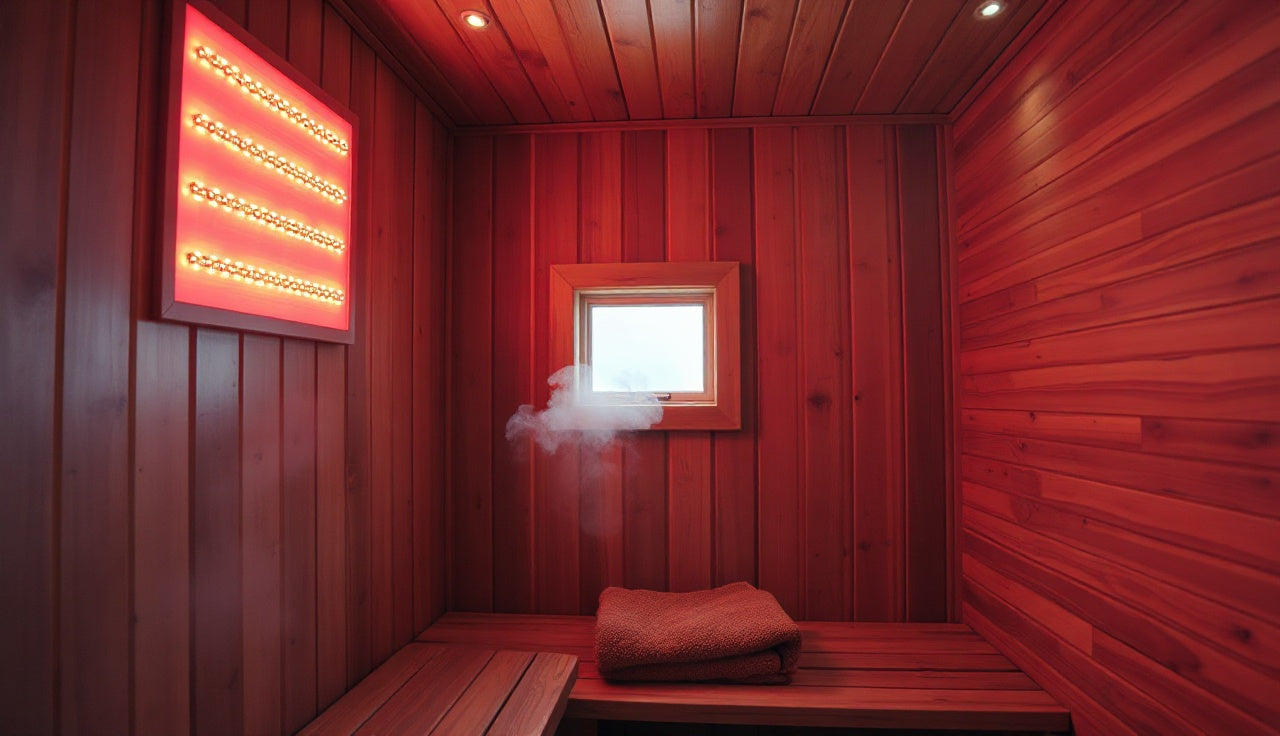
A red light sauna is an infrared sauna cabinet with red and near-infrared LED panels mounted inside the cabin. Two different technologies that happen to share the word infrared. Separating them makes everything else clearer.
Conventional infrared saunas heat you with far-infrared wavelengths, roughly 5,000 to 15,000 nanometers (nm). Those long wavelengths reach only a few millimeters into tissue, but they raise your core temperature well, which drives the sweating and cardiovascular response the sauna is known for [1].
Red light therapy, also called photobiomodulation (PBM), uses much shorter wavelengths. Red light sits in the 630 to 700 nm band. Near-infrared (NIR) sits in the 700 to 1,100 nm band. At those wavelengths, light gets absorbed by cytochrome c oxidase, a photoreceptor inside your mitochondria. That absorption appears to stimulate ATP production and cut oxidative stress inside cells, without generating meaningful heat [2].
So a red light sauna runs two treatments at once. The far-infrared panels heat your core. The red and NIR LED panels deliver photobiomodulation at the cellular level. Manufacturers now call these units "full-spectrum" or "red light therapy saunas," and the category has grown fast since around 2020. If you're comparing home sauna options and see this marketing, you're looking at a combo product.
One thing to know upfront. The LED output from most consumer saunas is far lower in irradiance (mW/cm²) than the standalone red light panels used in clinical studies. That gap changes how you read the research, and we'll get into it.
What does red light therapy actually do to your cells?
Red and near-infrared light gets absorbed by your mitochondria, and that absorption appears to speed up cellular energy production. A 2017 review in Photobiomodulation, Photomedicine, and Laser Surgery described it directly: red and NIR light is "absorbed by chromophores in the mitochondrial respiratory chain, leading to increases in electron transport, mitochondrial membrane potential and ATP production" [2].
That's the foundational claim, and the cell-culture and animal research behind it is strong.
What happens downstream is where the argument starts. The proposed effects in humans include lower reactive oxygen species (oxidative stress), more nitric oxide release (which widens blood vessels), less local inflammation through changes in prostaglandin signaling, and faster fibroblast activity (which matters for wound healing and collagen).
The hard part is moving from petri dish and mouse to human. Wavelength, irradiance, treatment time, and skin phototype all change how much light reaches the target tissue. A 2018 systematic review in the Annals of Biomedical Engineering found that dose-response relationships in human PBM studies are poorly standardized, which makes direct comparisons across trials unreliable [8].
That doesn't make the research worthless. It means you weight randomized controlled trials in humans above everything, and you stay skeptical of product pages that lead with mouse data.
What are the main health benefits of combining red light with sauna heat?
Here's where the human evidence is decent, and where it isn't. This is the part most people actually came for.
Muscle recovery and exercise performance
This is the best-supported use. A 2016 randomized controlled trial in Lasers in Medical Science found that near-infrared light applied before exercise cut muscle damage markers (creatine kinase and lactate dehydrogenase) versus placebo in trained athletes [4]. The heat side helps too. A 2015 study in the Journal of Science and Medicine in Sport found that post-exercise infrared sauna sessions improved recovery and lowered soreness across a 72-hour window [5].
Running both in one session makes sense for recovery. There's no head-to-head trial yet comparing the combo against either modality alone.
Skin collagen and appearance
A 2014 randomized study in Photomedicine and Laser Surgery with 136 participants found that twice-weekly red/NIR treatments produced "significantly improved skin complexion and skin feeling" plus a statistically significant rise in collagen density measured by ultrasound, versus sham [6]. Sauna heat raises skin blood flow on its own and may help the skin barrier, though the dermatology evidence for heat alone is thin.
Inflammation and pain
PBM has a reasonable evidence base for local pain and inflammation, especially in musculoskeletal conditions. The World Association for Laser Therapy has published dosing guidelines for tendinopathy and neck pain [3]. Far-infrared sauna use has been tied to less pain in small trials of patients with fibromyalgia and chronic fatigue, but the samples are small [1].
Cardiovascular circulation
Infrared sauna use produces measurable cardiovascular effects. A 2018 review in Mayo Clinic Proceedings reported that frequent sauna use (4 to 7 times per week) was tied to lower cardiovascular event risk in a large Finnish cohort, though that data came from traditional Finnish sauna [7]. Red light's contribution through nitric-oxide-driven vasodilation is plausible and supported in vitro, but isolated human circulation trials are limited.
Mental health and sleep
Weak direct evidence for the red light sauna combo specifically. Sauna use broadly has been linked to less depression and better sleep in observational data, partly through temperature regulation and endorphin release. Red light alone has pilot data for seasonal affective disorder and sleep quality through melatonin pathways, but these are early findings. Don't lean hard on these claims.
What the research does NOT support
Weight loss from a red light sauna is mostly marketing. Sweating out water weight is temporary and isn't fat loss. Red light has been studied for fat-cell disruption at specific clinical parameters (the Zerona device trials, for one), but the irradiance in a sauna is almost certainly far below what those trials used.
| Muscle recovery (PBM) | 8 |
| Skin collagen (PBM) | 7 |
| Pain reduction (PBM) | 7 |
| Cardiovascular (heat) | 8 |
| Inflammation (PBM) | 6 |
| Sleep / mood | 4 |
| Fat loss | 2 |
Source: Lasers in Medical Science 2016 [4], Photomedicine and Laser Surgery 2014 [6], Mayo Clinic Proceedings 2018 [7], WALT dosing guidelines [3]
How does a red light sauna compare to a regular infrared sauna?
A standard infrared sauna delivers the heat benefits well. A red light sauna adds LED panels, and that add-on only earns its keep if the panels hit a real irradiance threshold. If you're weighing sauna benefits or a plain infrared sauna buy, here's the honest comparison across what matters.
| Feature | Standard infrared sauna | Red light sauna (combo unit) |
|---|---|---|
| Heat mechanism | Far-infrared emitters | Far-infrared emitters (same) |
| Added therapy | None | Red/NIR LED panels (630 to 850 nm) |
| Cardiovascular response | Yes | Yes (same, from heat) |
| Photobiomodulation | No | Yes (if LED dose is adequate) |
| Typical price range | $1,500 to $5,000 | $3,000 to $8,000+ |
| LED irradiance concern | N/A | Many consumer units underpower LEDs |
| Evidence quality | Moderate (infrared sauna studies) | Mixed; two therapies studied separately |
The red light upgrade is worth it only when the LED panels clear a minimum irradiance, usually at least 20 to 40 mW/cm² at the surface, which not every consumer unit does. Ask for third-party irradiance specs before you buy. If a company can't produce them, that answers your question for you.
For a wider look at heat-based therapies, the sauna vs steam room breakdown covers how different heat delivery methods affect the body.
Is using red light therapy in a sauna safe?
For healthy adults, yes, with caveats. The heat carries the usual sauna risks and the light carries one specific one for your eyes.
The heat side brings dehydration, hypotension (low blood pressure, especially when you stand up), and overheating. The American Heart Association advises people with cardiovascular conditions to talk to their doctor before using saunas, and that holds here [7].
The red light side brings retinal risk. LEDs in the 630 to 850 nm range can damage the retina with direct, sustained exposure. Most reputable manufacturers include eye protection, and you use it every single session. Not optional.
Other considerations:
Pregnancy: no established safe exposure parameters exist for PBM in pregnancy. Skip it.
Active cancer: the concern is theoretical (light stimulating cell proliferation), but oncology patients should get physician clearance before either therapy.
Photosensitizing medications (certain antibiotics, retinoids, some NSAIDs): these can amplify light sensitivity and raise burn risk. Check with your prescribing physician.
Skin: red light at normal session parameters won't burn skin, but people with very fair skin or photosensitive conditions like lupus should be cautious.
Session duration: most research protocols run 10 to 20 minute light sessions and 15 to 30 minute sauna sessions. Stacking both at once means you stay on the conservative end of the sauna time. Hydrate before and after. Get out the moment you feel lightheaded.
How long should a red light sauna session be, and how often?
Start at 15 to 20 minutes total, 4 to 5 days a week, and build from there. There's no universal protocol because the research hasn't converged on one, but the available trials point to a workable range.
For photobiomodulation, clinical trials have used sessions of 8 to 20 minutes, with panels 6 to 12 inches from the skin [2]. Frequency in most trials runs 3 to 5 times per week for 4 to 12 weeks before measurable outcomes show up.
For infrared sauna, Finnish and Japanese research generally uses 15 to 30 minute sessions. A 2019 study in Complementary Therapies in Medicine found benefits in cohorts using sessions of around 20 minutes, 3 to 4 times per week [1].
Here's a practical home routine for a combined session:
Start with 15 to 20 minutes total. With the LED panels at torso or limb level inside the cabin, you get simultaneous exposure. Let the sauna pre-heat to your target (usually 120 to 150°F for far-infrared) before you step in. Wear eye protection the whole time. Drink 16 to 20 oz of water before and after.
Build up over two to four weeks. Most healthy, well-hydrated people can comfortably reach 25 to 30 minute sessions. Daily use isn't harmful for most healthy adults, but rest days give tissue time to answer the photobiomodulation stimulus, so 4 to 5 days a week is a sensible ceiling to start with.
If you're using it mainly for post-workout recovery, the muscle data is strongest for sessions taken within 60 minutes after training [4].
Does a red light sauna help with skin and anti-aging?
Skin is one of the more credible claims in this space, with the most consistent human trial data behind it. Expect real but modest gains, not laser-resurfacing results.
The 2014 Photomedicine and Laser Surgery trial, with 136 subjects, is the largest skin-focused RCT here. It found statistically significant improvements in skin roughness and collagen density after 30 treatments over 15 weeks using 611 to 650 nm (red) and 570 to 850 nm (broadband NIR) light [6]. A real finding from a peer-reviewed trial.
The mechanism is simple. Fibroblasts in the dermis absorb near-infrared light, which pushes up collagen Type I and III production, and red light lowers the matrix metalloproteinases (MMPs) that break collagen down. More production, less breakdown, more net collagen over time.
Sauna heat on its own raises skin blood flow and may bump transient hydration, but there's no strong separate evidence that heat alone builds collagen. The red light is doing most of the skin work.
Set realistic expectations. The improvements in the trials are genuine but small. You'll see better texture and some softening of fine lines if you stay consistent for months, not days.
Can a red light sauna help with muscle recovery and soreness?
Recovery is the strongest real-world case, and the evidence here is firmer than for most other claims. If you're spending money on a red light sauna for one reason, this is the one that holds up.
The 2016 Lasers in Medical Science RCT found that near-infrared pre-treatment (830 nm, 100 mW/cm², 30 seconds per point) cut post-exercise creatine kinase by a statistically significant margin versus placebo in trained men doing high-intensity knee extensions [4]. Creatine kinase is a direct marker of muscle membrane damage.
On the sauna side, a 2015 study in the Journal of Science and Medicine in Sport put male distance runners into either infrared sauna or a control condition after training runs. The sauna group reported lower DOMS (delayed onset muscle soreness) at 24 and 48 hours post-exercise [5].
The combo makes biological sense. Heat raises blood flow and speeds metabolite clearance, while red and NIR light may reduce local oxidative stress and speed mitochondrial repair in damaged fibers. Athletes running contrast therapy, alternating a cold plunge with sauna, can use the red light sauna as the warm half of that protocol.
Building a recovery setup at home? This is where I'd spend the money. The recovery evidence beats the anti-aging and weight-loss claims, and the cost-per-use math works when you're in there three to five times a week.
What should you look for when buying a red light sauna for home use?
The market is crowded and the quality spread is huge. LED irradiance is the one spec that separates a real device from a decorative one. Here's the full checklist.
LED irradiance (mW/cm²): The single most important number. Most PBM clinical studies use at least 20 to 100 mW/cm² at the treatment surface. Consumer sauna panels often skip this number, or they measure it at 1 inch when you'll be sitting 12 to 18 inches away. Ask for third-party testing at 6 inches and 12 inches. No data, no sale.
Wavelength coverage: Look for panels covering both red (630 to 670 nm) and near-infrared (810 to 850 nm). Cheaper units often use one band only. The combination outperforms either wavelength alone in PBM research.
EMF levels: Far-infrared emitters produce low-level electromagnetic fields. Some manufacturers test and publish EMF readings. Look for units below 3 mG at body distance, and ask for documentation.
Wood and build quality: Cedar and hemlock are the standard materials. Avoid particle board or strong off-gassing odors in an enclosed cabinet. The enclosure should feel tight, with little heat loss.
Size: A two-person unit costs roughly $4,000 to $8,000. A one-person unit runs $2,500 to $5,000 for models with credible LED specs. Anything under $2,000 waving red light claims earns extra scrutiny.
SweatDecks carries home sauna options including red light combo units, and the product pages list LED spec sheets, which is the floor you should expect from any retailer.
Tight on space or budget? A portable sauna paired with a separate standalone red light panel is a legitimate lower-cost route, though the experience is different.
How does red light therapy in a sauna compare to a standalone red light panel?
For pure photobiomodulation dosing, a standalone panel wins. For the combined heat-plus-light experience, the sauna wins. Which one you should buy depends on what you already own. Sit with this before you spend.
A standalone red light panel (Joovv, Mito Red, Rouge, and similar) delivers PBM at high irradiance with clinical-grade LEDs. A quality floor-standing unit runs $500 to $1,500 and delivers 40 to 100 mW/cm² at 6 inches from third-party-tested panels. You use it at room temperature, standing or sitting 6 to 18 inches away, for 10 to 20 minutes.
A red light sauna adds far-infrared heat, which brings its own documented benefits (cardiovascular and relaxation effects especially), but usually at lower LED irradiance from the in-cabin panels.
The practical call for most people: if you already own a quality infrared sauna and want PBM, a separate panel used before or after your session may outperform most integrated red light saunas on the light-therapy side. If you're starting from scratch, a combo unit that genuinely hits the irradiance minimums is the most space- and time-efficient answer.
If contrast protocols appeal to you, pairing a red light sauna session with an ice bath or cold plunge afterward is a popular recovery stack, though the research on that exact combination is early.
Are there any downsides or risks specific to red light saunas?
Cost and marketing noise are the two big ones. Beyond the safety points already covered, a few practical downsides deserve naming.
Cost first. A genuinely well-equipped red light sauna costs a lot more than a standard infrared unit. Doing the LED upgrade right isn't cheap.
Marketing noise is a real problem here. Plenty of units sold as "red light therapy saunas" carry decorative LEDs that throw warm-looking light but deliver too little irradiance to produce the cellular effects the trials measured. You usually can't tell the difference by eye.
Light degradation: LEDs lose output over time. Quality panels may hold 70 to 80% of initial output at 50,000 hours; cheaper LEDs fade faster. Four years at five sessions a week puts you around 1,000 to 1,500 hours of LED exposure, nowhere near 50,000, so degradation shouldn't worry you near-term. Worth knowing anyway.
Overheating with long sessions: the heat makes it easy to push a light session past what you'd do at a standalone panel. Set a timer. Heat blunts your sense of how long you've been in.
Long-term data is the honest gap. Nobody has good 10-year-plus data on continuous combined far-infrared plus PBM use. The individual therapies have been used safely for decades, and the combo looks low-risk by extension, but that's inference from the components, not a 20-year combined study.
Does red light therapy work better with heat or without it?
Nobody knows for certain. No clean three-arm trial has compared red light alone, sauna heat alone, and both combined on the same outcomes with adequate sample sizes. Here's what we can say honestly.
Heat raises local blood flow. More blood flow means more oxygen delivery and metabolite clearance at the site, which might improve the cellular response to PBM. That's the theoretical case for the combo producing a better result than either piece.
Heat also raises skin temperature, which shifts how light gets absorbed. At higher skin temperatures, vasodilation may change how chromophores in the tissue take up the light. Whether that's a net gain or loss isn't settled.
Practically, many users and practitioners report the combination feels more effective for recovery than either alone. That's anecdote, not evidence, but it's consistent anecdote, and the biological rationale is coherent enough that I wouldn't wave it off.
Until a proper combination trial exists, the honest position is this: both therapies have independent evidence, the combo is plausible and safe, and combining them is a reasonable bet. That's a different thing from the combo having proven superiority.
Frequently asked questions
What wavelengths should a red light sauna use?
Look for red light in the 630 to 670 nm range and near-infrared in the 810 to 850 nm range. These are the wavelengths best studied in photobiomodulation research. Many clinical trials use 830 nm for deep tissue and 630 to 650 nm for surface skin effects. A panel covering both bands beats one that covers a single wavelength.
How long does it take to see results from a red light sauna?
For muscle recovery, many users notice less soreness within the first few sessions. For skin changes like better texture or higher collagen density, the largest RCT (136 subjects, 2014) used 30 treatments over 15 weeks before measuring statistically significant improvement. Commit to 8 to 12 weeks of consistent use before judging skin or inflammation outcomes.
Can you use a red light sauna every day?
Daily use isn't harmful for most healthy adults based on available safety data. That said, PBM research generally shows 3 to 5 sessions per week produces clear outcomes, and daily sessions don't seem to add proportional benefit. Rest days may let tissue respond to the light stimulus. Starting at 4 to 5 days per week is a sensible approach.
Does a red light sauna help with weight loss?
Not meaningfully on its own. You lose water weight temporarily through sweating, but that's not fat loss. Red light has been studied for localized fat disruption using high-irradiance clinical devices, but consumer sauna panels almost certainly don't reach those irradiance levels. Diet and exercise remain the effective tools for fat loss.
Is red light therapy safe for your eyes?
The LEDs in red light saunas can damage the retina with direct, sustained exposure. Not theoretical. Always wear the protective eyewear that comes with your unit, or buy separate PBM-rated eye protection. Never stare into the LED panels during a session. This is the one non-negotiable safety rule specific to this category.
What is the difference between red light therapy and infrared sauna?
Infrared saunas use far-infrared wavelengths (5,000 to 15,000 nm) to heat your body from the outside in, driving sweating and cardiovascular effects like a traditional sauna. Red light therapy uses much shorter wavelengths (630 to 850 nm) absorbed by mitochondria in cells, which may stimulate ATP production and reduce oxidative stress, without generating significant heat.
Can you use a red light sauna if you have high blood pressure?
Sauna heat puts a real cardiovascular load on you, temporarily raising heart rate and blood flow. People with uncontrolled hypertension or cardiovascular disease should ask their physician before using any sauna, including red light models. Observational data (including the large Finnish KIHD study) links regular sauna use with lower long-term cardiovascular risk, but that's in healthy people, not those with active heart conditions.
How much does a red light sauna cost?
Expect $2,500 to $5,000 for a quality one-person unit with credible LED specs, and $4,000 to $8,000 for a two-person model. Budget units under $2,000 often use underpowered LED panels. Always ask for third-party irradiance data (mW/cm² at 6 inches) before buying. The cheapest units advertising red light often can't produce documented therapeutic irradiance.
Should you use red light therapy before or after a sauna session?
In a combo unit, both happen at once, which is the simplest approach. Using separate devices, pre-exercise PBM has the stronger muscle performance evidence (the 2016 Lasers in Medical Science RCT applied light before exercise). Post-exercise sauna use carries the recovery evidence. A practical stack: red light pre-workout, infrared sauna post-workout, then optionally a cold plunge.
Does red light therapy help with inflammation?
There's decent evidence for localized anti-inflammatory effects. PBM appears to reduce prostaglandin synthesis and oxidative stress in affected tissue, and the World Association for Laser Therapy has published dosing guidelines for inflammatory conditions like tendinopathy. Systemic inflammation reduction (measured by CRP or other blood markers) has weaker human evidence specifically from red light therapy.
Can you build a red light sauna setup at home without buying an expensive combo unit?
Yes. A portable infrared sauna ($200 to $600) paired with a standalone high-irradiance red light panel ($500 to $1,500) gives you both therapies for less than a premium combo unit. The experience is less elegant and simultaneous exposure is harder to pull off, but the therapeutic dose from each component can exceed what's in underpowered combo units.
What does photobiomodulation mean in the context of a sauna?
Photobiomodulation (PBM) is the scientific term for using specific light wavelengths to trigger biological responses in cells, mainly through absorption by cytochrome c oxidase in mitochondria. In a red light sauna, it refers to the red and near-infrared LED panels delivering those wavelengths while the sauna heats your body through far-infrared emission at the same time.
Are red light saunas worth the extra cost over a standard infrared sauna?
Only if the LED panels meet minimum irradiance thresholds (at least 20 to 40 mW/cm² at 6 inches, third-party tested). If they do, the extra $1,000 to $2,000 over a standard infrared unit buys real PBM capability for muscle recovery and skin. If the panels are decorative, you're overpaying for a standard infrared sauna with red-colored lighting.
Sources
- Complementary Therapies in Medicine, 2019: Infrared sauna in patients with rheumatoid arthritis and ankylosing spondylitis: Infrared sauna sessions of approximately 20 minutes, used 3–4 times per week, are associated with measurable health benefits including pain reduction in musculoskeletal conditions.
- Photobiomodulation, Photomedicine, and Laser Surgery (formerly Photomedicine and Laser Surgery), 2017: Mechanisms and applications of the anti-inflammatory effects of photobiomodulation: Red and NIR light is 'absorbed by chromophores in the mitochondrial respiratory chain, leading to increases in electron transport, mitochondrial membrane potential and ATP production.'
- World Association for Laser Therapy (WALT): Dosage recommendations for low-level laser therapy: WALT has published dosing guidelines for photobiomodulation in conditions such as tendinopathy and neck pain, noting that dose-response relationships in human PBM studies are poorly standardized.
- Lasers in Medical Science, 2016: Low-level laser therapy before eccentric exercise reduces muscle damage markers in humans: Pre-exercise near-infrared light therapy (830 nm, 100 mW/cm²) significantly reduced post-exercise creatine kinase and lactate dehydrogenase compared to placebo in trained athletes.
- Journal of Science and Medicine in Sport, 2015: Far-infrared saunas for recovery from ultra-marathon exercise: Post-exercise infrared sauna sessions improved recovery and reduced muscle soreness scores at 24 and 72 hours post-exercise in distance runners compared to control.
- Photomedicine and Laser Surgery, 2014: A controlled trial to determine the efficacy of red and near-infrared light treatment in patient satisfaction, reduction of fine lines and improvement of skin complexion: A 136-subject RCT found statistically significant increases in collagen density and improvements in skin roughness after 30 sessions of red/NIR light therapy over 15 weeks versus sham treatment.
- Mayo Clinic Proceedings, 2018: Cardiovascular and other health benefits of sauna bathing: a review of the evidence: Frequent sauna use (4–7 times per week) was associated with significantly reduced risk of cardiovascular events in the large Finnish KIHD cohort study; the American Heart Association advises cardiovascular patients to consult a physician before sauna use.
- Annals of Biomedical Engineering, 2018: Optical properties of skin and the therapeutic benefits of photobiomodulation: Dose-response relationships in human photobiomodulation studies are poorly standardized, making direct cross-trial comparisons unreliable; wavelength, irradiance, and skin type all affect tissue penetration.
- National Institutes of Health, National Center for Complementary and Integrative Health: Sauna: NIH NCCIH notes that sauna use has been studied for pain relief and cardiovascular health; people with heart disease or other conditions should consult a physician before use.
- FDA: Regulatory information on photobiomodulation and low-level laser therapy devices: The FDA regulates red and near-infrared light therapy devices as medical devices when marketed with therapeutic claims; consumer wellness devices marketed without drug claims fall under a different regulatory category.
- PubMed, National Library of Medicine: Search results for photobiomodulation skin collagen RCT: Multiple peer-reviewed trials on photobiomodulation and skin collagen are indexed at PubMed, the primary database used to verify citations in this article.

Share:
Steam sauna benefits: what the research actually shows
Steam sauna benefits: what the research actually shows