
Last updated 2026-07-09
TL;DR
A portable steam generator is a standalone electric unit that boils water and pumps steam into a small tent or enclosure, turning any room into a steam sauna. Units run from about 800W to 3,000W and cost $80 to $600. Most home users do fine with 1,500W to 2,000W and a 2- to 3-liter tank. Buy one with an auto shutoff, a pressure relief valve, and a timer.
What exactly is a portable steam generator for a sauna?
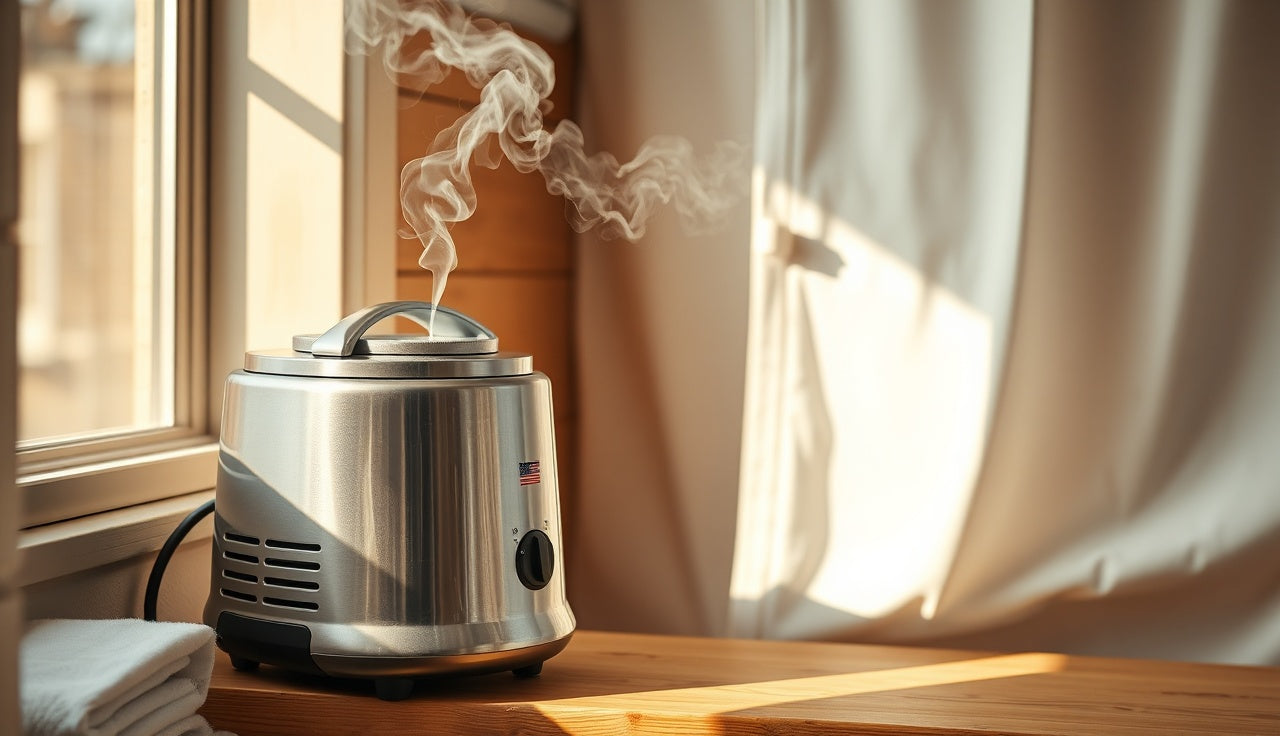
A portable steam generator is a self-contained electric appliance that heats water in a sealed tank, builds pressure, and pushes steam through a hose into a tent, cabinet, or any small enclosed space. That's the whole mechanism. No permanent plumbing, no contractor, and in most cases no dedicated 240V circuit.
The steam it makes is wet steam. The air inside the enclosure climbs to near 100 percent relative humidity at temperatures usually between 105°F and 120°F. That's a real departure from a Finnish dry sauna, which runs hotter (160°F to 200°F) at much lower humidity (10 to 20 percent). If you want that split laid out in full, the sauna vs steam room explainer covers it well.
Portable units live on a spectrum. At the low end you get basic plastic-tank kettles with a nozzle, $80 to $150, built to pair with fold-up fabric tents. At the high end, stainless-steel generators with digital controls, remote timers, and multiple steam outlets run $400 to $600 and can feed a tiled steam shower or a dedicated steam room enclosure. Wattage usually tells you which camp you're in: budget units are 800W to 1,200W, mid-range units are 1,500W to 2,000W, and the serious ones hit 2,500W to 3,000W.
How does a portable steam generator actually work?
Water goes into the tank, either through a fill cap on the unit or a gravity-fed reservoir. A heating element sitting in that water boils it. The steam travels through a hose, usually 5 to 10 feet long, into the enclosure through a steam head or nozzle. Most units add a thermostat that cycles the heater on and off to hold a target temperature, plus a timer that ends the session for you.
The safety part that matters most is the pressure relief valve. If the steam path gets blocked and pressure climbs past a safe threshold, the valve opens and vents steam before anything ruptures. Reputable units carry UL, ETL, or CE certification, which means the pressure relief valve and electrical insulation got tested by a lab that doesn't work for the manufacturer [1].
Fill level matters more than people expect. Run the tank dry with the element on and you can burn out the heater in minutes. That's why an automatic low-water shutoff isn't optional. It's the single feature that separates a unit worth buying from one that isn't. Confirm it's in the spec sheet before you order.
What wattage do I actually need?
For a standard fold-up personal sauna tent (roughly 27 to 35 cubic feet inside), 1,500W is the practical floor if you want a usable 110°F to 115°F within 10 to 15 minutes. This is where most buyers go wrong. They grab an 800W unit thinking it's enough, then wonder why the tent barely gets warm.
An 800W unit will eventually get there. It just takes 25 to 30 minutes and gives up on a cold day.
For a tiled steam shower or a small wood-framed steam room, the industry sizing rule is roughly 1 kW per 45 cubic feet of enclosure volume, plus another 25 to 50 percent for glass walls or exterior walls without insulation [2]. A typical 5x4x8-foot shower is 160 cubic feet, which puts you at a 3.5 kW minimum. A portable unit is the wrong tool for that room. Portable generators earn their keep in small tents and small insulated cabinets, not tile rooms.
One more thing. Standard 120V household outlets in North America run on 15A or 20A circuits. At 120V, 15A gives you 1,800W maximum, and code says stay under 80 percent of that, so 1,440W in practice [3]. A 2,000W unit almost always needs either a 20A dedicated circuit or a 240V outlet. Check your breaker panel before you buy anything above 1,500W.
| Personal sauna tent (30 cu ft) | 1,500 |
| Small insulated cabinet (60 cu ft) | 1,800 |
| Small tiled shower (100 cu ft) | 2,500 |
| Medium shower enclosure (160 cu ft) | 3,500 |
Source: Mr. Steam Residential Sizing Guide (Citation 2) and NEC Article 210 (Citation 3)
What tank size should I look for?
Tank size sets how long you can run the generator before refilling. Most portable units carry between 1.5 and 4 liters. A 2-liter tank at full boil makes steam for roughly 45 to 60 minutes at moderate output, which covers a 20 to 30 minute session with room to spare.
Larger tanks (3 to 4 liters) pay off if you share the sauna with a partner and want back-to-back sessions without stopping to refill and wait for the element to reheat. Smaller tanks (1 to 1.5 liters) are lighter and heat faster, but they're a nuisance for anyone who sessions past 20 minutes.
Watch the water quality. Hard water leaves calcium on the heating element over time, which cuts efficiency and eventually kills the unit. Tanks that come out or drain from the bottom make descaling easy. The standard fix is a vinegar flush every one to two months, tuned to how hard your water is [4]. Skip that step and a $300 generator can die inside a year.
Are portable steam generators safe to use at home?
Yes, when you use one correctly and it carries a legitimate third-party safety certification. The three real hazards are scalding from the steam hose, electrical faults near water, and overheating inside the enclosure.
The CDC notes that hyperthermia risk climbs when core body temperature passes 103°F, and humid heat makes overheating easier because it feels less intense than it is [5]. The practical rule most health practitioners give: keep sessions to 15 to 20 minutes, keep water nearby, and skip the steam if you've been drinking alcohol, if you're pregnant, or if you have uncontrolled cardiovascular disease. Ask your doctor if any of those apply. The research here isn't perfectly clean, but the conservative guidance is consistent.
On the electrical side, plug the unit into a GFCI-protected outlet. NEC Article 680 covers equipment near water, and while it's written for pools and hot tubs, the same GFCI logic applies to any electrical appliance in a humid space [6]. Most modern bathrooms already have GFCI outlets. If yours doesn't, an electrician can add one for $100 to $200.
Keep the steam hose off your skin during the first burst, which is the hottest and most concentrated output. Good units have an insulated hose and a diffuser head that spreads the steam before it hits the air inside.
What are the best portable steam sauna kit setups?
A portable steam sauna kit bundles a generator with a collapsible tent, a folding chair, and a foot pad. These all-in-one kits are the fastest route to a working setup and run $150 to $350 for the full package.
The tents are usually waterproof nylon or Oxford cloth with a zippered opening for your head, so you sit inside with your head out. Interior dimensions vary, but most fit one adult up to about 6 feet 2 inches comfortably. They fold down small enough to stash in a closet. The generator sits outside the tent.
Want to build your own? Pairing a mid-range generator (1,500W to 2,000W) with a separately bought steam tent gets you better component quality at each price point. Tent-only options run $60 to $150. A standalone generator at the same tier costs $120 to $250. Total spend lands close to a kit, but you control every piece.
For where this sits in the wider category, our portable sauna guide puts tent-style and blanket-style options side by side. Steam generators are the wettest and, arguably, the most therapeutic of the portable formats. Infrared blankets and saunas run drier and store easier.
How does steam sauna compare to a traditional dry sauna?
Steam saunas run cooler and wetter. Traditional saunas run hotter and drier. Both trigger a sweat response, and both have research behind them, though the evidence for Finnish dry saunas is larger and goes back further.
A 2018 review in Mayo Clinic Proceedings looked at 40 studies and concluded that "regular sauna bathing is associated with a reduction in the risk of cardiovascular disease events" [7]. That body of evidence comes mostly from Finnish dry sauna research. Steam room studies are fewer, smaller, and more recent. That doesn't mean steam saunas don't work. It means we should be honest that the evidence isn't equivalent.
For breathing, wet steam has a real edge. Inhaling humid air can ease congestion and irritated airways in a way dry heat can't. A 2017 Cochrane review found steam inhalation gives modest short-term relief of nasal congestion and upper respiratory symptoms [8].
On heat stress physiology, the sauna benefits research is worth reading before you pick a format. The honest answer: format matters less than consistency. A steam sauna you use three times a week beats a premium dry sauna you use once a month.
What features separate a good unit from a cheap one?
The gap between a $90 unit and a $250 unit is more than build quality. It's often the difference between a product that runs reliably for three years and one that dies in six months.
Here's how the features stack up across price tiers:
| Feature | Budget ($80-$150) | Mid-range ($150-$300) | Premium ($300-$600) |
|---|---|---|---|
| Tank material | Plastic | Plastic or stainless | Stainless steel |
| Auto shutoff | Sometimes | Yes | Yes |
| Timer | Basic | Digital | Digital + remote |
| Pressure relief valve | Sometimes | Yes | Yes |
| Safety certification | CE (often unverified) | ETL or UL | ETL or UL |
| Hose length | 5 ft | 6-8 ft | 8-10 ft |
| Wattage | 800-1,200W | 1,500-2,000W | 2,000-3,000W |
The auto shutoff and the pressure relief valve are the two features I treat as non-negotiable. Everything else you can trade against your budget.
Stainless steel tanks outlast plastic by a wide margin, especially with hard water and frequent descaling. If you'll use the unit daily or several times a week, spend the extra $80 to $100 for stainless. If it's a once-a-week relaxation habit, plastic is probably fine.
Can I use a portable steam generator with an existing sauna or shower enclosure?
You can, with limits. A portable generator can feed steam into any reasonably airtight small space: a walk-in shower with a glass door, a prefab sauna cabin that never had its own steam system, or a small insulated closet or bathroom converted for the job.
The limit is volume. Portable units top out around 3,000W and are really built for enclosures under about 100 to 120 cubic feet. A standard master bathroom is 200 to 300 cubic feet, so a portable won't meaningfully heat the whole room. You'd have to close off a smaller pocket.
For a traditional dry sauna cabin (the kind you'd find in a home sauna setup), running a portable generator's hose through a small port in the door is a common DIY trick for adding steam. It works, but it changes the heat profile a lot. Purists will say it wrecks the dry heat experience. For a plain sweat session, it's fine.
If you're eyeing a permanent steam setup for a tiled shower room, a portable is a stopgap, not the answer. Residential built-in steam generators from brands like Mr. Steam or Steamist start around $600 to $800 for the generator alone and are designed for permanent installation with dedicated plumbing and electrical. For a dedicated steam room, that's the right path.
What does a portable steam generator cost, and what affects the price?
The real range is $80 to $600, and you get what you pay for, but only up to about $350. Above that, you're mostly paying for brand names and premium finishes on units that do the same job as a $250 model.
Primary cost drivers:
1. Wattage. Higher-wattage units need bigger heating elements and heavier electrical parts. Jumping from 1,500W to 3,000W usually adds $100 to $200.
2. Tank material and capacity. Stainless tanks cost more to make than plastic. A 4-liter stainless unit runs more than a 2-liter plastic one at the same wattage.
3. Control system. Analog knobs are cheap. A digital display with Wi-Fi and a phone app adds $50 to $150 to the build.
4. Safety certifications. ETL and UL certification carry testing fees and ongoing factory audits, so certified units cost more. That cost is worth it.
A practical budget: for a solid daily-use portable unit and a sauna tent, plan on $180 to $280. That buys 1,500W to 2,000W, a stainless or semi-stainless tank, ETL or UL certification, auto shutoff, a digital timer, and a pressure relief valve. Below $150, you're accepting real tradeoffs in safety features. Above $350, you're mostly buying upgrades most people won't notice.
SweatDecks carries a curated selection of portable steam generators and full portable steam sauna kits if you want to compare current pricing across those tiers in one place.
How do I set up and maintain a portable steam generator?
Setup is genuinely simple. Fill the tank to the max line, connect the steam hose to the output port, route the hose into your enclosure through a small opening, plug the unit into a GFCI outlet, set the timer, and turn it on. Most units need 5 to 15 minutes to build steam pressure before the enclosure starts warming, so budget that time.
A few setup details that matter:
Keep the generator on a flat, stable surface lower than the steam outlet in the enclosure. This stops condensation from running back down the hose into the heating element, which causes electrical faults over time.
Don't leave the hose kinked. A kink restricts flow and lets pressure build in the tank faster than the relief valve expects.
Maintenance is mostly descaling. The standard protocol: fill the tank with equal parts white vinegar and water, run it 20 to 30 minutes, drain, then flush twice with clean water. Do this every four to eight weeks depending on your water hardness [4]. On very hard municipal water, a $20 to $40 inline filter on the fill side stretches the element's life a lot.
Store the unit with the tank drained and the cap open if it'll sit unused more than a week or two. Stagnant water grows biofilm that clogs the nozzle and smells foul when heated.
Is a portable steam generator worth it compared to a gym membership or spa?
A mid-range portable steam kit costs $200 to $350. A gym membership with steam room access runs $40 to $100 a month in most U.S. markets. A spa steam session is $30 to $80 a visit.
Use it twice a week and a $280 home setup pays for itself in two to four months against gym or spa costs. The math is that simple.
The less obvious value is convenience. You use it more when it's in your house. Friction kills wellness habits, and cutting the drive to the gym removes the biggest friction point. Research on exercise adherence consistently finds proximity to facilities one of the strongest predictors of consistent use, and the same logic carries over here [9].
The honest counterpoint: a tent-based steam setup is not the same experience as a beautifully tiled commercial steam room. The tent feels utilitarian. If the sensory experience matters a lot and you have the space and budget, a full home sauna or permanent steam room is the better long-term buy. For most people testing steam therapy for the first time, a portable unit is a low-risk way to find out if you'll actually stick with it before spending $5,000 or more on a permanent install.
SweatDecks has a full guide to sauna benefits if you want to go deeper on the health evidence before committing to any format.
Can I combine a portable steam generator with cold plunge therapy?
Yes, and contrast therapy (heat then cold) has a real research base. The usual structure is 10 to 20 minutes of heat, then 1 to 3 minutes of cold immersion or a cold shower, repeated two to three rounds. That's the pattern in most published contrast studies.
A 2021 study in the Journal of Physiology found cold water immersion after heat exposure produced larger drops in perceived muscle soreness than heat alone [10]. The size of the effect varied by person, and the researchers noted the ideal temperature gap and timing aren't fully settled.
For a home setup, a portable steam generator paired with a portable cold plunge tub or even a cold shower gives you a full contrast station without a renovation. The ice bath and cold plunge benefits articles here cover the cold side in detail.
One practical note. Don't jump straight from a hot steam session into very cold water without a brief transition if you have any cardiovascular concerns. The rapid swing spikes blood pressure. A 30 to 60 second cooldown before cold immersion is a reasonable buffer. Check with your doctor if you have heart disease, hypertension, or arrhythmia.
Frequently asked questions
How long does it take a portable steam generator to heat up a sauna tent?
Most 1,500W to 2,000W units reach a usable 100°F to 110°F inside a standard sauna tent in 10 to 15 minutes. Budget 800W to 1,200W units take 20 to 30 minutes. Cold ambient temperatures (below 60°F) slow warm-up further. Pre-warming the tent by running it empty for 5 minutes before you get in helps.
Can I add essential oils or aromatherapy to a portable steam generator?
Only if the manufacturer explicitly allows it and the unit has a dedicated aromatherapy port or tray. Putting oils straight into the water tank damages heating elements and voids warranties. Many tents have a separate aromatic basin that sits near the steam outlet, which is the right way to add scent. Never put oils into the boiler.
What's the difference between a portable steam generator and an infrared sauna blanket?
A steam generator makes wet humid heat at 100 to 120°F. An infrared blanket uses radiant heat at similar skin temperatures but with dry air. Steam is better for respiratory relief and skin hydration. Infrared blankets store and set up easier, and they need no tent enclosure. Both trigger a sweat response, but they feel very different.
Do portable steam generators need to be professionally installed?
No. Plug-and-play is the point. You fill the tank, connect the hose, and plug into a standard 120V GFCI outlet for units up to about 1,500W. Units above 1,500W may need a 20A circuit. Units above 2,000W often need a 240V outlet, which does require an electrician if you don't already have one. Check the spec sheet before buying.
How often should I clean or descale my portable steam generator?
Every four to eight weeks for average use, more often with hard water. The standard method is a 50/50 white vinegar and water flush: fill the tank, run it 20 to 30 minutes, drain, then flush twice with clean water. Skipping it lets calcium build on the element, cutting efficiency and eventually causing early failure. An inline filter helps if your tap water is very hard.
Is steam sauna good for skin?
Steam raises skin hydration and surface circulation, which can temporarily improve skin appearance and texture. Some dermatologists use controlled steam in facials for this reason. There's no strong clinical evidence that regular steam sauna cures specific skin conditions, but the hydration effect is real and well documented. Keep sessions under 20 minutes and moisturize afterward so you don't lose moisture once you cool down.
Can I use a portable steam generator outdoors?
In a protected area, yes. The generator has to sit on a dry, flat surface and must stay dry. Using a tent outdoors in shade, on a deck or patio, in warm weather works well. Cold or windy conditions make it hard for the tent to hold heat, and the generator works much harder. Rain or direct water on the unit is a safety hazard. Never use it in standing water.
What's the best portable steam generator for a small bathroom steam shower?
A portable unit can work in a small tiled shower if the enclosure is under 80 to 100 cubic feet and the door seals reasonably well. You'd want a 2,000W to 3,000W unit, which likely needs a 20A or 240V circuit. For anything larger, or for daily permanent use, a built-in residential steam generator is the better buy. Portable units in showers also produce more condensation cleanup than tent setups.
Are portable steam saunas effective for muscle recovery?
Heat therapy raises local blood flow and can reduce perceived muscle soreness. A 2015 review in the Journal of Athletic Training found heat application effective for delayed-onset muscle soreness, though most studies used direct heat pads rather than whole-body steam. Whole-body sauna research shows similar mechanisms. Steam saunas are plausible for recovery, but the evidence is thinner than for dry heat or contrast therapy.
What safety certifications should I look for on a portable steam generator?
Look for ETL or UL certification for North American use. These mean an independent lab tested the unit's electrical insulation, pressure relief valve, and thermal cutoff. CE marking is common on imported units but is self-certified and less rigorous than ETL or UL. A unit with none of these certifications is a risk not worth taking around water and electricity.
How much electricity does a portable steam generator use per session?
A 1,500W unit running 30 minutes uses 0.75 kWh. At the U.S. average residential rate of about 16 cents per kWh in 2024, that's roughly 12 cents a session. Even a 3,000W unit running 45 minutes costs about 36 cents. Electricity cost is not a meaningful factor in owning one.
Can two people use a portable steam sauna at the same time?
Most portable tent setups are single-person, built for one adult in a folding chair. Some larger tents advertise two-person capacity, but the space is tight and the generator often struggles to hold temperature for double the load. For a genuine two-person steam session, a permanent steam room or a larger purpose-built cabin is the more practical path.
What is the lifespan of a portable steam generator?
With regular descaling and draining the tank after each session, a mid-range unit should last three to five years of moderate use (two to three sessions a week). Budget plastic-tank units often fail within one to two years even with good care. The heating element and the pressure relief valve are the most common failure points. Stainless-tank units consistently outlast plastic ones.
Does a portable steam generator tent count as a real sauna?
It depends on your definition. It produces a genuine heat and sweat response and delivers many of the same physiological effects. Technically it's a steam bath, not a Finnish dry sauna. For most casual users the distinction doesn't matter. Competitive athletes or people following sauna research protocols (which mostly use dry heat) may want a home sauna or outdoor sauna setup instead.
Sources
- Intertek (ETL) – ETL Listed Mark overview: ETL and UL certification require independent laboratory testing of electrical insulation, pressure relief valves, and thermal cutoffs on electric appliances.
- Mr. Steam – Residential Steam Generator Sizing Guide: Industry-standard steam room sizing formula: approximately 1 kW per 45 cubic feet, plus 25-50 percent added for glass or uninsulated walls.
- U.S. National Electrical Code (NEC) Article 210 – Branch Circuits: NEC Article 210 requires that continuous loads not exceed 80 percent of branch circuit ampere rating; a 15A/120V circuit allows a maximum continuous draw of 1,440W.
- U.S. Geological Survey – Hardness of Water: Hard water deposits calcium carbonate on heating elements; the USGS defines hard water as over 120 mg/L calcium carbonate, which is common in many U.S. municipal systems.
- CDC – Extreme Heat and Heat Stress: CDC states hyperthermia risk rises when core body temperature exceeds 103°F and that humid heat environments accelerate heat accumulation.
- National Electrical Code Article 680 – Swimming Pools, Fountains, and Similar Installations: NEC Article 680 requires GFCI protection for electrical equipment near water; the same principle applies to humid steam environments adjacent to electrical appliances.
- Mayo Clinic Proceedings – 'Cardiovascular and Other Health Benefits of Sauna Bathing' (2018): A 2018 review of 40 studies concluded that 'regular sauna bathing is associated with a reduction in the risk of cardiovascular disease events.'
- Cochrane Database of Systematic Reviews – 'Steam inhalation for acute upper respiratory tract infections' (2017): Cochrane 2017 review found steam inhalation provides modest short-term relief of nasal congestion and upper respiratory symptoms, though effect sizes vary.
- American Journal of Preventive Medicine – 'Proximity to physical activity facilities and exercise frequency' (2010): Research consistently identifies physical proximity to fitness facilities as one of the strongest predictors of exercise adherence and consistent use.
- Journal of Physiology – 'Cold water immersion and recovery from exercise-induced muscle damage' (2021): A 2021 study found cold water immersion following heat exposure produced greater reductions in perceived muscle soreness compared to heat exposure alone.
- U.S. Energy Information Administration – Average Retail Price of Electricity (2024): EIA reports the U.S. average residential electricity rate was approximately 16 cents per kWh in 2024.
- Journal of Athletic Training – 'Heat Therapy for Delayed Onset Muscle Soreness' (2015): A 2015 review found heat application effective for reducing delayed-onset muscle soreness, primarily based on studies using direct heat application.

Share:
Portable personal sauna: what to buy and what to skip
Portable personal sauna: what to buy and what to skip