
Last updated 2026-07-09
TL;DR
A portable personal sauna is a freestanding, temporary heat enclosure you set up at home without construction. Styles range from fabric steam tents ($100, $300) to infrared pop-up pods ($200, $800). They deliver genuine heat exposure, but performance varies wildly by type. This guide covers every style, what the science supports, what to spend, and what's not worth your money.
What exactly is a portable personal sauna?
A portable personal sauna is any heat enclosure built for one person that needs no permanent installation. You set it up, use it, and store it. That's the whole category.
The word "portable" covers a lot of ground. At the cheap end you have fabric steam tents that fold flat like a camping chair. In the middle you have infrared pop-up pods with carbon or ceramic heating panels built into the walls. At the upper end there are collapsible barrel-style saunas made from real wood that assemble without tools but still weigh under 100 pounds. What ties them together is that none require a building permit, an electrician, or a contractor.
The distinction that matters most for results isn't size or style. It's heat type. Steam tents use a separate electric steam generator to fill the enclosure with wet heat, reaching 110 to 120°F (43 to 49°C) inside. Infrared pods use electrical heating panels to emit radiant energy that warms your body directly, usually at a lower air temperature of 110 to 140°F (43 to 60°C). Traditional dry heat portables are rare because it's genuinely hard to reach the 160 to 190°F (71 to 88°C) range Finnish-style sessions demand without a proper insulated structure and a real sauna heater.
If you're used to a home sauna or a gym sauna, adjust your expectations. Portables can get hot enough to produce meaningful sweat and physiological responses, but they won't match the air temperature or the steam-and-ladle ritual of a full outdoor sauna. That doesn't make them useless. It means you need to know what you're buying.
What are the different types of portable personal saunas?
There are four types worth knowing. Everything else is a variation on these.
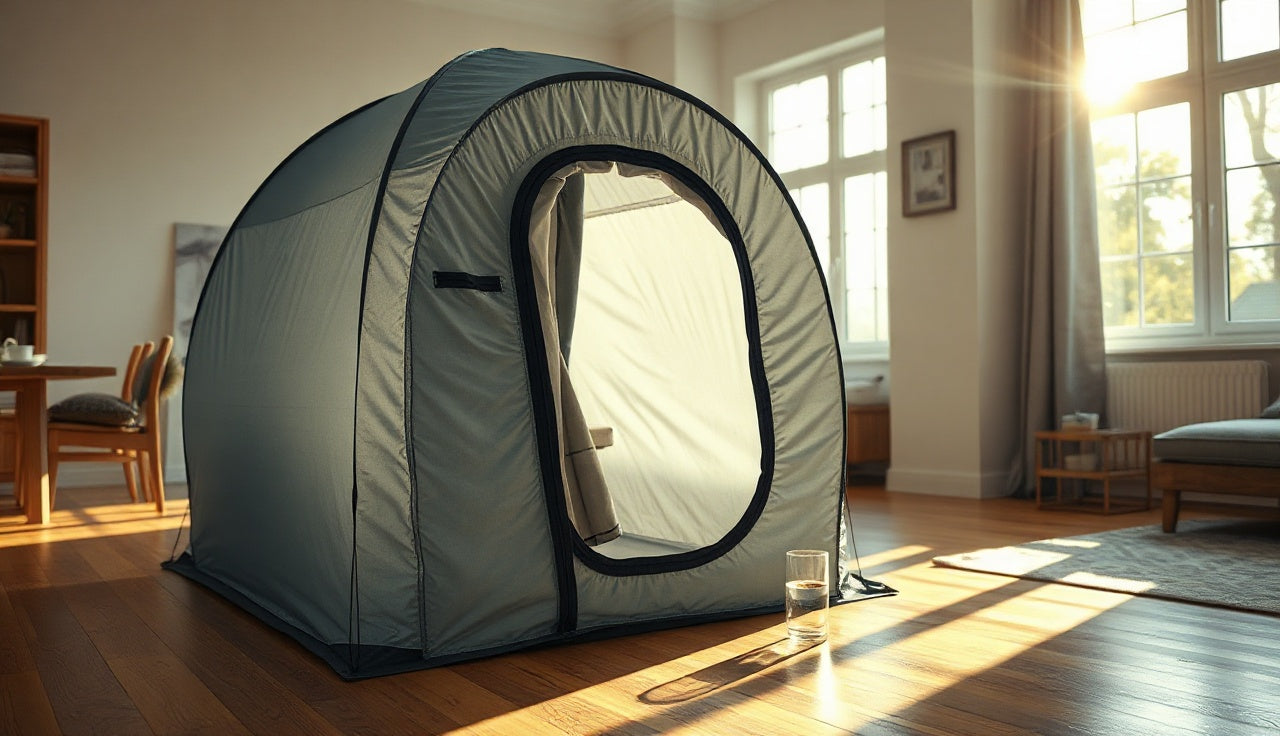
Steam tent saunas. A collapsible fabric enclosure, usually nylon or polyester, with a zippered opening for your head. A small electric steam generator sits outside and pipes steam in through a hose. Setup takes 5 to 10 minutes, heat-up is 10 to 15 minutes. Prices run $100, $300. They work. The air inside gets humid and hot quickly, and you will sweat. The drawbacks are real: the fabric doesn't hold heat well, the steam generator runs out of water in 20 to 30 minutes, and you're sitting on a small stool with your arms trapped inside the bag, which gets old fast.
Infrared pop-up pods. These look like a sleeping bag crossed with a tent. Carbon fiber or ceramic heating panels are sewn into the walls and connected to a control box. You zip yourself in with your head out, run the panels for 20 to 40 minutes, and the radiant heat does its work. Prices range $200, $500. No steam, no humidity, quieter experience. The limitation is panel output: most consumer units top out at 150W, 300W total, which is modest next to even the smallest purpose-built infrared sauna cabin.
Collapsible wood-frame saunas. These sit at the top of the portable market. They use real hemlock or spruce panels that slot together without tools, an actual electric sauna heater (1 to 2kW), and proper insulation. Setup takes 30 to 60 minutes. Some models weigh 60 to 90 lbs and need a standard 120V or 240V outlet depending on the heater. Prices are $400, $900. These are the closest thing to a real sauna in a portable form, and they perform noticeably better than fabric options.
Sauna blankets. Technically portable infrared devices, they deserve their own mention. You lie inside a quilted blanket with infrared panels, similar to an infrared pod but horizontal. Prices are $150, $600. They heat efficiently and store easily, but the experience is passive and prone to overheating at contact points. They're a reasonable entry point if your space is tight.
For a broader look at how these compare to the full portable sauna market, including two-person options, that guide covers it in more depth.
What does the research say about portable sauna health benefits?
The honest answer is that most of the strong research on sauna benefits used traditional Finnish dry saunas at 80 to 100°C, not portable steam tents or infrared pods. Don't assume the findings transfer perfectly.
That said, the underlying mechanism is heat stress and core temperature elevation. If a portable sauna raises your core temperature meaningfully, similar physiological responses likely follow. The question is whether they actually do that.
The most-cited Finnish cohort study, published in JAMA Internal Medicine in 2015, followed 2,315 middle-aged men and found that frequent sauna use (4 to 7 sessions per week) was associated with significantly lower rates of cardiovascular disease mortality compared to once-weekly use [1]. The sessions in that study were traditional Finnish saunas at roughly 80°C (176°F). Most portable steam tents don't come close to that temperature.
For infrared specifically, a 2018 review in Evidence-Based Complementary and Alternative Medicine looked at studies on infrared sauna therapy and found evidence for short-term benefit in heart failure, chronic pain, and fatigue conditions, but the authors noted study quality was generally low and sample sizes were small [2]. Nobody has good comparative data on fabric tents versus wood-frame infrared cabins versus traditional saunas in the same subjects.
What the evidence does support across heat modalities: passive heat exposure raises heart rate (studies show increases of 50 to 70% above resting in traditional sauna) [3], promotes sweating and mild cardiovascular work, and may support recovery from exercise by increasing blood flow to muscle tissue. Core temperature typically rises 1 to 2°C in a standard 20-minute session at sufficient heat.
For the full picture on what sauna research looks like across modalities, the sauna benefits breakdown goes deeper into the specific studies.
If you're pairing heat sessions with cold exposure, as contrast therapy protocols suggest, the cold plunge benefits article covers what the research says on the cold side of that equation.
| Traditional Finnish sauna (benchmark) | 185 |
| Collapsible wood-frame portable | 150 |
| Steam tent sauna | 115 |
| Infrared pod (air temp) | 105 |
| Sauna blanket (air temp) | 100 |
Source: Finnish Sauna Society temperature specifications [4]; consumer product testing ranges [2]
How hot do portable personal saunas actually get?
This is where marketing and reality diverge the most.
Steam tent manufacturers often claim interior temperatures of 130 to 150°F (54 to 65°C). Those numbers are achievable in the air near the steam inlet. The temperature six inches from your skin, inside the tent with your body radiating heat outward, is usually lower. Independent thermal gun measurements from sauna enthusiast communities consistently put steam tents at 100 to 120°F (38 to 49°C) ambient inside the enclosure once stabilized.
Infrared pods barely heat the air. They heat your body through radiant emission. Air temperature inside an infrared pod is often only 90 to 110°F (32 to 43°C), which sounds low, but the radiant component makes you sweat anyway. It's a genuinely different sensation from convective heat.
Collapsible wood-frame saunas with a real electric heater can hit 140 to 160°F (60 to 71°C) at seating level, which lands in the range of performance saunas. They're the only portable style that approaches that threshold reliably.
For reference, the Finnish Sauna Society specifies traditional sauna temperatures of 80 to 100°C (176 to 212°F) at head level [4]. No mainstream portable product reliably reaches that. The gap matters if you're chasing specific physiological outcomes tied to high-heat research. It matters less if your goal is to sweat regularly, ease muscle tension, and enjoy a wind-down ritual. Plenty of people find even a 115°F steam tent session genuinely relaxing and worth the money.
How much does a portable personal sauna cost?
Prices across the category look like this:
| Type | Price range | Heat type | Setup time | Durability |
|---|---|---|---|---|
| Steam tent | $100, $300 | Wet/steam | 5 to 10 min | Low (1 to 3 years) |
| Sauna blanket | $150, $600 | Infrared radiant | 2 to 5 min | Medium (2 to 4 years) |
| Infrared pod | $200, $500 | Infrared radiant | 5 to 15 min | Medium (2 to 5 years) |
| Collapsible wood-frame | $400, $900 | Electric dry/radiant | 30 to 60 min | High (5 to 10+ years) |
The $100 steam tent and the $800 wood-frame collapsible are both technically "portable personal saunas." They are not remotely comparable experiences. Cheap tents use thin fabric, underpowered steam generators that putter out mid-session, and wobbly frames. Mid-range infrared pods from established manufacturers run more consistently but stay limited by their panel output.
Running costs matter too. A steam tent generator draws about 600 to 800W. An infrared pod draws 150 to 300W. A wood-frame sauna with a 1.5kW heater draws 1,500W. At the US average residential electricity rate of 16.3 cents per kWh (as of early 2024, per the U.S. Energy Information Administration) [5], a 30-minute session in a 1,500W sauna costs roughly 12 cents. Even daily sessions add less than $4 per month in electricity. Running costs are not a real factor in your decision.
Where people overspend: cheap infrared pods from no-name brands with weak panels, poor EMF shielding, and no customer support. Where people underspend and regret it: buying the cheapest steam tent and abandoning it after three weeks because the steam generator keeps running dry mid-session.
Is a portable sauna safe to use at home?
Generally yes, with real caveats.
The electrical safety part is straightforward. Steam tent generators and most infrared pods run on standard 120V outlets and draw under 1,500W. Collapsible wood-frame saunas with larger heaters may need a 240V outlet, same as a dryer. Check the spec sheet before you buy. Never run any sauna appliance on an extension cord. Plug directly into a wall outlet.
Fire risk is low if the unit is used as directed. Keep all fabric components away from the heating element. Don't leave any portable sauna running unattended. Most units have auto-shutoff timers at 30 to 60 minutes.
The physiological cautions matter more than the electrical ones. Heat stress raises heart rate and blood pressure at first, before vasodilation kicks in. People with uncontrolled hypertension, heart arrhythmias, or who are pregnant should talk to a physician before using any sauna regularly [3]. Alcohol before or during sauna use sharply raises the risk of hypotension and collapse. The Finnish population data shows most cardiovascular incidents associated with sauna happen alongside alcohol, not heat alone [1].
Dehydration is real. Sweat losses in a 20-minute session can run 0.5 to 1.0 liters. Drink water before and after. This is not complicated, but people skip it.
For children and elderly users, shorter sessions and lower temperatures are appropriate. Kids under 2 should not use saunas. The National Center for Health Statistics does not publish specific pediatric sauna guidelines, but general hyperthermia risk in children is well-documented in pediatric emergency literature.
EMF exposure from infrared panels is a common concern. Most reputable infrared sauna manufacturers publish third-party EMF test results showing emissions in the low-milligauss range at body distance. The FCC does not specifically regulate infrared sauna EMF, and the research on low-level EMF health effects remains inconclusive. If this matters to you, look for published test data from the specific manufacturer.
What should you look for when buying a portable personal sauna?
Five things matter. Everything else is noise.
Heater or panel wattage. This is the single most predictive spec. A steam generator under 800W will run dry before you're done. An infrared pod under 200W total panel output will feel underwhelming. A wood-frame collapsible sauna needs at least 1,000W to heat properly.
Material quality. For steam tents, nylon holds up better than polyester over time and handles moisture better. For infrared pods, look for carbon fiber panels over cheap ceramic rods because they emit more evenly and last longer. For wood-frame units, hemlock and spruce are the standards. Avoid anything described as "engineered wood" in a heat environment.
Size and interior space. You should be able to sit comfortably with your arms at your sides and room to breathe. Most single-person steam tents feel cramped if you're over 5'10" or broad-shouldered. Check interior dimensions, not exterior.
Session timer and safety shutoff. Non-negotiable. If a unit has no automatic shutoff, don't buy it.
Warranty and brand support. A $250 infrared pod from a brand with no customer service number and no US address is a gamble. Longer warranties (2+ years) and domestic support contacts are worth a small premium.
Things that don't matter much: the number of color therapy LED modes (nice to have, not a reason to pick one unit over another), the exact shape of the tent, the built-in foot massager (usually weak and distracting), and most "negative ion" claims.
SweatDecks carries a curated selection of infrared and steam portable options with verified wattage specs and published EMF data. Worth checking before you dig through the noise on general retail sites.
How does a portable personal sauna compare to a home sauna?
Bluntly: a portable personal sauna is to a home sauna what a camping stove is to a kitchen range. Both cook food. One does it faster, more reliably, and with less friction.
A purpose-built home sauna, whether a barrel sauna in the backyard or an indoor infrared cabin, reaches higher temperatures, holds them more steadily, and gives you a more comfortable, immersive session. Construction or installation costs start around $3,000 on the low end and run to $20,000+ for custom builds. They stay put.
A portable personal sauna costs $100, $900, takes minutes to set up, stores in a closet, and travels. If you rent, move often, or genuinely aren't sure you'll stick with regular sauna use, starting portable is the sensible call. Plenty of people who start with a portable unit and build a consistent habit invest in a permanent setup later.
The other comparison that matters is sauna vs steam room. Steam tents are essentially personal steam rooms. If you prefer wet heat and high humidity, a steam tent will feel more familiar. If you prefer dry heat, an infrared pod or collapsible wood-frame unit is closer to the sauna experience you know from gyms.
For people comparing sauna styles across the full spectrum, including traditional Finnish, far-infrared, near-infrared, and steam, that overview covers the category from the ground up.
Can you use a portable sauna for cold and heat contrast therapy?
Contrast therapy, alternating heat and cold exposure, is a real protocol with supporting research. A 2013 meta-analysis in Sports Medicine found that contrast water therapy reduced muscle soreness more effectively than passive recovery [6]. The mechanism involves alternating vasodilation from heat and vasoconstriction from cold, driving circulation changes in muscle tissue.
A portable sauna fits into a contrast setup easily. The typical protocol is 10 to 15 minutes of heat followed by 1 to 3 minutes of cold, repeated 2 to 4 times. You can do that with a portable steam tent and a cold shower, or with a portable sauna and a cold plunge or ice bath.
The practical challenge is transition time. With a permanent sauna, you walk out and step into a cold plunge. With a portable steam tent, you unzip, stand up from a cramped stool, and then get to the cold. It adds a minute or two. Not disqualifying, just less elegant.
Collapsible wood-frame saunas are the most practical for contrast therapy because you can place them next to an outdoor cold plunge and the transition is nearly as clean as a permanent setup. Steam tents and infrared pods are harder to integrate spatially but still workable if you're using a cold shower.
The cold side is where investment pays off most. A quality cold plunge holds precise temperature far better than a tub full of ice. If you're serious about contrast protocols, spend on the cold equipment before you spend more on the heat equipment.
What are the downsides of portable personal saunas that nobody talks about?
The honest list.
They're uncomfortable in ways photos hide. Sitting on a small wooden stool with your arms inside a fabric bag for 20 minutes is not the same as sitting on a wide bench with room to stretch. Your wrists are hot, your hands are sweating, and you can't comfortably read, use your phone, or even fully relax your shoulders. Some people adapt fast. Others abandon their tent after two weeks.
Steam generators need maintenance. Mineral deposits from tap water build up inside the boiler. Descale it every 1 to 3 months depending on your water hardness. Most owners don't. The generator then underperforms or fails early. Distilled or filtered water extends the life dramatically.
Fabric degrades in humid heat. Most steam tents grow mold or mildew within the first year if you don't dry them out completely after every session. That means unzipping and airing out for 30 to 60 minutes, not folding it up damp and shoving it in a closet. That step takes discipline.
Infrared pods heat unevenly. Most have panels on the back and sides but not the front. The part of your body facing the open front of the pod gets less radiant heat. Some people fix this by rotating mid-session or using a reflective blanket.
Nobody makes a portable that smells like a real wood sauna. The scent of hot cedar or hemlock, that specific smell of a hot room, doesn't happen in a nylon tent. Minor for some, dealbreaker for others.
And this one is practical: they look strange in living spaces. A fabric tent half-deployed in your bedroom is not neutral decor. If how your home looks matters to you, think about that before you buy.
How should you use a portable personal sauna for best results?
Consistency matters more than session length. Three or four 20-minute sessions per week beats one 45-minute heroic session on Sundays.
For a steam tent or infrared pod, 15 to 30 minutes per session suits most healthy adults. Start with 15 minutes if you're new to heat exposure and build up over two to three weeks. If you feel dizzy, nauseated, or your heart rate feels irregular, stop and cool down. Those are not signals to push through.
Hydrate before you start. 16 oz of water in the 30 minutes before a session is a reasonable baseline. Keep water within reach during the session if the design allows.
For the best physiological response, use the sauna a couple of hours after intense exercise rather than right before. Post-exercise heat may support recovery, but the research on timing is not settled. If your main goal is relaxation and stress reduction, evening sessions work well. If your goal is cardiovascular adaptation, morning sessions or post-workout timing are both plausible.
Preheat for the full recommended time before you get in. A steam tent that hasn't reached temperature when you step in will never catch up, because your body's cooling competes with the heater. Most units need 10 to 15 minutes to properly pre-heat.
After each session, drink water, rest for 5 to 10 minutes before resuming activity, and if you're doing contrast therapy, move to the cold within 2 to 3 minutes of exiting the heat to hold the temperature differential.
Frequently asked questions
Do portable personal saunas actually work?
Yes, with realistic expectations. Steam tents and infrared pods raise skin temperature, cause sweating, and produce a mild cardiovascular response in most users. They won't match the 180°F air temperature of a traditional Finnish sauna, but they produce genuine heat stress. The evidence for health benefits is strongest for high-temperature traditional saunas, but regular use of portable units at lower temperatures still produces meaningful sweat sessions.
How long does it take to set up a portable personal sauna?
A steam tent takes 5 to 10 minutes to physically assemble and another 10 to 15 minutes to pre-heat. Infrared pods take 5 to 15 minutes to set up and heat up faster because they use radiant panels, not air heating. Collapsible wood-frame saunas take 30 to 60 minutes to assemble the first time, then 10 to 15 minutes for subsequent setups once you know the system.
Can I use a portable sauna every day?
Healthy adults can use a portable sauna daily. The Finnish cohort study associated 4 to 7 sessions per week with better cardiovascular outcomes than once per week. Start with 3 to 4 sessions weekly if you're new to regular heat exposure, and rehydrate after every session. Daily use is fine long-term for most people, but pay attention to how your body responds in the first few weeks.
What's the difference between an infrared sauna blanket and a portable sauna pod?
A sauna blanket has you lying down inside a quilted infrared wrap. A pod has you sitting with your head out of the enclosure. Blankets store easier and may heat more efficiently at contact points, but they can feel hot and constricting against your skin. Pods allow a more natural seated posture and airflow around your body. Both use infrared panels and reach similar temperatures.
Are portable saunas safe for people with high blood pressure?
Heat exposure initially raises blood pressure before vasodilation lowers it, so people with uncontrolled hypertension should consult a physician before regular sauna use. The Finnish population research showed the strongest benefits in people without pre-existing conditions. If your blood pressure is managed and stable, short sessions (10 to 15 minutes) at lower temperatures with physician approval are generally considered low-risk, but this isn't medical advice.
How much electricity does a portable sauna use?
Steam generators draw 600 to 800W. Infrared pods draw 150 to 300W. Wood-frame collapsible saunas with a real heater draw 1,000 to 1,500W. At the US average residential rate of 16.3 cents per kWh, a 30-minute session in a 1,500W unit costs about 12 cents. Even daily use adds under $4 per month in electricity, making running costs essentially a non-factor in the buying decision.
Can you use a portable sauna outdoors?
Technically yes, but with limits. Steam tents and infrared pods lose heat faster in cold outdoor air and were designed for indoor use. A collapsible wood-frame sauna performs better outdoors because it has real insulation. Any portable sauna used outdoors needs protection from wind and precipitation, and you need an outdoor-rated extension situation or a nearby outlet. Most manufacturers don't rate their products for year-round outdoor exposure.
What's the best portable personal sauna for a small apartment?
A sauna blanket or compact infrared pod makes the most sense for small apartments. Both store in a bag or closet, need only a standard outlet, and take under 10 minutes to deploy. Steam tents require more floor space during use and need ventilation to prevent moisture buildup in a small room. If moisture is a concern, an infrared blanket or pod avoids the humidity issue entirely.
How do I clean and maintain a portable personal sauna?
Steam tents need to be fully aired out after every session to prevent mold, and the steam generator needs descaling every 1 to 3 months depending on water hardness. Filtered or distilled water extends generator life. Infrared pods can be wiped down with a damp cloth. Wood-frame units should be aired after use and any wooden components wiped dry. Never use chemical cleaners inside any sauna enclosure.
Is a portable sauna worth it compared to a gym sauna membership?
A gym membership that includes sauna access typically runs $30, $80 per month. A quality portable sauna costs $200, $900 and pays for itself in 3 to 12 months of equivalent gym costs. The convenience of daily home access, no commute, and no shared space often makes the home unit more valuable long-term even if the experience is somewhat inferior to a full commercial sauna.
What temperature should a portable personal sauna reach?
Most steam tents reach 100 to 120°F (38 to 49°C) inside. Infrared pods reach similar air temperatures but feel hotter because they warm the body directly. Collapsible wood-frame saunas with real heaters can reach 140 to 160°F (60 to 71°C). For comparison, the Finnish Sauna Society specifies 80 to 100°C (176 to 212°F) for traditional saunas. Portables operate below that range, worth knowing if you're targeting specific research-backed heat thresholds.
Can I use essential oils in a portable sauna?
In a steam tent, yes: add a few drops of eucalyptus or peppermint oil to the steam generator's water reservoir and the vapor carries the scent. In an infrared pod or blanket, keep oils away from the electrical components. You can apply diluted essential oils to your skin before an infrared session or place a towel with oils inside the enclosure, but never put liquids into the electrical panel system.
How does a portable sauna compare to a sweat suit?
A sweat suit traps body heat against your skin to raise surface temperature, while a portable sauna heats an external environment that then heats your body. Both cause sweating but through different mechanisms. Sweat suits are cheaper and more portable but offer no temperature control and carry higher risk of overheating with intense exercise. Portable saunas provide controlled passive heat exposure. For a detailed comparison, the sweat suits guide covers how they stack up.
Sources
- JAMA Internal Medicine, Laukkanen et al. 2015, 'Association Between Sauna Bathing and Fatal Cardiovascular and All-Cause Mortality Events': Finnish cohort of 2,315 men; frequent sauna use (4-7x/week) associated with significantly lower cardiovascular disease mortality compared to once weekly use
- Evidence-Based Complementary and Alternative Medicine, Oosterveld et al. review on infrared sauna therapy: Infrared sauna therapy showed evidence for short-term benefit in heart failure, chronic pain, and fatigue; authors noted generally low study quality and small sample sizes
- Mayo Clinic Proceedings, Laukkanen & Laukkanen 2018, 'Sauna bathing and systemic inflammation': Heat exposure raises heart rate 50-70% above resting in traditional sauna; caution advised for people with uncontrolled hypertension and cardiac arrhythmias
- Finnish Sauna Society, official temperature specifications: Finnish Sauna Society specifies traditional sauna temperatures of 80-100°C (176-212°F) at head level
- U.S. Energy Information Administration, Electric Power Monthly, residential electricity rates: Average US residential electricity rate of approximately 16.3 cents per kWh as of early 2024
- Sports Medicine, Bieuzen et al. 2013 meta-analysis, 'Contrast Water Therapy and Exercise Induced Muscle Damage': Contrast water therapy reduced muscle soreness more effectively than passive recovery in meta-analysis
- Centers for Disease Control and Prevention (CDC), Heat Stress information page: Heat stress physiological responses including core temperature elevation and associated health cautions
- National Institutes of Health, National Library of Medicine, PubMed overview of sauna health research: Repository of peer-reviewed studies on sauna use, infrared therapy, and heat exposure health outcomes
- U.S. Consumer Product Safety Commission, Electric Appliance Safety Standards: Safety guidance for electric heat appliances including requirements for automatic shutoff and electrical rating compliance
- American College of Sports Medicine, Position Stand on Exercise and Fluid Replacement: Sweat loss during heat exposure sessions can run 0.5-1.0 liters per 20-minute session; pre-hydration guidance
Share:
Portable steam generator for sauna: the complete buyer's guide
Portable steam generator for sauna: the complete buyer's guide