
Last updated 2026-07-09
TL;DR
A portable sauna steamer is a small electric steam generator that pumps moist heat into a collapsible tent, pushing the interior to roughly 110 to 130°F in 5 to 10 minutes. Units cost $50 to $200. They're a legitimate low-cost way to try heat therapy, though they run wetter and cooler than traditional saunas and carry real burn and electrical risks worth respecting.
What is a portable sauna steamer, exactly?
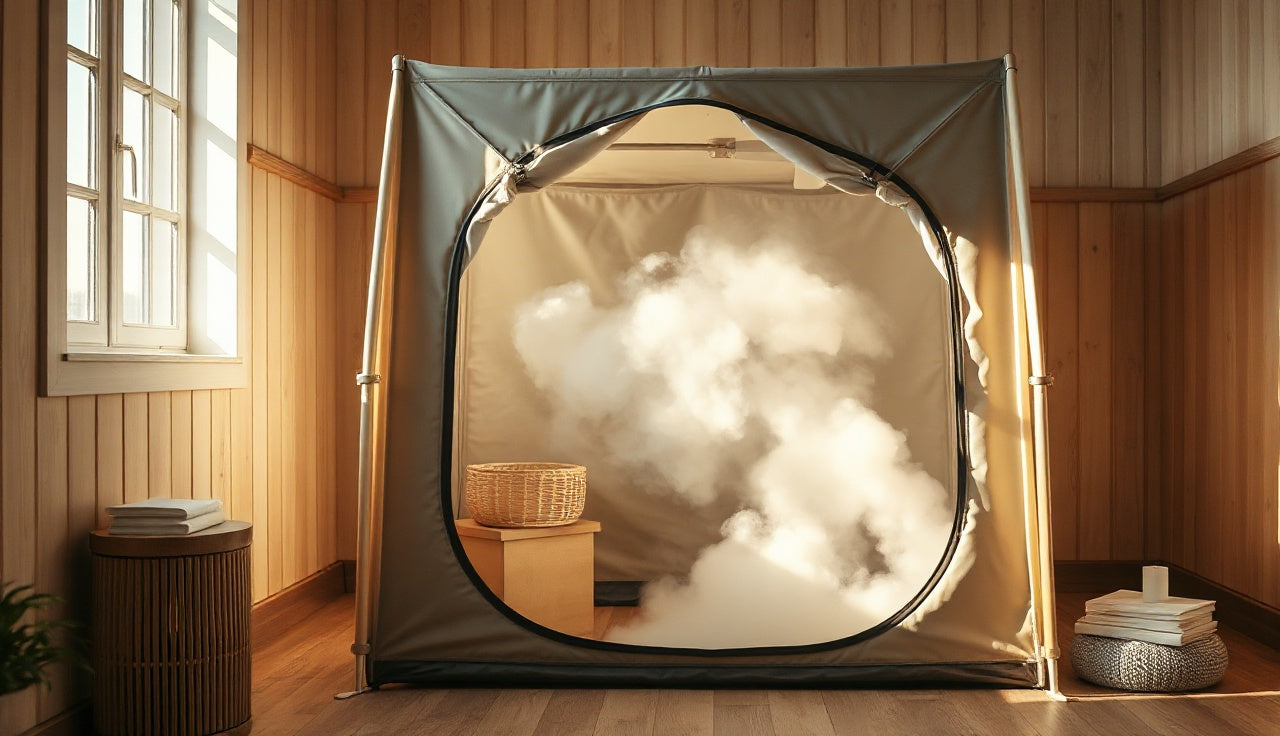
A portable sauna steamer is two things sold as one kit: a fabric pop-up tent sized for one seated person, and an electric steam generator that sits outside the tent and pipes hot steam in through a hose. You zip yourself in with your head poking out through a collar opening, flip the steamer on, and within five to ten minutes the interior air climbs into the 110 to 130°F range at close to 100% relative humidity [1].
The steam generator does the work. It's a small kettle with a heating element, a water reservoir (usually 1.5 to 2 liters), and a hose port. Wattage runs from about 800W on the cheapest units to around 1,000W on better ones. Most produce steam for 20 to 30 minutes on a full tank before you refill or an automatic shutoff kicks in.
This is a different animal from a dry sauna, where a wood-fired or electric stove heats rocks and air to 150 to 195°F at low humidity. The steamer trades temperature for moisture, the same heat-delivery principle behind a steam room. You sweat hard at a lower temperature because humid air moves heat onto your skin more efficiently than dry air at the same reading [2].
The tent is usually ripstop nylon or Oxford polyester with a reflective interior lining that traps heat. Most fold into a bag smaller than a sleeping bag. The whole kit weighs 5 to 10 lbs, plugs into a standard 110V outlet, and lives in a closet between uses. That's the pitch: real heat therapy with no construction project.
How hot do portable sauna steamers actually get, and how does that compare to a real sauna?
A typical portable steamer tops out around 110 to 130°F (43 to 54°C) with humidity near 100% [1]. A traditional Finnish-style sauna runs 150 to 195°F (65 to 90°C) at 10 to 20% relative humidity. An infrared home sauna lands in between, usually 120 to 150°F at moderate humidity.
Does that temperature gap change the physiological response? Partly. Core temperature rise and sweat rate are the mechanisms most tied to heat therapy benefits. Controlled study conditions found that a Finnish sauna at 176°F produced roughly a 1°C mean rectal temperature increase after two 12-minute sessions [11]. Lower-temperature wet heat can produce a similar core rise, just more slowly, because humid air stops sweat from evaporating and cooling you.
Here's the honest version. A portable steamer will make you sweat, raise your heart rate, and increase skin blood flow. Whether the magnitude matches what traditional-sauna studies show is genuinely uncertain. Almost all the positive cardiovascular and recovery research was done on Finnish dry saunas or hot water immersion, not portable steam tents [3]. The difference between a steamer and a barrel sauna is real, and anyone telling you otherwise is selling something.
| Heat source | Typical temp (°F) | Humidity | Session time | Approx. cost |
|---|---|---|---|---|
| Portable steam tent | 110 to 130 | ~100% | 15 to 30 min | $50, $200 |
| Infrared home sauna | 120 to 150 | Low | 20 to 40 min | $800, $4,000 |
| Traditional electric sauna | 150 to 195 | 10 to 30% | 10 to 20 min | $2,000, $8,000+ |
| Steam room (commercial) | 110 to 120 | ~100% | 10 to 20 min | N/A (gym) |
For the full range of sauna benefits and what the evidence actually supports, that's a longer read worth taking on separately.
What are the real benefits of using a portable sauna steamer?
The physiological effects of moist heat at these temperatures are reasonably documented, even if the studies mostly used hotter saunas or hot baths as the stimulus. Here's what holds up and where it gets shaky.
Sweating and a transient cardiovascular response are the most consistent effects. Heart rate rises to 100 to 150 bpm during a sauna session, roughly like light-to-moderate aerobic exercise, per a 2018 review in Mayo Clinic Proceedings [3]. That review reported regular sauna use (4 to 7 times per week) associated with lower rates of cardiovascular events in the Finnish population studied. That's observational data on dry sauna users, not steamer users, so read it as suggestive, not proof.
Muscle recovery is a common reason athletes buy these. Heat raises local blood flow and may cut delayed-onset soreness, though evidence on timing and magnitude is mixed. Nobody has clean data on portable steam tents for recovery; the closest studies use hot water immersion or dry sauna.
Respiratory comfort is where steam genuinely earns its keep. Warm, humid air loosens airways and mucus in a way dry heat can't. Steam inhalation has been used for upper respiratory symptoms for centuries. A 2017 Cochrane review on steam inhalation for the common cold found modest short-term symptom relief [4]. Don't call it a treatment, but the mechanism is real.
Skin hydration is a plausible extra. Steam at 100% humidity prevents transepidermal water loss during the session, and plenty of users report softer skin afterward. That evidence is mechanistic and anecdotal, not from controlled trials.
What the steamer won't do: reproduce the heat stress of a hot dry sauna, the hormonal and autonomic pattern seen in high-temperature protocols, or the cultural side of sauna life. For that fuller picture, compare the sauna vs steam room tradeoffs head to head.
| Portable steam tent | 120 |
| Steam room (commercial) | 115 |
| Infrared home sauna | 135 |
| Traditional electric sauna | 172 |
| Traditional wood-fired sauna | 185 |
Source: Harvard Health Publishing; Mayo Clinic Proceedings, Laukkanen et al. 2018
Are portable sauna steamers safe to use at home?
Generally yes, with real caveats. The risks aren't theoretical.
Burn risk from the steam hose is the most common injury. Steam leaving the hose sits at or near 212°F (100°C), hot enough to damage tissue in seconds. Most units route the hose toward the bottom of the tent so steam cools before it reaches your skin, but touching the hose connector or the steamer itself during operation will burn you. Keep the steamer at least 12 inches from the tent fabric and anything flammable [5].
Dehydration comes on faster than people expect. You can lose 0.5 to 1.5 kg of fluid in a 20-minute session, on par with a moderate run [10]. Drink 16 oz of water before you start and have more ready after. Dizzy, lightheaded, or nauseous? Get out. Sounds obvious, but the head-out design fools people into pushing longer than they should because they don't feel trapped.
Electrical safety near moisture matters. The steamer sits outside the tent, so it isn't in the steam path, but bathroom floors get wet and outlet placement counts. The Consumer Product Safety Commission recommends keeping electrical appliances away from water sources [5]. Don't run one in the shower or right beside a bathtub.
Medical contraindications track any heat therapy: uncontrolled hypertension, pregnancy (high heat exposure is associated with fetal neural tube risks, especially in the first trimester [6]), acute illness or fever, and recent cardiovascular events. Diagnosed cardiac condition? Talk to a physician first. No major cardiology body has issued specific guidance on portable steam tents, so general sauna contraindications apply.
Children and older adults should use shorter sessions with supervision. Thermoregulation gets less efficient with age, and children have a higher surface-area-to-mass ratio that speeds heat absorption [7].
How long should a session be, and how often should you use it?
Most manufacturers suggest 15 to 25 minutes per session. That lines up with research protocols, which usually run two 12-minute rounds with a short break, or a single 15 to 20 minute session [3].
Start shorter. New to heat therapy? Ten minutes is plenty for your first few sessions. Tolerance builds fast, usually within a week or two of regular use.
Frequency calls for common sense. The strongest cardiovascular associations come from frequent use, 4 or more sessions per week, but that research is on traditional saunas used by people who'd done it for decades [3]. For a portable steamer used for recovery or general wellness, 3 to 5 sessions per week is reasonable for most healthy adults. Daily use is probably fine if you stay hydrated and keep sessions under 25 minutes.
The real limiter is tank capacity. A 1.5-liter tank at 800W lasts roughly 20 to 30 minutes of active steam. Want longer? You'll pause, refill, and wait a few minutes for the water to come back up to temperature. Some users keep a thermos of hot water nearby to speed the refill.
What should you look for when buying a portable sauna steamer?
The market runs from $50 novelties to $200 units that are meaningfully better built. Here's what separates a good one from money wasted.
Wattage: 800 to 1,000W is the working range. Below 800W the steamer struggles to hold temperature, especially in a poorly insulated tent or a cool room. Above 1,000W is mostly marketing, since the tent's thermal capacity is the real bottleneck.
Tank size: 1.5 liters minimum. Smaller tanks force constant refilling and break up the session. Some units add an external water input tube you thread through the zipper to top off without opening the tent, which is a nice touch.
Timer and auto-shutoff: both standard, no exceptions. The dry-tank shutoff is a fire-prevention feature, not a luxury. Confirm the timer reaches at least 30 minutes and cuts the heating element, more than the steam flow.
Tent material and construction: look for heat-sealed interior seams rather than sewn ones, which leak steam faster. A reflective aluminum-coated lining holds heat better. The neck collar should close with a drawstring or velcro tight enough to keep steam in but loose enough that you don't feel strangled. Most tents ship with a plastic folding stool; some people swap in a solid wooden one.
Hose length: 4 to 5 feet between steamer and tent inlet gives you placement flexibility. Short hoses force the steamer too close to the fabric.
Cord length: a standard 6-foot cord limits your setup. A properly rated extension cord (14-gauge or heavier for 1,000W loads) buys you room [8].
Want something further up the ladder? Look at the portable sauna category more broadly, which includes barrel-style and infrared options that solve some of the fabric-tent limitations.
How much does a portable sauna steamer cost, and is it worth the money?
The price range is narrow. Nearly every portable steam sauna kit falls between $50 and $200, with the median around $80 to $120. A few "premium" outliers sit at $250 to $350, but from what I've seen, you're paying for a different tent design or a brand name, not better hardware in the steamer.
At the $80 to $120 sweet spot, you get a functional unit that heats a one-person tent adequately, has a real auto-shutoff, and holds up for a year or two of regular use. Failures usually come from the steamer (scale clogs the heating element) or the tent zipper (moisture cycling wears out plastic zippers fast). A monthly white vinegar descale stretches the steamer's life a lot.
Against a gym membership that includes steam room access, $100 upfront pays for itself fast if you use it 3+ times a week. Against any permanent install, even the cheapest $800 infrared cabinet, a steam tent is far cheaper to buy and to set up: no install cost, no electrical work, no permits.
Where it's a waste: if you already have gym steam room access, or if you want the experience of a real Finnish sauna. A portable steamer replaces no sauna at all, not a real sauna. If your budget hits $800 or more, skip the tent and look at entry-level infrared units or a proper portable barrel outdoor sauna.
SweatDecks covers heat therapy options across price points if you want to compare the next tier up.
How do you set up and use a portable sauna steamer step by step?
Setup is simpler than most people expect. Here's the sequence.
Put the folded tent on a hard, flat floor, ideally tile or hardwood rather than carpet, which holds moisture and mildews. Unfold it, about 30 seconds on most pop-up designs. Set the folding stool inside through the zipper.
Fill the reservoir with distilled or filtered water. Tap water works but speeds scale buildup. Position the steamer at least 12 inches from the tent fabric on a stable surface, slightly elevated on a small table or stool so the hose runs without kinking.
Thread the steam hose through the tent's inlet port (usually a small zipper-sealed opening near the bottom of one wall) and connect it to the steamer nipple. Zip the inlet port down around the hose as tight as it goes.
Turn the steamer on and let it heat before you climb in. That's 2 to 5 minutes depending on the unit. Starting early means the tent is warming while you wait, not the other way around.
Sit on the stool, zip the main door from the inside as far as it will go, and adjust the neck collar. Your head stays outside the whole session.
Set the timer. Start at 10 to 15 minutes on your first session. Keep a water bottle within reach outside the tent, since you can reach through the collar.
When it ends, unzip and stand up slowly. Going from heat to room temperature can drop your blood pressure briefly, especially if you pop up fast. Sit on the edge of a chair for 30 seconds first. Then drink, shower if you want, and let the tent air dry completely (fully open, at least an hour) before folding it away.
How do you clean and maintain a portable sauna steamer?
Maintenance is where most people fail, and it kills units early.
Descale the steamer every 4 to 6 weeks of regular use, or monthly if you run tap water. Fill the reservoir with a 1:1 mix of white vinegar and water, run it 10 minutes, then drain and run two full plain-water cycles to flush. Mineral scale on the heating element acts as insulation, drops efficiency, and eventually burns the element out. This is the number-one cause of steamer death.
Dry the tent completely after every use. Mildew in the fabric is a real problem, more than cosmetic. Unzip every opening, shake out pooled water from the bottom, and air it in a ventilated space. In humid climates, aim a small fan at the open tent. Never fold and store it while any surface is still damp.
Wipe the interior walls monthly with a diluted white vinegar spray (one part vinegar, four parts water) and a microfiber cloth. That clears mineral deposits from steam condensation and any bacterial film.
Check the hose fittings now and then for cracks or looseness. A leaking joint wastes steam and creates a burn risk if hot vapor escapes near skin or the steamer base.
Store the reservoir empty. Standing water between uses grows bacteria and speeds scale.
Can a portable sauna steamer help with muscle recovery or soreness?
Heat therapy for recovery is a legitimate use with decent mechanistic support, even if the specific evidence on portable steam tents is thin. Here's the honest picture.
Applying heat to muscles after exercise raises local blood flow, delivering more oxygen and nutrients while clearing byproducts like lactate. Post-exercise heat exposure has been associated with reduced perceived muscle soreness compared to passive recovery in several small trials, though effect sizes varied and study quality was mixed [9].
The steamer delivers whole-body heat rather than localized heat, so most major muscle groups get the blood flow effect at once. That's more efficient than a heating pad but less intense than hot water immersion, which covers the body and conducts heat more directly than air.
Timing matters, based on the limited evidence. Using heat within 30 to 60 minutes of training, before significant inflammation sets in, seems more useful than waiting hours. A 10 to 20 minute steam session post-workout slots in cleanly.
If you're serious about recovery and already using or eyeing a cold plunge, the heat-then-cold combo (contrast therapy) has its own evidence base. Cold constricts blood vessels and may reduce inflammation after the heat-driven dilation phase. Pairing cold plunge benefits with heat is a protocol worth reading up on separately. A steam tent slots naturally into an ice bath routine for exactly this reason, assuming you have both.
What are the limitations and downsides of portable sauna steamers?
Nobody should buy one without knowing what they're giving up.
You can't lie down or stretch out. Every steam tent is built for one person seated on a small stool. Want to fully relax? You're sitting upright with your head out for the whole session. Not painful, but nothing like lying on a real sauna bench.
The head-outside design caps core temperature rise. Your head and neck are major heat exchange sites. Keeping them in room-temperature air slows how hot your core gets versus a full enclosure where you breathe hot air. That's a physiological limit, not a comfort quirk.
Build quality swings hard in this price range. The $50 units often ship with zipper pulls that fail in months, undersized elements that can't hold temperature in a cool room, or hoses that crack after repeated heat cycling. Reading verified reviews carefully matters more here than in almost any other category.
One-person capacity is the standard. There's no practical two-person portable steam tent. Want to share the experience? You're in a different product category.
Steam versus sweat suits comes up too. Some athletes use sweat suits sauna style garments for similar thermoregulatory goals. Steam tents are more comfortable and probably safer than fully occlusive rubberized suits, but they fill a similar niche.
Noise: most steamers hiss or bubble at roughly 50 to 60 dB, about conversation level. Not loud, but not silent meditation either.
Is a portable sauna steamer worth it compared to other portable sauna options?
This is the comparison that matters most for buyers.
A portable steam tent at $50 to $200 is the cheapest way into home heat therapy, full stop. The next tier up is a one-person infrared cabinet, which starts around $800 and climbs past $2,000. Infrared runs drier, gets closer to traditional sauna temperatures, and encloses your full body including your head. It's also larger, heavier (50 to 100 lbs), and hungrier for space.
If you're genuinely unsure you'll stick with heat therapy, a steam tent is a low-risk test. Two months in, if you're using it 3 to 4 times a week and want more, you have real information to justify the bigger spend. Use it twice and let it die in the garage, and you're out $100, not $2,000.
If you're already committed, the tent's limits will wear on you within months. The lack of a full enclosure, the lower temperatures, and the fussy small steamer add up. That's when the full home sauna landscape starts making sense.
The costco sauna and big-box options in the $800 to $1,500 range sit in an interesting middle: real enclosures, infrared heat, still portable enough to move between rooms. That's the category to weigh if your budget stretches that far.
For most people just starting out who want to know if regular heat therapy fits their life: yes, a $100 portable sauna steamer is worth it. Just know exactly what it is and what it isn't.
Frequently asked questions
Can I use a portable sauna steamer every day?
Daily use is fine for healthy adults as long as sessions stay under 25 minutes, you drink enough water before and after, and you dry the tent completely between uses. The real practical limit is maintenance: daily use means descaling the steamer at least twice a month to prevent mineral buildup. If you feel dizzy or fatigued, back off the frequency.
Do portable sauna steamers really work for weight loss?
No, not in any lasting way. You lose fluid weight during a session (0.5 to 1.5 kg is typical) that returns the moment you rehydrate. Calories burned from the cardiovascular response are modest, roughly light exercise. No evidence supports steam tents for fat loss. Heat therapy has legitimate benefits, but weight loss isn't meaningfully one of them.
What kind of water should I use in a portable sauna steamer?
Distilled water is ideal because it has no minerals, so scale on the heating element stays minimal. Filtered tap water is a solid second choice. Plain tap water works but speeds scaling, which shortens the steamer's life. Don't add essential oils to the tank: they damage the element and hose. For aromatherapy, put a few drops in a small bowl of water inside the tent instead.
Is it safe to use a portable sauna steamer if I'm pregnant?
Heat that pushes core temperature above roughly 102°F (38.9°C) is associated with increased risk of neural tube defects, especially in the first trimester, per American College of Obstetricians and Gynecologists guidance. A steam session can absolutely raise core temperature that high. Standard advice is to avoid saunas and steam rooms during pregnancy, and that covers portable units. Talk to your OB before using one.
How long does it take for a portable sauna steamer to heat up?
Most units start producing steam within 5 to 8 minutes of turning on. The tent interior hits a noticeable heat level (around 100 to 110°F) within about 10 minutes and stabilizes near its max (110 to 130°F) after 12 to 15 minutes. Turning it on 5 to 8 minutes before you get in means you start in a warm tent, not a cool one.
Can two people use a portable sauna steam tent at the same time?
No standard portable steam tent is built for two adults. The interior fits one person on a small stool, and the steam generator can't heat a space for two adequately. For a shared sauna experience, you're looking at a different category: a traditional outdoor or indoor sauna, or a larger barrel-style unit.
What's the difference between a portable sauna steamer and an infrared portable sauna?
A steam sauna boils water to make hot humid air at 110 to 130°F and 100% humidity. An infrared portable sauna uses radiant panels to warm your body directly at 120 to 150°F in dry air. Infrared units cost $800 to $2,000+, enclose your full body including your head, and run drier. Steam units are far cheaper, smaller, and more portable, but run cooler and can't fully enclose you.
Does the head staying outside the tent reduce the benefits?
Yes, meaningfully. The head and neck are important heat exchange sites, and breathing hot humid air is part of the heat stress response in a traditional sauna. Keeping your head in room air slows core temperature rise and softens the autonomic response. You'll still sweat and get cardiovascular stimulation, but the effect is less intense than a full-body enclosure at the same duration.
Can I add essential oils to a portable sauna steamer?
Don't add oils to the water reservoir. They coat and damage the heating element, clog the hose, and can produce irritating compounds when superheated. For aromatherapy, put a few drops of eucalyptus or peppermint oil in a small heat-safe bowl of warm water and set it on the stool inside the tent with you. The session's steam will carry the scent safely.
How do I keep my portable sauna tent from getting moldy?
Air it out completely after every session: unzip all openings and leave it open at least one hour, ideally two. In humid climates, aim a small fan at the interior. Monthly, spray the inside with diluted white vinegar (1:4 vinegar to water), wipe it down, and air dry again. Never fold and store the tent while any part is still damp. Mildew, once set into nylon, is very hard to remove.
Are there any risks of using a portable sauna steamer with high blood pressure?
Heat causes vasodilation, which usually lowers blood pressure during a session, followed by a mild rebound afterward. For most people with controlled hypertension, that's tolerable. For uncontrolled or severe hypertension, the cardiovascular load carries real risk. No specific guidelines exist for portable steam tents, but cardiologists generally advise caution with any sauna use when hypertension is poorly controlled.
How often should I descale my portable sauna steamer?
Monthly if you use it 3 to 5 times a week, or every 4 to 6 weeks for lighter use. Running tap water instead of distilled? Descale every 2 to 3 weeks. The process is simple: fill the tank with a 50:50 white vinegar and water solution, run 10 minutes, drain, then run two full tanks of plain water to flush. Skipping this is the leading cause of steamer failure.
Can I use a portable sauna steamer for cold and flu symptoms?
Steam inhalation has modest evidence for short-term relief of nasal congestion and upper respiratory symptoms. A 2017 Cochrane review found some benefit for common cold symptoms with steam inhalation. A session will humidify your airways and may give temporary comfort. It won't shorten the illness and shouldn't replace medical care. Avoid it with a fever above 101°F, since piling on heat while your body fights infection is a bad idea.
What wattage portable sauna steamer should I buy?
Aim for 800 to 1,000W. Units below 800W often can't hold temperature, especially in cool rooms or poorly insulated tents. Units marketed above 1,000W rarely perform better because the tent's thermal capacity, not steamer output, is the real bottleneck. Within 800 to 1,000W, pay more attention to tank size, build quality, and auto-shutoff than to wattage.
Sources
- Harvard Health Publishing, Harvard Medical School – 'Sauna Health Benefits': Portable steam sauna tents reach 110–130°F at near-100% humidity; steam units operate in the wet-heat range comparable to traditional steam rooms
- National Oceanic and Atmospheric Administration (NOAA) – Heat Index explainer: Humid air transfers heat to the body more efficiently than dry air at the same temperature, which is why wet heat feels more intense at lower temperatures
- Laukkanen JA et al., Mayo Clinic Proceedings 2018 – 'Cardiovascular and Other Health Benefits of Sauna Bathing': Heart rate rises to 100–150 bpm during sauna sessions; frequent sauna use (4–7x/week) was associated with lower rates of cardiovascular events in observational data; typical research protocols use two 12-minute sessions or single 15–20 minute sessions at 176°F
- Singh M, Das RR, Cochrane Database of Systematic Reviews 2017 – 'Steam inhalation for the common cold': Steam inhalation showed modest short-term relief of nasal congestion and upper respiratory symptoms in the common cold; evidence quality was mixed
- U.S. Consumer Product Safety Commission (CPSC) – 'Electrical Safety' guidance: CPSC recommends keeping electrical appliances away from water sources and wet environments; burn risk from steam and fire risk from proximity of electrical devices to flammable materials
- American College of Obstetricians and Gynecologists (ACOG) – FAQ on pregnancy and heat exposure: Core body temperature above approximately 102°F (38.9°C) is associated with increased risk of neural tube defects, particularly in the first trimester; saunas and steam rooms are generally advised against during pregnancy
- National Institute on Aging (NIA), National Institutes of Health – 'Hot Weather Safety for Older Adults': Thermoregulatory efficiency decreases with age, increasing risk of heat-related illness; elderly individuals require shorter heat exposure durations and closer monitoring
- U.S. National Fire Protection Association (NFPA) – Extension cord safety: Extension cords for appliances drawing up to 1,000W should be rated at 14-gauge or heavier to prevent overheating and fire risk
- Versey NG et al., Sports Medicine 2013 – 'Water Immersion Recovery for Athletes: Effect on Exercise Performance and Practical Recommendations': Post-exercise heat application, including whole-body heat exposure, was associated with reduced perceived muscle soreness compared to passive recovery in several small trials, though effect sizes varied
- Hannuksela ML, Ellahham S – Annals of Medicine 2001, 'Benefits and risks of sauna bathing': Steam and sauna sessions can cause loss of 0.5–1.5 kg of fluid through sweating; rehydration after sessions is essential
- Moran DS, Mendal L – Industrial Health 2002, 'Core temperature measurement: methods and current insights': Finnish sauna at 176°F produced approximately 1°C mean rectal temperature increase after two 12-minute sessions in controlled study conditions

Share:
Home infrared sauna: the complete buyer's guide (2026)
Portable saunas for sale: what to buy and what to skip