
Last updated 2026-07-09
TL;DR
Portable saunas run from about $50 for a steam tent to $800 or more for a freestanding infrared cabin. Steam pods heat fast and cost little, but they feel cramped and leak at the collar. Infrared boxes cost more and give you a fuller, drier sweat. Neither matches a built-in sauna. Both work for recovery if you buy the right spec and use it consistently.
What types of portable saunas are actually for sale?
Two very different products hide under the "portable sauna" label. Confuse them and you waste your money.
The first is the steam tent, sometimes called a steam pod. Picture a camping chair draped in a nylon shell. A separate generator plugs into the wall, a hose feeds steam into the tent, and you sit with your head poking out the top. These pack into a duffel, cost little, and get hot fast. Prices run $50 to $250 depending on generator wattage and tent quality [1].
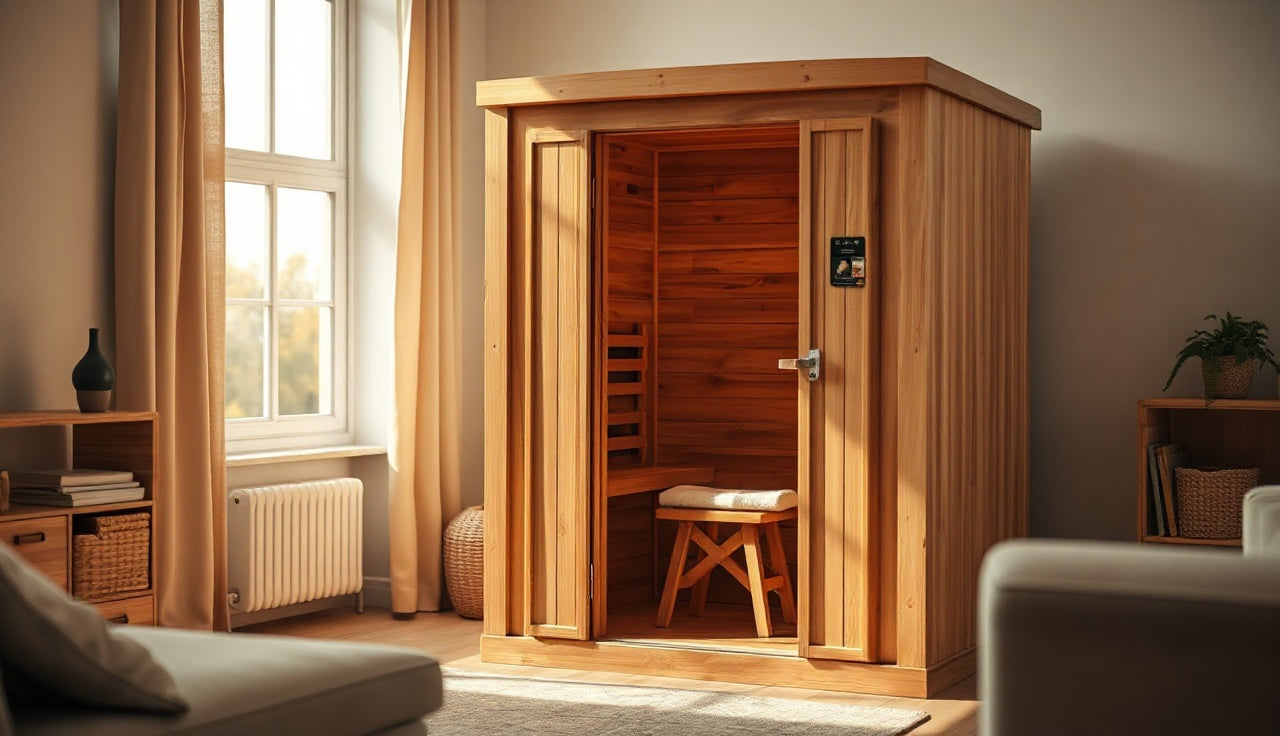
The second is the portable infrared sauna. This is a freestanding fabric or wood-panel box, big enough to sit upright with your head enclosed. Carbon or ceramic panels line the walls. They cost $300 to $800, take 10 to 15 minutes to preheat, and give you the dry heat most people picture when they say "sauna" [2]. They fold or break down for storage, but you're not carrying one to a campsite.
A third group, outdoor barrel and pod saunas, gets marketed as portable because it ships in pieces and skips a permit in many jurisdictions. Treat those as outdoor saunas. Different buying decision entirely.
Want the steam-room feel in portable form? Buy a steam tent. Want dry traditional heat you can break down and move? Buy a portable infrared cabin. The two feel nothing alike in use, and the heat-exposure research applies to each differently. The sauna vs steam room comparison is worth a read before you commit.
How much do portable saunas cost, and is the price gap worth it?
The range is wide, so here's the specific breakdown.
Entry-level steam tents (under $100): thin nylon shell, 600 to 900 watt generator, hits 104 to 113°F (40 to 45°C) in about 8 minutes. They work. The fabric tears, zippers fail, and steam output is marginal.
Mid-range steam tents ($100 to $250): reinforced Oxford nylon or polyester, 1000 to 1500 watt generator, a better seal at the neck collar. Brands like Durherm and SereneLife land here. This is the sweet spot for occasional home steam use [1].
Entry infrared cabins ($300 to $500): fabric walls, carbon fiber panels, single-zone control. Hits 120 to 140°F (49 to 60°C). The heat is even and the enclosure covers your whole body. Quality control at this price swings hard, so look for UL or ETL certification on the heating element [3].
Mid-to-upper infrared cabins ($500 to $800): thicker wood or reinforced frame, multi-zone panels, chromotherapy lighting, sometimes a Bluetooth speaker. Plan to use it four or five times a week for years? The extra $200 buys durability you'll actually feel.
Above $800 you're usually buying a permanent low-EMF infrared sauna that happens to install easily. At that point, weigh it against a contractor-installed home sauna.
So is the price gap worth it? For steam tents, no. Buy mid-range or skip the category. For infrared, yes. The $500 to $700 range produces a noticeably better and safer product than the $300 floor.
What should you look for in a portable steam sauna?
If you've settled on a steam model, a handful of specs actually matter.
Generator wattage comes first. A 1000-watt unit heats a small tent adequately. A 1500-watt unit heats faster and holds temperature better in a cool room. Below 800 watts you're losing the fight in any room under 70°F.
Neck collar design matters more than the listings let on. A loose collar bleeds steam around your shoulders, which drops the internal temperature and dumps moisture on your carpet. Look for an adjustable zippered or Velcro collar with at least a 6-inch overlap.
Timer and auto-shutoff are safety gear, not extras. The CPSC has published burn-risk guidance for prolonged hot-vapor exposure, and a unit without a timer is one you have to babysit [4]. Most decent models cut off at 30 or 60 minutes.
The steam hose should run at least 4 feet, so the generator sits well outside the tent with no contact against condensation. Short hoses that press a hot generator against the fabric are a fire hazard.
Here's the honest gap between a steam tent and an actual steam room. A built-in room holds humidity through the whole space. A tent holds it around your torso and leaks at the collar. Fine for sweating. Not the same experience.
You'll see the saunazen portable steam sauna all over search results. It runs the standard mid-range recipe: Oxford fabric, 1000 to 1200 watt generator, folding chair included. Reasonable product, but nothing about it beats comparable units at the same price. Don't pay extra for the name.
| Steam tent | 122 |
| Portable infrared cabin | 150 |
| Permanent infrared sauna | 160 |
| Traditional Finnish sauna | 200 |
Source: Journal of Human Kinetics, 2018; ACSM Heat Exposure Guidelines
What are the real health benefits of using a portable sauna?
Be careful here. The marketing around portable saunas runs way past the evidence.
Start with what the data supports. Regular sauna use (most studies define it as 15 to 20 minutes at 80°C / 176°F, four or more times a week) is linked to measurable heart benefits. A 2018 paper in Mayo Clinic Proceedings analyzed the Finnish Kuopio Ischemic Heart Disease cohort and found men who used a sauna four to seven times per week had a 63% lower risk of sudden cardiac death than once-weekly users [5]. The portable crowd loves citing this. The catch: those saunas ran at temperatures most portable units never touch.
Portable infrared models operate at 120 to 150°F (49 to 65°C), well under a Finnish sauna's 176 to 212°F (80 to 100°C). A 2018 review in the Journal of Human Kinetics found infrared sessions do raise core temperature and produce real sweating, but the cardiovascular stimulus is lower than traditional heat [6]. That doesn't make them useless. It means you can't copy the Finnish dose-response numbers straight across.
Muscle recovery evidence is thinner still. A small 2015 study in Springerplus found infrared sessions reduced delayed-onset muscle soreness after strength training [7]. Small samples, no large replication. Plausible mechanism (heat drives blood flow to damaged tissue), but not a settled fact.
Steam tents top out even lower. A tent at 113°F (45°C) makes you sweat, but the thermal load is mild next to an 80°C Finnish sauna.
The honest summary: portable saunas make you sweat and feel relaxed. They probably deliver some of the cardiovascular and recovery upside of regular heat exposure, at a smaller magnitude than a traditional sauna. The fuller evidence lives in our sauna benefits breakdown.
Interested in pairing heat with cold? The cold plunge benefits piece fills in the contrast-therapy side.
Are portable saunas safe to use at home?
Generally yes, with specific caveats worth knowing before you plug one in.
Electrical safety is the concrete concern. Portable infrared cabins draw 1200 to 1800 watts, roughly a hair dryer or space heater. Most standard 15-amp household circuits handle that fine, but don't share the circuit with other high-draw appliances [3]. Use a dedicated outlet. The heating elements should carry a UL, ETL, or CE mark. If a listing can't confirm one, pass.
Steam generators bring a scald risk. The reservoir water gets very hot. Keep kids out of the room during use. The CPSC recommends first-time users cap sessions at 15 minutes and build up gradually [4].
Dehydration is real. A 20-minute session at moderate heat can pull 0.5 to 1 liter of sweat out of you [8]. Drink 500ml before you get in and keep water within reach.
Pregnancy, cardiovascular disease, and medications that affect blood pressure or temperature regulation are contraindications. Clear them with a physician before using any sauna. The American College of Obstetricians and Gynecologists advises pregnant women to avoid raising core body temperature above 102.2°F (39°C) [9].
Ventilation matters early on. New infrared units off-gas low levels of volatile organic compounds from their fabric, worst when brand new. Run the unit empty for one or two sessions with the room ventilated before your first real use. The smell fades quickly.
Steam tents on carpet cause a slow moisture problem. Put a waterproof mat under the unit and let the floor dry between sessions.
How do portable infrared saunas compare to traditional and other sauna types?
Here's a straight comparison across the main formats, because the differences decide where your money goes.
| Type | Temp range | Heat-up time | Full-body enclosure | Avg cost | Truly portable |
|---|---|---|---|---|---|
| Steam tent | 104-122°F (40-50°C) | 5-10 min | No (head out) | $50-$250 | Yes |
| Portable infrared cabin | 120-150°F (49-65°C) | 10-20 min | Yes | $300-$800 | Sort of |
| Traditional Finnish (home) | 160-200°F (71-93°C) | 20-45 min | Yes | $2,000-$8,000+ | No |
| Infrared home unit (permanent) | 120-160°F (49-71°C) | 10-20 min | Yes | $1,500-$5,000 | No |
| Outdoor barrel sauna | 160-190°F (71-88°C) | 30-60 min | Yes | $3,000-$12,000+ | No |
The gap between a portable infrared cabin and a permanent installation is mostly construction quality, panel power density, and lifespan. You get 70 to 80% of the experience at 20 to 30% of the cost, which is a genuinely good deal if you're not ready to commit.
The gap between a steam tent and a traditional sauna is far wider. A steam tent sits closer to a hot damp chair than to a sauna. Not a knock, just useful to know before you buy one expecting a spa.
Serious about a permanent build? The home sauna guide walks through what that process really involves.
What are the best places to buy a portable sauna?
The market splits across a few channels, each with tradeoffs worth weighing.
Amazon has the widest selection and the deepest review pool, but quality control is uneven and returning a 40-pound infrared cabin is a chore. Read at least 30 reviews and sort for one-star to see the real failure modes before you buy [2].
Walmart and Target stock budget steam tents ($50 to $100) in-store and online. Fine for entry-level steam use. Don't expect more than a year of regular use out of them.
Some people search for a portable sauna at their local Costco or watch Costco's online rotation. Costco has carried portable infrared cabins at competitive prices, usually $400 to $600, though the inventory rotates seasonally and without warning. The Costco sauna guide covers what they typically carry and whether it's worth waiting for.
Specialty wellness retailers, SweatDecks included, carry a curated portable sauna range with tighter vetting on electrical certifications and EMF ratings. You'll pay a bit over Amazon floor prices, but the units come better documented and easier to get support on.
Ebay and Facebook Marketplace turn up lightly used infrared units at 40 to 60% of retail. The risk is unknown prior use and no warranty. Not worth it for a steam tent. For a $600 infrared unit, a $300 used one can make sense if you inspect it in person.
One check regardless of where you buy: confirm the seller can produce the electrical certification paperwork. That documentation matters if you ever file a homeowner's insurance claim after a fire-related incident.
How do you set up and use a portable sauna correctly?
Setup is simple, but a few details change the result.
Steam tent: fill the reservoir with distilled or filtered water (tap water calcifies the element faster), plug into a standard 120V outlet, set the timer to 15 to 30 minutes, and start the generator 5 to 8 minutes before you get in. The tent needs that head start to build heat. Wear a swimsuit or nothing. Keep a face towel and a water bottle handy. When the timer ends, open the tent right away. Sitting in cooling steam is miserable and burns off the benefit.
Portable infrared cabin: unfold and assemble (most take 5 to 10 minutes), preheat 10 to 15 minutes with the door closed, then step in. Infrared warms your skin and tissue directly rather than just heating the air, so you don't need traditional-sauna air temperatures to get a real thermal effect [6]. Sit on the provided stool or a small wooden bench. Sessions of 20 to 30 minutes are typical. Towel off before you stand, because a sweaty floor gets slick.
For both types, frequency beats duration for the habitual benefits the cardiovascular research describes. Four 20-minute sessions a week does more than one 60-minute marathon [5].
After any session, rehydrate with water and electrolytes. Doing contrast therapy? If you're moving from a session straight into a cold plunge or ice bath, sequence matters. Sauna first, cold second, and finish on cold for an alerting kick or warm for relaxation, depending on your goal.
What are the main complaints people have after buying a portable sauna?
One-star reviews across the major retailers tell you more than any marketing page.
For steam tents, the top complaint is leaking. The hose connection drips, the collar bleeds steam constantly, or the zipper fails within months. That's almost always a manufacturing quality issue you can't spot from a listing. Buying mid-range ($150 to $250) reduces it without eliminating it.
For infrared cabins, the top complaint is uneven heat. Cheap units with low-wattage panels throw hot spots near the panels and cool zones in the center. Panels on multiple walls (back, side, and floor) heat far more evenly than a single back panel. Check the spec sheet.
A second infrared complaint is EMF (electromagnetic field) output. Carbon fiber panels generally emit less EMF than ceramic rod heaters. Nobody has established a health threshold for the EMF levels consumer infrared saunas produce, and most certified units already meet the existing ICNIRP guidelines [10]. If low EMF matters to you, ask for the product's EMF measurement at the panel surface.
For both types, the included chair or stool is the weak link. The folding chair in a steam tent bends or snaps under heavier users. Budget $20 to $40 for a solid wooden stool replacement.
Fabric smell on first use shows up with both. It's off-gassing from manufacturing, not a health hazard in a ventilated room, and it clears within 2 to 3 sessions.
Can you use a portable sauna for weight loss or detox?
This is where the marketing sprints past the science, so let's be blunt.
Sauna use drops water weight through sweating. It shows on the scale right away. It is not fat loss. A 20-minute session might drop you 0.5 to 1 kg, and you regain it within an hour of drinking [8]. Anyone selling a portable sauna as a weight-loss device is selling that water trick as if it means something.
The "detox" claim gets murkier. Your liver and kidneys handle toxin clearance. Sweat carries small amounts of some metals and compounds, but the quantities are trivial next to what the liver processes. A 2011 review in the Journal of Environmental and Public Health found sweat contains trace metals including lead, mercury, and cadmium, and the authors suggested sweat excretion may play a supplementary role, but they were careful not to call it a primary detoxification pathway [11]. Citing that paper as proof saunas detox you is a stretch.
The honest case for a portable sauna: cardiovascular conditioning from repeated heat exposure, post-exercise recovery from increased blood flow, and relaxation through parasympathetic activation. Those are real and worth having. They don't need dressing up.
After contrast therapy? Pairing a portable session with a cold plunge or ice bath adds a physiological layer with its own evidence base. That protocol is genuinely interesting. More on contrast therapy and ice bath use.
What should you know before buying a portable sauna on sale or at a discount?
Clearance pricing on portable saunas is common, especially at the end of summer and around big retail holidays. Before you assume a discount is a deal, check a few things.
First, confirm the model isn't discontinued. A $400 infrared cabin cut to $200 might be clearance because the maker stopped producing replacement parts. If the elements fail in year two, you own an expensive fabric shell.
Second, check whether the warranty transfers on resale. Most manufacturers tie coverage to the original purchaser. A used unit from a third party usually carries no warranty at all.
Third, watch for counterfeit certifications. The ETL and UL marks are licensed, and manufacturers pay for testing and listing. Some overseas listings slap on logos they never earned. You can verify ETL-listed products through Intertek's online database and UL-listed products through UL's Product iQ database [3]. Five minutes of checking can protect you.
Fourth, read the return policy first. A portable infrared cabin is heavy and bulky to ship back. Some retailers charge 15 to 20% restocking fees that erase the discount. Amazon's large-item returns often route through a third-party carrier pickup that takes two weeks.
SweatDecks carries portable and home sauna models with documented certifications. To compare specific options next to built-in units, the sauna collection pages include spec-level detail that narrows the decision.
The best window is usually October through November, when retailers clear warm-weather wellness stock ahead of the holidays. Discounts of 20 to 30% off mid-range units are common then.
Frequently asked questions
How hot does a portable sauna actually get?
Steam tents typically reach 104-122°F (40-50°C) inside the enclosure. Portable infrared cabins reach 120-150°F (49-65°C). Traditional Finnish saunas run 160-200°F (71-93°C). The lower temperatures in portable units still produce meaningful sweating and heat exposure, but they don't fully replicate a traditional sauna experience.
How long should a portable sauna session be?
Most research on sauna benefits uses sessions of 15-20 minutes at temperature. For first-time users, 10-15 minutes is a sensible starting point, and the CPSC recommends building duration gradually. Sessions past 30 minutes in a portable unit carry higher dehydration and overheating risk without proportionally greater benefit.
Can a portable sauna help with muscle recovery?
A 2015 study published in Springerplus found that infrared sauna sessions reduced delayed-onset muscle soreness after strength training. The sample size was small and hasn't been widely replicated. The plausible mechanism is that heat increases peripheral blood flow to damaged tissue. Portable units at lower temperatures probably produce a milder version of this effect.
Are portable saunas safe for people with heart conditions?
People with cardiovascular disease, uncontrolled hypertension, or a recent cardiac event should consult a physician before using any sauna. The heat stress raises heart rate and dilates blood vessels. In healthy adults that's generally safe and may even help. In people with certain conditions it carries meaningful risk and needs medical clearance first.
What's the difference between a portable infrared sauna and a portable steam sauna?
A portable infrared sauna uses electric panels to emit radiant heat that warms your body directly in a dry environment. A portable steam sauna uses a generator to push humid steam into a tent, raising air temperature through moist heat. Infrared units enclose your whole body including your head; most steam tents leave your head exposed at the top.
Do portable saunas use a lot of electricity?
Steam tent generators typically draw 800-1500 watts. Portable infrared cabins draw 1200-1800 watts. A 30-minute session on a 1500-watt unit uses about 0.75 kWh. At an average U.S. electricity rate of roughly $0.16 per kWh (EIA, 2024), that's around $0.12 per session, making operating costs negligible.
Can I use a portable sauna every day?
Yes, daily use is safe for most healthy adults. The Finnish cardiovascular research found the strongest risk reduction in people using a sauna four to seven times per week. The main practical limit is hydration: replace fluids and electrolytes after every session. If you feel lightheaded, fatigued, or notice a rapid heartbeat, reduce frequency and duration.
What's the best portable sauna for small apartments?
Steam tents pack down to roughly the size of a carry-on bag and need only a standard outlet and a small floor space during use. They're the most practical option for apartments with limited storage. Portable infrared cabins fold smaller than a permanent sauna but still need a 4x4 foot floor area and dedicated closet space when stored.
Is the saunazen portable steam sauna worth buying?
The saunazen portable steam sauna is a mid-range steam tent with an Oxford fabric enclosure and a 1000-1200 watt generator. It's a functional product in the $150-$250 range. It isn't meaningfully better than other mid-range steam tents at similar prices. Buy it if the price and availability work for you, but don't pay a premium based on the name alone.
Can I use a portable sauna while pregnant?
No, not without specific medical clearance. The American College of Obstetricians and Gynecologists advises pregnant women to avoid raising core body temperature above 102.2°F (39°C). Sauna use, even in a portable unit, can push core temperature past that threshold. Most physicians recommend avoiding sauna use during pregnancy, particularly in the first trimester.
How long does a portable sauna last before it needs replacement?
Steam tents used 2-3 times per week typically last 1-3 years before zipper failure or fabric degradation. The steam generator often outlasts the tent by years. Portable infrared cabins used regularly last 3-7 years depending on build quality. Mid-range and upper-tier units have better fabric and panel longevity than budget models.
Do I need a special electrical outlet for a portable sauna?
No special outlet is required for most portable saunas. They run on standard 120V household circuits. Use a grounded outlet and avoid extension cords, which can overheat under the 1200-1800 watt load. Don't share the circuit with other high-draw appliances like a space heater or dryer during a session.
Can I do contrast therapy with a portable sauna and a cold plunge?
Yes. The typical protocol is 10-20 minutes in the sauna, then 1-3 minutes in cold water (a cold plunge, ice bath, or cold shower), repeated 2-3 cycles. End on cold for alertness or warm for relaxation depending on your goal. Portable saunas work fine for this; just be careful standing up after heat, since blood pressure can drop briefly.
What's the difference between using a sauna suit and a portable sauna?
A sauna suit is worn during exercise to trap body heat and increase sweating. A portable sauna applies external heat from a generator or infrared panels while you rest. Sauna suits create sweat through exercise-generated heat; portable saunas create it through passive heat exposure. The physiological stress and recovery dynamics differ. A dedicated sauna-suit comparison guide covers the details.
Sources
- Consumer Reports, Portable Sauna Buying Guide overview: Steam tent prices range from $50 to $250 depending on generator wattage and tent quality
- Amazon product category data, Portable Saunas: Portable infrared sauna cabins cost $300 to $800 in the consumer market
- Intertek ETL Listed Product Certification, Intertek.com: ETL and UL certification marks indicate electrical testing; consumers can verify listings through manufacturer databases
- U.S. Consumer Product Safety Commission, Hot Tubs, Spas, and Whirlpools Safety: CPSC guidance recommends auto-shutoff timers and limits for heat exposure; first-time users should limit sessions to 15 minutes
- Mayo Clinic Proceedings, 2018, Laukkanen et al., Sauna Bathing and Systemic Cardiovascular Conditions: Men using sauna four to seven times per week had 63% lower risk of sudden cardiac death compared to once-weekly users in the Kuopio Ischemic Heart Disease study cohort
- Journal of Human Kinetics, 2018, Podstawski et al., Infrared Sauna as a Passive Exercise Tool: Infrared sauna sessions raise core body temperature and produce meaningful sweating; cardiovascular stimulus is lower than traditional high-temperature sauna exposure
- Springerplus, 2015, Mero et al., Infrared Sauna Bathing in Athletes After Strength Training: Infrared sauna sessions reduced delayed-onset muscle soreness after strength training in a small controlled study
- American College of Sports Medicine, Position Stand on Heat and Hydration: A 20-minute sauna session at moderate heat can produce 0.5 to 1 liter of sweat
- American College of Obstetricians and Gynecologists, Committee Opinion on Heat Exposure in Pregnancy: ACOG advises pregnant women to avoid raising core body temperature above 102.2°F (39°C)
- International Commission on Non-Ionizing Radiation Protection (ICNIRP), EMF Guidelines: ICNIRP provides non-ionizing radiation exposure standards; most certified consumer infrared saunas meet these thresholds
- Journal of Environmental and Public Health, 2011, Genuis et al., Blood, Urine, and Sweat Study: Sweat contains trace metals including lead, mercury, and cadmium; authors noted sweat may play a supplementary but not primary role in excretion
- U.S. Energy Information Administration, Average Retail Price of Electricity, 2024: Average U.S. residential electricity rate is approximately $0.16 per kWh as of 2024 EIA data

Share:
Portable sauna steamer: what it is, what it does, and whether it's worth it
2-person hybrid infrared + steam sauna: the complete buyer's guide