
Last updated 2026-07-09
TL;DR
A portable outdoor sauna is any freestanding or collapsible heat unit you set up outside without permanent construction. Styles run from fabric pop-up tents (under $400) to cedar barrels you bolt together in a weekend ($1,500 to $5,000+). Heat comes from electric, wood, or infrared sources. Most homeowners are sweating within a few hours of delivery.
What exactly counts as a portable outdoor sauna?
The word "portable" gets stretched hard in this category. At one end sits a fabric steam tent that folds into a carry bag. At the other end sits a cedar barrel on a skid base that two people bolt together in an afternoon and, technically, load onto a truck if you ever move house. Both get sold as portable. The line that actually matters is whether the unit needs a permanent foundation or a fixed utility connection.
For this guide, portable means three things: no concrete footings, no hardwired panel connection (a standard 15-amp or 20-amp outlet is fine), and no permit-triggered permanent structure. That covers four product families: fabric and inflatable pop-up saunas, wood panel kits (barrel and cube shapes), prefab pod saunas on skid frames, and infrared cabin kits that snap together with cam locks or tongue-and-groove panels.
Comparing this to a fully fixed backyard build? The outdoor sauna guide covers permanent options in depth. This one sticks to what you can move, store, or take with you.
What are the main types of portable outdoor saunas?
Fabric pop-up / tent saunas. The cheapest way in, usually $200 to $500. A collapsible frame holds a heat-reflecting nylon or polyester shell. You sit inside on a stool while a small electric rod or steam generator pipes heat in from outside. They reach temperature in 10 to 20 minutes. The honest trade-off: they don't feel like a real sauna. The fabric bleeds heat, temperatures rarely top 130°F (54°C), and the whole thing lands closer to a personal steam cabinet. Fine for travel or the occasional session. Wrong tool for a daily ritual.
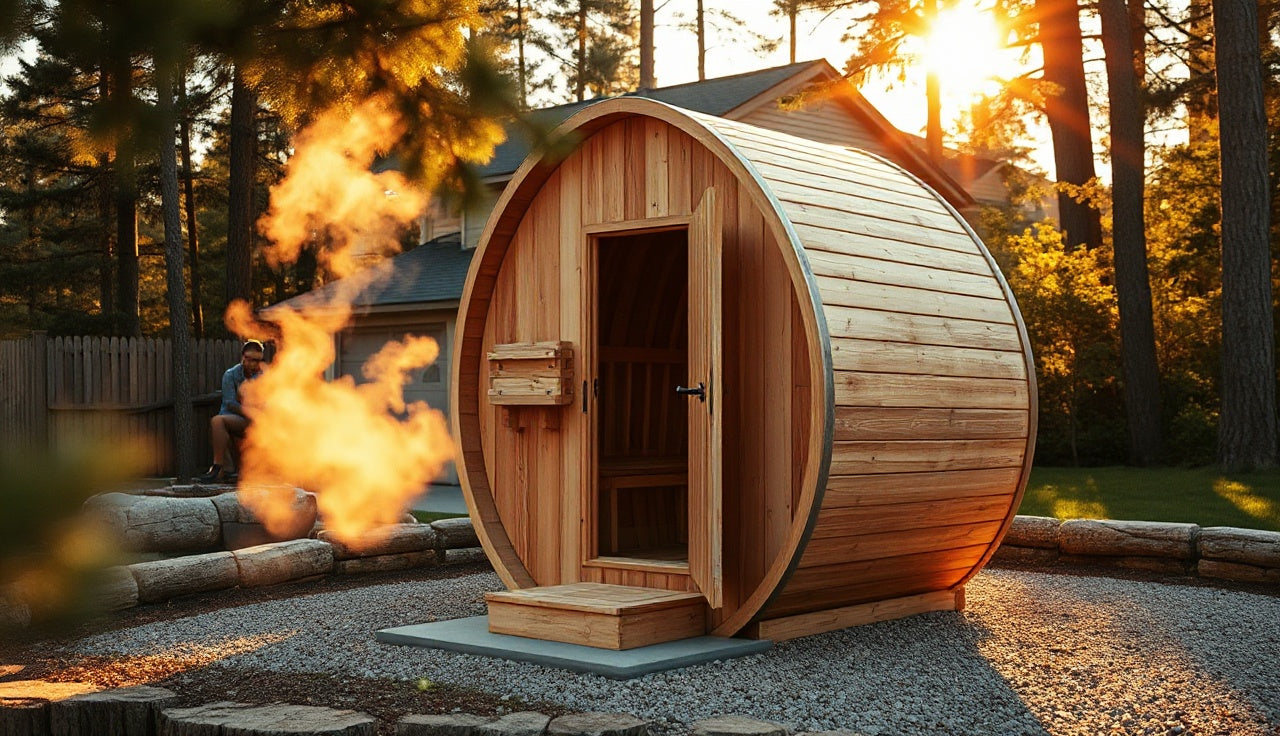
Barrel sauna kits. The most popular true portable option. Red cedar, hemlock, or Nordic spruce planks ship flat and assemble without special tools using pre-drilled cam locks or stainless banding straps. A standard 2-person barrel (roughly 4 ft diameter by 6 ft long) runs $1,500 to $2,800. A 4-person model with a porch overhang runs $3,500 to $5,500. Add a wood stove and these hit 160 to 190°F (71 to 88°C) in 30 to 60 minutes, or 45 to 75 minutes with a 6 kW electric heater. The cylindrical shape circulates heat well, so barrels use less energy per cubic foot than a rectangular box. [1]
Cube/cabin panel kits. Flat-pack rectangular cabins with tongue-and-groove or interlocking walls. Easier to insulate to code than a barrel, and easier to fit a changing bench inside. Price overlaps with barrels: $1,800 to $4,500 for a 2 to 4 person unit. Assembly runs 4 to 8 hours for two people.
Prefab pod saunas on skid frames. Pre-assembled or near-complete units that ship on a pallet. You don't build these. You place them. They weigh 400 to 900 lbs, so you need a forklift or pallet jack at delivery. Not portable in any casual sense, but they skip the foundation, and a building inspector usually treats them as personal property rather than a structure.
Infrared cabin kits. Same flat-pack assembly as cube kits, except the heater is a set of far-infrared carbon or ceramic panels mounted on the walls. These run cooler (110 to 140°F / 43 to 60°C) and draw less power (1.5 to 2.4 kW versus 4 to 9 kW for a traditional heater). To weigh the experience against dry heat, the sauna vs steam room article walks through the physiological difference between dry heat and radiant infrared heat.
How hot does a portable outdoor sauna actually get?
Hotter or colder than the product page promises, depending on the type and the weather. Here's the realistic spread.
| Sauna type | Typical air temp (°F) | Time to temp | Power draw |
|---|---|---|---|
| Fabric tent / steam cabinet | 110 to 130°F | 10 to 20 min | 1 to 1.8 kW |
| Infrared cabin kit | 110 to 145°F | 20 to 40 min | 1.5 to 2.4 kW |
| Electric barrel or cube kit | 150 to 185°F | 30 to 60 min | 4 to 9 kW |
| Wood-burning barrel | 160 to 200°F | 25 to 50 min | None (wood fuel) |
Traditional Finnish norms sit around 176 to 212°F (80 to 100°C) at head height with moderate humidity from löyly (water poured on the rocks) [2]. Most portable electric units in the $1,500 to $3,000 range hit 170 to 185°F in good conditions, which lands genuinely close to that standard. Outdoor air changes the math fast. A sauna that hits 185°F on a 70°F day might only reach 165°F on a 20°F winter night unless the walls are properly insulated.
For the research angle: a 2018 study in Mayo Clinic Proceedings notes that Finnish sauna sessions typically run at 80 to 100°C (176 to 212°F) for 5 to 20 minutes, which is the benchmark most people use when judging whether a unit delivers a "real" sauna experience. [3]
Do you need a permit for a portable outdoor sauna?
Most portable kit saunas that sit on grade, stay under a size threshold, and plug into a standard outlet don't trigger a building permit. That's the common case, not a guarantee. The answer changes by municipality, and the electrical side is where people get tripped up.
The International Residential Code (IRC), which most U.S. jurisdictions adopt with local amendments, generally exempts accessory structures under 200 square feet from permit requirements, though some cities set the threshold at 120 square feet [4]. A 4-person barrel sauna covers roughly 40 to 60 square feet of floor area, well under either line in most places. But if your city requires a permit for any accessory structure with an electrical connection, you may need one anyway, separate from the sauna itself.
Electrical is the real wrinkle. A 6 kW heater on 240V draws about 25 amps. Installing a new 240V circuit almost always means a licensed electrician and an electrical permit, no matter what the sauna structure requires. A 120V unit (typically 1 to 2 kW) runs on an existing outdoor GFCI outlet and usually skips the permit entirely. The National Electrical Code (NEC) Article 424 covers fixed electric space heating equipment and applies to most hardwired sauna heaters [5].
Call your local building department before you buy. Most have a one-page handout or a phone line for exactly this question. Five minutes now saves you a fine and a teardown later.
What surface do you need to put a portable outdoor sauna on?
You don't need a concrete pad, but you do need a surface that's level, stable, and drains. Grass is the worst long-term choice. Moisture under the floor panels feeds rot, and the sauna settles unevenly as the ground softens through wet seasons.
The best cheap option is a gravel bed: 4 to 6 inches of compacted crushed stone (3/4" minus or similar), sized to the sauna footprint plus a 12-inch perimeter. It drains, it stays level, and it costs $100 to $300 for most sauna sizes if you do the work yourself. Pavers on a sand bed work too. An existing concrete patio is fine as long as it's level within about 1/4 inch over the sauna's length.
Barrel saunas ship with pressure-treated skid bases or two horizontal runner beams. These sit right on gravel or pavers and let air move under the floor, which stretches the life of the bottom panels considerably. Some manufacturers void the warranty if you set the unit straight on soil.
Adding a cold plunge nearby for contrast therapy (hot and cold cycling)? Plan both footprints at once. The cold plunge guide has layout advice for that setup.
Wood-burning vs. electric heater: which is better for a portable outdoor sauna?
Both work well. The choice comes down to your situation, not to one being inherently better.
Wood-burning stoves (a Harvia M3, say, or a Huum Hive Wood) give you a high-humidity, authentic session that most sauna enthusiasts prefer. The heat stored in a stone-loaded wood stove holds temperature longer and lets you throw more löyly without the room crashing cold. The downsides are real: you need dry firewood, you start the fire 30 to 45 minutes before you want to sit, ash removal is a recurring chore, and most wood stoves need a chimney pipe through the ceiling, which adds $150 to $400 to the project and a roof penetration you have to weatherproof.
Electric heaters (4 to 9 kW for a portable sauna) are simpler: plug in, turn a dial, wait 30 to 60 minutes. Most include a timer and thermostat. The running cost is electricity. A 6 kW heater over 1.5 hours uses about 9 kWh. At the U.S. average residential rate of roughly $0.17/kWh as of 2024, that's about $1.50 per session [6]. Run three sessions a week for a year and you're at roughly $235 in electricity for the sauna alone.
For a unit you might move or store seasonally, electric wins on convenience. For a semi-permanent backyard barrel you plan to use hard, a wood stove earns the extra setup work.
The broader home sauna guide covers heater options for indoor and outdoor setups in the same format.
What does a portable outdoor sauna cost in 2026?
Here's the honest spread, including the costs that hide in the fine print.
Fabric tent saunas: $200 to $500 for the unit. Frame and heating element usually included. No real add-ons.
Infrared cabin kits (1 to 2 person): $800 to $2,000 for the unit. Add $0 to $200 for a GFCI outlet extension if there isn't one nearby. Some assembly required (1 to 3 hours, one person).
Electric barrel or cube kits (2 to 4 person): $1,500 to $4,500 for the unit with heater. Add $300 to $800 for a licensed electrician to run a 240V circuit if you need one. Add $100 to $300 for a gravel base. Realistic total: $2,000 to $5,600.
Wood-burning barrel kits (2 to 4 person): $1,200 to $4,000 for the unit. The stove may or may not be included (budget $300 to $700 if separate). Chimney kit adds $150 to $400. Firewood varies by region, but budget $150 to $400 per season for regular use. First-year total: $1,600 to $5,500.
Prefab pod saunas: $4,000 to $12,000 delivered. You pay for not building it yourself.
A note on tariffs. Finnish and Canadian manufacturers are the biggest exporters to the U.S. market. Duties on wood products and steel components move around, and several sauna brands raised prices 8 to 15% in 2025 in response to revised tariff schedules [12]. If a current price runs higher than a 2023 review suggested, that's likely why. Confirm pricing directly with the retailer.
| Fabric tent sauna | $450 |
| Infrared cabin kit (1–2 person) | $1,600 |
| Electric barrel kit (2–4 person) | $3,500 |
| Wood-burning barrel kit (2–4 person) | $4,000 |
| Prefab pod sauna | $8,000 |
Source: SweatDecks market survey; EIA electricity rates 2024 [6]
How long does it take to assemble a portable outdoor sauna kit?
Barrel sauna makers advertise assembly times that assume two experienced adults working without a break. First-timers should plan for more. Here's what to actually expect.
Fabric tent: 15 to 30 minutes, solo.
Infrared cabin kit (1 to 2 person): 1 to 3 hours, one or two people.
Barrel sauna kit (2-person): 3 to 6 hours, two people with basic tools (rubber mallet, drill, level, tape measure). Larger barrel kits with a front porch and changing room take 6 to 10 hours.
Cube/cabin panel kit (2 to 4 person): 4 to 8 hours, two people.
Three problems show up most often. Boards arrive warped or swollen from shipping moisture, so let them acclimate 24 to 48 hours if they land in winter. Pre-drilled holes drift out of alignment, so keep a good square handy. And the door hangs slightly out of plumb, so shim the frame before you torque everything down.
Read the full assembly manual before you order. A few budget kits ship instructions only in the original language (Finnish, German, or Chinese) with no English translation. Rare, but worth confirming in the product reviews before you commit.
What are the health benefits of using a sauna regularly?
The evidence here is stronger than for most wellness products, and it pays to be precise about what it actually shows.
The best dataset comes from the Kuopio Ischemic Heart Disease Risk Factor Study in Finland, which followed more than 2,300 middle-aged men for 20 years. Men who used the sauna 4 to 7 times per week had a 40% lower risk of all-cause mortality and a 63% lower risk of sudden cardiac death than once-per-week users, after adjusting for other risk factors [3]. The researchers described the cardiovascular response as resembling moderate-intensity exercise and characterized sauna use as "a safe activity for most healthy adults."
A 2022 review in Temperature (Taylor & Francis) covering 40 experimental studies found consistent evidence for reduced blood pressure, improved arterial compliance, and lower resting heart rate with regular use, though it flagged that most studies were short-term and run in Finland with traditional saunas at 80 to 100°C [7].
Mental health is thinner. A handful of small studies suggest reduced depression symptoms and better mood after sessions, but the samples are small and the confounding is hard to strip out. Nobody has good longitudinal data on this yet.
What the evidence does not clearly support: detoxification, dramatic weight loss, or immune enhancement. Sauna sweat is mostly water and electrolytes, not meaningful quantities of metabolic waste [8].
The sauna benefits article breaks the literature down by outcome category with citations.
Can you use a portable outdoor sauna year-round?
Yes, with caveats that hinge on your climate and your unit. A properly built barrel handles a Minnesota January. A fabric tent does not.
Fabric tent saunas are effectively summer-only in cold climates. Below about 40°F (4°C) outside, they shed heat faster than the small element can produce it. You'll get warm. You won't get hot.
Wood barrel and cube kits with 40mm or thicker kiln-dried walls perform well down to -20°F (-29°C) given enough heat time. Traditional Finnish saunas were built for Finnish winters, after all. A wood stove has the edge in the cold because it puts out more raw heat than most portable electric heaters. You'll just run it 45 to 60 minutes instead of 30 before you step in.
Electric units in cold climates benefit from an extra insulation layer between the inner wall and outer shell, which premium kits include and budget ones skip. Check the wall construction spec before buying if you're in a northern state or Canada.
Seasonal storage is an option for fabric tents and infrared kits. Break them down in November, store the panels flat in a garage, rebuild in April. Barrels are better left assembled year-round, since repeated disassembly stresses the joints, but they need a coat of UV-protective outdoor oil once a year.
For the contrast crowd, a cold plunge outdoors in winter next to a hot sauna is one of the sharpest combinations you can set up in a backyard. The ice bath guide covers cold-exposure safety if you're new to that side.
How do you maintain a portable outdoor sauna?
Lighter work than most people expect. Three things do the damage: moisture, UV light, and ignored wood joints.
Monthly: Wipe the interior benches with a damp cloth and a mild, non-chemical cleaner. Run the sauna for 30 minutes afterward with the door open so it dries fully. Check the heater rocks if you have them. Cracked rocks need replacing, and you want sauna-specific igneous rock (olivine diabase or peridotite), never sandstone or river rocks, which can shatter under thermal stress [9].
Twice a year: Treat exterior wood with a breathable UV-blocking oil or a product made for sauna exteriors. Leave interior benches untreated, or use only sauna-safe products (never standard deck sealers, which off-gas when hot). Check the metal banding and fasteners for rust. Inspect the door seal.
Annually: Clean the chimney flue on wood stoves. On electric heaters, check the element and the stone pile for mineral buildup if you pour hard water for löyly.
Cedar and hemlock are naturally rot-resistant, which is why they own the kit market. Spruce is cheaper and holds up fine if kept dry. Keep pressure-treated lumber out of the interior; those preservative chemicals aren't made for repeated high heat.
Curious how portable saunas pencil out against other formats over the long haul? The portable sauna article runs the cost-per-use math across a 5 to 10 year horizon.
Which brands make the best portable outdoor saunas?
Honest categories beat a single ranked list here, because the right pick depends on your budget and priorities.
Barrel kits under $2,500: Dundalk LeisureCraft (Canadian, widely available in the U.S.) and Almost Heaven Saunas (West Virginia) both hold strong reputations for wood quality and clear instructions. Harvia sells barrel kits too, though its heaters draw more praise than its kit structures.
Electric heaters: Harvia (Finland) and Huum (Estonia) make the most consistently well-reviewed residential heaters in the 6 to 9 kW range. Harvia's KIP series and the Huum Drop both sell well for barrel and cube kits at the $400 to $700 price point [11]. VEVOR and other Amazon-brand heaters can work, but warranty support and spare parts run thin.
Infrared kits: Sunlighten and Clearlight have long U.S. track records and use carbon fiber panels. Budget infrared kits from brands with no direct warranty support are genuinely risky, because infrared elements aren't standardized and replacements can be hard to source.
Prefab pods: TylöHelo (Finnish-Swedish) and Narvi sit in the premium tier, with prices to match. Want near-commercial quality without a custom build? That's the lane.
SweatDecks carries a range of portable outdoor sauna kits and heaters, including Huum and several barrel options, if you want current pricing and availability in one place.
One note on Costco: they run barrel sauna kits at attractive prices now and then. The costco sauna article covers what those units are actually like and whether they hold up.
Is a portable outdoor sauna worth the investment?
It depends heavily on how often you'll actually use it, which is a harder question than it sounds.
Use a sauna 3 to 4 times a week and the cardiovascular and recovery research is fairly convincing [3][7]. At that pace, even a $2,500 barrel works out to about $3 to $5 per session across the first two years (electricity aside), which beats most gym memberships and every commercial sauna visit over the same window.
Use it once a week or less and the math gets worse. You might be better served by a gym that has a sauna, at least until you're sure the habit will stick.
The honest risks: weather damage from bad placement or skipped maintenance, underuse because the setup friction (build a fire, wait 45 minutes) becomes a wall, and assembly frustration from a kit with lousy instructions.
The honest upside: a quality barrel on your own property is one of the more durable home wellness buys out there. A well-maintained cedar barrel lasts 15 to 20 years. It adds something to a property's appeal even if an appraisal never captures it cleanly. And a private backyard sauna builds a habit in a way a gym sauna rarely does.
For athletes and recovery-focused buyers, plan for a cold plunge alongside the sauna from the start. Contrast therapy changes the layout and sizing decisions you'll make about the space.
Frequently asked questions
Can I put a portable outdoor sauna on a wood deck?
Yes, with important caveats. The deck must be rated for the weight: a fully assembled 2-person barrel with occupants and a cast-iron stove can hit 800 to 1,200 lbs. Spread across the skid base, that's manageable for most properly built decks, but check with a contractor if your deck is older. Keep a fire-resistant mat under any wood-burning stove and clear the chimney past the deck railing and roof eaves by at least 24 inches.
How much electricity does a portable outdoor sauna use per session?
A typical 6 kW electric heater running 1.5 hours (including preheat) uses about 9 kWh per session. At the 2024 U.S. average residential rate of roughly $0.17/kWh, that's about $1.50 per session. A smaller 3.5 kW infrared unit over the same time uses around 5.25 kWh, or about $0.89. Annual cost for three sessions a week runs $230 to $350 for a standard electric unit.
What is the best wood for a portable outdoor sauna?
Western red cedar is the most common and widely rated the best all-around pick: naturally resistant to rot and insects, stable through repeated heat and humidity cycling, and aromatic. Nordic spruce (used in traditional Finnish saunas) is cheaper and performs well with proper maintenance. Hemlock is a solid middle ground, less aromatic than cedar but durable and smooth. Avoid pine for interior surfaces: the resin weeps at high temperatures and can burn skin on contact with benches.
Can you use a portable sauna in the winter?
Yes for wood barrel and cube kits with 40mm or thicker walls; they're built for cold climates and perform well down to -20°F with adequate heat-up time. Fabric tent saunas struggle below 40°F, since the material loses heat faster than a small element can replace it. Electric kits in cold climates benefit from thicker wall insulation. Plan on adding 15 to 20 minutes to your usual preheat when outdoor temperatures drop well below freezing.
Do portable outdoor saunas increase home value?
Indirectly, yes, though it's hard to isolate from other factors. Appraisers treat portable saunas as personal property rather than real property improvements, so they don't directly add to a formal appraisal. In practice, a well-maintained barrel sauna can be a meaningful selling point in certain markets, especially cold-climate regions and areas where outdoor living spaces command premiums. Don't expect a dollar-for-dollar return, but don't assume it adds nothing either.
How far from the house should a portable outdoor sauna be placed?
Most local fire codes require wood-burning outdoor structures to sit at least 10 feet from any building, and some jurisdictions require 15 to 25 feet. Electric saunas without an open flame have more flexibility, but you still want clearance for airflow and practical reasons (running extension cords across the whole yard is a bad idea). Check with your local building department for the exact setback in your zoning district, since they vary.
Are portable infrared saunas as effective as traditional saunas?
They produce a different physiological experience rather than a strictly better or worse one. Infrared units run at 110 to 145°F versus 160 to 195°F for traditional saunas. Most of the longevity research, including the Finnish cohort study showing 40 to 63% mortality reduction with frequent use, was done with traditional high-temperature saunas. Infrared still raises core body temperature and heart rate, and some users find it easier to tolerate for longer sessions, but the evidence base is thinner and the temperatures aren't equivalent.
Can one person assemble a barrel sauna kit alone?
For a 2-person barrel: technically yes, but it's much harder solo. The curved wall staves have to be held in position while you tighten the banding, and a second set of hands saves real time and keeps the staves from falling inward. Experienced builders estimate 6 to 8 hours solo versus 3 to 5 hours with two people. For a 4-person barrel with a porch extension, solo assembly isn't practical without building custom jigs to hold pieces in place.
What rocks should I use in a portable sauna heater?
Use sauna-specific igneous rocks: olivine diabase (the most common type sold for saunas), peridotite, or vulcanite. These have the thermal density to store and release heat without cracking. Avoid granite (it spalls), sandstone (too porous and soft), and smooth river rocks (they trap water and can explode under heat). Rocks need replacing every 1 to 2 years of regular use; cracked rocks won't hold heat properly and can damage the element if fragments fall through the grating.
What's the difference between a portable sauna and a traditional home sauna?
Mostly installation permanence, construction quality, and cost. A portable kit sauna assembles without a foundation and runs on standard outlet power. A traditional home sauna is usually a custom-built room with spray foam insulation, a hardwired 240V heater, and finish-grade wood lining. Portable kits cost $1,500 to $5,000 all-in; custom indoor saunas run $5,000 to $20,000+. For heat and overall feel, a quality portable barrel is genuinely comparable to many custom builds. The home sauna guide runs the full comparison.
Is it safe to use a portable sauna alone?
Generally yes for healthy adults following normal precautions: stay hydrated, limit sessions to 15 to 20 minutes, and skip alcohol before or during use. The Mayo Clinic Proceedings study of 2,300 Finnish men characterized sauna bathing as 'a safe activity for most healthy adults.' People with cardiovascular conditions, pregnancy, or low blood pressure should consult a physician first. Having someone nearby is smart if you're new to sauna use and unsure how your body handles the heat.
Can I run contrast therapy (hot/cold cycling) with a portable outdoor sauna?
Yes, and it's one of the most popular backyard wellness setups. You heat up in the sauna for 10 to 15 minutes, exit into a cold plunge or ice bath for 1 to 3 minutes, rest, and repeat. The research on contrast therapy specifically is mixed and mostly short-term, but many athletes report less perceived soreness and faster recovery between training sessions. Planning both footprints at the same time makes the logistics far cleaner.
How long do portable outdoor sauna kits last?
A quality cedar or hemlock barrel that's maintained well (annual exterior oiling, keeping the interior dry between uses, replacing cracked rocks, cleaning the flue on wood units) realistically lasts 15 to 20 years. Budget kits using thinner, lower-grade wood may degrade in 5 to 8 years, especially at the floor panels where moisture pools. The heater or stove typically lasts 10 to 15 years. Fabric tent saunas have much shorter lives: 3 to 5 years of regular use before the material fails or the frame corrodes.
Sources
- Aalto University / VTT Technical Research Centre of Finland, Sauna Studies publications: Cylindrical barrel shape circulates heat more efficiently per cubic foot than rectangular enclosures due to natural convection patterns in curved interiors
- Finnish Sauna Society, sauna tradition and temperature guidelines: Traditional Finnish sauna temperatures range from 80–100°C (176–212°F) at head height with moderate humidity from löyly
- Mayo Clinic Proceedings, 2018 – Sauna Bathing and Risk of Fatal Cardiovascular Diseases (Laukkanen et al.): Men using sauna 4–7 times per week had 40% lower all-cause mortality and 63% lower sudden cardiac death risk vs. once-per-week; researchers stated 'sauna bathing is a safe activity for most healthy adults'
- International Code Council, International Residential Code (IRC) – Accessory Structures: IRC generally exempts accessory structures under 200 square feet from permit requirements; some jurisdictions set threshold at 120 square feet
- NFPA 70: National Electrical Code (NEC), Article 424 – Fixed Electric Space Heating Equipment: NEC Article 424 governs fixed electric space heating equipment and applies to hardwired sauna heaters
- U.S. Energy Information Administration, Electric Power Monthly – Average Retail Electricity Prices: U.S. average residential electricity rate approximately $0.17/kWh as of 2024
- Temperature (Taylor & Francis), 2022 – Health effects of sauna bathing: a review of experimental studies (Patrick & Johnson): Review of 40 experimental studies found consistent evidence for reduced blood pressure, improved arterial compliance, and lower resting heart rate with regular sauna use
- National Kidney Foundation, Detox Diets and Sweating fact sheet: Sweat produced during sauna is primarily water and electrolytes, not significant quantities of metabolic waste or toxins
- Finnish Sauna Society, sauna heater stone recommendations: Recommended sauna heater stones are igneous types such as olivine diabase and peridotite; sandstone and river rocks can shatter or explode under thermal stress
- U.S. Consumer Product Safety Commission, Hot Tubs, Spas, and Saunas Safety: CPSC guidance recommends limiting sauna sessions to 15–20 minutes, staying hydrated, and avoiding alcohol before use
- Harvia Plc, product specifications for KIP and electric heater lines: Harvia KIP 6 kW heater draws approximately 25 amps on a 240V circuit; stone capacity and heat output specifications for residential sauna use
- U.S. International Trade Commission, Harmonized Tariff Schedule – wood saunas and wooden structures: Import duties on wood sauna kit components from Finland and Canada subject to tariff schedule revisions affecting 2025 pricing

Share:
Alpine sauna 2-3 person cedar barrel sauna: the complete buyer's guide
Cold plunge benefits for men: what the research actually shows