
Last updated 2026-07-09
TL;DR
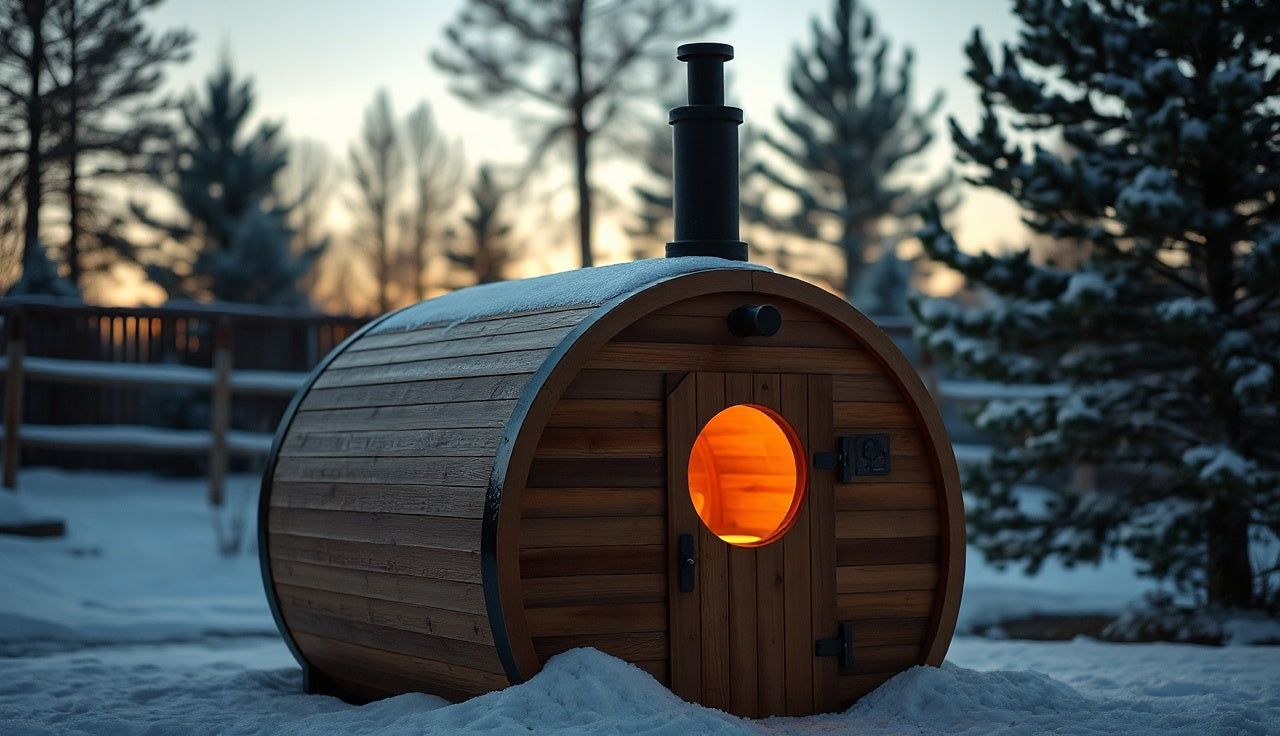
A 2-3 person cedar barrel sauna runs 5 to 6 feet in diameter and 6 to 7 feet long. Expect $3,000 to $7,500 for the unit alone. It heats to 160-190°F in 30 to 45 minutes with a good electric or wood-burning stove. Cedar shrugs off moisture and warping outdoors. Assembly takes two handy people one to two weekends.
What exactly is an Alpine-style cedar barrel sauna?
"Alpine" gets stamped on barrel saunas in marketing copy constantly, but the name points at a real design lineage. Scandinavian and Alpine European saunas were often cylindrical log structures built to survive brutal weather: heavy snow loads, freeze-thaw cycles, the kind of outdoor punishment that kills flat-roofed sheds in a decade.
The barrel shape solves a specific engineering problem. A round cross-section spreads stress evenly around the stave joints, so the wood expands and contracts with humidity swings without blowing the seams apart. That's no small thing if you're leaving a sauna outside year-round in Minnesota or Oregon.
Cedar is the wood of choice for most quality barrel saunas sold in North America, and the reasons are practical. Western red cedar (Thuja plicata) has natural oils that resist rot, and its low density means it doesn't store heat the way dense hardwoods do. Touch the wall of a cedar sauna after 45 minutes at 180°F and it's warm, not scalding. Touch a pine wall in the same conditions and you'll pull your hand back. Cedar also has low thermal conductivity, around 0.08 W/(m·K) by most wood science references, which is part of why the interior stays comfortable while the exterior stays weatherproof [1].
The "2-3 person" label usually means an interior bench that seats two adults lying down or three sitting upright. That distinction matters, because you often have to pick a side: a lounging sauna or a social one. For a home with two regular users, a 5-foot diameter barrel is the practical floor. Go smaller and it starts to feel like a coffin once you add a bench, a heater, and two people.
For background on sauna types and how barrel saunas stack up against traditional indoor units, see our full sauna guide.
What are the actual dimensions of a 2-3 person barrel sauna?
Barrel saunas are sized by diameter and length, and the two numbers interact in ways that aren't obvious until you've sat in a few. Diameter sets your headroom and how snug the walls feel. Length sets your bench.
| Configuration | Diameter | Length | Interior bench length | Typical capacity |
|---|---|---|---|---|
| Compact 2-person | 4 ft | 6 ft | ~5 ft | 2 seated, 1 lying |
| Standard 2-3 person | 5 ft | 6-7 ft | ~5.5-6 ft | 2-3 seated, 2 lying |
| Large 3-person | 6 ft | 7-8 ft | ~6.5 ft | 3 seated comfortably |
| Extra-large (4+) | 7 ft | 8+ ft | ~7+ ft | 4 seated |
The 5-foot diameter is the sweet spot for most households. You get full headroom sitting upright on the bench (the bench sits roughly 18 to 24 inches off the floor, putting your head about 4 feet from the floor centerline, well inside the dome). The 6-foot diameter feels noticeably roomier and is worth it if you host guests often or want to lie flat during sessions. It also eats more yard and weighs a lot more.
Wall thickness drives both thermal performance and outdoor durability. Look for staves at least 1.5 inches thick; the better-built units run 1.75 to 2 inches. Thicker staves hold heat longer, cut warm-up energy, and last longer through freeze-thaw. A 1.25-inch stave barrel is cheaper to build and cheaper to buy, but in a cold climate you'll feel it on your power bill and watch it weather faster.
Footprint on your property matters too. A 5-foot diameter by 7-foot length barrel needs roughly 8 by 10 feet of clear space once you account for door swing and ventilation clearance. Most local codes require 5 feet of setback from property lines for accessory structures, but check your specific municipality because setback rules vary widely [2].
How much does a 2-3 person cedar barrel sauna cost?
The unit itself runs $2,800 to $9,500 for a 2-3 person cedar barrel, depending on stave thickness, heater quality, and add-ons. Most solid mid-range units land between $4,000 and $6,500. Here's how the tiers break down in 2024-2025 pricing.
| Tier | Price range | What you typically get |
|---|---|---|
| Entry-level | $2,800-$4,000 | Thinner staves (1.25 in), basic electric heater, minimal hardware |
| Mid-range | $4,000-$6,500 | 1.5-1.75 in staves, quality heater (Harvia, Tylö, or equivalent), better assembly hardware |
| Premium | $6,500-$9,500+ | 1.75-2 in thick staves, premium heater, porch add-on, custom options |
That's just the unit. Add $200 to $600 for a gravel or concrete pad, $150 to $400 for a licensed electrician to run a 240V circuit (which most electric heaters require), and $0 to $800 depending on how much assembly help you hire. Go with a wood-burning stove instead of electric and you skip the electrical cost, but you add the stove ($400 to $900 for a good one) plus any chimney hardware.
A traditional prefab indoor sauna in the same capacity typically costs $3,500 to $8,000 for the cabinet plus electrical, so you're in a similar range either way. The barrel sauna lives outside, though, so it doesn't eat indoor square footage. For most homeowners that's real value.
Shipping catches people off guard. A fully crated 5-foot barrel sauna kit weighs 600 to 900 pounds. Freight from the manufacturer (most ship from Canada or the Pacific Northwest) runs $300 to $700 depending on distance. Some retailers fold shipping into the price; many don't. Read the line items carefully before you check out.
For a side-by-side look at the broader home sauna market and what each price point actually delivers, the home sauna buying guide goes deeper.
| Sauna unit (mid-range) | $5,200 |
| Electric heater (if separate) | $650 |
| 240V electrical circuit | $900 |
| Gravel pad preparation | $250 |
| Freight shipping | $500 |
| Assembly labor (optional) | $600 |
Source: U.S. Energy Information Administration, 2024; industry pricing aggregated from manufacturer listings
Which heater is better for a barrel sauna: electric or wood-burning?
Both work, and both carry real tradeoffs, so there's no clean winner. Electric is easier to live with day to day. Wood-burning is more satisfying if the ritual is the point. That's the honest short version.
Electric heaters are simple. You plug in (or hardwire) the unit, set the temperature on a digital controller, and come back in 30 to 45 minutes to a ready sauna. Quality electric heaters from Finnish makers like Harvia or Tylö last 15 to 20 years with basic care. The catch is the wiring. Most 2-3 person heaters draw 4.5 kW to 8 kW and need a dedicated 240V circuit. Depending on how far the sauna sits from your main panel, that run alone can cost $500 to $1,500 [3].
Wood-burning stoves give you what most purists are after: crackling fire, wood smoke, the ritual of building the fire before the session. They also heat faster in genuinely cold weather because they throw enormous BTUs with no electrical load. The cost is real. You need a supply of dry wood, a chimney running through the barrel roof (a tricky sealing job), and 45 to 60 minutes of tending to get it properly hot. And you can't fire it up from your phone on the drive home.
My honest take for a 2-3 person outdoor barrel: if you have a 240V outlet within 50 feet of the site, go electric. If you're installing somewhere remote with no easy power, wood-burning is the practical call. If the ritual is what you're chasing, wood will satisfy you more even though it's more work.
Watch the heater sizing. A common industry rule is 1 kW per 45 cubic feet of sauna volume, though manufacturers differ. A 5-foot diameter by 7-foot barrel holds roughly 130 to 140 cubic feet, which points to a 3 to 4 kW heater at the absolute minimum. Most quality units this size use 4.5 to 6 kW, which is right. Undersizing the heater is one of the most common ways a barrel sauna lets its owner down.
What are the health benefits of using a barrel sauna regularly?
Regular sauna use at 160-190°F for 15 to 20 minutes a session is safe for most healthy adults and links to better cardiovascular and recovery outcomes in observational research. It is not a medical treatment. The strongest data comes from traditional Finnish sauna studies, but a barrel sauna delivers the same mechanism: acute heat that raises core body temperature, so the effects should carry over.
The most cited work is the Kuopio Ischemic Heart Disease Risk Factor Study, which followed over 2,000 Finnish men for roughly 20 years. Men who used a sauna 4 to 7 times per week had a 40% lower risk of all-cause mortality than once-weekly users [4]. That's a striking association. Causality is harder to pin down, since frequent sauna users may share other healthy habits, and the study was observational. The researchers say as much themselves.
For athletic recovery, the evidence is more mechanistic. Heat exposure raises plasma volume, which can improve endurance performance. A 2007 study in the Journal of Science and Medicine in Sport found that post-exercise sauna use over three weeks increased running time-to-exhaustion compared to controls [5]. Most endurance athletes who sauna consistently report better recovery and less soreness, though controlled studies on barrel saunas specifically are essentially nonexistent.
Heat also triggers a stress response that increases heat shock proteins, which help cells repair damaged proteins. That's the molecular story behind most recovery claims. Whether it translates to faster muscle repair in practice is still being studied, and nobody should sell you certainty here.
Thinking about pairing your barrel sauna with a cold plunge for contrast therapy? Many users swear by it for recovery. Our guide on cold plunge benefits lays out what the research actually shows. Short version: the combination feels excellent and may sharpen the autonomic nervous system response, but the data is thinner than the enthusiasm.
One caution worth repeating. People with cardiovascular conditions, anyone pregnant, or anyone on medications that affect blood pressure should talk to a doctor before using a sauna [6].
How hard is it to assemble a cedar barrel sauna kit at home?
Most kits arrive as pre-cut, numbered stave pieces with hardware included, and two reasonably handy people can put one together over a weekend or two. It takes time and precision, not a contractor.
Here's the basic sequence. Lay down your base and cradle supports, stack the floor staves across them, then build the barrel walls by placing stave after stave and threading the metal tension bands through as you go. Tighten the bands progressively as you add staves. Once the barrel body is up, attach the door frame and install the end-caps (the flat circular walls on each side). Interior work comes last: benches, heater mounting, ventilation.
For a 5-foot by 7-foot kit with no surprises, plan on two full days for two people. Day one is mostly the barrel shell and end-caps. Day two is interior work, door hardware, and heater installation. Kits with front porches or dual-room layouts can stretch to three or four days.
The trickiest part for most DIYers is the stave tension banding. The staves need to be uniformly tight to prevent gaps, but overtightening before the wood has settled causes problems later. Most manufacturers print torque guidance in the manual. Follow it. The wood swells once it takes on moisture from your first few sessions, and the small gaps close on their own.
Things that make assembly easier: a helper (you truly cannot do this alone), a level and square kept within reach, and a dry-run placement of your cradle supports before you commit. Things that make it harder: cold weather that leaves the wood brittle, uneven ground, and missing hardware. Count the kit inventory against the packing list before you start a single step.
Tools you'll actually reach for: a rubber mallet, a wrench set for the band bolts, a drill, a level, and a circular saw if any cuts come up (though most kits ship cut to size).
What foundation or base do you need under a barrel sauna?
A barrel sauna sits on two or more cradle supports, curved wooden or composite arcs that match the barrel's radius, not on a flat foundation. Those cradles still need something stable and level underneath, and what you choose shapes how long the sauna lasts.
Gravel pad is the most common choice. Dig out the footprint 4 to 6 inches, fill with compacted crushed gravel, and level it. Gravel drains perfectly, costs $50 to $150 in materials for this size, and gives you a firm surface. Most manufacturers recommend it. The downside: it can shift slightly over years, especially in freeze-thaw climates, so you may need to relevel occasionally.
Concrete pad is more permanent and pricier. A 4-inch reinforced pad handles any climate and never moves. Expect $400 to $900 poured professionally at this size. If the sauna is staying put for decades, concrete earns its cost. But barrel saunas are actually relocatable, which is a genuine edge over built-in models, so if there's any chance you'll move it, skip the concrete.
Pressure-treated lumber deck shows up often in kits from Canadian manufacturers. Build a simple PT frame and let the cradles sit on top. This lifts the barrel off wet ground and ventilates underneath, which extends the life of the cradles and the wood they touch. The labor is modest if you're handy.
Do not set a barrel sauna directly on dirt, grass, or untreated wood touching soil. The cradles rot within a few years and you're staring at a hazardous lean. Most manufacturers void the cradle warranty outright if they're installed in ground contact.
How does a barrel sauna hold up outdoors in cold climates?
Cedar is well-suited to cold-climate outdoor use, and a good barrel sauna lasts 15 to 25 years there with reasonable care. Its natural oils resist rot, and its low density makes it less prone to freeze-thaw cracking than denser woods. But well-suited does not mean zero maintenance.
In USDA zones 3 through 6, roughly, here's what actually happens over time. The metal tension bands need periodic tightening, usually once a year for the first two or three years as the wood settles, then less often. Some gap between staves is normal in dry seasons and closes when humidity rises or you start using the sauna regularly. The exterior grays if left unfinished, which is cosmetic and not damage.
The roof is the weak point. Most barrel saunas use asphalt shingles, EPDM rubber, or polycarbonate panels on the curved top. Heavy snow loads can stress the structure if the sauna sits where snow piles up. The barrel shape helps, since snow slides off curves more readily than off flat roofs, but in heavy snow country you'll want to clear the top now and then.
For the wood itself you have three options: leave it natural (it grays gracefully), apply exterior cedar oil or a penetrating sealer every 2 to 3 years, or do nothing and accept faster weathering. Never seal or paint the interior wood. The chemicals off-gas in the heat.
On longevity, expect the door hinges and handle hardware to go first (5 to 10 years), then the tension bands (10 to 15 years). The barrel itself, if it's properly thick staves of proper cedar, should outlast most of its hardware.
Do you need a permit to install a barrel sauna in your yard?
Usually yes, though the rules swing hard by jurisdiction and the threshold matters. Most local building departments treat outdoor saunas as accessory structures, like sheds or hot tubs. Many municipalities exempt structures under a set square footage (often 120 to 200 square feet) from building permits, but the sauna still has to meet setback requirements, electrical codes, and any HOA rules.
The electrical work almost always needs a permit and a licensed electrician, whether or not the structure itself does. A 240V hardwired circuit is not a DIY gray area in most jurisdictions. NEC Article 680 covers pools, spas, and similar installations, and its provisions for outdoor electrical work are strict about GFCI protection and weatherproofing [7]. Your electrician will know what applies locally.
A practical checklist before you order: 1. Call your local planning or building department and describe the project (outdoor barrel sauna, approximate dimensions, electric heater). Ask whether a building permit is required and what the setback rules are. 2. Check your HOA covenants if you have them. Some ban any outdoor structure visible from the street. 3. Confirm your homeowner's insurance situation. Some policies cover the sauna as a permanent structure; others want a rider. Adding an outdoor sauna can shift your insured replacement value [8].
Most homeowners clear this without drama. The barrel sauna's small footprint often keeps it under the permit threshold. But skipping the calls and drawing a citation from code enforcement is an expensive mistake, so spend the 30 minutes.
How does a 2-3 person barrel sauna compare to other home sauna options?
A barrel sauna is one of several home sauna formats worth weighing. It wins on outdoor durability, relocatability, and the character of the heat. It loses to infrared on cost and convenience for solo users, and to a full cabin on interior room for bigger groups. Here's the honest comparison.
| Type | Space needed | Typical cost | Installation | Relocatable | Outdoor-ready |
|---|---|---|---|---|---|
| Cedar barrel sauna | Outdoor | $3,000-$9,500 | DIY-friendly | Yes | Yes |
| Traditional prefab cabin sauna | Indoor or outdoor | $3,500-$12,000+ | Moderate | Difficult | With enclosure |
| Infrared sauna cabin | Indoor | $2,500-$7,000 | Plug-in | Yes | No |
| Portable sauna tent | Anywhere | $150-$600 | Minutes | Yes | Partial |
| Custom built sauna | Indoor/outdoor | $10,000-$40,000+ | Professional | No | Optional |
For two people who want the full Finnish-style heat outdoors, the barrel sauna is probably the best product match. For a family of four or five, a cabin-style outdoor sauna or a custom room build makes more sense.
People often ask how a barrel sauna compares to a steam room. They're different environments. A barrel sauna runs 160-190°F at 10 to 20% humidity. A steam room runs 100-115°F at 95 to 100% humidity. The physiological effects overlap but aren't identical. If you've tried both and liked the dry-heat sensation, a barrel sauna is your answer. If you liked the steam room's wet air, a barrel sauna will feel aggressively dry by comparison.
SweatDecks carries a selected range of cedar barrel saunas in the 2-3 person size if you want to compare specific models side by side.
What should you look for in a quality cedar barrel sauna?
After looking at dozens of kits, a handful of specs separate the quality units from the ones that disappoint owners two years in. Stave thickness and hardware metal are the two most people skip over, and they're the two that matter most for longevity.
Stave thickness: 1.5 inches is my minimum; 1.75 inches is better. Budget units use 1.25-inch staves, and the gap in thermal performance and structural life is real.
Cedar species: Western red cedar (Thuja plicata) is the standard and what you want. Some makers use Nordic spruce (fine), white cedar (acceptable), or pine (avoid for outdoor use). If the listing doesn't name the species, ask before buying.
Band hardware: The tension bands and their fasteners should be stainless steel or galvanized. Raw steel rusts within a couple of seasons outdoors. Rusted bands stain the wood and eventually fail.
Door construction: A barrel sauna door needs to seal well for heat retention, but it also has to open from inside in an emergency. Look for a proper interior release and a door that swings outward. A gap at the bottom for fresh-air intake is normal and intentional.
Ventilation: There should be an adjustable intake vent near floor level and an exhaust vent near the top. Without it, CO2 builds up inside and sessions turn unpleasant and potentially unsafe. Some designs build ventilation into the door frame; others use separate vent plugs in the wall.
Heater included versus sold separately: Many kits don't include a heater. That's fine, since it lets you match the heater to your power setup, but budget for it. A quality electric heater for a 2-3 person barrel runs $400 to $900 on its own.
Warranty: Reputable manufacturers offer 2 to 5 years on the structure and 1 to 2 years on the heater. A maker unwilling to stand behind the barrel for at least 2 years is telling you something about their confidence in it.
For broader guidance on choosing between sauna types, our sauna benefits article covers what the research says about different session formats.
How do you maintain a cedar barrel sauna to make it last?
Maintenance is light, but skip it and you cut the lifespan hard. The whole routine comes down to letting it dry out after use, checking the bands each spring, and keeping standing water out.
Interior maintenance: After sessions, prop the door open for 20 to 30 minutes so steam and moisture escape. That keeps mold from taking hold in the interior wood. The benches darken with use, which is normal. To clean, use warm water and mild soap no more than a few times a year. Never use harsh cleaners, bleach, or solvents inside.
Exterior maintenance: Cedar grays naturally outdoors with no treatment, and plenty of people prefer that look. To keep the reddish-brown color, apply penetrating cedar oil or an exterior wood sealer every 2 to 3 years. Don't use deck stains or film-forming finishes on the exterior. They trap moisture and speed up decay.
Band tightening: Check the tension bands every spring and snug them with a wrench if they've loosened. Don't overtighten. You should be able to slip a credit card into the band-to-barrel gap but not a pencil. Most manufacturers print band-tightening steps in the manual with guidance for their specific hardware.
Heater maintenance: Electric heaters need almost nothing. Wipe the kiuas stones down annually and replace them every 3 to 5 years when they crack or crumble from thermal cycling. Wood-burning stoves need the ash cleared after each use, and the flue checked yearly for creosote buildup, especially if you burn resinous woods [9].
Winter storage: You don't need to disassemble a cedar barrel sauna for winter. The barrel design handles snow loads and freezing temperatures. Just make sure water isn't pooling inside the sauna or on the roof. A simple roof cap or tarp over the chimney opening keeps rain and snow out while the unit sits idle.
How does contrast therapy with a barrel sauna and cold plunge work?
Contrast therapy alternates heat and cold exposure, and a barrel sauna paired with a cold plunge is one of the better home setups for it. The basic protocol: 15 to 20 minutes in the sauna at 160-180°F, then straight into cold water at 50-60°F for 2 to 4 minutes, repeated 2 to 3 times.
The swing from heat to cold drives a dramatic cardiovascular response. Your blood vessels dilate fully in the sauna, then clamp down sharply in the cold. Heart rate jumps around. Most people describe a strong sense of alertness and wellbeing after a full contrast session.
The research base for contrast therapy specifically, rather than sauna alone or cold alone, is thinner than enthusiasts suggest. A 2012 Cochrane review of cold water immersion for muscle soreness found it reduces delayed-onset muscle soreness compared to passive rest, but the effect sizes were modest and the methods varied widely across studies [10]. Combining sauna and cold plunge appears to amplify the subjective experience, but head-to-head controlled studies on the combined protocol are limited.
Here's what the physiology suggests. Heat raises blood flow and relaxes muscle tissue. Cold lowers inflammation markers and releases endorphins. Alternating the two may create a pumping effect on circulation that speeds metabolite clearance from muscle. That's a reasonable mechanistic hypothesis. Whether it produces meaningfully faster performance recovery in controlled conditions is still being studied.
Practically: if you install a barrel sauna, a cold plunge or even a cold-water stock tank nearby makes the whole setup far more useful for recovery. Do the spatial planning before you settle where the sauna goes. For more on what cold exposure does on its own, see our guide on ice bath protocols.
Frequently asked questions
How long does it take to heat a 2-3 person cedar barrel sauna?
With a properly sized electric heater (4.5-6 kW for a 5-foot diameter barrel), expect 30 to 45 minutes to reach 160-180°F in moderate weather. Cold outdoor temperatures below 20°F can push warm-up to 60 minutes. A wood-burning stove takes 45 to 60 minutes regardless of weather but produces a more intense, even heat. Running the sauna right after another session cuts warm-up to 10 to 15 minutes.
Can a barrel sauna stay outside year-round in cold climates?
Yes. Cedar barrel saunas are built for cold-climate outdoor use. The barrel shape sheds snow loads naturally, and quality cedar resists freeze-thaw cracking better than most outdoor woods. You don't need to disassemble for winter. What helps: tighten the tension bands each spring, keep moisture from pooling inside when the sauna is idle, and clear heavy ice from the roof after major storms.
What size sauna do I actually need for 2-3 people?
A 5-foot diameter by 6-7 foot barrel is the practical minimum for two people who want to lie down and three seated upright. If you host guests often or want to recline fully, step up to a 6-foot diameter. The 4-foot diameter units sold as "2-person" are cramped with two adults. They're really solo-plus-one saunas once you account for bench, heater, and movement.
Do I need an electrician to install a barrel sauna?
If you're using an electric heater, almost certainly. Electric sauna heaters run on a dedicated 240V circuit and must be installed to NEC code, which in most jurisdictions requires a licensed electrician. Running that circuit can cost $300 to $1,500 depending on panel distance. Wood-burning barrel saunas need no electrical work, though you still have to meet local codes for outdoor structures.
How much does it cost to run a cedar barrel sauna per session?
A 6 kW electric heater running 1.5 hours (30-45 min warm-up plus one session) uses roughly 9 kWh. At the US average electricity rate of about $0.16 per kWh (EIA, 2024), that's about $1.44 per session. In high-cost states like California or Hawaii where rates top $0.30/kWh, the same session runs about $2.70. Wood-burning cost depends on local firewood prices, typically $0.50 to $2.00 per session equivalent.
Can I put a barrel sauna on a deck or patio?
Yes, with conditions. The deck must handle the load: a 5-foot cedar barrel sauna with heater and occupants can weigh 1,500 to 2,000 pounds. Most standard residential decks are built for 40 to 60 psf live load, which is usually enough but should be verified by whoever built the deck. The cradles should sit on load-bearing joists, more than decking. Also confirm clearance from wooden railings for heat and ventilation.
How long does a cedar barrel sauna last?
A well-built cedar barrel sauna with 1.5+ inch staves, quality hardware, and reasonable maintenance should last 15 to 25 years outdoors. The first parts to need replacement are usually door hardware (5 to 10 years) and tension bands (10 to 15 years). The cedar barrel structure itself is the most durable element. Skipping band tightening or letting moisture pool inside shortens this timeline significantly.
Is a cedar barrel sauna better than an infrared sauna?
They're different experiences. A cedar barrel sauna heats the air to 160-190°F (traditional Finnish style), which many users find more intense and more satisfying for the full ritual. Infrared saunas heat your body directly at 120-140°F with lower air temperature, which some people tolerate better. The evidence for cardiovascular benefits is stronger for traditional high-temperature sauna use. For outdoor installation, the barrel wins outright, since infrared units aren't weatherproof.
What rocks should I use in a barrel sauna heater?
Most electric and wood-burning heaters use olivine diabase or peridotite rocks, often sold as sauna stones. These dense, low-porosity volcanic rocks handle thermal cycling without cracking or exploding when you pour water over them. Avoid granite, limestone, or decorative river rocks, which can crack under repeated extreme heating. Replace sauna stones every 3 to 5 years when they show significant cracking or crumbling.
Does a barrel sauna add value to a home?
Possibly, but don't buy one expecting a dollar-for-dollar return at resale. Appraisers treat outdoor saunas like hot tubs: a modest positive for the right buyer, not a guaranteed value add for everyone. In markets where outdoor recreation and wellness run deep (Pacific Northwest, Midwest lake country, Colorado), an installed barrel sauna may genuinely help a sale. In other markets it can be irrelevant to buyers.
What's the best way to pair a barrel sauna with contrast therapy at home?
Put the sauna within easy walking distance of your cold plunge or cold water source. A dedicated cold plunge tub at 50-60°F works best, but a chest freezer converted to a cold plunge or even a cold outdoor shower can do the job. The protocol: 15 to 20 minutes of sauna heat, then 2 to 4 minutes of cold immersion, rest 5 minutes, repeat 2 to 3 cycles. Finish with cold for alertness or with heat for deeper relaxation.
Can I use a barrel sauna every day?
Most research on frequent sauna use, including the Kuopio cohort following Finnish men over 20 years, shows daily use is safe for healthy adults. The Finnish tradition has always included frequent, sometimes daily, sessions. Start with 2 to 3 sessions per week at 10 to 15 minutes if you're new to it, then build to 20 minutes as your heat tolerance grows. Stay hydrated, and avoid alcohol before or during sessions.
Is a 3 person barrel sauna noticeably larger than a 2 person model?
The difference is usually one size step: a 4-foot or 4.5-foot diameter versus a 5-foot or 6-foot diameter. In practice, going from 4.5 feet to 5 feet adds meaningful interior volume and changes the bench layout. The 5-foot diameter comfortably fits three adults seated or two lying down. If you're buying for regular use by three people, don't settle for a tight 4.5-foot barrel just to save a few hundred dollars.
Do barrel saunas require a concrete pad?
No. A compacted gravel pad (4 to 6 inches of crushed gravel, leveled) is the most common and manufacturer-recommended base. Concrete is more permanent and slightly more stable, but it's not required and makes relocating the sauna impossible. Pressure-treated lumber decking is another good option. What's not acceptable is bare dirt, grass, or untreated wood in direct ground contact, which rots the cradles within a few years.
Sources
- USDA Forest Products Laboratory, Wood Handbook Chapter 4: Moisture Relations and Physical Properties of Wood: Thermal conductivity of western red cedar is approximately 0.08 W/(m·K) due to its low density and cellular structure
- HUD Office of Policy Development and Research, Accessory Dwelling Units: Case Study: Most local codes require setback distances of 5 feet or more from property lines for accessory structures
- U.S. Department of Energy, Electrical Wiring Costs and Installation: Running a new 240V electrical circuit for outdoor appliances can cost $500-$1,500 depending on panel distance and local labor rates
- JAMA Internal Medicine, 'Association Between Sauna Bathing and Fatal Cardiovascular and All-Cause Mortality Events,' Laukkanen et al. 2015: Men who used a sauna 4-7 times per week had a 40% lower risk of all-cause mortality compared to once-weekly users in a 20-year follow-up study of over 2,000 Finnish men
- Journal of Science and Medicine in Sport, 'Effect of post-exercise sauna bathing on the endurance performance of competitive male runners,' Scoon et al. 2007: Post-exercise sauna use over three weeks increased running time-to-exhaustion compared to controls
- Mayo Clinic, Sauna Safety: People with cardiovascular conditions, pregnant women, and those on medications affecting blood pressure should consult a physician before sauna use
- NFPA 70 National Electrical Code, Article 680: Swimming Pools, Fountains, and Similar Installations: NEC Article 680 covers outdoor electrical installations near water features and requires GFCI protection and specific weatherproofing standards
- Insurance Information Institute, Home Insurance and Outdoor Structures: Adding a permanent outdoor structure such as a sauna may affect homeowner's insurance coverage and should be disclosed to your insurer
- U.S. Consumer Product Safety Commission, Wood-Burning Heaters and Fireplaces Safety: Wood-burning stoves and their flues should be inspected annually for creosote buildup, particularly when resinous wood species are used
- Cochrane Database of Systematic Reviews, 'Cold-water immersion (cryotherapy) for preventing and treating muscle soreness after exercise,' Bleakley et al. 2012: Cold water immersion reduces delayed-onset muscle soreness compared to passive rest, but effect sizes are modest and study methodology varies
- U.S. Energy Information Administration, Average Retail Price of Electricity: The US average residential electricity rate was approximately $0.16 per kWh as of 2024, with high-cost states such as California and Hawaii exceeding $0.30 per kWh

Share:
Cold plunge then hot tub: does the order actually matter?
Portable outdoor sauna: the complete buyer's guide (2026)