
Last updated 2026-07-09
TL;DR
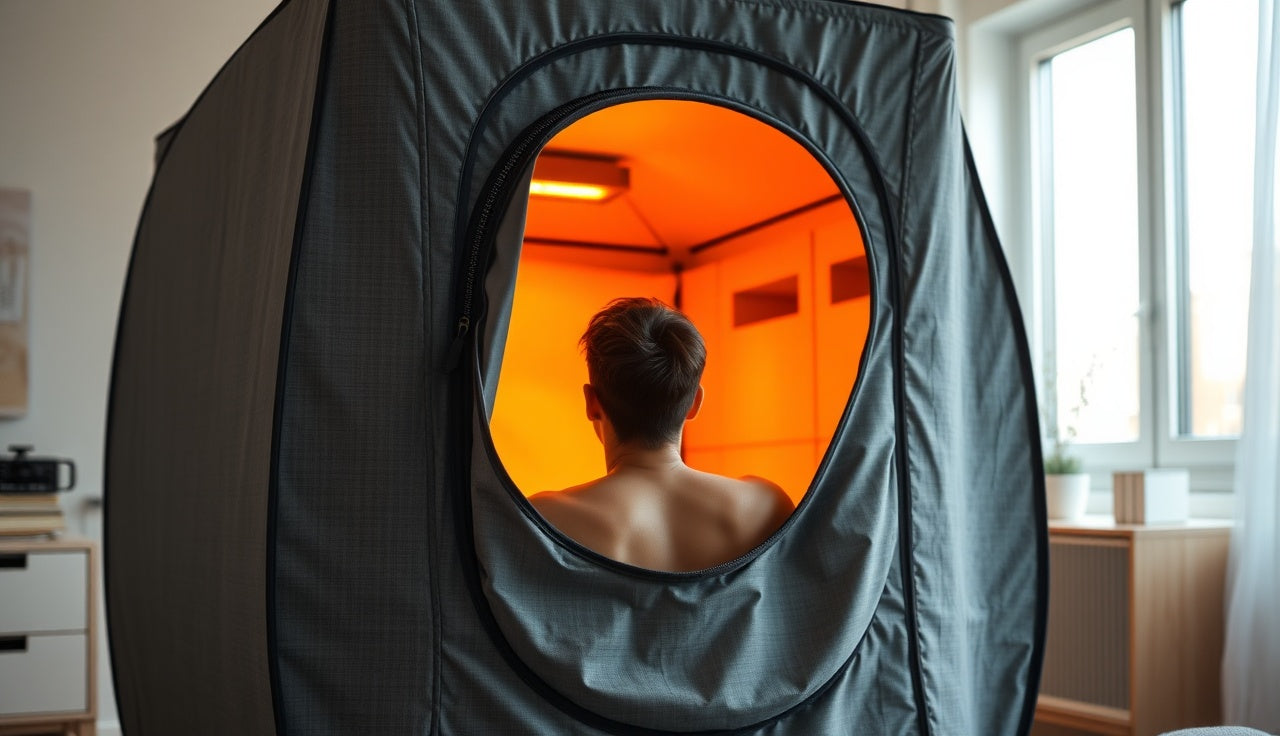
A portable infrared sauna is a zip-up tent or foldable blanket that uses far-infrared panels to heat your body directly, not the air around you. They cost $150 to $700, reach 120 to 140°F in 10 to 15 minutes, and fold into a closet. They work. But they run milder than a full cabin sauna, and the trade-offs are worth knowing before you spend a dime.
What is a portable infrared sauna?
A portable infrared sauna is a foldable enclosure, usually a pop-up tent or a wrap-around blanket, that holds far-infrared (FIR) heating panels. The panels emit electromagnetic radiation in the 5 to 15 micrometer wavelength range, which your skin and the tissue just beneath it absorb directly instead of waiting for the surrounding air to warm up [1]. That's the core difference from a traditional Finnish sauna: you're heating the body, not the room.
Most tent-style units have a zippered opening for your head, so you sit inside while your head stays out. Blanket-style models wrap around your whole body. Either way, the footprint is small. Folded down, most fit in a duffle bag or the corner of a closet.
These aren't the same as a home sauna or a full outdoor sauna cabin. Air temperature inside a portable unit tops out around 120 to 140°F, well below the 160 to 190°F of a traditional Finnish session. That lower temperature means lower cardiovascular demand. Some people prefer it. Others find it underwhelming.
The category splits into two shapes: tent saunas (fabric enclosure, chair inside, head out) and sauna blankets (lie down, wrapped head to toe). Each has a different feel and a different use case, and neither wins in every situation.
How does far-infrared heat actually work?
Infrared is light you can't see but can feel as warmth. The sun makes it. So does a campfire. So does your own body. Far-infrared sits at the longer-wavelength end of the infrared spectrum, roughly 6 to 14 micrometers, and that range happens to match the absorption frequencies of water molecules in human tissue [1].
When FIR panels radiate at those wavelengths, your skin absorbs the energy and converts it to heat at a depth of roughly 1 to 2 inches, depending on the study and the tissue. The air in the enclosure warms up too, but that's secondary. Your core temperature climbs mainly because the tissue itself is heating from the outside in.
Proponents claim FIR penetrates deeper than a traditional sauna's convective heat. The evidence on whether that produces meaningfully different physiological outcomes, compared to the same core-temperature rise from conventional heat, is mixed. The more honest framing: far-infrared makes it practical to get a real heat stimulus at lower air temperatures. That's a genuine win for people who can't stand hot air or who want to use heat in a small apartment.
Near-infrared (NIR) panels, sold in some premium portable units, operate at shorter wavelengths (around 700 to 1400 nm) and get marketed for different effects including photobiomodulation. The research on NIR at those wavelengths is a separate, younger literature, and the consumer products vary enormously in how much light they actually emit. Be skeptical of dramatic health claims stapled to NIR panels in budget units.
What are the real health benefits backed by research?
Most of the clinical research on sauna health benefits used traditional Finnish saunas at higher temperatures and longer durations, not portable infrared tents [2]. Extrapolating is reasonable but unconfirmed. Here's what the evidence actually says, benefit by benefit.
Cardiovascular effects are the most studied. A 2018 review in Mayo Clinic Proceedings noted that frequent sauna use (4 to 7 times per week) was associated with reduced risk of cardiovascular events in the Kuopio Ischemic Heart Disease study. Those were Finnish men in 174°F dry saunas, not 130°F infrared tents [2]. The mechanism, raising core temperature and heart rate to levels resembling moderate aerobic exercise, can plausibly be reproduced at lower temperatures if the session runs long enough.
Muscle recovery is where infrared gets specific attention. A small 2015 randomized controlled trial in the Journal of Athletic Training found that far-infrared sauna use after exercise improved next-day muscle strength recovery compared to passive rest, though the sample was small [3].
Blood pressure and arterial stiffness have shown modest improvement in short-term studies. A trial published in the Journal of Human Hypertension found repeated far-infrared thermal therapy reduced blood pressure and improved vascular function in patients with coronary risk factors, but these were supervised clinical settings, not home use [4].
Sleep gets reported anecdotally and has some support from the thermogenic sleep literature: raising core temperature before bed and then letting it fall can speed up sleep onset [5]. A portable infrared sauna used 1 to 2 hours before bed is a plausible way to trigger that.
No portable infrared sauna cures disease or replaces medical care. Anyone with cardiovascular conditions, pregnancy, or heat sensitivity should talk to a doctor first. That's not boilerplate. Heat stress has real contraindications.
Tent vs. blanket: which portable infrared sauna type is right for you?
| Feature | Tent-style | Blanket-style |
|---|---|---|
| Typical price | $200, $700 | $150, $600 |
| Setup time | 5 to 10 min | 1 to 2 min |
| Storage size | Duffle bag | Rolled blanket |
| Head position | Head out | Head in or out |
| Max temp | 120 to 140°F | 120 to 135°F |
| Sweat containment | Chair/towel needed | Liner sheet needed |
| Two-person options | Yes (larger models) | Rare |
| Best for | Seated relaxation, reading | Lying down, pre-sleep |
Tent-style units give you room to move and keep your head in cooler air, which most people find more comfortable. You can sit upright, stretch, or scroll your phone without the boxed-in feeling of being fully wrapped. Setup takes a little longer since you're assembling poles and positioning a chair, but most models collapse flat in a few minutes.
Blanket-style saunas, sometimes called infrared sauna blankets, are even more portable. They roll up like a sleeping bag. You lie flat inside a quilted, waterproof shell lined with FIR panels. Most have a separate head panel you can cover or leave open. Because you're horizontal and wrapped, some people find them more relaxing before sleep. The catch: you will sweat into the blanket, so a cotton liner sheet is non-negotiable for hygiene, and the interior fabrics deserve a hard look (see the EMF and material safety section below).
Want to use the unit with a partner? Look at the larger tent formats marketed as two-person units, like the morfone portable infrared sauna for two. These are oversized single-person tents, wide enough for two chairs and two sets of panels. They eat more space and cost more (often $400 to $700), but they're still far cheaper and smaller than any permanent cabin.
What do portable infrared saunas cost, and what does the price actually buy you?
The range runs wide: $150 at the low end for a basic blanket, $700 at the top for a larger tent with multiple panel zones and a controller. Most decent single-person units land between $200 and $400.
Here's what more money actually buys in this category.
Panel quality and EMF levels. Budget units often use plain resistance-heating elements wrapped in carbon fiber fabric and marketed as FIR. True low-EMF far-infrared panels use carbon fiber or ceramic emitters tuned to the FIR wavelength range and tested to produce minimal electric and magnetic field exposure. A credible manufacturer hands you third-party EMF test reports, not label claims.
Temperature control. Cheaper units have a single dial or a basic timer. Better units have digital controllers, multiple zones (feet, body, back), and programmable preheat. If you want to reliably hit a set temperature for a set duration, zone control matters.
Materials. The fabric touching your skin matters. Oxford cloth, waterproof polyester, and generic nylon all show up. Higher-end units specify non-toxic, non-off-gassing materials. When a unit heats up, whatever you're sitting in heats up too, so cheap synthetics are worth scrutinizing.
Warranty and support. A $200 unit from an unknown importer often has no real warranty path. A $400 unit from an established brand often carries a 1 to 2 year warranty and actual customer service.
Above $500 you hit diminishing returns unless you specifically need a two-person model or premium panel specs. The $250 to $350 range is the sweet spot for most buyers.
For scale, a permanent far-infrared cabin sauna starts around $1,500 to $2,500 for a single-person entry unit and can top $10,000 for premium models. A $300 portable unit is not the same experience, but it's real heat therapy at a fraction of the cost. If you're testing what a sauna practice feels like before committing to a permanent build, a portable unit is a smart starting point.
| Sauna blanket (single) | $300 |
| Portable infrared tent (single) | $400 |
| Portable infrared tent (2-person) | $550 |
| Entry infrared cabin (1-person) | $2,000 |
| Mid-range infrared cabin (2-person) | $4,500 |
| Traditional Finnish sauna (built) | $8,000 |
Source: Retail market survey, SweatDecks research, 2025
Are portable infrared saunas safe? What about EMF?
General heat safety applies directly. The risks are dehydration, orthostatic hypotension (dizziness when you stand), and, rarely, heat exhaustion. Drink water before and after. Skip alcohol beforehand. Keep sessions to 20 to 30 minutes until you know how your body responds. Don't use one if you're pregnant, have an implanted medical device, or have a condition that impairs sweating or thermoregulation [6].
EMF is a real concern worth understanding, not waving off. Infrared panels produce both electric fields and magnetic fields. The International Commission on Non-Ionizing Radiation Protection (ICNIRP) publishes reference levels for EMF exposure. For the general public at power frequencies, the reference level for magnetic flux density is 200 microtesla (µT) [7]. Well-made low-EMF panels typically measure below 3 µT at body distance in third-party tests. Budget units can read substantially higher, though still usually well under the ICNIRP threshold.
The honest position: no study has shown harm from the EMF levels these saunas produce. But if you're going to sit inside an enclosure of heating panels for 20 to 30 minutes several times a week, a unit with documented low-EMF output costs you nothing extra once you're already in the $300+ range. Buy the one with the paperwork.
Off-gassing from synthetic materials under heat is a related worry. Polyurethane coatings, certain dyes, and flame retardants in cheap fabrics can release volatile organic compounds (VOCs) when hot. Better manufacturers provide materials testing data. If a brand can't tell you what its liner fabric is or whether it's been tested, that's your answer.
The Consumer Product Safety Commission (CPSC) has no specific certification standard for portable saunas, which means no regulator vets these products before they reach you [8]. Third-party certifications (ETL, CE, RoHS) on the electrical components at least confirm the heating circuit meets safety standards.
How do portable infrared saunas compare to traditional saunas?
| Dimension | Portable infrared sauna | Traditional Finnish sauna | Full infrared cabin |
|---|---|---|---|
| Air temp | 120 to 140°F | 160 to 195°F | 120 to 150°F |
| Setup/install | None | Major construction | Moderate installation |
| Cost | $150, $700 | $3,000, $20,000+ | $1,500, $10,000+ |
| Storage | Closet | Permanent room | Permanent room |
| Session experience | Solo or 2-person tent | Social, high heat | Solo/duo, moderate heat |
| Humidity control | None | Löyly (steam) | None |
| Resale value | Low | High (adds to home value) | Moderate |
| Research depth | Thin | Extensive | Moderate |
The temperature gap is real and it matters. A traditional Finnish sauna at 180°F produces a stronger cardiovascular response, harder sweating, and (for most people) a more dramatic feel. If you've used a real Finnish sauna, a portable infrared tent will feel mild by comparison. That's not a flaw in the product. It's a different tool.
For people who can't tolerate high heat, who get respiratory irritation from hot air, or who want a gentler daily practice, the lower temperature is the whole point. For people chasing the high-heat Nordic experience, a portable unit will let them down.
Contrast therapy, alternating heat and cold, keeps growing in popularity. If you're pairing a sauna with a cold plunge or ice bath, a portable infrared unit works fine as the heat phase. The heat stimulus doesn't need Finnish-sauna intensity to produce a meaningful hot-to-cold swing.
What should you look for when buying a portable infrared sauna?
Five things actually matter at purchase time, and buyers who fixate on price ignore most of them.
Panel type and wavelength. Look for carbon fiber or ceramic far-infrared panels rated to emit in the 6 to 14 micrometer range. Carbon fiber panels are more common, heat faster, and have good emissivity in the FIR range. Ceramic panels take longer to warm up, and some argue they hold better spectral consistency. Either is fine. The 'far infrared' rating is what matters, not the carbon vs. ceramic debate.
Temperature range and controller. A unit that only reaches 120°F may not raise your core temperature fast enough, especially if your room is cold. Look for a max of at least 130°F and a controller that lets you set the target independently from the timer.
Material transparency. Can the seller tell you the fabric composition and whether it's been tested for off-gassing? If the listing says 'high-quality fabric' with no detail, ask. If nobody answers, that's the answer.
EMF documentation. Ask for third-party test results, not a label reading 'low EMF.' Legitimate results show specific magnetic flux density measurements in microtesla at stated distances.
Size and chair. Most tent saunas include a folding chair, and the quality swings wildly. A flimsy plastic chair that wobbles while you sweat is unpleasant and a little unsafe. Check the chair's weight rating. If you're over 200 lbs, confirm the chair and the enclosure are rated for it.
Setup time and storage convenience fall out of all this. A unit that ticks all five boxes but takes 20 minutes to assemble and needs a big bin to store is still legitimate if you use it often. One that sets up fast but is built from questionable materials is not worth the savings.
SweatDecks carries a small, checked selection of portable infrared saunas if you want to compare specific models with documented specs side by side.
How do you use a portable infrared sauna properly?
Start clean, dry, and hydrated. Drink 16 to 20 oz of water in the 30 minutes before you get in. Electrolytes matter more than plain water if your sessions run past 20 minutes or you're going daily. Sweat carries sodium, potassium, and magnesium, and topping up with plain water alone can slowly dilute your electrolyte levels.
Preheat the unit for 10 to 15 minutes before you climb in. Portable infrared saunas reach target temperature faster than a traditional sauna because the enclosed volume is small, but the panels still need warm-up time to hit consistent FIR output. Get in too early and your first 5 to 10 minutes run cool and inconsistent.
Start with 15 to 20 minute sessions. Most experienced users settle into 25 to 35 minutes. Going past 45 minutes with no break is a bad idea regardless of how seasoned you are. Dizzy, lightheaded, or a headache building? Get out.
For a tent: put a cotton or bamboo towel on the chair seat. You'll sweat plenty, and the towel absorbs it and makes cleanup easier. For a blanket: use a cotton liner sheet inside every single session. Wash it after each use.
When you exit, sit or lie down for a few minutes before standing. Blood pools in peripheral vessels during heat exposure, and standing up fast can drop your blood pressure. True in any sauna, worse if you're new.
Cooling down naturally is fine. If you're pairing with contrast therapy, waiting 5 to 10 minutes after exiting before hitting cold water lets your heart rate fall from peak and makes the cold jump less brutal, though the research on ideal hot-to-cold timing is thin. Read more about sauna benefits and contrast protocols if you want to get deliberate about your routine.
Who are portable infrared saunas best suited for, and who should skip them?
Portable infrared saunas make the most sense for one profile: someone who wants a regular heat practice, lives in an apartment or tight space, isn't ready to drop $2,000+ on a permanent build, and cares more about relaxation, muscle recovery, or pre-sleep wind-down than about recreating a scorching Finnish sauna.
Athletes training daily who want recovery between sessions often find a portable blanket or tent handy because it fits in a bedroom after a workout without displacing anyone or claiming a dedicated room. Paired with a cold plunge, a full contrast setup still comes in under $1,000.
Some people should be cautious or skip it entirely. Contraindications in the clinical literature and echoed by bodies like the American Academy of Dermatology include pregnancy, multiple sclerosis (heat can temporarily worsen neurological symptoms), active fever, hemophilia, hypotension, and metal implants near the panels [6]. Certain medications also blunt heat tolerance (diuretics, antihistamines, beta-blockers). If you're on regular medications, a conversation with your prescribing physician before starting is genuinely warranted, not a bureaucratic checkbox.
People expecting a social sauna will be disappointed. Portable infrared saunas are solo, or at best two-person, with no real equivalent to the communal, high-heat lodge of traditional sauna culture.
Serious enthusiasts who use heat several times a week and care about the full sensory experience, the steam, the high heat, the physical space, should think hard about whether a permanent option fits better. The home sauna and outdoor sauna pages on SweatDecks cover those in detail.
How do you maintain and clean a portable infrared sauna?
Maintenance is light compared to a traditional sauna or wet room, but there are real care steps that extend the unit's life and keep it hygienic.
Wipe down the interior panels with a damp cloth after each session. Don't spray water directly on the infrared panels or the electrical connections. Wipe the enclosure fabric with a diluted white vinegar solution (1:1 with water) or a gentle, unscented disinfectant. Skip bleach, which degrades fabric coatings.
For blanket-style units, the liner sheet catches most sweat, but the blanket interior still picks up moisture and body oils over time. Many manufacturers allow spot cleaning only, since most blankets aren't fully machine washable. Follow the care instructions closely. A soaked infrared blanket panel is a warranty-voiding, possibly unsafe object.
Drying matters. Don't fold or store the unit while the interior is still damp. Leave it open and unzipped in a well-ventilated spot for at least 30 to 60 minutes after wiping down. Mold and mildew love a heat enclosure with moisture trapped in the fabric folds.
The folding chair on tent models is usually the first thing to show wear. Rivets and hinges loosen with repeated folding. Tighten them now and then, and replace the chair if it wobbles badly rather than riding out a compromised one.
Manufacturers typically rate carbon fiber infrared panels at 3,000 to 5,000 hours, though independent verification of those numbers is hard to find. At 30 minutes a day, 5 days a week, 3,000 hours works out to roughly 10 years. Realistically, the controller electronics and the fabric give out first.
Frequently asked questions
How hot does a portable infrared sauna get?
Most portable infrared saunas reach 120 to 140°F at their maximum setting. That's below a traditional Finnish sauna (160 to 195°F) but high enough to raise core body temperature and produce real sweating. Preheat time is typically 10 to 15 minutes. If your room is cold in winter, it takes longer and the unit may not hit its rated maximum.
Can you lose weight using a portable infrared sauna?
You'll lose water weight from sweating, but it returns when you rehydrate. There's no solid clinical evidence that infrared sauna sessions produce meaningful fat loss independent of diet and exercise. Calorie burn during a session is real (similar to a light aerobic effort) but small. Don't buy one primarily for weight loss. It's the wrong tool for that job.
How long should a portable infrared sauna session be?
15 to 20 minutes is a sensible starting point. Experienced users typically settle into 25 to 35 minute sessions. Going past 45 minutes without a break raises dehydration and overheating risk. Listen to your body: dizziness, nausea, or a pounding pulse are signals to exit. Drink water before and after every session, and add electrolytes if you're going daily.
Is a portable infrared sauna good for muscle recovery?
There's modest evidence it helps. A 2015 randomized controlled trial in the Journal of Athletic Training found far-infrared sauna use after exercise improved next-day muscle strength recovery versus passive rest. Sample sizes were small. The plausible mechanism is improved circulation and reduced delayed-onset soreness. It's a reasonable recovery addition, not a replacement for sleep and nutrition.
Can two people use a portable infrared sauna together?
Standard portable infrared saunas are built for one. Larger tent-format models, sometimes marketed as two-person units like the morfone portable infrared sauna for two, are wide enough for two chairs and two sets of panels. They cost more, typically $400 to $700, and take up more space. Blanket-style units are strictly single-person. Verify interior width before buying if two-person use matters to you.
Are portable infrared saunas safe for daily use?
For most healthy adults, daily 20 to 30 minute sessions appear safe. The Finnish sauna literature (which used traditional saunas) found health associations with 4 to 7 sessions per week. But daily use without adequate hydration and electrolyte replacement can cause cumulative dehydration. Anyone with heart disease, low blood pressure, or heat-sensitivity conditions should consult a doctor before daily use.
What's the difference between near-infrared and far-infrared portable saunas?
Far-infrared (FIR) panels emit wavelengths around 6 to 14 micrometers, which tissue absorbs as heat. That's what most portable saunas use. Near-infrared (NIR) operates at 700 to 1400 nm and gets tied to photobiomodulation research. Consumer NIR sauna devices vary widely in actual output, and the clinical evidence for NIR-specific benefits in portable products is much thinner than the FIR evidence. FIR is the better-supported option for heat therapy.
Do portable infrared saunas use a lot of electricity?
A typical single-person portable infrared sauna draws 800 to 1800 watts. At the US average residential electricity price of roughly $0.16 per kWh as of 2024, a 30-minute session at 1200W costs about $0.10. Daily use adds roughly $3 per month to your bill. They run on standard 120V household outlets, so no special wiring is needed.
How do portable infrared saunas affect EMF exposure?
Infrared panels produce both electric and magnetic fields. The ICNIRP general public reference level for magnetic flux density at power frequencies is 200 microtesla. Well-built low-EMF panels typically measure below 3 µT at body distance in third-party tests, well within safe limits. Ask manufacturers for third-party EMF test data rather than trusting label claims alone.
Can I use a portable infrared sauna in my apartment?
Yes. Portable infrared saunas need no plumbing, no special ventilation, and no wiring beyond a standard 120V outlet. A standard 8x10 foot room fits most tent-style units when assembled. The enclosure does add some ambient heat to the room during use. Store it folded in a closet between sessions. Confirm your outlet circuit can handle 1200 to 1800W if other high-draw appliances share it.
How does a portable infrared sauna compare to a sauna blanket?
Both use FIR panels but differ in posture and feel. Tent saunas keep your head out and let you sit upright; blankets wrap your whole body and are used lying down. Blankets are more portable and cheaper on average ($150 to $400 vs. $200 to $700 for tents) but need a liner sheet every session and feel more confining. Tents suit people who want to sit and relax; blankets suit pre-sleep lying-down sessions.
What should I wear inside a portable infrared sauna?
As little as is comfortable. Most users wear light cotton shorts or a towel. Avoid synthetic workout clothes; they trap heat differently and don't breathe at these temperatures. For blanket-style units, bare skin with a cotton liner sheet is standard. Heavy clothing cuts how much infrared energy your skin can absorb and slows the core temperature response.
Are there portable infrared saunas that fold flat for travel?
Some blanket-style units roll up small enough to fit in a carry-on bag (under 10 lbs). Tent-style units fold flatter than you'd expect, usually to a disc or bag around 24 to 30 inches across, but most are checked-luggage territory. If travel portability is your main need, a sauna blanket is the practical pick. It's basically a sleeping bag you can pack into a hotel room.
Sources
- National Institutes of Health / NCBI – 'Far-infrared radiation (FIR): Its biological effects and medical applications': Far-infrared radiation in the 5–15 micrometer wavelength range is absorbed by human tissue directly, penetrating subcutaneous tissue and producing thermogenic effects at the tissue level.
- Mayo Clinic Proceedings – 'Sauna bathing and incident cardiovascular disease' (Laukkanen et al., 2018): Frequent sauna use (4–7 times per week) in the Kuopio Ischemic Heart Disease study was associated with reduced cardiovascular event risk; sessions were traditional Finnish saunas at approximately 174°F.
- Journal of Athletic Training – 'Effect of far-infrared sauna on recovery from strength exercise' (Mero et al., 2015): A small randomized controlled trial found far-infrared sauna use post-exercise improved next-day muscle strength recovery compared to passive rest.
- Journal of Human Hypertension (Nature) – far-infrared thermal therapy and vascular function research: Repeated far-infrared thermal therapy was shown to reduce blood pressure and improve impaired vascular endothelial function in patients with coronary risk factors in a supervised clinical setting.
- Sleep Medicine Reviews – 'The effect of warm bathing before bedtime on sleep quality' (Haghayegh et al., 2019): Passive body heating (including warm baths/showers) 1–2 hours before bed can accelerate sleep onset and improve sleep quality by aiding the core body temperature drop associated with sleep initiation.
- American Academy of Dermatology – Sauna safety and contraindications guidance: Contraindications to sauna use include pregnancy, certain cardiovascular conditions, hypotension, multiple sclerosis, and conditions that impair thermoregulation or sweating.
- International Commission on Non-Ionizing Radiation Protection (ICNIRP) – Guidelines for limiting exposure to electromagnetic fields: ICNIRP reference level for the general public magnetic flux density at power frequencies is 200 microtesla (µT); well-made low-EMF infrared panels typically measure below 3 µT at body distance.
- U.S. Consumer Product Safety Commission (CPSC) – Home sauna and portable heating device standards: The CPSC does not currently maintain a specific certification standard for portable infrared saunas; product safety is governed by general electrical safety standards applied to the heating components.
- U.S. Energy Information Administration (EIA) – Average retail electricity prices, 2024: U.S. average residential electricity price was approximately $0.16 per kWh as of 2024, used to calculate per-session operating cost.
- National Institutes of Health / NCBI – 'Clinical effects of regular dry sauna bathing: A systematic review' (Hussain & Cohen, 2018): Systematic review of sauna health benefit research noting that most existing clinical evidence is from traditional dry Finnish saunas, and direct extrapolation to infrared saunas requires caution.

Share:
Portable sauna tent: what it is, what it costs, and whether it's worth it
Dry sauna: what it is, how it works, and its real benefits