
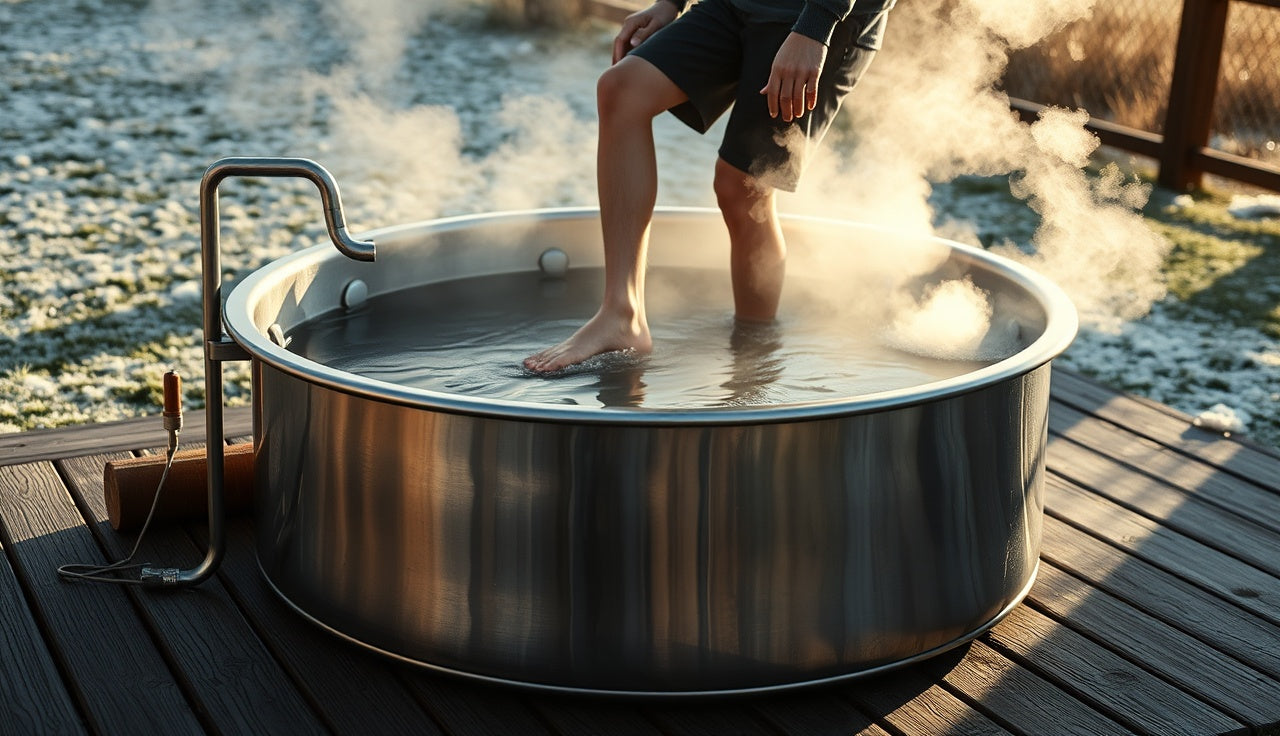
Last updated 2026-07-09
TL;DR
Most research and practitioner consensus puts the effective cold plunge temperature range at 50 to 59°F (10 to 15°C). Beginners should start closer to 59°F and aim for 2 to 5 minutes. Going colder is not automatically better. The biggest gains in norepinephrine, mood, and recovery markers appear well before you hit ice-bath territory.
What is a cold plunge, exactly?
A cold plunge is a deliberate, full or partial-body immersion in cold water, usually between 39°F and 60°F (4°C to 15°C), held for a timed duration. That's it. No mystery. The practice goes by several names: cold water immersion, cold water therapy, ice bath, and sometimes just "the plunge." They all mean the same basic thing. You get in cold water on purpose and stay there long enough to trigger a physiological response.
What separates a cold plunge from a cold shower or a dip in a chilly lake is the intentional control of temperature and time. A dedicated cold plunge tub or tank lets you hold a precise temperature, which matters if you're chasing specific outcomes rather than just general toughness. You can read more about the equipment side in our cold plunge guide.
The practice has roots in Scandinavian, Japanese (misogi), and Roman bathing traditions, but the modern fitness and recovery version runs on sports science research more than folklore. Andrew Huberman and others have popularized specific protocols, but the underlying physiology sat in peer-reviewed literature long before social media found it. [1]
What does a cold plunge do for your body?
Cold water immersion triggers a cascade of acute physiological responses. Within the first few seconds, your body activates the cold shock response: a gasp reflex, rapid breathing, and a sharp rise in heart rate and blood pressure. Your skin's cold receptors fire signals to the brainstem and sympathetic nervous system, which floods your bloodstream with norepinephrine. A 2021 study in Scientific Reports found that cold water immersion at roughly 14°C (57°F) produced a 200 to 300% increase in norepinephrine, a neurotransmitter linked to alertness, mood, and focus. [2]
Beyond the immediate shock, consistent cold water immersion appears to reduce delayed onset muscle soreness (DOMS). A 2012 Cochrane systematic review of 17 small trials found that cold water immersion reduced DOMS compared to passive rest at 24, 48, 72, and 96 hours post-exercise, though the authors noted the evidence quality was low to moderate. [3] The honest read: it probably helps with soreness, but nobody has clean data on the exact mechanism.
Other documented effects include reduced core temperature, vasoconstriction in peripheral tissues, and a post-immersion rebound vasodilation that some researchers think contributes to the recovery signal. Regular cold exposure also nudges up brown adipose tissue (BAT) activity, which has metabolic implications that are real but often overstated in popular media. [4]
What a cold plunge does not do: it does not definitively build muscle, cure depression, or guarantee longevity. Anyone making those claims is ahead of the evidence. The cold plunge benefits article covers the research in more depth.
What temperature should a cold plunge be?
The effective range most research uses is 50 to 59°F (10 to 15°C). That bracket is where you get measurable vasoconstriction, norepinephrine release, and the recovery-related effects without the serious risks that come with near-freezing water.
Here's a practical breakdown of what different temperatures actually feel like and what the evidence says about each zone:
| Temperature | Feel | Common use case | Notes |
|---|---|---|---|
| 32 to 39°F (0 to 4°C) | Extremely painful, fast numbness | Extreme cold therapy, some elite sport | Risk of cold shock response increases significantly; very short exposures only |
| 40 to 49°F (4 to 9°C) | Intense, breath-stealing | Advanced practitioners | Used in some DOMS research; higher risk for beginners |
| 50 to 59°F (10 to 15°C) | Cold but manageable with breathing | Most recovery protocols, general wellness | Best-studied range; most practitioner consensus lands here |
| 60 to 65°F (15 to 18°C) | Noticeably cold, not brutal | Beginners, hot weather use | Still triggers a response; good starting point |
| Above 65°F (18°C) | Refreshing, not therapeutic | Not typically counted as cold therapy | Limited physiological response |
Most commercially sold cold plunge tubs are built to hold temperatures in the 39 to 60°F range. Dedicated units with active chillers can hit the low end of that. Cheaper tubs relying on ice or ambient temperature will drift up, especially in warm climates.
Going colder is not automatically more effective. The Cochrane review and other studies didn't find a linear dose-response where colder equals more benefit. [3] Past a certain point, you're just adding risk. The 50 to 59°F range is where I'd tell most people to spend their time, and it's where the best cold plunges are built to operate.
If you're coming from a hot sauna session and doing contrast therapy, some protocols use water as warm as 65°F for the cold phase because the temperature gap from 190°F sauna air is already enormous. [5]
| 65°F (18°C) — refreshing | 30% |
| 60°F (15°C) — cold | 100% |
| 57°F (14°C) — optimal zone | 250% |
| 50°F (10°C) — intense | 300% |
| 40°F (4°C) — extreme | 310% |
Source: Søberg et al., Scientific Reports, 2021
How long should you cold plunge?
Huberman's widely cited protocol, drawn from his reading of the norepinephrine research, recommends 11 minutes per week total, split across 2 to 4 sessions. [2] That works out to roughly 2 to 5 minutes per session. That range matches what most sports science studies use in their protocols and what experienced practitioners actually do.
Beginner targets:
- First sessions: 1 to 2 minutes at 59°F
- After 2 to 4 weeks: build toward 3 to 5 minutes at 50 to 59°F
- Maintenance: 2 to 5 minutes, 3 to 4 times per week
There is no strong evidence that staying in longer than 10 to 15 minutes adds meaningful benefit, and the risk of hypothermia rises after that point, especially below 50°F. The National Center for Cold Water Safety notes that cold incapacitation can begin in water below 60°F within 3 to 30 minutes depending on body composition, fitness, and the individual. [6]
Time and temperature interact. A 2-minute plunge at 50°F is a different stimulus than a 2-minute plunge at 60°F. Colder water means your effective dose accumulates faster. When people ask "how long should you cold plunge," the honest answer is: enough to feel the sustained cold stress response, not so long that you're shivering uncontrollably or going numb in your hands and feet.
If you're using a cold plunge for post-workout recovery specifically, the most-cited protocol in the sports science literature is 10 to 15 minutes at 50 to 59°F. [3] For general wellness and the norepinephrine response, the shorter 2 to 5 minute window seems to be where the action is.
When is the best time to cold plunge?
This depends entirely on your goal.
For energy and mental focus, cold plunging in the morning appears to produce a longer-lasting alertness effect because the norepinephrine and cortisol spike stacks onto your body's natural morning cortisol peak. Doing it early front-loads the stimulatory effect through your day rather than disrupting sleep.
For post-workout recovery, timing relative to your training session matters more than time of day. Most sports scientists recommend waiting at least 1 to 2 hours after a strength training session before cold immersion if muscle growth is a priority. A 2015 study in the Journal of Physiology found that cold water immersion performed immediately after resistance training blunted some of the anabolic signaling pathways (specifically satellite cell activity and mTOR signaling) compared to active recovery. [7] If your goal is muscle building, save the cold plunge for rest days or the morning. If your goal is soreness reduction and you're not in a hypertrophy phase, timing matters less.
For sleep, avoid cold plunging within 1 to 2 hours of bed. The post-immersion rebound in core body temperature can temporarily delay sleep onset in some people, though others report the opposite. Nobody has great data on this yet.
Contrast therapy (sauna followed by cold plunge) is best done as a standalone session, not immediately before or after hard training. A typical protocol is 3 to 4 rounds of 15 to 20 minutes in a sauna followed by 2 to 5 minutes in the cold plunge, with a short rest between rounds. [5] Check the ice bath guide for more on timing with sport-specific protocols.
How to do a cold plunge safely
The cold shock response is real and it can be dangerous. Your first breath in cold water is involuntary and gasping. If your face is underwater when that happens, you inhale water. That's why you should always enter a cold plunge feet-first, never jump in face-first, and never cold plunge alone if you are a complete beginner.
A practical entry protocol: 1. Set the tub to your target temperature before you get in. 2. Do 2 to 3 slow, controlled breaths before stepping in. 3. Enter feet-first, lower yourself slowly. 4. Keep your arms in or out based on comfort; starting with arms out (less surface area in the water) reduces the intensity. 5. Focus on slow, nasal breathing rather than fighting the gasp reflex. 6. Set a timer. Don't try to judge duration by feel when you're cold-shocked. 7. Exit calmly when the timer goes off. Don't slam a hot shower immediately; let your body rewarm naturally for 5 to 10 minutes first.
People who should not cold plunge without medical clearance: those with uncontrolled hypertension, Raynaud's phenomenon, cardiovascular disease, or any condition affecting peripheral circulation. The blood pressure spike during cold shock can be significant. The American Heart Association doesn't publish specific cold plunge guidance, but its general cold weather cardiovascular warnings apply here. [8]
Do not cold plunge while intoxicated. Alcohol impairs the vasoconstriction response and clouds your judgment about when to exit.
For first-timers building a home setup, SweatDecks carries a curated selection of cold plunge tubs with active chillers that hold temperature precisely, which removes one variable from the equation.
Why do people cold plunge? The main reasons
The reasons people cold plunge cluster into a few categories, and the evidence behind each varies quite a bit.
Recovery from exercise. This is the best-supported use. The Cochrane review, multiple RCTs in sports science journals, and widespread athlete adoption all point toward real (if modest) reductions in DOMS and perceived fatigue. [3]
Mood and mental health. The norepinephrine data is solid. Whether that translates to clinically meaningful antidepressant effects in humans over the long term is less clear. A case report published in BMJ Case Reports in 2018 described cold water swimming improving treatment-resistant depression symptoms in one patient, but a single case report is not a clinical trial. [9] The mood boost after a cold plunge is real and noticeable. Whether it's therapeutic is a different question.
Metabolic activation. Cold exposure activates brown adipose tissue (BAT) and increases cold-induced thermogenesis. A study in the New England Journal of Medicine confirmed that adult humans have metabolically active BAT. [4] Whether regular cold plunging meaningfully changes body composition in practice, absent other interventions, is unproven.
Mental toughness and stress resilience. This is the hardest to measure and the most anecdotal, but plenty of practitioners report that voluntarily doing something uncomfortable trains a kind of stress tolerance that carries over. The physiological basis (habituation of the HPA axis stress response) is plausible but not well-studied in cold plunge contexts specifically.
Contrast therapy with sauna. Alternating heat and cold is one of the most reported uses. The sauna benefits article covers the heat side of the equation.
How much does a cold plunge cost?
The price range is enormous, which causes a lot of confusion. Here's an honest breakdown:
| Type | Price range | Temperature control | Notes |
|---|---|---|---|
| DIY ice bath (stock tank + ice) | $50, $300 setup | None (ice management) | Cheapest entry point; temp drifts; ice cost adds up |
| Inflatable/portable tubs | $100, $500 | None | Good for travel or trying the practice; not precise |
| Entry-level chillers with tub | $1,000, $2,500 | Yes, basic | Holds temp reasonably well; good for most home users |
| Mid-range units (The Plunge, etc.) | $3,000, $5,000 | Yes, precise | Ozone/UV filtration; reliable; what most serious buyers get |
| Premium/commercial grade | $5,000, $15,000+ | Yes, precise + advanced | Best filtration, fastest chilling, longer warranties |
The real cost question is: are you actually going to use it? A $4,500 unit you use 4 times a week for a year costs you about $2.16 per session. A $200 stock tank you use twice and abandon costs $100 per session. Buy what you'll actually use consistently.
Running costs matter too. Electric-chilling a tub to 50°F in a warm garage will add to your power bill. Active chillers typically draw 500 to 1,000 watts. Running a 750-watt unit for 4 hours a day in a state with average electricity rates (roughly $0.16/kWh as of 2024 per the U.S. Energy Information Administration) costs about $0.48/day, or roughly $175/year. [10] That's not nothing, but it's not a dealbreaker either.
What's the difference between a cold plunge and an ice bath?
Functionally, not much. Both are cold water immersions meant to produce the same physiological responses. The distinction is mostly practical.
An ice bath usually means a bathtub or portable tub filled with water and ice. You control temperature by how much ice you add, and the temperature drifts as the ice melts. Most DIY ice baths start around 50 to 55°F and drift warmer over a 15 to 20 minute session.
A cold plunge usually refers to a dedicated tub with an active refrigeration unit that holds a set temperature precisely. You dial in 50°F and it stays at 50°F for the whole session, and for the next session tomorrow.
The research literature uses both terms somewhat interchangeably, which adds to the confusion. When a study reports "cold water immersion at 14°C for 10 minutes," that's effectively a cold plunge protocol whether they used a controlled tank or an ice bath.
For home use, if you're serious about the practice and want consistency, a dedicated cold plunge tub wins over DIY ice every time. The ice cost alone (roughly $1 to 2 per pound, and you need 20 to 40 pounds to get a tub into the 50s) adds up fast. [10] See the ice bath article for a direct comparison of setup options.
Cold plunge temperature and time: putting it together into a real protocol
Theory is fine. Here's what an actual weekly protocol looks like for a healthy adult with a chilled tub.
Beginner (weeks 1 to 4):
- Temperature: 59°F (15°C)
- Duration: 2 to 3 minutes
- Frequency: 3x per week
- Timing: Morning or at least 2 hours post-workout
Intermediate (months 2 to 3):
- Temperature: 52 to 55°F (11 to 13°C)
- Duration: 3 to 5 minutes
- Frequency: 4x per week
- May add contrast rounds with sauna
Maintenance (ongoing):
- Temperature: 50 to 55°F (10 to 13°C)
- Duration: 5 minutes or Huberman's 11 minutes/week split across sessions [2]
- Frequency: 3 to 5x per week based on goals and training schedule
A few honest notes on this protocol. First, adaptation is real. Your first plunge at 59°F will feel brutal. Six weeks later, the same temperature at the same duration will feel manageable. That adaptation is partly habituation of the cold shock response and partly increased brown fat activation. [4] Don't chase colder and longer just because it feels easier; adjust based on your goals.
Second, the breath is everything. A slow exhale through pursed lips during entry is the single most effective technique for managing the gasp reflex. Practice it before you're in the water.
Third, don't skip the rewarm. Shivering after you exit is normal and is actually part of the thermogenic response. Five to ten minutes of natural rewarming before a hot shower gives your body time to finish that process. Hop straight into a hot shower and you short-circuit the afterdrop and the metabolic rebound.
For people also using a sauna, the sauna guide covers the heat side protocols, and SweatDecks carries both sauna and cold plunge products if you're building a home contrast therapy setup.
Common mistakes people make with cold plunge temperature
Going too cold too fast. A lot of first-timers think colder equals better and set their tub to 40°F on day one. This dramatically increases the cold shock response, makes the practice unpleasant to sustain, and adds meaningful risk without proportionally better outcomes. Start at 59°F. Build down.
Ignoring temperature drift in DIY setups. A stock tank with 30 pounds of ice might hit 50°F initially but drift to 60°F within 10 to 12 minutes as the ice melts. If your protocol assumes a consistent 50°F, you may not be getting what you think. A thermometer in the water is not optional for serious DIY setups.
Staying in too long to prove something. There's a culture around cold plunging that rewards suffering. Ten minutes at 45°F is not twice as good as five minutes. It may actually blunt the recovery signal by inducing too much vasoconstriction and pushing the afterdrop into hypothermic territory. The dose-response curve flattens and then arguably inverts.
Cold plunging immediately after heavy lifting in a hypertrophy phase. As noted above, the 2015 Journal of Physiology study found blunted anabolic signaling from immediate post-lift cold immersion. [7] If you're in a muscle-building block, either skip the post-workout plunge or wait at least 4 to 6 hours.
Using a cold plunge as a substitute for sleep and nutrition. Cold plunging when you're under-recovered, under-slept, and under-nourished piles another stressor onto an already stressed system. The practice works best as an enhancement to solid fundamentals, not a workaround for them.
Frequently asked questions
How cold should a cold plunge be?
The most-studied and practitioner-recommended range is 50 to 59°F (10 to 15°C). That range produces measurable norepinephrine release, vasoconstriction, and recovery benefits without the elevated risks of near-freezing water. Beginners should start at the warmer end, around 59°F, and work down over several weeks. Going below 50°F is not necessary for most people and increases risk without proportional extra benefit.
How long should you cold plunge?
For most adults, 2 to 5 minutes per session is the practical target. Huberman's protocol, based on norepinephrine research, recommends 11 minutes per week total split across 2 to 4 sessions. Sports science recovery protocols often use 10 to 15 minutes at 50 to 59°F. Past 15 minutes, risk of hypothermia rises and evidence for added benefit drops off. Start with 1 to 2 minutes and build up as you adapt.
What does a cold plunge do for you?
The main documented effects are a large increase in norepinephrine (200 to 300% in some studies), reduced delayed onset muscle soreness, and a strong subjective mood and alertness boost. Brown adipose tissue activation has metabolic implications. What it does not reliably do: build muscle, cure depression, or extend lifespan. Most benefits are real but modest; the evidence quality is low to moderate for most claims.
When is the best time to cold plunge?
Morning works best for energy and focus because the norepinephrine spike stacks onto natural cortisol rhythms. For workout recovery, wait at least 1 to 2 hours after strength training if muscle growth matters to you, since immediate cold immersion can blunt anabolic signaling. Avoid cold plunging within 1 to 2 hours of sleep. Contrast therapy sessions (sauna plus cold plunge) work well as standalone afternoon or evening protocols.
How do you do a cold plunge safely?
Enter feet-first, slowly. Take 2 to 3 controlled breaths before getting in. Focus on slow nasal or pursed-lip exhales once you're in the water to manage the cold shock gasp reflex. Set a timer; don't guess duration when cold-shocked. Exit before you lose sensation in hands or feet. Let your body rewarm naturally for 5 to 10 minutes before a hot shower. Never cold plunge alone as a complete beginner.
How much does a cold plunge cost?
DIY stock tank setups run $50, $300 but require ongoing ice purchases. Entry-level chilled tubs cost $1,000, $2,500. Mid-range units like The Plunge run $3,000, $5,000 with precise temperature control and filtration. Premium models go up to $15,000. Electricity for active chilling adds roughly $150, $200 per year based on U.S. average rates. Buy a quality chiller-based unit if you plan to use it consistently; ice costs add up fast.
What is the difference between a cold plunge and an ice bath?
An ice bath is typically a regular tub filled with water and ice, where temperature drifts as ice melts. A cold plunge is a dedicated unit with active refrigeration that holds a precise temperature throughout your session. The research literature uses both terms interchangeably. For home use, a dedicated cold plunge tub with a chiller gives you consistent, measurable temperature, which matters if you're following a specific protocol.
Can cold plunging blunt muscle growth?
It can if you do it immediately after strength training. A 2015 Journal of Physiology study found that cold water immersion right after resistance exercise blunted satellite cell activity and mTOR signaling compared to active recovery. If muscle hypertrophy is your main goal, either skip post-workout cold plunges during building phases or wait at least 4 to 6 hours after training. Cold plunging on rest days or in the morning remains fine.
How often should you cold plunge?
Three to four times per week is the most commonly recommended frequency for recovery and wellness purposes. Huberman's protocol targets 11 total minutes per week across 2 to 4 sessions. Daily cold plunging is practiced by some enthusiasts without documented harm, but there is no strong evidence that more frequent sessions beyond 4 to 5 per week add proportional benefit. Consistency over months matters more than daily frequency.
What happens to your body if you stay in a cold plunge too long?
Past 10 to 15 minutes, especially below 55°F, you risk genuine cold incapacitation and the early stages of hypothermia. Symptoms include uncontrollable shivering, loss of manual dexterity, confusion, and slowed heart rate. The National Center for Cold Water Safety notes cold incapacitation can begin within 3 to 30 minutes in water below 60°F depending on the individual. Exit well before numbness reaches your hands, feet, or core.
Does cold water temperature affect the benefits you get?
Yes, but not in a simple more-is-better way. The 50 to 59°F range produces the best-documented benefits. Research doesn't show a clear advantage to going below 50°F for most outcomes, and colder water means the cold shock response is stronger, which increases risk. Time and temperature interact: colder water at the same duration is a larger stimulus. Staying within the 50 to 59°F window and controlling duration is more effective than chasing the coldest possible temperature.
Is cold plunging safe for people with heart conditions?
People with uncontrolled hypertension, cardiovascular disease, arrhythmias, or Raynaud's phenomenon should get medical clearance before cold plunging. The cold shock response causes a rapid rise in heart rate and blood pressure that can be significant. The American Heart Association's guidance on cold weather cardiovascular risks is the relevant reference point. This is not a practice to start without discussing it with a doctor if you have any existing heart or circulation issues.
How long does the mood boost from a cold plunge last?
The norepinephrine spike from cold immersion is measurable within minutes and the elevated alertness and mood effect typically lasts several hours for most people, though this varies individually. Nobody has published rigorous data on exact duration. The 200 to 300% norepinephrine increase documented in a 2021 Scientific Reports study is the physiological basis, but how long that translates to subjective mood benefit in practice is not well-quantified.
What temperature is too warm to count as a cold plunge?
Most practitioners and researchers set the upper boundary around 60 to 65°F (15 to 18°C). Above 65°F, the cold shock response is minimal and the physiological signals associated with cold therapy, vasoconstriction, norepinephrine release, BAT activation, are significantly reduced. Water at 68°F might feel refreshing, especially after a sauna, but it does not qualify as therapeutic cold water immersion by the standards used in most studies.
Sources
- PubMed Central, Mooventhan & Nivethitha (2014) 'Scientific Evidence-Based Effects of Hydrotherapy on Various Systems of the Body': Historical and physiological overview of cold water immersion and hydrotherapy practices across cultures and medical contexts
- Scientific Reports, Søberg et al. (2021) 'Altered Brown Fat Thermoregulation and Enhanced Cold-Induced Thermogenesis in Young, Healthy, Winter-Swimming Men': Cold water immersion at approximately 14°C (57°F) produced a 200–300% increase in norepinephrine; the 11 minutes per week total protocol referenced by Huberman is derived from this and related norepinephrine research
- Cochrane Database of Systematic Reviews, Bleakley et al. (2012) 'Cold-water immersion (cryotherapy) for preventing and treating muscle soreness after exercise': Cold water immersion reduced DOMS compared to passive rest at 24, 48, 72, and 96 hours post-exercise across 17 small trials; evidence quality was low to moderate
- New England Journal of Medicine, Cypess et al. (2009) 'Identification and Importance of Brown Adipose Tissue in Adult Humans': Confirmed presence of metabolically active brown adipose tissue in adult humans; cold exposure activates BAT and increases cold-induced thermogenesis
- PubMed Central, Mooventhan & Nivethitha (2014), and general contrast therapy literature via NCBI: Contrast therapy protocols (alternating heat and cold) often use water up to 65°F for the cold phase when the heat source is a high-temperature sauna
- National Center for Cold Water Safety: Cold incapacitation can begin in water below 60°F within 3–30 minutes depending on body composition, fitness level, and individual factors
- Journal of Physiology, Roberts et al. (2015) 'Post-exercise cold water immersion attenuates acute anabolic signalling and long-term adaptations in muscle to strength training': Cold water immersion performed immediately after resistance training blunted satellite cell activity and mTOR anabolic signaling compared to active recovery
- American Heart Association: Cold exposure causes significant rises in heart rate and blood pressure; relevant to cardiovascular risk warnings for cold plunging
- BMJ Case Reports, van Tulleken et al. (2018) 'Open water swimming as a treatment for major depressive disorder': Case report describing cold water swimming improving treatment-resistant depression symptoms; a case report, not a clinical trial
- U.S. Energy Information Administration, Electric Power Monthly: Average U.S. retail electricity price approximately $0.16 per kWh as of 2024; used to calculate annual running cost of cold plunge chiller units
- PubMed, Tipton (1989) 'The initial responses to cold-water immersion in man': Describes the cold shock response including involuntary gasping, hyperventilation, and cardiovascular changes that occur within the first seconds of cold water immersion
Share:
Portable infrared sauna: what to know before you buy
Sauna temperature guide: what range actually works