
Last updated 2026-07-09
TL;DR
Portable home saunas range from $100 nylon steam tents to $1,800 folding infrared cabins. Tent-style units heat to 110 to 120°F and cost under $300. Folding far infrared panels reach 140 to 160°F and cost $500 to $2,000. Neither matches a built-in barrel sauna for heat depth, but both raise core body temperature and can produce measurable cardiovascular and recovery effects backed by peer-reviewed research.
What exactly is a portable home sauna?
A portable home sauna is any heat enclosure you can assemble without a contractor, move between rooms, and store flat or folded when you're done. That's a big category. Under it sits everything from a $100 nylon steam box you zip yourself into while sitting on a chair, to a $1,800 folding infrared cabin with carbon fiber panels on three sides.
What ties all of them together is setup in under 30 minutes and no permanent electrical work. Most run on a standard 110V household outlet. That's the pitch: a home sauna session without permits, framing, or a contractor invoice.
They split into three practical categories. Steam tent saunas use a small external steam generator (usually 800 to 1,000 watts) to pump moist heat into a fabric enclosure. Folding infrared panel saunas use carbon or ceramic heating panels inside a rigid or semi-rigid frame. Infrared sauna blankets are the most compact of all, basically a sleeping bag lined with heating elements that wrap around your body directly.
Each type heats your body differently, costs differently, and comes with its own tradeoffs. The right one depends almost entirely on what you want out of the session and how serious you are about making it a habit.
How do the different types compare in price, heat, and real-world use?
Here's the honest side-by-side. The numbers below come from current retail market data and manufacturer specifications, cross-checked against published product categories.
| Type | Typical price range | Peak temp | Setup time | Footprint stored | Who it suits |
|---|---|---|---|---|---|
| Steam tent | $100 to $300 | 110 to 120°F | 5 to 10 min | Fits in a bag | Beginners, tight budgets |
| Folding infrared cabin | $500 to $2,000 | 130 to 160°F | 15 to 30 min | Flat-pack, 6 to 10 sq ft | Regular users with space |
| Infrared sauna blanket | $200 to $700 | 140 to 160°F (surface) | 2 to 5 min | Rolled, suitcase-size | Apartment dwellers, travelers |
| Portable barrel / pop-up wood | $800 to $3,500 | 160 to 190°F | 20 to 60 min | Bulky, semi-permanent | Serious users, outdoors |
Steam tents are the cheapest way in and the most limited. Fabric can't hold heat efficiently, so most of the ambient air temperature leaks away. Your body gets warm, sure, but it feels closer to a steam room than a dry sauna. If you want to understand how those two feel different, the sauna vs steam room breakdown is worth reading before you spend anything.
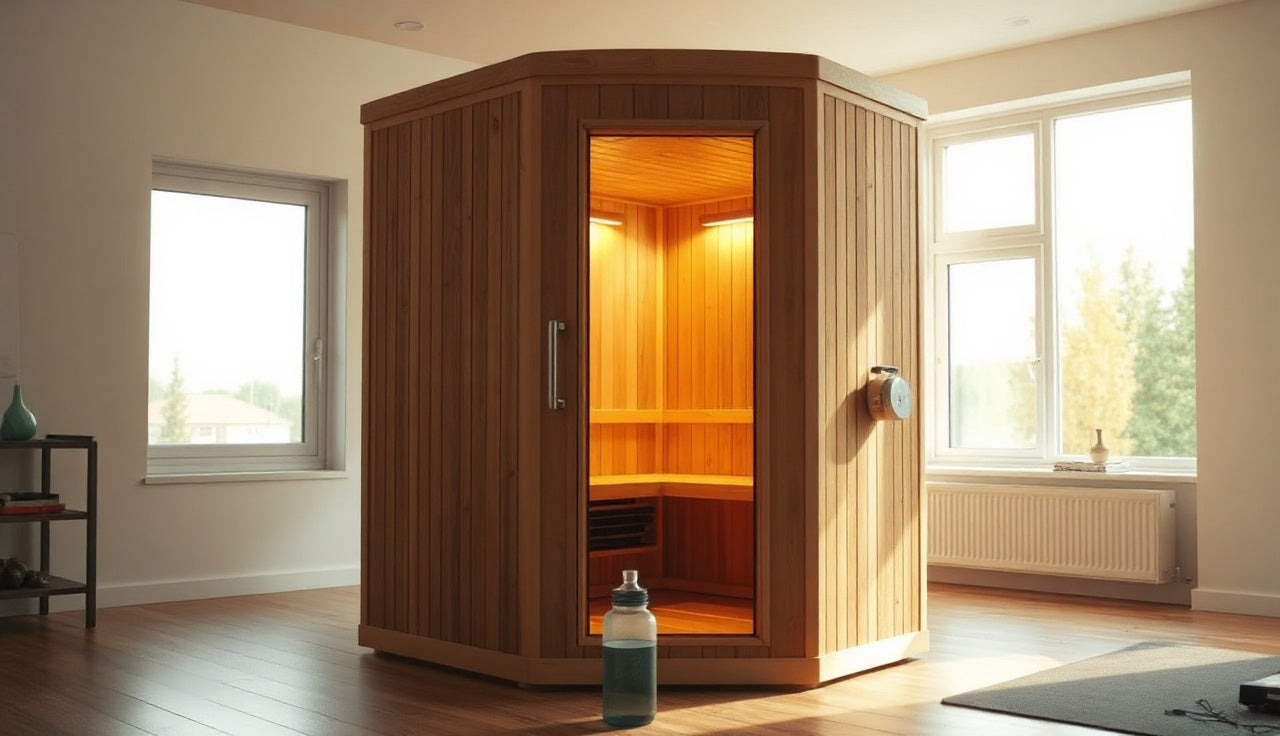
Folding infrared cabins are the sweet spot for anyone who'll actually use the thing week after week. A decent unit in the $700 to $1,200 range has real far infrared panels, an actual bench, and enough room that you're not folded like origami. The heat runs dry and directional, and the session lands much closer to a proper portable sauna than a tent ever will.
Blankets are the most portable option, but the session is strange until you adjust. You lie still, you sweat hard, and you can't reposition. Some people love that. Others hit session three and can't stand the closed-in feeling. The surface temperature reads high, but the blanket presses against your skin instead of radiating across an air gap, so it feels nothing like a panel cabin.
Does a portable sauna actually work, or is it a gimmick?
Depends on which portable sauna and how you use it. A quality folding far infrared cabin used three or four times a week produces real physiological effects. A $150 steam tent used once a week mostly just relaxes you.
Every sauna works the same basic way: it raises your core body temperature, which lifts your heart rate, dilates blood vessels, pushes sweat, and nudges hormones. The real question for portable units is whether they get hot enough, and stay hot enough, to trigger those effects reliably.
Steam tents in the $100 to $200 range: probably not at the level quality research demands. Most can't sustain the 80 to 100°C (176 to 212°F) air temperatures used in the Finnish sauna studies [1]. Your skin gets hot and you sweat, but the underlying mechanism isn't the same.
Far infrared portable saunas are more interesting. Far infrared (FIR) radiation runs at wavelengths of roughly 3 to 1000 micrometers and warms tissue directly rather than heating the surrounding air first [2]. A systematic review in Complementary Medicine Research looked at FIR sauna use and found associations with improved congestive heart failure symptoms and exercise tolerance, though the authors flagged that most studies were small and short [3]. Real finding, real research, and still not a promise of outcomes.
A 2018 review in Mayo Clinic Proceedings, indexed by the NIH, put it plainly: "regular sauna bathing is associated with a reduced risk of cardiovascular events" [4]. That conclusion leans on the large Finnish cohort studies, which used traditional saunas at 80 to 100°C. Portable units don't reach those air temperatures, but FIR cabins make up some of the gap by warming tissue directly at lower ambient temps.
So the honest line: a good folding far infrared cabin, used 3 to 4 times a week for 15 to 25 minutes, likely does something measurable. A cheap steam tent used occasionally mostly buys you relaxation. Relaxation is worth having. Just call it what it is.
| Steam tent sauna | $200 |
| Infrared sauna blanket | $450 |
| Folding infrared cabin | $1,250 |
| Portable barrel / pop-up | $2,150 |
| Built-in home sauna (installed) | $6,500 |
Source: Angi / HomeAdvisor cost guides and retail market data, 2024
What is far infrared, and does it matter which type of infrared heater you get?
Infrared sits just below visible red light on the electromagnetic spectrum. The sauna industry splits it into near (NIR), mid (MIR), and far (FIR), though those labels are as much marketing as science. The wavelength ranges run roughly: near 0.7 to 1.4 µm, mid 1.4 to 3 µm, far 3 to 1000 µm [2].
Far infrared is what matters most for a portable home infrared sauna. FIR wavelengths between about 7 and 14 µm sit close to the body's own thermal emission range, which is why tissue absorbs them efficiently. Carbon fiber panel heaters (thin, flat panels) emit mostly FIR and are the standard in better portable cabins now. Ceramic rod heaters also emit FIR, but they're older tech: they run hotter, cover less evenly, and show up mainly in budget units.
Near infrared (red light panels, heat lamps) is a different application with different claims, mostly skin-level photobiomodulation rather than deep tissue warming. Don't let a vendor blur the two.
For a far infrared portable sauna, carbon panels totaling 1,000 to 1,800 watts, spread across the front, back, and side walls, give you the most even coverage. Single-panel units (one heating surface behind you) are cheaper to build and noticeably worse to sit in.
What do portable saunas actually cost, including ongoing electricity?
The electricity almost nobody budgets for turns out to be trivial. A 1,400-watt infrared cabin costs about 11 cents per 30-minute session, or roughly $4 a month at four sessions a week. The unit price is the real number to weigh, not the running cost.
The upfront figures are in the comparison table above. Here's the math on the rest. A 1,400-watt portable infrared sauna running 30 minutes uses 0.7 kilowatt-hours (kWh) per session. The U.S. average residential electricity rate in 2024 was about 16.21 cents per kWh [5]. That's roughly 11 cents a session.
A 1,000-watt steam generator for a tent uses about 0.5 kWh per 30-minute session at similar rates, so the running cost lands in the same range.
The comparison that actually matters is against paying per visit. A gym or spa sauna session in most U.S. cities runs $20 to $60. A portable cabin at $800 pays for itself in 13 to 40 sessions depending on your city. At three sessions a week, that's a one to three month payback on the unit alone.
A built-in home sauna framed into a basement or garage costs $3,000 to $10,000+ installed [6]. A portable unit at $500 to $1,500 is a fraction of that, and it delivers a fraction of the experience too. Worth being honest about that gap before you talk yourself into either one.
What are the real safety risks with portable saunas at home?
Three risks are worth knowing before you buy: electrical load, heat and dehydration, and material off-gassing. None are dealbreakers. All are manageable if you pay attention.
Electrical load comes first. Most portable saunas draw 1,000 to 1,800 watts on a 110V circuit. That's 9 to 16 amps, within range for a standard 15-amp or 20-amp household circuit, but don't share the circuit with other high-draw appliances. Older wiring or a crowded panel? Check with an electrician before plugging in. The Consumer Product Safety Commission handles reports of sauna-related incidents, and its home electrical safety guidance covers circuit load [7].
Heat and dehydration come second. FDA guidance on sauna use recommends keeping sessions under 15 to 20 minutes for new users, skipping the sauna after alcohol, and getting out the moment you feel dizzy, faint, or nauseated [8]. Drink water before and after. That's not fussy caution. It's the baseline for any heat therapy.
Material off-gassing is third and the most overlooked with cheap units. Some inexpensive portable saunas use fabric liners, adhesives, and plastic parts that can release volatile organic compounds when heated. Look for units that specify low-VOC or formaldehyde-free materials, especially folding cabins where you sit enclosed in a small space. This is harder to verify than it should be. If a manufacturer dodges the question, that's your answer.
People with cardiovascular conditions, pregnancy, or medications that affect heat tolerance should talk to a physician before starting. The sauna benefits article goes deeper on who should and shouldn't be in the heat regularly.
How much space do you need to set up a portable home sauna?
Plan for a 5-foot by 5-foot clear area for a folding cabin, or roughly 3 feet by 3 feet plus entry room for a steam tent. Ceiling height and floor surface matter more than most buyers expect, and ventilation matters most of all.
Steam tents need about 3 feet by 3 feet of floor for the enclosure, plus 2 feet in front to step in and sit down. A bedroom corner or a bathroom works fine.
Folding infrared cabins vary, but most one-person units run about 35 to 40 inches wide by 35 to 40 inches deep by 72 to 75 inches tall assembled. Give yourself at least a 5-foot by 5-foot clear zone including room to swing the door open and step in.
Ceiling height trips people up. Most portable cabins stand 72 to 75 inches (6 to 6.25 feet). A standard 8-foot ceiling is plenty. A 7-foot basement drop ceiling gets tight.
Floor surface counts too. Tile and concrete are fine. Carpet soaks up sweat drip and turns into a hygiene problem over time. A rubber mat or a wooden slat insert fixes that if carpet is your only option.
Ventilation is the one people forget. You're dumping heat and moisture into whatever room the unit sits in. A closed bedroom gets noticeably humid over repeated sessions. An exhaust fan, a cracked window, or a bathroom with existing ventilation makes a better home for it.
How does a portable sauna compare to a permanent home sauna for recovery?
For pure recovery performance, a permanent built-in sauna wins on almost every metric: higher peak temperatures, longer sustainable sessions, better heat retention, and an always-ready convenience that keeps you consistent. A portable unit still does real work, but it's the smaller tool.
That said, portable units earn their place in a recovery routine when you use them right. Post-workout heat exposure (20 to 30 minutes at 140 to 160°F) has been studied for muscle soreness and growth hormone response. A study in the Journal of Science and Medicine in Sport found that 20-minute post-exercise sauna sessions over three weeks improved endurance run time to exhaustion by about 32% in trained runners, driven mainly by plasma volume expansion [9]. That study used a traditional sauna, not a portable one, but the core stimulus (sustained elevated core temperature) is reachable in a quality folding infrared cabin.
Where portable infrared genuinely holds its own: contrast therapy at home. A folding cabin paired with a cold plunge or ice bath is a realistic setup for under $2,500 total. Alternating heat and cold has real research behind it for cutting delayed onset muscle soreness and speeding return-to-training readiness [10].
SweatDecks carries portable infrared cabins alongside cold plunge tubs precisely because the two work together as a home contrast setup. If recovery is your goal, treat them as one system rather than two separate buys.
A permanent outdoor sauna is a different financial and lifestyle decision entirely. If you're weighing options at the top of the range, that article will help you think it through.
What should you look for (and avoid) when buying a portable sauna?
Buy on heating quality first, safety certification second, size third. Everything else is a distant fourth. Chromotherapy lights, built-in Bluetooth speakers, and ion generators are where budgets go to die.
Heating element quality leads. Carbon fiber flat panels beat ceramic rods. Panels on three or more walls beat a single back panel. Ask about emissivity rating and FIR wavelength range; better manufacturers publish both. Anything selling "near infrared" as its headline feature is offering something different from what the clinical sauna research studied.
Material quality and safety certification come next. Look for UL, ETL, or CE electrical certification on the control panel and heaters. For the enclosure, check for Canadian or European safety marks on any wood, and ask about formaldehyde content in engineered panels. Skip units whose only listed certification is a self-cert or a vague "RoHS compliant" sticker on the controller.
Size and door opening matter more than the marketing photos let on. Plenty of cabin shots show shorter-than-average models sitting with room to spare. Check the interior dimensions, not the exterior, and the bench height. A bench that sits too low ruins the session.
Control panel and timer features are worth paying for. Pre-heating (most units need 10 to 15 minutes to reach temperature) and an auto-shutoff session timer both earn their keep.
What to skip: color-changing LED chromotherapy is harmless but has no sauna-specific evidence behind it. Bluetooth speakers baked into $500 cabins tend to be junk. Negative ion generators do almost nothing in a small enclosed space. Spend on heating, not accessories.
To compare curated portable options in one place, the sauna collection at SweatDecks lists specs clearly.
How do you set up and use a portable home sauna for the first time?
Most people nail the setup and botch the session. Here's both, in order.
Setting up a folding infrared cabin takes 15 to 25 minutes the first time, under 10 once you've done it twice. Lay the floor panel first, then build the walls in the manufacturer's sequence (usually back wall, side walls, front frame, roof). Connect the heater leads before the roof goes on. Plug into a dedicated 15-amp or 20-amp circuit. Pre-heat for 10 to 15 minutes before you climb in.
For your first session, 10 to 15 minutes at a moderate setting (around 120 to 130°F for a FIR unit) is enough. You'll sweat more than you expect. Keep water within reach. Don't latch yourself in, and know how to get out fast if you need to.
For an ongoing routine, three to four sessions a week at 20 to 25 minutes is the range most often cited in cardiovascular benefit research [4]. Frequency beats duration up to a point. A shorter session you do regularly does more than a marathon session once a month.
After the session, cool down before you shower. Pairing with cold? A 2 to 3 minute cold shower or a cold plunge after the heat is the most common contrast protocol. The cold plunge benefits article covers what the research actually says about the cold side.
Cleaning: wipe the bench and panels with a damp cloth after each session. Let the unit dry with the door open for at least 20 minutes before folding or storing. Mold is a real risk in any warm, humid box that doesn't air out.
Are portable saunas worth it, or should you just buy a real sauna?
Worth it for whom, doing what, how often. That's the real question, and the answer splits cleanly by situation.
If you want to test heat therapy before committing $3,000 to $10,000 to a built-in unit, a portable infrared cabin in the $700 to $1,200 range is a reasonable trial. Use it for 90 days and see if the habit sticks. Most owners of permanent home saunas say the hard part was never the cost. It was not knowing whether they'd actually use the thing. A portable unit answers that at far lower financial risk.
If you already know you love sauna and want the best possible experience, a portable unit is not a substitute for a built-in or barrel sauna. The temperature ceiling is lower, the heat retention is lower, and the session feels different. The sauna guide covers the full range of permanent options.
If your living situation rules out a permanent install (apartment, renting, frequent moves), a folding portable cabin is the closest thing that actually works. That's not a compromise to be sheepish about. It's the right tool for the constraint.
The one group I'd steer away from the cheapest steam tents: people who read the cardiovascular research and assume any steam box replicates it. Those studies used real saunas at serious temperatures. A $150 nylon tent with a 700-watt generator is not that. Buy something better, or be honest with yourself about what you're buying.
Frequently asked questions
How long should a portable sauna session be?
For beginners, 10 to 15 minutes is a safe start. Experienced users typically do 20 to 30 minutes. The large Finnish population studies that showed cardiovascular benefits used sessions of 15 to 30 minutes, 4 to 7 times a week. Get out immediately if you feel dizzy, lightheaded, or nauseated. Drink 16 to 24 oz of water before and after every session regardless of length.
Can you use a portable sauna every day?
Daily use isn't harmful for most healthy adults. The Finnish cohort studies show the strongest cardiovascular associations at 4 to 7 sessions per week. Daily use at moderate temperatures (130 to 150°F for 20 minutes) is a reasonable protocol. The main practical concern isn't overuse, it's inadequate recovery if you're also training hard, since heat is a physiological stressor on top of exercise.
Do portable saunas help with weight loss?
The weight you lose during a session is water from sweating, and it comes right back once you rehydrate. There's no credible evidence sauna use directly burns fat. Some research suggests repeated heat stress may support insulin sensitivity and metabolic markers, but those are indirect effects in specific populations. Don't buy a portable sauna for weight loss. Buy it for recovery, cardiovascular conditioning, or relaxation.
What is the best portable sauna for a small apartment?
An infrared sauna blanket stores smallest (rolls to about suitcase size) and needs zero floor space during use since you lie on a bed or floor. For a cabin in a small apartment, look for a one-person folding model under 38 inches square. Measure your ceiling first; anything under 7.5 feet can feel cramped with a standard 72-inch-tall cabin.
Is a far infrared portable sauna better than a steam tent?
For consistent physiological benefit, yes. Far infrared saunas warm tissue directly, sustain higher effective temperatures than steam tents, and are easier to use repeatedly. Steam tents cost less upfront but struggle to hold heat, require managing an external generator, and dump moisture into the surrounding room. If your budget allows $500 or more, a folding FIR cabin is the meaningfully better buy.
Can you use a portable sauna outdoors?
Some folding cabin models are rated for outdoor use; most steam tents are not, since fabric degrades under UV and moisture. For regular outdoor use, a purpose-built barrel or pod sauna holds up far better. Using a portable unit on a covered patio occasionally is fine as long as it's out of direct weather and on a stable, level surface. Check the warranty; outdoor use often voids it.
How much electricity does a portable sauna use per month?
A 1,400-watt infrared cabin running 25 minutes per session, four sessions a week, uses roughly 9.3 kWh per month. At the U.S. average 2024 rate of 16.21 cents per kWh, that's about $1.51 a month in electricity. Even at peak hours in expensive states like California or Hawaii, monthly operating cost stays well under $10 for typical use.
Are portable saunas safe for people with high blood pressure?
Some research shows regular sauna use is associated with lower blood pressure over time, but acute heat exposure does raise heart rate and temporarily shift blood pressure. Anyone with uncontrolled hypertension, a history of cardiovascular events, or on antihypertensive medications should talk to a physician before starting. This isn't a call for self-diagnosis. FDA guidance recommends people with cardiovascular conditions consult a doctor before using saunas.
What is the difference between a portable sauna and a sauna blanket?
A portable sauna (cabin-style) is an enclosure you sit inside; heat radiates through the air and off the wall panels. A sauna blanket wraps around your body with the heating elements in direct contact or very close to your skin. Blankets hit higher surface temperatures, but the session is different: you can't move, sit up, or easily exit. Cabins feel like a real sauna; blankets feel like a heated sleeping bag.
Do you need a special electrical outlet for a portable home sauna?
Most portable saunas in the 1,000 to 1,800 watt range plug into a standard 110V (NEMA 5-15 or 5-20) outlet. They draw 9 to 16 amps, so don't share the circuit with other high-draw appliances. Some larger two- or three-person folding units draw more and may need a 240V outlet or a dedicated 20-amp circuit. Check the specs before buying, and have an electrician confirm your panel if you have any doubt.
How do you clean a portable sauna?
After each session, wipe the bench and interior with a clean, damp cloth. For folding cabins, leave the door open at least 20 minutes so moisture escapes before folding. For steam tents, empty and dry the generator after each use. Monthly, wipe the interior panels with a diluted white vinegar solution (1:10 vinegar to water) to prevent mold and mildew. Never use bleach or solvent-based cleaners on heating panels.
Can two people use a one-person portable sauna at once?
No. One-person units are sized for one person. Squeezing two in creates contact with heating panels (burn risk), restricts airflow, and pushes the heater past its rated capacity. Two-person portable cabins exist but run much larger (typically 55 to 60 inches wide) and cost significantly more. If shared sessions are the goal, a two-person folding cabin or a small built-in unit is the right call.
What's the best way to pair a portable sauna with cold plunge therapy?
The standard contrast protocol is 15 to 20 minutes of heat, then 2 to 5 minutes of cold, repeated 2 to 3 rounds with rest between. At home, heat in the portable cabin, then move to a cold plunge tub, cold shower, or ice bath. A 2012 review in Sports Medicine found contrast water therapy reduced DOMS ratings 24 hours post-exercise compared to passive rest. Allow a few minutes between extreme heat and cold to avoid rapid blood pressure swings.
Sources
- Laukkanen et al., JAMA Internal Medicine 2015 — Finnish sauna cohort study: Large Finnish cohort studies used traditional saunas at 80–100°C (176–212°F); the cardiovascular risk reduction findings are associated with those temperature ranges and session frequencies.
- NASA Science — Infrared waves / electromagnetic spectrum reference: Far infrared wavelengths run approximately 3–1000 micrometers; near infrared is 0.7–1.4 µm, mid infrared 1.4–3 µm.
- Beever R., Complementary Medicine Research — FIR sauna systematic review: A systematic review found associations between FIR sauna use and improvements in congestive heart failure symptoms and exercise tolerance; most studies were small and short-term.
- Laukkanen JA et al., Mayo Clinic Proceedings 2018 — NIH-indexed review on sauna and cardiovascular health: "Regular sauna bathing is associated with a reduced risk of cardiovascular events" per this 2018 review; frequency of 4–7 sessions per week showed the strongest associations.
- U.S. Energy Information Administration — Electricity data and average retail prices: The U.S. average residential electricity rate in 2024 was approximately 16.21 cents per kWh.
- Angi — Home sauna installation cost guide: Built-in home sauna installation typically costs $3,000–$10,000+ depending on size, materials, and electrical requirements.
- U.S. Consumer Product Safety Commission — Home electrical safety: The CPSC handles reports of sauna-related electrical incidents; their home electrical safety guidance covers circuit load and appliance requirements.
- U.S. Food and Drug Administration — medical device and product safety guidance: FDA guidance recommends avoiding sauna sessions longer than 15–20 minutes for new users, not using after alcohol consumption, and exiting immediately if dizzy or faint.
- Scoon GS et al., Journal of Science and Medicine in Sport 2007 — post-exercise sauna and endurance: 20-minute post-exercise sauna sessions over three weeks improved endurance run time to exhaustion by approximately 32% in trained runners, attributed largely to plasma volume expansion.
- Higgins TR et al., Sports Medicine 2012 — contrast water therapy and DOMS: Contrast water therapy (alternating hot and cold) reduced DOMS ratings 24 hours post-exercise compared to passive rest in the reviewed studies.
- U.S. Energy Information Administration — residential energy use overview: Household appliance wattage and kWh consumption reference data used to calculate monthly sauna electricity cost estimates.
Share:
How hot is a sauna? Temperature ranges for every type
Face ice bath: what it actually does and how to do it safely