
Last updated 2026-07-09
TL;DR
A face ice bath means submerging your face in near-freezing water (around 50°F / 10°C) for 15 to 60 seconds. It triggers the mammalian diving reflex, which slows heart rate and redirects blood flow. Evidence for puffiness reduction is real. Claims about anti-aging or pore-shrinking are mostly anecdote. Safe for most people, but not if you have Raynaud's, rosacea flares, or cardiovascular conditions.
What is a face ice bath, exactly?
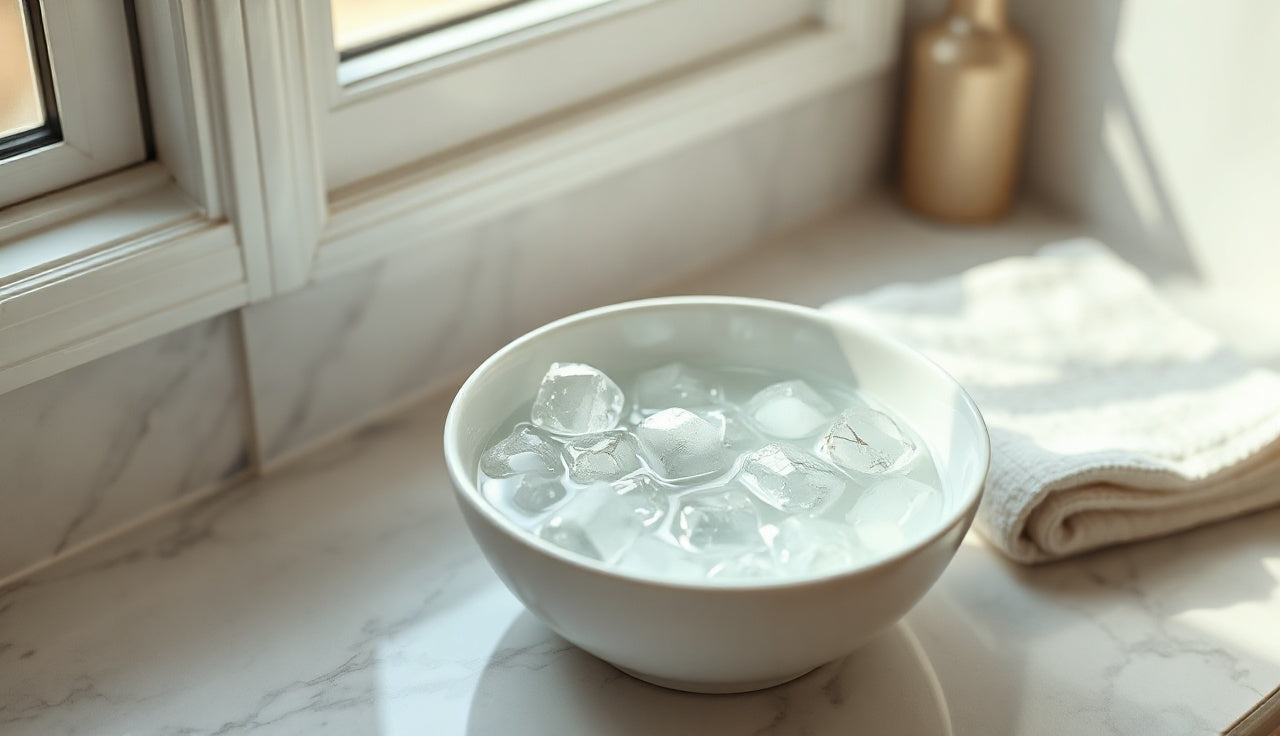
A face ice bath is what it sounds like. You fill a bowl with cold water and ice, then lower your face in up to the temples for a short hold, usually 15 to 60 seconds. People also call it an ice face bath, a cryotherapy facial, or a cold water face dip. Same thing, different labels.
The practice is older than the internet trend. Cold facial dips show up in beauty routines going back centuries, and dermatologists have used cold compresses to reduce swelling around the eyes for decades. What changed is that whole-body ice bath culture and social media pushed the face-submerge version mainstream around 2020 to 2023, when clips of athletes dunking their faces in hotel ice buckets started spreading everywhere.
Water temperature in a typical face ice bath sits between 40°F and 55°F (4°C to 13°C). That range matters. Below 40°F you risk ice-crystal damage to superficial skin with prolonged contact, and above 60°F you lose most of the vasoconstriction benefit. Most people land somewhere comfortable by filling a bowl with cold tap water, adding two handfuls of ice, and waiting about 90 seconds before going in.
This is not the same as running an ice cube across your skin. That is a much milder stimulus. Full facial submersion creates a pressure differential and a fast, even temperature drop across the whole face, which produces responses an ice cube pass cannot match.
What does a face ice bath actually do to your body?
The most documented response is the mammalian diving reflex. When cold water hits the face, especially around the nose and mouth, the trigeminal nerve signals the brainstem to slow the heart rate and shunt blood away from the extremities toward the core and brain [1]. This reflex exists in every air-breathing vertebrate, and it fires strongest from the face compared to any other body surface. Heart rate drops of 10 to 25% have been recorded in healthy adults during facial cold water immersion [1].
For people who treat the face dip as a recovery tool instead of a beauty step, that cardiac slowdown is the whole point. Some athletes and anxious folks use a brief facial submersion as a fast parasympathetic reset, sometimes inside a broader cold plunge or contrast session.
On the skin side, the cold causes immediate vasoconstriction. Blood vessels near the surface narrow fast, which is what reduces the look of puffiness and redness the second you lift your head out of the bowl. This is a temporary mechanical effect, not a structural change. Tissue rewarms and vessels dilate again within 10 to 20 minutes. The drop in visible swelling you notice after a rough night is real, and it fades [2].
Norepinephrine release is another real effect. Cold exposure triggers norepinephrine secretion, which carries anti-inflammatory signaling in tissue. A frequently cited study, Srámek et al. (2000), found that one hour of cold water immersion at 14°C raised plasma norepinephrine by about 300%, though that is whole-body immersion, not a face dip [3]. The effect from a 30-second facial dunk is far smaller and not well measured in isolation. Honest answer: nobody has measured norepinephrine specifically from facial cold dips in a controlled trial.
The "shrinking pores" claim is biologically wrong. Pores have no muscle. They cannot open or close. What you see after a face ice bath is constricted surrounding tissue that makes pores look smaller for a while. The moment your skin warms, the appearance returns to baseline.
Does a face ice bath reduce puffiness and inflammation?
For facial puffiness, yes, with the caveat that the effect is temporary. Cold-induced vasoconstriction drops fluid pressure in superficial tissue, which visibly deflates the puffiness around eyes and cheeks [2]. Cold compresses for swelling after eye surgery are standard clinical practice, and the mechanism is identical [2].
For inflammation in a skin-condition sense, the evidence is murkier. Some people with acne report that cold water calms active breakouts by cutting localized blood flow and slowing sebaceous activity for a short time. A handful of studies on cryotherapy for acne show some benefit, but those use clinical devices at much colder and more precise temperatures than a home bowl of ice water [4].
Rosacea is a double-edged situation. The initial vasoconstriction may quiet a flush, but the rebound vasodilation when skin rewarms can make redness worse in some people [4]. If rosacea is your reason for trying this, talk to a dermatologist first. The outcome is genuinely unpredictable and person-specific.
Post-workout facial inflammation, the kind that comes from long outdoor sessions or heavy training, does respond well to cold in the short term. The same principles behind cold plunge benefits for muscle recovery apply here in a local, limited way [7].
| Face ice bath (15-60 sec) | 15% |
| Full cold plunge / body immersion | 25% |
| Cold shower (60°F-70°F) | 7% |
| Cold compress (localized, non-face) | 3% |
Source: Tipton MJ, Journal of Physiology, 2008; Srámek et al., European Journal of Applied Physiology, 2000
Is an ice bath for face safe, or can it hurt your skin?
For most healthy adults, a 15 to 60 second face ice bath at properly prepared temperatures is safe [5]. Facial skin tolerates brief cold well because blood supply to the face is rich and rewarming is fast.
Here are the risks worth knowing.
Frostbite is not a realistic concern from a brief dip in a water-and-ice bowl. Frostbite needs sustained cold at or below 32°F (0°C) plus poor blood flow, and a liquid water bath in a kitchen bowl cannot get there. Water with ice equilibrates to exactly 32°F, and the ice keeps it from going lower. The real risk from direct ice-to-skin contact (holding an ice pack with no barrier) is an ice burn to superficial layers, but water immersion spreads the cold more evenly.
Cardiovascular stress is the more legitimate concern. The diving reflex can drop heart rate sharply, and in people with existing arrhythmias or heart conditions, that rapid change carries risk [1]. The American Heart Association treats sudden cold water immersion as a known trigger for cardiac events in vulnerable populations [6]. If you have a heart condition, check with your doctor first. This is not a boilerplate warning. The mechanism is real.
Raynaud's phenomenon is a contraindication. Cold triggers extreme vasoconstriction in people with Raynaud's, and while it usually shows up in the hands and feet, provoking a strong systemic cold response through facial immersion is a bad idea [10].
Nerve hypersensitivity is rare but real. Some people with trigeminal neuralgia find that cold facial contact sets off pain episodes.
For healthy people without those conditions, the main practical risk is staying in too long and getting an ice headache (the same sphenopalatine ganglion mechanism as brain freeze from a cold drink), or dunking too abruptly in very cold water and triggering a brief involuntary gasp.
How do you do a face ice bath correctly?
The setup takes about two minutes and needs nothing special.
Fill a bowl or basin big enough to cover your face to just above the temples. A standard mixing bowl or a clean kitchen pot is fine. Add enough cold tap water to submerge your face, then add two to three cups of ice. Wait 60 to 90 seconds for the water to chill, because cold-tap water usually runs 55°F to 65°F and needs the ice to pull it into the 50°F to 55°F target range.
Take a breath, lower your face, and keep your eyes closed. Hold 15 seconds on your first try. If that feels easy, build to 30 seconds over a few sessions, and up to 60 seconds if you want. Nothing in the evidence says going past 60 seconds does more for your skin, and holding so long it turns miserable kills the calming benefit of the dive reflex.
Lift your face, breathe normally, and pat dry with a clean towel. Do not rub hard right after. Skin is briefly more fragile after cold exposure. Apply moisturizer while the skin is still slightly damp to hold in hydration. Cold water is not inherently drying, but the evaporation afterward can be.
A few technique notes.
If you wear contacts, take them out first. Cold water can warp soft lenses.
Do not add anything to the water (essential oils, lemon juice, skincare additives) unless you are fully fine with those ingredients touching your open eyes. Stinging is unpleasant and can harm the cornea.
Time of day does not seem to matter physiologically. Most anecdotal reports favor morning use for the wake-up and depuff effect, and some people run it post-workout as a recovery and skin-calming step.
How cold should the water be for a face ice bath?
The working range is 40°F to 55°F (4°C to 13°C). A standard ice-water mix lands around 32°F to 35°F at the surface where the ice sits, and a bit warmer in the middle of the bowl where your face goes. In practice, a half-and-half water-to-ice ratio by volume gives an effective dipping zone around 38°F to 45°F at the point of facial contact.
If that feels too aggressive, use less ice. Starting near 50°F to 55°F and working colder over time beats going full cold on day one.
Here is where a face ice bath sits relative to other cold exposures.
| Method | Typical temp range | Duration typical | Main mechanism |
|---|---|---|---|
| Face ice bath | 38°F to 55°F (3°C to 13°C) | 15 to 60 sec | Diving reflex, vasoconstriction |
| Full ice bath | 50°F to 59°F (10°C to 15°C) | 10 to 20 min | Systemic cold shock, muscle recovery |
| Cold plunge tub | 39°F to 55°F (4°C to 13°C) | 2 to 10 min | Norepinephrine, inflammation reduction |
| Cold shower | 60°F to 70°F (15°C to 21°C) | 1 to 5 min | Mild sympathetic activation |
| Clinical cryotherapy facial | 14°F to 28°F (-10°C to -2°C) | 2 to 3 min | Targeted local tissue response |
The face ice bath sits at the low-equipment end of the spectrum. A dedicated cold plunge unit gives you tighter temperature control and full-body immersion, but for facial-only use a bowl is genuinely enough.
What are the claimed skin benefits, and which ones are actually supported?
This is where honest reporting matters most, because the gap between what is real and what gets claimed online is wide.
Supported by evidence:
Temporary puffiness reduction is real, well-documented, and driven by vasoconstriction [2]. Expect 10 to 30 minutes of a visibly less puffy face.
Heart rate slowing via the diving reflex is real, measurable, and fairly consistent in healthy adults [1]. Useful as a fast physiological reset.
The sympathetic-to-parasympathetic shift is supported by diving-reflex research and by broader cold exposure work, though the magnitude from facial-only dipping is smaller than full-body immersion [1] [8].
Mild temporary skin tightening is real but entirely temporary. Vasoconstriction causes it, and it reverses on rewarming.
Not supported, or only weakly supported:
Anti-aging effects have no controlled trials on facial ice baths and collagen synthesis or wrinkle depth. Some in-vitro work suggests cold stress can raise certain repair proteins in skin cells, but a dish is not a face.
Permanent pore reduction is biologically impossible. Pores lack smooth muscle [4].
Acne clearance has a few small studies suggesting cryotherapy at clinical temperatures reduces acne-causing bacterial activity, but a home ice bath is not clinical cryotherapy [4].
Long-term skin brightening is anecdotal only.
The honest summary: a face ice bath is a useful short-term recovery and depuffing tool with real physiological mechanisms. It is not a skin treatment in any medical sense.
Can you do a face ice bath every day?
Plenty of people report doing it daily without problems, and there is no established evidence that a once-daily face ice bath harms healthy individuals. The catch: the long-term skin effects of daily cold water immersion on facial tissue are not studied directly. Absence of harm evidence is not the same as proven safety at high frequency.
A few things to weigh for daily use.
Skin barrier: very cold water is not drying the way harsh cleansers are, but repeated rapid temperature cycling can affect the lipid layer of the stratum corneum over time [9]. A gentle moisturizer after each session is a reasonable protective step.
Cardiovascular habituation: regular cold exposure produces some adaptation in the cardiovascular response, meaning you become somewhat less reactive over time, which some people count as a benefit [3]. That is part of why consistent cold practice, full-body or facial, shows up in training protocols.
For most people, once a day is fine. Twice a day is probably diminishing returns. If you see persistent redness, rising skin sensitivity, or any odd skin changes, cut the frequency and reassess.
People already running whole-body cold plunges or contrast therapy sometimes tack on a quick face dip as a separate step, especially in the morning when they skip a full session. That works. If you want to build out a broader heat-cold practice, our guides on ice bath and cold plunge benefits cover the full-body protocols in detail.
How does a face ice bath compare to a full cold plunge?
They share mechanisms but differ a lot in magnitude and scope.
A full cold plunge submerges the body to the neck or shoulders. That creates a large surface for cold stimulus, a big metabolic response, systemic norepinephrine and dopamine release, and muscle-tissue effects from temperature plus hydrostatic pressure [3]. A face ice bath is a targeted, low-magnitude move that mostly fires the diving reflex and drives local vasoconstriction.
For recovery from hard training, a full cold plunge does more. For a quick morning reset, puffiness reduction, or calming your nervous system before something stressful, a face dip is faster, needs zero equipment, and works for anyone with a bowl and a freezer.
Some evidence suggests the diving reflex from facial cold immersion produces a proportionally stronger parasympathetic response than the same temperature on the limbs alone [1] [8]. That is one reason athletes sometimes stack both: a face dip for the fast reflex, a body plunge for systemic recovery.
If you are weighing a home cold plunge unit, know this: a face ice bath tells you almost nothing about how you will handle whole-body cold immersion. The experiences are genuinely different. SweatDecks has a full cold plunge selection if you are ready to move to full-body cold exposure.
Cost: a bowl of water and ice costs essentially nothing. Entry-level home cold plunge tubs start around $500 to $800, with quality units running $1,500 to $5,000 or more. For facial use only, there is no financial reason to buy equipment.
Who should avoid a face ice bath?
Most healthy adults can do this without issue. The people who should pause and consult a doctor first:
Anyone with a diagnosed heart condition, arrhythmia, or history of cardiac events. The diving reflex produces a rapid, significant heart rate drop. The American Heart Association has documented cold water immersion as a trigger for cardiac events in susceptible individuals [6].
People with Raynaud's phenomenon, since triggering a systemic cold response through the face can provoke episodes even when the hands never touch cold [10].
Anyone with active rosacea or reactive-vessel conditions. The rebound vasodilation after cold can worsen visible redness [4].
People with trigeminal neuralgia, where cold contact to the face can trigger pain.
Anyone on medications that strongly affect heart rate or circulation (beta blockers, certain antihypertensives) should ask the prescribing doctor about the interaction with an acute heart-rate-slowing stimulus.
Pregnant individuals should check with their OB before adding any new cold stress protocol, since cold exposure affects circulation in ways not specifically studied in facial-only contexts during pregnancy.
Children: the diving reflex is proportionally stronger in kids, and cold stress responses are more variable. Most pediatric cold exposure research focuses on safety, not wellness use. That is not proof it is harmful, but it is not a protocol developed or tested in children.
If you have cold urticaria (cold-triggered hives), even a brief facial cold immersion can set off a systemic histamine response. Test cold water on a small patch of skin first.
Is a face ice bath the same as a cryotherapy facial?
No, and the difference matters for expectations.
Clinical cryotherapy facials use nitrogen gas or specialized equipment to deliver controlled temperatures as low as 14°F to 28°F (-10°C to -2°C) across the face for 2 to 3 minutes, usually with trained supervision [4]. The extreme temperature gap and precise delivery produce a stronger, steadier stimulus than a home bowl, and a clinic can control the rewarming rate and how evenly the cold hits the skin.
A home face ice bath is warmer (38°F to 55°F vs. 14°F to 28°F), shorter, and less controlled. That is not necessarily a problem. It just means the response is smaller. For what most people actually want, depuffing and a nervous system reset, the home version delivers real results without the cost or access barrier of a clinic.
Clinical cryotherapy facials run roughly $75 to $200 per session depending on provider and location. A bowl of ice water is free. If you are doing this for skin maintenance rather than a specific clinical reason, the home approach is the rational default.
The one area where clinical cryotherapy clearly wins is acne. The extreme cold does appear to reduce bacterial activity and sebum production in ways a bowl of ice water is unlikely to reach at any meaningful depth [4].
What should you do after a face ice bath?
The minute right after the dip is when a few steps matter most.
Pat, do not rub, your face dry. Skin is mildly sensitized from the fast temperature swing, and hard toweling can cause micro-irritation.
Apply a hydrating moisturizer or serum while the skin is still slightly damp, within 60 seconds of drying. Cold water immersion does not strip oils the way soap does, but rapid rewarming creates transepidermal water loss as vessels dilate, and a moisturizer barrier helps [9].
Skip active acids (AHAs, BHAs, retinoids) right after a face ice bath. Skin permeability is briefly altered after cold exposure, and these ingredients may penetrate differently than expected, which can cause irritation.
Let your skin warm back to room temperature naturally before applying sunscreen and heading outside. That takes about 5 to 10 minutes.
If you do a face ice bath as part of a contrast session with heat (say, after a sauna round), the cold-after-heat order follows standard contrast logic. Heat dilates vessels and loosens pores, cold then constricts them. Many people find the combination feels better on skin than cold alone, and the contrast may amplify the nervous system benefits. Our sauna benefits guide covers the heat side if you want to build the full protocol.
Frequently asked questions
How long should I keep my face in an ice bath?
Start with 15 seconds and work up to 30 to 60 seconds over multiple sessions. There is no evidence that going beyond 60 seconds improves results for depuffing or skin benefits, and longer holds increase discomfort without clear payoff. Listen to your body. The moment you feel the urge to gasp, that is a good cue to come up.
Can a face ice bath help with dark circles under the eyes?
Temporarily, yes, for puffiness-related dark circles. Cold vasoconstriction reduces fluid buildup in the thin tissue under the eyes, making the area look less swollen and sometimes less shadowed. If your dark circles come from pigmentation or bone structure rather than swelling, cold water will not help. The effect lasts 10 to 30 minutes and then reverses.
Is it safe to open my eyes underwater during a face ice bath?
It is safer to keep them closed. Cold water triggers a strong involuntary blink anyway, and if you wear contact lenses, cold water can warp soft lenses and trap bacteria between the lens and cornea. If you want cold for eye puffiness specifically, a cold compress on closed eyelids is gentler and more targeted.
Can a face ice bath help with a hangover?
It can reduce the facial puffiness and dull skin that often come with alcohol-related dehydration, and the nervous system jolt from the diving reflex can help with alertness. It does not address the real causes of a hangover, which are dehydration, acetaldehyde buildup, and electrolyte loss. Helpful for the mirror, not a cure.
Does a face ice bath help with acne?
Weakly and temporarily. Cold reduces blood flow to the area, which can calm a red, active breakout for a short time. Clinical cryotherapy at much colder temperatures than a home bowl can reach does show some antibacterial effect on acne-causing bacteria. A home ice bath is unlikely to replicate that. For persistent acne, a dermatologist is a better first stop than a bowl of ice water.
What temperature should the water be for a face ice bath?
Aim for 40°F to 55°F (4°C to 13°C). A half-water, half-ice mixture by volume in a bowl lands around 38°F to 45°F where your face enters. If that feels too aggressive at first, use less ice and target the 50°F to 55°F range until you have built more cold tolerance.
Can I do a face ice bath if I have sensitive skin?
Probably yes, but with caution. Sensitive skin can react to fast temperature changes with temporary redness, extra reactivity, or tingling. Start with warmer cold water (50°F to 55°F) and a shorter hold (10 to 15 seconds) to test your skin. Follow right away with a gentle, fragrance-free moisturizer. If you have a diagnosed condition like rosacea or eczema, check with a dermatologist first.
Does a face ice bath tighten skin permanently?
No. The tightening you feel after a face ice bath comes from vasoconstriction, the narrowing of blood vessels near the skin surface. It reverses completely as your skin warms back to normal temperature, usually within 10 to 20 minutes. No controlled trials show that repeated face ice baths produce lasting changes to skin firmness or elasticity.
Can a face ice bath help reduce stress or anxiety?
There is real physiology here. The diving reflex from facial cold immersion activates the parasympathetic nervous system, slowing heart rate and pulling the body out of fight-or-flight. Some people use it as a fast reset in high-stress moments. Some anxiety treatment protocols include cold water facial immersion as a distress tolerance technique. The effect is real, short-acting, and not a substitute for clinical care.
How often can I do a face ice bath?
Once per day is what most regular users report doing without skin problems. No clinical study defines a safe maximum frequency for facial cold immersion specifically. Daily is likely fine for healthy adults. Twice daily is probably diminishing returns. If you notice rising skin sensitivity, persistent redness, or barrier disruption (flakiness, tightness), reduce frequency and moisturize more.
Is a face ice bath the same as the "ice hack" trends on social media?
The face ice bath overlaps with several social media trends under different names: ice facial, polar plunge for the face, cold water therapy facial. The physiological mechanism is the same across all of them. Some social versions add ingredients like green tea or cucumber to the water. Those additions have no proven benefit for the cold-exposure effects and add risk of eye irritation if you are submerging your face.
Will a face ice bath help after a long flight?
Likely yes for the puffiness. Long flights cause facial edema from cabin pressure, low humidity, and long stretches of sitting. Cold vasoconstriction after landing is one of the faster ways to reduce that puffy look. Hydrating hard before and during the flight addresses the underlying cause better, but a face ice bath at the hotel is a reasonable recovery tool.
Do I need any special equipment for a face ice bath at home?
No. A clean mixing bowl or kitchen basin, tap water, and ice from a standard freezer is all you need. Some people prefer a wider, shallower container so they do not have to angle their face awkwardly. If you want a dedicated setup, any food-safe container big enough for your face works. No pumps, chillers, or specialty products required.
Sources
- Physiology Journal (American Physiological Society): Diving response in humans: Facial cold water immersion triggers the mammalian diving reflex, producing heart rate drops of 10 to 25% in healthy adults via trigeminal nerve signaling to the brainstem
- American Academy of Ophthalmology: cold compresses for periorbital edema: Cold compresses and cold water application reduce periorbital swelling through vasoconstriction; standard clinical practice for post-surgical edema management
- Srámek P et al., European Journal of Applied Physiology, 2000: Human physiological responses to immersion into water of different temperatures: Cold water immersion at 14°C raised plasma norepinephrine by approximately 300% compared to thermoneutral water immersion in healthy subjects
- American Academy of Dermatology: acne treatment and cryotherapy overview: Clinical cryotherapy at controlled low temperatures can reduce acne-causing bacterial activity; pores lack smooth muscle and cannot permanently open or close
- National Institutes of Health / MedlinePlus: cold water immersion safety: Brief cold water immersion is generally safe for healthy adults; risks increase significantly in individuals with cardiovascular conditions
- American Heart Association: cold water immersion and cardiac risk: Sudden cold water immersion is a documented trigger for cardiac events in individuals with pre-existing heart conditions, including arrhythmia
- Bleakley CM et al., British Journal of Sports Medicine, 2012: Cold water immersion and recovery from exercise: Cold water immersion produces vasoconstriction, reduces tissue metabolic rate, and has documented short-term anti-inflammatory effects relevant to post-exercise recovery
- Tipton MJ, Journal of Physiology, 2008: The initial responses to cold water immersion: The cold shock response and diving reflex are the primary initial physiological responses to cold water immersion; the diving reflex is maximally triggered by facial cold contact
- National Eczema Association: skin barrier and temperature effects: Rapid temperature cycling and cold exposure can affect the stratum corneum lipid layer; moisturizer application after cold water exposure helps maintain barrier integrity
- Raynaud's Association: triggers and cold exposure: Cold exposure including systemic cold stress is a primary trigger for Raynaud's phenomenon episodes; those with the condition should exercise caution with cold water protocols

Share:
Are cold plunges good for you? What the science actually says
Are cold plunges good for you? What the science actually says