
Last updated 2026-07-09
TL;DR
A personal steam room heats a sealed tile or acrylic space to roughly 110 to 120°F at close to 100% humidity using a steam generator. Prefab kits start near $1,500. Custom tile builds run past $25,000. The cardiovascular research is real but drawn mostly from dry saunas, and every install needs a dedicated 240V circuit plus full six-surface waterproofing.
What exactly is a personal steam room?
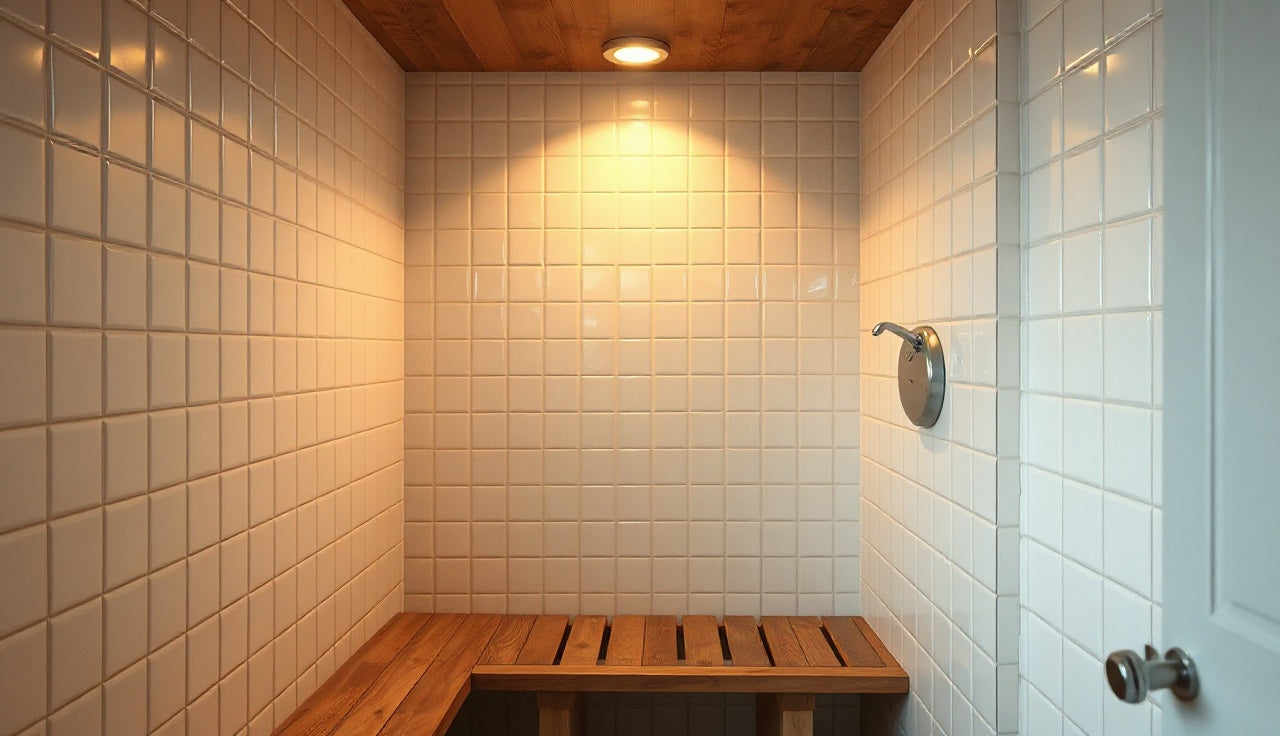
A personal steam room is a sealed, waterproofed enclosure where a generator boils water and pipes vapor in until the air hits close to 100% relative humidity at 110°F to 120°F (43 to 49°C). That mix of heat and moisture is what separates it from a traditional sauna, which runs 150 to 195°F with humidity usually below 30%.
The generator lives outside the enclosure, either in a cabinet under a bench or in a nearby mechanical room. It ties into a cold-water supply line and a drain, heats water to steam, and pushes that steam through a small head mounted low on one wall. The room has to be waterproofed on every surface because condensation soaks the whole space every session.
For a home user, "personal" usually means a unit sized for one to four people: roughly 3×3 feet up to 4×6 feet. That footprint fits a master bath, a basement corner, or an outdoor structure. Larger freestanding units exist. Once you go past six people, you are building something closer to a spa facility.
See how steam compares to dry heat in our sauna vs steam room breakdown.
What are the health benefits of a home steam room?
The cardiovascular evidence is the strongest thing steam-style heat has going for it. A 2015 study in JAMA Internal Medicine tracked 2,315 Finnish men over 20 years and found that using a sauna 4 to 7 times a week was tied to a 50% lower risk of fatal cardiovascular disease compared to once-weekly use [1]. That study used dry saunas, not steam rooms. The core mechanism, passive heat raising core temperature and heart rate, applies to both.
Respiratory relief is steam's own turf. Warm humid air loosens mucus and can ease symptoms for people with chronic sinusitis or mild asthma. A Cochrane Review on heated humidified air for the common cold found evidence of symptom relief but called for more rigorous trials [2]. Nobody should treat a steam room as a substitute for prescribed respiratory treatment.
Recovery is the third bucket, and it is the softest. Sauna bathing after exercise has been linked to less muscle soreness and better perceived recovery, but the trials usually run under 30 people and blinding is impossible in heat research. Honest summary: the cardiovascular signal is real and replicated, the recovery and respiratory signals are promising but unsettled.
Read the full picture in our sauna benefits guide.
One caution, stated plainly: steam rooms are contraindicated for people with uncontrolled hypertension, pregnancy past the first trimester under many guidelines, and anyone on medications that impair sweating or thermoregulation. The Finnish Sauna Society recommends talking to a physician before starting any regular heat therapy [3].
How much does a personal steam room cost to buy and install?
Two categories set the price: prefab kits and custom tile builds. Prefab starts around $1,500. Custom tile can pass $40,000.
Prefabricated steam showers arrive as acrylic or tempered-glass panel systems with the generator included. Entry-level units from Steam Planet or Ariel run $1,500 to $2,500 for a 3×3-foot single-person enclosure [4]. Mid-range units with better controls, chromotherapy lighting, and a built-in bench run $3,000 to $7,000. High-end prefab from Mr. Steam or Steamist reaches $10,000 to $15,000 once you add their premium generator lines.
Custom tile costs more, full stop. You pay for a waterproof membrane (a sheet system like Schluter Kerdi or a foam-board system), cement board, tile, grout, the generator, the bench, and labor. A licensed contractor usually quotes $8,000 to $25,000 depending on room size, tile choice, and regional labor. Upscale projects with imported stone and premium controls pass $40,000, but that is luxury territory.
The generator is the line item people underestimate. A generator sized for a 100-cubic-foot room (a 5×4×5-foot space) needs about 7 to 9 kilowatts of output. Mr. Steam and Steamist units in that range cost $900 to $2,200 for the generator alone, before installation [4].
Running costs stay modest. Electricity is roughly $0.10 to $0.50 per session depending on your kWh rate and generator size. Water use is about 1 to 2 gallons per 20-minute session for most residential generators. Descale the generator every few months if your water is hard. Heating elements last 5 to 10 years before replacement.
| Setup type | Typical cost range | Generator included? | DIY-friendly? |
|---|---|---|---|
| Prefab kit (entry) | $1,500 to $2,500 | Yes | Partially |
| Prefab kit (mid-range) | $3,000 to $7,000 | Yes | Partially |
| Prefab kit (high-end) | $8,000 to $15,000 | Yes | No |
| Custom tile (basic) | $8,000 to $15,000 | Usually separate | No |
| Custom tile (premium) | $15,000 to $40,000+ | Separate | No |
| Prefab kit (entry-level) | $2,000 |
| Prefab kit (mid-range) | $5,000 |
| Prefab kit (high-end) | $11,500 |
| Custom tile (basic) | $12,000 |
| Custom tile (premium) | $27,500 |
Source: Mr. Steam product pricing and contractor market data, 2024
What size steam generator do I need for a home steam room?
Size the generator to the room's cubic footage, but the math is not straight linear. Tile and stone absorb more heat than acrylic, so a fully tiled 80-cubic-foot room needs a bigger generator than the same volume in an acrylic kit. Manufacturer sizing charts add a multiplier for tile (roughly 1.25x), another for exterior walls (1.25x), and a smaller one for glass.
A rough guide: allow 1 kilowatt per 45 to 50 cubic feet for acrylic, or 1 kilowatt per 35 cubic feet for fully tiled rooms. A 4×4×7-foot tiled room is 112 cubic feet, which wants roughly a 9-kW generator.
Undersizing is the most common mistake people make. A generator that is too small runs constantly, never hits target temperature, wears out early, and gives you lukewarm mist instead of steam heat. When in doubt, size up one tier.
Brands to know: Mr. Steam (US-based, widely serviced), Steamist, Kohler (uses Steamist internals in some lines), ThermaSol, and Amerec. Service coverage in your area matters as much as the spec sheet.
What does installation actually require?
Installation is where projects get complicated and budgets blow up. Five systems matter: electrical, plumbing, waterproofing, ventilation, and the ceiling pitch.
Electrical: a residential steam generator needs a dedicated 240V circuit. A 9-kW unit at 240V draws about 37.5 amps at full load, so a 50-amp circuit with the right wire gauge is standard. The National Electrical Code Article 680 covers wet-location wiring [5]. If your panel has no room for a 50-amp double-pole breaker, you may face a panel upgrade, which adds $1,500 to $3,000.
Plumbing: the generator needs a cold water supply (usually a 1/2-inch line) and a drain for flushing. A licensed plumber is nearly always required to make those connections legally.
Waterproofing: this is where custom tile rooms live or die. The International Residential Code Section R307 and the Tile Council of North America Handbook both spell out waterproofing for wet areas [6][7]. Steam rooms need waterproofing on all six surfaces, floor, ceiling, and four walls, because steam condenses everywhere. A missed seam causes mold and rot. Do not cut corners here.
Ventilation: do not run an exhaust fan during a session. It defeats the purpose. You do need a way to dry the room afterward. A small exhaust fan on a timer, kicking on post-session, stops mold from building between uses.
Ceiling pitch: slope the ceiling slightly (a minimum of 1/8 inch per foot is a common recommendation) so condensation runs to the walls instead of dripping on you.
Permitting: most municipalities require a permit because the work touches electrical and plumbing. Pull it. The inspection catches problems you want caught before tile goes over them.
Can I add a steam generator to an existing shower?
Yes, with conditions. The enclosure has to be fully waterproofed, ceiling included, and it has to seal. A frameless glass door with a gap at the top leaks steam constantly and makes the generator run overtime.
The minimum practical size for a converted steam shower is about 36×36 inches, and even that is tight. You want at least 60 cubic feet for consistent heat. Smaller than that, the steam head produces hot spots near the outlet.
Existing tile and grout may or may not hold up. Standard sanded grout handles intermittent water fine. Constant steam is a different load, and grout that was never sealed properly soaks up moisture over time. Have a contractor assess the waterproofing before you commit.
Prefab conversion kits (generator, steam head, and controls, no enclosure) from Mr. Steam or Steamist run $700 to $3,000 depending on generator size. Add electrician and plumber fees on top.
If your bathroom is not already plumbed and wired for the generator, expect a full conversion to run $3,000 to $8,000 installed. That still beats a custom tile room built from scratch.
How does a personal steam room compare to a home sauna?
Temperature and humidity are the split. A steam room runs 110 to 120°F at close to 100% humidity. A Finnish sauna runs 150 to 195°F at 10 to 30% humidity. An infrared sauna runs 120 to 150°F at low humidity.
For pure cardiovascular heat load, the dry sauna literature is deeper and longer. The 20-year Finnish cohort study cited above used dry saunas [1]. Steam research is smaller and shorter. That said, many people find steam heat more tolerable, because the high humidity blocks the fast evaporative cooling of sweat, so the perceived heat feels gentler even at lower temperatures.
For dry skin or chest congestion, steam usually feels better in the short term. For people who want intense heat or get humidity-related joint discomfort, a dry sauna is often more comfortable.
Cost lines up like this: a prefab infrared sauna for two runs $1,500 to $4,000 installed. A prefab steam shower in the same size costs about the same. A custom wood sauna for two runs $4,000 to $12,000 installed. The custom steam build is generally the priciest option for a given footprint, thanks to waterproofing.
Explore home sauna options and costs, or compare portable sauna setups for a lower-commitment start.
Our full sauna vs steam room article runs the side-by-side in detail.
Are there prefab personal steam room kits worth buying?
Prefab kits are the right call for most homeowners who want steam without a major renovation. The best ones ship with a tested enclosure, a factory-matched generator, digital controls, and a warranty that covers the whole system.
Brands that show up as solid choices in contractor and consumer forums: Mr. Steam (strong US service network, good controls), Steamist (excellent generator reliability), Ariel and Steam Planet (budget-friendly, fine for occasional use but thinner warranties). Kohler makes premium integrated units, and you pay for the name.
Check these before you buy a kit. What is the generator warranty (3 years is baseline, 5 is good)? Does the enclosure include a real steam-tight door seal? Is the ceiling included, and is it pitched? Does the unit require professional installation to keep the warranty valid?
Most kits in the $3,000 to $7,000 range still need a licensed electrician for the generator hookup, even when you assemble the enclosure yourself. Budget for that.
One thing prefab cannot copy: sitting in a room built to your exact dimensions in premium stone tile. If that look matters to you, custom is the path. If you want heat and humidity at a manageable budget, a good prefab kit delivers reliably.
How do I maintain a home steam room?
Maintenance is the most underestimated part of ownership. Skip it and you get mold, generator failure, and repair bills.
After every session: leave the door open or run the exhaust fan for 20 to 30 minutes to dry the room. Wipe down tile if water is pooling in grout lines.
Monthly: inspect grout and caulk, especially at floor-wall junctions and around the steam head. Reapply grout sealer annually in a steam room, more often than a regular shower, because the moisture cycle never lets up.
Generator descaling: hard water (above 7 grains per gallon, roughly 120 mg/L) builds mineral deposits on the heating element and cuts efficiency. Most generators have a flush cycle or descaling port. Mr. Steam recommends descaling every 200 to 500 hours of use depending on water hardness [8]. Use a manufacturer-approved descaling solution, not vinegar, unless the manual specifically approves it.
Annual: have an electrician check the heating element resistance if output seems weak. Replace the steam head O-ring or check valve if steam comes in irregular bursts. Inspect the waterproof membrane at any accessible seams.
Heating elements last 5 to 10 years in a well-kept unit. Replacements cost $100 to $400 depending on the model. It is a DIY repair for anyone comfortable with basic electrical work, though some warranties require a licensed technician.
Can I use a personal steam room for contrast therapy?
Contrast therapy, alternating hot and cold, is one of the more practical protocols to build around a home steam room. Heat raises core temperature and dilates blood vessels. Cold (a plunge, an ice bath, or even a cold shower) triggers vasoconstriction. The idea is that cycling between the two improves circulation and speeds perceived recovery, though the research is mixed and most studies measure exercise performance or soreness rather than hard biomarkers [9].
A common protocol runs 10 to 15 minutes of heat, then 1 to 3 minutes of cold, for 2 to 4 cycles. The exact numbers vary by tradition. Nordic protocols often use longer heat phases, Japanese sento culture uses shorter ones.
For a home setup, a steam room paired with a cold plunge or ice bath is a genuinely functional contrast system. The steam room brings the heat. You do not need both on day one. Plenty of people start with the steam room and add cold later once the habit sticks.
SweatDecks carries cold plunge options that pair well with home steam setups if you want to build out a full contrast corner.
If you are starting from zero and want the most research-backed heat option rather than steam specifically, see the general sauna guide and sauna benefits pages.
Is a personal steam room worth it for most homeowners?
Honest answer: it depends on what you are replacing.
If you already have a big master bath shower stall sitting mostly unused, converting it to a steam shower is often worth the $3,000 to $8,000 for someone who will use it three or more times a week. Daily steam exposure over years is where the cardiovascular research shows the most consistent signal [1].
Building from scratch in a basement or outdoors is different. The custom tile route delivers the best long-term experience, but at a cost ($10,000 to $25,000 installed) that only pencils out for committed daily users. A prefab kit in that budget gives you 80% of the experience at 40% of the cost.
For occasional use, once a week or less, the math is hard to justify against a gym membership or a local spa. The equipment pays off only with consistent use.
Who gets the most value: athletes doing daily recovery, anyone managing chronic respiratory symptoms with physician sign-off, and people who genuinely enjoy the ritual and will treat it as a habit rather than a novelty that fades in two months.
One thing worth saying plainly. A steam room that goes unused is a mold-prone, expensive fixture. Before you spend $10,000, rent access to a steam room at a local gym for 30 days and see if you actually go. That test costs almost nothing and tells you everything.
For the full range of SweatDecks home wellness equipment, the steam room collection page is a good next stop.
Frequently asked questions
How long should a session in a personal steam room last?
Most guidelines suggest 15 to 20 minutes for healthy adults. The Finnish Sauna Society notes traditional sauna sessions average 15 to 20 minutes, and similar guidance applies to steam rooms. Beginners should start with 10 minutes and build tolerance. Staying past 30 minutes in a 110 to 120°F environment at full humidity raises core body temperature sharply and increases dehydration risk.
How much electricity does a home steam room use per session?
A 7.5-kW generator running at full load for 20 minutes uses about 2.5 kWh. At the US average residential rate of roughly $0.16 per kWh (EIA, 2024), that is about $0.40 per session. Higher-output generators (9 to 12 kW) for larger rooms run $0.50 to $0.80 per session. Monthly costs for daily use land around $12 to $25 in electricity alone.
What is the difference between a steam shower and a steam room?
A steam shower is a shower enclosure with a generator added, so you can use it as a regular shower or a steam bath. A steam room is a dedicated space built only for steam bathing, usually with benches, no showerhead, and a separate shower taken before entry. Steam rooms hold heat better and feel more immersive. Steam showers save space.
Can a steam room help with skin?
Steam opens pores and increases blood flow at the skin surface, which some dermatologists suggest may improve hydration temporarily. No large randomized trial has tested steam room use and skin health directly. In small observational work, regular steam bathing is associated with better skin texture. Rinse with cool water after a session to close pores, and avoid long exposure, which can irritate sensitive skin.
What temperature should a home steam room be set to?
110°F to 120°F (43 to 49°C) is the standard range for a residential steam room. Above 120°F at 100% humidity, heat exhaustion sets in faster than in a dry sauna because sweat cannot evaporate to cool you. Most residential generators cap the thermostat around 115 to 120°F. Start at 110°F and adjust from there based on comfort.
Do I need a permit to install a home steam room?
Almost certainly, for any install involving new electrical circuits or plumbing changes. A dedicated 240V/50A circuit for the generator is a permitted electrical job in nearly every US jurisdiction. Adding a water supply line to the generator usually needs a plumbing permit too. Check with your local building department. Unpermitted work can void homeowner's insurance coverage for related water or fire damage.
How do I prevent mold in a personal steam room?
Mold prevention comes down to three things: proper waterproofing at install, good ventilation after each session, and regular grout and caulk maintenance. Run an exhaust fan for 20 to 30 minutes after every use with the door open. Re-seal grout annually. Inspect floor-wall caulk joints every few months. Tile and glass resist mold; grout and caulk do not. Silicone caulk beats latex here.
What is the best flooring for a personal steam room?
Porcelain or ceramic tile with a slip-resistant rating (DCOF above 0.42 for wet areas, per the Tile Council of North America) is the standard. Natural stone works but needs sealing more often in a steam environment. Avoid wood flooring in a dedicated steam room: constant moisture causes swelling, rot, and mold. Want the warmth of wood? Use teak slat benches and keep the floor tiled.
Can I build a personal steam room outdoors?
Yes, with extra attention to insulation and weatherproofing. An outdoor steam room needs a heavily insulated enclosure (at least R-13 in the walls, R-19 or better in the ceiling) so the generator is not fighting the cold. The generator and plumbing lines must be protected from freezing. Cedar or redwood works for the exterior, with the interior built to the same waterproofing standards as an indoor unit.
Is steam therapy safe for people with high blood pressure?
Passive heat raises heart rate and temporarily lowers blood pressure during a session through vasodilation, but the cardiovascular stress is real. The American Heart Association does not prohibit sauna or steam use for people with controlled hypertension but recommends consulting a physician first. People with uncontrolled hypertension, recent cardiac events, or heart failure should not use a steam room without explicit physician clearance.
How long does a steam generator last?
Heating elements in residential generators last 5 to 10 years with proper maintenance and regular descaling. The housing and controls can last 15 to 20 years. Hard water shortens element life sharply if you skip descaling. Mr. Steam and Steamist both sell replacement elements for their units. Budget roughly $200 to $400 for an element swap every 5 to 8 years as a realistic maintenance cost.
What size personal steam room fits in a standard bathroom?
A 3×3-foot prefab steam shower fits nearly any bathroom with an existing shower footprint. A 4×4-foot dedicated steam room needs at least a medium master bath. Most residential steam rooms fall between 36 and 80 cubic feet. Under 36 cubic feet can feel claustrophobic and makes even steam distribution hard. A 4×5×7-foot room (140 cubic feet) is roomy for one and comfortable for two.
How do steam rooms differ from infrared saunas for home use?
Steam rooms heat the air with moist vapor at 110 to 120°F. Infrared saunas use radiant panels to heat the body directly at 120 to 150°F with low humidity. Infrared is easier to install (plug-in 240V, no plumbing), cheaper to build ($1,500 to $5,000 for a prefab cabin), and lower maintenance. Steam rooms need plumbing, extensive waterproofing, and regular generator upkeep. Both deliver heat therapy; the infrastructure differs a lot.
Sources
- JAMA Internal Medicine, Laukkanen et al. 2015: "Association Between Sauna Bathing and Fatal Cardiovascular and All-Cause Mortality Events": Frequent sauna use (4–7 times per week) was associated with a 50% lower risk of fatal cardiovascular disease vs once-weekly use in a 20-year Finnish cohort of 2,315 men.
- Cochrane Database of Systematic Reviews, Singh et al.: "Heated, humidified air for the common cold": Steam inhalation for upper respiratory symptoms shows evidence of relief but requires more rigorous trials per Cochrane Review.
- Finnish Sauna Society, health guidance: The Finnish Sauna Society recommends consulting a physician before beginning regular heat therapy, especially for those with cardiovascular conditions.
- Mr. Steam, residential steam generator product specifications: Residential steam generators in the 7–9 kW range for 100-cubic-foot rooms cost $900–$2,200 before installation.
- NFPA, National Electrical Code (NEC) Article 680: NEC Article 680 governs electrical wiring requirements for wet locations including steam rooms and pool areas.
- HUD / IRC, International Residential Code Section R307: Toilet, Bath, and Shower Spaces: IRC Section R307 specifies waterproofing requirements for wet areas in residential construction.
- Tile Council of North America (TCNA) Handbook for Ceramic, Glass, and Stone Tile Installation: TCNA Handbook specifies that steam room installations require waterproofing membranes on all six surfaces (floor, ceiling, four walls).
- Mr. Steam, maintenance and descaling guidelines: Mr. Steam recommends descaling generators every 200–500 hours of use depending on water hardness.
- Cochrane Database of Systematic Reviews, Bieuzen et al.: "Contrast water therapy and exercise induced muscle damage": Contrast water therapy research is mixed, with most studies measuring exercise performance or soreness rather than hard biomarkers.
- U.S. Energy Information Administration (EIA), Average Retail Price of Electricity, 2024: US average residential electricity rate was approximately $0.16 per kWh in 2024.
- TCNA Handbook: DCOF wet-area slip resistance requirements for tile: Tile Council of North America specifies a DCOF rating above 0.42 for wet-area floor tile in residential applications.
- American Heart Association, sauna and cardiovascular safety: The American Heart Association recommends physician consultation before sauna or steam use for people with hypertension or cardiovascular disease.
Share:
Benefits of steam room after workout: what the research says
Steam room for congestion: does it actually help?