
Last updated 2026-07-09
TL;DR
An outdoor infrared sauna uses infrared heaters instead of steam or hot rocks to warm your body directly, running at 120 to 150°F rather than the 170 to 195°F of a Finnish sauna. Units built for outdoor use start around $2,000 for a one-person barrel and climb past $10,000 for multi-person cabins with full weatherproofing and dual heaters. Add $1,000 to $3,000 for the pad and electrical.
What is an outdoor infrared sauna and how does it work?
An infrared sauna heats your body with infrared light rather than heating the air around you. A traditional Finnish sauna pours water over hot rocks to make steam and pushes air temperature to 170 to 195°F. An infrared unit runs cooler, usually 120 to 150°F, because the infrared wavelengths reach a few centimeters into skin and warm tissue directly. You don't need scorching air to carry the heat.[1]
Three wavelength bands are in play. Near-infrared (NIR) sits closest to visible light and has the shallowest penetration, around 1 to 2 mm. Mid-infrared (MIR) reaches a bit deeper. Far-infrared (FIR) penetrates 2 to 3 cm and is what most home heaters produce. The units advertised as "infrared saunas" are almost all full-spectrum or far-infrared only. Ceramic and carbon-fiber elements both make FIR. Carbon panels run cooler on the surface and cover more area. Ceramic rods get hotter and heat up faster.[2]
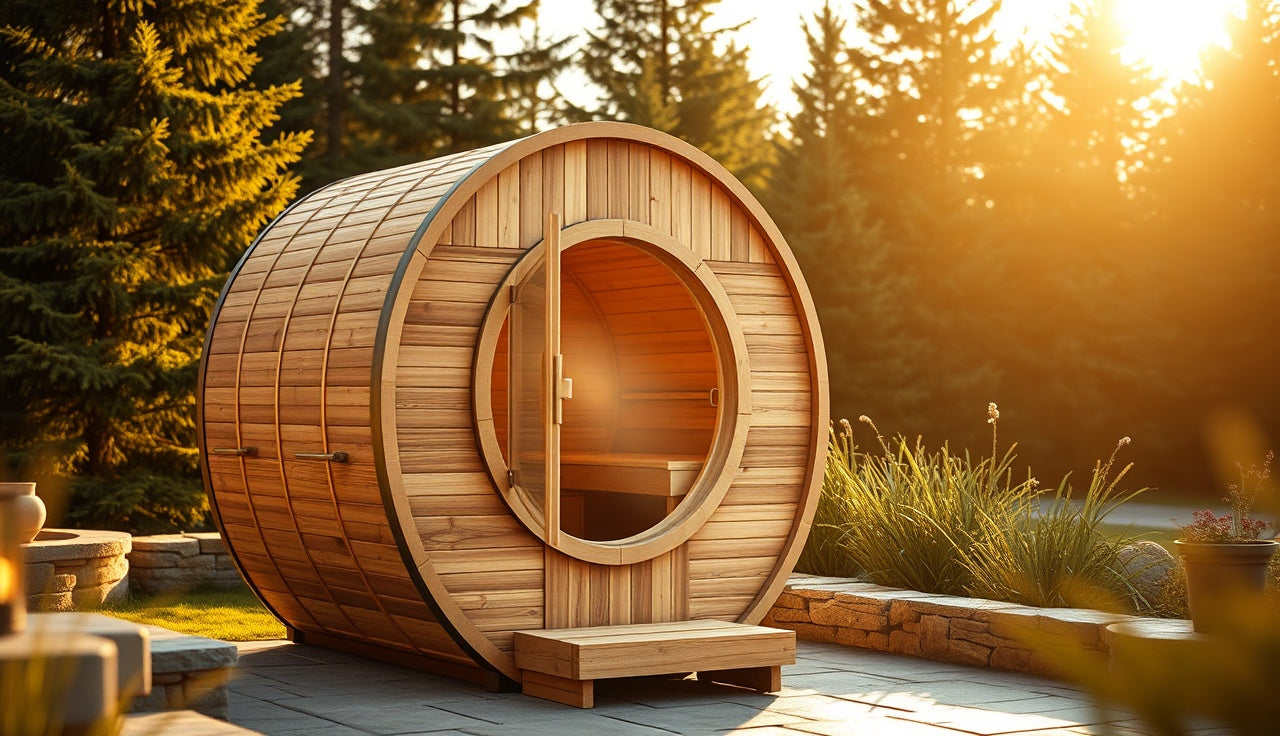
An outdoor infrared sauna is that same cabinet built to live outside year-round. That means a handful of things the indoor version skips: exterior cladding rated for UV and moisture (western red cedar and Alaskan yellow cedar are the two you'll see most), a real roof, tighter electrical weatherproofing, and insulation matched to your climate. The shell is usually a barrel, a pod, or a square cabin. Barrels shed water off the curved roof, which makes them a favorite in wet regions. Cabins look more like a small building and often have more headroom.
Comparing your options? Our overview of outdoor saunas puts infrared and traditional builds side by side.
What are the real health benefits of infrared sauna use?
The research is real but thin. Most studies use small samples, short durations, and can't blind participants (nearly impossible when the intervention is sitting in a hot box). Still, the signal is consistent enough to take seriously.
Cardiovascular response is the best-documented area. A 2018 systematic review in Evidence-Based Complementary and Alternative Medicine found repeated sauna sessions were associated with reductions in blood pressure and arterial stiffness in hypertensive patients, though the authors noted that "most of the studies had a small sample size and short duration."[3] A long-running Finnish cohort, the Kuopio Ischemic Heart Disease Risk Factor Study, tracked over 2,300 middle-aged men for up to 20 years and found frequent sauna use was associated with lower cardiovascular mortality. That was traditional sauna, not infrared.[4]
For infrared specifically, a 2015 pilot study in the Journal of the American College of Cardiology reported better exercise tolerance and quality of life in chronic heart failure patients who used a 60°C (140°F) far-infrared sauna 15 minutes a day for three weeks.[5] Small sample. Adjunctive therapy, not a cure. Worth knowing.
Muscle recovery is where people report the most subjective benefit. The mechanism is plausible: heat drives more blood into muscle tissue and may speed clearance of metabolic byproducts. Nobody has strong randomized data pitting infrared against cold for recovery. The closest work suggests heat bumps growth hormone briefly and may cut soreness, but the effect size is modest.
For the longer version of what the evidence shows, see our piece on sauna benefits.
Relaxation and sleep are the benefits most owners notice first. Your core temperature rises during the session, then drops fast afterward, which can help you fall asleep sooner. That's a plausible mechanism with some sleep research behind it, though the infrared-specific data is thin.
Contraindications are real. People with cardiovascular disease, anyone pregnant, and people on diuretics, beta blockers, or certain antihypertensives should talk to a physician before regular sauna use. The heat load is significant even at these lower temperatures.
How hot does an outdoor infrared sauna get, and is that enough?
Outdoor infrared saunas run between 110°F and 150°F (43 to 65°C). Most people settle in at 120 to 140°F. A Finnish sauna sits at 175 to 195°F; a steam room runs 100 to 115°F with near-100% humidity.[1]
| Type | Air temp (°F) | Humidity | Perceived intensity |
|---|---|---|---|
| Outdoor infrared | 110 to 150 | 10 to 20% | Moderate |
| Traditional Finnish | 170 to 195 | 10 to 20% | High |
| Steam room | 100 to 115 | 95 to 100% | Moderate-high |
| Infrared sauna blanket | 130 to 160 | N/A | Low-moderate |
The real question behind "is it hot enough" is whether the sweating and cardiovascular response hold up. They mostly do, because infrared heats tissue directly instead of relying on hot air to reach you. Heart rate, sweat rate, and perceived exertion in a 140°F infrared session land roughly where a short traditional session does, though most traditional sauna research runs hotter and longer.
If you want the brutal heat of a Scandinavian sauna, infrared won't get you there. If you want a session that produces real sweating, a raised heart rate, and a post-session glow without feeling like you're breathing oven air, 130 to 140°F hits the mark for most people. Some manufacturers add steam-injection options or a traditional heater attachment to their outdoor infrared cabins so you can run both modes.
What does an outdoor infrared sauna cost?
Prices span a wide range depending on size, heater quality, wood species, and build. Here's where the market sits as of mid-2025:
| Category | Price range | What you get |
|---|---|---|
| Entry-level 1-person | $2,000 to $3,500 | Carbon heaters, hemlock or spruce, basic controls |
| Mid-range 2-person cabin | $3,500 to $6,000 | Better cedar, dual heaters, Bluetooth panel |
| Premium 2 to 4 person | $6,000 to $10,000 | Canadian cedar, full-spectrum heaters, smart controls |
| High-end custom/barrel | $10,000+ | Custom builds, premium wood, architectural finish |
Those are unit prices. Installation adds to the total. You need a level pad (concrete, pavers, or a deck rated for the weight), a 240V/20 to 30A dedicated circuit run to the spot, and possibly a permit. Electrical rough-in from a licensed electrician runs $500 to $1,500 depending on distance from your panel. A concrete pad poured for a sauna runs $500 to $2,000 depending on size and region. Budget $1,000 to $3,000 for installation as a working floor.
Running costs stay modest. A two-person outdoor infrared sauna drawing 2,000 to 3,000 watts (2 to 3 kW) for an hour a day costs roughly $0.20 to $0.45 per session at average US electricity rates of $0.12 to $0.15/kWh.[6] Add cedar upkeep (re-oiling every 1 to 2 years, about $50 to $100 in product) and the ongoing overhead is small.
Be skeptical of anything under $2,000 sold as outdoor-rated. The wood, the weatherproofing, and the heater lifespan at that price rarely survive two or three winters.
| Entry 1-person | $2,750 |
| Mid-range 2-person cabin | $4,750 |
| Premium 2-4 person | $8,000 |
| High-end custom/barrel | $12,000 |
Source: U.S. Energy Information Administration + market survey, 2025
What should you look for in the best outdoor infrared sauna?
A few things matter. A lot of things are marketing noise. Here's what separates a good outdoor infrared sauna from one that warps, leaks, or fades within a few seasons.
Wood species is the biggest lever on longevity. Western red cedar is the standard. It resists rot, handles thermal expansion and contraction, and smells excellent. Alaskan yellow cedar is denser and more durable, less common, and more expensive. Spruce and hemlock are cheaper and fine indoors but degrade faster outside. Avoid anything described as "eucalyptus" or an unnamed "treated wood" for the exterior shell.
Heater quality and coverage matter more than the brand on the box. Carbon fiber panels cover more body surface from a larger emitter face and run at a lower surface temperature, so an accidental touch won't burn you. Ceramic heaters heat faster and reach higher temperatures. For a standard outdoor session, carbon fiber is the more comfortable and safer pick. Look for at least 1,500 watts of heater capacity per person, and check placement. Floor-level heaters that can catch splashed water are a weak point.
Weatherproofing details are easy to miss online. The roof needs a real overhang, waterproof underlayment, and cedar shingles or metal, not a flat board slapped on top. Door seals should be rubber or silicone, not foam. Electrical components need an outdoor rating and GFCI protection on the circuit. Ask the manufacturer directly about the vapor barrier strategy and what happens to the floor through a freeze-thaw cycle.
Control panel placement is a real quality-of-life issue. A panel inside the cabin is protected from weather but can take on moisture damage over years. A panel mounted outside lets you preheat from inside the house. Better units give you both a physical external switch and app control.
Size is a decision, not an afterthought. A one-person barrel handles solo use in minimal yard space, usually 4 to 5 feet across by 6 to 7 feet long. A two-person cabin gives you room to stretch out and still works fine alone. Jumping to four people usually means a footprint of 5x7 feet or larger, and you'll need to confirm your electrical service can carry it.
For how outdoor infrared stacks up against other backyard options, our home sauna guide has the full breakdown.
What electrical requirements does an outdoor infrared sauna need?
Most buyers underestimate this, and it's the part most likely to delay your install. Two-person and larger outdoor infrared saunas typically need a dedicated 240V, 20 to 30 amp circuit. Single-person units sometimes run on 120V/15A if the heater wattage is modest (under 1,500W), but read the spec sheet before you assume plug-and-play.
Running a 240V circuit outdoors takes outdoor-rated conduit, a weatherproof sub-panel or outlet box, and a GFCI breaker. The National Electrical Code (NEC) Article 680 covers outdoor electrical installations around water. Saunas aren't pools, but your inspector will likely apply similar outdoor moisture rules.[7]
You need a licensed electrician for this in most jurisdictions. Budget $500 to $1,500 for the run depending on distance from your main panel. If your panel is near capacity or older than 25 years, you may need an upgrade, which adds $2,000 to $5,000 to the project.
Permits are a real question. Most municipalities want a building permit for a permanent outdoor structure and a separate electrical permit. A sauna on skids or without a permanent foundation can skip the building permit in some places, but not all. Call your local building department before you buy. Skipping permits comes back to bite you when you sell the house.
One practical tip: run the conduit during the electrical rough-in even if the sauna is months away. Adding conduit after the pad is poured costs more and looks worse.
Can you use an outdoor infrared sauna year-round, even in cold climates?
Yes, with the right unit. This is one of the better arguments for outdoor infrared over a traditional wood-burning sauna in a hard climate. An infrared heater starts warming your body within 10 to 15 minutes of startup, versus the 30 to 45 minutes a wood-burning or electric rock heater needs to bring the whole room to temperature. In sub-zero weather, that faster start earns its keep.
Cold climates still put real stress on an outdoor structure. Temperature swings from -20°F to 90°F over a year expand and contract wood joints and can open gaps in the shell. Cedar handles this better than most species. Caulked joints fail faster than properly gapped tongue-and-groove construction. A quality outdoor build has drainage channels to stop ice buildup under the floor, sealed-but-not-caulked joints that let the wood move, and a roof pitch steep enough that snow slides off instead of compressing the structure.
Many manufacturers rate their units to -20°F or -30°F. Ask specifically whether the control electronics are rated for cold startup and whether the heating elements have low-temperature limits. Some digital panels throw errors below 0°F and need to warm up before they accept inputs.
For the harshest climates (Minnesota winters, the Canadian prairies), a barrel sauna with a dedicated wood-burning stove is still arguably more practical than pure infrared for year-round outdoor use. For most of the lower 48, a well-built infrared unit handles four seasons without trouble.
How do you install an outdoor infrared sauna in your backyard?
The physical install is more manageable than people expect. Most outdoor infrared cabins ship as pre-assembled panels or a kit and go together with basic tools in one to two days. Barrel saunas arrive as stave kits that assemble on the cradle stands provided.
Before the unit shows up you need three things ready: a level surface, completed electrical rough-in, and enough access for delivery. Most cabins and barrels are heavy (400 to 800-plus lbs) and arrive in crates you'll have to move.
For the foundation, a 4-inch concrete pad is the most permanent and cleanest option. Composite deck tiles or pressure-treated decking on a gravel base works for lighter units and sidesteps the permit question in some jurisdictions. The surface has to be truly level (within 1/4 inch across the footprint), rigid enough not to shift, and shaped to drain water away rather than pool underneath.
Siting matters more than most people think. Point the door away from prevailing wind to cut heat loss every time you open it. Afternoon shade in summer eases the cooling load. A short covered path from your back door makes winter use far more pleasant. If contrast therapy is part of your routine, plan for proximity to a cold plunge or outdoor shower now, not later.
Assembly follows the manufacturer's instructions. The main gotcha is making every interior electrical connection before you close the panel joints, because some designs make it hard to get back into the wall cavity. Test the heater before you seal the floor and roof.
How does outdoor infrared compare to a traditional outdoor sauna?
This is the real decision most buyers face, and neither option wins outright. A traditional outdoor sauna with an electric or wood-burning rock heater gets much hotter: 170 to 195°F versus 120 to 150°F for infrared. The steam (löyly) is a different experience in kind, more than degree. Plenty of sauna purists find infrared physically comfortable but flat compared to the ritual of pouring water on rocks. If that tradition matters to you, infrared won't replace it.
On the practical side, infrared wins on heat-up time (10 to 20 minutes versus 30 to 60 for traditional), a lower operating temperature that some people tolerate for longer, no water management or humidity soaking into the wood, and a lower purchase price at comparable sizes.
Traditional wins on a higher temperature ceiling for those who want it, authenticity, a better group experience because you can dial intensity up on the fly by adding water, and proven long-term durability. A well-built cedar sauna with an electric heater can run 30-plus years on basic maintenance.
For a first-time buyer who wants a backyard setup without a learning curve, outdoor infrared is the easier entry point. For a serious enthusiast who knows exactly what they want, traditional is worth the extra complexity.
SweatDecks carries both infrared and traditional outdoor options if you want to compare specs side by side before deciding. You can also see the broader landscape in our sauna overview.
Is an outdoor infrared sauna safe, and what precautions should you take?
At recommended temperatures and session lengths, outdoor infrared sauna use is well-tolerated by healthy adults. The risks are real but manageable with basic sense.
Dehydration is the most common issue. A 30-minute session at 140°F can produce 0.5 to 1 liter of sweat. Drink 16 to 24 oz of water before you go in and keep water with you inside. Alcohol before a sauna is a bad idea. It wrecks thermoregulation and multiplies dehydration risk. The U.S. Consumer Product Safety Commission advises limiting session length, staying hydrated, and avoiding alcohol before or during a session.[9]
Overheating happens, especially to first-timers who stay in longer than their body is ready for. Start with 10 to 15 minute sessions and add time as you acclimate. Get out if you feel dizzy, nauseous, or unusually uncomfortable. The door has to open easily from the inside at all times.
The electrical setup carries real risk if done wrong. That's not a DIY job unless you're a licensed electrician. GFCI protection on the circuit is non-negotiable. Water and 240V electronics are a serious combination.
Some people should get medical clearance first: anyone with cardiovascular disease, anyone on the medications noted earlier, anyone pregnant, and anyone with a condition that impairs sweating (like anhidrosis) or thermoregulation. The sauna industry doesn't regulate safety claims, so some marketing overstates benefits and understates risk for vulnerable groups.
Children under 12 should use infrared saunas at reduced temperatures and shorter durations, or not at all. There isn't strong safety data for frequent infrared use in children.
For outdoor units specifically: keep the exterior weatherproofed so no water can reach the heaters or electrical components, and check the shell each season for wood degradation or electrical wear.
How does an outdoor infrared sauna fit into a contrast therapy routine?
Contrast therapy, alternating heat and cold, is the most talked-about reason people pair a sauna with a cold plunge or ice bath. The theory: alternating vasodilation (heat) and vasoconstriction (cold) flushes metabolic waste from muscles, tamps down inflammation, and leaves you in a strong parasympathetic state afterward.
The honest data is mixed. A 2021 meta-analysis in Sports Medicine found some evidence that contrast water therapy cut perceived muscle soreness and fatigue markers compared to passive recovery, though effect sizes were modest and most studies used water immersion, not saunas paired with cold plunges.[8] The subjective payoff (feeling good afterward) shows up consistently, and the cardiovascular stress response is real.
In practice, pairing an outdoor infrared sauna with a cold plunge or ice bath in your backyard builds a genuinely effective recovery setup. The protocol most research leans on: 10 to 20 minutes of heat, then 2 to 5 minutes of cold, repeated 2 to 3 rounds. End on cold if the goal is reducing inflammation or waking up. End on heat if the goal is relaxation or sleep.
Infrared works fine in contrast protocols. Its lower temperature relative to a traditional sauna means you may need slightly longer heat rounds to reach the same cardiovascular response, but 15 to 20 minutes at 140°F is enough.
Site the sauna close to the cold plunge or outdoor shower. That kills the excuse of not wanting to cross a freezing yard between rounds. Fifteen feet of distance matters more than you'd guess on a January morning.
What are the best outdoor infrared sauna brands and what should you avoid?
Dozens of brands populate this space, from solid to borderline fraudulent. A few names carry consistent quality reputations and real customer track records.
Dynasty (Dynamic Saunas) makes well-regarded entry to mid-range units with good warranty support. Sunlighten is a premium brand with a large lineup, strong heater warranties, and third-party testing for low EMF output. Almost Heaven has a long history in outdoor barrel saunas with traditional heaters and some infrared hybrids. HealthMate has been in the sauna business over 30 years and publishes EMF measurement data. Finnleo/TylöHelo is a Finnish brand with traditional roots and some infrared lines, usually sold through dealers.
What to avoid: unnamed dropshippers on Amazon or warehouse sites with no physical address or phone number. Units built from unspecified wood listed only as "poplar" or "basswood" for the exterior. Brands that make EMF claims without showing measurement data. Any unit with a heater warranty under 1 year (good brands offer 3 to 5 years on heating elements).
Low EMF (electromagnetic field) is a marketing point worth understanding straight. Every infrared heater emits some EMF. Better manufacturers publish third-party measurements in milligauss at body distance and compare them to the 3 mG threshold common in the literature. If a brand publishes no numbers, be skeptical of the claim. If a brand says "zero EMF," that's physically impossible for a resistive heating element.
If a permanent outdoor install isn't the right fit yet, our portable sauna guide covers the lower end of the market.
Frequently asked questions
How long should a session in an outdoor infrared sauna be?
Most people do 20 to 45 minutes. If you're new to infrared, start with 10 to 15 minutes at around 120°F and add 5 minutes per session over the first two weeks as you acclimate. Research studies typically use 15 to 30 minute sessions. Anything past 45 minutes at 140°F is usually past the point of added benefit and raises dehydration risk.
How much electricity does an outdoor infrared sauna use?
A two-person unit typically draws 2,000 to 3,000 watts (2 to 3 kW). At the US average rate near $0.13/kWh, a one-hour session costs roughly $0.26 to $0.39. Running it daily for a year costs about $95 to $140 in electricity. Larger multi-person cabins drawing 4,000 to 6,000W cost proportionally more.
Do you need a building permit for an outdoor infrared sauna?
Usually yes, for both the structure and the electrical work, but it varies by municipality. Permanent structures on a concrete foundation almost always need a building permit. Units on skids or without a permanent foundation may fall under a size threshold in some places. A 240V circuit requires an electrical permit in nearly every jurisdiction. Check with your local building department before ordering.
What is the best wood for an outdoor infrared sauna?
Western red cedar is the standard and the right choice for most buyers. It resists rot, handles freeze-thaw cycles, doesn't splinter easily, and stays cool enough to touch at sauna temperatures. Alaskan yellow cedar is denser and more durable but harder to find. Avoid hemlock or spruce for exterior surfaces; they soak up moisture and degrade faster outdoors.
Can two people use an outdoor infrared sauna at the same time?
Yes, if you buy a two-person or larger unit. Two-person outdoor cabins typically measure 4x5 to 4x6 feet inside. It's genuinely comfortable for two, though a close fit. If you plan to use it with three or four people regularly, buy the next size up. Barrels rated for two run cozier than cabin-style units of the same rating.
How do you maintain an outdoor infrared sauna?
Clean cedar with a mild solution (diluted white vinegar or a sauna-specific cleaner) and wipe it dry. Re-oil the exterior wood every 1 to 2 years with a cedar-compatible exterior oil to prevent UV graying and cracking. Check door seals annually and replace any that show compression or cracks. Inspect electrical connections and heater elements once a year. Most infrared heaters last 10,000 to 30,000 hours depending on quality.
Is an outdoor infrared sauna worth it compared to going to a sauna studio?
At a studio charging $30 to $60 per session, a home unit pays for itself in 100 to 200 sessions for a $3,000 to $6,000 purchase. At three sessions a week, that's roughly one to two years to break even. The bigger argument is convenience: you use it more when it's in your backyard, especially in contrast setups where proximity to a cold plunge matters.
What is the difference between far-infrared and full-spectrum outdoor saunas?
Far-infrared (FIR) heaters emit the longest, most penetrating wavelengths for tissue warming. Full-spectrum units add near-infrared (NIR) and mid-infrared (MIR) emitters. Most published health research uses FIR. Near-infrared is promoted for skin and mitochondrial benefits, but the clinical evidence at sauna-level doses is much thinner. For most buyers, a quality FIR unit is the simpler, cheaper, and better-researched choice.
Can you put an outdoor infrared sauna on a wood deck?
Yes, if the deck is rated for the load. A two-person outdoor sauna typically weighs 400 to 700 lbs empty; add 200 to 400 lbs for two adults and water. Check your deck's load capacity, usually on the permit or available from the original contractor. Concrete footings or structural blocking under the footprint may be needed. Keep the deck surface well-drained underneath to prevent trapped moisture.
What EMF levels should I look for in an outdoor infrared sauna?
Look for units with published third-party EMF measurements of 3 milligauss or below at body distance. That threshold shows up in some occupational health guidelines, though the evidence linking low-level EMF from consumer appliances to harm is weak. Reputable brands like Sunlighten and HealthMate publish these measurements. Any brand claiming 'zero EMF' from a resistive heater is making a physically impossible claim.
How does an outdoor infrared sauna affect blood pressure?
A 2018 systematic review in Evidence-Based Complementary and Alternative Medicine found sauna bathing was associated with reductions in blood pressure among hypertensive patients, though study sizes were small. The mechanism is vasodilation during heat exposure. This does not replace prescribed medication. If you have hypertension, get clearance from your physician before regular sauna use and watch how you feel during and after sessions.
What is a reasonable warranty for an outdoor infrared sauna?
Look for at least 5 years on the wood structure, 3 to 5 years on heating elements, and 1 to 3 years on electronics and controls. Anything under 1 year on heaters is a red flag. Lifetime wood warranties from some premium brands (like Sunlighten's lifetime structural warranty) are partly marketing but also signal confidence in the material. Read the exclusions carefully for outdoor use, weathering, and water damage.
Can you use an outdoor infrared sauna in the rain or snow?
A properly weatherproofed outdoor infrared sauna can be used in rain and operated through winter. Never run any sauna with standing water inside the cabin or compromised electrical weatherproofing. Snow on the roof is fine if the roof is rated for your region's snow load. Keep rain off the interior and control panel by making sure the roof has adequate overhang and the door seals are intact.
How does contrast therapy with an outdoor infrared sauna work?
The standard protocol is 15 to 20 minutes in the sauna at 130 to 145°F, then 2 to 5 minutes in cold water (a cold plunge, ice bath, or cold shower), repeated 2 to 3 rounds. End on cold for anti-inflammatory goals; end on heat for relaxation. The alternation between vasodilation and vasoconstriction is the mechanism most often cited. A 2021 meta-analysis in Sports Medicine found modest evidence of reduced perceived soreness with contrast therapy versus passive recovery.
Sources
- NIH National Center for Complementary and Integrative Health, Sauna overview page: Infrared saunas operate at lower temperatures (typically 120–140°F) than traditional Finnish saunas (170–195°F) and heat the body directly using infrared light.
- National Institutes of Health, PubMed, Review of infrared sauna technology: Far-infrared wavelengths penetrate skin to a depth of approximately 2–3 cm; carbon fiber panels and ceramic rods are the two main heater types used in consumer saunas.
- Evidence-Based Complementary and Alternative Medicine, 2018, Sauna bathing and cardiovascular outcomes systematic review: Repeated sauna sessions were associated with reductions in blood pressure and arterial stiffness in hypertensive patients; authors noted 'most of the studies had a small sample size and short duration.'
- JAMA Internal Medicine, 2015, Kuopio Ischemic Heart Disease Risk Factor Study sauna findings: The Finnish Kuopio cohort study tracking over 2,300 middle-aged men for up to 20 years found frequent sauna use associated with reduced cardiovascular mortality.
- Journal of the American College of Cardiology, 2015, Far-infrared sauna and heart failure pilot study: A 2015 pilot study reported improvements in exercise tolerance and quality of life in chronic heart failure patients using a 60°C far-infrared sauna 15 minutes daily for three weeks.
- U.S. Energy Information Administration, Average retail electricity prices by state: Average U.S. residential electricity rates are approximately $0.12–$0.15 per kWh, used to calculate per-session sauna operating costs.
- National Fire Protection Association, NFPA 70 National Electrical Code Article 680: NEC Article 680 covers electrical installation requirements for outdoor areas with water and moisture exposure, applicable to outdoor sauna electrical rough-in.
- Sports Medicine, 2021, Meta-analysis of contrast water therapy for recovery: A 2021 meta-analysis found some evidence that contrast water therapy reduced perceived muscle soreness and fatigue markers compared to passive recovery, though effect sizes were modest.
- U.S. Consumer Product Safety Commission, Sauna safety guidance: CPSC guidance notes that sauna users should limit sessions, hydrate, and avoid alcohol use before or during sauna sessions due to dehydration and thermoregulation risks.
- U.S. Department of Energy, Building energy codes and residential electrical requirements: Dedicated 240V circuits with GFCI protection are required for high-wattage residential heating appliances installed outdoors per model energy codes.
- PubMed, EMF measurement literature citing 3 mG reference threshold: 3 milligauss is the EMF threshold commonly referenced in occupational and consumer electronics safety literature for evaluating infrared sauna heater emissions at body distance.

Share:
Portable steam room: what it is, how it works, and what to buy
Portable steam room: what it is, how it works, and what to buy