
Last updated 2026-07-09
TL;DR
Mod Tub is a U.S.-made vertical cold plunge you step into instead of recline in. It runs $4,000 to $6,500, holds water at 39 to 55°F, and fits a 2-foot square of floor. It plugs into a standard 110V outlet. Best for the daily solo user who wants filtered, temperature-locked cold water without a chest freezer hack.
What is a Mod Tub cold plunge, and who makes it?
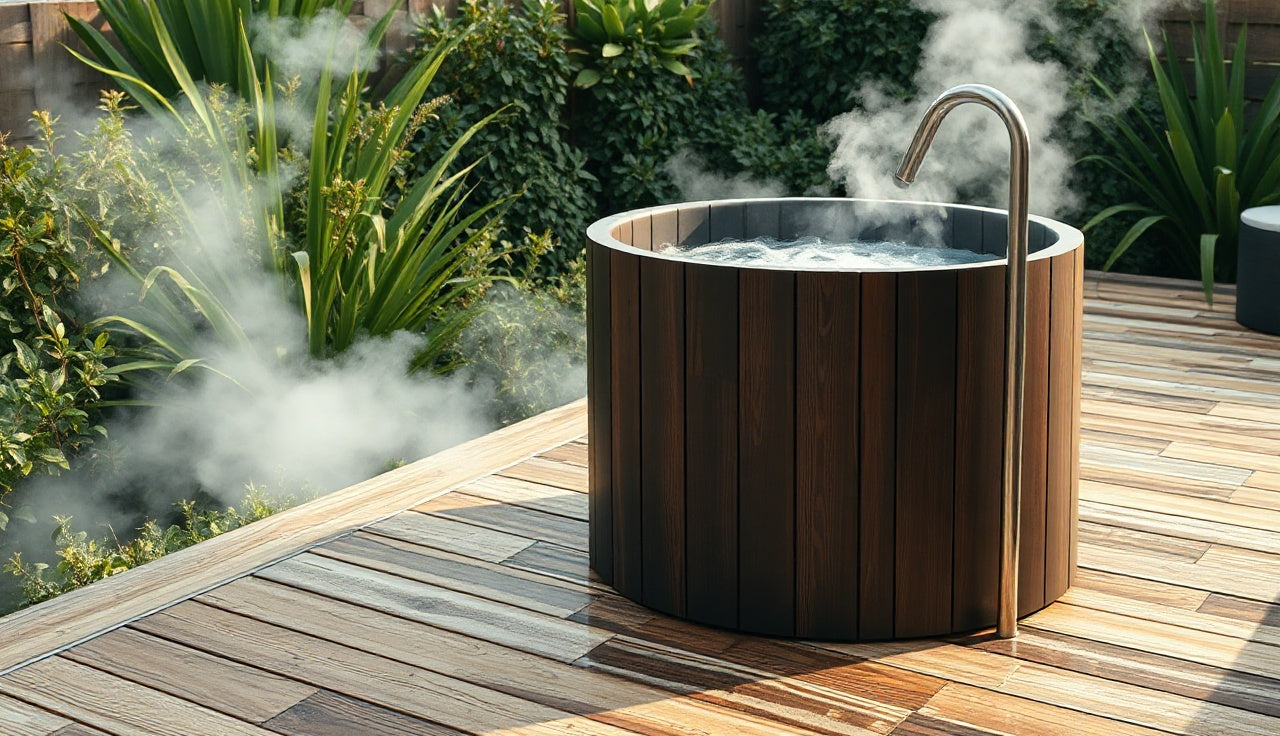
Mod Tub is a U.S.-based cold plunge company that builds a vertical tub: a chest-high, narrow tank you step down into rather than reclining like you would in a bathtub. That vertical orientation is the whole point. It lets the unit sit on roughly a 2-foot by 2-foot square of floor, which changes everything if you're squeezing a plunge into a garage, a small deck, or a corner of a bedroom.
The company launched during the early-2020s cold plunge boom. They build one core product instead of a sprawling catalog. The upside: the hardware and filtration have been refined more carefully than brands that bolt a chiller onto a generic fiberglass shell. The downside: if their single design doesn't fit your body or your room, there's nothing else in the brand to fall back on.
Mod Tub's buyer is the homeowner or athlete who wants something that looks intentional in a home gym, not a livestock trough or a modified freezer. It also targets people who priced commercial-grade plunges from Morozko Forge or Plunge and choked on the number, but who don't want to babysit a DIY rig either. If that describes you, keep reading before you spend a few thousand dollars.
For the full category picture, the SweatDecks cold plunge guide covers the whole market.
How cold does the Mod Tub actually get?
Mod Tub targets 39°F to 55°F (roughly 4°C to 13°C). The chiller on the standard unit is rated to pull water down to about 39°F in most ambient conditions, which is genuinely cold. For reference, most published cold water immersion research uses temperatures between 50°F and 59°F (10°C to 15°C) [1].
How fast it gets there depends on air temperature, starting water temperature, and how often you use it. In a climate-controlled garage in summer, expect several hours to cool a fresh fill. In a cool basement in winter, it hits target faster. Mod Tub recommends keeping the unit plugged in and running continuously instead of chilling from room temperature each session, which is the right call for any plunge with a compressor-based chiller.
The 39°F floor is competitive. Some home plunges stop at 50°F or 55°F, which is meaningfully warmer. Whether that gap matters depends on your protocol. If you follow the Huberman-style cold exposure framework, which cites 50°F to 60°F as a useful range for norepinephrine response [2], the Mod Tub's cooling depth is more than enough. If you're chasing a personal record for cold tolerance, the lower floor gives you room to push.
One honest caveat: chiller performance drops in hot ambient environments. Park the unit outside in Phoenix in July and the chiller works harder and may not hold 39°F. That's true of nearly every home plunge chiller, more than this one.
What does a Mod Tub cost, and what do you actually get for the price?
Mod Tub units have sold in the $4,000 to $6,500 range depending on configuration, though pricing shifts as the brand grows and component costs move. Check the current number directly with the brand or an authorized retailer, because second-hand listings and old reviews quote stale figures.
At that price, here's what you generally get:
- A thermally insulated tub shell, usually high-density polyethylene or similar, built to hold temperature without sweating on the outside
- A compressor-based chiller, not a simple pump, so you get active cooling instead of relying on ice
- A filtration and sanitation system, usually ozone or UV, that keeps water clean between fills so you're not dumping it every few days
- Digital temperature control and display
- A cover to hold temperature between sessions
The vertical design also means the water covers your shoulders while you stand inside, so you get full-body immersion that a lot of horizontal tubs can't manage for taller users.
Here's how Mod Tub lines up against comparable home plunges:
| Product | Approx. price | Min. temp | Footprint | Orientation |
|---|---|---|---|---|
| Mod Tub | $4,000, $6,500 | ~39°F | ~2 ft x 2 ft | Vertical |
| Plunge (Original) | $4,990, $5,990 | 39°F | ~4 ft x 2 ft | Horizontal |
| Ice Barrel 400 | $1,199 | No chiller (ice) | ~2 ft diameter | Vertical/barrel |
| Morozko Forge | $7,000, $9,000+ | 32°F | ~7 ft x 3 ft | Horizontal |
| DIY chest freezer | $300, $800 | ~32 to 40°F | ~5 ft x 2 ft | Horizontal |
Mod Tub sits in the middle. Not the cheapest, not the priciest. The DIY chest freezer costs a fraction but demands ongoing maintenance, skips proper filtration, and carries real safety questions around electrical modifications [3]. The Morozko Forge gets colder and is built to commercial standards, but it costs nearly double.
| DIY chest freezer | $800 |
| Ice Barrel 400 (no chiller) | $1,199 |
| Mod Tub (mid config) | $5,000 |
| Plunge Original | $5,490 |
| Morozko Forge | $8,000 |
Source: Brand pricing and SweatDecks market research, 2024
How does the vertical cold plunge tub design compare to horizontal tubs?
Most buyers dismiss this question too fast, and they get it wrong. Vertical versus horizontal isn't only about footprint. It changes how you get in and out, and it changes how the cold hits your body.
In a horizontal plunge (a bathtub-shaped unit or a chest freezer), you lower down and recline. Most of your body goes under at once, but the entry is easier physically because you step over a low wall and sit. In a vertical tub, you step down, legs first, and the water climbs your body as you descend. The warm-to-cold transition happens gradually by body part. Some people find that easier on the nerves; others find it worse because the anticipation builds with every inch.
For immersion depth, vertical wins for most body types. In a horizontal tub, unless you lie flat and the tub is deep, your shoulders sit at or near the water line. In a tall vertical tub, water reaches your neck with zero effort.
The footprint advantage is real. A horizontal plunge needs 4 to 5 feet of length minimum, a dealbreaker in a tight garage or on a narrow deck. A vertical unit at 2 feet square fits where nothing else would.
The main downside is entry and exit. You're stepping down into cold water, and wet feet on a wet surface are a slip risk. A grippy interior surface and a stable step or handle outside are not optional. Confirm Mod Tub includes grip surfaces before you buy.
Compared to a traditional ice bath setup, the vertical design also uses less water total, which speeds up chilling and stretches the time between water changes.
What are the electrical and installation requirements?
Mod Tub runs on standard 110V/120V power, which is one of its better practical selling points. You skip hiring an electrician to run a new 240V circuit, which can cost $300 to $800 depending on your panel and the run length [4]. Plug it into a GFCI-protected, outdoor-rated outlet and you're done on the electrical side.
GFCI (ground fault circuit interrupter) protection near water is not optional. The National Electrical Code Article 680 governs electrical work around pools and similar water features. A cold plunge isn't technically a pool, but applying the same GFCI standard is the right call for safety [5].
The unit needs a flat, level surface that can carry its full weight. Water weighs about 8.34 pounds per gallon [6]. A tub holding 150 gallons carries roughly 1,250 pounds of water alone, plus the tub itself. Confirm your deck or floor can take it before you place it. A poured concrete patio or a garage slab is fine. A wooden deck needs a look from someone who knows framing.
Drainage beats a large hot tub for simplicity. Most cold plunges this size drain through a standard garden hose connection, so you can run it to a floor drain or out to the yard. Indoor installs need a floor drain or a solid plan for water changes.
Mod Tub doesn't require professional installation in most cases, which saves money. Don't skip the leveling instructions, though. An unlevel tub strains the filtration pump and starts making vibration noise over time.
How do you maintain a Mod Tub, and how often do you need to change the water?
Maintenance is where cold plunge buyers get surprised, so here's the plain version.
Mod Tub includes a filtration and sanitation system, usually ozone or UV. These cut bioburden hard but don't erase the need for chemical sanitizers. You still monitor pH and sanitizer levels with test strips or a digital tester. The CDC's guidance on hot tub and spa water recommends keeping free chlorine at 3 to 10 ppm and pH between 7.2 and 7.8 for safe soaking [7]. Cold water at 39 to 50°F slows bacterial growth compared to a hot tub, so the sanitation demand is lower, but it isn't zero.
With good chemistry plus ozone or UV, most users change the water every 4 to 12 weeks depending on how many people use it and how often. A single daily user can often stretch to 6 to 8 weeks. A household of four plunging daily might need a change every 3 to 4 weeks.
The filter cartridge or media needs cleaning or replacement on the brand's schedule, usually every 1 to 3 months. Not a big time sink, but a real one. Budget $50 to $150 a year for consumables: filter media, sanitizer, test strips.
Electricity is worth doing the math on. A compressor-based chiller running continuously in a moderate climate draws roughly 300 to 600 watts. At the U.S. average residential rate of about 16 cents per kWh [8], continuous operation runs roughly $1.15 to $2.30 a day, or $35 to $70 a month. Your real cost swings with your climate and local rate.
What does the cold plunge research actually say about benefits?
Cold water immersion has a real body of research behind it, but the findings are more hedged than the wellness crowd lets on.
A 2022 review in the International Journal of Circumpolar Health found regular cold water immersion is associated with lower subjective fatigue and better mood scores, and it notes significant norepinephrine release during cold exposure [9]. Norepinephrine is a neurotransmitter and hormone tied to alertness and mood. The same review flags that the evidence base is still young and most studies run small samples.
For athletic recovery, a 2016 meta-analysis in the British Journal of Sports Medicine found cold water immersion reduces delayed onset muscle soreness more than passive recovery [10]. Here's the part that usually gets cut: cold immersion may also blunt some of the inflammatory signaling that drives strength adaptation when you use it right after resistance training. If strength is the goal, timing matters. Plunge a few hours after a lift, not immediately, and that interference appears to shrink.
Cold water triggers a predictable response: initial gasp, heart rate spike, then slowing, plus peripheral vasoconstriction. This is normal, and it's the mechanism behind much of the proposed benefit. It's also why people with uncontrolled hypertension, heart arrhythmias, or Raynaud's should talk to a physician before starting [11].
The honest summary: the evidence supports cold water immersion for mood, alertness, and acute soreness. Strength athletes should not plunge immediately post-lift. For longevity and metabolic claims, the data is thinner and more speculative.
Our cold plunge benefits guide goes deeper on the full research picture.
Is Mod Tub worth the money compared to cheaper alternatives?
Let's be straight about value, because it's the question that actually decides the purchase.
The DIY chest freezer route works. People have done it for years. A quality chest freezer in the 100-gallon range runs $300 to $500 new, and a submersible pump plus chiller upgrade adds $200 to $400. You can get cold water for under $800. The problems: filtration (most DIY rigs use chlorine tabs and manual testing, not automated systems), looks (it's a chest freezer), safety (modified freezers carry electrical risk if the compressor meets water), and the hours you spend keeping it clean.
Ice Barrel and similar barrel units around $1,200 are vertical, compact, and well-reviewed, but they have no chiller. You buy ice or run cold hose water, which is fine in a cold climate or if the ice budget doesn't bother you.
The Mod Tub's $4,000 to $6,500 buys a filtration system that actually works, a compressor chiller that holds a set temperature, a clean look, and a warranty from a U.S.-based company. If you plan to plunge daily for years, that's a reasonable spend. If you're not sure you'll stick with it, start cheaper.
My honest take: if you've plunged consistently for three months and you know this is part of your life, the Mod Tub is a sensible buy in its tier. If you're buying it to force yourself to start, that's a $5,000 bet on willpower. Try a gym or spa plunge for a month first.
SweatDecks stocks cold plunges at several price points so you can compare them side by side instead of trusting one brand's own site.
How does the Mod Tub work as a contrast therapy setup with a sauna?
Contrast therapy, alternating heat and cold, is one of the most popular home recovery protocols going. The basic version: heat (usually sauna) for 10 to 20 minutes, then cold immersion for 1 to 3 minutes, repeated for 2 to 4 rounds. Research on contrast therapy shows benefits for perceived recovery and soreness reduction compared to cold alone, though the ideal timing and temperature gaps are still being worked out [12].
The Mod Tub's compact vertical footprint makes it an easy pairing with a sauna. If you have a barrel sauna or a small indoor sauna, you can set the Mod Tub a few steps away and move between them without a long cold walk. That proximity matters more than it sounds. The transition time between hot and cold shapes the vascular response you're after.
Home recovery spaces built around a sauna plus a cold plunge are growing fast. If you're planning a full setup, read the home sauna guide for the heat-side installation requirements, then compare options at the sauna hub.
One practical note: sauna sessions dehydrate you. Cold plunging right after a long sauna without drinking water in between is a bad idea. Drink between rounds. Basic physiology, but worth stating flat out.
The sauna benefits research overlaps directly with cold plunge benefits around cardiovascular adaptation and mood, so a contrast protocol theoretically stacks both mechanisms.
What are the common complaints and real-world downsides of the Mod Tub?
No product at this price is perfect, and Mod Tub isn't the exception. Here are the pain points that come up in owner discussions and reviews.
First, chiller noise. Compressor-based chillers run roughly 50 to 65 decibels depending on model and ambient temperature. If the unit sits in a bedroom or an attached garage below a bedroom, that hum can wreck your sleep. Plan placement around it.
Second, the vertical design has a learning curve for entry and exit. Getting into cold water without a rail or step is harder than it sounds when your legs hit 40°F water and your body wants to pull back. Some owners add an aftermarket step or grab bar. Simple fix, but an added cost.
Third, in very hot climates the chiller works harder and burns more electricity. Above 95°F ambient, some owners report the unit struggles to hold its lowest settings. That's physics, not a defect, but it hits buyers in hot regions harder.
Fourth, customer service reports are mixed. Common with smaller direct-to-consumer wellness brands. Before buying, get the warranty terms in writing: what's covered, for how long, and the return policy if the unit shows up damaged.
Fifth, water capacity is lower than a horizontal plunge. That's by design, but it means the water warms faster under heavy use. One user is fine. Several users back-to-back will watch the temperature climb between plunges.
Who should buy a Mod Tub and who should look elsewhere?
Buy a Mod Tub if you have a small space and need the vertical footprint to fit a plunge at all, you want temperature-held filtered water without DIY effort, you're a daily solo user, and you're fine spending $4,000 to $6,500 on a recovery tool you'll actually use.
Look elsewhere if you have a big family or group of users (horizontal plunges with more water hold temperature better under load), you live somewhere extremely hot (the chiller will struggle), you want the coldest water possible (Morozko Forge at 32°F beats it), or you're not sure you'll stick with cold plunging (start with the ice bath approach at low cost).
If budget is the wall, the gap between a $1,200 barrel unit and a $5,000 Mod Tub is real. The barrel needs ice or cold-source water, but if your winter tap runs cold, it's a legitimate starting point. Athletes who've been plunging in ice baths and want dialed-in temperature and filtration will find the Mod Tub's feature set genuinely useful.
The vertical tub category is still young. Mod Tub is one of the earlier dedicated brands in the niche, but competitors are closing in. If you're not in a rush, watching the market another six months could mean better options at the same price.
Frequently asked questions
What temperature does the Mod Tub cold plunge reach?
Mod Tub's chiller is designed to cool water to about 39°F (4°C), with an upper range around 55°F. Most cold water immersion research uses temperatures between 50°F and 59°F, so the Mod Tub covers the full studied spectrum. Very hot ambient conditions can limit how low the unit actually reaches.
How much does a Mod Tub cold plunge cost?
Mod Tub cold plunges have sold in the $4,000 to $6,500 range depending on configuration. Prices shift over time, so confirm current pricing with the brand or an authorized retailer. That range puts it in the mid-tier of home cold plunges, above barrel units without chillers and below commercial-grade options like Morozko Forge.
Does a Mod Tub require 240V power or can I plug it into a regular outlet?
Mod Tub runs on standard 110V/120V power, so no new circuit is required. You do need a GFCI-protected, outdoor-rated outlet near the unit. The National Electrical Code Article 680 requires GFCI protection for receptacles within 20 feet of water features, and following that standard for a cold plunge is the right call regardless of local code specifics.
How often do I need to change the water in a Mod Tub?
With the built-in filtration and sanitation maintained properly, most solo users change the water every 4 to 8 weeks. Households with multiple daily users may need a change every 3 to 4 weeks. You still monitor pH and sanitizer levels with test strips. The CDC recommends free chlorine at 3 to 10 ppm and pH between 7.2 and 7.8 for safe water.
What is a vertical cold plunge tub and is it better than a horizontal one?
A vertical cold plunge tub is a chest-high, narrow tank you step down into rather than recline in. The main advantage is footprint: roughly 2 by 2 feet versus 4 to 5 feet for most horizontal units. Immersion depth is often better for taller users too. The tradeoff is that entry and exit take more care, and the smaller water volume can mean more temperature swing during heavy use.
Can I use a Mod Tub outdoors year-round?
Yes, in most climates. The unit is built for outdoor use. In very hot climates (ambient over 95°F), the chiller works harder and may miss its lowest settings. In freezing climates, winterize or keep it running when temperatures drop below 32°F to stop water in the lines from freezing. Follow the brand's winterization instructions for your region.
How does cold plunging affect muscle recovery and strength gains?
A 2016 meta-analysis in the British Journal of Sports Medicine found cold water immersion reduces delayed onset muscle soreness better than passive recovery. But plunging immediately after resistance training may blunt some inflammatory signaling that drives strength adaptation. If building strength is the goal, plunging several hours after a session rather than right away appears to reduce that interference.
Is contrast therapy (sauna plus cold plunge) more effective than cold plunging alone?
Research on contrast therapy shows benefits for perceived recovery and soreness reduction compared to cold alone, though optimal protocols vary. The Mod Tub's small footprint makes it practical to pair with a home sauna. Drink water between rounds since sauna sessions cause fluid loss. The science is promising but not settled on ideal temperature differentials and timing.
Who should not use a cold plunge?
People with uncontrolled hypertension, heart arrhythmias, Raynaud's syndrome, or other cardiovascular conditions should consult a physician before starting cold water immersion. The response triggered by cold immersion causes a heart rate spike and peripheral vasoconstriction, normal for healthy people but potentially risky for certain cardiac conditions. Pregnant individuals should also seek medical guidance.
How much does it cost to run a Mod Tub monthly?
A compressor-based chiller running continuously draws roughly 300 to 600 watts. At the U.S. average residential rate of about 16 cents per kWh, that works out to about $35 to $70 a month in electricity. Your actual cost depends on your local rate, ambient temperature, and how well the unit is insulated. Warmer climates raise costs because the chiller runs more to hold target temperature.
How long should a cold plunge session last?
Most cold water immersion research protocols use sessions of 1 to 15 minutes at temperatures between 50°F and 59°F. Sessions of 2 to 3 minutes are enough to trigger the norepinephrine and mood responses documented in published research. Longer is not automatically better, and staying in very cold water past uncontrollable shivering is not productive. Build duration gradually.
Is the Mod Tub good for tall people?
The vertical design is generally better for tall people than most horizontal home plunges, because the water depth can reach shoulder height even for users over six feet. Still, confirm the internal depth and interior dimensions from the brand before buying if you're over 6'2". Some vertical tubs have shoulder-level water depth that still leaves arms exposed.
How does Mod Tub compare to Plunge (The Plunge) cold plunge?
Both are U.S.-based home cold plunges in the $4,500 to $6,000 range with compressor chillers reaching around 39°F. Plunge's original model is horizontal with a larger water volume and easier entry and exit. Mod Tub's vertical design uses less floor space and gives deep shoulder immersion. Choose based on your space and whether entry comfort or footprint matters more.
Can I add the Mod Tub to my sauna setup as part of a full recovery space?
Yes, and the vertical footprint makes it one of the easiest cold plunges to place near a sauna, even in a small garage or outdoor space. For a full recovery setup, read the home sauna installation guide to understand electrical and ventilation needs on the heat side, then plan the plunge placement so the transition between hot and cold takes no more than a few steps.
Sources
- PubMed Central, Tipton et al. (2017) Cold water immersion: kill or cure? Experimental Physiology: Most cold water immersion research uses temperatures between 50°F and 59°F (10°C to 15°C)
- PubMed Central, Søberg et al. (2021) Deliberate cold exposure increases norepinephrine. Current Biology: Cold water immersion at 50°F to 60°F triggers significant norepinephrine release associated with alertness and mood
- U.S. Consumer Product Safety Commission, Electrical Safety: DIY electrical modifications to chest freezers used near water present safety hazards requiring careful electrical consideration
- U.S. Department of Energy, Energy.gov: Running a new 240V electrical circuit costs $300–$800 depending on panel distance and local labor
- NFPA 70 National Electrical Code Article 680, NFPA: NEC Article 680 requires GFCI protection for receptacles within 20 feet of water features
- USGS Water Science School, Water density and weight: Water weighs approximately 8.34 pounds per gallon at standard temperature
- CDC, Healthy Swimming: Hot Tub and Spa Water Chemistry Guidance: CDC recommends maintaining free chlorine at 3–10 ppm and pH between 7.2 and 7.8 for safe hot tub soaking water
- U.S. Energy Information Administration, Electricity Monthly Update: U.S. average residential electricity rate is approximately 16 cents per kWh (2023–2024 data)
- PubMed Central, Esperland et al. (2022) Health effects of cold water immersion. International Journal of Circumpolar Health: Regular cold water immersion is associated with reduced subjective fatigue, improved mood, and significant norepinephrine release
- British Journal of Sports Medicine, Machado et al. (2016) Cold water immersion versus passive recovery after exercise: meta-analysis: Cold water immersion reduces delayed onset muscle soreness more than passive recovery, per 2016 meta-analysis in BJSM
- PubMed Central, Tipton MJ (2012) Sudden cardiac death during open water swimming. British Journal of Sports Medicine: Cold water immersion triggers the dive reflex including heart rate spike and vasoconstriction; people with hypertension, arrhythmias, or Raynaud's should consult a physician
- PubMed Central, Versey et al. (2013) Water immersion recovery for athletes: effect on exercise performance and practical recommendations. Sports Medicine: Contrast therapy shows benefits for perceived recovery and soreness reduction compared to cold alone

Share:
Sauna and ice bath benefits: what the research actually shows
Sauna and ice bath benefits: what the research actually shows