
Last updated 2026-07-09
TL;DR
Mini home saunas range from $200 fold-up fabric tents to compact traditional units over $3,000 that fit a 4x4 foot footprint. Most run on a standard 120V outlet. They genuinely raise core body temperature and deliver many of the same heat-stress benefits as full-size saunas, with real tradeoffs in session quality, durability, and long-term value.
What counts as a mini sauna for home use?
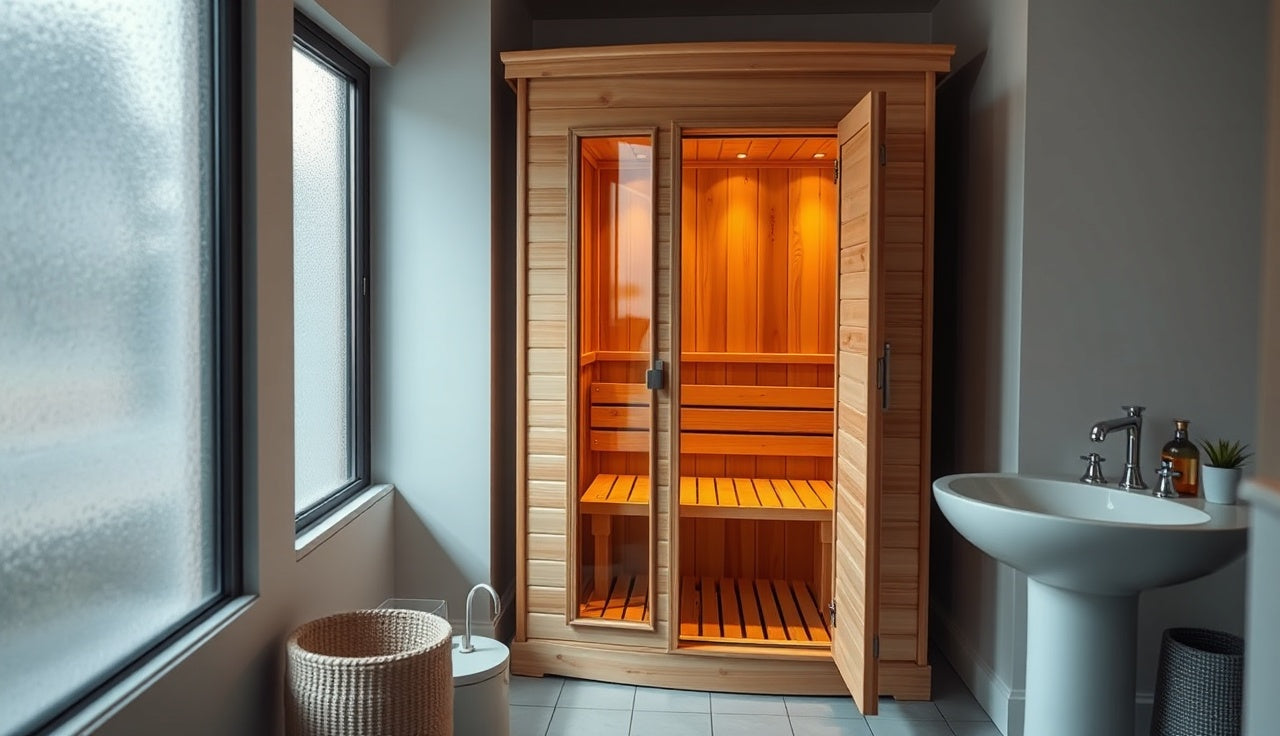
"Mini sauna" is a marketing term, not a technical category. It covers anything smaller than a traditional 2-person Nordic-style sauna, which usually starts around 4x6 feet of floor space. Mini units seat one person and measure somewhere between 3x3 and 4x5 feet on the floor.
Three main types show up when you shop. Portable fabric saunas (sauna tents or sauna pods) are the cheapest, fold up when you're done, and plug into a standard wall outlet. Compact one-person wooden box saunas are fixed structures, either infrared or electric-rock, that you assemble once and leave in place. Outdoor barrel saunas come in 4-foot-diameter versions that seat one or two people and get called "mini" even though they live outside.
Each type works on a different principle. Portable tents heat the air around your body from a steam generator or small infrared panel while leaving your head exposed. Traditional wood-box saunas heat the whole room including your head, which is how most of the research on sauna physiology was actually done. That distinction matters if you're buying for health reasons and want your experience to match what studies measured.
For a broader look at how all the formats fit together, see our guide to home saunas.
What are the real size requirements for a mini home sauna?
A one-person infrared box sauna needs a floor footprint of about 3 feet wide by 4 feet deep, give or take a few inches by brand. Add 12 to 18 inches on each open side for the door swing and comfortable entry. You also need at least 6 inches of clearance from any wall on the non-door sides for ventilation and heat dissipation.
So the real number is roughly a 5x6 foot area of usable floor, more than the sauna's stated footprint. That fits in a spare bedroom, a large bathroom, a basement corner, or a finished garage without much trouble.
Ceiling height is the part people miss. Infrared and electric saunas need at least 1 foot of clearance above the unit's roof. Most one-person boxes top out around 6 feet 3 inches, so a standard 8-foot ceiling is fine. A 7-foot finished basement ceiling is often tight. Measure before you order.
Weight matters too. A one-person hemlock or cedar infrared sauna weighs 200 to 350 pounds assembled. That sits inside the typical residential floor load rating of 40 pounds per square foot for wood-frame homes [1]. If you're putting it on a second floor with any age or condition concerns, check with a contractor first.
How much does a mini home sauna actually cost?
The range is wide. Here's a realistic breakdown by type:
| Type | Typical price range | Typical footprint | Power requirement |
|---|---|---|---|
| Portable fabric sauna tent | $200 - $500 | Folds flat | 120V / 10-15A |
| One-person infrared wood box | $800 - $2,500 | ~3x4 ft | 120V / 15-20A |
| One-person traditional electric (rock) | $1,500 - $3,500 | ~3x4 ft | 120V or 240V |
| Mini outdoor barrel sauna (4-ft dia.) | $2,000 - $5,000 | ~4x6 ft + clearance | Wood-fired or 240V |
Those prices are for the unit alone. Installation, a dedicated circuit from an electrician, and floor protection (a waterproof mat or tile base under a traditional sauna) add to the total. A dedicated 20-amp circuit typically costs $150 to $300 to install depending on how far the panel is [2]. A 240V circuit for a traditional electric heater adds $300 to $600 more.
Running costs stay low. A one-person infrared sauna drawing 1.5 to 1.8 kW for 45 minutes costs roughly $0.10 to $0.15 per session at the national average residential electricity rate of about $0.16 per kWh [3]. Traditional electric rock heaters draw more power (2 to 3 kW for a small unit) but sessions run shorter.
The value question is whether you'll actually use it. A gym membership costs $40 to $80 per month on average, and most commercial gyms don't have a sauna at all, or share one among dozens of members. A $1,500 infrared sauna pays for itself in avoided gym costs within two to three years of steady use. That math only works if you use it.
| Portable fabric tent sauna | $350 |
| One-person infrared wood box | $1,650 |
| One-person traditional electric (rock) | $2,500 |
| Mini outdoor barrel sauna (4-ft dia.) | $3,500 |
Source: SweatDecks market survey of major US sauna retailers, 2025
Infrared vs. traditional (Finnish) electric: which is better for a mini sauna?
It depends on what you're optimizing for. That's the honest answer to the most common question buyers ask.
Traditional Finnish saunas heat the air to 160-200°F, and you add humidity with a ladle of water on hot rocks (löyly). Infrared saunas run cooler, typically 120-150°F, and use panels to warm your body directly instead of heating all the air in the room. Both raise your core body temperature. Most peer-reviewed research on sauna cardiovascular effects, including the well-known Finnish cohort studies, used traditional dry Finnish saunas [4]. That doesn't mean infrared fails to work. It means the evidence base is thinner and the session feels different.
For a mini sauna, infrared wins on practicality. A 120V outlet handles most one-person infrared units. They reach temperature in 10 to 15 minutes versus 30 to 45 minutes for a traditional electric unit. They're easier on the structure, since you're not trapping condensation and high humidity inside a small wood box in your home. And they cost less to run.
Traditional mini saunas feel more like the real thing. The steam, the heat hitting your face, the ritual of pouring water. If that matters to you, a small 2kW traditional heater in a tight one-person room delivers it. Just plan for proper ventilation to manage moisture, plus a floor drain or at minimum a waterproof floor system.
For a side-by-side breakdown of the broader sauna vs. steam room question, see sauna vs steam room.
What are the health benefits, and what does the science actually show?
Regular sauna use is linked to real cardiovascular and recovery benefits in the research, though the strong studies used full-size traditional saunas several times a week over years. Match your expectations to that.
The most-cited findings come from the Kuopio Ischemic Heart Disease Risk Factor Study, a prospective cohort of over 2,000 Finnish men followed for about 20 years. Men who used a sauna 4 to 7 times per week had a 40% lower risk of all-cause mortality than once-a-week users [4]. That's an association, not a controlled trial, and the population was Finnish men who used saunas culturally. Extrapolating to a 30-minute infrared session three times a week takes some caution.
On recovery and performance, a 2018 review in Mayo Clinic Proceedings reported that regular sauna bathing appears to produce cardiovascular effects broadly similar to moderate-intensity exercise, including reduced blood pressure and improved endothelial function [5]. The authors called the findings promising and asked for more randomized controlled trials.
Heat acclimation from repeated sessions has solid evidence behind it. A 2007 study in the Journal of Science and Medicine in Sport found that post-exercise sauna bathing for three weeks improved distance running performance and increased red blood cell volume and plasma volume [6]. Athletes use saunas for exactly this, and it works whether the sauna is full-size or compact.
For a deeper breakdown of what's established versus what's still speculative, see sauna benefits.
Mini saunas deliver these effects because the mechanism is core temperature elevation and a cardiovascular stress response, not room size. A one-person 150°F infrared session raises your core temp, your heart rate, and your sweat rate. The catch is whether you hit the same temperatures and session lengths as the studied groups. Most infrared users don't, which is part of why the evidence for infrared specifically is harder to read.
Are mini home saunas safe to use, and who shouldn't use one?
For healthy adults, sauna use is safe with basic precautions. The main risks are dehydration, orthostatic hypotension (lightheadedness when you stand up fast after a hot session), and overheating.
Guidance from the American College of Sports Medicine and Finnish sauna research points the same direction: keep sessions to 15-20 minutes, hydrate before and after, and cool down gradually rather than jumping straight into cold water if you have any cardiovascular concerns.
Talk to a physician before regular sauna use if you have unstable angina, a recent myocardial infarction, severe aortic stenosis, or uncontrolled hypertension [5]. Pregnant women are generally advised to avoid hot sauna sessions, especially in the first trimester, because elevated core temperature is teratogenic at high levels. The CDC ties increased risk of neural tube defects to maternal core temperature above 102°F (38.9°C) [7].
Alcohol and saunas are a genuinely bad mix. A Finnish review of sauna deaths found alcohol in the blood of a large share of cases [8]. Don't use a mini sauna drunk.
For home use, make sure electrical connections meet code, use a GFCI outlet for anything near moisture, and never push a sauna's thermostat past its rated range. Most residential infrared saunas have a built-in high-limit cutoff around 160-165°F.
What should you look for in a mini sauna purchase?
Wood species is the first thing buyers notice and one of the least important. Hemlock, cedar, and basswood all work. Cedar smells great and is naturally antimicrobial. Basswood suits people with wood allergies. Hemlock sits in the middle on both. What matters more is panel thickness (at least 1 inch for good heat retention) and whether the tongue-and-groove joints are tight.
For infrared saunas, look at EMF ratings. Near-infrared and far-infrared panels both generate low-frequency electromagnetic fields, and some emit more than others. Reputable manufacturers publish Gauss measurements. Levels under 3 milligauss at seated distance are treated as low [9]. Marketing gets loud here, so find actual third-party measurements instead of a bare "low-EMF" claim.
Heater quality in a traditional sauna matters more than anything else. A cheap resistance coil in a small room works but won't last. Harvia and Helo are Finnish brands with long track records. Tylo is Swedish. These companies have made sauna heaters for decades, and their small residential units (2-3 kW) fit a one-person room well.
Warranty is a real signal. Reputable makers offer at least 1 to 3 years on the heater and 3 to 5 years on the wood structure. A unit with a 90-day warranty on everything is telling you something.
For plug-and-play options that suit travel or apartments, a portable sauna is worth reading about separately from a fixed mini sauna, since the use case and experience differ.
SweatDecks curates a selection of one-person saunas vetted for build quality, EMF ratings, and heater brand. Good starting point if you don't want to research every manufacturer from scratch.
Do you need a permit to install a mini home sauna?
Usually not for the sauna itself, but very possibly for the electrical work. Rules vary by jurisdiction, and this is one of the most under-researched parts of the buying process.
A pre-built, plug-in infrared sauna that runs on a standard 15 or 20-amp 120V circuit gets treated like a large appliance in most municipalities. You plug it in, you use it, no permit. But if an electrician has to add a dedicated circuit, that work generally needs an electrical permit and inspection under local codes derived from the National Electrical Code [2].
A 240V circuit for a traditional electric heater almost always requires a permit. Wiring it yourself without a licensed electrician is illegal in most jurisdictions and will create problems with homeowner's insurance if anything goes wrong.
Adding a mini sauna to a bathroom or building out a dedicated room can cross into a renovation permit if you're moving walls, adding ventilation, or modifying plumbing. Check with your local building department. Most give you a straight answer in a five-minute call.
For an outdoor barrel sauna, a structure under a set footprint (often 120 to 200 square feet depending on local code) is frequently exempt from building permits, though this varies a lot. Some HOAs ban any permanent structure regardless of size. Confirm before you order a 300-pound barrel.
How long does a mini home sauna last, and what maintenance does it need?
A well-made one-person wood sauna, properly maintained, should last 15 to 20 years. The heater is the most common failure point. Good Finnish heaters (Harvia's small residential units, for example) are rated by the manufacturer for 20,000 to 30,000 hours, which is decades of normal home use.
The wood needs almost no maintenance if you keep it dry between sessions and wipe up sweat with a clean towel. Don't apply oils or stains to interior sauna wood. They vaporize at sauna temperatures and you end up inhaling them. Sand lightly with 220-grit if the bench wood gets rough. That's it.
Infrared panels in a cheaper unit can degrade over time, losing output. There's no great way to test this at home without specialized equipment. If your infrared sauna takes noticeably longer to warm up than it did new, that's a signal.
For portable fabric saunas, the steam generator is the failure point. Most units offer replacement steam heads, and the fabric washes in a tub with mild soap. Expect 3 to 7 years from a fabric sauna with regular use before something fails and parts run out.
Ventilation gaps and door seals deserve an annual check. A warped door that doesn't seal wastes energy and makes it hard to hold temperature.
How does a mini sauna compare to contrast therapy with a cold plunge?
Sauna and cold plunge together, what most people call contrast therapy, has gotten popular for post-exercise recovery. The basic protocol is heat for 10-20 minutes, cold immersion for 2-3 minutes, repeated 2-3 rounds.
The cardiovascular demand of moving hot to cold is significant. Blood vessels dilate aggressively in heat and constrict sharply in cold, creating a vascular pumping effect. Whether that specifically speeds recovery versus passive rest is still under study. A 2016 meta-analysis in the British Journal of Sports Medicine found cold-water immersion reduced perceived muscle soreness after exercise, but effects on functional recovery were smaller and inconsistent [10].
The practical question for a home setup is whether you have room for both. A mini sauna at 3x4 feet and a one-person cold plunge can physically share the same garage or basement corner. Some buyers start with one and add the other later. If the cold side is your main interest, a standalone ice bath is worth reading about on its own terms.
For athletic recovery, one timing detail is worth knowing: multiple studies suggest cold water immersion right after strength training may blunt long-term muscle growth, possibly by cutting the acute inflammatory response that drives protein synthesis [11]. If your main goal is building muscle, a cold plunge straight after lifting is probably counterproductive. Sauna in that window looks neutral to mildly helpful. For endurance athletes and general recovery, the math changes.
SweatDecks has a guide on cold plunge benefits that covers the evidence in more depth if you're weighing which to prioritize.
What are the best mini sauna options to actually consider?
I'll give you categories rather than ranked SKUs, because products change and a framework stays useful longer.
First sauna on a tight budget ($200-$500): A portable fabric tent sauna with a 1,000-1,500W steam generator is a legitimate starting point. The experience differs from a traditional sauna (head stays out, more steamy than dry) but you'll sweat, you'll warm up, and it stores in a closet. It's a trial run, not a lifestyle purchase.
Serious one-person infrared under $2,000: Look for a 1.5-2 kW full-spectrum or far-infrared heater array, hemlock or cedar with at least 3/4-inch (ideally 1-inch) panels, chromotherapy lighting (nice, irrelevant to outcomes), and a published EMF level. Read reviews from owners past 12 months, not unboxing videos.
Real traditional experience in a small footprint: A Harvia Vega or Harvia Cilindro compact heater (2-3 kW) paired with a custom or semi-custom one-person room built to spec. This runs more ($2,500-$4,000+ with the room build) but delivers a Finnish sauna feel in a compact space and lasts decades.
Outdoor: A 4-foot or 4.5-foot diameter barrel sauna with a wood-burning or electric heater is genuinely excellent for a small yard or patio. Wood-fired versions need no electrical work at all. The tradeoff is you can't casually fire it up on a Tuesday night. Plan 45 to 60 minutes of fire-building lead time.
See our sauna guide for a full breakdown of how sauna types compare, and outdoor sauna if the barrel or cabin-style route interests you.
Frequently asked questions
Can a mini sauna fit in an apartment?
Yes, but with real constraints. A one-person infrared box sauna fits in roughly 5x6 feet of floor space and plugs into a standard 120V outlet, so many apartments can hold one. The bigger obstacles are lease restrictions on modifications, building rules about electrical use, and the added heat load in a small unit. Get written landlord approval before ordering anything you can't easily return.
How hot does a mini home sauna get?
Infrared mini saunas typically reach 120 to 150°F (49-65°C) at bench level. Traditional electric mini saunas can hit 160 to 190°F (71-88°C). Portable fabric tent saunas with steam generators usually top out around 110-120°F. For reference, traditional Finnish saunas in research studies run at 80-100°C (176-212°F) air temperature, which most home infrared units don't match.
Does a mini sauna use a lot of electricity?
Not much. A one-person infrared sauna draws roughly 1.5 to 1.8 kW. At the US average residential rate of about $0.16 per kWh, a 45-minute session costs around $0.10 to $0.15. Traditional electric units draw 2 to 3 kW but sessions run shorter. Even daily use adds only about $3 to $5 per month to a typical electric bill.
What is the difference between a one-person sauna and a mini sauna?
They're the same thing in most cases. "Mini sauna" and "one-person sauna" get used interchangeably by most retailers. Technically a one-person sauna names the seating capacity, while "mini" refers to the overall footprint. Some two-person saunas get marketed as "mini" if they're compact relative to full-size units. Always check the actual floor dimensions rather than trusting a marketing size label.
Is a portable sauna tent as good as a real sauna?
It's a different experience, not worse in every dimension. Fabric tent saunas genuinely raise your body temperature and make you sweat. But your head stays outside the unit, so you miss the full-body heat exposure that Finnish sauna research measured. For casual heat therapy and relaxation, they work fine. For closely matching the conditions in cardiovascular health studies, a traditional box sauna is the better match.
Can I use a mini sauna every day?
Most healthy adults can use a sauna daily without harm. The Finnish population studies included frequent users (4-7 times per week) who showed better health outcomes than once-a-week users. Practical limits are dehydration (drink 16-24 oz of water before each session) and skin dryness with very frequent use. There's no strong evidence daily sauna use harms healthy people, but listen to your body and take breaks if you feel run down.
How long should a mini sauna session be?
Most recommendations land at 15 to 20 minutes for beginners, with experienced users going up to 30 minutes. The Finnish cohort studies typically involved sessions of about 15-20 minutes. Longer doesn't automatically mean better. The cardiovascular stress response plateaus and overheating risk climbs. Start at 10-15 minutes, see how you feel when you exit and in the following hour, and adjust from there.
What wood is best for a mini home sauna?
Cedar is the most popular choice for traditional saunas. It's naturally antimicrobial, handles humidity well, smells pleasant, and resists warping. Hemlock is lighter in color, less aromatic, and a good pick if cedar smell is too strong. Basswood is hypoallergenic and works well for infrared saunas that run cooler. Avoid pine for hot interior surfaces. It releases resin at high heat. Any of the three named options work well for a one-person unit.
Do mini saunas need ventilation or drainage?
Infrared saunas produce far less moisture than traditional ones and usually don't need a floor drain, though a waterproof mat under the unit is smart. Traditional electric saunas should have a small floor drain or at minimum a sloped, waterproof floor to handle sweat runoff and cleaning water. Air-exchange ventilation (a small vent near the floor and one near the ceiling) matters in any enclosed sauna room to prevent CO2 buildup and manage humidity.
Can a mini sauna help with weight loss?
Any weight you lose during a session is water weight from sweating, and it comes back when you rehydrate. There's no good evidence that regular sauna use causes meaningful fat loss on its own. Heart rate does climb during a session (one study measured increases to 100-150 bpm), which burns some calories, but not at a level that changes body composition without other lifestyle factors. Use it for recovery and cardiovascular conditioning, not weight loss.
What's the cheapest way to get a real sauna experience at home?
A fabric tent sauna for $250 to $400 gives you heat and sweat for minimal cost and no installation. If you want a permanent wood box, used saunas turn up on Facebook Marketplace and Craigslist regularly in the $400 to $900 range. The main risk is buying one with mold or degraded panels, so inspect in person. Building your own one-person room with a Harvia 2kW heater is doable for under $1,500 if you're comfortable with basic carpentry.
How do I clean a mini sauna?
Wipe benches with a clean towel after each use to lift sweat before it soaks into the wood. Deep clean monthly with mild soap and water or a diluted hydrogen peroxide spray on benches and walls. Never use harsh chemical cleaners inside a sauna. They off-gas when heated. Sand the bench surface lightly once or twice a year if the wood feels rough or looks discolored. Leave the door slightly open between sessions so moisture escapes.
Is a mini sauna worth it compared to a gym membership?
For regular users, yes. A $1,500 infrared sauna spread over five years costs about $25 per month plus electricity, and you use it on your schedule with no commute. Gym memberships average $40-80 per month, and most commercial gyms share saunas among many members or don't have one. The break-even hinges entirely on how often you use it. Use a home sauna three or more times per week and the numbers favor you within two to three years.
Sources
- American Wood Council, Wood Frame Construction Manual: Typical residential wood-frame floor load rating is 40 pounds per square foot for living areas under standard building codes.
- U.S. Department of Energy, Office of Electricity: Electrical circuit installation and additions to residential panels generally require a permit and inspection under local electrical codes derived from the National Electrical Code.
- U.S. Energy Information Administration, Electric Power Monthly: Average US residential electricity retail price is approximately $0.16 per kWh as of recent reporting periods.
- JAMA Internal Medicine, Laukkanen et al. 2015, Sauna Bathing and Sudden Cardiac Death: Men using a sauna 4-7 times per week had 40% lower risk of all-cause mortality compared to once-a-week users in the Kuopio Ischemic Heart Disease Risk Factor Study over ~20 years.
- Mayo Clinic Proceedings, Laukkanen et al. 2018, Cardiovascular and Other Health Benefits of Sauna Bathing: Regular sauna bathing produces cardiovascular effects broadly similar to moderate-intensity exercise, including reduced blood pressure and improved endothelial function; authors called for more randomized controlled trials.
- Journal of Science and Medicine in Sport, Scoon et al. 2007, Effect of post-exercise sauna bathing on the endurance performance: Post-exercise sauna bathing for three weeks improved distance running performance and increased red blood cell volume and plasma volume.
- CDC, National Center on Birth Defects and Developmental Disabilities: Elevated maternal core body temperature above 38.9°C (102°F) is associated with increased risk of neural tube defects, particularly in the first trimester.
- Duodecim Medical Journal (Finnish), Hannuksela & Ellahham 2001, Benefits and risks of sauna bathing: Finnish autopsy studies found alcohol present in the blood of a significant proportion of sauna-related deaths, indicating alcohol-sauna combination as a major risk factor.
- National Institute of Environmental Health Sciences, EMF Electric and Magnetic Fields: Residential EMF levels are typically discussed in the context of milligauss measurements; 3 milligauss is frequently cited as a low-exposure reference point in consumer EMF literature.
- British Journal of Sports Medicine, Machado et al. 2016, Acute effects of cold-water immersion on muscle soreness: Meta-analysis found cold-water immersion reduced perceived muscle soreness after exercise, but effects on functional recovery were smaller and inconsistent across studies.
- Journal of Physiology, Roberts et al. 2015, Post-exercise cold water immersion attenuates acute anabolic signalling: Cold water immersion immediately after resistance training attenuated long-term muscle hypertrophy adaptations, potentially by reducing the acute inflammatory signaling that drives protein synthesis.

Share:
How to build a homemade sauna: costs, materials, and real options
How much does an electrician cost to install a barrel sauna?