
Last updated 2026-07-09
TL;DR
A homemade sauna costs roughly $2,000 to $4,500 for a DIY barrel kit you assemble yourself, $2,000 to $7,000 for a framed indoor room build, and $2,700 to $8,600 for a quality prefab dropped in your backyard. Wood type, heater, and permits are the three decisions that matter. Most residential projects take one to three weekends of actual building.
What does it actually cost to build a homemade sauna?
A homemade sauna costs $2,000 to $7,000 all in for most people, and the wide spread comes down to whether you're bolting together a cedar barrel in an afternoon or framing, insulating, and wiring an 8x10 room from scratch. Here is an honest breakdown by approach.
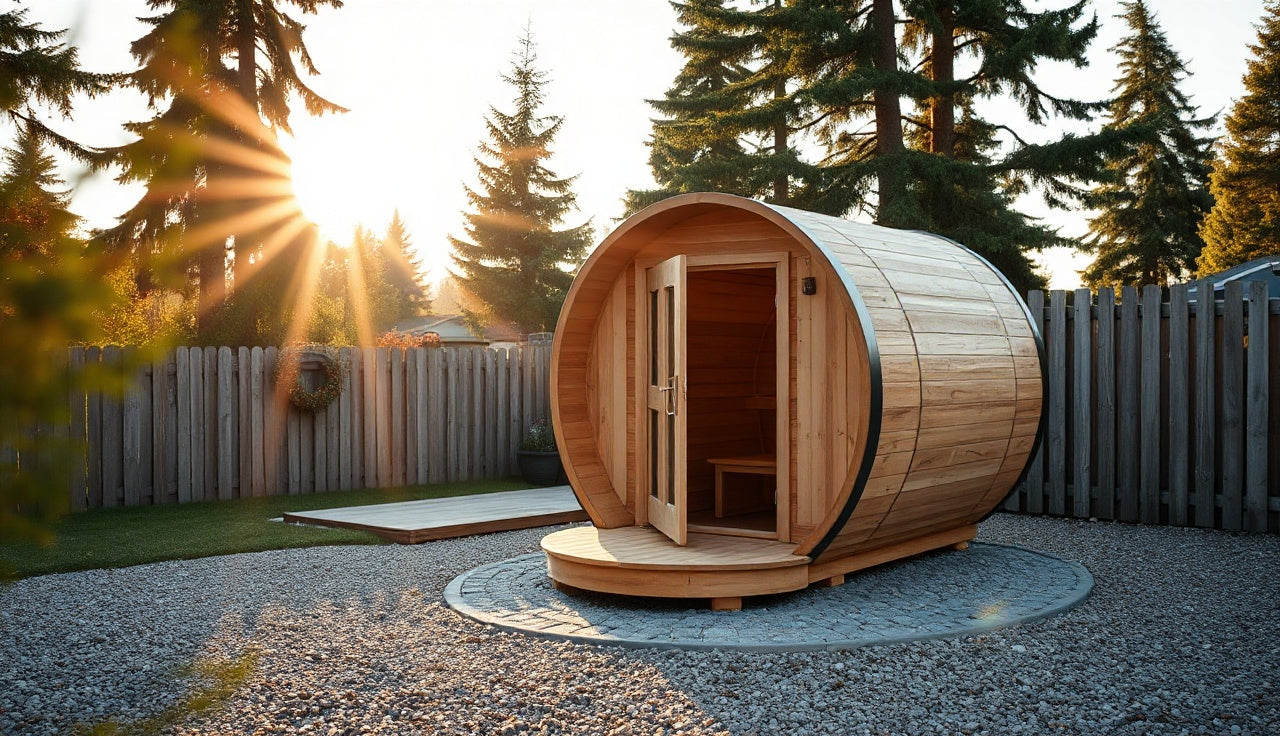
A DIY barrel sauna kit runs $1,200 to $2,500 for the wood and hoops, plus $500 to $1,500 for a heater, plus a concrete pad or gravel base ($200 to $600). Call it $2,000 to $4,500 all in for most people [1].
A framed indoor sauna room, built in a basement or spare bathroom, costs more in materials but saves the exterior work. Expect $800 to $2,000 in lumber, insulation, and vapor barrier, $400 to $900 in tongue-and-groove cedar for the interior, and $600 to $2,500 for the heater. Add electrical rough-in ($200 to $800 if you DIY, $500 to $1,500 if you hire) and you land at $2,000 to $7,000 depending on size and finish quality [1].
Prefab modular saunas ship as pre-cut panels you assemble in a few hours. They run $2,500 to $8,000 before shipping. Quality varies a lot. Entry-level units from big-box stores use thinner wood and cheaper heaters, while purpose-built sauna brands use 1.5-inch Nordic spruce or western red cedar and proper Harvia or Huum heaters.
The biggest cost driver, outside of size, is the heater. A quality 6kW to 8kW electric sauna heater from a Finnish manufacturer costs $500 to $1,200. Cheap sub-$300 heaters frequently fail within two to three years and don't hold temperature well in colder climates.
| Build type | Materials | Heater | Electrical/labor | Total range |
|---|---|---|---|---|
| DIY barrel kit | $1,200 to $2,500 | $500 to $1,500 | $200 to $600 (pad) | $2,000 to $4,500 |
| DIY indoor room (framed) | $1,200 to $2,900 | $600 to $2,500 | $200 to $1,500 | $2,000 to $7,000 |
| Prefab panel kit | $2,500 to $8,000 | included | $200 to $600 | $2,700 to $8,600 |
| Prefab, professional install | $5,000 to $15,000+ | included | included | $5,000 to $15,000+ |
These ranges come from contractor cost databases and manufacturer price lists as of 2024 to 2025 [1][2]. Your local electrical costs alone can swing the total by $1,000.
| DIY barrel kit (entry) | $2,000 |
| DIY barrel kit (quality) | $4,500 |
| DIY indoor framed room (entry) | $2,000 |
| DIY indoor framed room (quality) | $7,000 |
| Prefab panel kit (entry) | $2,700 |
| Prefab panel kit (premium) | $8,600 |
| Prefab, professional install | $15,000 |
Source: Angi / HomeGuide cost databases, 2024
What kind of wood should you use for a homemade sauna?
Use a low-density softwood with minimal resin: western red cedar in North America, or Nordic spruce and aspen if you can source them. The interior of a sauna cycles from ambient temperature up to 170 to 195°F and back, repeatedly. Woods that stay relatively cool to the touch, resist cracking, and don't weep sticky resin at high heat are the ones that hold up.
Western red cedar is the most popular choice in North America. It's naturally rot-resistant, smells good, stays cool to the touch, and is available at most lumber yards in 1x4 tongue-and-groove. The U.S. Forest Service notes cedar's natural rot resistance and low thermal conductivity make it well suited to high-heat, moisture-exposed applications [12]. The downside is cost: prices spiked after 2020 and clear vertical-grain cedar runs $3 to $6 per linear foot depending on your region.
Nordic spruce and aspen are the Finnish standard. Aspen has almost no resin, which is why it lines benches in commercial saunas across Scandinavia. It's harder to find in the US but available through specialty suppliers. Nordic spruce is a reasonable middle ground: lower resin than American pine, widely available, and cheaper than cedar.
Avoid pressure-treated lumber anywhere inside the sauna. The preservatives (historically arsenic-based, now copper-based) off-gas at high temperatures and are not safe to breathe. Skip construction-grade pine with visible knots too: knots are resin pockets that weep at sauna temperatures.
For the exterior of an outdoor barrel or cabin-style sauna, you have more room to work. Cedar, redwood, and thermally modified wood (heat-treated to improve stability and rot resistance) all hold up well. Thermally modified pine or ash runs cheaper than cedar and does well in wet climates.
For the frame and substructure, regular 2x4 or 2x6 construction lumber is fine. The interior cladding is what matters for heat and safety.
Do you need a permit to build a backyard or indoor sauna?
Probably yes, for anything permanent. Requirements vary by municipality, but a few rules hold almost everywhere in the US. Any sauna on a permanent foundation is usually treated as an accessory structure, and any sauna with a 240V circuit needs an electrical permit.
An outdoor sauna on a permanent foundation (concrete pad, deck footings, or similar) counts as an accessory structure in most codes. Many jurisdictions require a building permit once the structure exceeds 120 to 200 square feet, and some require one for any enclosed structure regardless of size. Check your local zoning code for setbacks too: most residential zones require 5 to 10 feet from property lines.
Any sauna that needs a dedicated 240V circuit (which is almost all of them, since most heaters draw 30 to 60 amps) needs an electrical permit and inspection. This is non-negotiable in most US jurisdictions. Skip it and you create real liability problems, because unpermitted electrical work voids most homeowner's insurance in a fire or damage claim [4].
An indoor sauna built inside your existing home's footprint often triggers a permit if you're altering the space (adding a drain, running new circuits, or modifying insulation). A simple room conversion where you're only adding interior cladding may not.
The fastest path: call your local building department before you buy materials. A five-minute conversation saves you from tearing out finished work. Many counties post their permit thresholds online.
In Canada, provincial building codes apply and run generally similar to US requirements. In the EU, national codes vary, but most treat outdoor saunas as garden structures with permitting thresholds based on floor area.
What heater do you need for a homemade sauna?
For a traditional Finnish sauna you want an electric stove that heats rocks (a kiuas), sized at roughly 1 kW per 45 cubic feet of room volume. Get the heater wrong and nothing else matters. This is the one component worth spending on.
The rocks store thermal mass and let you pour water to create löyly, the burst of steam that raises perceived temperature without heating the air much. A stove without a rock tray produces dry heat and misses the whole point.
Sizing is straightforward. The standard rule is 1 kW per 45 cubic feet of room volume, with an upward adjustment for exterior walls, glass, or poor insulation [5]. A 6x8x7-foot interior space is 336 cubic feet, so you need roughly 7.5 kW. Round up to an 8 kW unit.
Finnish brands (Harvia, Huum, Narvi, Tylö) run the quality tier. Harvia's KIP series costs $500 to $900 and has a solid track record. Huum's Drop is better looking and costs $900 to $1,400. For a DIY build, either works well.
Wood-burning sauna stoves are legal in most US states for outdoor use and produce the most authentic heat. They need a proper chimney and clearances (typically 18 inches from combustibles per NFPA 211 [6]), and most jurisdictions prohibit them indoors in residential buildings. They also heat unevenly compared to electric until you learn to manage the fire.
Infrared heaters are a different category. They don't heat the air to traditional sauna temperatures (they typically run 120 to 140°F versus 150 to 195°F for Finnish saunas) and don't work with water for löyly. They're easier to install (plug-in 120V units exist) but they deliver a fundamentally different experience. Worth knowing if that's what you want, but don't buy an infrared heater expecting a Finnish sauna.
For a home sauna of any type, budget at least $500 for the heater. The $199 units on Amazon are a bad bet for a structure you're putting real money into.
How do you insulate and ventilate a homemade sauna room?
Insulation and ventilation are the two things DIY sauna builders most often get wrong, and both affect safety before comfort. The room needs a vapor barrier on the interior side of the insulation, plus a low fresh-air intake near the heater and a high exhaust vent on the opposite wall.
For insulation: a sauna room needs a vapor barrier on the warm side (facing the interior), then insulation, then the wall structure. The vapor barrier keeps moisture from migrating into the wall cavity and rotting the framing. Use 6-mil polyethylene sheeting and tape the seams carefully. Foil-faced foam board (polyisocyanurate) works well as a combined vapor barrier and insulation layer and installs more easily in small spaces than fiberglass batts.
The ceiling needs the most insulation because heat rises. Aim for R-26 to R-30 in the ceiling and R-13 to R-19 in the walls for a heated space in a temperate climate. In cold climates, go higher.
Ventilation is not optional. The Finnish Sauna Society specifies a fresh-air intake low on one wall (near the heater) and an exhaust vent high on the opposite wall or ceiling [8]. That layout creates convective circulation and keeps oxygen from depleting. A single 4-inch vent with an adjustable damper on each end handles a small room. Without it, the room gets stuffy fast and long sessions turn uncomfortable and potentially unsafe.
The floor should not be sealed airtight. Traditional sauna floors use wood slats over a drain, or tile with a floor drain. The floor stays cooler than the air and drains rinse water. If you're building in a basement, a simple floor drain earns back the extra plumbing cost.
Door selection matters too. Use a solid wood or glass door with no exposed metal hardware on the interior (metal burns skin). Sauna-specific doors with wood handles and tempered glass run $200 to $500 from most sauna suppliers.
Can you build a barrel sauna yourself without professional help?
Yes. A barrel sauna is the most accessible DIY sauna project for most homeowners, and it's what I'd recommend for anyone who wants to build rather than buy. The only step that trips people up is running the 240V circuit, and you can hire that out.
The barrel shape is structurally self-supporting: the hooped staves hold each other in compression, the same principle as a wine barrel. No framing, no drywall, no insulation. You pour or compact a gravel base or concrete pad, assemble the staves per the kit instructions, tighten the galvanized bands, install the heater, and run power.
A typical 6-foot-diameter, 7-foot-long barrel kit comes with pre-cut and pre-matched cedar staves, end walls, bands, benches, and a door. Assembly takes two people one full day, or one person two days. The hardest part is getting the base level.
The trade-offs: barrel saunas lose heat faster than well-insulated room saunas in very cold climates, because the curved wall has more surface area relative to volume and there's no insulation layer. In Minnesota winters, plan on a bigger heater and a longer preheat. In mild climates, this isn't a problem.
For a portable sauna alternative that skips construction entirely, fabric tent-style saunas exist in the $100 to $400 range. They work, but they deliver a much less satisfying experience and rarely last more than a few years with regular use.
The barrel kit route is genuinely achievable for anyone comfortable with basic tools, a level, and a tape measure. You don't need carpentry experience. You do need to be comfortable running a 240V circuit or willing to hire an electrician for that one step.
How do you wire the electrical for a homemade sauna?
Almost every sauna heater over 2 kW runs on 240V, and most residential heaters draw between 20 and 60 amps. That means a dedicated circuit, correct wire gauge, and GFCI protection. This is the one part of a sauna build where mistakes have real consequences.
A 6 kW heater at 240V draws 25 amps. The National Electrical Code requires the circuit be sized at 125% of continuous load, so that's a 30-amp circuit minimum, with 10 AWG wire [9]. An 8 kW heater at 240V draws about 33 amps, which calls for a 40-amp breaker and 8 AWG wire.
For outdoor saunas or sauna rooms with a shower or steam, GFCI protection is required under NEC Article 680 (wet locations) and most local amendments [9]. A GFCI breaker at the panel is the cleanest way to handle it.
The thermostat and timer control usually mounts outside the sauna room on the exterior wall so it doesn't overheat. Most quality heaters come with an external control unit. Don't mount the controller inside the hot room.
If you're not comfortable with panel work, hire a licensed electrician for the circuit alone. Materials run $150 to $400; labor adds $300 to $700 typically. Money well spent.
Always pull the electrical permit. The inspection is a free second set of eyes on your wiring, and unpermitted electrical work voids most homeowner's insurance in a fire or damage claim [4].
How hot does a homemade sauna need to get, and how long does it take to heat up?
Traditional Finnish saunas run between 150°F and 195°F (65 to 90°C) at bench level, and a properly sized heater reaches 170°F in 30 to 45 minutes from cold. The air near the floor sits cooler, around 100 to 120°F, which is why you climb up and sit high.
The World Health Organization notes that humans tolerate these temperatures because the dry air (and the löyly steam cycle) lets sweat evaporate and cool the skin efficiently [10]. Poor insulation, an undersized heater, or very cold ambient temperatures (an unheated garage in January) can stretch preheat to 60 to 90 minutes.
The temperature sensor placement matters. Put it on the wall about 6 inches below the ceiling near the top bench. That's what your body actually feels. A thermometer on the floor reads much lower and gives you a false sense of the room's state.
Infrared saunas target surface warming rather than air temperature and operate at 120 to 140°F. They heat up in 10 to 15 minutes. Different physiology, different experience.
For sauna benefits, the research (primarily Finnish population studies and cardiovascular work from Jari Laukkanen's group at the University of Eastern Finland) generally uses sessions of 15 to 20 minutes at temperatures around 175°F [11]. If your homemade sauna can't reliably reach 160°F, you may not be recreating the conditions those studies describe.
What are the best wood choices and layouts for the interior benches?
Aspen is the gold standard for benches, with clear western red cedar and thermally modified wood as the practical runners-up. You spend your entire session on the benches, so the wood needs to stay smooth, cool to the touch, crack-resistant, and mold-resistant.
Aspen is light-colored, extremely low in resin, and doesn't get hot enough to burn skin even at 190°F. It's less common in North American lumber yards but available from sauna suppliers.
Clear western red cedar works well and is easier to source. Thermally modified wood (specifically modified pine or alder) is a growing alternative: the process drives out resins and improves stability, and it tends to stay cooler than untreated wood.
Avoid oak, pine, and most tropical hardwoods for benches. Oak and hardwoods conduct heat too well and can burn you. Pine weeps resin.
For layout, the standard two-tier configuration puts a lower bench about 18 inches off the floor and an upper bench 36 to 42 inches up. The upper bench gets much hotter thanks to stratification. In a small room (4x6 feet or less), a single L-shaped bench that lets you lie flat is often more practical than two tiers.
Bench construction uses 2x4 clear cedar or aspen boards with quarter-inch gaps between them for drainage and airflow. Pre-drill all holes to prevent splitting. Don't use exposed metal screws: go with stainless steel or, better, wooden pegs or hidden fasteners, because exposed metal gets hot enough to brand skin.
SweatDecks carries several prebuilt interior bench kits sized for common room dimensions if you want to skip the fabrication step and focus on the structure.
How does a homemade sauna compare to a prefab or commercial unit?
A well-built DIY sauna using quality materials can match or beat a mid-range prefab on performance. The prefab wins on convenience and a predictable outcome. The DIY wins on cost and customization.
The main risk of DIY is insulation and vapor barrier mistakes. A prefab panel kit from a reputable sauna brand ships with the vapor barrier already laminated to the panels, which removes one of the biggest failure points. That's real value.
A prefab from a discount retailer (think Costco or Amazon private-label units) often uses thinner wood (3/4-inch versus 1.5-inch panels), lower-wattage heaters, and thinner insulation. The Costco sauna units are fine as starter products but don't last 15 to 20 years the way a purpose-built structure does.
If you're serious about sauna as a long-term practice, the math on building well from the start beats buying cheap and replacing in five years. A DIY room sauna built with 2x6 framing, a proper vapor barrier, 1.5-inch tongue-and-groove cedar, and a Harvia heater will still be running in 20 years.
For more on the broader sauna landscape, our guide to outdoor saunas covers siting and weatherproofing, and the sauna vs steam room comparison covers whether a steam setup fits you better.
The short version on homemade versus prefab: if you can follow instructions and run basic tools, build it. If you want it done in a day with minimal decisions, buy a panel kit from a quality brand.
Is it safe to use a homemade sauna, and what are the real risks?
A well-built sauna used responsibly is safe for most healthy adults. The risks are real but manageable, and they cluster in a few predictable places: dehydration, cardiovascular stress, and (in a DIY build) electrical and fire hazards.
Dehydration and overheating are the most common problems. A typical session causes 0.5 to 1.0 kg of fluid loss through sweat [10]. Hydrate before and after, keep sessions under 20 minutes at high temperatures, and cool down between rounds. That handles most of it.
Cardiovascular stress is real. Blood pressure drops during sauna use as blood vessels dilate. People with uncontrolled hypertension, recent cardiac events, or severe aortic stenosis should get physician clearance before regular use [11]. The Finnish cardiovascular data generally shows benefit for healthy adults with regular use, but the study populations were not people with active cardiac disease.
Electrical safety in a DIY build is where homemade saunas actually go wrong. A 240V circuit near wood and moisture is a fire risk if wired incorrectly. GFCI protection, proper wire gauge, and a permit inspection address this. Don't skip the inspection.
Fire clearance for wood-burning stoves calls for 18 inches from combustibles, a UL-listed stove, and an insulated chimney [6]. Wood-burning stoves indoors are generally a bad idea for a DIY builder without experience.
For anyone pairing sauna sessions with cold water immersion, the cold plunge article covers contrast therapy protocols. The combination is popular and the physiological rationale is reasonable, though the research base for the specific pairing is thinner than the sauna-only literature.
Pregnant women, young children, and people on certain medications (diuretics, some antihypertensives, alcohol) should be especially cautious. This is not medical advice: talk to your doctor before starting a regular sauna practice if you have any underlying conditions.
What is the realistic timeline for a homemade sauna project?
Most DIY sauna builds take two to six weekends of actual work, but the calendar runs six to eight weeks once you factor in permits and inspections. Start with the permit application, not the lumber order.
Week one is planning and permits. Draw a simple floor plan, calculate materials, submit the permit application. Many municipalities take two to four weeks to issue permits, so this is the first thing to do.
While you wait, order your heater and hardware. Heaters from Finnish brands often ship from overseas or from US warehouses with one to three week lead times. Running out of framing lumber mid-project is annoying; sitting on a finished room for three weeks waiting on a heater is worse.
Actual construction for a DIY indoor room: one weekend for framing and vapor barrier, one weekend for insulation and interior cladding, one weekend for benches and door, then the electrical inspection and final hookup. Call it three to four build weekends.
A barrel kit is faster: one weekend for the base, one day for assembly, a few hours for the heater once power is run.
The slowest part of almost every DIY sauna project is waiting for the permit and the electrical inspection. Plan for six to eight weeks total from decision to first session if you're doing everything correctly.
Don't let the timeline talk you out of doing it right. An unpermitted sauna complicates a home sale, may not be covered by insurance, and skips the safety check on the electrical work.
Frequently asked questions
How much does it cost to build a homemade sauna?
Costs range from about $2,000 for a basic DIY barrel kit to $7,000 or more for a framed indoor room with quality materials and a proper Finnish heater. The heater alone accounts for $500 to $2,500 of that, and electrical work adds $200 to $1,500 depending on whether you DIY or hire out. Discount prefab units from big-box stores start around $1,500 but use thinner wood and lower-quality heaters.
What is the cheapest way to build a homemade sauna?
The cheapest functional sauna is a small (4x6 foot) indoor room conversion using a spare closet or bathroom, framed with 2x4s, lined with foil-faced foam board as vapor barrier and insulation, finished with 1x4 clear cedar, and heated with a 4 to 6 kW electric heater. Total materials can come in under $1,500 if you do all the labor and source lumber from a regional yard. A 120V plug-in infrared unit is cheaper still but produces a very different experience.
Do I need a permit to build a sauna in my backyard?
Almost certainly yes for any permanent structure. Most US municipalities require a building permit for enclosed accessory structures, especially those over 120 to 200 square feet, and always require an electrical permit for a 240V circuit. Skipping permits can void your homeowner's insurance and create problems at resale. Call your local building department before starting; the conversation takes five minutes.
What type of wood is best for a DIY sauna?
Western red cedar is the most practical choice in North America: low resin, naturally rot-resistant, widely available in tongue-and-groove profiles, and cool to the touch at sauna temperatures. Aspen is the Finnish standard for benches specifically because it has almost no resin and stays coolest. Avoid pressure-treated lumber and knotty pine inside the hot room; both release harmful compounds or sticky resin at high heat.
Can I use an outdoor shed as a sauna?
Yes, an existing shed is one of the most practical bases for a backyard sauna conversion. You'll need to add a vapor barrier and insulation on the interior walls and ceiling, replace or line the floor with wood slats or tile over a drain, install a sauna door, and run power for the heater. The shed's existing frame and roof save real time and material cost versus building from scratch. Confirm the structure is solid and level first.
How long does it take to heat a homemade sauna?
A properly sized heater in a well-insulated room reaches 170°F in 30 to 45 minutes from a cold start. Poor insulation or an undersized heater in a cold garage can push that to 90 minutes. Infrared saunas heat up in 10 to 15 minutes but operate at lower temperatures (120 to 140°F). Place the temperature probe near the ceiling at the upper bench level for an accurate reading of what you'll actually feel.
What size sauna should I build at home?
A 4x6 foot interior is the practical minimum for two people sitting upright. A 6x8 foot room lets two people lie down or four sit comfortably and is the most common home sauna size. Bigger is not always better: a larger room needs a more powerful heater, more materials, and a longer preheat. Size the room for your real usage pattern, not for the occasional large gathering.
What is the difference between a DIY sauna and a prefab sauna kit?
A DIY sauna is built from raw lumber and components you source separately. A prefab kit ships as pre-cut, pre-matched panels you assemble without cutting. Prefabs are faster (often one day), use pre-laminated vapor barriers, and come with matched hardware. DIY is cheaper and more customizable but takes more skill and time. Quality prefabs from sauna-specific brands outperform cheap big-box kits, even though both get called 'prefab.'
Can I build a sauna without any carpentry experience?
A barrel kit is genuinely achievable without carpentry experience: it's mostly bolting and tightening hardware, not cutting and fitting wood. A framed room sauna needs basic carpentry skills (measuring, cutting straight lines, hanging a door) but is well within reach for most people who've done home improvement projects. The electrical work is the one area where lack of experience causes real problems; hire an electrician for the circuit if you're not confident.
Is it safe to build a wood-burning sauna at home?
Wood-burning stoves are safe outdoors with proper installation: a UL-listed stove, 18 inches of clearance from all combustibles, and a correctly installed insulated chimney. Most US building codes prohibit wood-burning sauna stoves inside residential structures. For a first DIY sauna, an electric heater is simpler and safer. Save the wood-burning option for a dedicated outdoor cabin-style structure where you can install the chimney correctly.
How do I ventilate a homemade sauna properly?
A sauna room needs a fresh-air intake low on one wall (near the heater) and an exhaust vent high on the opposite wall or ceiling. This convective loop keeps oxygen levels safe and stops the room from getting stuffy. A 4-inch vent with an adjustable damper on each opening is enough for rooms up to 8x10 feet. Without proper ventilation, even a well-heated sauna turns uncomfortable and potentially dangerous within 15 to 20 minutes.
Should I pair my homemade sauna with a cold plunge?
Contrast therapy (alternating heat and cold) is popular and the physiological rationale is solid: sauna dilates blood vessels and raises core temperature, cold immersion constricts vessels and triggers a different recovery response. The research on the specific combination is less developed than on each therapy individually, but many athletes report better recovery and mood. If you're interested, the cold plunge and ice bath guides cover home setup options.
What electrical requirements does a homemade sauna need?
Most electric sauna heaters need a dedicated 240V circuit. A 6 kW heater needs a 30-amp circuit with 10 AWG wire; an 8 kW heater needs 40 amps and 8 AWG wire. The National Electrical Code requires GFCI protection in wet or sauna locations. The heater control and timer should mount outside the hot room. Always pull an electrical permit; the inspection is the safety net for a circuit in a wood structure.
How long does a homemade sauna last?
A well-built sauna using quality wood, a proper vapor barrier, and a Finnish-brand heater should last 20 to 30 years with basic maintenance. The heater elements may need replacement every 10 to 15 years. Cheap prefab units with thin walls and budget heaters often show degradation in five to seven years. Annual maintenance is minimal: check the vapor barrier for tears, sand rough bench surfaces, and confirm vent dampers move freely.
Sources
- HomeAdvisor / Angi: Sauna Installation Cost Guide: DIY sauna material and installation cost ranges by project type, 2024 estimates
- HomeGuide: Sauna Cost Guide: Prefab and custom sauna cost ranges including heater and electrical
- U.S. Department of Housing and Urban Development: Accessory structures and electrical circuits require local building permits; unpermitted work affects insurance and resale
- Harvia: Sauna Heater Sizing Guide: Recommended heater sizing is approximately 1 kW per 45 cubic feet of sauna room volume, adjusted for insulation and exterior walls
- NFPA 211: Standard for Chimneys, Fireplaces, Vents, and Solid Fuel-Burning Appliances: 18-inch clearance from combustibles required for solid-fuel appliances; proper UL-listed chimney required for wood-burning installations
- Finnish Sauna Society: Sauna Construction Guidelines: Sauna rooms require a fresh-air intake at floor level near the heater and an exhaust vent on the opposite wall near the ceiling for safe ventilation
- NFPA 70: National Electrical Code (NEC) Articles 210 and 680: Dedicated 240V circuits must be sized at 125% of continuous load; GFCI protection required in wet locations including sauna rooms
- World Health Organization: Heat and Health: Traditional Finnish saunas operate at 65–90°C (150–195°F); typical session causes 0.5–1.0 kg fluid loss through perspiration
- Laukkanen JA et al., JAMA Internal Medicine 2015: Association Between Sauna Bathing and Fatal Cardiovascular and All-Cause Mortality Events: Finnish population study found frequent sauna use (4–7 times per week, 15–20 minutes, ~175°F) associated with reduced cardiovascular mortality in healthy adults; people with active cardiac disease were not the study population
- U.S. Forest Service: Wood as a Building Material: Western red cedar has natural rot-resistance and low thermal conductivity, making it suitable for high-heat and moisture-exposed interior applications

Share:
What are the benefits of a sauna? The evidence explained
Mini sauna for home: what to know before you buy