
Last updated 2026-07-09
TL;DR
An infrared sauna mat is a portable, mat-shaped far-infrared (FIR) heater you lie on at home. Mats reach surface temperatures of 130 to 160°F and cost $100 to $1,200 depending on size and EMF shielding. The research on FIR heat is promising but thin, and a mat gives you a gentler, more accessible heat session than a sauna cabin, never an equal one.
What exactly is an infrared sauna mat?
An infrared sauna mat is a padded, flexible panel with heating elements inside that emit far-infrared (FIR) radiation, meaning electromagnetic energy in the 3 to 1000 micrometer wavelength range. Unlike a traditional or portable sauna, a mat has no enclosure. You lie on it. The infrared energy goes into your skin surface directly, warming tissue without heating the surrounding air first.
The practical effect is strange the first time you feel it. The mat's surface might sit at 140°F while the air around you stays at room temperature. That is the core difference between a sauna mat and every other sauna format, including the full-cabin home sauna most people picture. You get direct radiant heat, not convective heat soaking through an enclosed room.
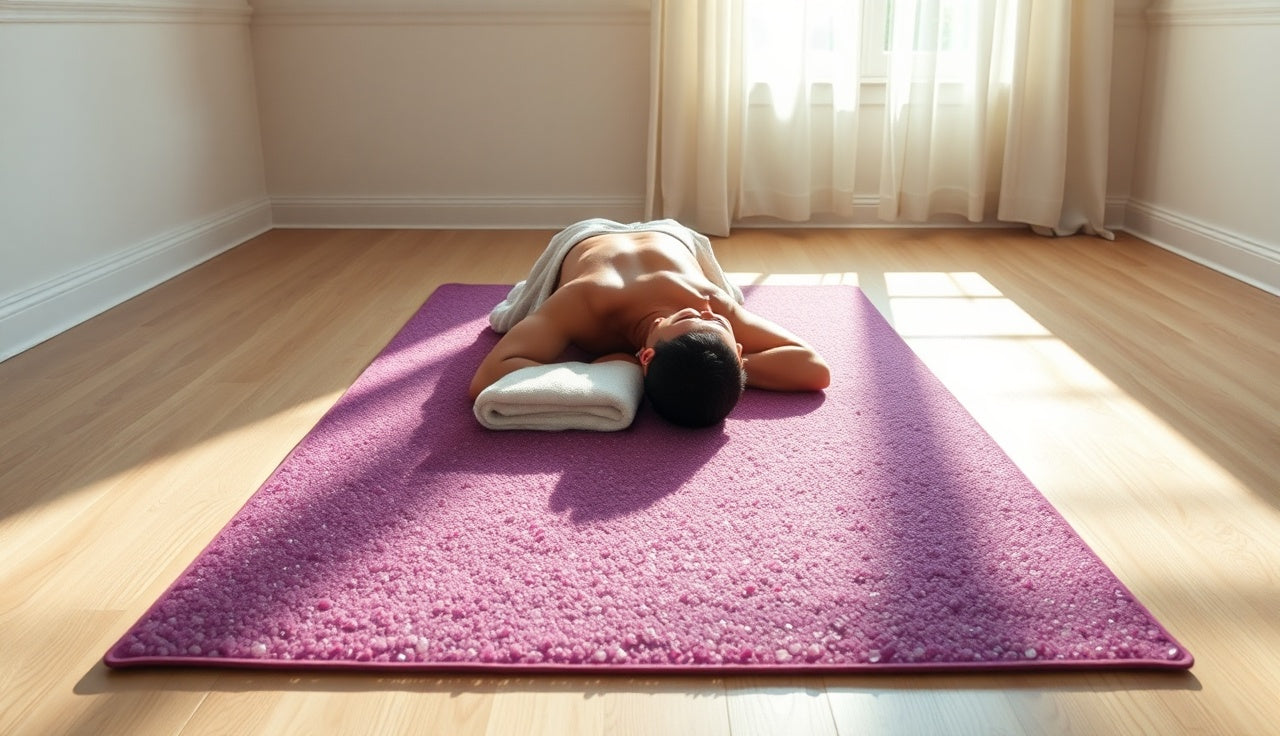
Most mats stack several materials. From the bottom up, you typically have a waterproof shell, an EMF-shielding layer (more on that shortly), heating coils or carbon fiber panels, a layer of natural crystals such as amethyst, tourmaline, or jade, and a top cover. The crystals turn the electrical heat into far-infrared emission more efficiently than bare metal coils would. Amethyst is the most common. Some manufacturers claim it also throws off negative ions, though the evidence for that at mat-surface distances is thin.
Mats come in three basic sizes. Small runs roughly 20 x 32 inches and covers the torso and upper legs. Medium runs about 24 x 60 inches and covers the full body lying down. Extra-large goes up to 31 x 71 inches with pillow sections and full-body coverage. Small mats start around $100 to $200. Full-body therapeutic-grade mats from brands with independent safety certifications run $500 to $1,200 [1].
How does far-infrared heat actually work in the body?
Far-infrared radiation gets absorbed by water molecules in your tissue, making them vibrate and produce heat from inside the tissue rather than from the skin surface inward. Penetration depth is commonly cited as 1.5 to 2 inches (roughly 4 cm), though that figure comes from studies on mid-infrared wavelengths, and the exact tissue depth for FIR in the 8 to 12 micrometer range is still argued over in the literature [2].
What is clearer: FIR heat raises core body temperature, which sets off the same thermoregulatory response as any other sauna. Heart rate climbs. Peripheral blood vessels widen. Sweat glands switch on. A 2015 systematic review in Complementary Medicine Research found that repeated far-infrared sauna sessions were linked to modest drops in blood pressure and better vascular function in people with cardiovascular risk factors, though the authors flagged that study populations were small and controls were inconsistent [3].
The gap between lying on a mat and sitting in a full sauna cabin is the size of the thermal challenge. A traditional Finnish sauna runs 160 to 200°F ambient air. A far-infrared cabin runs 120 to 150°F ambient. A mat does not heat the ambient air at all. So the cardiovascular and sweating stimulus from a mat is real, but it is genuinely milder than a cabin session of the same length. That mildness suits some people well: those who find a cabin claustrophobic, those with lower heat tolerance, and those who want a long, low-key session during sleep or while reading.
A 2009 study in the Journal of Cardiac Failure found that repeated far-infrared sauna therapy in chronic heart failure patients improved exercise tolerance and lowered brain natriuretic peptide levels. The catch: the researchers used a purpose-built far-infrared cabin at 60°C (140°F) for 15 minutes a session, not a mat [4]. Using that study to sell a mat is a stretch. The underlying FIR mechanism, though, is the same.
What are the real benefits of an infrared sauna mat?
The honest answer breaks into three buckets: some benefits are well-supported, some are plausible, and some are marketing.
Well-supported by evidence: heat-driven cardiovascular response (higher heart rate, peripheral vasodilation), sweat production, and short-term muscle relaxation from warmth. These are basic physiology, not mat-specific claims. Raise your core temperature and you get them.
Plausible but not mat-specific: the blood pressure and vascular improvements seen in FIR sauna studies [3][4] are likely real for consistent users. Those studies used cabin saunas, not mats. Extrapolating to a mat is reasonable, not confirmed.
Commonly claimed, poorly supported at mat-level doses: heavy metal detox through sweat. Sweating does excrete trace amounts of some metals, but sweat is a minor exit route. Your kidneys and liver handle the overwhelming majority of toxin elimination. A 2011 review in the Journal of Environmental and Public Health found that sweat analysis is unreliable for toxin monitoring and that sweat excretion of metals varies wildly between individuals [5]. Use a mat because it feels good and may improve circulation. Do not count on it to detox anything.
Access is a benefit people undervalue. A mat folds up, slides under a bed, and hits working temperature in about five minutes. For someone renting an apartment who can't build a cabin, a mat is the only practical FIR option. Set against the full sauna benefits of a built cabin, a mat is a compromise. A very convenient, affordable compromise.
Sleep is the underrated use case. Some people run a mat at low temperature (100 to 110°F) for 20 to 30 minutes before bed. The body's cooling rebound after the session may help you fall asleep faster, which mirrors the mechanism behind warm baths shortening sleep latency in adults [6].
What should you look for when buying an infrared sauna mat?
Five things matter more than brand name or marketing copy.
First: EMF levels. Electrical heating elements produce electromagnetic fields (EMF). The units that matter are milligauss (mG) for magnetic fields and volts per meter (V/m) for electric fields. Lying directly on the mat puts you very close to the source. Quality mats have a shielding layer and publish third-party test results showing magnetic fields below 3 mG and electric fields near zero at body contact. The International Commission on Non-Ionizing Radiation Protection (ICNIRP) sets a general public guideline of 200,000 mG for magnetic fields, which no mat comes anywhere near, but "low EMF" matters to plenty of buyers, and a well-shielded mat comes with independent test reports you can request [7]. If a company can't hand those over, walk away.
Second: certifications. Look for UL listing (electrical safety), CE mark (EU standard), RoHS compliance (restricts hazardous substances), and, for the PEMF function if it's included, FDA registration as a Class II device. The FTC has sent warning letters to companies making unsupported health claims about infrared devices, so you want a manufacturer that clearly understands its regulatory obligations [13].
Third: crystal type and layer construction. Amethyst, tourmaline, and jade are the three standard crystals. Amethyst produces FIR most consistently in independent tests. Tourmaline shows up because it reportedly emits negative ions, though consumer mats do not approach the ion output of clinical ionizers. Jade appears in some traditional Korean hot stone therapies (ondol-style). All three emit FIR fine. Construction density matters more than crystal type: how many pounds of crystal per square foot, and whether the crystals are natural or synthetic.
Fourth: temperature range and controller precision. A good mat has a digital controller, more than a dial, and holds temperature within a few degrees of the set point. A range of 95 to 160°F covers most use cases, from gentle warming to a real sweat session.
Fifth: warranty and return policy. Budget mats often ship with 90-day warranties. Reputable brands give one to three years on the heating elements and controller. A mat with a dead heating strip is expensive to fix, and warranty coverage is the line between a $200 paperweight and a working product.
One more thing: weight. A full-body mat with multiple crystal layers can weigh 18 to 30 pounds. If you plan to store it under your bed and drag it out daily, that weight adds up fast.
How much does an infrared sauna mat cost?
Prices sort into three real tiers, from about $100 at the bottom to $1,200-plus at the top.
| Tier | Typical price range | What you get | What you give up |
|---|---|---|---|
| Budget | $100 to $300 | Single-zone heat, basic controller, limited EMF shielding, short warranty | Independent certifications, consistent crystal density, support |
| Mid-range | $300 to $600 | Better EMF shielding, digital controller, 1-year warranty, some certifications | PEMF layer, premium crystal weight, extended warranty |
| Professional / therapeutic | $600 to $1,200+ | Full-body coverage, PEMF + FIR combo, independent EMF test reports, 2 to 3 year warranty, higher crystal density | Portability (heavier), significant upfront cost |
The mid-range tier at $300 to $600 is where most honest reviewers land when recommending a first mat. The budget tier carries more quality-consistency risk. The premium tier's PEMF (pulsed electromagnetic field) function is a feature with its own separate evidence base that not everyone needs.
For comparison: a decent entry-level far-infrared cabin (two-person) costs $1,500 to $3,000, eats 50-plus square feet, and needs a dedicated 20-amp circuit [9]. A mat at $400 is not the same experience. It is a fraction of the footprint and cost. If you want to work through the full cabin route first, the home sauna and outdoor sauna guides on this site walk that territory in detail.
| Budget (basic FIR, minimal shielding) | $200 |
| Mid-range (digital control, EMF shielding, 1-yr warranty) | $450 |
| Professional / therapeutic (PEMF + FIR, certified, 2-3 yr warranty) | $900 |
Source: Consumer Reports, sauna and heat therapy product pricing overview
What is the difference between a sauna mat and a sauna blanket?
This question comes up constantly, and the distinction is real.
A sauna blanket wraps around you like a sleeping bag. It encloses your body, so the air inside the blanket heats up too. You get a mix of radiant heat (from the FIR elements in the blanket material) and convective heat (from the trapped warm air). Most people sweat more in a blanket because heat can't escape as easily. Blankets are also harder to clean, since sweat soaks into the interior lining.
A mat lies flat under you. Your back, glutes, and the backs of your legs get direct FIR contact. Your front gets little to no heat unless you flip over, which some protocols do call for. The mat surface wipes down easily, but the thermal load on your body is lower than a blanket delivers.
Neither one is strictly better. If maximum sweating is the goal, a blanket usually wins. If you want to lie flat, do breathwork, read, or drift off to sleep, a mat is more comfortable. Some people split the difference: a mat underneath with a light blanket on top to trap more heat and get closer to the blanket experience without the constriction.
How do you use an infrared sauna mat safely?
Basic protocol: preheat the mat for 10 to 15 minutes before you lie on it. Wear light, breathable clothing or lie on a cotton towel to soak up sweat and cut direct skin contact with the crystal surface, which can be uneven and harder than it looks. Start with 20 to 30 minute sessions at 120 to 130°F if you are new to heat therapy. Work up to 45 minutes at 140 to 150°F over several weeks.
Hydration matters. Sweat losses during a mat session can run 0.5 to 1 liter depending on duration and temperature. Drink 16 to 20 ounces of water or an electrolyte drink before you start, and replace fluids after [10].
Some people should not use a mat without medical clearance: pregnant women, people with active multiple sclerosis (heat sensitivity is a known problem), anyone with an implanted electronic device (pacemakers, cochlear implants), and people with conditions that impair sweating or thermoregulation. The FDA clearance for far-infrared saunas as medical devices applies to the cabin format specifically. Mats are generally sold as wellness products, not medical devices, so talk to your doctor first if any of the above applies to you [8].
Do not run a mat on a foam mattress without a firm pad underneath. Foam can hold heat from the mat in ways that create a fire hazard, and most manufacturers specify use on a firm, flat, heat-tolerant surface. Never leave a mat running unattended or fall asleep with it set above 110°F.
For a cold-therapy pairing: some people alternate mat sessions with a cold plunge or ice bath for contrast therapy. The physiological logic holds (heat dilates blood vessels, cold constricts them), though the evidence base for contrast therapy outcomes is still developing. If that interests you, the cold plunge benefits article has the research breakdown.
How does a sauna mat compare to a full infrared sauna cabin?
Here is the honest comparison.
A full far-infrared cabin heats the ambient air to 120 to 150°F while the FIR panels warm your skin directly. Your entire body sits inside the heat, front and back. Sessions usually run 20 to 45 minutes. Most research on far-infrared health outcomes, including the cardiac and vascular studies, used cabins, not mats [3][4].
A mat heats only the surfaces touching it. Your front side stays in room-temperature air. The thermal challenge is real but clearly lower unless you use a blanket or towel to trap heat on top. Sessions tend to run 30 to 60 minutes because the intensity is lower.
For cardiovascular benefits from heat, a cabin probably produces a stronger dose-response, since the whole-body thermal load is higher. For convenience, cost, and portability, a mat wins every time.
If you have never tried any sauna format and want to find out whether heat therapy is something you'll actually stick with, a mat is a reasonable lower-cost starting point. If you are committed and have the space and budget, a cabin delivers a different, more intense experience. The sauna vs steam room article covers how traditional and infrared cabins differ from each other if that comparison helps.
SweatDecks carries mats and full cabin options side by side, which makes it easier to compare specs without bouncing between manufacturer sites.
What does PEMF mean on sauna mat listings, and do you need it?
PEMF stands for pulsed electromagnetic field therapy. It is a separate technology from FIR heat. PEMF devices send low-frequency electromagnetic pulses into tissue, and the research behind PEMF includes FDA-cleared devices for bone healing (nonunion fractures specifically) plus some evidence for pain and inflammation relief [11].
Here is where buyers get confused. The PEMF in most consumer sauna mats runs at very low intensity compared to the clinical PEMF devices used in the studies. A clinical PEMF device might output 50 to 3,000 microtesla. Consumer mats typically output 3 to 30 microtesla. Whether that lower intensity produces the same tissue effects is not well established.
Do you need PEMF in a mat? Probably not, unless you have a specific reason to think low-intensity PEMF helps you (some people with chronic joint pain or bone-healing needs seek it out). It adds $150 to $400 to the price. For most buyers who mainly want FIR heat, paying a premium for PEMF is speculative spending. If you are genuinely curious about PEMF, look at dedicated PEMF devices instead of treating the mat version as a stand-in for them.
Are infrared sauna mats safe for everyday use?
Daily use at moderate temperatures and durations (30 minutes at 120 to 140°F) appears safe for healthy adults, based on the general tolerance data from FIR sauna research, which ran sessions three to five times a week over multiple weeks without adverse events in the study populations [3][4]. Nobody has published a long-term daily mat study specifically, so there is genuine uncertainty about what "everyday" means at the extreme end.
The practical risk from daily use is more mundane: overheating, dehydration, and skin irritation from sweating straight onto crystal surfaces. A cotton liner, good hydration, and sessions under 45 minutes handle all three. Your skin is a decent signal too. If it stays red and warm for more than 30 to 60 minutes after a session, you went too long or too hot.
For people pairing heat with cold water immersion, the ice bath guide has protocol specifics on timing and temperature. The two modalities work well together when used thoughtfully, ideally on alternating days rather than stacked on the same day if you are new to either.
Long-term, electrical safety is the thing that matters most. Buy from a manufacturer with current UL or IEC certification, inspect the cord and controller for wear every few months, and retire any mat that shows fraying or uneven heat. A cheap mat with a failing heating element is a burn and fire risk.
What do real users report about infrared sauna mats?
This deserves plain honesty. There are no large, independent randomized trials comparing mat users to controls. What exists is a mix of small FIR cabin studies, manufacturer-sponsored surveys, and the kind of community feedback you find on forums and retail review sections.
Common positive reports: less muscle soreness after exercise, better sleep when used before bed, general relaxation, and relief from lower back stiffness. These are plausible outcomes from any heat therapy. They are not mat-specific magic.
Common complaints: the mat is less comfortable than expected (crystal surfaces are uneven), the heat on the back doesn't feel like a sauna (because the front stays cool), the controller dies within a year on budget models, and the product doesn't match the dramatic health claims in the marketing.
The realistic user runs the mat three to five times a week, enjoys 30 to 40 minute sessions, and treats it as a convenient supplement to a recovery or wellness routine. Nobody is curing disease with a mat. People are getting warm, relaxing muscles, and probably improving circulation a little. That is genuinely useful, and it doesn't have to be more than that to justify the purchase for the right buyer.
If you want something closer to the full sauna experience and have the space, look at the portable sauna category, which includes pop-up tent designs that at least wrap some warm air around your body.
Frequently asked questions
How long should I stay on an infrared sauna mat per session?
Start with 20 to 30 minutes at 120 to 130°F for your first few sessions. Once you are comfortable, 40 to 45 minutes at 140 to 150°F is a typical target for experienced users. Longer than 60 minutes at high heat raises dehydration and overheating risk without proportionally more benefit. Drink water before and after every session.
Can an infrared sauna mat help with back pain?
Heat therapy has decent evidence for short-term relief of nonspecific low back pain. A 2006 Cochrane review found heat wrap therapy reduced pain and disability compared to placebo for acute lower back pain. An infrared mat delivers localized heat straight to the lumbar region when you lie on it, which is mechanistically similar. This is pain relief, not treatment of any underlying structural cause.
Do infrared sauna mats really produce EMF, and is that dangerous?
Yes, all electrical heating elements produce EMF. Well-shielded mats typically measure below 3 milligauss magnetic field at body contact distance, far under the ICNIRP public limit of 200,000 milligauss. The practical risk from a properly shielded mat is considered very low. Ask any manufacturer for independent third-party EMF test reports before buying. If they can't provide them, choose a different brand.
What crystals are used in infrared sauna mats and does the type matter?
Amethyst, tourmaline, and jade are the three standard options. All emit far-infrared radiation when heated. Amethyst is the most studied and performs consistently in independent tests. Tourmaline is credited with negative ion emission, though consumer mats don't produce clinically meaningful ion levels. Jade is traditional in Korean thermotherapy. Crystal type matters less than crystal density and overall construction quality.
Can I use an infrared sauna mat every day?
Daily use at moderate temperature and duration (30 minutes at 120 to 140°F) appears safe for healthy adults, based on tolerance data from FIR sauna studies that ran sessions three to five times weekly without adverse events. There is no dedicated long-term daily mat study. Stay hydrated, use a cotton liner to protect your skin, and watch for signs of overheating like prolonged redness or lightheadedness.
Is an infrared sauna mat the same as a sauna blanket?
No. A mat lies flat under you, heating only the surfaces in direct contact. A sauna blanket wraps around your body like a sleeping bag, trapping warm air and heating your front and back at once. Blankets generally produce more sweat because they enclose more body surface. Mats are more comfortable for lying still, easier to clean, and better suited to longer, lower-intensity sessions.
How much does a good infrared sauna mat cost?
Budget mats run $100 to $300 but often lack independent safety certifications and EMF shielding data. The mid-range tier of $300 to $600 is where most well-reviewed options sit, with digital temperature control, better EMF shielding, and a one-year warranty. Professional therapeutic mats with PEMF layers and full certifications run $600 to $1,200. For most buyers, the $300 to $600 range is the practical sweet spot.
What certifications should I look for on an infrared sauna mat?
Look for UL listing or IEC 60335 compliance (electrical safety), CE mark, RoHS compliance for hazardous substance restrictions, and, if the mat includes PEMF, FDA registration as a Class II device. Third-party EMF test reports from an accredited lab matter too. Manufacturer self-certifications without independent lab backing are much weaker evidence of safety.
Can I use an infrared sauna mat if I'm pregnant?
No, not without explicit clearance from your OB or midwife, and most will advise against it. Elevated core body temperature during pregnancy, especially in the first trimester, is associated with increased risk of neural tube defects. The threshold of concern is a core temperature above 102°F (39°C). Any heat therapy that raises core temperature meaningfully should be avoided during pregnancy.
Does an infrared sauna mat actually make you sweat as much as a regular sauna?
Usually less. A traditional sauna at 180°F or an infrared cabin at 140°F ambient heats your entire body, including your front, sides, and the air you breathe. A mat heats only the surfaces touching it, so your front stays at room temperature. You will sweat, especially with a towel or blanket on top, but total sweat volume and cardiovascular challenge run lower than a full cabin session of the same length.
Can I use an infrared sauna mat for weight loss?
The weight you drop during a mat session is almost entirely water from sweat, and it returns when you rehydrate. Fat metabolism from a single heat session is negligible. Some studies on regular sauna use show modest links to metabolic health markers over time, but none establish fat loss from sauna use alone. A mat is not a weight loss device. Anyone marketing it that way is overstating the evidence.
What is the difference between near-infrared and far-infrared in a sauna mat?
Far-infrared (FIR) sits in the 3 to 1000 micrometer range and is what almost all sauna mats emit. It gets absorbed by water molecules in superficial tissue and produces gentle, deep-feeling warmth. Near-infrared (NIR, 0.75 to 1.4 micrometers) is used in red light therapy and has a different evidence base built on photobiomodulation. Most sauna mats use FIR only. Some premium mats combine both, but NIR at mat contact distance has limited research behind it specifically.
How do I clean and maintain an infrared sauna mat?
After each session, wipe the surface with a damp cloth and a gentle, non-alcohol cleaner, or wash the removable cover if the mat has one. Always use a cotton towel or mat liner during sessions to soak up sweat and reduce direct skin-to-crystal contact. Store the mat rolled or flat, never folded at sharp angles, to protect the heating elements. Inspect the cord and controller every few months for wear or discoloration.
Sources
- Consumer Reports, Sauna and heat therapy product pricing overview: Infrared sauna mat prices range from approximately $100 for small budget models to over $1,200 for professional therapeutic full-body mats with PEMF.
- NASA Technical Reports Server, Infrared radiation tissue penetration reference: Far-infrared radiation in the 8–12 micrometer range penetrates superficial tissue; depth estimates vary by wavelength and tissue type.
- Complementary Medicine Research, 2015 systematic review of far-infrared sauna and cardiovascular outcomes: Repeated far-infrared sauna sessions were associated with modest reductions in blood pressure and improved vascular function in cardiovascular risk populations; study populations were small and controls inconsistent.
- Journal of Cardiac Failure, Kihara et al. 2009, FIR sauna in chronic heart failure: Repeated far-infrared sauna therapy at 60°C for 15 minutes in chronic heart failure patients improved exercise tolerance and reduced brain natriuretic peptide levels.
- Journal of Environmental and Public Health, Genuis et al. 2011, sweat as a route of toxin excretion: Sweat analysis is unreliable for toxin monitoring and sweat excretion of metals varies enormously between individuals; sweat is not a major detoxification pathway.
- Sleep Medicine Reviews, Haghayegh et al. 2019, warm bath/shower before sleep and sleep onset: Warm baths or showers 1–2 hours before bed were associated with faster sleep onset, likely through passive body cooling afterward.
- International Commission on Non-Ionizing Radiation Protection (ICNIRP), EMF general public exposure guidelines: ICNIRP sets a general public magnetic field guideline of 200,000 milligauss (200 millitesla) at power-frequency fields; consumer mats operate far below this threshold.
- U.S. Food and Drug Administration, Radiation-Emitting Products: Infrared Radiation: FDA regulatory oversight covers radiation-emitting products including far-infrared sauna cabins cleared as Class II devices; consumer mats are generally sold as wellness products, not medical devices.
- U.S. Department of Energy, Home electrical circuit requirements and amperage guidance: A dedicated 20-amp circuit is typically required for full infrared sauna cabin installation.
- American College of Sports Medicine, Exercise and fluid replacement position stand: Sweat losses during heat exposure can reach 0.5 to 1 liter or more depending on duration and ambient temperature; pre- and post-session hydration of 16–20 ounces is standard guidance.
- U.S. Food and Drug Administration, PEMF device regulatory clearance for bone healing: FDA has cleared certain PEMF devices as Class II medical devices for treatment of nonunion bone fractures and related applications.
- Cochrane Database of Systematic Reviews, French et al. 2006, superficial heat for low back pain: Heat wrap therapy reduced pain and disability compared to placebo for acute nonspecific lower back pain in the short term.
- U.S. Federal Trade Commission, Health product advertising enforcement actions: FTC has issued warning letters to companies making unsupported health claims about infrared and heat-based wellness devices.
Share:
How long should you stay in an ice bath? Time, temperature, and what the research says
Sauna hat benefits: what it actually does for your head