
Last updated 2026-07-09
TL;DR
An infrared barrel sauna is a curved wood barrel shell heated by infrared panels instead of a stove. It runs cooler (120 to 150°F) than a Finnish sauna (160 to 195°F), heats your body directly instead of the air, sets up outdoors on a standard 120V or 240V circuit, and costs $2,000 to $8,000 depending on size and wood species.
What is an infrared barrel sauna and how does it work?
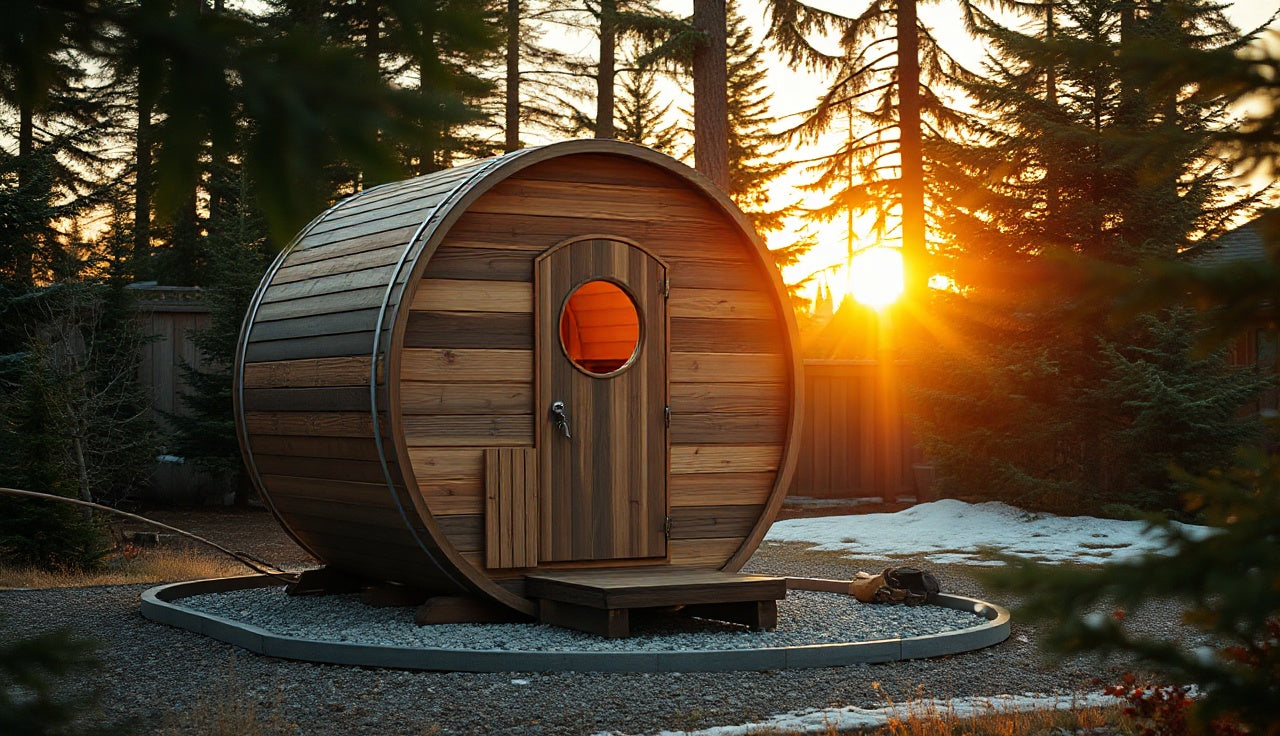
A barrel sauna is a cylindrical wood structure built from curved staves, the same method coopers use for wine casks. The shape earns its keep. A curved ceiling sits closer to the bathers than a flat roof does, so the interior volume is smaller for a given floor footprint. Smaller volume heats faster and holds heat better.
An infrared barrel sauna swaps the traditional kiuas (a wood-burning or electric stove with a rock basket) for infrared heating panels mounted inside the walls, under the benches, or around the lower half of the cabin. Those panels emit radiation in the near-infrared (NIR, roughly 0.75 to 1.4 µm), mid-infrared, or far-infrared (FIR, 3 to 1000 µm) range depending on the emitter [1]. The energy is absorbed directly by your skin and the tissue just below it without first heating the surrounding air, which is why the room stays so much cooler than a traditional sauna.
Typical operating temperatures for infrared barrel saunas run 120 to 150°F (49 to 65°C), against 160 to 195°F (71 to 91°C) for a conventional Finnish sauna [2]. The lower air temperature feels more breathable to many people, especially anyone who finds conventional heat oppressive.
The barrel format wins outdoors for a simple reason: the round shape sheds rain and snow far better than a flat roof, and the thick staved walls (usually 1.5 to 2 inches of solid wood) add insulation. Most units ship as prefabricated kits and go together in a day with basic hand tools.
How does infrared heating actually differ from a traditional sauna?
A Finnish sauna heats the air to high temperatures, and you sweat by sitting in that hot air, absorbing convection and radiation from the walls and stove. Infrared skips the middleman. The panels radiate energy that penetrates the outer skin, your core temperature climbs, and you start sweating from the inside out.
Far-infrared wavelengths (the most common in consumer saunas) reach a tissue depth of roughly 1.5 inches (3 to 4 cm), according to a review in Infrared Physics & Technology [1]. Near-infrared panels run hotter and reach slightly deeper, but they need careful placement to avoid surface burns, so FIR dominates residential units.
The sweat mechanism itself is identical no matter the heat source. Your hypothalamus reads rising core temperature and fires the eccrine sweat glands. The cardiovascular response (heart rate and cardiac output climbing to push blood toward the skin for cooling) tracks the same path. A small randomized crossover study in Complementary Medicine Research found that far-infrared sessions around 140°F produced cardiovascular responses comparable to moderate-intensity exercise [3].
Humidity is the real divide. Infrared saunas run with almost no steam, so the relative humidity inside is basically whatever the outdoor air is doing. A Finnish sauna, especially when you ladle water on the rocks, spikes to 30 to 60% humidity for a moment. Some people love the dry infrared feel. Traditional sauna diehards often find it flat. Neither is medically superior for general wellness, and anyone who tells you one crushes the other is overstating the evidence.
For a wider look at every sauna type, see our guide on home sauna options.
What are the documented health benefits of infrared sauna use?
Sauna research in general is reasonably strong. The Finnish KIHD (Kuopio Ischemic Heart Disease) cohort study, published in JAMA Internal Medicine in 2015, followed 2,315 middle-aged Finnish men for 20 years and found that men who used a sauna 4 to 7 times a week had a 40% lower risk of fatal cardiovascular disease than once-a-week users [4]. That study used traditional Finnish saunas, not infrared, so you cannot copy those exact numbers over to infrared.
Infrared-specific evidence is thinner. A 2002 randomized trial in the Journal of Cardiac Failure found that daily 15-minute far-infrared sessions over two weeks improved symptoms and quality of life in patients with congestive heart failure, though the sample was small (n=30) and clinical [5]. A 2005 pilot study in Psychosomatic Medicine (two patients) reported reduced fatigue and depressive symptoms in chronic fatigue syndrome after repeated far-infrared thermal therapy [6]. Encouraging, but tiny.
For healthy recreational users, the benefits that show up most consistently are transient drops in blood pressure, relaxation and lower cortisol, temporary relief from muscle soreness, and general cardiovascular conditioning from the heat stress response. A review in Mayo Clinic Proceedings (2018) put it plainly: "Regular sauna bathing is associated with a risk reduction of cardiovascular and all-cause mortality, but the causal relationships and mechanisms are still being investigated" [7].
Be skeptical of any vendor claiming infrared saunas flush heavy metals through your sweat. Sweat carries trace metals, sure, but your kidneys and liver handle the overwhelming majority of metabolic waste, and the sweat-detox science is weak. For the full picture on what regular sauna use does and does not do, read sauna benefits.
What does an infrared barrel sauna cost?
Prices run from $2,000 to $8,000 for most prefabricated kits, and the gaps between tiers are real.
| Category | Price range | Typical size | Wood type |
|---|---|---|---|
| Entry-level | $2,000 to $3,500 | 2-person | Hemlock, spruce |
| Mid-range | $3,500 to $5,500 | 2 to 4 person | Cedar, hemlock |
| Premium | $5,500 to $8,000 | 4 to 6 person | Cedar, thermowood |
| High-end custom | $8,000 to $15,000+ | 4 to 8 person | Old-growth cedar, aspen |
The figures above reflect the U.S. retail market for prefabricated kits as of mid-2025. Individual prices swing with vendor and shipping destination.
Wood species drives price more than anything except size. Western red cedar has natural antimicrobial oils, shrugs off moisture, and smells great, which puts it at the top. Hemlock and spruce cost less and work fine indoors but warp faster outdoors if you skip the sealing. Thermowood (heat-treated softwood) sits in the middle: more dimensionally stable than untreated wood, cheaper than cedar.
Budget for installation too. Most kits need a level pad (gravel, pavers, or concrete, roughly $200 to $800 DIY or $500 to $2,000 hired out), an electrical circuit ($150 to $600 for a licensed electrician depending on the run from your panel), and maybe a canopy or roof extension if you get heavy snow.
Operating cost is the pleasant surprise. A 2-person infrared barrel typically draws 1.2 to 1.8 kW. At the U.S. average residential rate of 16.4 cents per kWh (EIA, 2024), a one-hour session runs about 20 to 30 cents [8]. A 4-person unit pulling 2.5 to 3.0 kW costs around 40 to 50 cents. A traditional sauna often pulls 6 to 9 kW, so the math is not close.
| 2-person infrared barrel | 1.5 |
| 4-person infrared barrel | 2.8 |
| 2-person traditional electric | 4.5 |
| 4-person traditional electric | 6.5 |
| 6-person traditional electric | 9.0 |
Source: U.S. Energy Information Administration, 2024 (rate basis); manufacturer spec ranges
What wood species is best for an outdoor infrared barrel sauna?
Wood choice matters far more outdoors than indoors, because you are fighting humidity, UV, freeze-thaw, and biological growth all at once.
Western red cedar is the standard pick for outdoor barrels, and it earns it. Its natural extractives (terpenes and phenolics) resist rot and insects without any treatment, it stays dimensionally stable through moisture swings, and it feels good against bare skin because it conducts heat poorly. The USDA Wood Handbook classifies western red cedar heartwood as Class I or Class II decay-resistant depending on heartwood content [9].
Thermo-treated pine or spruce (heated to 400 to 430°F in an oxygen-free kiln) is a legitimate alternative. The heat treatment reworks the wood's cell structure, making it more stable and rot-resistant than untreated softwood, though still short of old-growth cedar heartwood.
Nordic white spruce shows up in a lot of European-made barrels. It is lighter, cheaper, and holds up with regular sealing. Pick spruce or pine and you should budget for an exterior sealant every 1 to 2 years plus more frequent inspection.
Aspen shows up inside the cabin because it stays cool to the touch even when the room is hot, which makes the benches comfortable. Hybrid builds are common: thermowood or cedar staves outside, aspen benches and trim inside.
Skip these entirely: pressure-treated lumber, MDF, and plywood have no business in a sauna. Even faint off-gassing from adhesives and preservatives at temperature is worth dodging.
How hard is it to install an infrared barrel sauna outdoors?
Harder than the kit instructions suggest, but still a friendly DIY project for two people over a weekend.
The usual sequence: prep and level the base, assemble the stave ring sections, lay the floor boards, mount the heating panels and bench frame, wire the unit to your circuit, then caulk and seal the exterior.
Base prep is where people blow their time estimate. The base needs to be level within about a quarter inch across its length, drain well so water never pools under the barrel, and hold 800 to 2,000 lbs (wood shell, benches, and occupants combined). Compacted gravel over landscape fabric is the simplest route. Concrete pavers on compacted gravel are more permanent and easier to re-level later. Poured concrete is overkill for most backyards.
Electrical is the one step that genuinely needs a licensed electrician in most jurisdictions. Most 2-person units run on 120V, 20A service (a heavy-duty outdoor circuit). Larger 4-person and 6-person units usually want 240V, 20 to 30A, the same as a clothes dryer. The National Electrical Code does not govern saunas the way NEC Article 680 governs pools, but Article 422 covers fixed electrical equipment, and your inspector will want a GFCI-protected, outdoor-rated circuit [10].
Permits vary wildly. Many municipalities skip a permit for a prefabricated sauna with no permanent foundation, but plenty do not. Check with your building department before you buy the pad materials. Some HOAs restrict outdoor structures on top of that.
Two people usually finish the full kit in 6 to 10 hours. Solo, plan on 12 to 16 hours across two days.
Weighing this against something simpler? Our portable sauna guide covers lower-commitment setups.
How do infrared barrel saunas compare to traditional barrel saunas?
Same barrel shape, very different heat and feel.
| Feature | Infrared barrel sauna | Traditional barrel sauna |
|---|---|---|
| Operating temp | 120 to 150°F (49 to 65°C) | 160 to 195°F (71 to 91°C) |
| Heat-up time | 20 to 40 min | 30 to 60 min (electric) / 45 to 90 min (wood) |
| Power draw | 1.2 to 3.0 kW | 4.5 to 9.0 kW |
| Steam (löyly) | No | Yes |
| Humidity | Very low (ambient) | Moderate to high when water thrown |
| Session feel | Warm and dry | Intensely hot, steamy |
| Maintenance | Panels (10 to 20 years), no stones | Stove elements or firebox, rocks every few years |
| Price range (2-person kit) | $2,000 to $5,500 | $1,800 to $6,000 |
The heat-up and power differences are practical, not academic. Want to jump in for 30 minutes after work with no planning? Infrared wins. Love the ritual of building heat, throwing steam, and hitting temperatures that make you feel like you are in a Finnish lake cottage? A traditional stove is worth the wait and the higher power draw.
Traditional advocates have a fair point: the cardiovascular load from very high air temperature (plus the convective heat off hot walls, stacked on the infrared load) is probably greater per minute than what infrared delivers at 130°F. Whether that extra load is a benefit or just a harder session comes down to preference and your health status.
For a broader look at heat bathing environments, see sauna vs steam room.
What size infrared barrel sauna do you actually need?
Most people buy too small. That is nearly unanimous from owners who wish they had sized up.
Barrels get sold by person capacity (2-person, 4-person, 6-person), but the industry has no standard for what one "person" means. A "2-person" barrel from one maker might give you 48 inches of bench length. Another gives you 60. Measure the actual bench before you buy.
Solo use with room to stretch out: a 2-person unit is fine. Two people sitting upright: still a 2-person, but confirm the bench runs at least 55 to 60 inches. Two people who want to lie down: 4-person minimum.
Diameter is the measurement that decides comfort. Most 2-person barrels run 4 feet (48 inches) interior diameter. Four-person barrels run 5 to 6 feet. Center height at the peak of the curve roughly equals the interior radius plus the bench clearance, so a 4-foot barrel gives you about 3 feet from bench to ceiling at the peak. Comfortable for sitting, no chance of standing fully upright. Six-foot barrels let you stand.
Length governs bench space and how many bodies fit. Standard residential kits run 6, 7, and 8 feet. An 8-foot barrel with 5-foot diameter is a genuinely comfortable 2 to 4 person sauna that also lets one person lie flat.
For outdoor placement, add 18 to 24 inches on all sides for clearance, ventilation, and door access. A 6-foot diameter, 8-foot barrel wants roughly a 9x11-foot footprint with that clearance.
What should you look for when buying an infrared barrel sauna?
Panel type and certification matter most.
For panels, look for carbon fiber or ceramic full-spectrum units, not cheap carbon plate heaters that emit mostly far-infrared at low wattage. Carbon fiber panels heat up in a few minutes and spread heat evenly. Some makers use low-EMF panels and publish third-party test reports. If EMF worries you, ask for the test data instead of accepting the marketing line.
Electrical certification is non-negotiable. Look for ETL or UL listing (or CSA for Canadian buyers). Those mean an accredited safety lab tested the unit against the applicable standards. An uncertified unit can void a homeowner's insurance claim and will not clear a building inspection.
Wood quality: ask for photos of actual stave cross-sections, not glamour shots. You want tight grain and heartwood (the darker inner wood, more durable) throughout. Ask whether the wood was kiln-dried before assembly. Green or badly dried wood cracks and warps.
Panel placement: panels under the bench and low on the walls do more useful work than panels only up high, because they warm you from below and the sides instead of just overhead. A mix of bench-level and wall panels is the target.
Warranty: reputable makers cover at least 2 to 3 years on electrical components and 5 to 10 years on the wood shell. Distrust lifetime warranties with no specifics. Read what they actually cover.
Support footprint counts too. A company with nothing but a Chinese e-commerce warehouse and no U.S. phone line can leave you stranded when a panel dies in year two. SweatDecks carries vetted infrared barrel models with direct U.S. support, which belongs in your price comparison.
Last, read the real owner reviews for specific models on independent forums (Sauna Talk, Reddit's r/Sauna) over the vendor's product page. Actual owners talk about panel failures, wood warping, and assembly headaches in ways marketing copy never will.
How do you maintain an outdoor infrared barrel sauna?
Lighter than a stove-based sauna, but not zero.
Wood care: seal the exterior staves with an outdoor wood oil or UV-blocking sealant every 12 to 24 months, depending on climate. Wet climates (Pacific Northwest, New England) may need it yearly. Dry climates (Southwest) often stretch to every 2 years. Teak oil, linseed oil, and commercial deck sealers all work. Skip film-forming paints and varnishes on the interior, which can off-gas.
Interior: wipe the benches and walls with a dry or barely damp cloth after each use. Sweat is mildly acidic and grays untreated wood over time if it sits. A diluted baking soda solution (1 tablespoon per quart) cleans well without dumping harsh chemicals into a closed space you are going to breathe.
Panels: far-infrared carbon or ceramic panels usually last 10 to 20 years in normal home use. The failure modes are cracked panel glass (from impact, not heat) and wiring connectors that oxidize. Inspect the connections once a year. Keep the panels dry and never run the sauna with standing water inside.
Ventilation: barrel saunas should have a fresh-air vent near the floor and an exhaust vent near the peak. Keep both clear. A clogged exhaust traps humidity and speeds up wood rot and mold.
Winter: in hard-freeze climates, pull the glass door insert if it is not tempered outdoor glass, and confirm any floor drain is clear. Most solid wood barrels handle freezing fine. The threat is moisture trapped in the panels or wiring, not the wood.
Is contrast therapy with an infrared barrel sauna effective?
Contrast therapy means alternating heat and cold: sauna, then cold plunge or ice bath, then back to heat. It is one of the most-debated recovery protocols among athletes right now, and the evidence is more interesting than either camp admits.
A 2021 systematic review in the European Journal of Applied Physiology examined 23 studies on whole-body cryotherapy and cold water immersion after exercise and found consistent short-term reductions in perceived muscle soreness and fatigue, though effects on actual performance were mixed [11]. One catch: cold right after resistance training may blunt some of the molecular signaling (specifically mTOR pathway activation) that drives muscle protein synthesis, per research in the Journal of Physiology [12]. If hypertrophy is the goal, wait 4 to 6 hours after a strength session before you plunge.
For cardiovascular recovery, stress reduction, and sleep, the contrast protocol has steadier support. The heat phase drives a cardiovascular response and bumps growth hormone briefly. The cold phase fires the sympathetic nervous system and may lift mood through norepinephrine release [6].
In practice, an outdoor infrared barrel pairs naturally with a cold plunge tub or ice bath on the same patio. A common protocol is 15 to 20 minutes of sauna, 2 to 5 minutes of cold (50 to 59°F water), 5 to 10 minutes of rest, then 2 to 3 rounds. Finish on heat for relaxation, finish on cold for alertness.
For more on what cold exposure adds, see our guide on cold plunge benefits.
Are there safety concerns specific to infrared barrel saunas?
Infrared barrel saunas are generally gentler than high-temperature traditional saunas for heat-sensitive people, mostly because the air stays cooler. Lower temperature does not mean zero risk.
Dehydration is the most common problem. You can lose 0.5 to 1 liter of sweat per hour in an infrared sauna without noticing, because the dry air evaporates it fast. Drink water before and during sessions. The old advice to avoid drinking during a sauna is outdated and potentially dangerous.
Cardiovascular caution: anyone with uncontrolled hypertension, a recent heart attack or stroke, unstable angina, or severe aortic stenosis should get physician clearance before regular use. The ACC and AHA have no formal position statement on saunas specifically, but most cardiology guidance treats a sauna as moderate cardiovascular stress, on par with a brisk walk.
Pregnancy: guidance from the American College of Obstetricians and Gynecologists is to avoid raising core body temperature above 102.2°F (39°C) during pregnancy, because first-trimester hyperthermia is linked to a higher risk of neural tube defects [13]. Infrared sauna at 130 to 140°F can push core temperature to that line, so pregnant women should check with their OB first.
EMF: some buyers worry about electromagnetic field exposure from the panels. Most quality panels at normal bench distances (18 to 24 inches) measure well under 3 mG, a precautionary threshold some health groups cite, though the World Health Organization has set no firm residential EMF limit for the non-ionizing radiation these heaters produce.
And skip alcohol before or during a session. Alcohol wrecks thermoregulation and judgment, and it shows up in a lot of sauna-related fatalities.
Frequently asked questions
How long does it take an infrared barrel sauna to heat up?
Most infrared barrel saunas reach their operating temperature of 120 to 140°F in 20 to 40 minutes. The barrel's smaller interior volume compared to a box sauna helps. Cold outdoor air adds time; on a freezing winter day, add 10 to 15 minutes. Carbon fiber panels heat faster than older carbon plate designs.
Can I leave an infrared barrel sauna outside year-round?
Yes, in most climates. Solid cedar or thermowood barrels handle rain, snow, and freeze-thaw well if the exterior is sealed and the unit sits on a draining base. The electrical components need protection from direct water; confirm the circuit has outdoor-rated GFCI protection. Very humid climates (Gulf Coast, tropics) call for more frequent wood treatment.
Do infrared barrel saunas need a special electrical outlet?
Two-person units usually run on a 120V, 20A outlet, similar to a heavy kitchen appliance. Four-person and larger units typically require a dedicated 240V, 20 to 30A circuit, the same as a clothes dryer. Either way, a licensed electrician should install the circuit and verify GFCI protection. Check the unit's spec sheet for exact electrical requirements before buying.
How much electricity does an infrared barrel sauna use per month?
A typical 2-person unit draws 1.5 to 1.8 kW and costs roughly 25 to 30 cents per one-hour session at the U.S. average rate of 16.4 cents per kWh. Daily 45-minute sessions add up to about $5 to $8 per month, far less than a traditional stove drawing 6 to 9 kW. Actual cost depends on your utility rate and preheat time.
What is the best wood for an outdoor infrared barrel sauna?
Western red cedar is the best all-around choice: natural rot resistance, dimensional stability, a comfortable surface temperature, and a pleasant aroma. Thermowood (heat-treated pine or spruce) is a solid budget alternative with better stability than untreated softwood. Avoid pressure-treated lumber entirely; those preservatives should not be in a closed heated space.
Is an infrared barrel sauna the same as a traditional Finnish sauna?
No. A Finnish sauna uses a stove with heated rocks to push air temperature to 160 to 195°F, and you can add steam by pouring water on the rocks. An infrared barrel sauna uses radiant panels, runs at 120 to 150°F with very low humidity, and produces no steam. The barrel shape is the same; the heat source and experience are very different.
How many people fit in a 4-person infrared barrel sauna?
Four adults fit comfortably if the barrel is at least 5 feet in interior diameter and 7 to 8 feet long, but two adults with room to move is the real sweet spot for most 4-person barrels. For lying down or stretching, a 4-person barrel comfortably fits two. Size up if space and budget allow.
Do I need a building permit for an outdoor infrared barrel sauna?
It depends on your municipality. Many jurisdictions skip a permit for a prefabricated sauna with no permanent foundation, but a new electrical circuit almost always requires a permit and inspection. Check with your building department before you start, especially if you have an HOA, because covenants often carry separate rules for outdoor structures.
What is the lifespan of an infrared barrel sauna?
A quality cedar barrel shell, sealed and maintained, can last 20 to 30 years or more. Infrared panels typically last 10 to 20 years. Control boards and wiring connectors are the most likely early failures, usually covered under warranty in years 1 to 3. A well-maintained barrel sauna from a quality maker easily outlasts its warranty period.
Can you use an infrared barrel sauna if you have high blood pressure?
Sauna use, infrared included, is associated with transient drops in blood pressure during and right after a session. But people with uncontrolled or severe hypertension should get physician clearance before starting. The heat stress is roughly equivalent to moderate-intensity exercise, so if your doctor has cleared you for a brisk walk, sauna use generally sits in the same category.
What is the difference between near-infrared and far-infrared saunas?
Near-infrared (NIR, 0.75 to 1.4 µm) runs hotter, penetrates tissue slightly deeper, and historically used incandescent bulbs that also throw visible light. Far-infrared (FIR, 3 to 1000 µm) is what nearly all modern consumer barrel saunas use. FIR carbon or ceramic panels are efficient, heat quickly, and spread warmth evenly without the intense localized heat of NIR bulbs.
How does an infrared barrel sauna compare to a box-shaped infrared sauna?
The heating technology is identical. The barrel has a smaller interior volume for a given floor footprint, which can mean faster heat-up and better heat retention, and it sheds rain and snow better outdoors. Box saunas are easier to frame, easier to add windows and glass walls to, and more familiar to residential builders if you are doing a custom job.
Can you pair an infrared barrel sauna with a cold plunge for contrast therapy?
Yes, and it is one of the most popular uses. A typical protocol is 15 to 20 minutes in the sauna, then 2 to 5 minutes in a cold plunge at 50 to 59°F, repeated 2 to 3 rounds. If muscle building is a priority, avoid cold immersion right after a strength session, since research suggests it may blunt muscle protein synthesis. For general recovery and stress relief, the combination is well tolerated.
What maintenance does an infrared barrel sauna require?
Seal the exterior wood every 12 to 24 months with a UV-blocking outdoor wood oil. Wipe down interior benches after each use. Inspect panel connections and ventilation openings once a year. Keep the base well-drained so moisture cannot wick up into the lower staves. No rock replacement, no ash cleanup, no firebox inspection, which is the main maintenance edge over wood-burning units.
Sources
- Infrared Physics & Technology / PMC, Vatansever & Hamblin 2012, 'Far infrared radiation: its biological effects and medical applications': Far-infrared wavelengths penetrate tissue to a depth of roughly 1.5 inches (3–4 cm); FIR spans 3–1000 µm
- Finnish Sauna Society, sauna temperature guidelines: Traditional Finnish sauna operating temperatures range from 160–195°F (71–91°C)
- Complementary Medicine Research, Beever 2009, 'Far-infrared saunas for treatment of cardiovascular risk factors': Far-infrared sauna sessions at around 140°F produced cardiovascular responses comparable to moderate-intensity exercise
- JAMA Internal Medicine, Laukkanen et al. 2015, 'Association Between Sauna Bathing and Fatal Cardiovascular and All-Cause Mortality Events': Men who used a sauna 4–7 times per week had 40% lower risk of fatal cardiovascular disease vs. once-weekly users in the KIHD cohort (n=2,315, 20-year follow-up)
- Journal of Cardiac Failure, Kihara et al. 2002, 'Repeated sauna treatment improves vascular endothelial and cardiac function in patients with chronic heart failure': Daily 15-minute far-infrared sauna sessions over two weeks improved symptoms and quality of life in congestive heart failure patients (n=30)
- Psychosomatic Medicine, Masuda et al. 2005, 'The effects of repeated thermal therapy for two patients with chronic fatigue syndrome': Repeated far-infrared sauna sessions reduced fatigue and depressive symptoms in chronic fatigue syndrome patients (pilot study)
- Mayo Clinic Proceedings, Laukkanen et al. 2018, 'Cardiovascular and Other Health Benefits of Sauna Bathing: A Review of the Evidence': "Regular sauna bathing is associated with a risk reduction of cardiovascular and all-cause mortality, but the causal relationships and mechanisms are still being investigated"
- U.S. Energy Information Administration, Electric Power Monthly, Average Retail Price of Electricity 2024: U.S. average residential electricity rate was approximately 16.4 cents per kWh in 2024
- USDA Forest Products Laboratory, Wood Handbook, Chapter 5, Decay Resistance of Wood: Western red cedar heartwood has Class I or Class II natural decay resistance due to extractives content
- National Fire Protection Association, National Electrical Code (NFPA 70), Articles 422 and 680: NEC Article 422 covers fixed electrical equipment; inspectors typically require GFCI-protected, outdoor-rated circuits for outdoor saunas
- European Journal of Applied Physiology, Higgins et al. 2021, systematic review on cold water immersion and cryotherapy for recovery: 23-study systematic review found consistent short-term reductions in perceived muscle soreness and fatigue from cold immersion after exercise
- Journal of Physiology, Roberts et al. 2015, 'Post-exercise cold water immersion attenuates acute anabolic signalling': Cold water immersion after resistance training may blunt mTOR pathway activation and attenuate muscle protein synthesis signaling
- American College of Obstetricians and Gynecologists, Committee Opinion on Physical Activity and Exercise During Pregnancy: ACOG recommends avoiding maternal core temperature above 102.2°F (39°C) during pregnancy due to association with neural tube defects

Share:
4-person barrel sauna: what to know before you buy
Portable personal sauna: what to buy and what to skip