
Last updated 2026-07-09
TL;DR
Inflatable cold plunge tubs cost $100 to $800, versus $2,000 to $10,000+ for rigid units. They pack down small, set up in minutes, and work indoors or out. Their limits are durability, insulation, and depth. For casual cold exposure or travel, they make sense. Daily users usually outgrow them within a year and move to a rigid tub with a chiller.
What is an inflatable cold plunge tub, and how does it work?
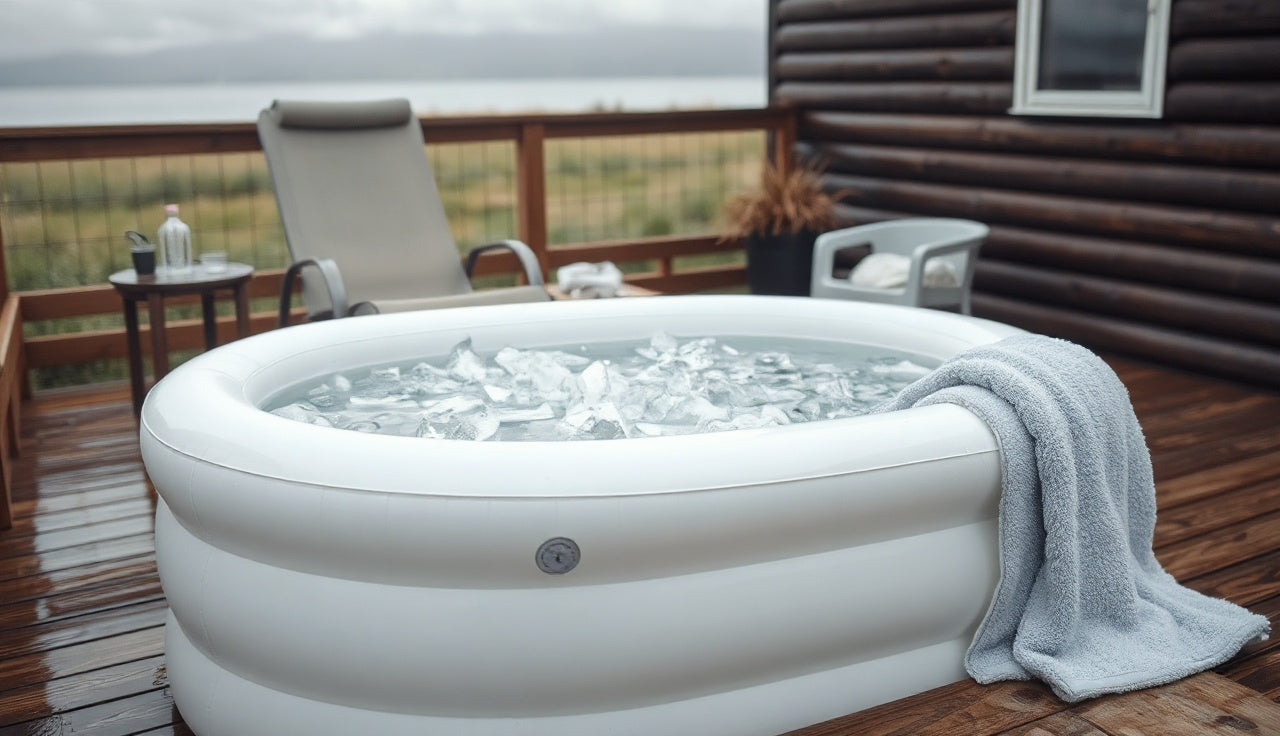
An inflatable cold plunge tub is a portable, air-supported vessel you fill with cold water and sit in for short immersions, usually two to fifteen minutes. The walls and floor are multi-layer PVC or TPU laminate, the same category of material used in inflatable kayaks and paddleboard drop-stitch panels. Quality swings hard across price tiers.
Most models inflate with an electric pump in three to eight minutes. You fill from a garden hose, add ice bags or connect an external chiller, and you're in cold water. That's the whole setup. No plumbing. No drainage system. No contractor.
Here's the distinction that matters. Inflatables don't have built-in chillers. Units like the Plunge cold plunge tub or the Redwood Outdoors Alaskan cold plunge tub are rigid, plumbed, and come with refrigeration. An inflatable relies on you to get the water cold and keep it cold, either with bagged ice or a separate chiller you drop in or connect externally.
Water temperature is the whole point. Cold water immersion research generally targets 50°F to 59°F (10°C to 15°C) as the range where physiological responses, including norepinephrine release and changes in heart rate variability, show up consistently [1]. Getting an inflatable into that range with enough ice is easy. Staying there across multiple daily sessions without a chiller is where the format starts to struggle.
How much does an inflatable cold plunge tub cost?
Inflatable cold plunge tubs run $100 to $800, with the split falling into three clear tiers. Entry-level tubs from Amazon and big-box brands cost $100 to $250. Mid-range models with thicker walls, better seams, and higher weight ratings sit at $250 to $500. Premium inflatables with drop-stitch construction, insulated covers, and wider interiors reach $600 to $800.
Here's how that compares to other cold plunge options:
| Type | Typical Price Range | Chiller Included | Setup Time |
|---|---|---|---|
| Inflatable cold plunge tub | $100 to $800 | No | 5 to 15 min |
| Stock tank (DIY) | $150 to $400 | No | Hours to days |
| Rigid tub with external chiller | $800 to $2,500 | No (separate) | Hours |
| All-in-one cold plunge unit | $2,000 to $10,000+ | Yes | Hours to days |
| Ice bath (commercial gym) | $5,000 to $20,000 | Yes | Permanent |
The inflatable wins on upfront cost and zero installation. The gap widens once you count that rigid units often need electrical work, drainage, and sometimes a concrete pad.
The math gets murkier on ice. Target 55°F water with tap that runs at 65°F and you need roughly 1 pound of ice per gallon to drop it 10°F, based on the latent heat of fusion of ice [2]. A 100-gallon tub eats about 100 pounds per session. Bagged ice at $3 to $6 per 20-pound bag adds $15 to $30 a session. Three sessions a week runs $180 to $360 a month, which erases the savings over a chiller unit fast. If you plan to plunge daily, price a portable chiller ($300 to $700 for a capable model) into your budget from day one.
What are the real benefits of cold water immersion?
Cold water immersion has a legitimate research base. The popular claims often outrun the evidence, so here's what the data actually shows.
A 2022 meta-analysis in PLOS ONE found that cold water immersion significantly reduced delayed onset muscle soreness (DOMS) compared to passive recovery, with the strongest effects in the 24 to 48 hour window after exercise [3]. That's a replicated finding and probably the best-supported reason to own a home cold plunge.
Neurotransmitter effects are also real. A study by Srámek et al. in the European Journal of Applied Physiology found that one hour of immersion in 14°C water raised norepinephrine by 300% and dopamine by 250% [4]. Those are large numbers. Whether they translate into the mood and focus improvements users report is biologically plausible, but most of that experience data is self-reported.
Claims about fat loss through brown adipose tissue, immune boosts, and metabolic rate are shakier. Some studies show direction. Few show a magnitude that matters clinically. Nobody should buy a cold plunge expecting to lose weight from cold alone.
Cardiovascular safety is the other side. Cold water immersion causes an immediate jump in heart rate and blood pressure, then peripheral vasoconstriction. Healthy adults handle it. For people with uncontrolled hypertension, arrhythmias, or Raynaud's disease, it's a genuine risk. The American Heart Association flags cold water shock as a drowning risk factor in open-water swimming [5]. Check with a doctor first if you have any cardiovascular history.
For a full breakdown, the cold plunge benefits guide covers individual studies in more depth.
| Inflatable cold plunge tub (entry) | $175 |
| Inflatable cold plunge tub (premium) | $650 |
| Stock tank (DIY) | $275 |
| Rigid tub + external chiller | $1,650 |
| All-in-one cold plunge unit | $6,000 |
Source: SweatDecks market survey and manufacturer pricing, 2025
How do inflatable cold plunge tubs compare to rigid outdoor cold plunge tubs?
This is the question most buyers circle back to once the sticker shock of rigid units wears off. Rigid tubs last decades and hold temperature automatically. Inflatables trade that permanence for portability and a much lower price.
Rigid outdoor cold plunge tubs, whether acrylic, fiberglass, cedar, or stainless steel, last ten to twenty-plus years with proper maintenance. They hold their shape, don't puncture, and often pair with recirculating chillers that hold a set temperature on their own. The Redwood Outdoors Alaskan cold plunge tub is a cedar barrel design meant to live on a deck permanently. The Plunge cold plunge tub is an acrylic unit with built-in filtration and chilling.
Inflatables give all that up for portability. You can use one in an apartment, take it camping, or store it in a closet between uses. That's genuinely useful for a real subset of buyers.
Durability is where inflatables take the most honest criticism. PVC seams degrade under repeated pressure, UV, and temperature cycling. Entry-level tubs often leak within one to two years. Better models with welded seams and UV-resistant coatings last longer, but still fall short of a cedar tub you refinish every few years.
Depth matters more than buyers expect. Good cold water immersion needs water over your torso, ideally to the shoulders. Many inflatables run 24 to 28 inches deep, which works if you sit upright with knees bent. Taller users or anyone who wants to recline will fight the geometry. Rigid tubs are usually deeper and shaped for seated immersion.
Insulation is the third gap. Air-filled walls give some thermal buffer, but water warms faster than in an insulated rigid tub with a lid. On a warm day, 55°F water can climb to 65°F in two to three hours without more ice.
What should you look for when buying an inflatable cold plunge tub?
A handful of specs separate a tub you'll use for years from one you'll deflate and forget in the garage. Wall construction, interior size, seam type, drain hardware, insulation, and weight rating are the six to check.
Wall construction comes first. Drop-stitch construction, where thousands of internal polyester threads connect the top and bottom panels, gives you a rigid flat floor and walls that don't bow under your weight. It's the same reason paddleboards feel solid underfoot. Non-drop-stitch tubs have a rounded, barrel shape that feels unstable when you shift. Worth paying more for.
Interior dimensions matter for your body. A useful minimum is 30 inches in diameter (or 24 by 36 inches for rectangular models) and 26 inches of water depth. Over 6 feet tall? Look for tubs marketed as "XL" and check the interior measurements against your seated posture.
Seam type is a durability proxy. Welded seams (sometimes called hot-air or RF-welded) outlast glued seams, which are standard on budget models. The listing usually states which type. If it doesn't, assume glued.
Drain valve quality is underrated. A real ball valve at the bottom makes draining quick and skips the awkward hose-siphon dance you get with cheap drain plugs. Some premium tubs add a garden-hose inlet, a small convenience worth having.
Insulated covers earn their cost if you keep water in the tub between sessions. Losing four to six degrees overnight means more ice the next day.
Weight capacity, last. Most inflatables list 250 to 330 pounds. If you're near the top of that, check whether the rating covers the walls alone or includes water on the base. A filled 100-gallon tub already carries over 830 pounds of water, so the number you care about is side-wall integrity under your body, not total system load.
Can you use an inflatable cold plunge tub outdoors year-round?
You can, with conditions. Summer means fighting heat gain. Winter means protecting the tub from freezing. Both are manageable with some storage discipline, but neither is effortless.
In summer, the challenge is keeping water cold. Direct sun heats it fast, so shade or an insulated cover becomes essential. A black or dark-colored inflatable absorbs radiant heat far faster than a light one. Outdoor use in hot climates without a chiller means heavy ice costs from May through September.
Winter creates the opposite problem. In a climate where overnight temps drop below 30°F, water sitting in the tub can freeze and split the PVC. Most manufacturers advise draining the tub when temperatures stay below freezing for long stretches. Some users run a small aquarium pump to keep water moving (moving water freezes at a lower temperature than still water), which helps in marginal cold. It won't save you through sustained sub-freezing weather.
UV degradation is real for outdoor use. Both PVC and TPU break down under prolonged sun. A tub left inflated in direct sun year-round shows material brittleness within two to four years even if it never punctures. Storing it deflated indoors between uses adds years of life.
If year-round outdoor use is the main plan, a rigid outdoor cold plunge tub, or a stock tank with an insulating lid and chiller, is a more honest fit. The inflatable works best for semi-regular outdoor use with some storage sense in extreme weather.
How do you keep an inflatable cold plunge tub clean?
Water hygiene gets glossed over in marketing copy, and it matters a lot. Cold water doesn't sanitize itself the way hot water does, so any water you reuse needs treatment or a fast turnover.
A hot tub at 104°F has some self-sanitizing effect from heat. Your cold plunge at 55°F has none. Skin cells, body oils, and environmental contaminants build up fast in water that sits across multiple sessions untreated.
Most users pick one of three approaches. First, daily dump-and-refill: simple, water-hungry, but sanitary. Using 80 to 100 gallons per session at $0.01 to $0.02 per gallon is under $2 per fill, which is negligible. Second, chemical treatment: low-concentration pool chlorine or non-chlorine oxidizers (like potassium monopersulfate) at cold-water-appropriate levels can stretch a fill to three to seven days. Third, UV or ozone: small inline UV sterilizers built for spas can be adapted with some DIY effort, though they're more common on rigid setups with recirculating pumps.
For most inflatable owners, the practical answer is low-dose chlorine (target 1 to 3 ppm free chlorine), a water change every three to five days, and a quick wipe of the interior walls when you drain. Keep it covered between sessions to cut debris and evaporation.
One warning: some manufacturers void the warranty if you run chlorine above a set concentration. Read the care guide before you add anything. Low concentrations used in standard pool and spa care are generally fine. Bleach at cleaning strength will degrade PVC quickly.
How does cold plunge compare to a sauna, and should you do both?
Cold plunge and sauna push opposite physiological responses, and the research on combining them is genuinely interesting. One heats you and opens vessels. The other cools you and clamps them shut. Alternating the two is the basis of contrast therapy.
A sauna session (typically 170°F to 195°F for a traditional Finnish sauna) causes peripheral vasodilation, a higher heart rate, and heavy sweating. Core temperature rises. A cold plunge right after triggers vasoconstriction and a fast drop in skin and peripheral temperature. That swing between states is what practitioners chase.
A study in the International Journal of Circumpolar Health found that Finnish sauna bathing followed by cold water immersion was associated with improved autonomic nervous system function in the participants studied [6]. Real finding, but observational and in a specific population (Finnish adults with long sauna histories). Stretch it too far and you overstate what we know.
For muscle recovery, there's a nuance people miss. Cold water immersion after strength training may blunt some of the long-term muscle growth you want, because the inflammatory response cold suppresses is also part of the signal for muscle protein synthesis [7]. The 2020 study by Fuchs et al. in Acta Physiologica examined exactly this anabolic signaling question. If building muscle is your goal, save the plunge for non-training days, or put real time between your lift and your cold.
To explore the heat side, the home sauna guide covers setup options in detail, and sauna benefits covers the research. Pairing a portable sauna with an inflatable cold plunge tub is one of the cheapest ways to run contrast therapy at home.
What are the best inflatable cold plunge tubs in 2025?
There's no clean "best" here. The category is fragmented, new brands appear every few months, and quality control varies even within one brand's lineup. What follows is an honest framework, not sponsored rankings.
At the entry level ($100 to $200), you're looking at cylindrical PVC tubs from brands like Polar Recovery, Lumi Therapy, and various Amazon generics. They work. Seams are usually glued, depth is around 24 inches, and they'll last one to three years with moderate use. Good for someone testing whether cold plunge is for them before spending real money.
At the mid range ($250 to $500), drop-stitch construction shows up more often. Brands like Ice Barrel (which also makes a rigid unit) offer flat-floor designs with better shape retention. Committing to two to four plunges a week? This tier makes more sense.
At the premium end ($500 to $800), you get insulated covers included, higher-gauge TPU, better drain hardware, and sometimes compatibility with specific external chillers. The difference in feel between a $200 and a $700 inflatable is real, roughly the gap between a pool float and a paddleboard.
If you're weighing a step up to a rigid tub, SweatDecks carries a selection of cold plunge units worth comparing side by side. The price jump is real, and so is the durability gap.
One honest note: nobody in this category has long-term independent reliability data the way appliance makers do. The best proxy is warranty length (look for at least one year on the tub, ideally two) and seam type. Welded beats glued every time.
Is an inflatable cold plunge tub worth it, or should you buy a rigid tub?
Buy an inflatable if you rent and can't make permanent changes, you want to try cold plunge before spending serious money, you have limited outdoor space, or you need something portable for travel and events. At $200 to $400 for a decent mid-range unit, the cost of finding out cold plunge isn't for you is low.
Skip the inflatable and go rigid if you already know you'll plunge three or more times a week, you want automated temperature without daily ice logistics, or you're building it into a permanent deck alongside a sauna. The friction of managing ice and water quality in an inflatable compounds over months. Committed users almost always graduate to rigid setups within one to two years.
The middle path most people overlook is a rigid stock tank (galvanized steel or polyethylene, 150 to 250 gallons) paired with an external chiller. Total cost runs $500 to $1,500, it lasts decades, and it skips the markup on branded all-in-one units. It's not pretty. It works.
If you do go inflatable, treat it as a proof-of-concept phase. Use it consistently for three months. Still plunging at week twelve with enthusiasm? That's your signal to upgrade. The money on the inflatable wasn't wasted. It bought you certainty before a bigger purchase.
SweatDecks has guides across the broader cold plunge category if you want to compare specific rigid units once you've decided to commit.
What safety rules apply to cold water immersion at home?
Cold water immersion is safe for most healthy adults, but the risks are real. Keep sessions short, never plunge alone at first, and get medical clearance if you have cardiovascular history. Those three habits cover most of the danger.
Cold shock response is the most immediate threat. Entering water below 60°F causes an involuntary gasp reflex and hyperventilation that can last 30 to 90 seconds [5]. In open water this kills people because they inhale water. In a controlled home plunge the risk is lower, but never plunge alone for your first several sessions, and never submerge your face or hold your breath in cold water. The American Heart Association describes cold water shock as a primary mechanism in cold water drowning [5].
Hypothermia from home plunging is uncommon but possible if sessions run long. Most protocols target two to fifteen minutes at 50°F to 59°F. Get out when you feel the urge to shiver hard. Mild shivering is normal. Sustained heavy shivering means your body is losing the thermal battle. A 2017 paper by Tipton et al. in Temperature (Taylor & Francis) noted that water temperature and immersion duration are the two primary variables governing core temperature drop, with water below 50°F producing significant core temperature drops in under ten minutes for some people [8].
Children, elderly individuals, pregnant women, and anyone on medications that affect blood pressure or heart rate carry extra risk. These groups should get medical clearance before starting.
Practically: keep first sessions to 2 to 3 minutes, have someone nearby, step out slowly to avoid orthostatic hypotension (blood pooling in the legs when you stand up fast from cold water), and warm up passively with dry clothes and a blanket rather than jumping into a hot shower, which can swing your blood pressure hard.
Frequently asked questions
How long do inflatable cold plunge tubs last?
It depends heavily on construction and storage. Budget PVC tubs with glued seams usually show leaks within one to two years of regular use. Mid-range and premium models with drop-stitch construction and welded seams last three to five years with proper care: indoor storage when not in use, no chemicals above the manufacturer's limits, and keeping them out of extended direct UV.
How much ice do I need for an inflatable cold plunge tub?
Rough rule: one pound of ice lowers one gallon of water by about 10°F. If your tap runs at 65°F and you want 55°F, that's roughly 1 pound of ice per gallon. For a 100-gallon tub, that's 100 pounds of ice per session. At $3 to $6 per 20-pound bag, plan on $15 to $30 per fill. A portable chiller eliminates that cost and usually pays off within three to six months of regular use.
Can an inflatable cold plunge tub be used indoors?
Yes. Inflatable cold plunge tubs work on any indoor floor that can handle the weight. A 100-gallon tub filled with water weighs roughly 830 pounds plus the user. Most structurally sound residential floors handle this concentrated load, but placing the tub over a load-bearing area with a rubber mat underneath to spread the weight is a reasonable precaution. Drainage is the bigger indoor challenge; you'll need a way to pump or hose the water out.
What temperature should a cold plunge tub be?
Most research on cold water immersion uses 50°F to 59°F (10°C to 15°C). That range consistently produces the physiological responses studied, including norepinephrine increases and reduced DOMS. Beginners often start at 60°F to 65°F and work down over several weeks. Water below 50°F is much more intense and should be approached with caution, especially in longer sessions.
How do I keep my inflatable cold plunge water clean between sessions?
Easiest approach for most people: hold 1 to 3 ppm free chlorine using standard pool or spa tablets, cover the tub between sessions, and change the water every three to five days. Prefer chemical-free? Daily water dumps are the cleanest option at a marginal $1 to $2 per fill depending on local rates. Wipe the interior walls when you drain. Some manufacturers prohibit chlorine above certain concentrations, so check your care guide first.
Should I cold plunge before or after a sauna?
Most contrast therapy protocols put the cold plunge after the sauna. The typical sequence is sauna (10 to 20 minutes), brief rest (2 to 5 minutes), cold plunge (2 to 5 minutes), then another round or a final rest. Starting with cold and moving to heat is less common and often feels worse, because you enter the sauna already vasoconstricted. Order matters less than consistency; pick what you'll actually stick to.
Can cold plunging hurt muscle growth?
There's real evidence for the concern. Research by Fuchs et al. in Acta Physiologica examined cold water immersion after resistance training and its effect on anabolic signaling relevant to long-term muscle adaptation. If building muscle is a primary goal, consider limiting cold plunge to non-resistance-training days, or waiting at least four to six hours after a lifting session before you plunge.
Are inflatable cold plunge tubs safe to use in winter outdoors?
In above-freezing temperatures, yes. Below freezing, water sitting in the tub can freeze and split the PVC walls and seams. Most manufacturers advise draining the tub when temperatures are expected to stay below 32°F for extended periods. Running a small circulation pump in marginal cold (28°F to 32°F) helps delay freezing. In genuinely cold climates, store the deflated tub indoors through winter.
What is the difference between an inflatable cold plunge and a stock tank?
A stock tank (galvanized steel or polyethylene livestock trough) is a rigid, non-inflatable vessel often used as a DIY cold plunge. Stock tanks cost $150 to $400, outlast most inflatables, and pair well with external chillers, but they're not portable or packable. Inflatables win on portability and storage. Stock tanks win on durability, depth options, and long-term cost. Both work; pick based on whether portability or permanence matters more.
How long should a cold plunge session last for beginners?
Start with two to three minutes at 60°F to 65°F for your first few sessions. As tolerance builds over one to two weeks, drop the temperature toward 55°F and extend to five to ten minutes. Most published protocols use two to fifteen minutes at 50°F to 59°F. There's no evidence that going past fifteen minutes adds meaningful benefit, and it raises the risk of core temperature drop at very cold temperatures.
Do inflatable cold plunge tubs work with a chiller unit?
Many do, but compatibility varies. Some inflatables have inlet and outlet ports sized for standard spa hose fittings that connect directly to a portable chiller. Others need an adapter or a submersible chiller dropped into the water. Check the tub's specs for hose connection size and flow rate before you buy a chiller separately. Chillers capable of reaching 50°F in a 100-gallon tub typically cost $400 to $800.
How do inflatable cold plunge tubs affect cardiovascular health?
Cold water immersion causes an immediate jump in heart rate and blood pressure from cold shock, followed by vasoconstriction. For healthy adults this is transient and generally well tolerated. For people with hypertension, arrhythmias, or other cardiovascular conditions, the response poses real risk. The American Heart Association identifies cold water shock as a significant factor in cold water drowning. Anyone with cardiovascular history should get medical clearance before starting.
What is the best inflatable cold plunge tub for tall people?
Prioritize interior diameter above everything else. Look for tubs with at least 32 to 34 inches of interior diameter, or rectangular models 26 by 40 inches or larger, with water depth of at least 26 inches. Drop-stitch construction helps because the flat floor gives more usable seated height. Some brands sell specific XL models for users over 6 feet; always check interior dimensions in the specs rather than trusting marketing descriptions.
Is cold plunge good for anxiety or mental health?
There's biological plausibility and some early evidence. Cold water immersion reliably raises norepinephrine and dopamine acutely, and some small studies report better mood scores after regular cold exposure. A case report published in BMJ Case Reports described marked improvement in depression symptoms following cold water swimming in one patient, though a single case is very limited evidence. Treat cold plunge as a complementary practice, not a standalone treatment for clinical anxiety or depression.
Sources
- Srámek P et al., European Journal of Applied Physiology (2000), 'Human physiological responses to immersion into water of different temperatures': Cold water immersion at 14°C increased norepinephrine by 300% and dopamine by 250%; research generally targets 50–59°F (10–15°C) for consistent physiological responses
- USDA Agricultural Research Service, food and water thermodynamics reference: Approximately 1 pound of ice is needed to lower 1 gallon of water by roughly 10°F, based on latent heat of fusion (144 BTU/lb) and specific heat of water
- Moore E et al., PLOS ONE (2022), 'Cold water immersion for the prevention and treatment of delayed onset muscle soreness: systematic review and meta-analysis': Cold water immersion significantly reduced DOMS compared to passive recovery, with the strongest effects at 24–48 hours post-exercise
- Srámek P et al., European Journal of Applied Physiology (2000), 'Human physiological responses to immersion into water of different temperatures': One-hour immersion in 14°C water increased norepinephrine by 300% and dopamine by 250% in healthy subjects
- American Heart Association, guidance on cold water shock and drowning risk: Cold water shock causes involuntary gasp reflex and hyperventilation; the AHA identifies cold water shock as a primary mechanism in cold water drowning
- Kauppinen K, International Journal of Circumpolar Health (1997), 'Sauna, shower, and ice water immersion: physiological responses': Finnish sauna bathing followed by cold water immersion was associated with improved autonomic nervous system function markers in subjects studied
- Fuchs CJ et al., Acta Physiologica (2020), 'Cold water immersion after resistance exercise does not attenuate anabolic signaling': Study examined cold water immersion after resistance training and its effect on anabolic signaling relevant to long-term hypertrophic muscle adaptation
- Tipton MJ et al., Temperature (Taylor & Francis, 2017), 'Cold water immersion: kill or cure?': Water temperature and immersion duration are the two primary variables governing core temperature drop, with water below 50°F producing significant core temperature drops in under 10 minutes for some individuals
- van Tulleken C et al., BMJ Case Reports (2018), 'Open water swimming as a treatment for major depressive disorder': A single case report described significant improvement in depression symptoms following regular cold water swimming, with biological plausibility via norepinephrine and dopamine pathways
- U.S. Energy Information Administration, residential energy and utility cost reference: Average U.S. residential utility costs referenced for context on cost-per-gallon estimates
- U.S. EPA WaterSense, statistics and facts on residential water use: Residential water costs referenced for per-gallon fill cost estimates ($0.01–$0.02 per gallon) used in the ice and water cost analysis

Share:
Benefits of sauna use: what the research actually shows
Finlandia sauna: the full guide to a Finnish tradition done right