
Last updated 2026-07-09
TL;DR
A Finlandia sauna is a dry Finnish-style heat room running 170 to 195°F (77 to 90°C) at 10 to 20% humidity, heated by a wood-burning or electric kiuas (sauna stove) topped with rocks. Loyly, water ladled onto the rocks, makes a short steam burst. Regular use links to lower cardiac death risk in peer-reviewed Finnish cohort data, though no sauna cures or treats disease.
What exactly is a Finlandia sauna?
A Finlandia sauna is a dry-heat room built in the Finnish tradition. The word "Finlandia" does double duty. It's a cultural label, and it's the name of one of North America's oldest sauna stove and kit makers, founded in Vancouver in 1964. So when someone says "Finlandia sauna," they mean either the authentic Finnish approach or a product from that brand. This article covers both.
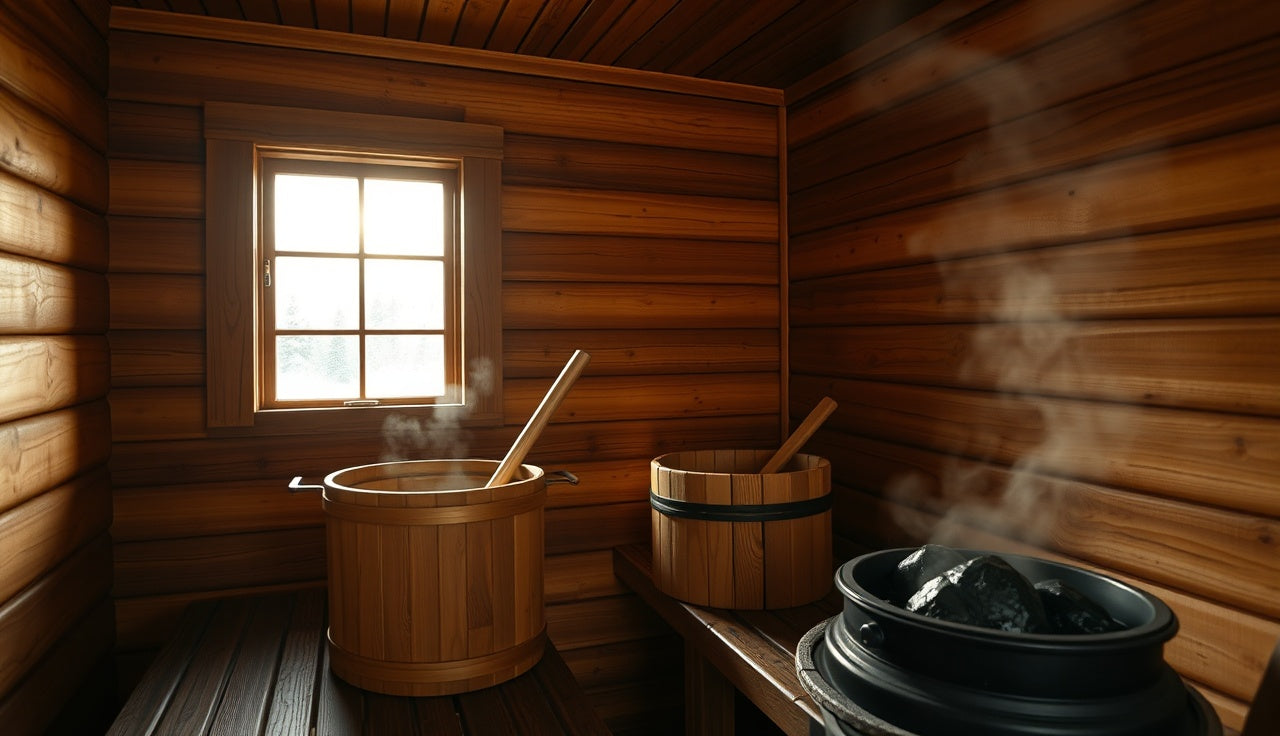
The heart of a Finnish sauna is the kiuas: a stove loaded with igneous rocks (usually olivine or peridotite) that soak up and radiate heat. Air temperature climbs to 170 to 195°F (77 to 90°C), but relative humidity stays low, 10% to 20%, so the heat feels intense yet breathable instead of suffocating [1]. A steam room does the opposite: 110 to 120°F at near 100% humidity. The sauna vs steam room breakdown covers the physiology if you want the full comparison.
Then there's loyly. That's the ritual that separates a real Finnish sauna from a sauna-shaped box. You ladle a little water over the hot rocks, it flash-vaporizes, and a wave of steam raises the perceived heat hard for 30 to 60 seconds before it disperses. Finnish saunas are social spaces, not solo wellness pods.
How does a Finnish sauna actually work?
The physics are simpler than the marketing suggests. The kiuas heats its rocks to 300 to 500°F (150 to 260°C). Those rocks hold enormous thermal mass, which is why a proper sauna keeps a stable temperature even when the door opens over and over. Electric heaters, the most common type for home use, run resistance coils that heat the rocks directly and take 30 to 60 minutes to reach operating temperature [2].
Wood-burning heaters take longer, usually 1 to 2 hours for the rocks to fully saturate, but the heat profile differs. A wood fire throws infrared radiation on top of convective heat, and many traditionalists prefer it for that. Neither type wins on health outcomes. The research base is built almost entirely on Finnish electric saunas, because that's what the long-running Finnish cohort studies used.
Room construction matters nearly as much as the heater. Authentic Finnish saunas use Nordic spruce, pine, or aspen for benches and walls. Those woods stay cool enough to touch (low thermal conductivity) and shrug off the repeated wet-dry cycling without warping badly. Cedar shows up in most North American products and performs about the same, though it smells different. Hemlock and basswood also work. The detail most buyers ignore is the insulation package behind the walls. Skimp there and the heater cycles constantly, energy costs climb, and the heat feels uneven.
What does the health research actually show?
The strongest evidence comes from Finland's KIHD study (Kuopio Ischemic Heart Disease Risk Factor Study), a prospective cohort that tracked 2,315 Finnish men for over 20 years. Men who used the sauna 4 to 7 times per week had a 63% lower risk of sudden cardiac death than men who went once a week [3]. The researchers controlled for exercise, smoking, alcohol, and existing cardiovascular disease. That doesn't prove cause, and the authors say plainly it's observational, but it's the cleanest long-running dataset we have.
A 2018 review in Mayo Clinic Proceedings summarized the cardiovascular literature and concluded that "regular sauna bathing is associated with a reduced risk of vascular diseases such as high blood pressure, cardiovascular disease, and neurocognitive diseases" [4]. The same review flagged a consistent blood pressure finding: acute sauna use drops systolic blood pressure about 6 to 8 mmHg in some studies, though it returns to baseline within 30 minutes of cooling down.
For athletic recovery, the evidence is thinner. A 2021 study in the Journal of Human Kinetics found post-exercise sauna sessions improved perceived recovery scores compared to passive rest, but sports-recovery samples are typically small (under 30 athletes) and protocols vary wildly [5]. Nobody has good long-term randomized controlled trial data for sauna as a recovery tool the way we do for cold exposure. The sauna benefits article goes deeper on the studied outcomes.
One real risk: the American College of Obstetricians and Gynecologists advises against sauna use in pregnancy [6]. Raising core temperature above 102°F (39°C) in the first trimester is linked to neural tube defect risk in animal models and observational human data. Alcohol plus sauna is a documented killer. Finnish fatality data shows alcohol as a cofactor in sauna-related deaths again and again.
| 1x per week (baseline) | 0% |
| 2–3x per week | 22% |
| 4–7x per week | 63% |
Source: JAMA Internal Medicine, Laukkanen et al., 2015
How much does a home Finlandia sauna cost?
The range is genuinely wide, from a few thousand dollars for a kit to well past $30,000 for a custom outdoor cabin. Here's a realistic breakdown by category:
| Type | Typical installed cost | Heater type | Session temp range |
|---|---|---|---|
| Pre-cut kit, indoor 2-person | $3,000 to $6,000 | Electric | 160 to 190°F |
| Pre-built indoor barrel sauna | $4,000 to $8,000 | Electric or wood | 160 to 190°F |
| Custom indoor room, 4-person | $8,000 to $20,000+ | Electric | 170 to 195°F |
| Outdoor cabin sauna | $10,000 to $30,000+ | Wood or electric | 160 to 200°F |
| Finlandia brand electric heater alone | $600 to $2,000 | Electric | depends on room size |
The Finlandia brand (finlandiasauna.com) sells heater units and pre-cut kits separately. Their heater line runs from roughly 3 kW (a small 1-2 person room) to 17 kW for larger commercial rooms, with residential units usually in the $600 to $2,000 range [7]. Pre-cut kit packages that bundle walls, benches, and a heater run $3,000 to $6,000 before installation labor.
Electrical work is the hidden cost. A 6 kW heater needs a dedicated 240V/30A circuit; an 8 to 12 kW heater may need 240V/40 to 60A. If your panel is maxed out, an electrician upgrade adds $500 to $2,500 depending on location and panel age. Permits matter too. Most jurisdictions require an electrical permit for the dedicated circuit and a building permit if you're adding square footage. Call your local building department before you order anything.
If a full indoor build is out of budget, a portable sauna gets you into Finnish-style heat for under $500. The experience isn't the same, but it's a start.
What size sauna heater do I need?
The standard rule from Finlandia and most heater makers is 1 kW of heater power per 45 cubic feet of room volume, assuming the room is well-insulated with proper vapor barriers [7]. A room that's 6 feet long by 5 feet wide by 7 feet tall (210 cubic feet) needs roughly 4.7 kW, so you'd size up to a 6 kW unit.
Adjustments matter. Add 25% capacity for a large glass door or window, because glass sheds heat fast. Add another 25% if you're heating a cold-climate garage or an outdoor structure. Under-sizing the heater is the single most common mistake in home builds. The room crawls to 140°F and stalls, loyly produces no vapor because the rocks never got hot enough, and the whole thing feels flat.
Placement shapes the session too. The kiuas sits in a corner or against one wall, usually at floor level, with the rocks reachable for water. Benches are tiered. The top bench (lauteet) runs 12 to 18 inches below the ceiling, where the hottest air pools. Finnish tradition uses a two-level bench so bathers pick their heat by moving up or down.
What are the real differences between a Finlandia sauna and other sauna types?
The Finnish sauna differs from three alternatives people usually compare it to.
Infrared sauna: An infrared sauna heats your body directly with light panels instead of heating the air. Room air typically sits at 120 to 140°F, well under a Finnish sauna. Some research uses infrared (a 2018 trial in Complementary Medicine Research found blood pressure and arterial stiffness improvements after 3 months), but the Finnish cohort studies behind the impressive longevity data all used traditional steam-capable saunas, not infrared [8]. The two aren't directly comparable.
American "health club" sauna: Most U.S. gym saunas are underpowered electric heaters in tile rooms with a drain, often running 150 to 160°F with oversized rocks and a sign forbidding water. They work, but loyly usually isn't possible. A home sauna built to Finnish specs beats them on every dimension.
Smoke sauna (savusauna): The oldest type, heated by a wood fire burning directly in the room with no chimney. Smoke cures the wood and rocks over several hours, then the fire dies and the room vents before anyone enters. The radiant heat off smoke-cured rocks is legendarily soft. Almost nobody builds these in the U.S. for a home setup.
How do I build or install a Finlandia sauna at home?
A pre-cut kit is the practical choice for most homeowners. The basic sequence: frame the room (or convert a closet or spare room), install a vapor barrier on all six surfaces, add insulation (R-11 to R-19 in the walls, R-19 to R-26 in the ceiling), install cedar or spruce tongue-and-groove paneling, build or set the benches, run the dedicated electrical circuit, mount the heater, and hang the door (usually tempered glass or solid wood with a magnetic latch).
The vapor barrier is the step most DIYers botch. Finnish tradition calls for an aluminum foil vapor barrier directly behind the paneling, foil facing into the room. That reflects radiant heat back into the space and blocks moisture from soaking the insulation. Plain polyethylene sheet works as a moisture barrier but reflects nothing.
Doors open outward. Always. It's both Finnish tradition and a safety rule: if someone passes out inside, a door that opens inward could trap them. The International Building Code doesn't specifically require outward-swinging sauna doors in homes, but every experienced sauna builder treats it as non-negotiable.
For outdoor builds, the outdoor sauna guide covers foundations, weatherproofing, and the permit landscape in more depth. Barrel saunas have taken off for outdoor installs because the round shape supports itself and needs no floor framing.
What is proper Finnish sauna etiquette and how do you use one correctly?
A Finnish sauna session isn't complicated, but a few rhythms make it work far better than just sitting in a hot box.
Here's a standard round. Sit on the top bench for 10 to 20 minutes, letting the heat build until you sweat freely. Exit. Cool down with a cold shower, outdoor air, or a lake if you're lucky. Rest 5 to 15 minutes. Repeat, 2 to 4 rounds total. A full session usually runs 1 to 2 hours. That cycle of heat stress and cool recovery is the mechanism most researchers believe drives the cardiovascular adaptations [3].
Loyly comes in small amounts, about a 200 to 400 ml ladle per person. Throw too much water at once and you get searing steam that scalds airways, especially on an overloaded heater. Pour slowly, from a low angle, aiming for the center of the rock pile.
Hydration is a between-rounds job. Finnish custom is to drink during the cooling periods, not inside the room. A typical 20-minute session at 185°F pulls 0.5 to 1.0 liters of sweat. Alcohol before or during sauna wrecks thermoregulation and drives most documented sauna fatalities. The Finnish Institute for Health and Welfare has studied this explicitly [9].
For athletes pairing heat with cold, a cold plunge after the rounds finishes the contrast therapy protocol. Some research suggests the heat-cold alternation produces a bigger cardiovascular stimulus than either alone, though the evidence on optimal protocols is still thin.
Are there safety concerns or contraindications?
Most healthy adults tolerate a Finnish sauna fine. The genuinely evidence-based concerns are narrower than sauna marketing implies, and narrower than the fear-based warnings suggest.
Cardiovascular: The KIHD data is actually reassuring for people with stable cardiovascular disease. Still, acute sauna use pushes heart rate to 100 to 150 bpm, comparable to moderate exercise. Anyone with unstable angina, a recent heart attack, or poorly controlled hypertension should get a physician's clearance first [4].
Overheating: Core temperature rises about 1°C every 10 to 15 minutes in a properly hot sauna. Sessions past 20 minutes without a cooling break can push core temperature into problem territory, especially for people who are dehydrated or very old. Listen to your body. Dizziness, nausea, or a headache means get out now.
Medications: Some antihypertensives, diuretics, and cardiac drugs change thermoregulation or electrolyte balance. The interaction with sauna heat is under-studied. When in doubt, ask the prescribing physician.
Electrical safety: The heater must sit on a GFCI-protected circuit. NFPA 70 (the National Electrical Code), Article 424, covers fixed electric space heating equipment and sets the grounding and circuit requirements that apply to sauna heaters [10]. Use a licensed electrician.
How does Finlandia compare to other sauna brands?
Finlandia Sauna Products has made heaters and pre-cut kits in North America since 1964, one of the oldest domestic brands in the category. Their heaters come out of a partnership with Finnish heater suppliers, and the core line is solid mid-range gear, not the cheapest and not the top of the market.
For comparison, here are the main brands in the North American residential sauna market:
| Brand | Origin | Price tier | Known for |
|---|---|---|---|
| Finlandia | Canada/Finland | Mid | Long track record, pre-cut kits |
| Harvia | Finland | Mid-premium | Wide heater range, Finnish-made |
| Tylö | Sweden | Premium | High-end commercial and residential |
| HUUM | Estonia | Premium | Design-forward, app control |
| Amerec | USA | Mid | Commercial-focused, wide distribution |
| Almost Heaven | USA | Entry-mid | Barrel saunas, value segment |
For a home builder who wants a reliable kiuas without paying for brand prestige, Finlandia and Harvia are the two names the sauna enthusiast community recommends most. Both use real igneous rocks, both keep spare parts in stock, and both carry UL or ETL listing for North American electrical standards.
SweatDecks carries a curated selection of home sauna setups if you want to browse configurations already sized for residential installation.
One thing to keep straight: the name "Finlandia" has nothing to do with Finnish government certification. There is no official "Finlandia approval" for saunas. Finland's national sauna association (Suomen Saunaseura) keeps traditional standards but does not certify commercial products sold abroad.
What should I look for when buying a Finlandia sauna kit or heater?
Start with the heater. The rocks are the soul of the sauna, and an underpowered or badly designed heater ruins every session. Look for a rock capacity of at least 20 to 25 kg for a residential room. More rock mass means slower heat-up but steadier temperature and better loyly steam. The Finlandia FLB and FIN electric series and several Harvia models clear that minimum.
Check the safety listing. In North America, look for UL or ETL listing on the heater. Canadian Standards Association (CSA) certification is the Canadian equivalent. An unlisted heater is a real insurance and fire problem, not a theoretical one.
For the kit, assess the wood. Vertical grain cedar or spruce panels outlast flat-sawn boards. The tongue-and-groove profile should be tight, no visible gaps. Bench material needs to be smooth enough to sit on comfortably and free of knots at seating level, since knots get hot and burn skin.
The door glass should be at least 10mm tempered safety glass. Hardware should be stainless steel or coated to survive the moisture. The thermometer and hygrometer are small purchases that matter a lot for running good sessions. A sauna reading 150°F needs more heat before loyly works well, and you won't know without a gauge.
Still deciding whether a full build is right for you? Comparing a home sauna build against a portable sauna is a useful middle step. And if you're serious about contrast therapy for recovery, pairing the sauna with a cold plunge gives you the full Finnish protocol.
Frequently asked questions
What temperature does a Finlandia sauna run at?
A properly built Finnish sauna runs 170 to 195°F (77 to 90°C) at 10 to 20% relative humidity. Humidity spikes briefly to 40 to 60% during loyly (water poured on the rocks) then drops back. Anything below 160°F usually means an undersized heater or poor insulation. Most users find 180 to 190°F the sweet spot for effective sweating without overwhelming discomfort.
How long does it take to heat a Finlandia sauna?
An electric kiuas takes 30 to 60 minutes to bring the room to operating temperature, depending on room size and insulation quality. Wood-burning heaters take 1 to 2 hours because the rocks need to fully saturate with heat before loyly works properly. Running the heater to full temperature before entering, not cutting it short, is what produces good steam.
How often should you use a Finnish sauna for health benefits?
The KIHD cohort study found the strongest cardiovascular associations with 4 to 7 sessions per week, but even 2 to 3 sessions per week showed meaningful benefit over once a week. Session length in that study averaged 14 minutes per round. Nobody has a clean dose-response curve yet. Two or three 15-20 minute sessions per week is a reasonable starting point for most healthy adults.
What is loyly and how do you do it correctly?
Loyly (pronounced roughly LOO-loo) is the Finnish practice of pouring water on the hot sauna rocks to create a burst of steam. Use a small wooden ladle and about 200 to 400 ml per pour. Aim for the center of the rock pile and pour slowly. Too much water at once can produce searing steam. Let the vapor disperse fully (30 to 60 seconds) before the next ladle.
Can you use a Finlandia sauna every day?
Daily sauna use appears safe for healthy adults and is normal in Finland, where roughly 3 million saunas exist for a population of 5.5 million. The Finnish Institute for Health and Welfare reports that many Finns sauna daily. The main daily-use risks are dehydration (replace fluids after each session) and the additive effect of alcohol, which sharply raises danger in any sauna session.
What wood is used in a Finnish sauna?
Traditional Finnish saunas use Nordic spruce, alder, or aspen. In North American products, western red cedar is the most common because it resists moisture well, has low thermal conductivity (stays cool to touch), and is easy to find. Hemlock and basswood are solid alternatives at lower price points. Avoid pressure-treated or resinous woods like pine in the hot areas, since heat can make resin bleed.
Is a Finlandia sauna better than an infrared sauna?
They cover different temperature ranges and the research bases are separate. A Finnish sauna runs 170 to 195°F and produces loyly steam; the longest cardiovascular outcome studies used traditional Finnish saunas. Infrared saunas run 120 to 140°F with no steam option and have smaller studies showing blood pressure and relaxation benefits. Most experienced users prefer the Finnish style for the full experience, but infrared is easier to install.
How much does it cost to run a home sauna electrically?
A 6 kW heater running for 1 hour uses 6 kWh. At the U.S. average residential rate of about 16 cents per kWh (EIA, 2024), that's roughly 96 cents per session. A 9 kW heater in a larger room costs about $1.44 per hour. Annual cost for 4 sessions per week with a 6 kW unit is roughly $200. Actual cost varies by local rates and insulation quality.
Do you need a permit to install a home sauna?
Almost certainly yes for the electrical work: a dedicated 240V circuit for the heater requires an electrical permit in most U.S. jurisdictions under the National Electrical Code. If the sauna room adds conditioned square footage, a building permit is also typically required. Rules vary by city and county, so check with your local building department before starting. Skipping permits creates problems at resale and may void homeowner's insurance.
What is the difference between a Finnish sauna and a steam room?
A Finnish sauna runs 170 to 195°F at 10 to 20% humidity; a steam room runs 110 to 120°F at close to 100% humidity. The Finnish sauna produces dry heat with brief steam from loyly; the steam room maintains continuous mist from a steam generator. The breathing experience is very different: sauna air is hot and dry, steam room air is thick and wet. Most traditional health benefit research comes from Finnish sauna data, not steam rooms.
What rocks are used in a Finlandia sauna heater?
Finnish tradition uses olivine (peridotite) rocks, dense igneous stones that store heat well and resist fracturing from repeated water exposure. Some heaters use diabase or granite variants. Replace the rocks every 3 to 5 years as they fracture and lose heat-storage capacity over time. Never use porous rocks like sandstone or other sedimentary stones; they can explode when water hits them hot.
Can you put a Finlandia sauna outdoors?
Yes, and outdoor saunas are traditional in Finland. Outdoor builds need weatherproof construction, an appropriate foundation (concrete pad, piers, or a full floor frame), and careful attention to the vapor barrier system since temperature differentials are greater. Wood-burning heaters are common outdoors because they don't require running 240V underground. Barrel saunas are a popular ready-made outdoor option that installs faster than a custom build.
Is it safe to sauna while pregnant?
The American College of Obstetricians and Gynecologists advises against activities that raise core body temperature above 102°F (39°C) during the first trimester, due to association with neural tube defect risk. Traditional Finnish sauna temperatures easily exceed this threshold. Pregnant women should consult their physician before using any sauna. Most OBs recommend avoiding sauna use, particularly in the first trimester.
What is the Finlandia sauna brand and where are their products made?
Finlandia Sauna Products Inc. was founded in 1964 in Vancouver, British Columbia. Their heaters are produced in partnership with Finnish manufacturing partners. They sell pre-cut sauna kits, electric heaters (3 to 17 kW range), accessories, and replacement parts. They are one of the few North American companies with a direct Finnish manufacturing heritage and a decades-long distribution network across the U.S. and Canada.
Sources
- Harvard T.H. Chan School of Public Health, The Nutrition Source: Sauna Use: Finnish sauna air temperature runs 70–100°C (160–212°F) with relative humidity of 10–20%
- Finlandia Sauna Products Inc., Heater Installation and Sizing Guide: Electric kiuas units require 30–60 minutes to reach operating temperature; sizing at 1 kW per 45 cubic feet of well-insulated room
- JAMA Internal Medicine, Laukkanen et al. 2015, Association Between Sauna Bathing and Fatal Cardiovascular and All-Cause Mortality Events: Men using sauna 4–7 times/week had 63% lower risk of sudden cardiac death vs. once/week in the 2,315-person KIHD cohort over 20 years
- Mayo Clinic Proceedings, Laukkanen et al. 2018, Cardiovascular and Other Health Benefits of Sauna Bathing: Regular sauna bathing is associated with reduced risk of vascular diseases including high blood pressure and cardiovascular disease; acute use produces 6–8 mmHg systolic blood pressure drop
- American College of Obstetricians and Gynecologists (ACOG), Committee Opinion on Exercise During Pregnancy: ACOG advises avoiding activities that raise maternal core temperature above 102°F (39°C) in the first trimester due to risk of neural tube defects
- Finlandia Sauna Products Inc., Product Catalog and Heater Specifications: Residential Finlandia electric heaters range from 3 kW to 17 kW; retail pricing approximately $600–$2,000 for residential units; sizing recommendation of 1 kW per 45 cubic feet
- Complementary Medicine Research, Brenke et al. 2018, Infrared Sauna in Heart Failure: 3-month infrared sauna use associated with improvements in blood pressure and arterial stiffness in study participants
- Finnish Institute for Health and Welfare (THL), Sauna Safety Report: Alcohol consumption is a consistent cofactor in Finnish sauna-related fatalities; THL has documented this pattern in national mortality data
- NFPA 70 National Electrical Code, Article 424, Fixed Electric Space Heating Equipment: NEC Article 424 governs fixed electric space heating including sauna heaters, requiring dedicated circuits, grounding, and GFCI protection where applicable
- U.S. Energy Information Administration (EIA), Electric Power Monthly, Average Retail Price of Electricity 2024: U.S. average residential electricity rate approximately 16 cents per kWh as of 2024
- Statistics Finland / Finnish Sauna Society (Suomen Saunaseura), Finnish Sauna Culture Facts: Finland has approximately 3 million saunas for a population of 5.5 million; daily sauna use is common and considered safe for healthy adults

Share:
Inflatable cold plunge tubs: the complete buyer's guide
Radiant health sauna: what it is, what the research shows, and how to choose one