
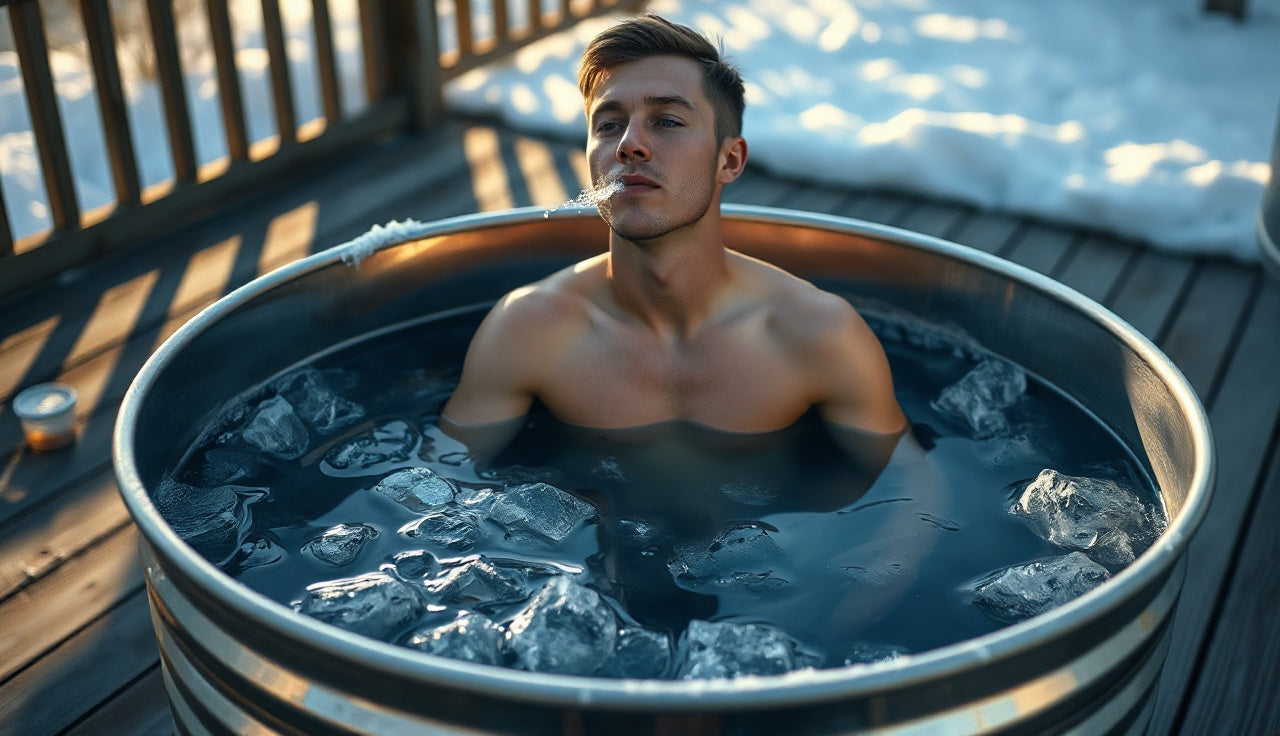
Last updated 2026-07-09
TL;DR
Ice bathing means immersing your body in water between 50°F and 59°F (10 to 15°C) for 10 to 15 minutes. Research shows it cuts delayed-onset muscle soreness by roughly 20% versus passive rest. The cold triggers vasoconstriction, a norepinephrine spike, and a brief anti-inflammatory response. It's no cure-all. But for recovery and mental toughness, it's one of the more evidence-backed things you can do at home.
What is ice bathing and how is it different from a cold shower or cold plunge?
Ice bathing is full or partial body immersion in cold water, usually 50 to 59°F (10 to 15°C), for 5 to 20 minutes. A cold shower runs over the skin but never surrounds it. That distinction matters more than it sounds. Water pulls heat away from the body roughly 25 times faster than air at the same temperature [1], so a 55°F bath draws heat out of your muscles in a way a 55°F breeze never could.
A cold plunge usually means a dedicated tub or vessel, sometimes chilled by a machine. An ice bath, in the traditional sense, means filling a tub with water and dumping bags of ice in until you hit your target temperature. The physiology is identical if the temperature matches. What changes is cost, convenience, and how precisely you can hold the temp.
Some people use the terms interchangeably. For this article, "ice bathing" covers any deliberate whole-body cold immersion in that 50 to 59°F window, whatever the container.
What does ice bathing actually do to your body?
The second cold water hits your skin, several things happen fast. Peripheral blood vessels clamp down and push blood toward your core organs. Your heart rate drops a little. Your sympathetic nervous system fires hard and dumps norepinephrine into your blood. Within seconds, your body reads the situation as survival.
Norepinephrine is the interesting part. A 2004 study by Pirkko Huttunen and colleagues in the International Journal of Circumpolar Health found that regular cold water immersion raised norepinephrine levels by 200 to 300% [2]. That neurochemical jump is behind much of the mood lift people describe. It isn't mystical. It's a measurable stress hormone response, the same family you'd get from a hard workout.
Inflammation is messier. Cold cuts blood flow to damaged tissue, which slows swelling right after exercise. A 2012 Cochrane review of 17 randomized trials found cold water immersion reduced delayed-onset muscle soreness (DOMS) compared to passive rest, with effects showing up at 24, 48, 72, and 96 hours post-exercise [3]. Later meta-analyses confirmed those effects held.
Here's the tradeoff. The same blunting of inflammation that eases soreness may also slow muscle adaptation if you ice bath right after every strength session. A 2015 paper in the Journal of Physiology by Roberts and colleagues found post-exercise cold water immersion cut long-term gains in muscle mass and strength compared to active recovery [4]. When and why you use it matters a lot.
What temperature should the water be for an ice bath?
Aim for 50 to 59°F (10 to 15°C). That's the range most sports medicine and exercise science literature settles on [3]. Colder than that raises the risk of cold shock and, with long exposure, hypothermia, without buying you more benefit. Warmer than 60°F softens the vasoconstriction enough that you're barely stress-dosing the body.
At home, the method is simple. Fill the tub with cold tap water, then add ice until the temperature drops into range. A floating thermometer does the job. If you're running a dedicated unit, most quality cold plunge tubs hold 50 to 55°F without constant ice top-ups.
New to this? Start warm, around 58 to 60°F, and work down over a few weeks. The adaptation is real. What feels paralyzing in week one feels uncomfortable but doable by week four.
| Water Temperature | Physiological Effect | Recommended Duration |
|---|---|---|
| 60 to 68°F (15 to 20°C) | Mild vasoconstriction, modest temp drop | 15 to 20 min |
| 50 to 59°F (10 to 15°C) | Strong vasoconstriction, DOMS reduction | 10 to 15 min |
| 41 to 50°F (5 to 10°C) | Intense cold shock response, rapid core cooling | 5 to 10 min max |
| Below 41°F (<5°C) | Dangerous for most people, hypothermia risk | Not recommended |
| 24 hrs post-exercise | 1.4 |
| 48 hrs post-exercise | 1.6 |
| 72 hrs post-exercise | 1.5 |
| 96 hrs post-exercise | 1.2 |
Source: Bleakley et al., Cochrane Database of Systematic Reviews, 2012 [3]
How long should you stay in an ice bath?
The research sweet spot is 11 to 15 minutes at 50 to 59°F for recovery [3]. Staying longer in that range doesn't add much and starts pushing into real cold stress. The Cochrane authors noted most trials with positive results used 11 to 15 minute protocols.
Shorter sessions, around 5 to 7 minutes, seem to trigger the norepinephrine spike without fully delivering the anti-inflammatory effect on muscle. So there's a case for short sessions on days when you just want the mental jolt and recovery isn't the point.
The variable that matters is cooling your core tissue, more than your skin. That takes time and depends on water temperature. At 50°F, 10 minutes is about the floor for meaningfully cooling the muscle in your legs. At 55°F, you might need 13 to 15 minutes for the same effect.
Don't white-knuckle your way to 20 minutes on day one. The biggest risk for beginners isn't injury. It's building an aversion so strong you quit.
What are the real benefits of ice bathing, according to research?
Let's separate what the evidence shows from what's hype.
Well-supported: less DOMS. The Cochrane review [3] is the strongest evidence, covering thousands of participants across 17 trials. The effect is real and consistent. If your goal is to train hard, stay less sore, and repeat quickly, ice bathing is one of the more reliable tools you have.
Well-supported: mood and alertness. The norepinephrine spike is documented [2], and the anecdotal reports line up with the biology. Nobody has run a large randomized trial on ice baths for depression, but the mechanism is plausible and the risk is low for healthy adults.
Moderately supported: less swelling in acute injury. The old RICE protocol (rest, ice, compression, elevation) was the clinical standard for decades, though newer guidance has questioned aggressive icing of fresh injuries [5]. Some sports medicine authors proposed replacing RICE with PEACE & LOVE in 2019.
Weakly supported or oversold: fat loss through brown fat, immune boosts, longevity. The brown fat story is real in rodents and there's some human data [6], but controlled human fat-loss trials on ice bathing are thin and the effect sizes are small.
For the cold plunge benefits crowd that wants the full rundown, the honest read is this: ice bathing is a real recovery tool with real neurological effects. It is not a metabolic miracle.
The 2012 Cochrane review stated that "cold water immersion was more effective than passive rest in reducing muscle soreness" at multiple post-exercise timepoints, a finding later meta-analyses have echoed [3].
Is ice bathing safe, and who should avoid it?
For most healthy adults, brief cold water immersion is safe. The risks are real but manageable with basic precautions.
Cold shock is the main acute risk. When cold water hits your face and torso, you gasp involuntarily, your heart rate spikes, and you may hyperventilate. This response peaks in the first 30 to 90 seconds and is behind most cold-water drowning deaths [7]. Enter gradually. Sitting in a tub removes the submersion danger that makes open-water cold shock lethal.
Hypothermia takes sustained exposure. In a 50 to 55°F bath, a healthy adult won't reach clinical hypothermia in 15 minutes. But lose track of time, fall asleep (it happens), or have poor thermoregulation, and it becomes a real concern. Set a timer. Tell someone you're doing it, especially early on.
Who should skip it or check with a doctor first:
- People with Raynaud's disease (cold triggers severe vascular spasm)
- Anyone with a history of cardiac arrhythmia or a recent heart event
- People with hypertension that isn't well controlled (cold spikes blood pressure sharply)
- Pregnant women
- Anyone on medications that impair thermoregulation
The CDC has no ice bath guidance specifically, but its cold water and hypothermia safety pages note that water below 60°F can overwhelm even strong swimmers fast, which is exactly why a controlled setting matters [7].
One thing worth saying plainly: ice bathing nude, which many people prefer for full skin exposure, is fine physiologically. The only practical note is that neoprene or thick fabric slows heat transfer, so going without a suit gets you the full temperature effect faster. Whether you want that depends on your experience level.
How do you set up an ice bath at home?
The simplest setup is a standard bathtub, cold tap water, and 20 to 40 lbs of bagged ice from a gas station or grocery store. Fill the tub halfway with cold water, add ice, stir, and check the temperature. Budget $5 to 10 per session in ice if you go this route often.
The next step up is a large stock tank, usually 100 to 150 gallon galvanized steel, from a farm supply store for $150 to 300. These are wide enough to sit comfortably and deep enough to cover your torso. You'll still need ice, but the larger volume holds cold longer.
Dedicated cold plunge tubs with mechanical chillers run $2,000 to $7,000 for quality residential units. They hold temperature without ice, filter the water, and let you set an exact number. If you're plunging 5 or more times a week, the math starts favoring the upfront cost over endless ice runs.
Portable inflatable options exist in the $100 to 400 range. They work, but most insulate poorly, so temperature drops fast on hot days and you're back to buying serious ice.
In cold climates, a stock tank or purpose-built plunge tub set outside stays cold on its own through winter. Some people pair this with a home sauna for contrast therapy, alternating heat and cold. There's decent evidence the contrast protocol (sauna then cold plunge) improves circulation and subjective recovery more than either alone, though most of that research is observational so far.
SweatDecks carries cold plunge tubs and accessories for home recovery setups, including chest freezer conversions and dedicated plunge vessels.
Should you ice bath before or after a workout?
After. Almost always after, with a few caveats.
Pre-workout cold immersion temporarily cuts muscle power. A 2010 review found that cooling muscle tissue before exercise reduced sprint speed and jump height [8]. That's the opposite of what you want heading into a session.
Post-workout, the question is immediate or wait an hour. For endurance athletes or anyone focused purely on recovery, immediate post-exercise immersion maximizes the anti-inflammatory and soreness-reducing effect. For strength and hypertrophy goals, waiting 4 to 6 hours, or skipping it after your hardest lifting sessions, preserves more of the adaptation signal.
The Roberts 2015 paper [4] is the reference here. Over 12 weeks, people who used cold water immersion after every strength session gained less muscle mass and strength than those who did active recovery (light cycling). The gap was meaningful: the cold group showed roughly half the hypertrophy gains.
So, in practice: use ice bathing freely after conditioning, long runs, or games. Be selective after heavy lifting days. It's not a rigid rule, but it's what the best evidence supports.
Does ice bathing help with mental health and stress?
This is where the science is promising but early, so be honest with yourself about certainty.
The norepinephrine and dopamine response to cold immersion is measurable and repeatable [2]. Norepinephrine drives mood, focus, and stress tolerance. The calm-but-alert feeling regular ice bathers describe matches what you'd predict from that chemistry.
A small 2022 study in PLOS ONE looked at open-water swimming (cold, immersive, outdoors) in adults with depression and found improved depression scores, though the study was small, unblinded, and tangled up with exercise and social factors [9]. Nobody has done the gold-standard randomized controlled trial of ice bathing versus antidepressants. Be skeptical of anyone who implies the evidence is stronger than that.
Here's what's fair to say. Cold immersion creates a genuine physiological stress that, practiced regularly and by choice, appears to build stress tolerance. You're training your nervous system to stay calm under pressure. Whether that carries over to everyday stress is plausible but not proven at scale.
There's also a behavioral piece that gets overlooked. Doing something hard on purpose, day after day, in a controlled setting, builds confidence. That's not a chemical mechanism. It's just what hard things do to people who keep showing up.
How does ice bathing compare to contrast therapy (alternating hot and cold)?
Contrast therapy, cycling between a hot environment like a sauna and cold immersion, has its own evidence base and may beat cold alone for acute recovery.
The proposed mechanism is a vascular pump. Heat dilates blood vessels, cold constricts them, and cycling between the two moves blood in and out of peripheral tissue more aggressively than either does solo. Some small trials found contrast therapy better than cold alone for reducing DOMS and perceived fatigue [10].
If you have both heat and cold on hand (say a sauna and a cold plunge), the standard protocol is sauna for 15 to 20 minutes at around 175 to 195°F, then cold immersion for 5 to 10 minutes, repeated 2 to 3 rounds. End on cold if recovery and alertness are the goal. End on heat if sleep and relaxation are the priority.
For the heat side of this, sauna benefits covers what heat exposure does to the body and where the research is strong. The short version: the cardiovascular and growth hormone responses from sauna are well-documented and pair well with cold's anti-inflammatory effects.
If you're building a home setup for contrast therapy, pairing a plunge tub with an outdoor sauna is the most common configuration. Proximity matters. You don't want a 200-foot walk between protocols in January.
How much does ice bathing cost and what equipment do you actually need?
Here's a realistic cost breakdown:
| Setup Type | Upfront Cost | Ongoing Cost | Best For |
|---|---|---|---|
| Bathtub + grocery store ice | $0 | $5 to 15/session | Casual or beginner use |
| Stock tank (100 to 150 gal) | $150 to 300 | $5 to 10/session in ice | Budget-conscious regular users |
| Chest freezer conversion (DIY) | $300 to 600 (used freezer + pump) | ~$15 to 20/mo electricity | Frequent use, DIY-comfortable |
| Portable inflatable plunge tub | $100 to 400 | Ice cost varies | Travel, small spaces |
| Dedicated cold plunge unit (chilled) | $2,000 to 7,000 | $20 to 50/mo electricity | Daily use, no ice hassle |
For 1 to 2 sessions a week, the bathtub-and-ice method is completely legitimate and costs almost nothing beyond the ice. The math flips if you're plunging 5 to 7 days a week. At $10 a session, that's $300 to 400 a month on ice, which makes a chiller unit look reasonable inside 12 to 18 months.
Beyond the container you need a waterproof thermometer (under $15), a timer, and a way to warm up after (robe, towels, warm space). Add a rubber mat inside the tub if the surface is slippery. That's genuinely it.
If you're building a home recovery space and want to compare tubs, SweatDecks has a cold plunge collection that runs from entry-level portable tubs to chilled units, with filter systems on the higher-end models.
What should you do after an ice bath to recover properly?
Get out before you're too cold to move safely. Sounds obvious, but cold impairs fine motor control, so having a robe or towel within arm's reach matters more than you'd think.
Once you're out, dry off, put on warm layers, and move gently. Light walking or easy movement restores circulation faster than sitting still. Don't jump straight into a hot shower. The rapid reversal can make you dizzy as blood rushes back to the periphery.
Don't skip the rewarming. Shivering is your body doing its job, but sustained shivering after you've dried and dressed is a signal to warm the room. A warm (not hot) drink helps more psychologically than thermally, but it doesn't hurt.
Most people feel the mood lift and mental clarity within 20 to 30 minutes of getting out, as norepinephrine peaks and the body settles. That window is a great time to eat, work, or train if your schedule allows.
One thing to avoid: going back to sleep right after, especially in a cold room. In beginners, the thermoregulatory response can lag, and falling asleep before you've fully rewarmed is one of the less common but real risk scenarios.
Frequently asked questions
How cold does water need to be for an ice bath to work?
The research-supported range is 50 to 59°F (10 to 15°C). Water in this range produces meaningful vasoconstriction and reduces delayed-onset muscle soreness in clinical trials. Going colder adds risk without proportional benefit. Going warmer than 60°F reduces the physiological stimulus significantly. A basic floating thermometer is all you need to confirm you're in range.
How long should a beginner stay in an ice bath?
Start with 5 minutes at the warmer end of the range (57 to 60°F). The goal is to stay calm and breathe through the cold shock response, not to prove toughness. Work up to 10 to 15 minutes over several weeks as your tolerance builds. Most research showing meaningful recovery benefits used 11 to 15 minute protocols, so that's a reasonable long-term target.
Is it OK to ice bath every day?
For most healthy adults, daily cold immersion appears safe. The concern is that daily post-strength-training ice baths may blunt muscle adaptation over time, per the Roberts 2015 study. A practical middle ground: ice bath daily if you're focused on conditioning and recovery, but skip it or delay it on days after heavy strength work if hypertrophy is a goal.
Can ice bathing help with weight loss or burning fat?
Cold exposure does activate brown adipose tissue (brown fat), which burns calories to generate heat. There's real human data on this. But the caloric expenditure is modest, and no controlled trial has shown meaningful fat loss from ice bathing alone. The metabolic effect is real but small. Treat it as a potential minor bonus, not a weight-loss strategy.
What's the difference between an ice bath and a cold plunge?
Physiologically, nothing if the temperatures match. "Ice bath" usually means a bathtub or container filled with water and ice. "Cold plunge" often refers to a dedicated vessel, sometimes mechanically chilled. The terms get used interchangeably. The key variables are water temperature and immersion duration, not the specific container type.
Is ice bathing nude better than wearing a swimsuit?
Nude ice bathing increases the rate of heat transfer slightly because there's no fabric layer between your skin and the water. A thin swimsuit probably makes a small difference; thick neoprene makes a bigger one. For maximum cold stimulus in the research-supported temperature range, going without a suit is fine physiologically. It comes down to personal preference and context.
Should I ice bath before or after a sauna?
After. In contrast therapy protocols, sauna comes first (heat causes vasodilation), then cold plunge (cold causes vasoconstriction). This sequence creates the strongest vascular pump effect. If you reverse it, you're starting cold and then warming up, which is still fine for relaxation but doesn't produce the same circulatory contrast. End on cold for alertness, on heat for sleep and relaxation.
Can ice bathing reduce inflammation?
Yes, in the acute post-exercise sense. Cold reduces blood flow to peripheral tissue, slowing the inflammatory cascade in the first 24 to 72 hours after hard exercise. This is why DOMS is consistently lower in ice bath groups across clinical trials. The tradeoff is that this same anti-inflammatory effect may reduce the adaptive signal for muscle growth if used after every strength session.
Is ice bathing dangerous for people with heart conditions?
Potentially yes. Cold water immersion causes a rapid spike in heart rate, blood pressure, and sympathetic nervous system activity. For people with cardiac arrhythmia, uncontrolled hypertension, or a recent cardiac event, this is a real risk. Consult a physician before starting if any of those apply to you. Healthy adults without cardiac history face minimal risk in a controlled, timed bath.
How many bags of ice do you need for an ice bath?
It depends on your starting tap water temperature and target. As a rough guide, to bring a half-full standard bathtub from 65°F to 55°F, you typically need 20 to 40 lbs of ice (2 to 4 standard 10-lb bags). In summer when tap water runs warmer (70 to 75°F), you may need 40 to 60 lbs. Buy a thermometer and dial it in based on your actual tap temperature.
Does ice bathing help with anxiety or depression?
The evidence is early but plausible. Cold immersion produces a documented spike in norepinephrine, a neurotransmitter involved in mood and alertness. A small 2022 PLOS ONE study found improved depression scores in open-water swimmers, though it was small and confounded by other factors. No large clinical trial has tested ice bathing as a treatment for anxiety or depression specifically. The effect is real; the magnitude is uncertain.
What's the cheapest way to do ice bathing at home?
A standard bathtub plus bagged ice from a grocery store or gas station costs $0 to set up and $5 to 15 per session in ice. A 100 to 150 gallon galvanized steel stock tank from a farm supply store ($150 to 300) is the next step up: more room, holds temperature longer, and moves to the backyard easily. Beyond that, DIY chest freezer conversions or purpose-built chilled plunge units are the options.
Sources
- Engineering Toolbox: Thermal Conductivity of Common Materials: Water conducts heat approximately 25 times faster than air at equivalent temperatures
- Huttunen P et al., International Journal of Circumpolar Health, 2004: Norepinephrine and cold water immersion: Regular cold water immersion raised norepinephrine levels by 200–300% in study participants
- Bleakley C et al., Cochrane Database of Systematic Reviews, 2012: Cold water immersion for preventing and treating muscle soreness after exercise: Cold water immersion reduced delayed-onset muscle soreness compared to passive rest at 24, 48, 72, and 96 hours post-exercise across 17 trials; optimal protocol 11–15 min at 50–59°F
- Roberts LA et al., Journal of Physiology, 2015: Post-exercise cold water immersion attenuates acute anabolic signalling and long-term adaptations in muscle: Cold water immersion after every strength session significantly reduced muscle mass and strength gains over 12 weeks compared to active recovery
- Dubois B & Esculier J-F, British Journal of Sports Medicine, 2020: PEACE & LOVE acronym for soft tissue injuries: Updated sports medicine guidance questioned aggressive icing of acute injuries and proposed PEACE & LOVE as a replacement for RICE
- van Marken Lichtenbelt WD et al., New England Journal of Medicine, 2009: Cold-activated brown adipose tissue in healthy men: Cold exposure activates brown adipose tissue in humans, which burns calories to generate heat
- CDC: Cold Water Survival and Hypothermia Safety: Water below 60°F can overwhelm thermoregulation quickly; cold shock response causes involuntary gasping and hyperventilation in the first 30–90 seconds of immersion
- Crowther RG et al., Journal of Strength and Conditioning Research, 2010: Pre-exercise muscle cooling and performance: Cooling muscle tissue before exercise reduced sprint speed and jump height in reviewed studies
- van Tulleken C et al., PLOS ONE, 2022: Open water swimming and depression symptoms: Small study found improvements in depression scores in participants who engaged in regular open-water cold water swimming, with caveats about confounding factors
- Bieuzen F et al., PLOS ONE, 2013: Contrast water therapy and exercise-induced muscle damage: Contrast water therapy showed superior recovery outcomes compared to cold water immersion alone in some small trials measuring DOMS and fatigue
- National Institute of Environmental Health Sciences (NIEHS): Referenced for physiological temperature thresholds in cold water immersion safety guidance

Share:
Inflatable ice bath: everything you need to know before buying
Inflatable ice bath: everything you need to know before buying