
Last updated 2026-07-09
TL;DR
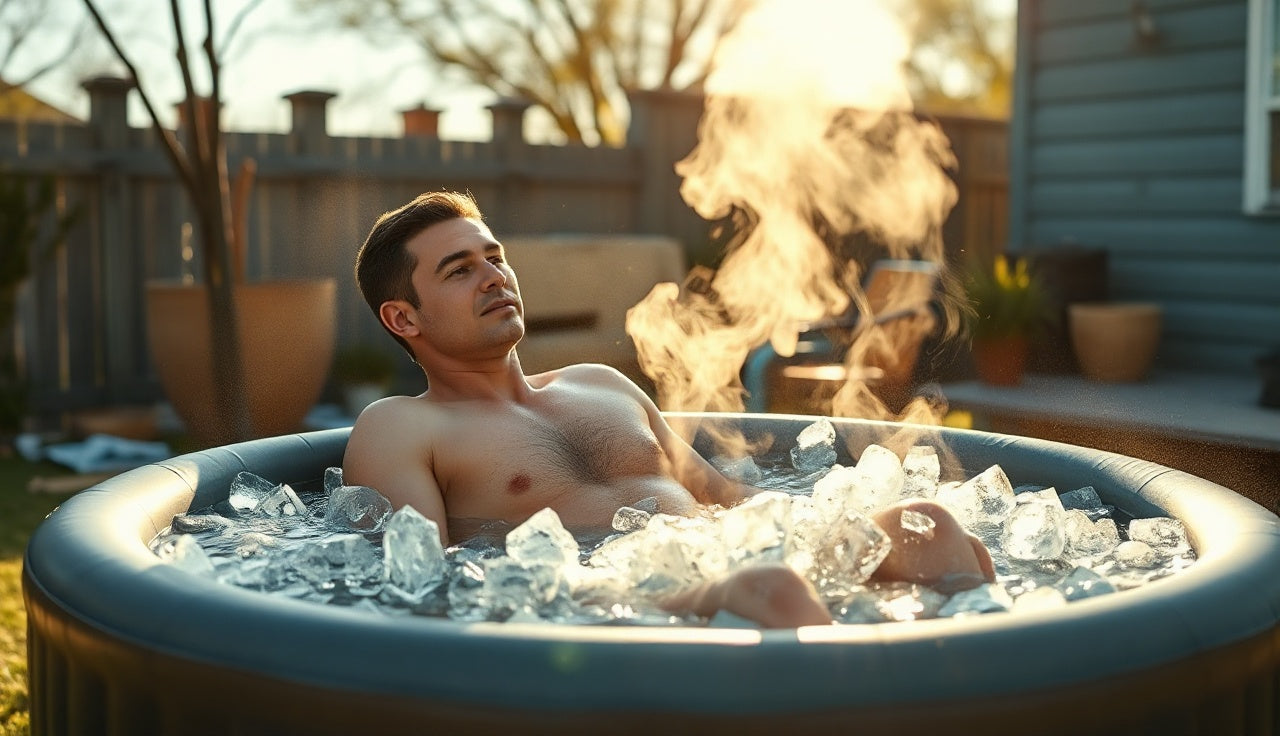
An inflatable ice bath is a portable, air-walled tub you fill with cold water and ice for cold water immersion at home. Good ones hold temperature for 20 to 40 minutes, cost $40 to $300, and pack into a bag. They work for recovery, but they trade away insulation, durability, and depth compared to rigid cold plunges.
What is an inflatable ice bath tub and how does it work?
An inflatable ice bath is exactly what it sounds like. It's a freestanding tub made from layered PVC or TPU walls that you inflate with a hand or electric pump, fill with water, and cool with ice or a chiller attachment. The air-filled walls do double duty: light insulation, plus a stable shape without any rigid frame or plumbing.
Setup takes five to fifteen minutes. Inflate the walls, set the tub on a flat surface (indoors or outdoors), fill with water, add ice, wait for the temperature to drop to your target range, and get in. Most tubs hold 150 to 250 liters. That's enough to submerge from the neck down if you sit upright.
They are not the same as a cold plunge. That term usually means a hard-shell insulated unit, sometimes with a built-in chiller, that holds temperature for hours or days. An inflatable tub relies on ice you add yourself or a portable chiller you clip to the side. Hold time is shorter. Ice consumption is higher. And the walls won't survive years of hard use the way rigid units do. For anyone who wants to try cold plunge therapy without dropping hundreds or thousands of dollars, an inflatable tub is a reasonable place to start.
How cold do inflatable ice baths actually get, and how long do they stay cold?
Fill temperature and hold time depend on three things: your ambient temperature, the quality of the tub walls, and how much ice you use. In a typical indoor or shaded outdoor spot (65 to 75°F ambient), here's what to expect:
- Starting water temperature after filling: 55 to 65°F with tap water, depending on your region and season
- With 20 to 30 lbs of ice added: water drops to 50 to 59°F within 10 to 20 minutes
- Hold time at that range: 20 to 45 minutes before rising more than 5°F, assuming you get in and stay still
Research on cold water immersion generally uses water at 50 to 59°F (10 to 15°C) for 10 to 20 minutes [1][2]. That's achievable in an inflatable tub with enough ice. On a hot day outdoors, you'll burn through ice faster and hold time shrinks. In a cool basement, the tub performs much better.
Double-wall and triple-wall designs from higher-priced brands (roughly $150 to $300) do measurably better than single-wall budget tubs ($40 to $80). None come close to an insulated hard-shell plunge with a chiller, which can hold 50°F for 24 hours between sessions.
For daily users, the ice cost stacks up fast. A 20-lb bag from a gas station runs $3 to $5. Plunge every day and that's $90 to $150 a month in ice alone, which starts to make a proper cold plunge unit look cheap over time.
What are the actual recovery benefits, and what does the research say?
Cold water immersion has a real body of evidence behind it, though the effects are more modest than the wellness industry likes to claim. The most consistent finding is reduced perceived muscle soreness (DOMS) in the 24 to 96 hours after hard training. A 2012 Cochrane review of 17 trials found cold water immersion significantly reduced DOMS compared to rest, with the strongest effects at 11 to 15°C (52 to 59°F) for 11 to 15 minutes [2].
A 2021 meta-analysis in PLOS ONE found cold water immersion reduced muscle soreness and improved recovery of muscle function after exercise, though the authors noted effect sizes varied widely and study quality was mixed [3].
There's evidence for cardiovascular and autonomic effects too. Regular cold exposure appears to raise norepinephrine sharply. One controlled study found norepinephrine climbed by up to 300% during immersion at 14°C (57°F) [4]. Whether that translates into meaningful mood or energy changes in healthy adults is less clear.
Our cold plunge benefits guide walks through the full evidence base.
Here's the honest caveat. Most of this research runs on athletes and healthy adults in controlled lab conditions. Inflatable tubs introduce more temperature variability than any lab protocol. You might hit 55°F, or you might end up sitting in 63°F water depending on ice load and the weather. The benefits are real. They're also sensitive to getting the water genuinely cold, which takes some effort with an inflatable setup.
| Beginner / intro (59–65°F) | 62 |
| Research standard range (50–59°F) | 55 |
| Advanced / short exposure (43–50°F) | 47 |
Source: Versey et al., International Journal of Sports Physiology and Performance, 2013
How much does an inflatable ice bath cost?
The price range is wide. Here's what you get at each tier:
| Price tier | Typical cost | Wall construction | Expected lifespan | Chiller compatible |
|---|---|---|---|---|
| Budget | $40 to $80 | Single-wall PVC | 6 to 18 months | Rarely |
| Mid-range | $80 to $150 | Double-wall PVC or TPU | 1 to 3 years | Sometimes |
| Premium | $150 to $300 | Multi-layer TPU, reinforced seams | 2 to 5 years | Usually |
| Hard-shell cold plunge | $500 to $5,000+ | Rigid polymer or stainless | 5 to 15+ years | Yes |
Budget tubs from Amazon or general sporting goods stores are fine for occasional use or trying the practice before spending more. The seams are the weak point. Most failures reported in product reviews trace back to seam separation at the top rail or at the base where the tub meets a hard surface. A foam mat underneath extends life noticeably.
Mid-range options ($80 to $150) are where most people land and stay. They hold up to daily use if you treat them well, and the double-wall build insulates noticeably better than single-wall tubs.
The premium tier ($150 to $300) includes brands that weld TPU instead of gluing PVC seams, and some accept standard 3/4-inch garden hose fittings for a chiller. If you're serious about daily plunging but not ready for a hard-shell unit, that's the tier to target.
Weighing an inflatable against a full cold plunge setup? The math turns entirely on how often you'll use it and whether daily ice costs bother you.
How do inflatable ice baths compare to rigid cold plunges?
Here's the honest comparison most buying guides skip.
An inflatable ice bath is lighter, cheaper, and easier to store. It's also less insulated, less durable, and more dependent on your willingness to haul ice. A rigid cold plunge (or an insulated barrel plunge) costs more upfront but holds temperature, survives years of use, and with a chiller attached costs almost nothing to run day to day.
For someone who plunges two or three times a week during a fitness season, an inflatable tub works fine. For someone who wants a cold plunge every morning year-round, the ice cost and temperature swings get old fast. The people who switch to a chiller-equipped hard-shell after six months of ice hauling rarely look back.
Setup and takedown matter too. An inflatable takes 5 to 15 minutes to inflate and fill. A hard-shell unit is ready whenever you are. If friction in the routine makes you skip sessions, that's a real cost.
Portability is the inflatable's genuine edge. Take one to a race, a cabin, or a hotel room with a bathtub. Store it in a closet when it's not in use. For people in apartments, small homes, or temporary living situations, that counts for a lot.
Our ice bath guide breaks down every form factor in detail.
What features should I look for in an inflatable ice bath tub?
Not all inflatable ice baths are built the same. These are the specs that actually change your experience.
Wall material. TPU (thermoplastic polyurethane) resists punctures and holds shape better than PVC over time. PVC is fine for budget tubs, but it can crack in cold temperatures after repeated thermal cycling.
Seam construction. Welded seams outlast glued seams. Look for tubs that advertise RF-welded or heat-welded construction. Glued seams are the most common failure point.
Water capacity and depth. Most inflatable ice baths hold 200 to 250 liters and reach 24 to 28 inches of water depth when full. That's enough for shoulder immersion if you're under about 5'10". Taller users may need a tub rated 300 liters or more.
Drain valve. A large-diameter drain valve (1 inch or more) empties the tub in 5 to 10 minutes. Small valves take 30 to 45 minutes. This sounds minor until you've stood around waiting half an hour for an empty tub.
Chiller port compatibility. If you might add a portable chiller later, check whether the tub has a dedicated inlet and outlet port, or at least a 3/4-inch threaded fitting. Not all inflatables support this.
Cover. A cover that fits properly matters for two reasons: temperature retention when you're out of the tub, and keeping debris out if you use it outdoors. Some tubs include one. Many don't.
Weight capacity. Most inflatables are rated for 220 to 330 lbs. Near the upper limit, the walls splay outward and depth drops. Check the spec before buying.
How do you set up and maintain an inflatable ice bath?
Setup is simple. Here's the sequence that heads off the common mistakes:
1. Choose your surface. Flat and smooth is best. Concrete or wood works fine. Gravel or rough pavement grinds down the base. A foam tile or rubber mat underneath is cheap insurance. 2. Inflate the walls. Most tubs need a standard hand or electric pump. Inflate until the walls are firm but not rock-hard. Overinflation stresses the seams; underinflation lets the tub deform when it's full of water. 3. Fill with water. Cold tap water is your starting point. In many regions, winter tap water runs 45 to 55°F. In summer it climbs to 65 to 70°F, which means more ice. 4. Add ice. Target 10 to 20 lbs per use to drop the temperature 10 to 15°F. Add more for hotter ambient conditions. 5. Wait 10 to 15 minutes for the temperature to equalize before getting in.
Maintenance comes down to one main enemy: mold and algae. Stagnant cold water with organic material off your body grows bacteria and algae within 24 to 48 hours. Your options:
- Change the water every 1 to 3 uses
- Add a small amount of food-grade hydrogen peroxide or a spa sanitizer tablet rated for cold water (check the manufacturer's guidance on chemical compatibility with your tub material)
- Run a small battery-powered circulation pump to stop stagnation
Dry the interior after draining if you plan to store the tub deflated. Trapped moisture grows mold inside folded walls. That's hard to clean and it degrades the material over time.
Store inflatable tubs above 40°F when you can. PVC turns brittle below freezing and cracks at fold lines.
Is an inflatable ice bath safe? Who should avoid cold water immersion?
Cold water immersion carries real physiological risks that don't disappear because the tub is portable and cheap.
The main risk for most healthy adults is the cold shock response: a sudden gasp reflex, hyperventilation, and cardiovascular stress triggered by rapid skin cooling on entry. It peaks in the first 30 to 90 seconds of immersion and eases as the body settles. Entering slowly and controlling your breathing cuts the response substantially [5].
The CDC's water safety guidance notes that cold water shock can cause involuntary inhalation, which is dangerous if your airway is at or below the waterline [6]. Sitting upright in an inflatable tub (rather than floating face-down) keeps that risk low for healthy adults.
Get medical clearance before using a cold plunge or inflatable ice bath if you're in any of these groups:
- People with cardiovascular disease, hypertension, or arrhythmia
- Anyone with Raynaud's syndrome
- People with open wounds or active skin infections
- Pregnant individuals
- Anyone recovering from an injury involving nerve damage
The American Heart Association has noted that sudden cold exposure can trigger cardiac events in susceptible people [7]. If you have any cardiovascular history, talk to your doctor before starting a cold immersion practice.
For healthy adults, most research protocols use 10 to 20 minutes at 50 to 59°F (10 to 15°C) as the standard range [1][2]. Staying under 20 minutes and never plunging alone (especially early on) is sensible.
Children and older adults have less efficient thermoregulation. They should use shorter durations and warmer water if they use cold immersion at all.
What temperature should an inflatable ice bath be?
Most cold water immersion research targets 50 to 59°F (10 to 15°C) [1][2]. That's cold enough to produce the responses studied (reduced DOMS, norepinephrine increase, cardiovascular stimulation) and it's the most evidence-backed target you can aim for.
In practice:
- 59 to 65°F (15 to 18°C): Cool, tolerable for beginners, produces some response
- 50 to 59°F (10 to 15°C): The research-supported range; achievable with 15 to 25 lbs of ice in most conditions
- Below 50°F (below 10°C): Very cold, short exposures (3 to 8 minutes), usually for experienced practitioners
Beginners, start at 60°F for 5 minutes and build toward longer exposures at colder temperatures over several weeks. Adaptation is real. Most regular plungers find 55°F comfortable within 3 to 4 weeks of consistent practice.
Nobody has definitive data on whether 50°F for 10 minutes beats 55°F for 12 minutes. The closest research suggests that reaching adequate vasoconstriction and cold shock response matters more than hitting a precise number. Get it cold enough to feel challenging. That's a workable rule.
Can I use a portable chiller with an inflatable ice bath?
Yes. Some inflatable ice baths pair with portable water chillers, and that combination changes the economics of cold plunging.
A portable chiller (also called an ice bath chiller or water chiller) is a small refrigeration unit that circulates water through a cooling coil. Consumer-grade units that can cool a 200-liter tub run about $300 to $800. Add a compatible inflatable tub ($150 to $300) and total cost lands at $450 to $1,100, still below most entry-level hard-shell plunges with built-in chillers.
The practical payoff: you stop buying ice. At $3 to $5 per bag with daily use, ice runs $90 to $150 per month. A chiller pays for itself in 3 to 6 months for daily users.
Compatibility matters. The chiller needs inlet and outlet ports that match the tub's fittings. Most chillers use 3/4-inch garden hose threads. Check before buying, because not every inflatable tub has chiller-ready ports.
Chillers also let you dial in a precise temperature and hold it indefinitely. That's a different experience from ice-and-wait. If you're already planning to add a chiller, be honest with yourself about whether a mid-range hard-shell plunge at $500 to $800 makes more sense. The durability gap is real.
SweatDecks carries options across this range if you want to compare inflatable-plus-chiller setups against hard-shell alternatives in one place.
How does an inflatable ice bath fit into a contrast therapy routine?
Contrast therapy, alternating heat and cold exposure, has a real evidence base for recovery. The usual protocol is heat first (sauna, hot tub, steam room) followed by cold immersion, repeated in cycles. A common structure is 10 to 20 minutes of heat, 2 to 5 minutes of cold, repeated 2 to 4 times [8].
An inflatable ice bath pairs naturally with a portable or outdoor sauna. Run both in a backyard, on a deck, or in a garage. Neither needs plumbing. The combination costs $200 to $1,500 depending on which sauna form factor you pick.
For the specifics, a portable sauna or outdoor sauna alongside an inflatable cold tub is the most accessible entry point.
The cold-after-heat sequence has better research support than cold-before-heat for recovery [8]. The heat drives vasodilation and muscle relaxation; the cold drives vasoconstriction and dampens inflammatory signaling. The swing between the two seems to matter more than either stimulus alone.
One caveat. If your goal is building muscle, there's evidence that post-exercise cold immersion may blunt some anabolic signaling [9]. If you're lifting for size, timing matters. Cold after cardio or skill work is less likely to interfere with gains than cold right after a heavy resistance session.
What are the most common problems with inflatable ice baths?
Here's the honest list of failure modes.
Seam leaks. The most common issue. Usually shows up at the top rail or base seam after 3 to 12 months of use. Repair kits with PVC patch adhesive handle small leaks. Large seam separations are usually terminal.
Temperature loss. In hot weather, water can rise 5 to 10°F within 20 to 30 minutes of adding ice. That frustrates people chasing a consistent protocol. The fix is more ice, a chiller, or moving the tub somewhere cool.
Algae and mold. Water left sitting 24 to 48 hours starts growing. Manageable with proper water care, but it takes active maintenance. Hard-shell tubs with ozone or UV systems handle this automatically. Inflatables don't.
Wall splay. Fully loaded, the walls can bow outward and cut effective depth by 3 to 6 inches. Premium tubs with vertical reinforcement resist this better than budget models.
Pump failure. The electric pumps bundled with budget tubs are often low quality. Keep the manual backup pump. You'll need it eventually.
Cold weather cracking. PVC gets brittle below 32°F. Storing an inflatable in an unheated garage through a hard winter can crack the walls at fold lines. Store it inside, inflated or loosely folded, during freezing weather.
None of these are dealbreakers if you understand the trade-offs going in. They become dealbreakers only if you expected an inflatable to perform like a $2,000 hard-shell unit.
Frequently asked questions
How long does an inflatable ice bath stay cold?
With 20 to 30 lbs of ice in a double-wall inflatable tub, expect 20 to 45 minutes before water temperature rises more than 5°F. Budget single-wall tubs lose temperature faster, often within 15 to 20 minutes. Ambient conditions matter a lot: a cool basement holds temperature much longer than an outdoor tub in summer. A portable chiller attachment extends hold time indefinitely.
How much ice do I need for an inflatable ice bath?
A 200-liter inflatable tub filled with 65°F tap water needs roughly 20 to 30 lbs of ice to reach 55 to 58°F. In cooler conditions or with colder tap water, 15 to 20 lbs may be enough. On hot days outdoors, you might need 40+ lbs. A standard 20-lb bag from a grocery or gas station costs $3 to $5 and gets most people to a workable temperature.
Can you use an inflatable ice bath indoors?
Yes. Most inflatable ice baths fit in a bathroom, garage, or basement. The main concerns are floor protection (water splashes on entry and exit), drain access (you'll need a pump, a siphon, or a long hose run to a drain), and weight on the floor. A full 200-liter tub weighs roughly 440 lbs. Most residential floors handle this fine, but check if you're on an upper floor with a known weight limit.
How often should I change the water in an inflatable ice bath?
Without sanitizer, every 1 to 3 uses. With a spa-grade sanitizer tablet or diluted hydrogen peroxide at a compatible concentration, you can stretch to 1 to 2 weeks. Check your tub manufacturer's guidance on chemical compatibility before using any sanitizer. When water looks cloudy or picks up an odor, change it regardless of when you last did.
Are inflatable ice baths worth it compared to a hard-shell cold plunge?
For beginners testing cold water immersion, an inflatable ice bath is a low-cost, low-commitment way to start. For daily users who stick with it, the ongoing ice cost ($90 to $150 per month) and temperature swings often make a hard-shell plunge or chiller-equipped setup worth the higher upfront cost within 6 to 12 months. If you're consistent, plan to upgrade eventually.
What size inflatable ice bath do I need?
Most adults need a tub holding at least 200 liters with 24 to 28 inches of water depth for shoulder-level immersion while seated upright. Taller users (over 5'10") should look for 250 to 300 liter models. Diameter matters too: a tub under 30 inches across feels cramped for most adults. Check capacity and interior dimensions rather than the outer size listed in product specs.
Can two people use an inflatable ice bath at the same time?
Technically yes if the tub is large enough, but most consumer inflatable ice baths are single-person designs rated for one occupant up to 220 to 330 lbs. Two-person inflatable tubs exist but are uncommon and expensive ($300+). For couples or training partners who want to plunge together, a large stock tank or a hard-shell two-person cold plunge is usually a better fit.
How long should I stay in an inflatable ice bath?
Research protocols typically use 10 to 20 minutes at 50 to 59°F (10 to 15°C). Beginners should start with 5 minutes and build from there over several weeks. Let how you feel guide duration: hard shivering or losing sensation in your extremities means get out. There is no proven benefit to staying past 20 minutes, and hypothermia risk climbs meaningfully beyond that point.
Do inflatable ice baths work for athletes?
Yes, within realistic expectations. Multiple studies find cold water immersion reduces DOMS and speeds perceived recovery after intense training. The 2012 Cochrane review of 17 trials found significant reductions in delayed onset muscle soreness compared to rest. An inflatable tub delivers these benefits if you can get and hold the water cold enough, typically below 59°F. If blunted hypertrophy worries you, time the cold away from heavy resistance sessions.
Can an inflatable ice bath be used in winter outdoors?
Yes, with caveats. PVC can crack below 32°F at fold lines, so keep the tub inflated year-round if it stays outside, or bring it in when temperatures drop below freezing. Cold air actually helps: outdoor winter use means less ice to hit your target temperature. Guard against the water freezing solid overnight in sub-freezing temperatures, because ice expansion can split seams.
What is the best inflatable ice bath brand?
No single brand owns the category. Mid-range and premium options using welded TPU construction and chiller-compatible ports generally outperform budget PVC tubs. Look for RF-welded or heat-welded seams, large drain valves (1 inch or more), and verified weight ratings. Reading failure-mode reviews on Amazon and Reddit gives a more accurate read on real-world durability than brand marketing does.
How do I clean an inflatable ice bath?
After draining, wipe the interior with a diluted white vinegar solution (1:4 vinegar to water) or a mild, non-abrasive cleaner compatible with PVC or TPU. Rinse thoroughly. For ongoing sanitation while the tub is in use, spa sanitizer tablets or a small amount of food-grade hydrogen peroxide slow bacterial and algae growth. Dry the interior before folding for storage so mold can't form in trapped moisture.
What is the difference between an inflatable ice bath and a cold plunge pool?
An inflatable ice bath uses air-filled PVC or TPU walls, relies on ice you add manually, and is portable and inexpensive ($40 to $300). A cold plunge pool typically has rigid walls, better insulation, and often a built-in or attachable chiller for precise temperature control. Hard-shell cold plunges cost $500 to $5,000+. The trade-off is upfront cost against long-term convenience, ice expense, and temperature consistency.
Sources
- International Journal of Sports Physiology and Performance, Versey et al. 2013: Most cold water immersion research protocols use water at 10–15°C (50–59°F) for 10–20 minutes
- Cochrane Database of Systematic Reviews, Bleakley et al. 2012: Cold water immersion significantly reduced DOMS compared to rest across 17 trials, with strongest effects at 11–15°C for 11–15 minutes
- PLOS ONE, Moore et al. 2021 meta-analysis on cold water immersion and recovery: Cold water immersion reduced muscle soreness and improved recovery of muscle function after exercise; effect sizes varied widely across studies
- European Journal of Applied Physiology, Srámek et al. 2000: Norepinephrine increased by up to 300% during cold water immersion at 14°C
- BMJ, Tipton MJ 2019, Cold water immersion physiology and safety: Cold shock response (gasp reflex, hyperventilation, cardiovascular stress) peaks in the first 30–90 seconds of cold water immersion and can be mitigated by slow entry and controlled breathing
- CDC, Drowning Prevention: Cold water shock can cause involuntary inhalation, which is dangerous if the airway is at or near the waterline
- American Heart Association, Cold Weather and Cardiovascular Disease: Sudden cold water immersion can trigger cardiac events in susceptible individuals
- Journal of Athletic Training, contrast water therapy and recovery guidance: Contrast therapy alternating heat and cold, with cold following heat, supports post-exercise recovery
- Journal of Physiology, Roberts et al. 2015: Post-exercise cold water immersion may attenuate anabolic signaling and blunt long-term hypertrophy adaptations from resistance training
- National Institutes of Health, MedlinePlus – Hypothermia: Cold water hypothermia risk increases meaningfully with extended immersion duration beyond 20 minutes at temperatures below 15°C

Share:
Ice bathing: what it does, how to do it, and whether it's worth it
Ice bathing: what it does, how to do it, and whether it's worth it