
Last updated 2026-07-09
TL;DR
A converted chest freezer ice bath costs $245 to $640 all-in and holds cold water indefinitely, but it needs a GFCI outlet, waterproofing, and regular water changes. A dedicated cold plunge chiller runs $900 to $4,500, automates everything, and cleans the water on its own. Pick the freezer if budget rules and you like a project. Pick the chiller if you plunge daily and want zero friction.
What is a chest freezer ice bath and how does it work?
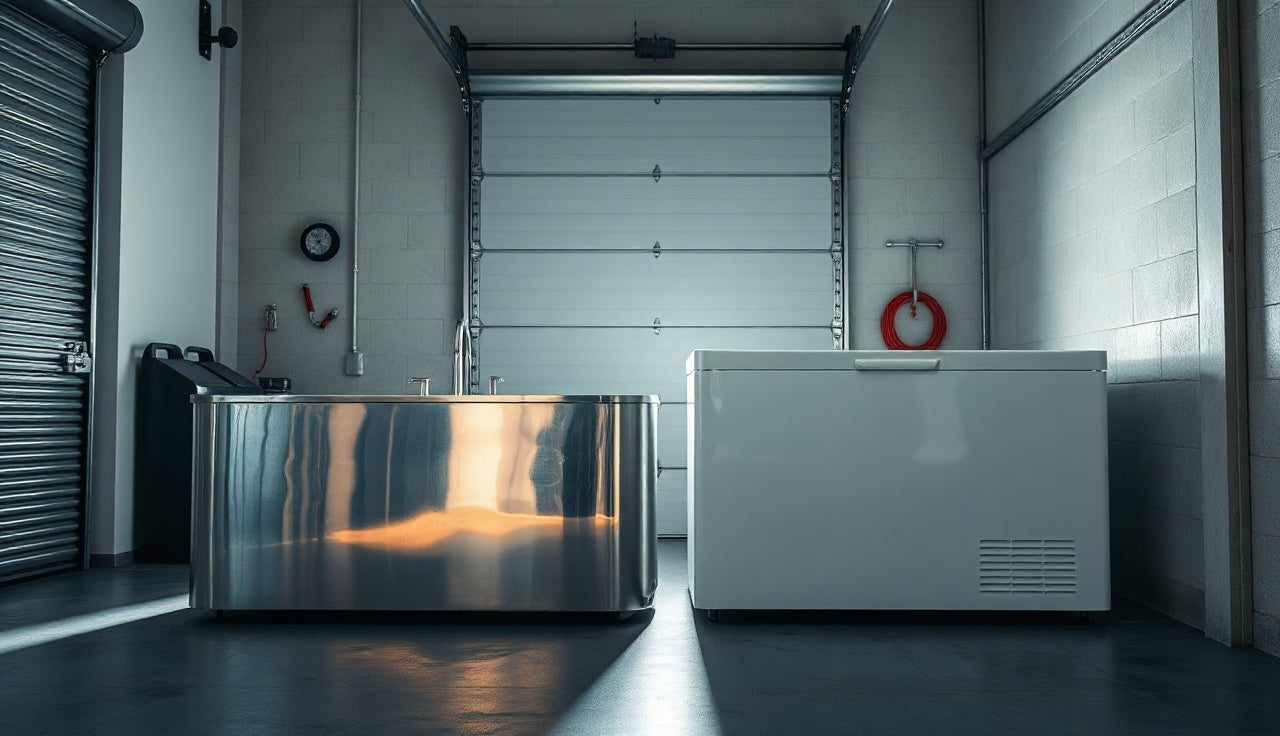
A chest freezer ice bath is exactly what it sounds like. You take a standard chest freezer, usually 5 to 15 cubic feet, fill it with water, and use it as a cold plunge tub. Set the freezer thermostat to your target temperature, somewhere between 39°F and 59°F (4°C to 15°C), and the compressor holds it there. Most people add a small submersible or aquarium pump to circulate the water and slow bacterial growth.
The freezer was never built to hold water, so you have to line it. Three approaches cover most builds: a food-grade vinyl liner cut and folded to fit, a custom-shaped liner ordered online, or a heavy-duty plastic tub dropped inside. Some builders coat the interior with pool epoxy or pond liner material. None of this is hard. All of it adds a couple of hours of work and $30 to $150 in materials.
The appeal is obvious. A $200 chest freezer can maintain 40°F water indefinitely with no ice runs after setup. On raw cost, nothing beats it. The catch lives in the setup work, the leak risk, and the electrical requirements, and those matter more than most YouTube builds admit.
For why cold water immersion earns the effort at all, the ice bath and cold plunge benefits guides cover the physiology in detail.
What is a cold plunge chiller and how is it different?
A cold plunge chiller is a refrigeration unit built to cool the water in an attached tub. It sits outside the tub or on a nearby shelf, pulls water through a heat exchanger, and returns it cold. Most chillers also run a filter and UV sanitation loop that keeps the water clean between changes. You buy it, fill the tub, plug it in, set a temperature. That's the whole setup.
Dedicated systems with a built-in chiller from brands like Plunge and Ice Barrel run roughly $1,000 to $4,500 depending on tank size and chiller capacity [1]. Standalone chillers you bolt onto an existing tub run $500 to $2,500 depending on BTU output and filtration. A chiller rated around 1/4 horsepower usually cools a 100-gallon tub to 50°F in two to four hours in moderate ambient temperatures. That number slides hard if the chiller is baking in a hot garage in July.
The difference from a chest freezer comes down to flow. A chiller moves water constantly, which helps both sanitation and temperature consistency. A chest freezer relies on the compressor cycling on and off. Without a pump, the water stratifies: colder at the bottom, warmer near the surface, sometimes by 10 degrees.
How do the costs compare: chest freezer vs chiller?
The chest freezer wins on upfront cost, and it isn't close.
A new 7-cubic-foot chest freezer, enough for most adults to submerge to the shoulders, costs $150 to $300 at Home Depot, Lowe's, or Costco. Add a liner ($30 to $150), a submersible pump ($15 to $40), and a GFCI outlet if you don't have one ($50 to $150 installed), and you land at $245 to $640 all-in for a working cold plunge.
A purpose-built cold plunge with a chiller starts around $900 and climbs past $2,000 for a model with serious filtration and a reliable cooling range. Buy a quality freestanding chiller and pair it with a separate tub, and the combined cost usually lands at $800 to $2,500.
Long-term cost is where it gets interesting. A chest freezer without a chiller only needs ice if you want water colder than the compressor manages alone, which rarely happens since most freezers get water to 39°F on their own. Electricity is the real ongoing cost on both sides. A chest freezer running continuously draws roughly 100 to 200 watts depending on insulation and ambient temperature [2]. A chiller draws 300 to 700 watts when its compressor is active. Neither breaks a power bill, but the freezer is cheaper to run.
| Setup | Upfront Cost | Typical Running Cost (est.) | Setup Complexity |
|---|---|---|---|
| Chest freezer (DIY liner) | $245, $640 | $10, $25/month electricity | Moderate (2 to 4 hrs) |
| Chest freezer + external chiller | $700, $1,200 | $15, $35/month electricity | High |
| Dedicated cold plunge (chiller built-in) | $900, $4,500 | $15, $40/month electricity | Low (plug and fill) |
| Tub + standalone chiller | $800, $2,500 | $15, $35/month electricity | Low-moderate |
These electricity estimates assume typical residential rates around $0.13 to $0.17 per kWh [3] and daily use. Your actual bill depends on your local rate, how well insulated your setup is, and whether you live in Phoenix or Portland.
| Chest freezer DIY (basic) | $430 |
| Chest freezer + external chiller | $950 |
| Tub + standalone chiller | $1,650 |
| Dedicated cold plunge (chiller built-in) | $2,700 |
Source: U.S. EIA and consumer market pricing ranges, 2024
What are the real advantages of a chest freezer ice bath?
Cost is the headline. A few other advantages hold up under honest scrutiny.
A chest freezer is available everywhere, today, with no lead time. Decide you want a cold plunge on Friday and you can have one running by Sunday night. Quality dedicated systems often carry two to eight week lead times depending on the manufacturer.
Chest freezers are also stubbornly reliable. They're built to run for years without a break. The compressor technology is old, parts are common, and repairs stay cheap. A $250 big-box freezer will probably outlast a $2,000 cold plunge chiller on pure mechanical grounds, though nobody can promise that in a given case.
The temperature floor sits lower, too. A chest freezer can push water into the mid-30s Fahrenheit, well below what most chiller-equipped tubs reach. Most people don't want 35°F water. It's genuinely painful and not clearly better than 50 to 55°F for typical recovery goals [4]. But the option is there if you want it.
And a chest freezer is discreet. It doesn't announce itself as a luxury wellness product. If your space is a garage gym rather than a spa, that fits.
What are the real drawbacks of a chest freezer ice bath?
The leak risk is the big one. Chest freezers aren't designed to hold standing water. If the liner fails, water can reach the compressor, corrode the interior, and create an electrical hazard. It doesn't happen often with a well-made liner. When it does, your $250 freezer turns into a liability.
Sanitation is a real concern. Without continuous filtration, the water gets dirty fast. Cold slows bacterial growth but never stops it. Most people drain and refill every two to four weeks. A submersible pump with a small filter helps, but it's not a UV filtration system. Plunge daily and you're either changing water often or accepting less-than-clean water.
The ergonomics are awkward for a lot of people. Chest freezers load from the top, so you're climbing in and out of a box with high, slippery walls. Getting in and out gracefully takes practice. If you have knee or hip issues, that's a real barrier.
Then there's the wiring. National Electrical Code Article 210.8 requires GFCI protection for receptacles in garages and other locations near water [5]. Without a properly protected outlet in the right spot, you need an electrician before you run this setup safely. That cost is real, and DIY builds tend to skip right past it.
What are the real advantages of a dedicated cold plunge chiller?
Convenience is the main advantage, and it's a big one if you actually plan to use this thing every day.
A purpose-built cold plunge with a chiller needs no setup effort. Fill it, plug it in, set the temperature, done. Filtration runs on its own. The water stays clean for weeks or months between full changes depending on the system. You step in from ground level, since most tubs are designed for easy entry. The experience is simply better.
Filtration matters more than people expect. A UV loop paired with a micro-filter keeps bacteria and biofilm in check without chemical dosing. Some systems add ozone or use both. Share the tub with family, or plunge right after hard workouts, and that clean water earns its keep.
Temperature precision is another genuine advantage. A good chiller holds water within one or two degrees of your set point. That consistency makes it easier to track a protocol and notice how you respond to different temperatures over time. A chest freezer cycles harder and stratifies.
For anyone running contrast therapy alongside a sauna, an always-ready cold plunge is part of what keeps the routine going. The cold plunge guide covers how to structure a contrast protocol.
What are the real drawbacks of a dedicated cold plunge chiller?
Price is the obvious one. Paying $1,500 to $3,000 for a cold plunge is a lot of money, and the honest truth is that a $300 chest freezer with a $40 liner does the same core job: it puts your body in cold water.
Chillers break. The refrigeration inside dedicated plunges uses compressor technology much like a chest freezer's, but wiring it to pumps, filters, and digital controls adds failure points. When something breaks on a $2,500 unit, parts and service tend to be slow and expensive. Warranty and support vary a lot between manufacturers, so check before you buy.
Size is a constraint. Most dedicated tubs come with fixed dimensions, and some feel cramped for tall users or anyone who wants to fully submerge. Chest freezers come in a range of sizes, including very large units with far more room.
And purpose-built plunges are high-visibility items. Put one in a garage or backyard and it looks like exactly what it is. That might suit you fine or even please you, but it's a different look than a plain freezer in the corner.
Which is better for cold plunge temperature: chest freezer or chiller?
For most people doing cold water immersion for recovery or general wellness, the range most research uses is 50°F to 59°F (10°C to 15°C), held two to fifteen minutes depending on protocol [4]. Both a chest freezer and a quality chiller reach and hold that range without trouble.
Want colder, say 40°F to 45°F? The chest freezer has the edge. Its compressor cools an enclosed water mass below what most portable chillers manage, since many portables bottom out around 39°F and struggle to hold it when the ambient air is warm. Most people never need to go that cold.
Consistency is the freezer's weak point. Without a circulating pump, the water at the bottom can sit 5 to 10°F colder than the surface. A pump helps a lot. A quality chiller with built-in circulation keeps the temperature far more even throughout the tub.
Track your cold exposure closely and the chiller wins on precision. Just want to get cold and stay cold? Both work.
Is a chest freezer ice bath safe to use?
It can be, but only if you take electrical safety seriously. Water and electricity are a dangerous pairing, and a chest freezer is an electrical appliance sitting next to (and full of) water.
NEC Article 210.8 requires GFCI protection for receptacles in garages, bathrooms, and outdoor locations [5]. Any outlet powering your chest freezer ice bath must be GFCI protected. This is not optional. Adding one is cheap if you hire an electrician, but skipping it is genuinely dangerous. The U.S. Consumer Product Safety Commission recommends GFCI protection near water precisely to prevent electrocution from appliances [9].
Never plug accessories, your submersible pump or any lights, into a non-GFCI outlet near the water. Keep cords away from the water. Don't run extension cords that aren't rated for the load. These are standard rules, but they carry more weight when you're sitting in a pool of water wired to an appliance.
Cold water immersion also carries cardiovascular risk for some people. The cold shock response can cause rapid heart rate, gasping, and hyperventilation in the first 30 to 60 seconds of immersion [6]. People with heart conditions, arrhythmias, or uncontrolled high blood pressure should talk to a doctor before starting a cold plunge routine. That applies equally to chest freezers and dedicated systems.
Plunging alone, especially early on, is a bad idea. The cold shock response can disorient you. Keep someone nearby the first several times.
How do you keep the water clean in a chest freezer ice bath?
Cold water is a hostile place for bacteria, but it's not sterile. Without active filtration, a chest freezer tub needs regular water changes.
Three common approaches: run a small submersible pond or aquarium pump to keep the water moving, add a splash of food-grade 3% hydrogen peroxide (roughly 1 to 2 cups per 100 gallons) every few days, or drop in a small amount of hot-tub bromine tablets, which work in cold water better than chlorine. Some people clip a basic cartridge filter onto the pump.
None of this matches a dedicated cold plunge with UV filtration and a multi-stage filter. If you plunge daily and refuse to think about water chemistry, a dedicated system is easier, full stop.
Most serious chest freezer users end up changing water every two to four weeks and wiping down the liner between changes. That's maybe two hours of maintenance a month. Not a huge burden, but more than zero, which is roughly what a good dedicated system asks between full water changes (typically every one to three months depending on system and usage).
SweatDecks has a cold plunge collection worth a look if you're weighing dedicated systems, especially when filtration and daily convenience top your list.
Who should buy a chest freezer and who should buy a chiller?
Buy a chest freezer if your budget is under $600, you're comfortable with a one-time DIY project, you have a GFCI outlet (or will add one), and you're not sharing the tub with several people every day. It's also the smarter pick if you're unsure you'll stick with the habit. Losing $300 stings a lot less than losing $2,500.
Buy a dedicated cold plunge with a chiller if you're committed to daily plunging, you want zero friction, you're running contrast therapy with a sauna and want the whole thing turnkey, or you're sharing it with a partner or family. The convenience premium is real and worth paying when this becomes a daily practice.
The chest freezer is also right for the serious athlete who wants maximum temperature flexibility, since it pushes water genuinely cold in ways some consumer chillers can't match in warm climates.
If you're already invested in a home sauna and want to add cold contrast, a dedicated system usually fits better both practically and aesthetically. The home sauna and sauna benefits guides cover building a full heat-cold recovery setup at home.
Can you use a chest freezer with an external chiller unit?
Yes, and this middle-ground option is popular for good reason. Use the chest freezer for its size, insulation, and low cost, then attach an external chiller to circulate and cool the water. The freezer becomes the tank. The chiller handles cooling, filtration, and circulation.
This costs more than a pure DIY freezer build ($700 to $1,200 is a fair range) but less than most purpose-built systems. You get the large volume and low temperature floor of the freezer with the convenience and sanitation of a chiller.
Plumbing is the main challenge. You cut holes in the freezer wall for the intake and return lines, seal them well, and connect the chiller. It's not complicated, but it does ask for some comfort with basic plumbing and waterproofing. Plenty of YouTube builds walk through this exact setup, and the results are generally good.
One thing to watch: external chillers vary a lot in quality and cooling capacity. A cheap 1/10 HP unit will struggle to cool a large freezer in a hot garage. Match the chiller BTU rating to your tub volume and ambient temperature. As a rough rule, plan on about 1/5 to 1/4 HP per 100 gallons for reasonable performance in a temperate climate [7].
What size chest freezer do you need for a cold plunge?
For one person sitting or crouching with water to shoulder level, a 7-cubic-foot chest freezer is usually enough but feels cramped for taller users. A 10-cubic-foot unit gives more comfortable room. Fifteen cubic feet allows a full-length soak for most adults.
In practical terms: a 7-cubic-foot freezer holds roughly 50 to 55 gallons of water, a 10-cubic-foot freezer holds 70 to 75 gallons, and a 15-cubic-foot unit holds around 100 to 110 gallons. Those volumes matter because they set how long the freezer takes to cool the first fill (typically 8 to 24 hours from room-temperature water) and how much hydrogen peroxide or other sanitizer you'll need.
Most freezers built for ice bath use sit in the 7 to 15 cubic foot range. Below 7 cubic feet you're fighting for space. Above 15 cubic feet you're in commercial freezer territory with commercial prices. The sweet spot for most adults is 10 to 12 cubic feet, which runs $250 to $400 new.
Two people plunging at once realistically means 15 cubic feet or more, or a purpose-built cold plunge tub designed for two.
Frequently asked questions
How long does a chest freezer take to cool water for a cold plunge?
Starting from room-temperature tap water (roughly 60 to 70°F), a typical 7 to 10 cubic foot chest freezer takes 8 to 24 hours to bring water down to 40 to 50°F. The range depends on the freezer's BTU rating, ambient temperature, and how well the liner insulates. Pre-cooling with a bag of ice cuts the wait a lot. After the first fill, holding temperature is quick once the compressor settles at the set point.
Can a chest freezer ice bath make you sick from bacteria?
Cold water slows bacterial growth considerably, but it doesn't eliminate it. Without sanitation, bacteria and biofilm build up over weeks. A circulating pump plus a small amount of food-grade hydrogen peroxide or bromine keeps most chest freezer baths safe. Change the water every two to four weeks and wipe down the liner. Dedicated chillers with UV filtration cut this risk further and need less active maintenance.
What temperature should a cold plunge be set to?
Most cold water immersion research uses 50°F to 59°F (10°C to 15°C) for recovery protocols, typically two to fifteen minutes. Temperatures below 50°F are colder than most studies use and aren't clearly more effective for general recovery. Starting around 55 to 60°F and moving cooler as you acclimate is a reasonable approach. Both chest freezers and dedicated chillers hold this range easily.
Do I need a GFCI outlet for a chest freezer ice bath?
Yes. National Electrical Code Article 210.8 requires GFCI protection for outlets in garages, bathrooms, outdoors, and other areas near water sources. A chest freezer holding water is exactly the scenario the code covers. Running one on a non-GFCI outlet near water is a serious safety risk. Adding a GFCI outlet typically costs $50 to $150 installed by an electrician and is non-negotiable for safe operation.
How much does it cost to run a chest freezer ice bath per month?
A typical 7 to 10 cubic foot chest freezer draws 100 to 200 watts when running. Running continuously at an average residential rate near $0.15 per kWh, that's roughly $11 to $22 per month in electricity. A dedicated cold plunge chiller draws more (300 to 700 watts active) but cycles, landing in a similar $15 to $40 per month range. Neither meaningfully dents most household energy bills.
How do you waterproof a chest freezer for an ice bath?
The most reliable options are a purpose-made chest freezer liner (vinyl or polyethylene, custom-cut to fit), a heavy-duty plastic tub or stock tank dropped inside, or pond liner material folded and secured at the corners. Pool epoxy applied to the interior works too but needs careful prep and curing time. The liner approach is fastest and most common. Seal any drain plug opening with silicone before you fill.
Is a cold plunge chiller worth the extra cost?
If you plunge daily and want zero friction, yes. A dedicated chiller automates temperature control, handles filtration, and drops maintenance to almost nothing. For occasional users or anyone uncertain about the habit, the chest freezer's $300 upfront cost is far more forgiving. The break-even in saved time and convenience usually lands around three to six months of daily use, though that's a rough estimate.
Can you use a chest freezer ice bath outdoors?
Yes, with some care. Outdoor use means rain, debris, and temperature swings that affect compressor efficiency. In hot climates the freezer works harder to hold cold water, which raises electricity use and can shorten compressor life. Use a cover when it's idle. Make sure the outlet is weatherproofed and GFCI protected. Shade helps a lot in summer.
How often should you change the water in a chest freezer ice bath?
Most users change the water every two to four weeks with basic sanitation (a circulating pump plus hydrogen peroxide or bromine). Without any sanitation, water degrades faster and should change weekly. Adding UV filtration through an external chiller stretches those intervals. You'll know it's time when the water turns cloudy, smells off, or shows debris. Cold alone doesn't keep water clean forever.
What are the health benefits of cold water immersion?
Research shows cold water immersion can reduce perceived muscle soreness and inflammation after exercise, and may improve mood and alertness through norepinephrine release. A 2022 study in PLOS ONE found cold water immersion more effective than passive recovery for reducing perceived soreness in the 24 to 48 hours after exercise [8]. Long-term metabolic and mental health effects are less settled. No cold plunge setup, chest freezer or chiller, replaces medical care.
Is it safe to cold plunge alone?
The cold shock response in the first 30 to 60 seconds of immersion causes rapid heart rate, gasping, and sometimes disorientation. Plunging alone, especially early in your practice, carries real risk if something goes wrong. Keep someone nearby for the first several sessions. People with cardiac conditions, arrhythmias, or high blood pressure should consult a physician before starting cold immersion.
What is the best chest freezer size for a cold plunge?
A 10 to 12 cubic foot chest freezer (roughly 70 to 85 gallons of water) is the best balance for most adults. It gives comfortable shoulder-deep immersion without being so large it takes forever to cool or costs a fortune to run. Seven cubic feet works but feels cramped for anyone over 5'8". Fifteen cubic feet gives full-length room and suits taller users or two-person setups, but costs more and draws more power.
Can you do contrast therapy at home with a chest freezer and sauna?
Yes, and many people do. A chest freezer ice bath paired with a home sauna makes an effective contrast therapy setup for a fraction of the cost of commercial spa systems. The main practical challenge is proximity: you want to move between hot and cold quickly, ideally within 30 seconds. Setting them up in the same space, like a garage gym, makes the protocol far easier to keep.
Sources
- Consumer Reports, Cold Plunge Tub Buying Guide: Dedicated cold plunge systems range from approximately $900 to $4,500 depending on size and chiller quality.
- U.S. Department of Energy, ENERGY STAR Program — Refrigerators and Freezers: Chest freezers typically draw 100–200 watts depending on insulation quality and ambient conditions.
- U.S. Energy Information Administration, Electric Power Monthly — Average Retail Price of Electricity: Average U.S. residential electricity prices are approximately $0.13–$0.17 per kWh.
- PLOS ONE, 'Cold water immersion and other forms of cryotherapy: physiological changes potentially affecting recovery from high-intensity exercise' (2021): Most cold water immersion research protocols use temperatures of 10°C to 15°C (50°F to 59°F) for two to fifteen minutes.
- National Fire Protection Association, NFPA 70 National Electrical Code Article 210.8: NEC Article 210.8 requires GFCI protection for receptacles in garages, bathrooms, outdoors, and other areas near water.
- BMJ Open Sport and Exercise Medicine, 'The cold shock response and its role in cold water drowning' (2014), Tipton et al.: Cold shock response causes rapid heart rate, gasping, and hyperventilation in the first 30–60 seconds of cold water immersion.
- Pentair Aquatic Systems, Chiller Sizing Guide: A rule of thumb for water chiller sizing is approximately 1/5 to 1/4 horsepower per 100 gallons for adequate cooling in temperate ambient conditions.
- PLOS ONE, 'Cold water immersion reduces muscle soreness perceived in the 24–48 hours after exercise' (2022): Cold water immersion was found more effective than passive recovery for reducing perceived soreness in the 24–48 hours post-exercise.
- U.S. Consumer Product Safety Commission, GFCI Safety Information: GFCI protection is required near water sources to prevent electrocution hazards from electrical appliances.
- International Journal of Sports Physiology and Performance, 'Effects of cold water immersion on muscle damage and recovery' (Versey et al., 2013): Cold water immersion at 10–15°C is the most commonly studied protocol range for post-exercise recovery in sports science literature.

Share:
Polar dive cold plunge: what it is, how it works, and is it worth it
Infrared sauna kit: what you actually get and what to know before buying