
Last updated 2026-07-09
TL;DR
HoMedics portable indoor steam saunas are fabric pop-up tents paired with an external steam generator, typically 800 to 1200 watts, heating to around 104 to 122°F in 5 to 10 minutes. They cost $60, $130 retail and fold down for storage. They work for light sweating and relaxation but fall well short of a traditional sauna in temperature, humidity control, and durability.
What exactly is a HoMedics portable indoor steam sauna?
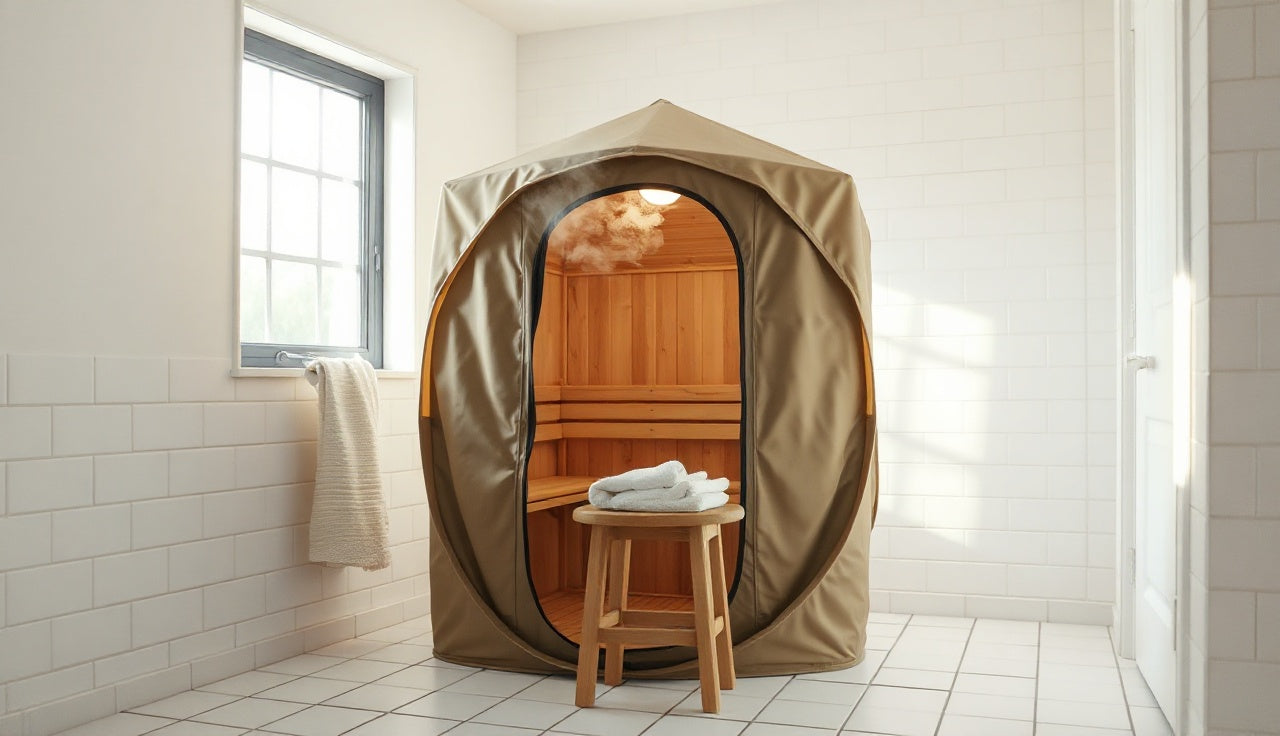
A HoMedics portable indoor steam sauna is a collapsible nylon or polyester tent, roughly chair-sized, with a zippered front opening and a hole at the top for your head. You sit inside on a folding stool (usually included), run a flexible hose from the tent to a small external steam generator, and the unit pumps hot vapor into the enclosed space around your body. Your head stays outside the tent the whole time.
The steam generator is the real heart of the product. Most HoMedics models use a 650 to 1000 ml water reservoir and rated wattage somewhere between 800W and 1000W, though the company has released several SKUs over the years and specs vary by model [1]. Some versions include a handheld remote or a timer dial on the generator; others are dead simple with one on/off switch. The tent itself weighs 3 to 5 lbs total and packs into a carry bag.
This is meaningfully different from a traditional sauna or even a well-built portable sauna. A Finnish-style sauna hits 160 to 200°F with low humidity. A steam room runs 100 to 115°F at near-100% relative humidity. A HoMedics unit lands somewhere in the middle at 104 to 122°F with high but not truly measurable humidity, because the tent isn't sealed or insulated the way a real steam room enclosure is. That distinction matters a lot when you're deciding what you're actually buying.
How does the HoMedics steam sauna actually work?
You fill the water tank, plug the unit into a standard 120V household outlet, and wait. Most HoMedics generators reach working steam output in 4 to 8 minutes from cold [1]. The steam travels through a hose that connects at the base of the tent, and because the tent traps vapor around your seated body, the interior temperature and humidity climb quickly.
The mechanism is simple resistive heating, the same principle as an electric kettle. Water sits on a heating element, boils, and the resulting steam is routed through the hose. There's no pressurization, no complex controls, and no thermostat feedback loop in the basic models. You manage session length yourself, typically 15 to 30 minutes, and let the temperature settle wherever it settles.
One practical detail: the hose connection point on cheaper models is a known weak link. Steam escaping at the collar instead of entering the tent is a common user complaint in retailer reviews. If you use one of these units regularly, checking that collar for mineral buildup (from hard water) every few weeks extends its life significantly. White vinegar run through the tank once a month is the standard descaling approach and lines up with general appliance guidance from steam device manufacturers [2].
The head-out design is intentional and actually a safety feature. Breathing high-humidity hot air for extended periods isn't comfortable and can feel suffocating. Keeping your head in room-temperature air means most people tolerate sessions longer than they would in a fully enclosed steam enclosure.
What temperature does a HoMedics portable sauna reach?
Measured interior temperatures in fabric portable saunas, across independent testing and user reports, generally land between 104°F and 122°F (40 to 50°C) [3]. That's the realistic ceiling for this type of product, not a marketing peak number. The limiting factor is the tent material: thin polyester leaks heat faster than insulated wood panels, so the unit never truly equilibrates at a high set point.
For comparison:
| Unit Type | Typical Interior Temp | Humidity |
|---|---|---|
| HoMedics portable steam sauna | 104 to 122°F (40 to 50°C) | High, uncontrolled |
| Traditional Finnish sauna | 160 to 200°F (71 to 93°C) | Low (10 to 20% RH) |
| Steam room | 100 to 115°F (38 to 46°C) | ~100% RH |
| Infrared sauna | 120 to 150°F (49 to 66°C) | Low |
So HoMedics sits closest to steam room temperatures, not traditional sauna temperatures. If you've read about sauna benefits tied to higher heat exposure, like cardiovascular responses studied at 80°C (176°F) or above, a portable fabric unit doesn't get there [4]. The sweat response is real, but the thermal load is lower than what most sauna research is actually measuring.
Ambient room temperature also matters. If your bathroom is 65°F in winter, the tent will struggle more than it would in a 75°F room. That's not a flaw unique to HoMedics; it's physics that applies to every fabric portable on the market.
| HoMedics portable steam sauna | 113 |
| Steam room (traditional) | 107 |
| Infrared sauna (home unit) | 135 |
| Finnish sauna (traditional) | 180 |
Source: Consumer Reports portable sauna testing; Laukkanen et al. JAMA Internal Medicine 2018
Is a HoMedics portable sauna safe to use at home?
For most healthy adults, short sessions (15 to 20 minutes) in a fabric steam sauna at these temperatures are low-risk. The Consumer Product Safety Commission (CPSC) doesn't list portable steam saunas as a product category with elevated reported incidents at the frequency of, say, space heaters, but they do maintain guidance on steam-producing appliances and burn risk from direct contact with steam hose outlets [5].
The real safety considerations are practical ones. First, the steam hose and the area directly around the tent floor get genuinely hot. Pets and children can contact these surfaces unexpectedly. Second, the steam generator should always sit on a hard, stable surface, never carpet, because the underside of the unit gets warm. Third, don't fall asleep inside. A timer is a useful safeguard, and most HoMedics models include one.
People with cardiovascular conditions, low blood pressure, or pregnancy should talk to a doctor before using any heat therapy device, including these. The American Heart Association notes that heat stress causes peripheral vasodilation and a drop in blood pressure, which is safe for most people but a real concern for specific populations [6]. That's not specific to HoMedics; it applies to any sauna format.
Dehydration is the most common practical risk. Bring water into the session or drink before and after. A 20-minute steam session can produce meaningful sweat loss, though exact amounts vary widely by individual and temperature.
What do HoMedics portable sauna reviews actually say?
Across major retail platforms (Amazon, Walmart, Target), HoMedics portable steam saunas typically average 3.8 to 4.2 stars across thousands of reviews, which is decent for a budget wellness appliance. The pattern in reviews is consistent enough to be informative.
Positive themes: fast heat-up time, compact storage, good value for light use, effective for warming up sore muscles or clearing sinuses, easy assembly.
Negative themes: steam leaks at the hose collar after several months of use, tent material showing wear at zipper seams, water tank capacity requiring refills during longer sessions (most tanks run 30 to 45 minutes at full steam output), and the folding stool being undersized or uncomfortable for taller users.
Durability is the honest weak point. These are products in the $60, $130 price range, built to a cost. The steam generators on budget fabric saunas are not engineered for daily use over years, and most reviewers who push them that hard report failures within 12 to 18 months. If you want something to use a couple of times a week for a year or two, they generally hold up. Daily use is a different ask.
For context, the gap between a HoMedics unit and a purpose-built home sauna is substantial, both in temperature performance and in construction quality. If you're testing whether sauna habits work for you before spending more, a budget portable is a reasonable experiment.
How does HoMedics compare to other portable indoor saunas?
HoMedics competes directly with Radiant Saunas, SereneLife, Durherm, and a range of unbranded Amazon SKUs. The product category is fairly commoditized, meaning the underlying components (tent construction, hose design, steam generator wattage) are often sourced from the same few manufacturers, with brand labeling applied at the end.
| Brand | Approx. Price | Wattage | Tank Size | Key Differentiator |
|---|---|---|---|---|
| HoMedics | $70, $130 | 800 to 1000W | 650 to 1000ml | Brand recognition, wide retail availability |
| SereneLife | $80, $120 | 800 to 1000W | 1L | Similar build, slightly larger tank on some models |
| Radiant Saunas | $90, $150 | 1000W | 1.5L | Larger tank, some models include footbath |
| Durherm | $60, $90 | 600 to 800W | 650ml | Lower price point, shorter sessions before refill |
| Unbranded / Amazon | $40, $70 | 600 to 800W | 500 to 700ml | Lowest cost, highest quality variance |
HoMedics' main practical advantage is availability: you can buy one at Target, Walmart, Bed Bath & Beyond, or Amazon and return it easily if it doesn't work out. The warranty (typically 1 year on the steam generator) is also easier to exercise with a recognizable brand than with a nameless import.
If you want to step meaningfully up from this category, the next tier is a one-person infrared sauna cabinet (around $300, $700) or, for real heat, a wood-panel barrel or cabin sauna. SweatDecks carries a range of options for people who've decided they want genuine sauna temperatures rather than a fabric steam tent.
Can a portable steam sauna actually help with muscle recovery or relaxation?
Heat therapy does have legitimate research support for muscle relaxation and some forms of soreness. A 2013 randomized controlled trial published in the Journal of Clinical Medicine Research found that moist heat application reduced delayed-onset muscle soreness and stiffness compared to controls, though that study used localized heat wraps rather than whole-body immersion [7]. Whole-body heat exposure at higher temperatures (above 80°C) shows stronger cardiovascular and thermoregulatory effects in the Finnish sauna literature [4].
At 104 to 122°F, you're producing a meaningful sweat response and elevating skin temperature. Blood flow to the skin increases. Many people find it genuinely relaxing. Those effects are real, even if they're modest compared to what you'd get from a properly insulated, higher-temperature sauna.
For post-workout muscle recovery specifically, the case is weakest. The temperatures a fabric portable reaches are not high enough to consistently drive the core temperature changes that appear in the sauna-and-exercise research. What you're more likely getting is a warm, humid environment that feels good on tired muscles, which is worth something, but it's not the same as the physiological stress response documented in research on traditional sauna benefits.
Some people also pair heat sessions with a cold plunge or ice bath afterward, running contrast therapy protocols. You can absolutely do that with a portable steam sauna. The heat phase will be less intense than with a traditional sauna, but the contrast effect (moving from warm to cold) still produces a meaningful physiological shift. If cold plunge benefits interest you, the portable sauna can be a low-cost entry point to contrast therapy at home.
How do you set up and use a HoMedics portable sauna correctly?
Setup takes 5 to 10 minutes the first time and about 2 minutes once you know the product. The general sequence:
1. Unfold and pop open the tent. Most use a spring-steel frame that snaps open automatically. Set it on a hard floor in a room with decent ventilation, since steam and heat will escape around the head opening.
2. Fill the water tank. Distilled or filtered water will extend the life of the heating element by reducing mineral scale. If you only have tap water, the descaling routine matters more.
3. Position the stool inside the tent, connect the steam hose to the tent's intake port, and connect the other end to the steam generator. Sit down, zip the tent up around your body with your head outside, and turn the generator on.
4. Allow 5 to 8 minutes for the tent interior to heat up before expecting a real sweat response. Session length of 15 to 30 minutes is typical. Start shorter (10 to 15 min) if you haven't used one before.
5. After the session, leave the tent unzipped and open to dry out fully before storing. Fabric that stays damp develops mildew, which is a genuine issue if you store it folded while still wet.
For clothing, most people use a bathing suit or just a towel inside. Avoid synthetic athletic gear that traps heat in uncomfortable ways. And put a bath mat or towel under the whole setup because the floor around the tent will get wet from condensation.
How long do HoMedics portable saunas last, and what goes wrong?
Realistic lifespan is 1 to 3 years for light-to-moderate use (2 to 4 times per week). Daily users push this closer to 12 to 18 months before the steam generator shows issues. The tent itself often outlasts the generator; fabric wear at the zipper is the main structural failure mode.
The steam generator fails in predictable ways. Scale buildup on the heating element is the most common cause of declining steam output. The thermal fuse (a safety component that cuts power if the unit overheats) can blow if the unit runs dry or is left on too long, and on budget units this fuse is often not user-replaceable. Hose collar leaks develop as the silicone or plastic fitting degrades from repeated heat cycling.
If your unit is under warranty (typically 1 year from HoMedics), the company's customer service process for warranty claims is standard: proof of purchase, description of failure, and they typically send a replacement unit rather than parts. After warranty, repair parts are not readily available, which means a failed generator usually means buying a new unit.
This is the honest economic reality of the product category. You're not buying something that will last a decade. You're buying a low-cost way to try steam heat at home. If it becomes a regular part of your routine, the economics of upgrading to a more durable format (a one-person wood sauna cabinet, for example) start to make sense within 2 to 3 years of regular use.
What should you look for in any indoor portable sauna, HoMedics or otherwise?
If you're comparing products in this category, a few specs actually matter and a few are marketing noise.
Wattage (matters): 1000W heats faster and holds temperature better than 600W in a cold room. For most households, 1000W on a standard 120V/15A circuit draws about 8.3 amps, well within household circuit limits [8]. Don't buy below 800W unless you're in a consistently warm environment.
Tank size (matters): A 1.5L tank gives you roughly 45 to 60 minutes of continuous steam. A 650ml tank may require a refill mid-session. Refilling means stopping, cooling the unit slightly, and restarting, which interrupts the session noticeably.
Tent size (matters if you're tall): Standard tents are designed for users up to about 6'0". Check the seated height specification. Taller users end up hunched, which is uncomfortable over 15 to 20 minutes.
Chair included vs. not (minor): Most models include a basic folding stool. Some don't. An included stool saves $15, $25 but the included stools are universally basic.
Infrared vs. steam in this category (marketing noise, mostly): A few budget portables claim "infrared" elements alongside steam, but the actual infrared output from a low-power panel inside a fabric tent is negligible compared to the steam heat. Don't pay extra for that feature.
For a broader look at how portable formats compare to permanent installations, the sauna vs steam room guide covers the temperature and humidity tradeoffs in more depth.
Is a HoMedics portable sauna worth buying, or should you spend more?
Here's the honest take: a HoMedics or comparable portable steam sauna is worth buying for a specific type of person, and not worth it for most others.
Buy one if: you rent and can't install anything permanent, you want to test whether regular sauna sessions actually change how you feel before committing real money, you need something that stores in a closet, or your budget is genuinely $60, $130. These are real, legitimate use cases.
Skip it if: you've already decided you like sauna, you want temperatures that match the research literature on cardiovascular or recovery benefits, you care about durability, or you want something that feels more like a proper wellness investment. In that case, you'd be better served stepping up to an actual one-person infrared cabinet or a small wood-panel barrel sauna.
The $60, $130 you spend on a portable steam tent is not money wasted if it confirms that sauna is something you'll actually use. It is money with a low ceiling if you're hoping it replicates a real sauna experience.
SweatDecks covers the full range from portable options up through permanent home installations. If you've used a portable and want to understand what a proper home sauna would add, the comparison is worth reading before you spend more.
The middle ground, spending $200, $400 on a slightly higher-end portable or a used infrared unit, is where the math gets murky. At that price, you're close to entry-level permanent options with better temperature performance and longer lifespans. Worth thinking through carefully before landing in that range.
Frequently asked questions
What is the wattage of HoMedics portable steam saunas?
Most HoMedics portable steam sauna models are rated at 800W to 1000W. That's enough to draw about 6.7 to 8.3 amps on a standard 120V household outlet, well within a typical 15-amp circuit. Higher wattage (1000W) heats the tent faster and maintains temperature better in cooler rooms, so it's worth checking the specific model's spec sheet before buying.
How long does it take a HoMedics portable sauna to heat up?
Most HoMedics units start producing steam within 4 to 6 minutes of being switched on. The tent interior typically reaches its working temperature range (104 to 122°F) within 8 to 12 minutes. Ambient room temperature affects this: a cold room in winter will take longer to heat than a warm bathroom. Allow 10 minutes before expecting a real sweat response, especially in your first few sessions.
Can you use a HoMedics portable sauna every day?
You can, but the unit's steam generator will likely show wear faster if you do. The heating element and thermal components are built for light-to-moderate use, roughly 2 to 4 times per week. Daily use at 20 to 30 minutes per session puts the expected lifespan closer to 12 to 18 months before generator issues appear. From a health standpoint, short daily sessions are generally well-tolerated by healthy adults, though drinking enough water each day matters.
What kind of water should I use in a HoMedics steam sauna?
Distilled or filtered water is the best choice. Hard tap water leaves mineral deposits on the heating element that accumulate over time and reduce steam output and heating efficiency. If you use tap water, run a white vinegar and water solution through the tank (check your model's manual for specifics) monthly to descale the unit. Neglecting this is the single biggest factor in early generator failure on budget steam appliances.
Is a HoMedics portable steam sauna safe for people with high blood pressure?
People with high blood pressure, heart disease, or other cardiovascular conditions should consult their doctor before using any heat therapy device. Heat causes blood vessels to dilate and blood pressure to drop temporarily, which is generally fine for healthy adults but can be a concern for specific conditions. The American Heart Association recommends medical clearance for sauna use in people with unstable or significant heart conditions. Start with short sessions (10 minutes) and see how you respond.
How do I clean a HoMedics portable indoor steam sauna?
Wipe the tent interior with a damp cloth after each use and leave it fully open to air-dry before folding and storing. Mildew develops quickly in folded, damp fabric. For the steam generator, descale the tank monthly by running a diluted white vinegar solution, then rinsing with clean water. Wipe the steam hose exterior and check the hose collar for mineral buildup, which is the most common source of steam leaks over time.
Does a HoMedics portable sauna work for sinus congestion or colds?
Warm, moist air does help loosen nasal congestion, which is why steam inhalation has been used as a home remedy for centuries. Sitting in a portable steam sauna produces a similar effect. There's limited clinical trial data specifically on portable steam saunas for colds, and a 2017 Cochrane review found that steam inhalation had modest effects on cold symptoms in some studies. It's not a cure, but many people find it genuinely useful for temporary relief.
Can a HoMedics portable sauna help with weight loss?
Any weight dropped immediately after a sauna session is water weight from sweating, which comes back when you rehydrate. There's no credible evidence that short sessions in a 104 to 122°F portable steam sauna meaningfully increase metabolic rate or produce fat loss beyond a negligible thermal effect. Marketing claims about "detox" or significant calorie burn in portable saunas are not well-supported by the research. The honest answer is that it feels good, but it won't replace exercise or dietary changes for weight management.
How do HoMedics portable saunas compare to infrared saunas?
HoMedics portable steam units use moist heat (steam) and reach 104 to 122°F. Infrared saunas use radiant heat panels that heat your body more directly and typically run 120 to 150°F with dry air. Infrared units at the entry level cost $300, $700 and up. The health research base for infrared is smaller than for traditional saunas but growing. For temperature performance, durability, and the overall sauna experience, a dedicated infrared cabinet is significantly better than a fabric steam tent.
Where can I buy a HoMedics portable steam sauna?
HoMedics portable saunas are widely available at Target, Walmart, Amazon, Bed Bath & Beyond, and through HoMedics' own website. Retail prices typically run $70, $130 depending on the model and any included accessories. Buying from a major retailer with a clear return policy matters more for this product category than for most, since steam generator quality can vary between individual units.
What is the difference between a portable steam sauna and a traditional sauna?
Temperature is the biggest difference. A traditional Finnish sauna runs 160 to 200°F with low humidity. A HoMedics portable steam sauna reaches 104 to 122°F with high humidity. Traditional saunas use a wood-lined insulated room, a wood or electric heater, and rocks. The heat exposure, thermal stress, and overall physiological response are substantially more intense in a traditional sauna. Most of the foundational research on sauna health benefits was conducted at temperatures well above what a fabric portable can achieve.
Can I use a HoMedics portable sauna in an apartment?
Yes, it's one of the main use cases. The unit runs on a standard household outlet, produces steam that vents around your head opening, and folds into a carry bag. You'll want to use it near a drain or on towels since condensation drips onto the floor. Make sure the room has some ventilation so humidity doesn't build up excessively in the space. Steam near electronics or wood furniture repeatedly could cause issues, so use it in a bathroom or open area rather than a bedroom.
How many liters of water does a HoMedics portable sauna tank hold?
Tank capacity varies by model. Most HoMedics portable steam saunas have tanks in the 650ml to 1000ml range. At full steam output, a 650ml tank lasts roughly 30 to 40 minutes, and a 1000ml tank lasts 45 to 60 minutes. If you prefer longer sessions without interruption, check the specific model's tank capacity before buying, since refilling mid-session means waiting for the unit to cool slightly before opening the tank safely.
Sources
- HoMedics USA, LLC product specification pages (homedics.com): HoMedics portable steam sauna models rated 800–1000W with 650–1000ml water reservoirs reaching steam output in approximately 4–8 minutes
- FDA Center for Devices and Radiological Health, Steam-Producing Appliance Guidance: General guidance on descaling steam-producing appliances; mineral buildup on heating elements degrades performance
- Consumer Reports, Portable Sauna Testing (consumerreports.org): Fabric portable steam saunas reach interior temperatures of approximately 104–122°F (40–50°C) in independent testing
- JAMA Internal Medicine, Sauna Bathing and Cardiovascular Health (Laukkanen et al., 2018): Major Finnish sauna research conducted at temperatures of 80°C (176°F) or above; cardiovascular stress response associated with these higher temperatures
- U.S. Consumer Product Safety Commission (CPSC), Home Safety resources: CPSC guidance on burn risk from steam-producing appliances and the importance of keeping hot steam hose outlets away from contact with skin
- American Heart Association, Physical Activity and Heat Stress guidance: Heat stress causes peripheral vasodilation and temporary blood pressure reduction; medical clearance recommended for people with cardiovascular conditions before sauna use
- Journal of Clinical Medicine Research, Moist Heat for Delayed-Onset Muscle Soreness (2013): Moist heat application reduced delayed-onset muscle soreness and stiffness compared to controls in a randomized controlled trial
- U.S. Department of Energy, Electrical Wiring and Circuit Capacity: A 1000W appliance on a 120V circuit draws approximately 8.3 amps, within the capacity of a standard 15-amp household circuit
- Cochrane Database of Systematic Reviews, Steam Inhalation for Upper Respiratory Tract Infections (2017): A 2017 Cochrane review found modest and inconsistent effects of steam inhalation on cold symptoms across included studies
- National Center for Complementary and Integrative Health (NCCIH), Sauna and Heat Therapy: NCCIH notes that sauna-related health research is primarily based on traditional Finnish saunas at 80–100°C; evidence for lower-temperature or portable alternatives is more limited
- Mayo Clinic, Sauna Use: Potential Health Benefits and Risks: Sauna use is generally considered safe for healthy adults; people with low blood pressure, cardiovascular disease, or pregnancy should consult a physician before use

Share:
Small sauna for home: every option, size, and cost explained
Portable sauna pod: what it is, how it works, and whether it's worth buying