
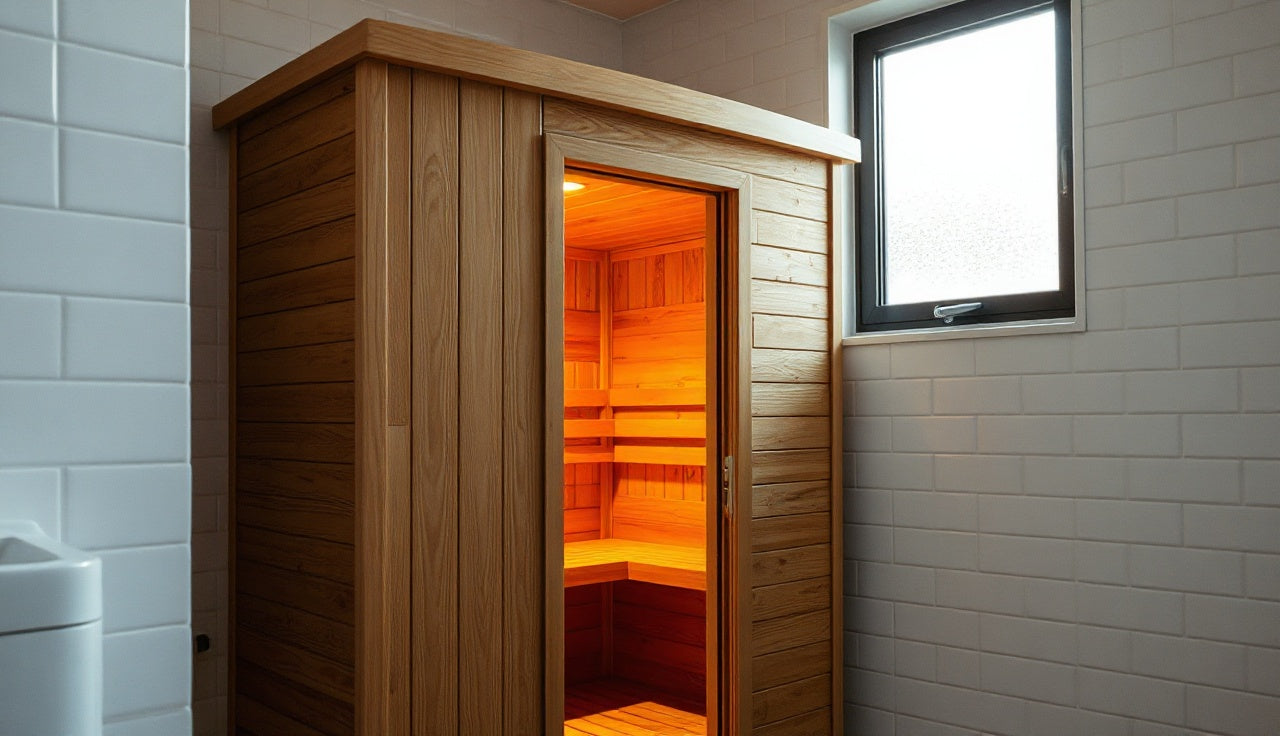
Last updated 2026-07-09
TL;DR
A small home sauna fits in a spare bathroom, a converted closet, a deck corner, or a garage. One-person indoor units start near $1,500 for infrared and $3,000 for traditional Finnish. Compact outdoor barrel saunas run $2,500 to $6,000. Size, heat type, and electrical needs decide whether a unit actually works in your space.
What counts as a 'small' home sauna?
Most manufacturers call anything built for one or two people a small sauna. In practice that means a footprint between 3x3 feet and 4x6 feet, with ceiling height from 6.5 to 7 feet. A true 1-person unit squeezes into about 36 square feet of floor space. A 2-person unit usually wants 48 to 56 square feet.
Those numbers decide which spaces are usable. A single-person infrared cabin often fits inside a large walk-in closet or the corner of a master bathroom with no structural work at all. A 4x4 traditional Finnish sauna with a real rock heater needs ventilation, a floor drain or waterproof membrane, and usually a 240V circuit. That changes the project scope a lot.
The word 'small' also gets stuck on portable saunas, the fabric or nylon tent-style enclosures that fold flat. Those are genuinely tiny in storage, but they're a different product with different performance. This article sticks to hard-sided cabin units, because that's what most people mean when they search for a small home sauna.
One more number worth knowing. Sauna room sizing guidance recommends a minimum of 8 to 10 cubic feet of air space per person for a comfortable session. Most solo cabins land in the 100 to 150 cubic foot range, which is plenty of room to breathe.
What are the different types of small home saunas?
There are four categories worth knowing, and they don't swap in for each other.
Infrared saunas use electric panels (carbon or ceramic) that emit infrared wavelengths and heat your body directly instead of heating the air first. They run cooler, typically 120 to 150°F, against 170 to 200°F for a traditional Finnish sauna [2]. Most 1-person and 2-person models plug into a standard 120V 15- or 20-amp circuit, so installation is simple. They warm up fast too, usually 15 to 20 minutes versus 30 to 60 for a wood or electric-rock sauna.
Traditional Finnish saunas with an electric rock heater are the classic experience. You heat rocks to high temperature, pour water over them (löyly), and get a burst of steam that spikes the humidity and the perceived heat. This type needs a 240V circuit and a proper drain or waterproof floor, because water is part of the ritual. For a small home room, a 3kW to 4.5kW electric heater covers a 1 to 2-person space.
Wood-burning small saunas almost always live outdoors. A compact barrel sauna or a small cabin-style unit runs on a small wood stove. The heat source needs no electricity (though you'll want a light), but these are slower to warm, they need a chimney or exhaust pipe, and you deal with ash. Best for detached garages, backyards, or cabins.
Steam saunas and steam showers get lumped in with saunas, but they're their own thing. Our sauna vs steam room guide breaks it down. In a small space, a steam generator on a tiled enclosure is often easier to retrofit than a full sauna cabin.
For most homeowners adding a first indoor sauna, infrared is the right call. It's lighter, simpler, and less likely to trigger permits or structural changes. If you want the real Finnish heat and the option to throw water on rocks, go traditional electric even though the install is a bigger job.
What size small sauna do you actually need?
Honest answer: most people buy bigger than they need and then resent the footprint, or they buy the smallest box on the market and regret it inside a year.
For solo use, a 1-person unit (roughly 3x3 to 3x4 feet) works fine. You sit comfortably, and in a 5-foot-wide model you can even lie down. But if there's any chance a second person joins you, even now and then, step up to a 2-person unit. Being crammed into a hot box with someone else's elbow in your ribs kills the mood.
For two regular users, a 4x4 or 4x5 foot unit is the practical floor. You each get a bench without sitting on top of each other.
Ceiling height gets skipped in size talk, and it shouldn't. The hottest air pools near the ceiling. A 7-foot ceiling lets you sit on an upper bench in the best heat while keeping headroom. Some compact indoor units drop to 6.5 feet to clear a duct or joist under a standard 8-foot ceiling, and that's usually fine.
| Configuration | Typical footprint | Who it's for |
|---|---|---|
| 1-person indoor infrared | 3x3 ft to 3x4 ft | Solo daily users, very tight spaces |
| 2-person indoor infrared | 4x4 ft to 4x5 ft | Couples, occasional second user |
| 2-person traditional electric | 4x4 ft to 5x5 ft | Anyone wanting authentic Finnish heat |
| Small outdoor barrel (2-person) | 4 ft dia x 5-6 ft | Backyard, no indoor space available |
| Small outdoor cabin (2-4 person) | 5x7 ft to 6x8 ft | Families, better longevity outdoors |
One thing catches people off guard. The listed exterior dimensions include wall thickness, usually 1.5 to 2 inches of wood per side on infrared cabins and up to 3 to 4 inches on insulated outdoor units. The inside is noticeably smaller than the box dimensions suggest.
| 1-person infrared (entry-level) | $1,350 |
| 1-2 person infrared (mid-range) | $3,500 |
| 2-person traditional electric (kit) | $5,000 |
| Small outdoor barrel (2-person) | $4,250 |
| Small outdoor cabin (2-4 person) | $8,500 |
Source: U.S. Energy Information Administration and market survey of retail sauna prices, 2024
Where can you put a small sauna inside your home?
More places than you'd expect, fewer than the vendors imply.
A dedicated bathroom with 50-plus square feet of open floor is the cleanest option. Moisture stays contained, there's usually a drain, and ventilation is already handled. An infrared sauna throws off almost no steam, so you can even set one on a carpeted floor if you put a waterproof mat under it.
Walk-in closets work well for single-person infrared units. A 5x6 or 6x7 foot closet is bigger than the sauna. The catches are the electrical circuit (closets rarely have a 20-amp run already) and ventilation. You need a way to push warm air out so the surrounding room doesn't cook. A louvered door or a small wall vent usually does it.
Garages are the most forgiving spot for traditional saunas. Concrete floors shrug off water, height is generous, and pulling a new 240V circuit is easier in unfinished space. Cold matters, though. An uninsulated garage in Minnesota needs a stronger heater to fight the ambient chill.
Basements work if you manage moisture. Traditional saunas make humidity and the wood wants to breathe. A drain, a vapor barrier where the sauna meets the floor, and an exhaust path outside keep moisture from rotting the surrounding framing.
Spaces that almost never work: powder rooms (no room for benches), rooms directly above the main panel with no clear circuit path, and any space where a joist or beam cuts into the line the sauna needs.
Want to go outside instead? Our outdoor sauna guide covers what changes about site prep, drainage, and permits when the unit lives in the yard.
What do small home saunas cost?
The range is wide, and the cheapest options carry real trade-offs.
Single-person infrared saunas from entry-level brands start around $1,200 to $1,500. At that price you get thin hemlock or poplar that dents and scratches, lower-watt panels that may not heat the whole cabin evenly, and a thin warranty. Fine for occasional use, not built to survive a decade.
A quality 1 to 2-person infrared unit runs $2,500 to $4,500. That buys better wood (basswood or Canadian hemlock in 1-inch planks), a full set of carbon fiber panels with real coverage, a digital controller, chromotherapy lighting, and a 5- to 7-year warranty from a brand with actual US customer service.
Traditional Finnish electric saunas in a 2-person size run $3,000 to $7,000 for the materials (prefab kit plus heater), before electrical work or labor. A licensed electrician running a 240V circuit adds $300 to $800 depending on your panel and the run distance [3].
Small outdoor barrel saunas (2 to 4 person) start around $2,500 and top out near $6,000 for the barrel and heater together. Cabin-style outdoor units with better insulation and a more traditional build run $5,000 to $12,000 in small sizes.
Don't ignore running costs. A traditional heater pulling 1,200 watts at $0.16 per kWh (the 2024 US average residential rate) costs about $0.19 per session hour [4]. An infrared panel drawing 1,500 watts costs about the same. Neither moves your electric bill in any real way at 4 to 5 sessions a week.
For the full breakdown of what drives total home sauna cost, including permits and construction, that guide covers the whole picture.
Do small home saunas need permits?
This trips up a lot of buyers, and the answer depends on your city or county and on the type of sauna.
Pre-assembled indoor infrared cabins that plug into a standard outlet are almost always treated as appliances, the same as a washing machine. Most jurisdictions don't require a permit to install an appliance. Confirm with your local building department, but that's the typical case [5].
Cross into 240V electrical work and you almost certainly need an electrical permit. In most US states, any new circuit added to the panel requires a permit and an inspection. The permit itself usually costs $50 to $200, and the inspection confirms the work meets the National Electrical Code [5]. Skipping it is a bad idea. An unpermitted 240V install can void your homeowners insurance if there's ever a fire or damage claim [10].
Outdoor saunas larger than about 120 to 200 square feet (the threshold varies by jurisdiction) sitting on a permanent foundation typically need a building permit. A freestanding small barrel sauna on a gravel or deck pad often slips under the threshold in many counties, but this varies enough that you should check locally before you order.
If you're in a planned community with an HOA, its rules can restrict exterior structures no matter what the county allows. That's a separate approval entirely.
Call your local building department before you buy. It's a five-minute conversation that saves you from a stop-work order or a headache at resale.
What are the health benefits of using a small home sauna?
The research on sauna use is genuinely interesting, and it's worth being straight about what it shows and what it doesn't.
The strongest evidence is cardiovascular. A 2018 study in Mayo Clinic Proceedings followed 2,315 Finnish men for 20 years and found that frequent sauna use (4 to 7 sessions per week) was associated with a 63% lower risk of sudden cardiac death and a 50% lower risk of cardiovascular disease mortality compared to once-weekly use [7]. The relationship was dose-dependent: more frequent sessions tracked with stronger associations. The authors were clear this is observational data and can't prove causation.
On blood pressure, a 2017 review in the Journal of Human Hypertension reported that a single sauna session produced acute drops in blood pressure similar in size to moderate-intensity exercise [8]. Whether repeated sessions produce lasting change is less settled.
Heat stress also appears to raise growth hormone and improve insulin sensitivity in some short-term studies, though the effect sizes are modest and the protocols vary enough that strong general claims are hard to make.
Regular sauna bathing has also been linked to lower stroke risk in a dose-dependent pattern across a long-term Finnish cohort [11].
For muscle recovery, heat raises blood flow to muscle and cuts delayed-onset muscle soreness in several small trials. The real value of a home sauna for athletes is that the barrier to consistent use nearly vanishes. Ten to fifteen minutes after a hard session is trivial when the sauna is ten feet from your bedroom.
Our sauna benefits article covers the full research landscape by outcome if you want the detailed version.
One real caution. People with uncontrolled hypertension, a recent heart attack, or pregnancy should talk to a physician before regular sauna use. That's medical common sense, not a legal disclaimer.
Infrared vs traditional sauna for a small home: which is better?
Neither is objectively better. They're different experiences with different install demands.
Infrared runs cooler (120 to 150°F), so plenty of people find it more tolerable, especially beginners. You still sweat hard, because the infrared energy sinks a few millimeters into skin and muscle and heats you directly. Sessions run 20 to 40 minutes. No steam, no poured water, so no humidity in the surrounding room and no drain required. Easier to install in most homes. It feels more like a warm cocoon than a punishing sweat.
Traditional Finnish at 170 to 200°F with steam off poured water is physically intense. Ten minutes at 190°F with a full round of löyly is nothing like 30 minutes in an infrared cabin. If you've sat in a real Finnish sauna, a gym spa sauna, or a Nordic wellness center, traditional electric gets you closest to that. The install is more complex but manageable.
For a small space, infrared wins on practicality. For the experience itself, traditional wins if you can handle the install. Buying your first home sauna and not sure you'll love it? Start with a good mid-range infrared. Certain you want the full Finnish heat and ready to do it right? Budget for the traditional setup.
A note on portable sauna options. These are almost always infrared or far-infrared blanket style, a third path that costs $200 to $600 and needs zero installation. A reasonable way to test heat therapy before you commit to a cabin.
What should you look for in a small home sauna?
Five things separate a good unit from a bad one at the same price.
Wood quality and thickness. The best small saunas use Canadian hemlock, basswood, or Nordic spruce in planks at least 3/4 inch thick. Thicker wood holds heat and resists warping from repeated thermal cycling. Poplar and pine show up in budget units. Not disasters, but they dent and discolor faster.
Heater coverage. For infrared, you want panels on the back wall, both side walls, and ideally the floor (leg and foot coverage) or a low front panel. Single-wall panels that only heat your back don't earn the purchase. For traditional electric heaters, size roughly 1kW per 45 to 50 cubic feet of room volume.
Electrical requirements you can actually meet. A 1-person infrared unit at 120V/15A plugs in anywhere. A 2-person unit often pulls 20A and may need a dedicated circuit. A traditional electric sauna almost always needs 240V. Check the spec before you order.
Warranty and brand stability. A 5-year or longer warranty on the heater and structure is the floor for a mid-range unit. Confirm the brand has a US presence and stocks replacement parts. Some cheap units are effectively disposable because the parts don't exist.
Assembly. Most small home saunas ship as prefab panels that interlock with basic hardware or none at all. Read the assembly reviews specifically. A unit two adults can build correctly in an afternoon is fine. One that needs shimming, forcing, or improvising signals sloppy manufacturing tolerances.
SweatDecks carries a set of small home saunas across infrared and traditional styles if you want to compare specific models side by side.
Can you combine a small sauna with cold plunge therapy at home?
Yes, and it's one of the more compelling setups for recovery-focused homeowners.
Contrast therapy, alternating heat and cold, has a real evidence base. A 2021 study in the International Journal of Environmental Research and Public Health found that hot-cold contrast protocols cut muscle soreness markers more than either heat or cold alone [9]. The mechanism involves alternating vasodilation from heat and vasoconstriction from cold, a kind of pump effect through the circulation.
A typical home routine: 15 to 20 minutes in the sauna, straight into a cold plunge or ice bath for 2 to 4 minutes, rest, then repeat 2 to 3 rounds. You don't need much room. A 1-person sauna plus a chest-freezer plunge or a purpose-built cold tub fits in a garage, a basement corner, or a covered deck.
Cold plunge options have gotten far more accessible in the last few years. Pre-chilled tubs with filtration start around $2,000 to $3,500 for quality units, and they're far cleaner than a DIY ice bath. If budget is the constraint, a stock tank with ice and a small aquarium pump for circulation runs under $500, but you're buying ice constantly.
For the full evidence on cold exposure, our cold plunge benefits guide covers what's supported and what's still being worked out.
What are the most common mistakes people make buying a small home sauna?
Buying without measuring the path from the front door to the install spot is the most expensive mistake. Prefab sauna panels ship in long flat boxes, often 7 to 8 feet long. If your basement stair turns 90 degrees or your hallway is 34 inches wide, you may not get the panels where you want them. Measure every doorway, hallway, and stair landing on the route before you order.
Underestimating electrical work is second. People read '120V, plugs into standard outlet' and never check whether the circuit in that spot is dedicated and rated for continuous load. A sauna pulling 15 amps on a shared 15-amp circuit trips breakers all day. A dedicated circuit is the right move even for plug-in units.
Buying on price alone. The $1,200 units exist and some are genuinely usable. But the wood is thin, the heating elements run inconsistent, and customer service when something breaks is often a dead end. For a product you use 4 to 5 times a week, the durability gap between a $1,400 unit and a $3,000 unit is real.
Ignoring ventilation. A sauna in a sealed room builds heat and humidity in the surrounding space. You need a ventilated door, a wall vent to the outside or to a larger room, or at minimum a louvered insert. This hits infrared saunas in closets and small rooms hardest.
Expecting a portable sauna to replace a cabin. The blanket and tent-style far-infrared products are fine for what they are. But if you want to sit upright in a hot room and sweat for 20 to 40 minutes as a ritual, a tent won't deliver that. Be honest about which product you actually want.
How long do small home saunas last, and what maintenance do they need?
A well-built traditional sauna in a properly ventilated space lasts 20 to 30 years. Wood is the limiting factor, not the heater. Quality hemlock or cedar that dries out between sessions stays sound for decades. Cheap poplar in a humid, poorly ventilated space starts to discolor and warp inside a few years.
Infrared panels are the usual failure point in infrared saunas. Carbon fiber panels tend to last 15 to 20 years. Ceramic rod elements run shorter, typically 10 to 15 years, and they're more brittle. Controller boards and wiring are the next failure point, and parts availability from the manufacturer decides whether a repair is worth it or the unit becomes a write-off.
Maintenance is light compared to most home appliances. For any sauna:
- Wipe the bench and floor with a damp cloth after each session. Sweat left on wood causes discoloration and eventually odor.
- Sand lightly with fine-grit paper once a year to refresh the bench surface.
- For traditional saunas, replace the rocks every 2 to 3 years. Rocks fracture and lose their ability to absorb and release heat evenly.
- Check the heater element yearly on traditional electric units. Most makers sell replacement elements a handy owner can swap without an electrician.
- Keep the area around the heater clear of towels and wood debris. Basic fire safety.
For infrared units, there's essentially nothing to service mechanically. Keep the panels dust-free and leave the door open after each session so the cabinet dries out.
Frequently asked questions
What is the smallest sauna you can install at home?
The smallest hard-sided cabins are 1-person infrared units with a footprint around 3x3 feet, about 36 square feet of floor space. They fit in a large closet, a bathroom corner, or a small spare room. Fabric or tent-style portable saunas fold smaller still, but they're a different product with a much less satisfying experience.
How much does a small home sauna cost to run per month?
Very little. A 1,500-watt infrared sauna run 30 minutes a day at the 2024 US average residential rate of $0.16 per kWh costs about $3.60 a month. A traditional electric sauna with a 3kW heater run 45 minutes daily costs roughly $6.50 a month. Neither noticeably moves your utility bill at typical daily use.
Can a small sauna fit in an apartment?
Technically yes, for a 1-person infrared unit. The real barriers are your lease (most ban permanent installations), building management rules, and the fact that most apartments lack a dedicated 20-amp circuit in a bedroom or living room. A plug-in 120V single-person infrared cabin you can take with you when you move is the only realistic apartment option.
Do infrared saunas give you the same benefits as traditional saunas?
Most research on sauna health outcomes (cardiovascular, blood pressure, recovery) used traditional high-heat Finnish saunas. Infrared saunas produce comparable sweat rates at lower ambient temperatures. Whether the physiological effects are identical is still debated; the infrared evidence base is smaller. For general wellness, either type appears beneficial. To replicate specific Finnish research protocols, traditional heat is more faithful.
What wood is best for a small home sauna?
Canadian hemlock and basswood are the most common in quality indoor infrared saunas. They're low-resin, stay cool to the touch at sauna temperatures, and resist moisture. For traditional Finnish saunas and outdoor units, Nordic spruce and cedar are standard. Cedar smells great but costs more. Avoid pine in any real-heat sauna; the resin drips and leaves a sticky surface.
How long does it take to heat up a small home sauna?
A 1-person infrared cabin reaches operating temperature in 15 to 20 minutes. A small traditional electric sauna takes 30 to 45 minutes to bring rocks and air up to 170 to 190°F properly. Wood-burning saunas take 45 to 90 minutes depending on wood quality and outdoor temperature. Infrared wins on warm-up time, which matters a lot for spontaneous daily use.
Does a small sauna add value to a home?
Possibly, but don't buy one expecting a return at resale. A well-installed traditional sauna in a dedicated room or attached to a bathroom can be a selling point, especially in colder climates and wellness-minded markets. A bolt-in infrared cabin is personal property you take with you. There's no reliable data showing saunas consistently raise home appraisal values.
Can you use a small home sauna every day?
Yes for most healthy adults. The Finnish population study that found cardiovascular benefits used 4 to 7 sessions per week as its top frequency group, and that group showed the strongest associations with positive outcomes. Daily 15 to 20 minute sessions are a common habit for athletes and wellness users. Stay hydrated, and get out if you feel dizzy. People with heart conditions should consult a physician first.
What's the difference between a small sauna and a steam room?
A sauna uses dry heat with optional low humidity (usually 10 to 30% relative humidity). A steam room uses wet heat at near-100% humidity and lower temperatures, typically 110 to 120°F. The experience, wood requirements, ventilation needs, and installation all differ. Our sauna vs steam room guide covers the full comparison if you're deciding between the two.
How do I ventilate a small home sauna properly?
The standard setup is a low intake vent near the floor (close to the heater) and a high exhaust vent near the ceiling on the opposite wall, or an exhaust to the room outside the sauna. That creates convective airflow that refreshes oxygen during sessions. Infrared saunas have looser requirements because there's no steam, but some airflow still matters so the surrounding room doesn't overheat.
Is a barrel sauna a good small option for a backyard?
A 4-foot diameter barrel in a 5- to 6-foot length is one of the most efficient small outdoor options. The round shape concentrates heat, and barrels typically reach temperature 20 to 30% faster than equivalent rectangular rooms because there's less air to heat. They look distinctive, hold up outdoors in cedar or Nordic spruce, and two people fit comfortably in a 4-foot diameter unit.
Can I install a small sauna myself, or do I need a contractor?
The cabin itself is usually DIY-friendly. Most prefab panels interlock with basic hand tools, and manufacturers include detailed instructions. Where you should not DIY is the 240V circuit if your unit needs one. That work requires a licensed electrician and, in most jurisdictions, a permit and inspection. Doing 240V wiring yourself without a permit is an insurance and code risk that isn't worth the savings.
What accessories do I need for a small home sauna?
The essentials are a thermometer and hygrometer (temperature and humidity), a wooden ladle and bucket if you have a traditional heater, a timer, and bench towels or cotton seat pads. A small wooden backrest makes longer sessions comfortable. Infrared saunas often build in a chromotherapy light. Everything else, including eucalyptus oils, scrub brushes, and sauna hats, is optional.
Sources
- Harvard Health Publishing, Harvard Medical School, Sauna health benefits: Traditional Finnish saunas operate at 158 to 212°F; infrared saunas operate at lower temperatures around 120 to 140°F
- Angi, Cost to install a dedicated electrical circuit: Licensed electrician running a 240V dedicated circuit costs $300 to $800 depending on panel proximity and run length
- U.S. Energy Information Administration, Electricity data: Average US residential electricity rate in 2024 was approximately $0.16 per kWh
- International Code Council: Pre-assembled plug-in appliances generally do not require a building permit; 240V new circuit work requires an electrical permit in most jurisdictions
- Laukkanen T et al., Mayo Clinic Proceedings, 2018 - Cardiovascular and other health effects of sauna bathing: Frequent sauna use 4 to 7 times per week was associated with 63% lower risk of sudden cardiac death compared to once-weekly use over 20-year follow-up of 2,315 Finnish men
- Journal of Human Hypertension, 2017 - Sauna bathing and cardiovascular effects: A single sauna session produced acute blood pressure reductions similar in magnitude to moderate-intensity exercise
- International Journal of Environmental Research and Public Health, 2021 - Effects of contrast water therapy on delayed-onset muscle soreness: Hot-cold contrast protocols reduced muscle soreness markers more effectively than either heat or cold alone
- U.S. Consumer Product Safety Commission, Home electrical safety: Unpermitted electrical installations can void homeowners insurance coverage in fire or damage claims
- Kunutsor SK et al., BMC Medicine, 2018 - Sauna bathing and stroke risk in Finnish men and women: Regular sauna bathing was associated with reduced risk of stroke in a dose-dependent manner across a long-term Finnish population cohort

Share:
Steam Room Generator Guide: Sizing, Installation Scope, Service, and Troubleshooting
Steam Room Generator Guide: Sizing, Installation Scope, Service, and Troubleshooting