
Last updated 2026-07-09
TL;DR
A home sauna costs $200 for a portable tent to $25,000 or more for a custom build. Most homeowners spend $4,000 to $10,000 all-in for a quality pre-built barrel or cabin sauna with professional install. Electrical work, permits, and accessories add $500 to $3,000 on top of the unit price.
What does a home sauna actually cost?
It depends almost entirely on what type of sauna you want and how much work your home needs to support it. The range is wide. A basic portable sauna tent costs $200 to $500. A pre-built indoor barrel or cabin sauna runs $2,000 to $8,000 for the unit alone. A fully custom outdoor sauna, built and wired by contractors, can push $15,000 to $25,000 or beyond.
Most buyers who do their homework spend $4,000 to $10,000 total, including the unit, delivery, electrical work, and accessories [10]. That middle range buys a real sauna, not a gimmick, with either a traditional Finnish-style electric heater or an infrared panel system.
The heater matters a lot. Traditional electric heaters cost more to run than infrared but produce authentic high heat and steam when you pour water on the rocks. Infrared saunas run at lower temperatures and draw less power, which cuts operating costs. Neither is objectively better. They produce different experiences. See our deeper look at home sauna options to figure out which type fits your goals.
How much does each type of home sauna cost?
Here is a realistic breakdown by sauna type, covering the unit cost before installation.
| Sauna Type | Unit Price Range | Typical Size | Heater Type |
|---|---|---|---|
| Portable tent/blanket | $200 to $600 | 1-person | Infrared |
| Plug-in indoor infrared | $1,500 to $5,000 | 1 to 3 person | Infrared |
| Pre-built electric cabin | $2,500 to $8,000 | 2 to 4 person | Electric rock |
| Barrel sauna (pre-cut kit) | $3,000 to $9,000 | 2 to 6 person | Electric rock |
| Outdoor sauna cabin (prefab) | $6,000 to $18,000 | 4 to 8 person | Electric rock or wood |
| Custom indoor/outdoor build | $12,000 to $30,000+ | Any | Any |
Portable saunas are entry-level in every sense. They work, but they don't hold heat the way a wood-lined room does, and the experience is noticeably different from sitting inside one. If you've never used a sauna and want to test whether you'll actually use one, starting with a portable sauna under $500 is a reasonable experiment.
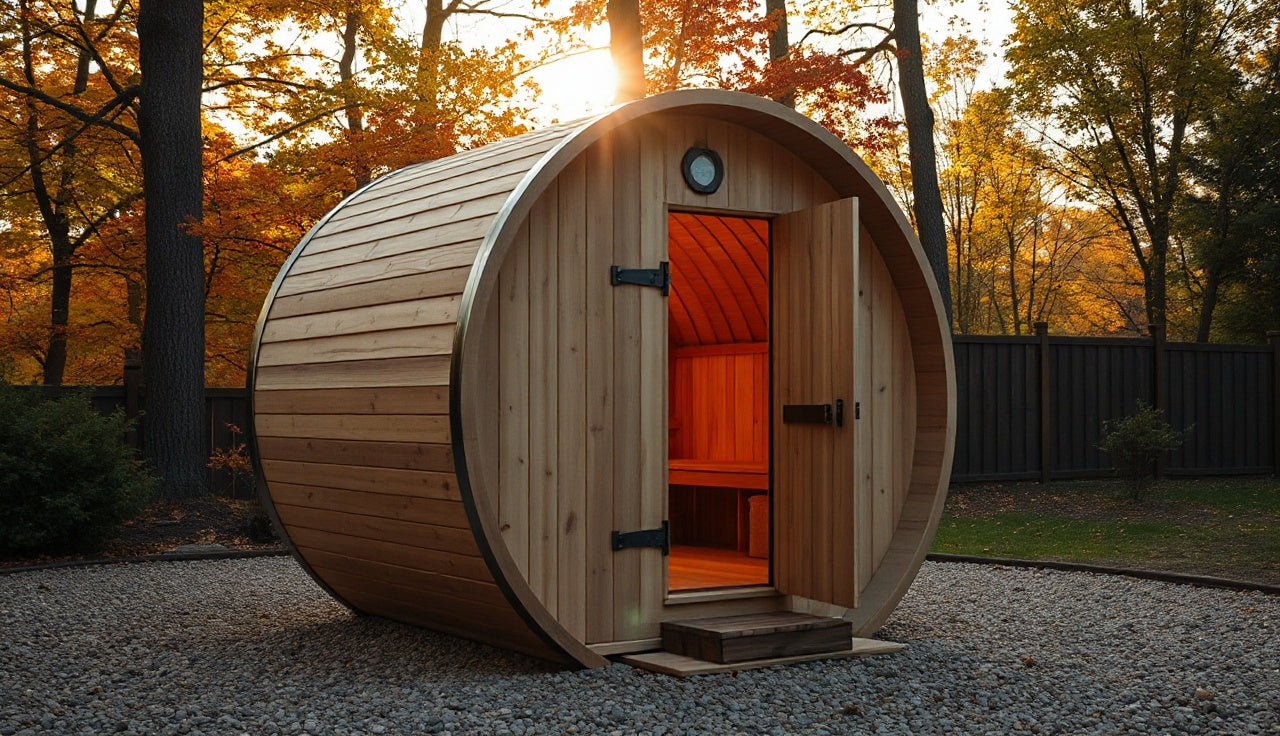
Infrared cabin units in the $2,000 to $5,000 range are the most popular starting point for homeowners. Many plug into a standard 120V outlet (the lower-end 1-person units) or a 240V/20A circuit (most 2-person and larger units). Barrel saunas are popular outdoors because they shed rain well and look good in a backyard. Pre-cut kits from Canadian or Scandinavian suppliers usually include the lumber, benches, and a heater, but you pay for assembly, either your own weekend or a contractor's time. Custom builds give you full control over size, wood species, and features, and they get priced like a small room addition.
How much does home sauna installation cost?
Installation is where budgets get blindsided. The unit price is only the beginning, and electrical work is the biggest variable. Most electric rock heaters (6kW to 9kW) need a dedicated 240V/40A or 240V/60A circuit. Running a new circuit from your panel to the sauna location costs $300 to $1,500 depending on distance and whether your panel has capacity [10]. If your panel is full or underpowered, a panel upgrade adds $1,500 to $4,000 on top of that [10].
Infrared units under 1,500 watts plug into a standard 120V/15A outlet, which means zero electrical upgrade cost in many homes. Larger infrared units (2,000 to 3,000 watts) need a dedicated 240V/20A circuit, roughly $200 to $600 to add.
Delivery and placement adds $150 to $500 for most pre-built units. Barrel sauna assembly by a contractor runs $500 to $1,500. A site-built custom sauna room is a full construction project: framing, vapor barrier, sauna-grade wood paneling, bench construction, heater install. Labor alone can run $3,000 to $8,000.
Permits get overlooked constantly. Most jurisdictions require an electrical permit for new 240V circuits, and some require a building permit for any structure over 120 square feet or any addition to your home. Permit fees range from $50 to $500 depending on your municipality [2]. Skipping permits on electrical work creates real liability and can complicate a homeowner's insurance claim. Not worth cutting that corner.
| Portable tent/blanket | $400 |
| Plug-in infrared (1-person) | $2,200 |
| Infrared cabin (2-person) | $4,500 |
| Pre-built electric cabin | $6,500 |
| Barrel sauna (outdoor kit) | $8,000 |
| Prefab outdoor cabin | $14,000 |
| Custom build | $22,000 |
Source: Angi/HomeAdvisor Sauna Installation Cost Guide, 2024
What does it cost to run a home sauna each month?
Operating cost comes down to three things: heater wattage, how often you use it, and your local electricity rate. The U.S. average residential electricity rate was 16.2 cents per kWh in 2024, according to the U.S. Energy Information Administration [3].
A typical 6kW electric heater takes 30 to 45 minutes to reach temperature, then cycles on and off to hold heat. A one-hour session including preheat uses roughly 4 to 6 kWh. At 16.2 cents per kWh, that runs $0.65 to $0.97 per session [3].
Use it four times a week and you're looking at about $11 to $17 per month in electricity. Five sessions a week pushes it to $14 to $21. A wood-burning sauna erases the electricity cost but adds firewood: a cord of hardwood runs $200 to $400 in most of the country, and a cord lasts many months of regular use.
Infrared saunas draw lower wattage (1,500 to 3,000 watts versus 6,000 to 9,000 for electric rock) but need longer sessions to reach similar effects, so the per-session energy gap is smaller than the wattage difference suggests. A typical 2kW infrared session uses 1 to 1.5 kWh, about $0.16 to $0.24. Regular infrared users save roughly $8 to $15 per month over electric rock heaters.
Maintenance stays cheap. Cedar and other sauna-grade woods need no finishing. The main expenses are heater element replacement every 5 to 10 years ($150 to $400) and occasional stone replacement for electric heaters ($30 to $80). Cleaning supplies come down to a bucket, a brush, and some diluted white vinegar.
Does a home sauna add value to your house?
There's no clean answer, and anyone who quotes you a precise ROI figure is guessing. Appraisers treat saunas like other specialty amenities: they add value in markets where buyers expect them and add little where they don't.
In Scandinavian-influenced markets (parts of Minnesota, Michigan, the Pacific Northwest) and in luxury-tier homes, a quality sauna room can add $5,000 to $15,000 in perceived value, based on National Association of Realtors survey data on home features [4]. In a mid-range suburban home in a warm-weather state, a sauna may add little to the appraised value, and some buyers who don't use one may see it as a quirky liability.
Outdoor structures like barrel saunas and sauna cabins are generally treated as personal property unless they sit on a permanent foundation, which affects whether they count toward the home's assessed value. A portable or semi-permanent outdoor sauna you take with you when you move has no effect on the sale price.
Here's the better framing. Don't buy a home sauna expecting to recoup the cost at resale. Buy it because you'll use it regularly. The sauna benefits research on cardiovascular health, stress, and recovery is the real return, and that value goes to you, not to some future buyer.
Indoor vs. outdoor home sauna: which costs more?
Outdoor saunas almost always cost more to install, even when the unit price is similar. The reasons are practical.
Outdoor units need weatherproofing, either from the unit itself (most barrel saunas are built for outdoor use) or from a separate structure. They also need a weatherproof electrical run from the house to the sauna, which costs more than an indoor run. If your backyard sauna sits more than 30 or 40 feet from your main panel, conduit and wire can add $500 to $1,500 to the electrical bill.
Outdoor saunas also need a proper base. Most barrel sauna makers recommend pressure-treated wood rails, gravel beds, or concrete blocks. A poured concrete pad (4 inches, 8x10 feet) costs $800 to $2,000 depending on your market. Gravel or paver bases run cheaper, around $200 to $600 for materials.
Indoor saunas skip the foundation and weatherproofing but demand real ventilation. A sauna room inside your house needs a fresh air source, usually a low vent in the door or wall, plus a way to exhaust humid air so it doesn't wreck the surrounding drywall. A proper vapor barrier behind the wood paneling is essential for an indoor build. Miss it and you get mold in the wall cavity.
For outdoor options, read our guide on outdoor sauna setups, which covers foundation types, heater choices, and what to expect from installation.
How much current do home saunas use, and what circuit do you need?
The answer varies by heater type and size, and it's one of the most searched questions buyers have before purchasing. Traditional electric rock heaters get rated by kilowatts: 3kW for very small 1-person units, 4.5kW to 6kW for 2 to 4-person saunas, 8kW to 12kW for larger rooms. A 6kW heater at 240V draws 25 amps. A 9kW heater draws about 37.5 amps.
The National Electrical Code (NEC) Article 424 requires a dedicated circuit sized at 125% of the continuous load for electric heating appliances [5]. So a 6kW heater needs a circuit rated for at least 31.25 amps, which means a 40-amp breaker and 8 AWG wire minimum. Most electricians install a 50-amp circuit for a 6kW sauna to leave headroom [5].
Infrared saunas are simpler. A 1-person unit drawing 1,500 watts runs on a standard 120V/15A household circuit. A 2-person unit drawing 2,400 to 3,000 watts needs a dedicated 240V/20A circuit. Those are the same circuits used for window air conditioners, so most homes can take one without a panel upgrade.
Always check the heater manufacturer's install specs before hiring an electrician. Some makers specify 60A breakers for their larger heaters, and installing the wrong size creates a fire hazard and voids the warranty. SweatDecks lists clear electrical requirements on each product page, which helps you get an accurate quote from your electrician before you buy.
Wood-burning heaters skip electrical requirements entirely, but they only make sense for outdoor saunas with proper chimney clearances, and many municipalities restrict wood-burning appliances. Check local codes first [2].
What's the cheapest way to add a sauna at home?
There are real options at every price tier if budget is the main constraint.
Under $500: a sauna blanket or portable tent. These work differently from a room sauna but do produce heat and sweat. Blankets fold up and store in a closet. Tents feel slightly more immersive but still fall well short of the real thing.
$1,500 to $3,000: a 1-person plug-in infrared cabin sauna. These arrive pre-assembled or nearly so, plug into a standard outlet (or a 20A dedicated circuit at most), and fit in a corner of a bedroom, basement, or garage. Build quality varies a lot at this price, so third-party reviews earn their keep.
$3,000 to $6,000: a 2-person infrared or electric cabin sauna on a 240V circuit. This is the sweet spot for most buyers who want a real sauna experience. You get room to relax, a proper heater, and a unit built to last 10 to 20 years with little maintenance.
DIY barrel sauna kits from makers like Almost Heaven or comparable Canadian suppliers start around $3,000 to $5,000 for the kit. If you're handy and can do the assembly yourself (usually a full weekend for two people), you save $500 to $1,500 in labor. The electrical work still needs a licensed electrician unless you hold the certification yourself.
Skipping permits to save money is the wrong move. Beyond the safety issues, unpermitted electrical work can void your homeowner's insurance after a fire, and it creates a disclosure obligation when you sell the home [2].
Is it worth buying a sauna at Costco or through a big-box retailer?
Costco, Home Depot, and similar retailers sell sauna units, mostly in the $1,500 to $4,000 range. The value is real at that price, and warehouse-club return policies are hard to beat if you end up unhappy.
The tradeoff is selection and support. Big-box retailers carry a narrow range, and if you have technical questions about the heater, circuit requirements, or warranty service, you're often on your own. Specialty sauna retailers and brands tend to offer better support and more detailed documentation.
Our Costco sauna guide breaks down the specific models these stores typically stock and whether they represent good value.
Watch heater quality with any budget sauna. Cheap heaters (often unbranded or no-name) fail faster and can be hard to replace. A quality heater from Harvia, Tylö, or a similar Finnish maker carries a multi-year warranty, and replacement parts stay available. Paying a few hundred dollars more for a known heater brand inside a kit often makes better economic sense over a 10-year ownership window.
How does home sauna cost compare to a gym membership over time?
This comparison is legitimate, more than a marketing exercise. The average U.S. gym membership costs $40 to $70 per month, or $480 to $840 per year [6]. If your main reason for the gym is sauna access (and that's true for a meaningful number of people), the math shifts fast.
A $5,000 home sauna with $200 in annual electricity breaks even against a $55/month gym membership in about 8 years. Use the sauna more than the gym average (many enthusiasts do), or pay for a premium membership above $70/month, and the breakeven comes sooner.
The comparison isn't purely financial, though. A home sauna is open at 6am or 11pm, has no waiting, and skips the commute. For people who use saunas regularly for recovery or stress, convenience drives compliance, and compliance is the real variable. A $5,000 sauna you use four times a week beats a $50/month gym membership you use twice a month.
For athletes combining heat and cold, pairing a home sauna with a cold plunge gives you contrast therapy at home that no standard gym membership includes. That combination costs $5,000 to $15,000 all-in but delivers a recovery setup that would otherwise require a sports medicine facility or a high-end athletic club.
What hidden costs should you budget for before buying?
Most cost estimates online cover unit prices only. Here's what typically gets left off the invoice until you're already committed.
Electrical permit and inspection: $50 to $300 depending on municipality [2]. Required for any new 240V circuit in most U.S. jurisdictions.
Electrician labor: $300 to $1,500 for a new circuit, more if the panel needs work [10].
Delivery surcharges: many sauna brands charge standard shipping, then add $100 to $400 in freight fees for large items or remote locations.
Foundation or base (outdoor units): $200 to $2,000 depending on material.
Accessories: a quality sauna bucket and ladle set costs $30 to $80. A thermometer and hygrometer run $20 to $50. Sauna stones for a new heater (if not included) run $30 to $60. Bench covers and back rests add another $50 to $150. None of these are optional for an enjoyable session. They just don't show up in the headline unit price.
Homeowner's insurance rider: some insurers want a rider or policy update when you add a sauna, especially an outdoor structure. This might cost $50 to $200 per year or nothing, depending on your policy. Call your insurer before installation.
On the sauna hub page, we've compiled a full buyer's checklist covering these pre-purchase steps in more detail.
What are the real health benefits that justify the cost?
This is the honest version of the ROI question. The research on sauna use is genuinely interesting, and the evidence is stronger than most people expect, but it's also more nuanced than wellness marketing lets on.
The most cited study is a 2018 analysis in Mayo Clinic Proceedings that followed 2,315 middle-aged Finnish men and found those who used a sauna 4 to 7 times per week had significantly lower rates of cardiovascular disease mortality than once-per-week users [7]. The authors stated that "sauna bathing is associated with a reduced risk of vascular diseases such as high blood pressure, cardiovascular disease, and neurocognitive diseases" [7]. It's an observational study, so causation isn't established, and Finnish sauna habits may differ from what most Americans will realistically do.
A 2021 review in the International Journal of Environmental Research and Public Health found consistent evidence that regular sauna use improves markers of arterial stiffness and reduces systolic blood pressure in the short term [8]. The effect sizes are modest but real.
For recovery, the mechanism is better understood. Heat stress raises core body temperature, lifts heart rate similarly to moderate aerobic exercise, and triggers hormetic stress responses including heat shock protein production [9]. Whether that translates to faster muscle recovery is still being studied. Nobody has clean randomized controlled trial data specifically on athlete recovery from home sauna use.
For a straight summary of what the evidence shows, the sauna benefits article covers the research without overstating the conclusions.
Frequently asked questions
How much does a 2-person home sauna cost including installation?
A 2-person home sauna typically costs $2,500 to $6,000 for the unit, plus $500 to $1,500 for electrical work and permits, so budget $3,000 to $7,500 all-in. Infrared models at the lower end can run on a dedicated 240V/20A circuit. Traditional electric rock heaters at the higher end need a 240V/40A to 50A circuit, which costs more to install but delivers a more authentic sauna experience.
Can I install a home sauna myself to save money?
You can assemble a pre-cut barrel sauna kit yourself if you're comfortable with basic carpentry, and that saves $500 to $1,500 in labor. The electrical work is a different matter. A dedicated 240V circuit requires a licensed electrician in most U.S. states, and doing it yourself without proper certification risks failed inspections, voided warranties, and fire hazards. Budget the electrical portion no matter your DIY ambitions.
How much electricity does a home sauna use per month?
A 6kW electric heater used four times per week for one hour per session uses roughly 16 to 24 kWh per month. At the U.S. average of 16.2 cents per kWh, that's about $2.60 to $3.90 per week, or $11 to $17 per month. Infrared saunas running at 2kW use about one-third as much electricity per session. Your actual cost depends on local rates, session length, and how well your sauna holds heat.
What is the cheapest home sauna option that actually works?
A sauna blanket or portable tent in the $200 to $600 range produces real heat and sweat, and it's a legitimate entry point for first-time users. It won't replicate sitting in a wood-lined room, and the heat retention feels noticeably different. For a more authentic experience on a tight budget, a plug-in 1-person infrared cabin unit starting around $1,500 is the lowest price where the experience gets genuinely satisfying.
Does a home sauna require a building permit?
Almost always yes for the electrical work: a new 240V circuit requires an electrical permit in most U.S. jurisdictions. For the structure itself, an indoor sauna room inside existing square footage often doesn't need a building permit, but an outdoor structure over a certain size (often 120 square feet) usually does. Rules vary by municipality, so contact your local building department before starting any work. Permit fees generally run $50 to $500.
How long does a home sauna last?
A well-built cedar or hemlock sauna room can last 20 to 30 years with little maintenance. The weakest link is usually the heater: quality Finnish-made heaters from Harvia or Tylö carry 2 to 5-year warranties and realistically last 10 to 15 years before needing element replacement. Cheap no-name heaters often fail in 3 to 5 years. The wood itself doesn't rot under normal sauna conditions because it dries completely between sessions.
Is an infrared sauna cheaper than a traditional sauna?
The unit price is often similar in the $2,000 to $5,000 range, but infrared saunas cost less to install because they need less electrical capacity, and less to run because they use 1,500 to 3,000 watts versus 6,000 to 9,000 for electric rock heaters. The experience differs: infrared heats your body more directly at lower air temperatures (110 to 130°F), while traditional saunas heat the room to 170 to 195°F with optional steam from water poured on rocks.
What size home sauna do I need?
A 1-person sauna needs about 3x3 feet of floor space. A 2-person sauna is comfortable at 4x4 feet. A 4-person sauna fits in roughly 5x7 feet. The heater is sized to match room volume: about 1kW per 50 cubic feet of space is the standard guideline from most heater makers. Buying a slightly oversized sauna beats undersizing, because you can lower the temperature but you can't easily expand the room later.
Can a home sauna be used outdoors year-round?
Yes, most barrel saunas and prefab outdoor cabin saunas are built for year-round use in any North American climate. The wood handles freeze-thaw cycles well, and the heating element keeps the interior hot regardless of outside temperature. The main considerations are a weatherproof electrical connection, snow load on the roof in high-snowfall areas, and a door that opens away from prevailing wind. Budget extra preheat time (45 to 60 minutes instead of 30) in very cold weather.
How does home sauna cost compare to a steam room?
A home steam room costs more than a comparable sauna in most cases. Steam generators run $500 to $2,500 for the unit alone, and the room itself requires fully waterproofed tile or acrylic walls, a pitched ceiling to prevent drips, and a proper drain, adding $2,000 to $10,000 in construction. A comparable sauna needs no waterproofing beyond a vapor barrier. Our sauna vs steam room guide covers the full cost and experience comparison.
Do home saunas increase home value?
Possibly, but not reliably. In markets where buyers expect or value saunas (luxury homes, Scandinavian-influenced regions), a quality built-in sauna room can add $5,000 to $15,000 in perceived value, based on National Association of Realtors survey data. In typical suburban markets, a sauna adds little to appraised value and may complicate the sale if buyers see it as a liability. A portable or non-permanent sauna adds nothing to home value because it moves with you.
What wood is used in home saunas and does it affect cost?
Western red cedar is the most common sauna wood in North America and costs more than hemlock or aspen. Cedar resists moisture, doesn't splinter, and smells pleasant. Hemlock is cheaper (sometimes $200 to $500 less per unit) and nearly as good. Nordic spruce is traditional in Finnish saunas and falls in the middle price-wise. Avoid pine: it contains resins that drip when heated and can cause burns and staining. Wood type matters mainly for durability and sensory experience, not structural integrity.
Is combining a sauna with a cold plunge worth the extra cost?
For serious recovery users, yes. Contrast therapy protocols alternating heat and cold have research support for reducing muscle soreness and improving parasympathetic recovery, though the evidence is still building. A dedicated cold plunge or ice bath setup costs $300 to $5,000 depending on type. Adding one to a $5,000 sauna brings total cost to $5,500 to $10,000 for a home contrast therapy station that a commercial gym or spa would charge $30 to $60 per session to access.
Sources
- U.S. Consumer Product Safety Commission, Electrical Safety: Electrical permits are required for new circuit installations in most U.S. jurisdictions; skipping permits creates safety and insurance liability
- U.S. Energy Information Administration, Electric Power Monthly: Average U.S. residential electricity rate was 16.2 cents per kWh in 2024
- National Association of Realtors, Remodeling Impact Report: Specialty amenities including saunas add $5,000 to $15,000 in perceived value in markets where buyers expect them
- National Fire Protection Association, NFPA 70 National Electrical Code Article 424: NEC Article 424 requires a dedicated circuit sized at 125% of the continuous load for electric heating appliances
- Statista, Average Monthly Cost of a Gym Membership in the U.S.: Average U.S. gym membership costs $40 to $70 per month
- Mayo Clinic Proceedings, Sauna Bathing and Incident Cardiovascular Disease (2018): Sauna bathing 4 to 7 times per week was associated with significantly lower cardiovascular disease mortality; authors stated sauna bathing is associated with reduced risk of vascular diseases including high blood pressure and cardiovascular disease
- International Journal of Environmental Research and Public Health, Health Effects of Sauna Bathing (2021): Regular sauna use consistently improves markers of arterial stiffness and reduces systolic blood pressure in the short term
- National Institutes of Health, PubMed: Heat Shock Proteins and Exercise: Heat stress triggers heat shock protein production as part of a hormetic stress response; core body temperature elevation mimics moderate aerobic exercise in cardiovascular load
- HomeAdvisor / Angi, Sauna Installation Cost Guide: Most homeowners spend $3,000 to $10,000 all-in for a quality pre-built sauna with professional installation; custom builds reach $25,000 or more
Share:
Icebound Pro 1HP cold plunge chiller: full buyer's guide
Ice Barrel 500 cold plunge tub: honest review and full breakdown