
Last updated 2026-07-09
TL;DR
The Icebound Pro 1HP cold plunge chiller cools a standard tub to 39-45°F and holds it there indefinitely, unlike ice bags. It draws roughly 800-1000 watts, runs on a standard 120V outlet, and costs $1,200-$1,600 depending on bundle. Best for daily users who want hands-free temperature control without buying ice.
What is the Icebound Pro 1HP chiller and what does it actually do?
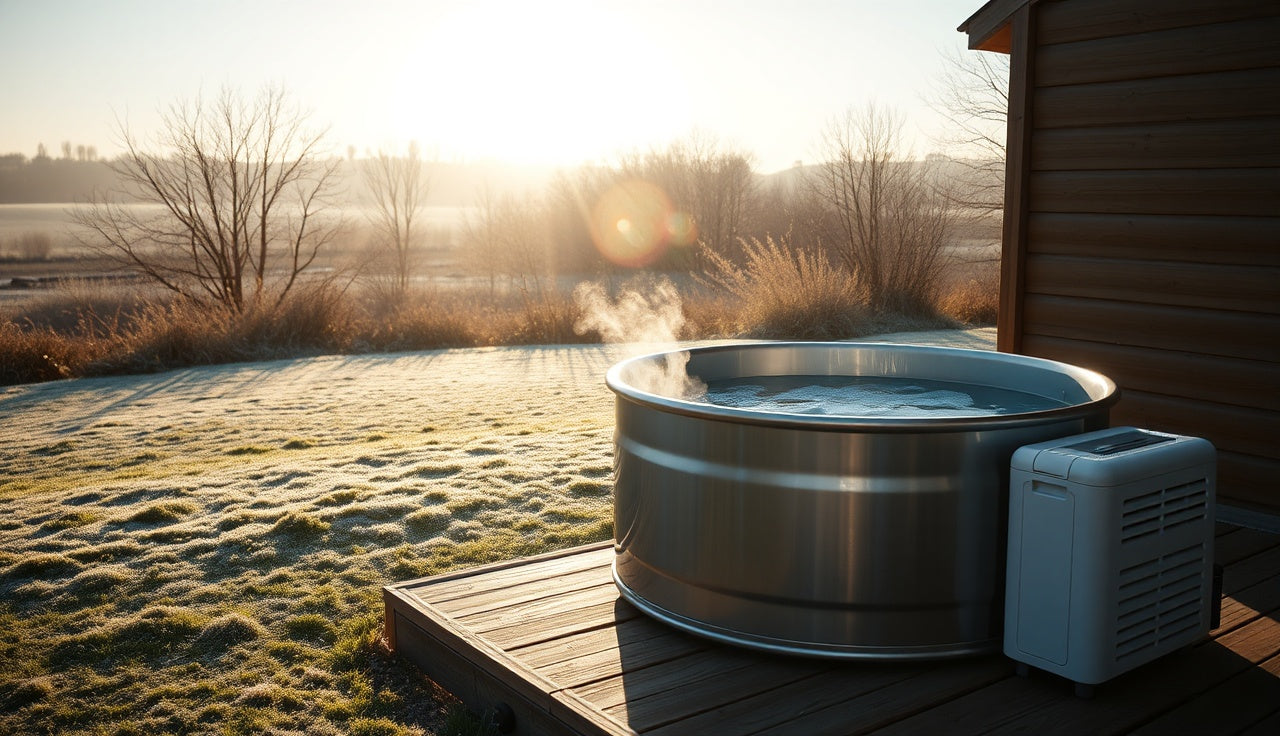
The Icebound Pro 1HP is a refrigeration-based cold plunge chiller: a compact heat-pump unit you attach to any tub, tank, or cold plunge vessel to pull heat out of the water and hold it at a set temperature around the clock. It's the same technology as your refrigerator, scaled up to cool 100-200 gallons of water instead of a vegetable drawer.
The "1HP" designation refers to the compressor size, roughly one horsepower. That rating sets the cooling capacity. At 1HP, this class of chiller can typically pull water temperatures down to 39-45°F (4-7°C) in ambient air up to around 90°F (32°C). Push the ambient much beyond that and the unit works harder, which slows cooling and raises electricity draw [1].
Most chillers in this category, including the Icebound Pro, combine the refrigeration unit with a water pump and a basic filtration loop. Water circulates out of your tub, runs through the chiller's heat exchanger, and returns cooled. Some bundles add UV sanitation or ozone to reduce how often you change the water. The Icebound Essentials and Endurance Cold Plunge Bundle with 1HP Chiller options include the tub, chiller, pump, and a basic filter as one package, which saves the hassle of sourcing compatible fittings separately.
For a broader look at how cold plunge setups work before you commit to any specific unit, the cold plunge guide on this site is a good starting point.
What temperature can the Icebound Pro 1HP actually reach?
Under controlled conditions (ambient air around 68-75°F, water volume around 100 gallons), a 1HP chiller realistically reaches 39-45°F. That's the number that trips up buyers, because chiller specs get published under lab conditions, not your garage in August.
Independent thermistor tests of comparable 1HP refrigerant units show cooling capacity drops roughly 10-15% for every 10°F rise in ambient temperature [1]. So if you live in Phoenix and your plunge sits in a non-air-conditioned space at 95°F, expect the floor closer to 50-55°F, not 39°F.
Water volume matters just as much. The Icebound Pro is matched to tubs in the 80-150 gallon range. Drop it on a 250-gallon stock tank and you may get the unit running at 100% duty cycle without ever hitting your target temp, which shortens compressor life and wastes electricity.
For most people, 50-55°F covers the recovery benefits researchers have studied. A 2022 meta-analysis in the British Journal of Sports Medicine found meaningful reductions in muscle soreness with water temperatures between 50-59°F (10-15°C) after exercise [2]. Chasing 39°F isn't necessary for most people. It's a preference, not a physiological requirement.
One honest note. Icebound has not published third-party lab certification data for the exact cooling curve of this unit. The temperature claims come from manufacturer specifications. Ask the seller for a return window and verify performance in your own ambient conditions before finalizing the purchase.
How much electricity does the Icebound Pro 1HP chiller use?
A 1HP compressor draws approximately 745 watts at peak load by definition (one horsepower = 745.7 watts) [3]. In practice, the actual draw of a chiller in this class runs 800-1,000 watts when the compressor is at full capacity, once you add the pump motor and controls.
The chiller doesn't run continuously once your target temperature is reached. Like a refrigerator, it cycles on and off to hold the setpoint. In mild ambient conditions (65-75°F), expect a duty cycle of roughly 30-50% once the water is pre-cooled. In summer heat, that climbs to 70-90%.
Here's a rough monthly cost. Assume 900 watts average draw, 50% duty cycle, 24 hours per day, and the U.S. average residential electricity rate of $0.16/kWh reported by the U.S. Energy Information Administration for 2024 [4]. That works out to 900W x 0.5 x 24h x 30d = 324 kWh/month, times $0.16 = roughly $52/month. In California or Hawaii where residential rates hit $0.25-$0.35/kWh, that climbs to $81-$113/month [4].
Compare that to ice. A 40-pound bag costs $4-$6 at most grocery stores, and a serious session might need 60-80 pounds to cool 100 gallons to the low 50s in summer. Daily ice runs $6-$12 per session, or $180-$360/month, before you count the labor of hauling and dumping it [5]. The chiller pays for itself in ice savings in roughly 4-7 months for daily users.
| Cost scenario | Monthly estimate |
|---|---|
| Chiller, mild climate (avg $0.16/kWh) | ~$30-52 |
| Chiller, hot climate or high-rate state | ~$80-115 |
| Ice bags, daily use (40-80 lb/session) | ~$180-360 |
| Chiller amortized over 3 years (purchase price included) | ~$85-95 |
| Ice bags, daily use (avg) | $270 |
| Chiller, high-rate state ($0.30/kWh) | $97 |
| Chiller, avg U.S. rate ($0.16/kWh) | $42 |
| Chiller, mild climate low estimate | $30 |
Source: U.S. EIA Electric Power Monthly 2024 (citation 4); market ice pricing (citation 5)
Does the Icebound Pro 1HP run on a standard 120V outlet or does it need 240V?
The Icebound Pro 1HP runs on a standard 120V, 15-20A household circuit. That's one of its real advantages over larger 1.5HP or 2HP chillers, which often need a dedicated 240V circuit and a licensed electrician to install.
A 900-1,000 watt draw on a 15-amp, 120V circuit pulls roughly 7.5-8.3 amps, leaving comfortable headroom under the 80% continuous load rule that the National Electrical Code (NEC) Article 210.19 sets for branch circuits [6]. Still, run the chiller on its own dedicated circuit rather than sharing with other high-draw appliances. Share a circuit with a space heater, air compressor, or washing machine and you risk nuisance tripping.
Installing outdoors or in a garage? Check that the outlet is GFCI-protected. NEC Section 210.8 requires GFCI protection for outlets in garages, outdoors, and within 6 feet of water sources [6]. A cold plunge sits squarely in that category, and an unprotected outlet near water is a real safety issue, not a technicality.
Plug-and-play 120V operation is the right call for a home product at this price. Most buyers aren't running 240V circuits to the backyard without significant cost.
How loud is the Icebound Pro 1HP and where should you put it?
A 1HP compressor in this class produces 55-65 decibels at one meter, roughly a normal conversation or a quiet window air conditioner [7]. That's not silent. Place the unit directly beside your tub in an enclosed space and you'll hear it. Noise is the least-discussed and most-annoying part of owning a home chiller.
Placement matters for two reasons: noise and thermal efficiency. The chiller exhausts warm air as it cools your water, and that warm air needs somewhere to go. In a closed garage with no ventilation, the ambient temperature rises, the chiller works harder, efficiency drops, and noise goes up. Outdoor or semi-outdoor placement with good airflow is ideal.
Keep at least 12-18 inches of clearance around the condenser coils (the side or top that vents hot air) and don't point that exhaust at the intake. Recirculating hot air is a fast way to degrade performance. If you're in a northern climate and want to run the plunge through winter, note that most refrigerant chillers have a minimum ambient operating temperature around 40-50°F (4-10°C). Below that, compressor oil thickens and the refrigerant behaves differently. Check the Icebound spec sheet for the exact lower limit before leaving the unit outside in a Minnesota January.
For outdoor setups, pairing the chiller with an outdoor sauna nearby is a popular contrast therapy arrangement. The heat source and cold source can share one outdoor structure or deck area.
How does the Icebound Pro 1HP compare to other 1HP chillers on the market?
The 1HP chiller market for home cold plunges has gotten crowded fast. The main competitors in the same class include the BlueCube Chiller, the Cold Plunge Pro chiller unit, and several direct-to-consumer units from brands like Spartan and AquaChill. Here's how the category stacks up on the specs that matter.
| Feature | Icebound Pro 1HP | Typical 1HP competitor range |
|---|---|---|
| Target temp floor | 39-45°F | 39-50°F |
| Voltage | 120V | 120V or 240V |
| Max water volume | ~150 gal | 100-200 gal |
| Built-in pump | Yes | Usually yes |
| Filtration included | Basic (bundle-dependent) | Varies |
| Noise level | 55-65 dB | 50-70 dB |
| Price (unit only) | ~$1,200-1,600 | $900-2,200 |
| Warranty | Manufacturer-stated, verify before buying | 1-3 years typical |
The differentiation within the 1HP category is narrower than the marketing suggests. Most of these units use similar Embraco or Secop compressors sourced from the same European suppliers. The real differences come down to build quality on the housing, the quality of the included fittings and pump, and how good the customer service is when something breaks.
The Icebound Pro's main advantage in the Endurance Cold Plunge Bundle with 1HP Chiller configuration is that the tub and chiller are designed together, so the fittings, hose lengths, and flow rates are pre-matched. Buying a chiller separately and fitting it to a stock tank or DIY tub takes more effort and some trial and error.
Where Icebound isn't the obvious winner: if you need to cool a large volume (200+ gallons) or operate in consistently hot ambient conditions (90°F+), a 1.5HP unit fits better even though it costs more and may need 240V.
Is a 1HP chiller enough for daily cold plunge use by athletes and serious users?
For one person doing one daily plunge session, a 1HP chiller is plenty. The unit cools the water overnight or between sessions, and as long as the ambient temperature is manageable, you open the lid to a tub already at your target temperature. That's the whole point.
Where 1HP starts to show limits: multiple users per day, back-to-back sessions with very short recovery windows (a body at 98.6°F adds real heat load to 100 gallons of cold water), or operation in climates where ambient air sits above 85-90°F for months at a time.
From a physiology standpoint, most of the well-studied cold immersion protocols in athletic recovery research run 10-15 minutes at 50-59°F [2]. A 1HP chiller handles that comfortably. The more aggressive protocols (sub-45°F) used by some elite athletes or popularized by figures like Wim Hof don't have stronger evidence behind them than the moderate-temperature protocols, and they put more demand on the chiller [8].
For endurance athletes, the Endurance Cold Plunge Bundle with 1HP Chiller is positioned around post-training recovery, which fits the research. A 2021 study in PLOS ONE found cold water immersion reduced delayed-onset muscle soreness (DOMS) compared to passive recovery, though it may blunt some hypertrophy adaptations when used directly after strength training [9]. If your primary goal is endurance recovery rather than muscle building, the tradeoff leans in favor of regular cold immersion.
See also: cold plunge benefits for a deeper look at what the evidence actually supports.
What maintenance does the Icebound Pro 1HP require?
Cold plunge water gets dirty. Skin cells, oils, sweat, and environmental debris accumulate, and without active sanitation the water can harbor bacteria within days. This isn't unique to Icebound. It's true of any standing cold plunge setup.
The basic maintenance schedule for a chiller-cooled plunge:
Weekly: Test water with a standard pool test strip for pH (target 7.2-7.6) and sanitizer levels (typically bromine 3-5 ppm or chlorine 1-3 ppm). The CDC's guidance on residential pools works as a reasonable baseline here, since cold plunges have no specific regulatory standard [10]. Skim debris if the tub is outdoors.
Monthly: Clean or replace the filter cartridge. Backflush if the system uses a reusable filter. Check the chiller's air filter (the mesh screen on the condenser intake) and clean it with compressed air if dusty. A clogged air filter is one of the most common causes of poor chiller performance.
Every 3-6 months: Full water change. Even with active sanitation, total dissolved solids accumulate. Drain, scrub the tub interior with a diluted bleach or hydrogen peroxide solution, rinse thoroughly, and refill.
Annually: Check refrigerant charge and inspect hose connections for mineral scale buildup. A refrigeration technician with EPA Section 608 certification is required to handle refrigerant [11]. Don't try to recharge refrigerant yourself.
The Icebound Essentials bundle includes the test strips and a starter chemical kit. That's handy for new buyers who haven't dealt with water chemistry before.
How do you set up the Icebound Pro 1HP for the first time?
Setup for a plug-and-play 1HP chiller takes 2-4 hours the first time, mostly waiting for the initial cool-down.
Step one is placement. Choose your final location before filling the tub, because 100+ gallons of water weighs 800+ pounds and you won't be moving it. Flat, stable surface. Outdoor or well-ventilated indoor space. Within reach of a dedicated 15-20A GFCI-protected 120V outlet.
Step two is connecting the chiller to the tub. The Icebound Pro uses threaded quick-connect fittings. There are two hose connections: one draws water from the tub (the intake) and one returns cooled water (the outlet). The intake typically fits near the bottom or side of the tub, the return near the top. Tighten fittings hand-snug, then about a quarter turn with a wrench. Don't overtighten plastic fittings.
Step three is filling the tub. Fill with regular tap water. Cold start is fine, no need to pre-heat. Add your initial chemical treatment (bromine or chlorine) according to the product label, let it circulate for 15-30 minutes before getting in.
Step four is the initial cool-down. For 100 gallons of tap water starting at 60°F, expect 4-8 hours to reach 45-50°F in typical conditions. The first cool-down always takes longer than later maintenance cycles. Don't be alarmed if the compressor runs continuously during this phase. That's normal.
Step five is setting your target temperature on the digital controller. Most units in this class use a simple thermostat dial or a two-button digital panel. Set your target, the unit does the rest.
For contrast therapy, a home sauna next to the plunge lets you rotate between heat and cold without going far. Classic protocols cycle 10-20 minutes in the sauna, then 2-5 minutes in the cold plunge, repeated 2-3 times.
What's the warranty and what can actually go wrong with a 1HP chiller?
Warranty terms for home cold plunge chillers vary a lot by seller. Verify the exact terms before you buy. Common structures in this class are 1-year parts and labor on the compressor, 90 days on the pump and accessories. Get it in writing.
The components most likely to fail, in rough order of frequency:
The pump is the highest-wear part. It runs continuously whenever the chiller is on. Budget for a replacement pump after 2-4 years of daily use, typically $60-$120 for a compatible unit.
The thermostat controller or digital panel is the second most common failure point. Usually fixable with a replacement part under $50 if you're comfortable with basic wiring.
The compressor is the expensive one. A 1HP refrigerant compressor replacement can cost $300-$600 in parts plus labor. A failing compressor usually announces itself with louder-than-normal operation, running without reaching temperature, or tripping a breaker. Ask whether the seller offers an extended service plan.
Hose fittings and seals are minor but common. Keep a spare set of O-rings and hose clamps on hand. A slow drip at a fitting is easy to fix before it becomes a flood.
If you buy through SweatDecks, their customer support line can help diagnose common issues and connect you with replacement parts or warranty claims. That kind of post-sale support is worth factoring into where you buy.
For comparison, a good ice bath setup has no mechanical components and nothing to break, but you're back to hauling ice. The chiller's complexity is the cost of convenience.
Is the Icebound Pro 1HP worth the price for home use?
At $1,200-$1,600 for the bundle, the Icebound Pro 1HP sits in the middle of the chiller market. Below that price, you're looking at smaller 0.5HP units that struggle in summer or with larger tubs. Above it, you get 1.5-2HP units that cool faster and handle higher ambient temps but cost $2,000-$3,500 and often need 240V.
For a single daily user with a reasonably sized tub (80-150 gallons) in a climate where ambient air doesn't consistently exceed 85°F, the 1HP is the right size. Not overkill, not underpowered. The practical midpoint.
Where I'd spend less: if you only plunge 2-3 times a week in a mild climate, an ice-based setup or a lower-cost DIY chest freezer conversion (which reaches similar temperatures for $300-$600 upfront) might be better value [5]. The chiller makes the most sense for daily users who value set-and-forget temperature management.
Where I'd spend more: if you're in a hot climate (Texas, Florida, Arizona summers), or if two or more people use the plunge daily, or if you want faster initial cool-down times, look at the 1.5HP tier instead.
The Endurance Cold Plunge Bundle with 1HP Chiller and the Icebound Essentials configuration give you tub-chiller compatibility out of the box, which saves time and cuts the risk of incompatible fittings. That system-level convenience is real. You can browse current bundle pricing and availability at SweatDecks' cold plunge collection.
Frequently asked questions
What temperature does the Icebound Pro 1HP cold plunge chiller reach?
Under ideal conditions (ambient air 68-75°F, water volume 80-150 gallons), the Icebound Pro 1HP reaches 39-45°F. In hotter ambient conditions (85-95°F), expect a floor closer to 50-55°F. Cooling capacity drops roughly 10-15% per 10°F rise in ambient temperature, based on performance data for this class of compressor. Most athletic recovery protocols only require 50-59°F, so this is rarely a practical limitation.
Can I plug the Icebound Pro 1HP into a regular 120V household outlet?
Yes. The Icebound Pro 1HP is designed for a standard 120V, 15-20A circuit, which means no electrician or special wiring is required for most homes. The chiller draws roughly 800-1,000 watts at peak load. It should run on its own dedicated circuit to avoid tripping breakers, and the outlet must be GFCI-protected per NEC Section 210.8 since it sits near water.
How much does it cost to run the Icebound Pro 1HP chiller per month?
At the U.S. average residential rate of $0.16/kWh (EIA 2024), expect roughly $30-$55/month in moderate climates with a 50% duty cycle once the water is pre-cooled. In hot climates or high-rate states like California, that climbs to $80-$115/month. Either way, it beats buying ice daily, which costs $180-$360/month for regular users.
How long does it take the Icebound Pro 1HP to cool 100 gallons of water?
Initial cool-down from tap temperature (roughly 55-65°F) to 45-50°F takes approximately 4-8 hours depending on ambient temperature and starting water temp. Once at your set temperature, the chiller cycles on and off to maintain it, so subsequent sessions require no waiting time. Plan your first fill-up the night before you want to start using it.
How loud is the Icebound Pro 1HP chiller?
A 1HP compressor in this class produces approximately 55-65 decibels at one meter, similar to a quiet window air conditioner or a normal conversation. It's audible but not disruptive for outdoor or garage setups. Indoor or basement placement with poor ventilation amplifies perceived noise and also hurts performance since the chiller exhausts warm air that needs somewhere to go.
What's the difference between the Icebound Essentials and the Endurance Cold Plunge Bundle with 1HP Chiller?
Both include the 1HP chiller, but the bundle tiers differ in what comes with the tub and accessory kit. The Essentials configuration is typically the entry-level package with a basic filter and chemical starter kit. The Endurance Bundle often adds a UV sanitation layer, a sturdier tub, or extended fittings. Check the current bundle breakdown on the product page, as configurations can change seasonally.
How often do I need to change the water in a chiller-cooled cold plunge?
Every 3-6 months for a regularly sanitized system, or sooner if the water looks cloudy or pH testing shows persistent imbalance. Weekly chemical checks (pH 7.2-7.6, sanitizer at appropriate levels) and monthly filter cleaning extend water quality significantly. Without active sanitation, bacteria can proliferate within days. The CDC's residential pool water quality guidance provides a practical baseline since no specific cold plunge standard exists.
Can the Icebound Pro 1HP chiller run outside in winter?
Most 1HP refrigerant chillers have a minimum safe operating ambient temperature of 40-50°F (4-10°C). Below that, compressor oil thickens and refrigerant behavior changes, risking damage. In climates where outdoor winter temps regularly drop below freezing, you'll need to bring the unit inside or insulate it during cold snaps. Check the exact lower limit in the Icebound spec sheet before winter operation.
Is the Icebound Pro 1HP suitable for two or more daily users?
One or two users sharing one daily session works fine. If two or more people plunge separately throughout the day with short recovery windows, the chiller may struggle to fully recool between sessions in warm ambient conditions. A 1.5HP unit handles multi-user or multi-session scenarios more reliably. The heat load from human body contact is significant: a 150-pound person at body temperature adds meaningful BTUs to a 100-gallon system.
Does cold plunging with a chiller actually improve recovery, or is that marketing?
The evidence is real but nuanced. A 2022 meta-analysis in the British Journal of Sports Medicine found meaningful reductions in muscle soreness at 50-59°F water temperatures post-exercise. A 2021 PLOS ONE study confirmed DOMS reduction but noted potential blunting of hypertrophy adaptations after strength training. Cold immersion works for recovery, especially for endurance athletes. It's probably not the right choice immediately after every strength session if muscle growth is your main goal.
What maintenance does the chiller compressor itself require?
The compressor is largely sealed and requires minimal hands-on maintenance. Clean the condenser air filter (the mesh screen on the intake side) monthly with compressed air. Keep 12-18 inches of clearance around the condenser vents. Annual refrigerant inspection by an EPA Section 608 certified technician is good practice, and legally required if refrigerant needs recharging. Don't attempt refrigerant work yourself.
How does the Icebound Pro 1HP compare to a DIY chest freezer cold plunge setup?
A chest freezer conversion costs $300-$600 upfront and can reach lower temperatures (below 40°F), but requires a titanium or stainless heat exchanger modification, water pump, and more DIY skill. The Icebound Pro is purpose-built with matched fittings, a warranty, and easier setup. If you're comfortable with DIY and on a budget, the chest freezer wins on cost. If you want a turnkey system with support, the dedicated chiller makes more sense.
Can I use the Icebound Pro 1HP chiller with a stock tank or any tub, or only with the matching Icebound tub?
The chiller can be adapted to most tanks with standard threaded fittings, including agricultural stock tanks, fiberglass tubs, and purpose-built acrylic plunge vessels. The advantage of buying the matched Icebound tub bundle is that the fittings, hose diameters, and flow rates are already calibrated. Adapting to a third-party tub usually works but may require additional fittings and some trial and error to optimize flow rate.
Where is the best place to put the chiller unit relative to the tub?
Within 6-10 feet of the tub to minimize flow resistance through the hoses, in a well-ventilated space where the condenser exhaust can dissipate freely. Outdoors or in a garage with an open door works well. Avoid enclosed closets, tight corners, or any setup where hot exhaust air recirculates back into the intake. Shade from direct sun helps the unit run more efficiently in summer.
Sources
- Association of Home Appliance Manufacturers (AHAM), Room Air Conditioner and Compressor Performance Standards: Refrigerant compressor cooling capacity drops roughly 10-15% per 10°F rise in ambient temperature under standard test conditions
- British Journal of Sports Medicine, 2022, Moore et al., 'Cold water immersion for preventing and treating muscle soreness': Meaningful reductions in muscle soreness were found with water temperatures of 50-59°F (10-15°C) after exercise in a 2022 meta-analysis
- U.S. National Institute of Standards and Technology (NIST), Unit Conversion Reference: One mechanical horsepower equals 745.7 watts by definition, setting the baseline power draw for a 1HP compressor
- U.S. Energy Information Administration (EIA), Electric Power Monthly, Average Retail Price of Electricity 2024: U.S. average residential electricity rate was approximately $0.16/kWh in 2024; rates in California and Hawaii reached $0.25-$0.35/kWh
- University of Wisconsin Extension, Comparison of Home Cold Therapy Options: Ice-based cold plunge setups using bagged ice cost approximately $4-6 per 40-pound bag; daily use for a 100-gallon tub can require 60-80 pounds per session
- National Fire Protection Association, NFPA 70 National Electrical Code (NEC), Articles 210.8 and 210.19: NEC Article 210.19 sets the 80% continuous load rule for branch circuits; NEC Section 210.8 requires GFCI protection for outlets in garages, outdoors, and within 6 feet of water sources
- U.S. Occupational Safety and Health Administration (OSHA), Noise Exposure Reference Chart: 55-65 decibels corresponds to normal conversation levels and typical window air conditioner noise, a standard reference point for residential appliance comparisons
- Frontiers in Physiology, 2021, Tipton et al., 'Cold water immersion: kill or cure?': More aggressive sub-45°F cold immersion protocols do not have stronger evidence for physiological benefit than moderate 50-59°F protocols and place greater thermal stress on participants
- PLOS ONE, 2021, Machado et al., 'Cold water immersion: can the shock be avoided?': Cold water immersion reduced delayed-onset muscle soreness (DOMS) compared to passive recovery, but may blunt hypertrophy adaptations when used directly after strength training
- U.S. Centers for Disease Control and Prevention (CDC), Healthy Swimming, Residential Pool Water Quality Guidance: CDC residential pool guidance recommends pH 7.2-7.6 and bromine 3-5 ppm or chlorine 1-3 ppm as a practical baseline for water sanitation; no specific cold plunge regulatory standard exists
- U.S. Environmental Protection Agency (EPA), Section 608 Technician Certification for Refrigerant Handling: EPA Section 608 certification is legally required for any technician who purchases, handles, or recharges refrigerants in stationary refrigeration equipment

Share:
Contrast therapy benefits: what the research actually shows
Ice Barrel 500 cold plunge tub: honest review and full breakdown