
Last updated 2026-07-09
TL;DR
The Grizzly is a large-format cold plunge tub built for serious home use, with interior room for taller or heavier athletes. Pair it with an external chiller and it holds water at 39 to 59°F. Plan on $3,000 to $6,000 total depending on the chiller. It fits people who want a durable outdoor setup they can leave out year-round.
What is the Grizzly cold plunge and who makes it?
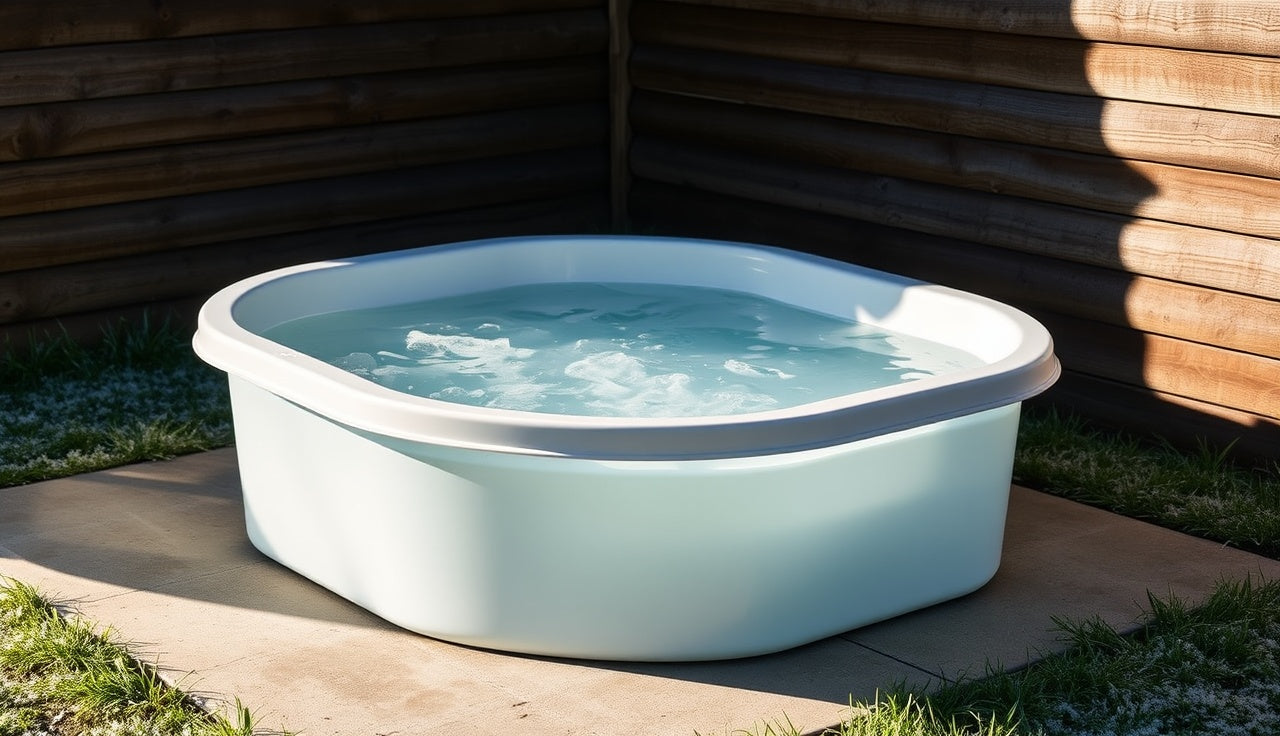
The Grizzly cold plunge is a freestanding cold-water immersion tub built for home and athlete use. It does not come from one of the giant fitness conglomerates. A smaller specialty manufacturer focused on cold therapy hardware makes it, which is why the design reads like it was drawn by someone who actually plunges rather than someone chasing a trend.
The shell is rotationally molded polyethylene, the same material class used in agricultural tanks and whitewater kayaks. That matters. Polyethylene handles sustained cold and UV exposure far better than fiberglass or acrylic, both of which can crack or craze after a few winters outside [1].
The Grizzly sits in the category the industry loosely calls a "large tub" plunge. Its interior footprint is bigger than a standard barrel plunge or a compact cylinder, and that is the whole point. If you are over six feet tall or carry serious muscle mass, the size is not a detail. Sitting hunched with your knees above the waterline defeats most of the reason you got in.
Want the full category picture before you zero in on this tub? The cold plunge guide covers the landscape.
What are the actual dimensions and weight of the Grizzly tub?
Published dimensions vary a little by retailer listing, and Grizzly has revised its shell geometry at least once, so treat any spec you find as approximate until the seller confirms it. Widely reported interior numbers run roughly 72 to 74 inches long, 28 to 30 inches wide, and a water depth of about 22 to 24 inches. A six-foot adult gets enough length to submerge from shoulders to feet with legs reasonably extended.
The empty tub weighs somewhere between 150 and 200 lbs depending on the build variant. Filled, it is immovable. A cubic foot of water weighs 62.4 lbs [2], and the Grizzly holds roughly 100 to 120 gallons, which puts loaded weight at 950 to 1,150 lbs including the shell. Your deck or pad has to carry that. Standard residential deck framing is rated around 40 lbs per square foot for live load, so a roughly 10-square-foot footprint at 1,100 lbs works out to 110 lbs per square foot, well past what typical wood decks are designed for [3]. Concrete pads are the safest base. Get a structural engineer to check any wood deck before you commit.
The lid, when it comes included, adds insulation that slows temperature rise between sessions. Skip the lid and your chiller runs harder to hold target.
What temperature range does the Grizzly cold plunge hold?
The Grizzly is just a vessel. Water temperature depends entirely on the chiller or ice protocol you pair with it.
Paired with a purpose-built cold plunge chiller, most setups target 39 to 59°F (4 to 15°C). The lower half of that band, roughly 39 to 50°F, is where much of the cold water immersion research was run. A 2022 meta-analysis in PLOS ONE found that immersion at 10 to 15°C (50 to 59°F) reduced delayed-onset muscle soreness and perceived fatigue compared to passive recovery [4]. Colder than 50°F buys you no clear physiological gain and adds cold shock risk.
The cold shock response, the involuntary gasp and rapid breathing that hits in the first 30 to 90 seconds, is strongest below 59°F [5]. The Royal Life Saving Society UK states that "cold shock is the main cause of death associated with sudden immersion in cold water," and notes that repeated exposure meaningfully reduces the response [5]. New to this? Start at 60°F and work down over a few weeks. That is the smarter path, not a timid one.
Ice instead of a chiller can hit the same temperatures, but holding them is expensive and takes real labor. An ice bath works fine for occasional use. Plunge more than three times a week and the yearly ice cost usually pays for the chiller.
For the full picture on what cold immersion does to the body, read the cold plunge benefits guide next.
| DIY stock tank + chiller | $1,000 |
| Ice Barrel 400 + chiller | $2,400 |
| Grizzly tub + mid chiller | $3,800 |
| Plunge Pro (bundled) | $3,490 |
| The Cold Plunge (bundled) | $4,990 |
Source: Market pricing survey, SweatDecks research, mid-2025
What chiller does the Grizzly cold plunge use, and what does that cost?
The Grizzly is chiller-agnostic. It connects through standard hose fittings to any compatible cold plunge chiller. Common pairings include units from Cold Plunge (the brand), Penguin Chillers, or generic 1/3 to 1/2 HP chillers sold for plunge use.
The chiller is where the budget gets real. Here is an honest breakdown:
| Component | Approx. cost (USD) |
|---|---|
| Grizzly tub shell | $1,500 to $2,500 |
| Entry 1/3 HP chiller | $800 to $1,200 |
| Mid-range 1/2 HP chiller | $1,400 to $2,000 |
| Filtration/ozone add-on | $200 to $500 |
| Plumbing fittings and install | $100 to $300 |
| Total realistic range | $2,600 to $5,300 |
These figures reflect market pricing as of mid-2025 and will shift. Horsepower matters most in warm climates. If ambient air is 85°F and you want 50°F water, a 1/3 HP chiller will struggle, and you likely need at least 1/2 HP. Chiller makers publish BTU removal ratings, so you can calculate whether a unit beats your ambient heat load before you buy.
Electricity depends on your rate and how hard the chiller cycles. A 1/2 HP chiller draws roughly 500 to 700 watts. Run it four hours a day at $0.16/kWh, close to the US average residential rate in 2024 [6], and you spend around $11 to $16 a month. Small line item, but put it in the math.
How does the Grizzly compare to other large cold plunge tubs?
The large-tub plunge market has grown fast, and the Grizzly competes with a handful of rotationally molded and fiberglass options. Here is where it lands:
| Tub | Interior length | Material | Starting price (tub only) | Chiller included? |
|---|---|---|---|---|
| Grizzly | ~73 in | Poly | ~$1,500 to $2,500 | No |
| Ice Barrel 400 | ~45 in diameter | Poly | ~$1,200 | No |
| The Cold Plunge (brand) | 71 in | Acrylic/fiberglass | ~$4,990 bundled | Yes |
| Plunge Pro | 71 in | Poly | ~$3,490 bundled | Yes |
| DIY stock tank | 60 to 72 in | Galvanized steel | $200 to $400 | No |
Prices are approximate and change often. The Grizzly's pitch is simple: a durable, large shell without the bundled-brand premium. The tradeoff is that you handle sourcing and integrating your own chiller, filtration, and water care.
The Ice Barrel is popular but too short for full-body immersion for most adults. The bundled options from The Cold Plunge or Plunge are simpler out of the box and cost more. The DIY galvanized stock tank is the cheapest path and the most work, with rust and water quality headaches over time.
Want something that also runs a sauna contrast session? The outdoor sauna guide covers which outdoor configurations pair well with a plunge this size.
Is the Grizzly cold plunge good for outdoor year-round use?
Yes, with caveats. The polyethylene shell takes freeze-thaw cycles better than fiberglass or acrylic. But leave water sitting in any tub in a freeze-prone climate without a chiller running or a freeze-protection plan, and you will crack fittings, ruin seals, and can deform even a poly shell if the ice expands enough.
If winters where you live drop below 32°F regularly, you have three choices. Run the chiller, which keeps water moving and prevents freezing down to the chiller's minimum ambient rating (usually around 35 to 40°F air). Drain the tub for the season. Or insulate hard and add a water circulator. Most chiller manufacturers publish a minimum ambient operating temperature. Do not ignore that number.
UV is less of a worry with quality polyethylene, which gets UV-stabilized during manufacturing. Cheaper poly tubs skip that step, so ask the seller whether the shell is UV-stabilized if you live somewhere sunny.
The lid earns its keep outdoors. Leaves, insects, and debris get in fast. Serious outdoor setups add ozone or a UV filtration loop because outdoor conditions wreck water quality quicker. The CDC recommends maintaining free chlorine at 1 to 3 ppm and pH between 7.2 and 7.8 for pools and small water features [7]. Cold plunge water follows the same chemistry logic.
How do you maintain water quality in a Grizzly cold plunge?
Water care is the part most buyers underestimate. Cold slows bacterial growth compared to a hot tub, but it does not stop it. You are dropping your body, with all its oils, sweat, and skin bacteria, into the same water again and again. The water needs active treatment.
The common approaches:
1. Chlorine or bromine: the same chemistry as pool and spa water. Follow CDC guidance of 1 to 3 ppm free chlorine and pH 7.2 to 7.8 [7]. Test twice a week with a strip or digital tester. Bromine is a common alternative, especially in lower-pH water.
2. Ozone: an ozone generator injects ozone as the water circulates, oxidizing contaminants. It cuts the chlorine you need but does not replace it. Most serious setups run ozone plus a small residual chlorine level.
3. UV sterilization: a UV lamp in the circulation line kills pathogens. Same logic as ozone, it helps but rarely does the job alone.
4. Drain and refill: some people just drain every 1 to 2 weeks and start fresh. Simple, but it wastes water and forces the chiller to re-cool from scratch each time.
Showering before you plunge is the single highest-leverage move to extend water life. Obvious, and most people still skip it.
What are the real health benefits of using a cold plunge like the Grizzly?
Cold water immersion has a reasonably solid evidence base for a few specific outcomes and a much thinner one for the bigger claims you see in marketing.
What the evidence supports:
Muscle recovery. The 2022 PLOS ONE meta-analysis found significant reductions in DOMS with immersion at 10 to 15°C [4]. The effect is real but not huge. Cold immersion lowers perceived soreness, which matters for how often you can train.
Mood and alertness. A 2021 study in PLOS ONE linked to Søberg's work reported that cold water immersion raised dopamine and norepinephrine and improved reported mood in healthy adults [8]. That is a meaningful mood signal for a small weekly time cost.
Cold adaptation. Repeated exposure genuinely blunts the cold shock response and the discomfort of immersion [5]. That is well-established in thermal physiology.
What is shakier: claims about brown fat activation, metabolic rate changes, and immune function have some preliminary support, but the studies are small, the effects modest, and nobody has good long-term data on whether home plunging moves those needles at a population level.
Cardiometabolic effects. Cold immersion triggers acute vasoconstriction and a spike in blood pressure and heart rate. In healthy adults that is transient and not harmful. If you have cardiovascular disease, hypertension, or Raynaud's, talk to a physician before you start. That is not legal boilerplate. The hemodynamic stress is real [9].
More on all of it in the cold plunge benefits article, which goes study by study.
How long should you stay in a Grizzly cold plunge per session?
The most-cited protocol comes from Dr. Susanna Søberg's work, which pointed to meaningful neurochemical effects at roughly 11 minutes of total cold water immersion per week [8]. That is not 11 minutes in one sitting. It is cumulative across several sessions.
In practice, most beginners handle 2 to 3 minutes at 55 to 60°F. As tolerance builds over weeks, 5 to 10 minute sessions become accessible at colder temperatures. Going past 10 to 15 minutes in water below 50°F is not clearly better and raises real hypothermia risk for most adults [9].
For recovery specifically, immersion within 30 to 60 minutes after exercise seems to work best [4]. For mood and alertness, most practitioners report morning immersion works best anecdotally, though the research does not have the granularity to confirm timing as a variable.
One detail worth knowing: getting out slowly and warming naturally, rather than jumping straight into a hot shower, appears to extend some of the norepinephrine bump that makes you feel alert afterward. The data on that specific point is thin, but the mechanism holds up physiologically.
Is a Grizzly cold plunge worth the money compared to cheaper options?
Honest answer: it depends almost entirely on how often you will actually use it and whether you need the size.
If you are 5'8" and under, an Ice Barrel or a well-kept stock tank does the same physiological job for a fraction of the price. Cold water immersion works whether the vessel costs $300 or $5,000. The water does not care what holds it.
If you are taller, carry more muscle, or want partner immersion sessions, the Grizzly's interior volume earns its price. Hunching in a too-small tub is uncomfortable enough that it becomes a reason to skip the plunge, and frequency is what drives adaptation.
Durability is the other real argument. A galvanized stock tank outdoors rusts at the fittings within 1 to 3 years under regular treatment chemistry. A quality poly shell lasts a decade or more with no meaningful degradation.
The worst-value scenario is buying the Grizzly, setting it up badly, letting the water go, and using it twice before you quit. That happens more than people admit. Cheaper commitment options exist, and there is no shame in starting with an ice bath protocol to confirm you actually want this habit before you spend $3,000 or more.
SweatDecks carries a curated selection of cold plunge tubs and chillers if you want to compare specs side by side before you commit.
What should you know before buying a Grizzly cold plunge for your home?
A few things buyers regularly miss:
Electrical requirements. Most 1/2 HP chillers run on standard 110V/15A circuits. Some larger units need 220V. Know what you have available before you order.
Floor drain or hose access. You need a way to drain 100-plus gallons. If your location has no floor drain and no hose run long enough to reach one, draining turns into a chore fast. Plan this before installation, not after.
Water source. Filling from a garden hose is fine. Initial fill takes roughly 15 to 20 minutes for 100 gallons. Cold water takes longer to chill from tap temperature (usually 50 to 70°F depending on your region) than from an already-cold start.
Permits and HOA. A permanently installed outdoor plumbing fixture sometimes triggers permit requirements or HOA restrictions. This varies entirely by jurisdiction. Outdoor structures and permanent fixtures generally require building permits in most US municipalities [10]. Check before you install.
Warranty and support. Because Grizzly is a smaller manufacturer, get the warranty terms in writing before purchase. What is covered, for how long, and who pays freight on a warranty return for a 200 lb tub are all worth asking up front.
Thinking about pairing this with a sauna for contrast therapy? Read the home sauna guide alongside this one. Contrast sessions, heat then cold, are one of the most reliable habits that keeps people coming back to both pieces of gear.
How does contrast therapy with a cold plunge and sauna actually work?
Contrast therapy alternates heat exposure and cold immersion. A typical protocol runs 10 to 20 minutes in the sauna at 170 to 190°F, then 2 to 5 minutes in the cold plunge, repeated for 2 to 3 cycles.
The mechanism is straightforward. Heat causes vasodilation: blood vessels expand, heart rate rises, blood moves toward the skin. Cold causes vasoconstriction: blood gets driven back toward the core and heart rate drops. Alternating the two creates what some call a "vascular pump" effect, though the evidence that it beats either modality alone for recovery is mixed.
A 2013 systematic review in the Journal of Science and Medicine in Sport found that contrast water therapy reduced muscle soreness more than passive recovery but could not consistently outperform cold water immersion alone [11]. What contrast does reliably is drive adherence. People enjoy the alternating stress and relief, and enjoyment keeps them consistent.
For the contrast to work, the sauna and the plunge have to sit close enough that the transition takes under 60 seconds. A sauna at one end of the yard and a plunge at the other means you lose real vascular effect in the walk.
The sauna benefits article covers the heat side in depth, and the outdoor sauna guide has notes on placement relative to a plunge.
Frequently asked questions
What is the Grizzly cold plunge tub made of?
The Grizzly shell is rotationally molded polyethylene, the same material class used in heavy-duty agricultural tanks and whitewater kayaks. It handles UV exposure, freeze-thaw cycles, and pool chemistry better than fiberglass or acrylic. Quality polyethylene is UV-stabilized during manufacturing, which prevents the chalking and cracking that shorter-lived materials develop after a few outdoor seasons.
Does the Grizzly cold plunge come with a chiller?
No. The Grizzly ships as a shell with fittings. You source and install your own chiller. That is both a flexibility win and a complication: you can match chiller horsepower to your climate and budget, but you own compatibility, plumbing connections, and water care integration. Budget an added $800 to $2,000 for a quality chiller on top of the tub cost.
What temperature does a Grizzly cold plunge reach?
With a properly sized chiller, you can hold water at 39 to 59°F (4 to 15°C). Most practitioners target 50 to 59°F for recovery and adaptation. Going below 50°F buys no clear physiological gain and raises cold shock risk, especially for beginners. Most chillers have a thermostat you set and forget; the unit cycles to hold it.
How many gallons does the Grizzly cold plunge hold?
The Grizzly holds roughly 100 to 120 gallons depending on fill level and build variant. At 8.34 lbs per gallon, a full tub adds 830 to 1,000 lbs of water to a shell that weighs 150 to 200 lbs. Total loaded weight of 950 to 1,150 lbs means you need a structural concrete pad or an engineered deck surface.
Can I use a Grizzly cold plunge outdoors in winter?
Yes, if you keep water circulating or drain it for winter. The poly shell handles freeze-thaw well, but static water in fittings and plumbing will freeze and crack below 32°F. Most chillers specify a minimum ambient operating temperature around 35 to 40°F. Below that, either drain the tub and flush the chiller lines or move the chiller to a sheltered spot.
How often should you change the water in a Grizzly cold plunge?
With active treatment (chlorine or bromine at 1 to 3 ppm, pH 7.2 to 7.8) plus an ozone or UV loop, many users go 4 to 8 weeks between full drain-and-refills. Without treatment, water quality degrades within days of regular use. Shower before plunging, test chemistry twice a week, and drain when clarity or smell tells you to. There is no universal schedule.
Is a Grizzly cold plunge big enough for two people?
At 73 inches long and 28 to 30 inches wide, two smaller adults can squeeze in, but it is tight. The tub is designed around one large user. Tandem use sharply raises the bioload on the water, so you need more aggressive treatment and more frequent changes. If two-person immersion is a regular plan, a custom built-in or a larger commercial-style plunge pool serves better.
How long does it take a Grizzly cold plunge to reach temperature from tap water?
Starting from tap water at 60 to 70°F and targeting 50°F, a 1/2 HP chiller typically takes 4 to 8 hours to pull down 100 to 120 gallons. Ambient air, direct sun, and insulation all affect that. An insulated lid cuts the chiller load a lot. Running the initial chill overnight so you wake up to target-temp water is the common approach.
What electrical setup does the Grizzly cold plunge need?
The tub needs no power. The chiller sets the electrical requirement. Most 1/3 HP chillers run on standard 110V/15A household circuits, same as a refrigerator. Some 1/2 HP or larger units need a dedicated 220V circuit. Confirm the chiller's electrical specs before purchase, and if 220V is required, budget $200 to $600 for an electrician to run a dedicated circuit.
Does cold plunging actually reduce muscle soreness?
The evidence is reasonably strong for short-term reduction in delayed-onset muscle soreness. A 2022 meta-analysis in PLOS ONE found that cold water immersion at 10 to 15°C significantly reduced DOMS and perceived fatigue compared to passive recovery. The effect is real but not dramatic. Cold plunging helps you feel less sore and recover faster between sessions, but it does not replace sleep, nutrition, or training load management.
Is it safe to cold plunge every day?
For healthy adults, daily cold plunging appears safe. There are no known harms from daily immersion at appropriate temperatures and durations. One caution: some research suggests cold immersion right after strength training may blunt long-term muscle growth by suppressing the inflammatory signal that drives adaptation. If building muscle is the primary goal, save plunges for non-lifting days or do them several hours after training.
How does the Grizzly cold plunge compare to building a DIY cold plunge?
A DIY setup using a galvanized stock tank and a window AC unit or dedicated chiller runs $400 to $1,500 all-in. It works. The downsides are rust at fittings within a few years, a less ergonomic shape, and usually no insulated lid. The Grizzly costs more but gives you a purpose-built poly shell with better longevity. If you want to confirm the habit before spending serious money, DIY is the honest starting point.
Do I need a permit to install a Grizzly cold plunge outside?
Possibly. Permit requirements depend on your local jurisdiction. A freestanding tub on a patio that connects only to a garden hose for filling usually does not trigger permits. Adding plumbing connections, a permanent electrical circuit, or placing the unit on a structure rather than grade often does. Check with your local building department before installation. HOA rules may impose extra restrictions regardless of permit status.
Sources
- Rotational Molding Association, material properties overview: Rotationally molded polyethylene handles UV exposure and freeze-thaw cycles better than fiberglass or acrylic for outdoor water containment applications.
- USGS Water Science School, water density and weight: A cubic foot of water weighs 62.4 lbs at standard conditions.
- International Code Council (ICC), International Residential Code deck provisions: Standard residential deck framing is designed for approximately 40 lbs per square foot live load; point loads from heavy filled vessels can exceed this rating.
- Moore E et al., PLOS ONE 2022, cold water immersion meta-analysis: Cold water immersion at 10 to 15°C significantly reduced delayed-onset muscle soreness and perceived fatigue compared to passive recovery in a 2022 meta-analysis.
- Royal Life Saving Society UK, Cold Water Shock guidance: Cold shock is the main cause of death associated with sudden immersion in cold water; the RLSS states that habituation over repeated exposures significantly reduces the response.
- U.S. Energy Information Administration, Electricity data and average retail price 2024: Average US residential electricity rate was approximately $0.16/kWh in 2024.
- CDC, Healthy Swimming pool and hot tub chemistry guidance: CDC recommends maintaining free chlorine at 1 to 3 ppm and pH between 7.2 and 7.8 for pools and small water features.
- Søberg S et al., PLOS ONE 2021, thermal bathing human study: Cold water immersion raised dopamine and norepinephrine levels and improved reported mood in healthy adults.
- Tipton MJ, The Journal of Physiology 2008, cold water immersion cardiovascular effects: Cold water immersion triggers acute vasoconstriction, blood pressure spike, and heart rate changes; the hemodynamic stress is real and medically relevant for people with cardiovascular conditions.
- U.S. Department of Housing and Urban Development, building permit guidance: Outdoor structures and permanent fixtures generally require building permits in most US municipalities; requirements vary by jurisdiction.
- Versey N et al., Journal of Science and Medicine in Sport 2013, contrast water therapy systematic review: A systematic review found contrast water therapy reduced muscle soreness more than passive recovery but could not consistently outperform cold water immersion alone.

Share:
Brookstone portable cold plunge tub: what you actually get
Daily sauna benefits: what the research actually shows