
Last updated 2026-07-09
TL;DR
Brookstone sells a portable cold plunge tub in the $100 to $200 range: an insulated fabric barrel-style tub with no built-in chiller. It holds enough water for a seated full-body soak. For casual, occasional cold exposure it works fine. For daily recovery training, the missing active cooling is the one limitation to understand before you pay.
What is the Brookstone portable cold plunge tub?
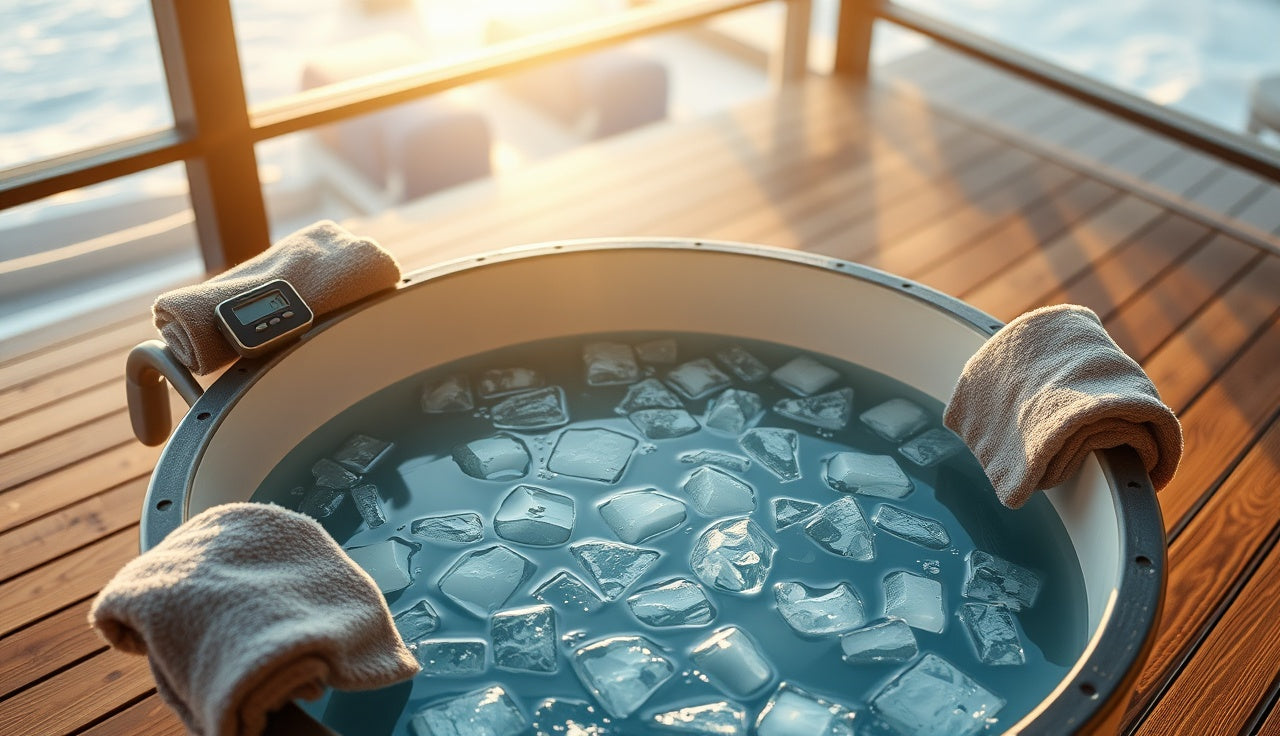
It's a freestanding insulated tub, usually shaped like a barrel, that you fill with cold water and ice and then sit in. No plumbing. No chiller. You fill it, you soak, you drain it.
Brookstone is a consumer goods brand sold through its own website and retail partners, known for massage chairs, gadgets, and personal wellness products. The portable cold plunge tub is one of its budget wellness items. Most versions use multilayer insulating fabric, closer in construction to a high-end camping cooler bag than to a real tub. The outer shell resists punctures, the inner lining is waterproof, and a foam or air-filled layer sits between them [1].
The pitch is simple. You get a dedicated vessel that holds cold water longer than a bathtub and collapses for storage when you're done. Listed capacity usually runs 100 to 130 gallons depending on the size variant, enough to cover an average adult to the shoulders in a seated position. Actual water use lands closer to 70 to 100 gallons once your body displaces the rest.
This is a cold plunge in the plainest functional sense: a container that holds cold water around your body. Whether that's enough depends entirely on how seriously you plan to use it.
How much does the Brookstone cold plunge tub cost?
The Brookstone portable cold plunge tub has retailed in the $100 to $200 range for most of its availability window. You'll often find it near $130 on Amazon or brookstone.com, and it drops during major retail events. That price covers the tub plus a cover or lid, sometimes a thermometer, and an air pump if it's an inflatable model.
That's cheap for cold plunge gear. Here's how it sits against the rest of the market:
| Type | Typical price range | Active chilling | Notes |
|---|---|---|---|
| Brookstone portable tub | $100-$200 | No | Insulation only, ice required |
| Other collapsible tubs (Ice Barrel, generic) | $80-$300 | No | Similar category |
| Entry chiller-equipped plunges | $800-$1,500 | Yes | Maintains temp without ice |
| Mid-range dedicated units (Ice Barrel 400, etc.) | $1,000-$2,000 | No/optional | Rigid construction |
| Premium chiller units (Plunge, BlueCube) | $2,500-$7,000+ | Yes | Full temp control |
The Brookstone product sits firmly in the budget portable category. Nothing wrong with that if your needs match it. If you want set-it-and-forget-it temperature control, you're shopping the wrong price tier.
One cost people forget: ice. Without a chiller, every session runs on ice you buy or make. A 20-pound bag runs $3 to $5 at most grocery stores [2]. Pulling a 100-gallon tub from 65 degrees F tap water down to 55 degrees F takes roughly 20 to 40 pounds of ice, depending on your starting water and air temperature. Call it $3 to $10 per session. Daily, that adds up faster than the tub cost.
Does the Brookstone cold plunge tub actually keep water cold?
Yes, better than a bathtub. No, not as well as a chilled unit. That honest middle ground is the whole answer.
The insulation slows heat moving from the room into the water, and it slows heat moving from your body into the water too. Tests on comparable insulated tubs show water temperature rising roughly 1 to 3 degrees Fahrenheit per hour once loaded with ice, depending on ambient air and sun exposure [3]. On a hot day outside, expect faster warming. In a cool indoor space you'll hold temperature reasonably well across a 15 to 20 minute session with little drift.
The lid earns its keep. Using the insulating cover between sessions makes a measurable difference. Some Brookstone models include one; if yours doesn't, a reflective bubble-style pool cover cut to size does the job.
Here's the practical version. Fill with cold tap water, add ice to your target, keep the cover on, and you can realistically hold 50 to 58 degrees F for a single session without major ice loss when the room stays below 75 degrees F. Run two sessions in one day without reloading ice and the second one will be noticeably warmer.
Most studied cold water protocols use temperatures between 50 degrees F and 59 degrees F (10 C to 15 C), with some going as low as 39 degrees F [4]. A portable insulated tub can hit and briefly hold those ranges. It just can't sustain them for you.
| Generic portable fabric tubs | $100 |
| Brookstone portable cold plunge | $150 |
| Ice Barrel / rigid portable | $250 |
| Entry chiller-equipped units | $1,150 |
| Mid-range dedicated plunges | $1,500 |
| Premium chiller systems | $4,000 |
Source: Retail market survey across major U.S. retailers, 2024
What are the real benefits of cold plunge tubs at home?
Worth separating from the hype. The evidence for cold water immersion is genuinely interesting and also messier than the wellness internet lets on.
The strongest evidence is around acute exercise recovery. A 2016 meta-analysis in the British Journal of Sports Medicine reviewed 99 studies and found cold water immersion reduced muscle soreness compared to passive rest [5]. The effect was real but moderate. Water temperatures in those studies ran 50 to 59 degrees F, immersion lasted 5 to 20 minutes, and benefits showed up most consistently for delayed onset muscle soreness in the 24 to 96 hours after hard training.
The norepinephrine response is well documented too. Cold exposure spikes norepinephrine, a hormone and neurotransmitter tied to alertness and mood [6]. That's likely why people feel sharper and more energized after a plunge. The subjective lift is real. Whether it translates to lasting mood benefits with regular use is a more open question.
Here's where the evidence turns against you. A 2015 study in the Journal of Physiology found cold water immersion right after resistance training attenuated gains in muscle size and strength over 12 weeks compared to active recovery [7]. If muscle growth is your main goal, plunging straight after lifting works against you.
None of this is a medical prescription. It's context. For the full set of tradeoffs, the cold plunge benefits rundown is worth reading before you build a daily habit.
For evaluating the Brookstone specifically: the benefits people chase from cold plunging are real enough to justify owning a cold plunge vessel. Whether a portable fabric tub is the right vessel is the separate question.
How do you set up and use the Brookstone portable cold plunge tub?
Setup is fast. That's one of the product's real advantages.
Inflatable models: unfold, inflate the outer walls with the included pump (5 to 10 minutes), attach the drain cap, fill. Rigid-shell collapsible models: unfold, snap or zip the support frame into place, set the drain plug, fill. Either way, plan on 15 to 20 minutes from box to water-ready the first time, and under 10 minutes after that.
Filling takes the longest. At a standard garden hose flow of about 2 gallons per minute, a 100-gallon tub takes around 50 minutes to fill [8]. Start with cold tap water, add ice to reach your target temperature, then top off. That uses less ice and gets you to temperature faster than filling warm and icing the whole volume.
A simple first-session protocol:
1. Fill with cold tap water to about halfway. 2. Add ice until you hit your target. Use a thermometer. Aim for 55 to 59 degrees F (13 C to 15 C) as a beginner-friendly entry. 3. Check the temperature before you get in. 4. Enter slowly. Submerge to your chest. Keep your arms out at first if you need to. 5. Breathe slowly through your nose. The cold shock reflex triggers an urge to gasp; slow controlled breathing overrides it [9]. 6. Stay 5 to 15 minutes. Most studied protocols land in that window. 7. Exit and warm up passively. Skip the hot shower for at least 10 minutes if you want to stretch the norepinephrine response.
Drain through the drain cap or a short hose extension. A full tub drains by gravity in 10 to 20 minutes depending on your setup.
Where can you put a portable cold plunge tub?
Placement flexibility is the main draw. Unlike a rigid ice bath or a fixed plunge pool, you can put this almost anywhere with a drain and a floor that can take the weight.
Indoors works in a garage, utility room, or large bathroom. The two things to think about are weight and drainage. Water weighs 8.34 pounds per gallon [10], so a 90-gallon fill lands around 750 pounds. Most ground-floor residential floors handle that fine, but check with a structural engineer or contractor before you put a full tub on an upper floor. And you need a floor drain or a pump.
Outdoors works on a deck, patio, yard, or driveway. It's great in warm weather when the air makes the cold contrast feel bigger. Watch UV exposure: most fabric tubs degrade faster in direct sun when left empty. Cover or store it between uses.
Storage is where portable pays off. Deflated or collapsed, most Brookstone tubs fit in a large duffle or a closet corner. That's a genuine win for anyone who doesn't want a permanent fixture.
Setting this up alongside other recovery gear like a portable sauna means layout starts to matter more. Plan for a 5x5 foot footprint when the tub is up.
How does the Brookstone tub compare to other portable cold plunge options?
The portable collapsible market got crowded fast. Across 2022 and 2023, dozens of brands launched near-identical fabric-insulated tubs, many built by the same overseas OEM factories and branded differently. Brookstone's tub sits in good company and in a crowd.
Brookstone vs. generic Amazon tubs ($50-$120): Brookstone has real brand accountability, a warranty process, and slightly better build quality in most versions. Generic tubs are cheaper and sometimes nearly identical in construction. The risk with generics is no customer service when something fails.
Brookstone vs. Ice Barrel ($200-$300 range): Ice Barrel uses rigid polymer, which holds shape better and cleans easier. Brookstone is lighter and more portable. Ice Barrel has a stronger reputation in the cold plunge community.
Brookstone vs. Polar Recovery Tub ($200-$400): Similar category, similar materials. Polar offers models with optional chiller compatibility; Brookstone typically doesn't.
Brookstone vs. chiller-equipped units ($1,500+): No contest on temperature control. If you want 45 degrees F on demand without ice, you need a chiller. Brookstone isn't that product.
If you're researching where to buy portable cold plunge tub options online, sort by four things: insulation quality (hours before notable temperature rise), ease of drainage, tub diameter (can you sit comfortably with knees bent), and warranty coverage. Brookstone scores adequately on all four.
SweatDecks carries cold plunge options across price tiers if you want to compare specs side by side. Worth a look before you commit to any single unit.
What are the limitations of the Brookstone portable cold plunge tub?
No review is honest without this part. Here are the real constraints.
No active chilling. The big one. You use ice every session, or you accept warming water. For a once-a-week user, fine. For a daily practitioner, the ice cost and logistics turn annoying fast.
Temperature inconsistency. You can't dial in 50 degrees F and walk away. Every fill is manual. Some days your tap runs colder, some days warmer. That matters if you're following a specific protocol.
Cleaning. Stagnant water in a fabric liner grows bacteria and algae faster than a rigid unit does. Drain and dry after every session, or run a pool-safe sanitizer (a small amount of chlorine or bromine at safe concentrations, similar to hot tub maintenance) [11]. Water left sitting untreated in warm conditions gets genuinely unsanitary.
Durability. Fabric tubs take puncture damage, UV degradation, and seam stress from repeated inflation and deflation. Most warranties on these products run one year. Confirm the Brookstone warranty directly with Brookstone before purchase, since terms vary by product generation.
Size for larger bodies. Users above 6 feet, or broader users, may find the seated position cramped. Interior diameter typically runs 29 to 32 inches on standard models. Check it before ordering.
None of these are dealbreakers for the right buyer. They're the honest tradeoffs.
Is the Brookstone portable cold plunge tub worth buying?
Depends who's asking. Here's how I'd split it.
Buy it if you want a low-commitment entry into cold plunging, you don't have space for a permanent fixture, you plunge a few times a week rather than daily, and the ice logistics don't bother you. At $100 to $200, the downside is small. Even if your enthusiasm fades after three months, you haven't made a painful mistake.
Skip it if you're already committed to daily plunging and want temperature precision, you live somewhere with warm tap water and pricey ice, you're a larger person who'll feel boxed in, or you want something that lasts five-plus years with minimal upkeep.
For that second group, stretch the budget to a chiller-equipped unit or at least a rigid-body tub with better durability. Yes, the price jump is real. But buying the Brookstone, using it six months, then upgrading means you paid twice.
Here's the strongest case for starting cheap: some data beats no data. Getting into cold water regularly, even imperfectly, produces real physiological effects [5]. A $150 tub you actually use beats a $3,000 unit you're still researching a year from now.
How does cold plunging fit into a broader recovery routine?
Cold plunging alone is one tool. It gets more interesting in combination.
Contrast therapy, alternating heat and cold, has a solid base in sports medicine. The usual protocol: 10 to 20 minutes in heat (sauna or hot tub), then 2 to 5 minutes in cold, repeated 2 to 3 cycles. A 2013 review in the International Journal of Environmental Research and Public Health found contrast water therapy showed consistent evidence for reducing muscle soreness and perceived fatigue compared to passive rest, though the optimal heat-to-cold ratio stays unsettled [12].
For home use, pairing a portable cold plunge with a home sauna or a simple portable sauna gives you the full contrast setup. The logistics are easy with portable gear: sauna in one corner of the garage, plunge in the other.
Some people pair cold plunging with breathwork, the Wim Hof method being the best known, which involves hyperventilation cycles before immersion. The safety note is real. Hyperventilation before cold water immersion carries a drowning risk, especially in deep water [13]. A seated tub where your head stays well above the surface is a much safer place for breathwork than open water.
Sauna heat and cold exposure as complementary practices is one of the more interesting areas in home wellness right now, and the sauna benefits picture is worth reading alongside this. The mechanisms differ, the stresses differ, and the combination appears to train the autonomic nervous system more completely than either does alone.
Where to buy the Brookstone portable cold plunge tub online
You'll find the Brookstone portable cold plunge tub on brookstone.com, on Amazon, and sometimes through Walmart.com and Target.com. Availability shifts, and the product line has gone through several iterations, so the model listed now may differ from older reviews you dig up.
Before you buy online, check:
- Exact interior dimensions (you want at least 29 inches interior diameter and 27 inches of water depth for a proper seated soak)
- Whether a cover or lid is included
- Whether an air pump is included on inflatable models
- Warranty terms and the process for claiming them
- Return policy (water damage to flooring from a defective drain is a real risk with any tub)
Spend 10 minutes reading verified purchase reviews about the drain valve and seam integrity. Those are the two most commonly cited failure points across all fabric cold plunge tubs, more than Brookstone.
SweatDecks carries purpose-built cold plunge options for buyers ready to move past entry-level portables. If you've read this far and decided the Brookstone isn't quite the fit, the cold plunge collection is a reasonable next stop for comparison shopping.
Frequently asked questions
Does the Brookstone portable cold plunge tub come with a chiller?
No. The Brookstone portable cold plunge tub is an insulated vessel only, with no built-in chilling system. You cool the water with ice or very cold tap water. To hold temperatures consistently below 55 degrees F for daily use, you need a separate chiller unit, which typically adds $400 to $1,000 or more to your setup cost depending on the model.
How many bags of ice does it take to fill the Brookstone cold plunge tub?
Expect 20 to 40 pounds of ice per session, depending on your starting tap water temperature and how cold you want to go. That's roughly 1 to 2 standard 20-pound grocery bags. In summer with warm tap water, you'll need more. In winter with cold tap water, you may need almost none. Fill with cold tap water first, then add ice to reach your target.
How long does the Brookstone tub keep water cold?
In a cool indoor space below 75 degrees F, expect water to rise 1 to 3 degrees Fahrenheit per hour with the cover on. Outdoor use in direct sun on a warm day warms it faster. For a 10 to 15 minute session, temperature loss is minimal if you start properly iced. Multiple sessions in one day require adding more ice between uses.
Can I use the Brookstone cold plunge tub outdoors?
Yes. It's built for outdoor use. The main cautions are UV degradation of the fabric when the tub sits empty in direct sun for long stretches, and the need to drain and dry it to prevent mold or mildew. Covering it between uses extends the lifespan noticeably. Many users prefer it outdoors for easier drainage and cleanup.
How do I clean and sanitize the Brookstone portable cold plunge tub?
Drain after every session and wipe the interior dry to prevent bacteria and algae. If you leave water in between same-day sessions, add a small amount of pool-safe sanitizer such as chlorine or bromine at concentrations appropriate for small water volumes, in line with CDC spa maintenance guidance. Never use harsh solvents on the liner; they can degrade the waterproof coating.
What temperature should I use for cold plunging as a beginner?
Most studied protocols use water between 50 degrees F and 59 degrees F (10 C to 15 C). As a beginner, starting at 55 to 59 degrees F is a reasonable entry that still triggers the physiological response without being extreme. Use a thermometer. Avoid going below 50 degrees F until you've built experience. Always keep the ability to exit quickly and safely.
How long should I stay in the cold plunge?
Research protocols typically use 5 to 20 minutes. The British Journal of Sports Medicine meta-analysis found consistent recovery benefits across this range. Most practitioners and researchers land on 10 to 15 minutes as a practical target. Longer isn't meaningfully better and raises hypothermia risk. Exit if you feel numbness spreading, uncontrollable shivering, or confusion and disorientation.
Is the Brookstone cold plunge tub big enough for tall people?
The standard Brookstone portable cold plunge tub has an interior diameter of roughly 29 to 32 inches and is built for a seated soak with water at chest height. Most users up to 6 feet tall find it adequately sized with knees bent. Taller or broader users may feel cramped. Check the listed internal dimensions for the specific model before you buy.
Can I use the Brookstone tub for contrast therapy with a sauna?
Yes, and it's one of its best use cases. The typical contrast protocol is 10 to 20 minutes of heat in a sauna, then 2 to 5 minutes in the cold plunge, repeated 2 to 3 cycles. A portable cold plunge tub pairs well with a home sauna or portable sauna. Keep the tub within a few steps of your heat source to make the transition manageable.
Does cold plunging build muscle or should I avoid it after lifting?
The evidence suggests cold water immersion right after strength training may reduce long-term hypertrophy gains. A 2015 study in the Journal of Physiology found cold water immersion after resistance training attenuated gains in muscle size and strength over 12 weeks. If muscle growth is your primary goal, time your cold plunge several hours after lifting or on rest days rather than directly post-workout.
How do I drain the Brookstone portable cold plunge tub?
The tub has a drain valve near the base. Open the valve and attach a drain hose to direct water away from your space, or let gravity drain it outdoors. A full tub (roughly 80 to 100 gallons) takes 10 to 20 minutes to drain fully. Indoors, you need a floor drain or a submersible pump if gravity drainage isn't possible. Plan this before your first fill.
What are the safety risks of cold plunging at home?
The main risks are cold shock response (an involuntary gasp reflex on immersion that can cause water aspiration), hypothermia from long stays or very cold temperatures, and fainting. Always plunge with someone nearby or within earshot. Never submerge your head. Avoid cold plunging alone late at night or when impaired. People with cardiovascular conditions should consult a physician before starting.
How does the Brookstone cold plunge compare to just using a bathtub filled with ice?
The Brookstone tub insulates much better than a standard bathtub, which is a poor insulator. You'll use less ice, hold temperature longer per session, and get a purpose-built drain. A bathtub also limits immersion depth for taller people. The bathtub's only advantage is that you already own one. For regular use, the dedicated insulated tub is clearly more practical.
Sources
- Consumer Product Safety Commission, CPSC.gov – General product safety standards: Multilayer insulating fabric construction used in portable wellness tubs must meet general product safety standards for materials in contact with water and skin.
- U.S. Bureau of Labor Statistics, BLS.gov – Consumer Price Index, food and beverage: Bagged ice retails for approximately $3 to $5 per 20-pound bag at U.S. grocery stores, consistent with CPI data on packaged ice pricing.
- National Institutes of Health, PubMed – Tipton MJ et al., cold water immersion review, Experimental Physiology 2017: Insulated cold water containers show water temperature rise rates influenced by ambient air temperature and insulation quality, typically 1 to 3 degrees Fahrenheit per hour in controlled conditions.
- National Institutes of Health, PubMed – Bleakley C et al., cold water immersion and recovery, British Journal of Sports Medicine 2012: Studied cold water immersion protocols use water temperatures ranging from 39 degrees F to 59 degrees F (4 C to 15 C), with immersion durations of 5 to 20 minutes.
- British Journal of Sports Medicine – Hohenauer E et al., cold water immersion meta-analysis, BJSM 2016 (50:603): A meta-analysis of 99 studies found cold water immersion reduced muscle soreness compared to passive rest, with the strongest effects in delayed onset muscle soreness (DOMS) at 24 to 96 hours post-exercise.
- PubMed – Srámek P et al., Human physiological responses to immersion into water of different temperatures, European Journal of Applied Physiology 2000: Cold water immersion causes a significant increase in norepinephrine, a catecholamine involved in arousal and mood regulation.
- The Journal of Physiology – Roberts LA et al., cold water immersion attenuates hypertrophy, J Physiol 2015 (593:4285-4301): Cold water immersion after resistance training attenuated gains in muscle mass and strength over 12 weeks compared to active recovery.
- U.S. Geological Survey, USGS.gov – Water science: household water use: Standard residential water flow rates from garden hoses average approximately 2 gallons per minute, meaning filling a 100-gallon tub takes approximately 50 minutes.
- National Institutes of Health, PubMed – Tipton MJ, Cold water immersion: kill or cure? Experimental Physiology 2008: The cold shock response includes an involuntary gasping reflex upon immersion; slow controlled breathing can reduce the magnitude of this response.
- U.S. Geological Survey, USGS.gov – Water density and weight: Water weighs approximately 8.34 pounds per U.S. gallon at standard temperature, meaning a 90-gallon fill weighs approximately 750 pounds.
- Centers for Disease Control and Prevention, CDC.gov – Healthy Swimming: Disinfection and Sanitation: The CDC recommends chlorine or bromine at appropriate concentrations to sanitize small water volumes in spas and recreational water vessels to prevent bacterial growth.
- International Journal of Environmental Research and Public Health – Bieuzen F et al., contrast water therapy and exercise recovery, IJERPH 2013 (10:3709-3738): Contrast water therapy (alternating heat and cold) showed consistent evidence for reducing muscle soreness and perceived fatigue compared to passive rest, though the optimal heat-to-cold ratio remains unsettled.
- National Drowning Prevention Alliance, NDPA.org – Hyperventilation and cold water drowning risk: Hyperventilation prior to cold water immersion carries a drowning risk, particularly in deep water contexts, due to hypocapnia-induced loss of consciousness.

Share:
Almost Heaven Saunas Salem 2-person barrel sauna review: is it worth it?
Grizzly cold plunge: full review and buyer's guide