
Last updated 2026-07-11
TL;DR
Start with 3 to 5 drops of pure eucalyptus oil mixed into a ladle of water (roughly 300 to 500 ml), then pour that mixture over the sauna rocks. That's enough for a noticeable aromatic effect without overwhelming the room or irritating airways. Never apply undiluted oil directly to hot rocks. Adjust down if anyone in the session has asthma or respiratory sensitivity.
What is the right amount of eucalyptus oil to use in a sauna?
Three to five drops of eucalyptus essential oil added to a full ladle of water (approximately 300 to 500 ml), poured over the sauna rocks. That's the standard starting point. The dilution rate sits around 0.5 to 1 percent, which lines up with the safe inhalation and topical guidance published by the International Fragrance Association [1].
For most people, 3 drops is enough. The heat vaporizes the volatile compounds fast, and the enclosed space concentrates them quickly. If the scent feels faint after a couple of minutes, add 1 or 2 more drops to your next ladle. Going straight to 10 or 15 drops on your first try is a common mistake. It makes the air feel sharp and can set off coughing or eye irritation.
Larger commercial or outdoor saunas with higher ceilings hold more air, so you might go up to 7 or 8 drops per ladle. In a compact home sauna with 150 to 200 cubic feet of interior space, 3 to 5 drops is genuinely plenty.
A few variables shift the right number: how fresh your oil is (older oils are weaker), whether your sauna runs wet or dry, and your own sensitivity to eucalyptol, the active compound. Start low, assess after a few minutes, and scale up on the next pour if you need to.
What kind of eucalyptus oil should you use in a sauna?
Use 100 percent pure eucalyptus essential oil. Not a fragrance oil, not a blend, not a product labeled "eucalyptus scent." Fragrance oils are synthetic and often carry fixatives, solvents, and carriers that were never meant to be inhaled at high heat. When those compounds hit 185 to 200°F (85 to 93°C) sauna air, they can break down into irritants.
The species matters too. Eucalyptus globulus is the most common and has the highest eucalyptol (1,8-cineole) content, typically 60 to 85 percent [2]. That's the compound behind the cooling, mentholated sensation and the respiratory effect most people associate with eucalyptus. Eucalyptus radiata is milder, and some people who find globulus too intense prefer it. Either one works in a sauna.
Check that the bottle shows the Latin species name, country of origin, and a batch or lot number. Those signal a producer doing real quality control. Reputable suppliers also post GC/MS (gas chromatography/mass spectrometry) reports that confirm the eucalyptol percentage and rule out adulterants.
Skip any eucalyptus oil that lists ingredients beyond the essential oil itself. Carrier oils like fractionated coconut or jojoba can smoke or leave residue on your rocks, which wears them down over time.
How do you actually add eucalyptus oil to sauna water?
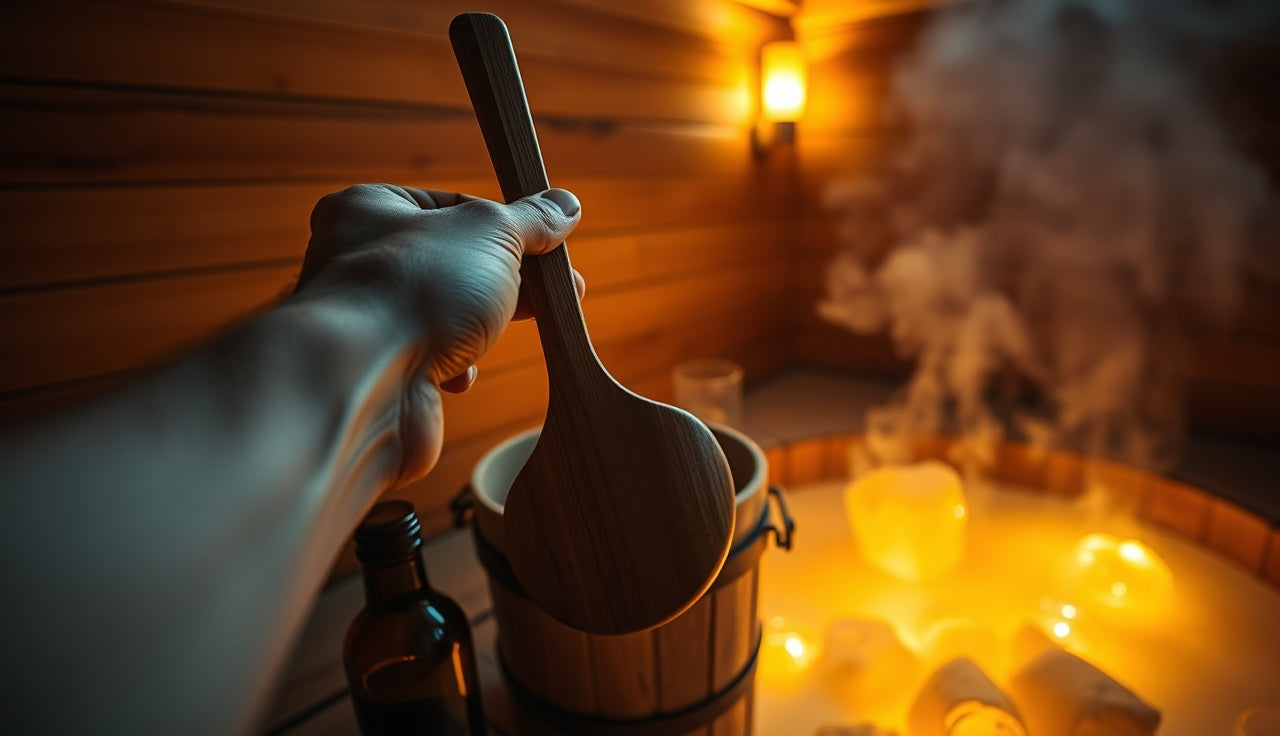
The method is simple, but the order matters. Fill your ladle with water first, then add your drops of eucalyptus oil to the water. Never drip oil straight onto the rocks. Undiluted essential oil on a rock surface at 175 to 200°F can flash-vaporize unevenly, pool in one spot, and throw off an acrid plume instead of a steady release. It can also degrade the rock surface over repeated sessions [3].
Once the oil is mixed into the ladle water, pour it slowly and evenly over the rocks in a circular motion. That spreads the steam and scent around the room. A slow pour gives you a longer, gentler wave of löyly (the Finnish term for the steam cloud that rises off the rocks). A fast dump gives you one big burst and then nothing.
Wait 2 to 3 minutes between pours. That gives you time to read the scent level and lets the room stabilize before you add more moisture. Most traditional sessions run 2 to 4 pours over a 10 to 15 minute round, and that cadence works well with eucalyptus.
If you keep a bucket outside the sauna, pre-mix a session's worth: roughly 10 to 15 drops in a full bucket (about 3 liters), stir it, and ladle from that throughout. Oil and water won't fully emulsify, so give it a quick stir before each scoop.
| First-timer, any sauna | 3 |
| Beginner, small sauna (<200 cu ft) | 4 |
| Regular user, small sauna (<200 cu ft) | 5 |
| Regular user, large sauna (200-400 cu ft) | 7 |
| Sensitive airways, any sauna | 2 |
| Infrared sauna (diffuser, per tank) | 7 |
Source: Finnish Sauna Society guidelines and IFRA dilution standards
Is eucalyptus oil safe to inhale in a sauna?
At the doses described here (3 to 5 drops in 300 to 500 ml of water), eucalyptus oil inhalation is considered safe for healthy adults. Eucalyptol has a well-documented safety profile at low concentrations. The European Medicines Agency includes oral eucalyptus preparations in its community herbal monographs for upper respiratory use [4].
There are real contraindications, though. People with asthma should approach eucalyptus carefully. A trial published in Respiratory Medicine (Juergens et al., 2003) found that 1,8-cineole had anti-inflammatory effects in COPD patients [5], but high-concentration inhalation can trigger bronchospasm in some asthma patients. The mechanism is dose-dependent: low concentrations look bronchodilatory, while concentrated vapor can irritate hyperreactive airways. If you have asthma, cap it at 1 to 2 drops, stay near the door, and stop if you feel any chest tightness.
Don't use eucalyptus in a sauna with children under age 2. Eucalyptol has been linked to serious adverse events in very young children even at small oral doses, and the FDA has flagged warnings on eucalyptus-containing products aimed at young kids [6]. Older children should use only 1 to 2 drops, and an adult should watch them for any sign of respiratory distress.
People with epilepsy, and anyone on certain medications (including some anticoagulants and diabetes drugs), should check with a physician first. Eucalyptol can interact with those drugs when it's absorbed systemically [7].
For a healthy adult in a normal session, 3 to 5 drops per ladle is a safe, effective dose that most people find genuinely enjoyable.
Does eucalyptus oil have any real health benefits in a sauna?
Honest answer: the sauna benefits are real, and the eucalyptus benefits are real, but almost nobody has studied the two together with any rigor.
Eucalyptol (1,8-cineole) has shown anti-inflammatory and mucolytic effects in clinical studies. A randomized controlled trial in Respiratory Medicine (Juergens et al., 2003) found that 1,8-cineole reduced exacerbation frequency and improved lung function in COPD patients over 6 months [5]. A 2016 review in Evidence-Based Complementary and Alternative Medicine found eucalyptus oil effective for upper respiratory tract infections at therapeutic doses [2].
Sauna sessions on their own have a solid evidence base for cardiovascular health, stress reduction, and short-term airway clearance from heat and humidity [8]. Pairing steam-heated air with eucalyptol is a plausible combination for clearing nasal passages and easing breathing during a session. It feels good. Most regular sauna users say so.
What nobody has published is a rigorous trial on sauna plus eucalyptus oil specifically. The closest data comes from steam inhalation studies, which show symptomatic relief for common cold sufferers with modest effect sizes. So: expect subjective respiratory comfort, with limited hard data on clinical outcomes. Enjoy it for what it is.
See more on sauna benefits for the full evidence rundown on what regular sauna use does for health.
How often can you use eucalyptus oil in a sauna session?
In a typical 15 to 20 minute round, you'll pour 2 to 4 ladles of water over the rocks. You can add eucalyptus to every ladle or just the first one or two. The aromatic effect peaks with the first pour and builds a little with each one after, so some people front-load the scent and switch to plain water for the later pours.
Across a full session with multiple rounds, there's no firm limit as long as you're not getting irritated. A reasonable approach: use eucalyptus in rounds one and two, then switch to plain water for any extra rounds if you've been in for 45 minutes or more and your airways start to feel dry.
For daily sauna users, eucalyptus every session is fine. Some Finnish and Russian banya practitioners have used birch or eucalyptus at every session for decades. The variable that actually matters is personal tolerance. At these concentrations, there's no cumulative dose to worry about.
Can you use eucalyptus oil in every type of sauna?
Most saunas, yes. A few differences by type are worth knowing.
| Sauna Type | Works with Eucalyptus? | Notes |
|---|---|---|
| Traditional Finnish (wood-fired or electric with rocks) | Yes, best fit | Ladle-on-rocks method works perfectly |
| Infrared sauna | Yes, with modification | No rocks to pour on; use a diffuser or place a small dish of diluted oil near (not on) the heating panels |
| Steam room | Yes | Add to the water supply or use a few drops near the steam inlet; the already-humid air disperses it well |
| Portable sauna (tent style) | Yes | Use a diffuser inside or add drops to the steam generator water if the manual allows it |
| Barrel or outdoor sauna | Yes | Same as traditional; larger volume may need 5 to 7 drops per ladle |
Infrared saunas need a note. There are no rocks and no löyly mechanism, so you can't pour anything. A cool-mist ultrasonic diffuser running near the floor works well. Use 5 to 8 drops in the diffuser's water reservoir. Don't place eucalyptus oil directly on infrared heating panels; the oil leaves a residue that's hard to clean and can affect panel performance over time [3].
For portable saunas, check your steam generator's manual. Some manufacturers explicitly allow essential oils in the water tank. Others warn against it because oils can clog the heating element. When you're not sure, use a separate diffuser.
What happens if you use too much eucalyptus oil in a sauna?
Too much eucalyptus oil is uncomfortable rather than dangerous for healthy adults, but it's unpleasant enough that people sometimes bail on a session early.
Common signs you've overdone it: stinging or burning eyes, sharp coughing, a tight feeling in the chest, or a headache building during the session. The enclosed space means any concentration that's too high spreads fast. Open the door for a minute to ventilate and it usually clears within a few minutes.
At very high doses, eucalyptol can cause dizziness and nausea when inhaled. That's far above normal sauna levels, but worth knowing if someone decides to pour half a bottle into a ladle. A 2011 review in Phytotherapy Research noted that eucalyptol is well-tolerated at low to moderate doses but can cause CNS effects at high exposures [7].
If irritation shows up, step out, get fresh air, and drink water. At typical sauna concentrations, symptoms from aromatic overexposure resolve quickly. If someone has a known eucalyptus allergy or sensitivity, they shouldn't be in the room at all.
What's the best eucalyptus oil ratio for beginners vs. experienced users?
Here's a practical table based on session experience and sauna size:
| User Type | Sauna Size (cubic ft) | Drops per ladle | Ladles per round |
|---|---|---|---|
| First timer | Any | 2 to 3 | 1 to 2 |
| Occasional user | Under 200 | 3 to 5 | 2 to 3 |
| Occasional user | 200 to 400 | 5 to 7 | 2 to 3 |
| Regular user | Under 200 | 4 to 6 | 2 to 4 |
| Regular user | 200 to 400 | 6 to 8 | 2 to 4 |
| Sensitive airways (any) | Any | 1 to 2 | 1 |
Treat these as starting points. If you're new, do the first pour with 2 drops, wait 3 minutes, and then decide whether to add more. The sauna is already a physiological stressor. The heat, the humidity, and the cardiovascular demand add up, so piling a new aromatic compound on top at a high dose stacks a lot at once on a first session.
Experienced users who love the effect and have no sensitivity can push toward the higher end of the ranges above without any concern.
Are there any eucalyptus oil alternatives that work well in a sauna?
Several essential oils work well in a sauna, and you can rotate them or blend them with eucalyptus for variety.
Peppermint is the most common alternative. It gives a similar menthol-cooling effect and contains menthol and menthone instead of eucalyptol. Use 2 to 3 drops per ladle; it's stronger by perceived intensity than eucalyptus.
Pine and spruce oils are traditional in Nordic and Russian banya culture, where birch whisks (veniks) sit alongside pine resin aromas. They're gentler and earthier. 4 to 6 drops per ladle works well.
Lavender is a favorite for evening or relaxation-focused sessions. It doesn't clear the airways the way eucalyptus does, but it smells pleasant and has real evidence for anxiolytic effects at low inhalation doses [9].
Birch tar oil, used in traditional Russian banyas, has a smoky, medicinal quality. It's an acquired taste. 1 to 2 drops is plenty.
For sauna vs steam room comparisons, a steam room is often the better setting for aromatics. The humidity is already high, which helps carry volatile compounds, and the lower temperature reduces the chance of any oil breaking down into irritants at extreme heat.
SweatDecks carries a selection of sauna accessories if you're building out a home setup and want proper aromatic tools to go with your sauna investment.
How should you store eucalyptus oil and how long does it last?
Eucalyptus essential oil oxidizes over time. An opened bottle left at room temperature in direct light can degrade noticeably within 1 to 2 years. Oxidized eucalyptus smells sharper and more turpentine-like, and it's more likely to irritate skin and airways [1].
Store your oil in a dark glass bottle (amber or cobalt), away from heat and light, ideally in a cool cabinet. Kept that way, an opened bottle of high-quality eucalyptus oil stays effective for 2 to 3 years. Unopened, it can last 5 years or more.
Smell it before each session. Fresh eucalyptus smells clean, sharp, and cooling. If it smells musty, flat, or chemical-harsh, it's past its prime. Toss it and buy a new bottle. A 30 ml bottle of quality eucalyptus oil runs roughly $10 to $20, so this is not the place to be cheap or to stretch an old bottle too far.
For sauna use, a 10 ml bottle (about 200 drops) lasts months at 3 to 5 drops per session. A 30 ml bottle is often the most practical size for regular sauna users.
Frequently asked questions
Can I put eucalyptus oil directly on sauna rocks without mixing it with water?
No. Undiluted eucalyptus oil on hot rocks produces an intense, uneven burst of vapor that can irritate eyes and airways, and it may leave a resinous residue that degrades the rocks over time. Always mix 3 to 5 drops into a full ladle of water (300 to 500 ml) first, then pour the mixture over the rocks.
How many drops of eucalyptus oil per liter of sauna water is correct?
About 8 to 12 drops per liter of water, which works out to roughly 0.5 to 1 percent dilution. In practice, most people pour ladle by ladle (roughly 300 to 500 ml per ladle), so that means 3 to 5 drops per ladle. If you're pre-mixing a whole bucket (3 liters), use 10 to 15 drops and stir before each scoop.
Is eucalyptus oil safe in a sauna for people with asthma?
Possibly, at very low doses, but with caution. High-concentration eucalyptol inhalation can trigger bronchospasm in people with reactive airways. If you have asthma, use no more than 1 to 2 drops per ladle, stay near the sauna door, and exit immediately if you notice chest tightness or increased wheezing. Check with your physician before using eucalyptus oil in a sauna.
Can you use eucalyptus oil in an infrared sauna?
Yes, but not by pouring it on anything. Infrared saunas have no rocks and no löyly mechanism. Use a cool-mist ultrasonic diffuser inside the cabin with 5 to 8 drops of eucalyptus oil in the diffuser's water tank. Never apply oil directly to infrared heating panels; the residue can be difficult to remove and may affect performance over time.
How often should you use eucalyptus oil in a sauna?
There's no defined limit for healthy adults. Daily sauna users who enjoy eucalyptus use it every session without issue. A typical session runs 2 to 4 pours over 15 to 20 minutes with eucalyptus added to the first 1 to 2 pours. If your airways feel dry or irritated, switch to plain water for the remaining pours and consider cutting back to every other session.
What's the difference between eucalyptus oil and eucalyptus-scented products for saunas?
Eucalyptus-scented products use synthetic fragrance compounds, not actual eucalyptus essential oil. Those synthetic compounds aren't designed for high-temperature inhalation and can break down into irritants when they hit 185 to 200°F sauna air. Always use 100 percent pure eucalyptus essential oil (look for Eucalyptus globulus or Eucalyptus radiata on the label) for sauna use.
Can eucalyptus oil damage sauna rocks or heaters?
Undiluted oil dropped directly on rocks can leave a resinous residue that builds up over repeated sessions and can degrade rock integrity. Properly diluted in water (3 to 5 drops per ladle), the risk is minimal. For electric heaters, avoid getting any liquid on the heating elements. Always pour over the rocks themselves, not the heater housing, following your heater manufacturer's instructions.
Can children use a sauna with eucalyptus oil?
Eucalyptus oil is not recommended for children under age 2. The FDA has flagged eucalyptol for adverse events in very young children. For older children in a sauna, use 1 to 2 drops maximum in a ladle of water and watch for any respiratory distress. Many practitioners skip aromatic oils entirely in saunas with young children and use plain water only.
Does eucalyptus oil help with breathing in a sauna?
Anecdotally yes, and there's a plausible mechanism. Eucalyptol (1,8-cineole), the active compound, has shown mucolytic and anti-inflammatory properties in clinical trials for COPD and upper respiratory conditions. Combined with the steam and heat of a sauna, many users report clearer breathing and nasal decongestion during sessions. Rigorous trials studying this specific combination are lacking.
How do I know if I've used too much eucalyptus oil in the sauna?
Stinging or watering eyes, sharp coughing, chest tightness, or a building headache are clear signals you've overdone it. Open the sauna door to ventilate, switch to plain water for the rest of the session, and exit if symptoms don't clear within 2 to 3 minutes of fresh airflow. Next session, cut your dose by half and scale back up from there.
Can I mix eucalyptus oil with other essential oils in a sauna?
Yes, blending is common and generally safe. Popular combinations include eucalyptus with peppermint (2 drops each), eucalyptus with pine or spruce (3 eucalyptus, 3 pine), or eucalyptus with lavender for a calmer effect. Keep the total drop count for the blend at the level you'd use for eucalyptus alone (3 to 5 drops per ladle combined), not per oil.
What brand or type of eucalyptus oil is best for sauna use?
Look for 100 percent pure Eucalyptus globulus or Eucalyptus radiata essential oil from a supplier that provides GC/MS testing reports, lists the country of origin, and packages in dark glass. Eucalyptus globulus has higher eucalyptol content (up to 85 percent) and a stronger, more medicinal scent. Eucalyptus radiata is milder. Reputable brands include Plant Therapy, Rocky Mountain Oils, and Florihana, though many quality options exist.
Sources
- International Fragrance Association (IFRA), Standards Library: Eucalyptus oil safe use at low concentration (approximately 0.5 to 1 percent dilution) for inhalation and topical applications, with guidance on oxidized oil increased irritation risk
- Evidence-Based Complementary and Alternative Medicine, Eucalyptus review (2016): Eucalyptus globulus essential oil contains 60 to 85 percent eucalyptol (1,8-cineole) and was found effective for upper respiratory tract infections at therapeutic doses
- Finnish Sauna Society, Sauna Usage Guidelines: Guidance on proper löyly technique including adding scented water to sauna rocks and avoiding direct application of undiluted oils to rocks or heater elements
- European Medicines Agency, Community Herbal Monograph on Eucalyptus globulus: EMA community herbal monograph includes oral eucalyptus preparations for upper respiratory use, confirming a recognized therapeutic profile for eucalyptol
- Respiratory Medicine, Juergens et al. (2003), Inhibitory Activity of 1,8-Cineol in COPD: Randomized controlled trial found 1,8-cineole (eucalyptol) reduced exacerbation frequency and improved lung function in COPD patients over 6 months; also demonstrated anti-inflammatory effects
- U.S. Food and Drug Administration (FDA), Over-the-Counter Drug Products: FDA has flagged warnings on eucalyptus-containing products for children under age 2 due to risk of serious adverse events from eucalyptol exposure
- Phytotherapy Research, Eucalyptus oil toxicology review (2011): Eucalyptol is well-tolerated at low to moderate inhalation doses but can cause CNS effects (dizziness, nausea) at high exposures; also noted potential drug interactions with anticoagulants and hypoglycemic agents
- Mayo Clinic Proceedings, Laukkanen et al. (2018), Cardiovascular and health effects of sauna bathing: Regular sauna use associated with cardiovascular benefits, stress reduction, and transient improvement in airway function through heat and humidity exposure
- Frontiers in Pharmacology, Lavender inhalation anxiolytic effects review (2019): Lavender essential oil inhalation at low doses has demonstrated anxiolytic effects in multiple trials, supporting use as a relaxation-focused sauna aromatic
- National Institutes of Health, National Center for Complementary and Integrative Health, Eucalyptus fact sheet: Eucalyptus oil is used for respiratory conditions; NCCIH notes insufficient evidence for many claims but acknowledges eucalyptol's bioactive properties in airway applications
Share:
Homemade sauna wood cleaner: recipes that actually work
How to use a sauna whisk (birch bundle): the complete guide