
Last updated 2026-07-10
TL;DR
An electric sauna heater warms a bed of stones with resistive elements. The stones heat the air, then flash into steam when you splash water on them. Size one by room volume: about 1 kW per 50 cubic feet (1.4 cubic meters). Most home units run 3 to 9 kW, need a dedicated 240V circuit, and cost $300 to $2,500 depending on brand, wattage, and controls.
What is an electric sauna heater and how does it work?
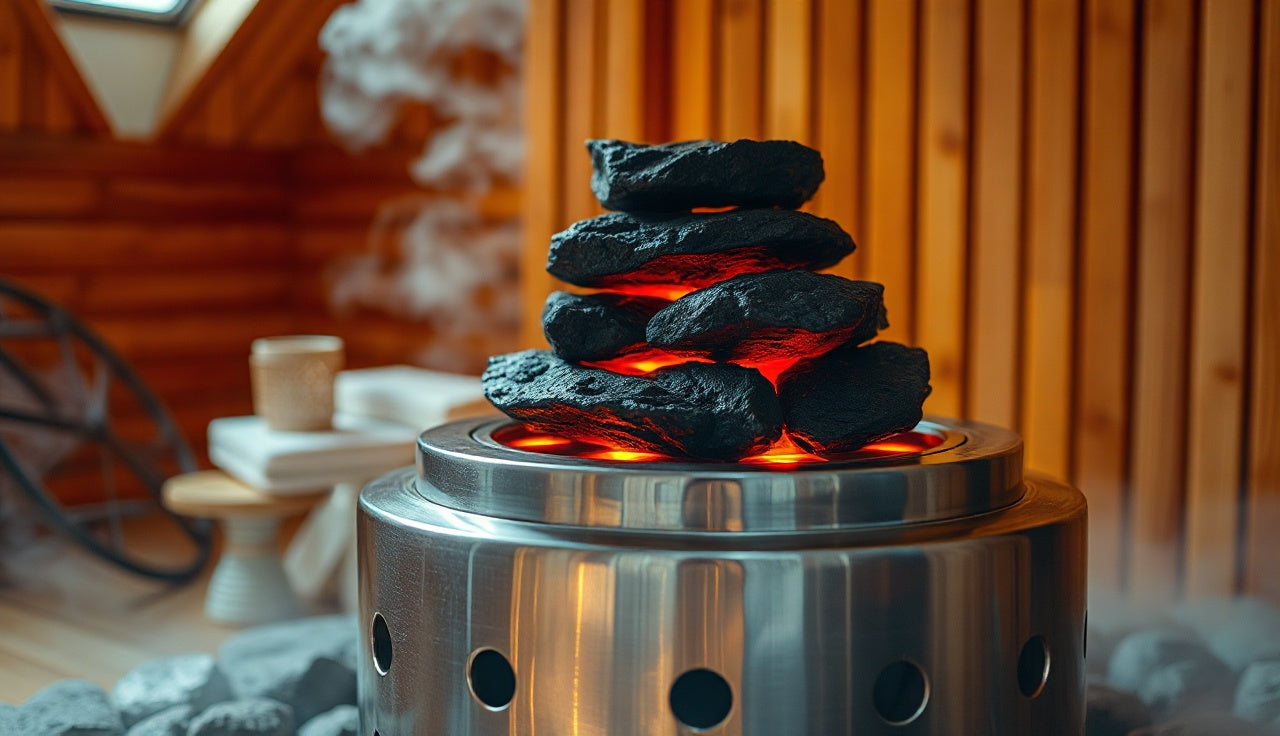
An electric sauna heater is a metal cabinet, usually stainless or painted carbon steel, holding a stack of volcanic rocks above resistive heating coils. Turn it on and the coils heat the rocks. The rocks heat the air around them through convection and radiation. Ladle water onto those hot rocks and it flashes into steam, spiking the humidity and the felt temperature in a second. That burst of steam is called löyly in Finnish. It is the whole point of the ritual.
Electricity in, heat and steam out. No combustion byproducts, no flue, no hauling wood. A correctly sized heater reaches target temperature (150°F to 195°F, or 65°C to 90°C) in 30 to 45 minutes depending on room size and insulation [1].
Electric heaters dominate North American homes for two reasons. Local building codes in most states and provinces treat them like any other high-amperage appliance, with no special review, while wood-burning units can trigger EPA and local air-quality scrutiny [2]. And any licensed electrician who has wired a range or a hot tub can install one.
How do you size an electric sauna heater for your room?
The sizing rule every major Scandinavian manufacturer uses, echoed in UL and ETL guidance, is 1 kilowatt for every 45 to 50 cubic feet of room volume [3]. Measure length by width by ceiling height in feet, multiply to get cubic feet, divide by 50, then round up to the next available wattage.
Take a common home sauna at 6 ft × 5 ft × 7 ft. That is 210 cubic feet. Divide by 50 and you get 4.2 kW, so the nearest standard sizes are a 4.5 kW or a 6 kW unit. Go with the 6 kW if your walls are poorly insulated, if the room has a glass wall, or if a cold climate means the wood never fully acclimates.
Adjustments worth making:
| Condition | Adjustment |
|---|---|
| Glass walls or window | Add 1.5 kW |
| Exterior wall with minimal insulation | Add 1 kW |
| Ceiling above 7 ft | Add proportional volume |
| Cold climate (below 20°F average winter) | Add 1 to 2 kW |
| Very small room under 100 cu ft | Minimum 3 kW anyway |
Never undersize. A heater pinned at 100% all the time wears out faster and may never hit target temperature. Don't wildly oversize either. A 12 kW heater in a 200-cubic-foot room reaches temperature in 15 minutes flat, then cycles hard and costs more to wire.
For a home sauna build, heater size is one of the first decisions you make, because it sets your panel load and can trigger a subpanel upgrade.
What wiring and electrical requirements does an electric sauna heater need?
Every residential electric sauna heater in North America needs a dedicated 240V circuit. Amperage tracks wattage: divide watts by 240 to get amps. A 6,000W heater pulls 25 amps. A 9,000W unit pulls 37.5 amps. NEC (National Electrical Code) Article 424 and Article 680 cover fixed electric space heating and related installations, and most AHJs (authorities having jurisdiction) apply these to sauna heaters [4].
Wiring requirements for common sizes:
| Heater size | Draw (240V) | Minimum wire gauge | Breaker size |
|---|---|---|---|
| 3 kW | 12.5 A | 12 AWG | 20 A |
| 4.5 kW | 18.75 A | 10 AWG | 30 A |
| 6 kW | 25 A | 10 AWG | 40 A |
| 8 kW | 33.3 A | 8 AWG | 50 A |
| 9 kW | 37.5 A | 8 AWG | 60 A |
NEC requires the breaker rated at 125% of continuous load, so always round up. Use copper wire only. Aluminum conductors are a bad idea for sauna work because the heat cycling causes expansion and contraction that loosens terminals over time.
Pull a permit. Have a licensed electrician do the work. Homeowners in some states can pull their own permits for certain projects, but a sauna heater is a continuous-duty high-wattage load, and insurers have denied fire claims after finding unpermitted electrical work. A permit runs $75 to $200 in most jurisdictions, which is nothing against the cost of a denied claim [4].
The heater also has to be bonded to ground and installed at the clearance the manufacturer specifies, usually a minimum of 4 to 6 inches from combustible surfaces.
| 100 cu ft room | 3 |
| 150 cu ft room | 3 |
| 200 cu ft room | 4.5 |
| 250 cu ft room | 6 |
| 300 cu ft room | 6 |
| 350 cu ft room | 8 |
| 450 cu ft room | 9 |
Source: Harvia PLC, Electric Heater Sizing Guide (citation 3)
What types of electric sauna heaters are there?
Three main form factors show up in home saunas.
Floor-mounted heaters are the oldest and the most common. They sit on the floor with a protective railing around the stone bed. They hold the most rocks (some take 30 to 60 kg), which buys you the best heat mass and the most authentic steam response. The tradeoff is floor space and the permanent clearance zone.
Wall-mounted heaters attach at bench height or above. They free up floor space, which matters in a tight room. They hold fewer rocks, so the steam response is a touch lighter. You see these in smaller builds and prefab cabin saunas.
Corner-mount heaters are a wall-mount variation shaped to tuck into a corner and save even more room. Good for spaces under 150 cubic feet where a floor unit would crowd you.
There is a fourth category worth knowing about: combination units that run as both a dry sauna heater and a steam generator. They are less common and cost more. Most people are better off with a standard electric heater plus a ladle and bucket, which gives you all the steam control you need and nothing to break.
For how electric heating stacks up against steam generation, see our sauna vs steam room explainer.
How much does an electric sauna heater cost?
Price tracks almost directly with wattage and brand tier. Here is an honest breakdown at current retail:
| Category | Wattage range | Price range (heater only) |
|---|---|---|
| Budget / entry-level | 3 to 4.5 kW | $250 to $500 |
| Mid-range | 4.5 to 8 kW | $500 to $1,200 |
| Premium (Finnish brands) | 6 to 17 kW | $1,200 to $2,500+ |
| Commercial / large residential | 9 to 18 kW | $2,000 to $5,000 |
The heater is only part of it. Add electrical installation ($400 to $1,500 depending on panel distance and local labor rates), rocks if they aren't included ($30 to $100 for a 20 kg bag of olivine or peridotite), and a controller if it isn't bundled. Some premium Finnish units ship with WiFi controls in the box. Most budget units don't.
For context, a complete home sauna build runs from roughly $3,000 for a DIY prefab kit to $20,000 or more for a custom timber-frame outdoor room. The heater is rarely the biggest line item.
Operating cost comes down to your electricity rate and how often you go. A 6 kW heater running 1.5 hours (warm-up included) burns about 9 kWh per session. At the U.S. average retail rate of roughly 16.4 cents per kWh (EIA, 2024 data), that is about $1.48 a session [5]. Four sessions a week works out to around $25 a month.
What are the best sauna rocks and how much do you need?
The rocks matter more than most buyers expect. They are the thermal mass that holds heat while the coils cycle on and off, and they are what absorbs and releases steam. Wrong rocks crack, leach minerals into the steam, or shatter when water hits them.
The two best rock types for electric heaters are olivine (peridotite) and diabase (gabbro). Both handle thermal cycling, hold their shape, and produce clean steam [6]. Granite works but cracks faster. Skip decorative river rocks, sandstone, and any porous sedimentary rock.
Every manufacturer specifies a minimum and maximum rock load in kilograms per model. A 6 kW floor unit might call for 25 to 40 kg. Under-load it and you cut heat mass and make the heater cycle more. Over-load it and you block airflow and cook the elements.
Replace your rocks every 2 to 4 years in regular use. They absorb mineral deposits and crack internally over time. Degraded rocks give off a sulfurous smell when wet. Fresh rocks make a real difference in steam quality.
The standard Finnish advice is to wash new rocks, rinse them, then run a dry burn at full temperature for one hour before you add any water [6].
What sauna heater controls should you look for?
Controls come in three flavors: mechanical analog, digital panel, and WiFi app-connected.
Analog controls are a dial for temperature and a dial or timer for duration. Dead simple, rarely fail. For a cabin sauna or anyone who just wants the thing to work, analog is fine.
Digital panel controls set exact temperatures (in °F or °C), timers, and sometimes humidity targets. They usually mount inside the sauna with a remote sensor. Better units let you pre-program sessions so the room is hot when you walk in after work.
WiFi controls connect to a phone app. You start warm-up from the car, set schedules, sometimes track energy use. Harvia (with its Xenio controllers) and Huum both make app controls that hold up well. The catch: if the app dies or the cloud service goes dark, you lose remote control. Confirm the heater still runs manually if the WiFi drops.
One feature worth paying for is a room temperature sensor mounted at bench height instead of at the heater. A sensor at the heater reads high and lies to you. Bench-height measurement gives you the number you're actually sitting in, which is the only one that matters.
Safety features to verify: overheat cutoff (required for a UL 875 / ETL listing [7]), a timer that maxes out (most cap at 1 to 3 hours as a fire backstop), and a childproof stone guard on floor units.
Are electric sauna heaters safe? What certifications should you check?
Electric sauna heaters are safe when a recognized NRTL (Nationally Recognized Testing Laboratory) has listed them and you install them to that listing. The two marks you'll see in North America are UL (Underwriters Laboratories) and ETL (Intertek). Both test to the same ANSI/UL 875 standard for electric dry bath heaters [7]. A CE mark alone (European conformity) is not enough for a U.S. install. Some imports carry only CE and were never tested to U.S. voltage or clearance requirements.
UL 875 covers electric sauna heaters specifically and sets rules for temperature limits, insulation, grounding, and protection against contact with the heated stone bed. In its product outline, UL describes the standard as covering "electrically heated sauna bath heaters" intended for permanent installation in residential and commercial buildings [7].
Don't buy a heater without a UL or ETL listing unless you're ready for your homeowner's insurance to deny a fire claim. This is not hypothetical. Insurers look for listed equipment in fire investigations.
Clearances from the listing usually run: minimum 4 inches from combustible walls on the sides, 12 to 16 inches of clear space above the stone bed, and the guard or railing that ships with the unit has to be installed.
Carbon monoxide is a non-issue with electric (no combustion), but ventilation still matters for comfort. A low vent for fresh-air intake and a high vent on the opposite wall for exhaust is the standard setup for sauna rooms.
How does an electric sauna heater compare to wood-burning and infrared?
Three heating technologies compete for the home sauna. Here they are side by side.
| Feature | Electric | Wood-burning | Infrared |
|---|---|---|---|
| Installation complexity | Medium (electrician) | High (chimney, EPA regs) | Low (plug-in) |
| Preheat time | 30 to 45 min | 45 to 90 min | 10 to 20 min |
| Max temperature | 185 to 195°F | 190 to 210°F | 120 to 140°F |
| Steam (löyly) | Yes, full | Yes, full | Very limited |
| Operating cost | Low to medium | Low (if you have wood) | Low |
| Maintenance | Rocks every 2 to 4 yr | Chimney cleaning, ash | Emitter replacement |
| Authentic sauna feel | High | Highest | Low |
| Indoor-friendly | Yes | Difficult | Yes |
Wood-burning gives the highest temperatures and the most traditional atmosphere. EPA rules on wood heater emissions [2] and the need for a properly lined chimney make it hard to install indoors in most places. It makes the most sense in a dedicated outdoor sauna building.
Infrared heaters warm your body directly with radiant panels instead of heating the air. Room temperature stays lower (120°F to 140°F) and humidity is minimal. The experience is genuinely different from a traditional sauna. Not better, not worse, just different. If you want the classic hot-air, high-humidity Finnish session, infrared will let you down.
Electric is the practical middle for most homeowners: full temperature, real löyly, works indoors, no combustion.
What are the leading electric sauna heater brands?
A handful of brands have earned steady reputations in the North American market.
Harvia, a Finnish public company founded in 1950, is the largest sauna heater maker in the world and holds the biggest share of the North American residential market. Their heaters run across price points, from the entry-level Vega to the high-end Cilindro. Parts and replacement elements are easy to find.
Huum, another Finnish brand, has moved fast with bucket-style heaters (the DROP and HIVE) built around a large stone load relative to heater size, which lifts steam quality. Their units sit toward the premium end ($1,000 to $2,000 for the heater alone).
Finnleo and Tylo are both well-established Finnish-heritage brands with strong North American distribution and solid UL listings.
EOS, a German brand, makes commercial-grade heaters popular in luxury residential builds for their durability and stone capacity.
On the budget end, Vevor and Finlandia sell at lower prices. Finlandia units are UL-listed and a reasonable value in the 4.5 to 6 kW range. Vevor and similar imports are hit-or-miss on certification, so verify the UL or ETL mark before you buy.
If you want a complete setup, SweatDecks carries a selection of electric heaters and full sauna kits, all vetted for proper certification and sizing.
One honest opinion: for a home sauna you plan to use 200-plus times over five or more years, a Harvia mid-range or a Huum unit is money well spent over a budget import. The elements, the controls, and the warranty support are all meaningfully better.
How do you install an electric sauna heater?
Installation splits into two tracks: room prep and electrical hookup. You can do the room prep yourself. The electrical goes through a licensed electrician in most jurisdictions.
Room prep checklist:
- Walls and ceiling lined with kiln-dried softwood (Western red cedar, Nordic spruce, or aspen are most common; avoid aromatic cedar on the ceiling where it meets the highest heat)
- Vapor barrier installed correctly (usually foil-faced, behind the wood paneling)
- Flooring that tolerates water: tile, concrete, or sealed wood
- Heater location set (floor models need a flat, level surface; wall models need a stud or blocking to anchor the bracket)
- Rocks on hand, weighed and washed, ready to load once the electrical is live
Electrical prep: your electrician runs the correctly gauged wire from the panel (or subpanel) to a disconnect or junction box next to the sauna room, then connects it to the heater's lead wires per the manufacturer's wiring diagram. Most heaters ship with that diagram in the box and a copy in the manual.
After the electrical is connected and before you load rocks, run a test with the stone bed empty to confirm the elements heat and the thermostat reads right. Then load the rocks, run a 60-minute dry burn to seat them, and you're ready.
Typical install time for a prefab room: one to two days for a skilled DIYer on the carpentry, plus a 2 to 4 hour electrical visit. Custom builds take longer. A portable sauna or tent-style setup has different, and usually simpler, requirements.
How long do electric sauna heaters last and what maintenance do they need?
A well-built heater from a reputable brand lasts 15 to 20 years with normal use and basic care [8]. The limiting part is usually the heating elements, which you can replace individually on most quality units for $50 to $150 each. That beats replacing the whole heater.
Maintenance schedule:
After every session: wipe out the stone bed area if debris has fallen in. Leave the door open for 30 minutes to dry the room.
Every 6 months: inspect the stones for cracks, crumbling, or discoloration. Check the elements for corrosion or burn marks. Confirm the stone guard is secure.
Every 2 to 4 years: replace the rocks entirely. This is the single highest-impact task for steam quality.
Every 3 to 5 years, or at the first sign of uneven heating: test the elements with a multimeter for resistance. A failed element reads open (infinite resistance). Most heaters have two or three elements. One can fail while the others keep working, but the heater will run hotter on one side and warm up more slowly.
Don't pour salt water or essential oils straight onto the rocks unless the manufacturer says you can. Oils coat the elements, cut heat transfer, and degrade the rock surface. Use an aroma cup that hangs on the railing, or add oils to the water in the bucket.
The wood interior needs no finish or treatment. Kiln-dried softwood handles heat and humidity on its own. Do not stain, varnish, or oil interior sauna wood. It will off-gas at high temperatures.
Can a sauna heater help with recovery and health? What does the research say?
The health research on sauna use is real and growing, but it needs context.
The most-cited evidence on frequent sauna use and heart health comes from the Kuopio Ischemic Heart Disease Risk Factor Study (KIHD) at the University of Eastern Finland, which followed more than 2,300 Finnish men for over 20 years. The 2015 JAMA Internal Medicine paper by Laukkanen and colleagues found that men who used a sauna 4 to 7 times a week had a 40% lower risk of fatal cardiovascular disease than once-weekly users [9]. This is an association study, not a randomized trial, so causation is not proven and you should read the result with that limit in mind.
Shorter-term effects with stronger mechanistic support: heart rate rises the way it does during moderate aerobic exercise, blood pressure dips temporarily after a session, core temperature climbs in a way that may affect immune signaling, and growth hormone rises after prolonged heat exposure [10].
Heat stress also sits at the center of the sauna benefits case for athlete recovery. Several small randomized trials report reduced muscle soreness and better perceived recovery after heat exposure, though effect sizes vary and the study groups are small.
Honest framing: sauna use looks like a genuinely useful recovery and cardiovascular tool for most healthy adults. It is not a treatment for any disease. People with certain cardiovascular conditions, anyone pregnant, or anyone on medications that affect thermoregulation should talk to a physician before starting regular sessions [10].
If you want contrast therapy, alternating heat with a cold plunge or ice bath, that protocol has its own growing research base. The cold plunge benefits page covers the cold side in detail.
Frequently asked questions
Can I use a regular 120V outlet for a sauna heater?
No. Every residential electric sauna heater for traditional use requires 240V. There are no meaningful sauna heaters that run on a 120V household outlet, because the minimum wattage (3,000W for even a tiny room) exceeds what a 120V/20A circuit supplies. If a product is marketed as a 120V sauna heater, it is almost certainly an infrared panel unit, not a traditional rock-style heater.
What temperature should an electric sauna heater reach?
Traditional Finnish sauna temperature at bench height runs 150°F to 195°F (65°C to 90°C). Most electric thermostats max out around 185°F to 195°F. Temperature varies a lot by height: floor level might be 110°F while the upper bench is 180°F, which is normal. The target is the temperature at seated bench height, not the thermostat reading near the heater.
How long does it take an electric sauna heater to warm up?
A correctly sized heater warms a properly insulated room in 30 to 45 minutes. A cold, uninsulated, or oversized room takes longer. Finnish tradition calls for letting the room preheat fully before you enter, which also means the benches and walls have soaked up heat and won't feel cold. Using the preheat timer so the room is ready when you want it is standard practice.
Do you need to add water to an electric sauna heater?
You don't have to, but adding water is the whole point of a traditional session. Ladling small amounts onto the hot rocks releases steam (löyly), raising perceived humidity and heat intensity sharply without raising air temperature much. That sensation drives most of the sweating response. Use clean water. Some people add a tiny bit of essential oil to the water in the ladle, though never directly onto the rocks.
Can I install an electric sauna heater myself?
You can do the room carpentry and heater mounting yourself in most jurisdictions, but the electrical connection must go through a licensed electrician in nearly all U.S. states and Canadian provinces. You'll also need a permit in most areas. Doing the 240V wiring yourself without a license is a fire risk and will likely void your homeowner's insurance if something goes wrong.
What is the difference between a 6 kW and a 9 kW sauna heater?
The 6 kW unit suits rooms up to roughly 300 cubic feet (about 6×7×7 ft). The 9 kW handles rooms up to 450 cubic feet, or large rooms with hard conditions like glass walls or exterior exposure. The 9 kW also heats faster in the same space. The wiring differs: a 9 kW unit needs a 60A circuit versus 40A for the 6 kW, which can mean a heavier wire run and a bigger breaker.
How often should I replace the rocks in my electric sauna heater?
Every 2 to 4 years with regular use (3 to 4 sessions per week). You'll know when rocks crack visibly, crumble in your hand, smell sulfurous when water hits them, or when steam output drops off. Use olivine (peridotite) or diabase (gabbro) for best results. Wash new rocks before loading, then run a 60-minute dry burn before the first splash of water.
Can an electric sauna heater be used outdoors?
Most residential electric heaters are rated for indoor installation only. In an outdoor sauna building with proper weatherproofing (weathertight junction boxes, correctly rated conduit, and a fully enclosed insulated structure), an indoor-rated heater works fine because it never sees weather directly. True outdoor-rated heaters (IP-rated for moisture) exist but are less common. Always confirm the heater's installation-location rating in the manual before mounting.
Is an electric sauna heater cheaper to run than a wood-burning one?
It depends on your local electricity rate and wood cost. At the U.S. average of about 16.4 cents/kWh (EIA, 2024), a 1.5-hour session with a 6 kW heater costs roughly $1.50. If you have free or cheap firewood, wood wins easily. At high electricity rates (Hawaii, California), electricity costs 2 to 4 times more per session. Most urban homeowners find electric more convenient and cost-competitive once wood delivery is factored in.
What sauna heater brands are the most reliable?
Harvia (Finland) has the broadest market share, the most available replacement parts, and a consistent reliability record across its mid-range and premium lines. Huum (also Finnish) earns steady praise for steam quality thanks to its large stone beds. Finnleo and Tylo are solid. On the budget end, Finlandia offers reasonable value with a proper UL listing. Avoid unlisted imports at any price; the certification gap is a real safety and insurance issue.
Can I use an electric sauna heater in a barrel sauna or prefab kit?
Yes. Most barrel saunas and prefab kits sold in North America are designed for electric heaters. The kit usually specifies a compatible wattage range (commonly 6 to 9 kW for a 2-person barrel). Make sure your heater carries a UL or ETL listing and that its wattage matches the room volume. Barrel saunas often sell with or without a heater, and buying the heater separately gives you more control over quality.
Does an electric sauna heater need ventilation in the room?
Yes. Ventilation matters for comfort and air quality, not for combustion safety (electric produces none) but to bring in fresh oxygen and keep the room from going stuffy. The standard setup is a small vent (roughly 4×6 inches) near the floor below the heater for intake, and a vent on the opposite wall near the ceiling for exhaust. Many builders also leave a small gap under the door.
Will a sauna heater raise my home electricity bill significantly?
For most households, no. A 6 kW heater run 1.5 hours, four times a week, uses about 36 kWh per week. At 16.4 cents/kWh that is roughly $5.90 a week, or about $25 a month. That is on par with running a window air conditioner on hot summer days. Heavier commercial use or very large rooms (9+ kW) cost proportionally more, and rates vary a lot by state.
Can I add an electric sauna heater to an existing room in my house?
Yes, this is common. A spare bathroom, a closet conversion, or a dedicated room can become a sauna if it meets a few conditions: it can be lined with vapor-tolerant softwood, the panel has capacity for a new 240V circuit, and you can hold the required clearances around the heater. Bathrooms with existing tile are easier to convert. Insulation is the key variable; a poorly insulated room wastes electricity and never reaches ideal temperature.
Sources
- Finnish Sauna Society, Sauna Guide: Electric sauna heaters typically reach target temperature of 65°C to 90°C (150°F to 195°F) in 30 to 45 minutes
- U.S. EPA, Wood Heater Program: Wood-burning heaters are subject to EPA emission regulations that do not apply to electric heaters
- Harvia PLC, Electric Heater Sizing Guide: Standard sizing rule of approximately 1 kW per 45 to 50 cubic feet of sauna room volume
- National Fire Protection Association, NFPA 70 National Electrical Code: NEC Article 424 and Article 680 cover fixed electric space heating; breakers must be rated at 125% of continuous load
- U.S. Energy Information Administration, Electric Power Monthly — Average Retail Price of Electricity: U.S. average retail residential electricity rate was approximately 16.4 cents per kWh in 2024
- Finnish Sauna Society, Sauna Stones Guidance: Olivine (peridotite) and diabase (gabbro) are recommended sauna rock types; rocks should be washed before use and a dry burn performed before first water application
- UL Standards & Engagement, ANSI/UL 875 Standard for Electric Dry Bath Heaters: UL 875 covers 'electrically heated sauna bath heaters' intended for permanent installation, setting requirements for temperature limits, insulation, grounding, and overheat protection
- Huum, Heater Care and Maintenance Guide: A well-maintained electric sauna heater from a quality manufacturer has an expected service life of 15 to 20 years with element replacement as needed
- Laukkanen JA et al., JAMA Internal Medicine, 2015 — Association Between Sauna Bathing and Fatal Cardiovascular and All-Cause Mortality Events: Men who used a sauna 4 to 7 times per week had a 40% lower risk of fatal cardiovascular disease compared to once-weekly users in a 20-year cohort study (association, not proven causation)
- Harvard Health Publishing, Harvard Medical School — Sauna Health Effects: Sauna use raises heart rate comparably to moderate aerobic exercise and may temporarily reduce blood pressure; people with cardiovascular conditions should consult a physician before regular use

Share:
Hot tub cold plunge combo: the complete buyer's guide
Sauna for stress relief: what the science actually says