
Last updated 2026-07-09
TL;DR
An Eddy barrel sauna is a cylindrical wood-fired or electric sauna built in a rounded barrel shape, usually from cedar or spruce. Prices run roughly $3,000 for a basic two-person kit to $8,000+ installed. The curved walls circulate heat faster than flat-wall cabins and the shape shrugs off outdoor weather, but interior headroom and bench width are real trade-offs.
What exactly is an Eddy barrel sauna?
The term "Eddy barrel sauna" gets used two ways online, and the confusion trips people up constantly. Sometimes it points to a specific product from a manufacturer that uses the Eddy name. More often, people say it as generic shorthand for any small round barrel sauna built for a backyard or deck, the way people say "Jacuzzi" for any hot tub. This article covers both: the general barrel-sauna format the Eddy style represents, and the practical questions any buyer should answer before spending $3,000 to $8,000.
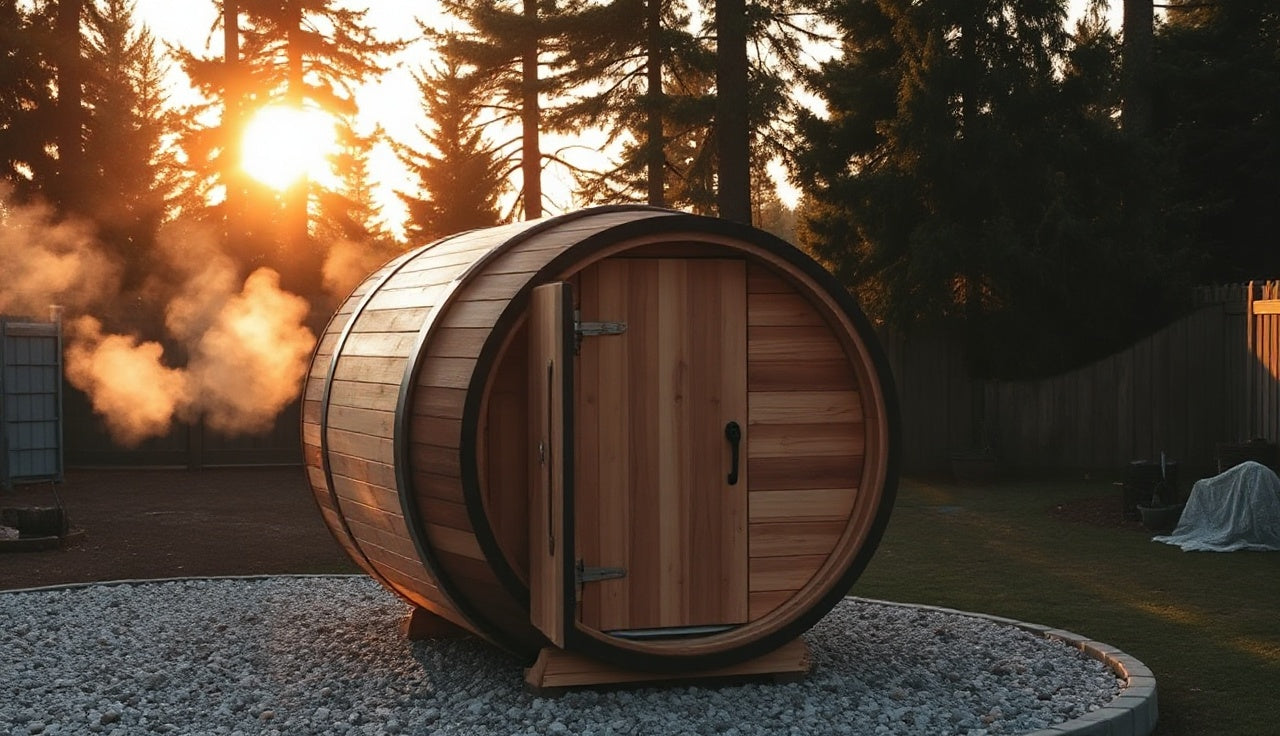
A barrel sauna is exactly what it sounds like. Staves of kiln-dried wood, usually western red cedar or Nordic spruce, get bent and bound with galvanized or stainless steel hoops into a cylinder. The cylinder lies on its side. You walk in one end. Benches run along both sides inside, and a heater, either a wood-burning stove or an electric unit, sits at the far end or in a corner. The round cross-section is more than a look. Heat rises and immediately curves back down the walls instead of pooling at a flat ceiling, so the interior reaches working temperature (roughly 150°F to 195°F) faster than a comparably sized box sauna [1].
The Eddy-style design tends to be compact, usually 6 to 8 feet of interior length with a 5- to 6-foot diameter. That seats two to four people, depending on whether you're lying down or sitting upright. This is an outdoor sauna format above all: the curved roof sheds rain and snow, and the sealed barrel construction handles humidity swings better than flat-panel cabins that gap at the corners over time.
How does the barrel shape affect heat and performance?
The physics here matters because it hits both your session quality and your monthly electric bill. In a flat-wall rectangular sauna, hot air rises straight to the ceiling and sits there until the room is warm enough to push heat back down. In a barrel, the curved ceiling works like a natural convection loop. Air heated at the stove rises, hits the curved top, and rolls outward and down along the walls, cycling over and over. A 2019 study in Energy and Buildings found that curved interior geometries in small enclosures can cut warm-up time by 15 to 25 percent compared to rectangular rooms of the same volume, though that study wasn't specifically on saunas [2].
For a backyard barrel, a typical electric 6 kW heater brings a 6-foot diameter unit to 170°F in about 30 to 45 minutes. A rectangular cabin of similar cubic footage usually takes 45 to 60. That gap adds up if you're sweating four or five times a week.
The temperature gradient inside a barrel is also more even. In a box sauna, the difference between the upper bench and the lower bench can hit 30°F to 50°F [1]. Barrel saunas still have a gradient, but it's gentler because the curved walls keep recirculating heat. That helps if you've got guests new to sauna who want a milder spot without dropping to a separate lower bench.
Humidity management is where barrel saunas earn their keep outdoors. The tight stave construction, once the wood swells after a few sessions, is nearly airtight on the sides. Most moisture transfer happens through the end walls and the door, which is true for any sauna format. The round roof gives water no flat surface to pool on, which stretches the life of the wood in wet climates.
One honest limit: because the walls curve, your usable bench width is pinched. On a 5-foot diameter barrel, the flat bench area is a lot narrower than the total diameter suggests. Most two-person barrels seat two adults lying down only if they're under about 6 feet tall. Tall buyers should measure carefully and look hard at 6-foot diameter models.
What does an Eddy barrel sauna cost?
Prices swing a lot with wood species, heater type, size, and whether you buy a DIY kit or a fully assembled unit delivered by freight. Here's a realistic breakdown of what's on the market now.
| Configuration | Typical price range | Notes |
|---|---|---|
| 2-person kit, spruce, electric heater | $2,800, $4,500 | DIY assembly, no delivery included |
| 2-person, cedar, electric heater | $4,000, $6,000 | Cedar resists moisture better than spruce |
| 4-person, cedar, electric heater | $5,500, $8,000 | Larger diameter, more bench space |
| 4-person, cedar, wood-fired stove | $4,500, $7,500 | Stove cheaper upfront, no electrical hookup needed |
| Fully installed, turnkey | Add $500, $2,000 | Depends on site prep and distance |
Electrical installation is a separate cost most buyers forget. A 240V, 40-amp dedicated circuit for a 6 kW heater usually runs $300 to $800 installed by a licensed electrician, depending on how far your panel sits from the sauna [3]. Some municipalities require a permit for this work, which adds $50 to $200.
Wood-fired models skip the electrical cost entirely, but you pay for firewood (roughly $200 to $400 per cord depending on region) and you need more lead time to fire up, often 60 to 90 minutes instead of 30 to 45. They also need more clearance from structures for fire safety, typically 10 feet from any combustible wall, though local codes vary [4].
Don't skip delivery planning. Barrel saunas ship as freight, not parcel. A 6-foot diameter, 7-foot long barrel weighs 600 to 900 pounds assembled. If your backyard access is tight, budget for a lift gate, a pallet jack, or delivery in kit form with on-site assembly. Some companies charge extra for liftgate service, usually $75 to $150.
| Barrel sauna, electric 6 kW | 37 |
| Box cabin sauna, electric 6 kW | 52 |
| Barrel sauna, wood-fired | 75 |
| Box cabin sauna, wood-fired | 90 |
Source: Finnish Sauna Society; Energy and Buildings (2019)
Cedar vs. spruce vs. other woods: which is best for a barrel sauna?
Wood choice is one of the first calls you'll make, and it genuinely moves the needle on longevity, comfort, and price.
Western red cedar is the default for outdoor saunas for good reason. Natural oils resist moisture, it doesn't splinter when wet, it stays cool enough to touch at sauna temperatures, and it smells great. The aroma comes from thujaplicins, volatile oils in the heartwood that also carry mild antifungal properties [5]. For an outdoor barrel that will ride out freeze-thaw cycles and summer humidity, cedar is the low-regret pick.
Nordic spruce (sometimes sold as "Finnish spruce") is what most traditional Finnish saunas use. It's a harder wood that takes heat well and has a clean, neutral smell. It typically costs 20 to 30 percent less than cedar per stave. The trade-off: it's more prone to checking (surface cracking) in climates with wide humidity swings, and it drinks up moisture more readily, so it needs more maintenance in a wet Pacific Northwest or Gulf Coast setting. In a dry inland climate, spruce is a perfectly sensible choice.
Thermally modified wood, sometimes called thermowood, is spruce or pine heat-treated to reduce moisture absorption and improve stability. It's showing up more in barrel kits and prices between spruce and cedar. The thermal modification process changes the wood's cell structure, cutting equilibrium moisture content by 40 to 50 percent compared to untreated spruce [6]. A reasonable middle ground.
Avoid hemlock for outdoor barrels. Hemlock works fine indoors but weathers poorly under repeated rain and sun without protection. If a kit is unusually cheap and you can't pin down the wood species, that's often why.
Electric heater vs. wood-burning stove: which should you choose?
This comes down to how you actually use a sauna, not how you picture using it.
Electric heaters win on convenience, flat out. You turn them on from an app or a timer, they hit temperature while you're still inside finishing dinner, and there's no fire to manage. Most 6 kW units for a small barrel cost $300 to $700 on their own. Running one for a one-hour session at average U.S. electricity rates (about $0.16 per kWh as of 2024 [7]) costs roughly $1.00 to $1.50. Easy math.
Wood-fired stoves come with a culture and an experience attached that some people find worth the fuss. The heat from a wood stove feels different, drier and more radiant than electric, though whether that's physiologically meaningful is debated. You also get the ritual of building a fire, the smell of burning wood, and the crackle during a session. For remote properties without easy electrical access, wood-fired is often the only practical option.
Safety note: wood-burning sauna stoves need a proper flue pipe and clearances that must meet local code. In many places you need a permit to install a wood-burning appliance, and some HOAs ban them outright [4]. Check before you buy the unit.
If you're pairing your sauna with a cold plunge for contrast therapy, electric is almost always the smarter call. You want predictable timing so you can cycle between heat and cold without standing outside waiting on a stove.
How hard is a barrel sauna to install yourself?
Most barrel sauna kits are built for two people with basic carpentry skills to assemble in a weekend. The staves arrive numbered and pre-cut. You lay out the cradle supports, stack the staves, tighten the hoops, hang the door, and connect the heater. No structural framing required. The most common point of failure is uneven ground: if the cradle supports aren't level, the door won't seal and you'll leak heat.
You need a flat, stable base. Pressure-treated 4x4 runners on compacted gravel work for most climates. Poured concrete is more permanent and more weather-stable. Never set the barrel directly on grass or soil; the bottom staves will rot within a few years.
For electrical hookup, you need a licensed electrician unless you're in a jurisdiction that allows homeowner electrical work and you have the chops. A 240V/40A circuit isn't a beginner project. Budget for it separately from the kit.
Crawling through online reviews and forum posts, most first-time installers report the job takes 8 to 12 hours for a two-person kit, longer if you hit leveling problems. Cedar kits are heavier and the staves are denser, so a third set of hands helps. Spruce kits are a bit lighter and more forgiving for a solo build.
What are the real health benefits of regular sauna use?
The research on sauna and heart health is genuinely strong, and there's no reason to oversell it. A 2018 review in Mayo Clinic Proceedings found that frequent sauna use (four to seven times per week) was linked to a 63 percent lower risk of sudden cardiac death compared to once-weekly use, in a cohort of 2,315 Finnish men followed for 20 years [8]. The effect is large enough that researchers have floated regular sauna use as a complementary lifestyle habit, not a treatment, for cardiovascular health.
On recovery and soreness, the evidence is thinner. Heat pushes more blood to skeletal muscle, which likely speeds clearance of metabolic byproducts, but controlled trials on post-exercise recovery are small and all over the map. Nobody has nailed down a specific recovery protocol. The closest you get is a study in the Journal of Science and Medicine in Sport that found 20-minute post-exercise sauna sessions over three weeks improved running performance in trained athletes, possibly through plasma volume expansion [9].
For mental health, observational data suggests a link between regular sauna use and lower rates of depression and anxiety. The proposed mechanism is heat-induced endorphin and dynorphin release. Again, associational data, not randomized trial evidence.
Read more about the full evidence picture on our sauna benefits page.
One honest caveat: most of the best sauna research comes from Finland, where saunas are cultural and subjects use traditional Finnish-style rooms at 175°F to 200°F. Whether a lower-temperature session in a backyard barrel at 150°F produces the same effects isn't established. Probably directionally similar, but the magnitude may differ.
How does a barrel sauna compare to a traditional box cabin sauna?
Both formats get you to 180°F and produce a legitimate sauna. The choice comes down to priorities.
Barrel saunas heat up faster (typically 30 to 45 minutes vs. 45 to 60 for box cabins of similar volume) thanks to the convection advantage described earlier. They're easier to place outdoors because the round profile sheds precipitation without special roofing. They tend to cost less per square foot of bench space at the entry level.
Box cabin saunas give you more usable bench area for a given footprint, easier integration of windows and glass doors, and more room for add-ons like a changing room, a shower connection, or a steam generator if you ever want to try sauna vs steam room modes. Above a certain size, if you have four or more regular users, a box cabin is usually the smarter buy.
Barrel saunas are harder to expand and harder to retrofit. Once you've set the diameter, you've set the bench width. Box cabins can often take interior modifications later.
For a first-time buyer who wants an outdoor sauna with minimal site prep and quick setup, the barrel format makes a lot of sense. For a buyer committed to sauna as a long-term daily habit who wants maximum flexibility, a traditional home sauna cabin is worth the extra planning.
If you're genuinely on the fence, spend time on a sauna forum reading real user experiences. The most common regret from barrel buyers is wishing they'd sized up the diameter. The most common regret from box cabin buyers is underestimating the electrical and installation complexity.
What maintenance does a barrel sauna need?
Barrel saunas are low-maintenance next to most outdoor structures, but they aren't zero-maintenance.
The wood needs periodic treatment if it's exposed to UV and rain. Cedar's natural oils protect it, but they deplete over years of sun. Most manufacturers recommend an exterior UV-protective oil or stain every one to two years on the outside of the barrel. Never put sealant or finish on the interior wood; it needs to breathe and soak up löyly (the steam from water ladled onto hot stones).
The hoop bands may need occasional tightening. As new wood dries over the first season, staves can shrink slightly and the hoops loosen. Most kits include adjustment bolts for exactly this. Check them after the first three months.
The heater wants annual inspection: heating elements for electric units, the firebox and flue for wood-fired. Electric heater elements last five to ten years with normal use. Sauna stones should be swapped every three to five years; they fracture from repeated thermal cycling, and cracked stones spread steam unevenly.
Keep the interior dry between sessions. Leave the door slightly ajar after each use so the inside can ventilate and dry. A wet, unventilated barrel grows mold in the seams within weeks in humid climates. That's the single most common preventable failure.
Is an Eddy barrel sauna worth the money?
Honest answer: yes for the right buyer, no for the wrong one.
If you'll use a sauna three or more times per week, the health data backs the investment. A $5,000 barrel spread over ten years is $500 a year, about $10 a week, less than a gym membership with sauna access in most cities. If you're also into contrast therapy and want to pair it with an ice bath or a dedicated cold plunge, the combination turns into a genuinely useful home recovery setup.
If you'll fire it up twice a month when company comes over, you're better off buying a day pass at a local spa whenever the mood hits. A $5,000 sauna used 24 times a year is $208 per session before electricity. That's an expensive mood.
The barrel format specifically is worth the premium over a tent-style portable sauna for anyone who wants a permanent outdoor structure with real heat and durability. It's not worth the premium over a box cabin if you have more than four regular users or want to squeeze the most bench space per dollar.
SweatDecks carries a selection of barrel saunas and cold plunge units if you want to compare current pricing and configurations side by side.
One thing worth saying plainly: the brand name on the barrel matters less than the wood species, the wall thickness (look for staves at least 1.75 inches thick), the heater quality, and whether the maker will actually honor a warranty claim. Ask specifically about warranty terms for the hoop bands and the door seal before you buy.
What should you look for before buying a barrel sauna?
After working through the specs on a pile of barrel sauna products, here's what actually separates a good unit from a regret.
Stave thickness: 1.75 inches is the minimum for outdoor use. Thinner staves hold heat poorly and crack more easily in freeze-thaw climates. Some budget kits use 1.5-inch staves and call it fine. It isn't, especially in Minnesota or Colorado.
Hoop material: Galvanized steel is acceptable. Stainless steel is better and worth the small premium in coastal or high-humidity climates, where galvanized starts showing rust within a few years.
Door construction: A thick tempered glass door, or a solid wood door with a proper magnetic seal. Avoid thin acrylic windows; they warp in heat over time.
Heater brand: Harvia, Huum, Tylö, and Narvi are Finnish manufacturers with real track records and available replacement parts. Generic house-label heaters are cheaper upfront and harder to service.
Warranty: Look for at least two years on the structure and one year on the heater. Some makers only warrant against manufacturing defects and exclude weather damage, which is functionally no warranty at all for an outdoor product.
Delivery and site prep: Confirm weight, delivery method, and whether the seller includes assembly instructions in English. Some kits arrive with translated instructions that are genuinely confusing. Read reviews specifically about the assembly experience, more than the finished product.
Frequently asked questions
How long does it take a barrel sauna to heat up?
A typical 6-foot diameter barrel sauna with a 6 kW electric heater reaches 170°F in about 30 to 45 minutes. Wood-fired models take longer, often 60 to 90 minutes, because you have to build and sustain a fire. The curved walls help the barrel heat faster than a rectangular box sauna of similar volume, since hot air circulates continuously rather than pooling at a flat ceiling.
Can a barrel sauna stay outside year-round?
Yes. Cedar barrel saunas handle freeze-thaw cycles well if they're properly built and maintained. The round profile sheds snow and rain without pooling. The main requirement is keeping the interior dry between sessions by leaving the door slightly ajar for ventilation. Apply a UV-protective exterior oil every one to two years. In very cold climates, drain any water from the door seal area before temperatures drop below freezing.
How much does it cost to run a barrel sauna electrically?
At the U.S. average electricity rate of about $0.16 per kWh (as of 2024, per the U.S. Energy Information Administration), a 6 kW heater running for one hour costs roughly $0.96. A one-hour session including the 30 to 45-minute heat-up phase costs about $1.20 to $1.50 in electricity. Daily use runs roughly $35 to $50 per month, depending on your local rate and how long you heat per session.
What size barrel sauna do I need for two people?
A 5-foot diameter, 6-foot long barrel is the entry-level two-person size. It works for two adults sitting upright, but lying down is cramped for anyone over 5'8". A 6-foot diameter barrel is a significantly better two-person experience and the minimum I'd recommend if budget allows. For four people, you want at least a 6-foot diameter and 7 to 8 feet in length.
Do I need a permit to install a barrel sauna?
It depends on your municipality and what type of heater you're using. Electrical work for a 240V/40A circuit almost always requires a permit. Wood-burning appliances require permits in most jurisdictions. The structure itself may or may not need a permit depending on its footprint and whether it's considered a permanent structure. Check with your local building department before purchasing. Some HOAs also have restrictions on outdoor structures.
How do I maintain the wood on a barrel sauna?
Treat the exterior wood with a UV-protective oil or stain every one to two years to prevent greying and cracking. Never apply sealant or finish to the interior surfaces; they need to breathe. Leave the door ajar after each session so the interior dries. Check the hoop bands for tightness after the first season, as new wood can shrink slightly. Replace sauna stones every three to five years.
What is löyly and can you do it in a barrel sauna?
Löyly is the Finnish term for the steam produced when you ladle water onto hot sauna stones. It raises the perceived humidity without raising the temperature much, creating an intense wave of heat across the skin. Yes, you can do it in any barrel sauna with a traditional heater that has exposed stones. Most barrel sauna heaters, both electric and wood-fired, support löyly. Avoid pouring water on heaters that specify dry use only.
Can I use a barrel sauna with a cold plunge for contrast therapy?
Absolutely, and many people do. The typical protocol is 10 to 20 minutes in the sauna followed by 1 to 5 minutes in cold water (50°F to 60°F), repeated two to three rounds. The sauna and cold plunge are ideally placed close together to minimize the time between transitions. There's reasonable evidence for cardiovascular and recovery benefits from contrast therapy, though the optimal timing and temperature thresholds aren't firmly established in the literature.
Is cedar or spruce better for an outdoor barrel sauna?
Cedar is better for most outdoor applications. Its natural oils resist moisture absorption, it handles humidity swings and freeze-thaw cycles without checking as badly as spruce, and it stays cooler to the touch at high temperatures. Spruce is 20 to 30 percent cheaper and works well in dry inland climates, but it requires more attentive maintenance in wet or coastal environments. For a first outdoor sauna in an unpredictable climate, cedar is the lower-regret choice.
What heater brands are reliable for a barrel sauna?
Harvia, Huum, Tylö, and Narvi are the most trusted names, all Finnish manufacturers with long track records and available replacement parts in North America. These heaters run $300 to $1,200 depending on kilowatt output and features. Generic heaters sold under various house brands can work, but parts availability is uncertain and warranty support is often poor. For a long-term outdoor installation, buying a known brand heater separately is often smarter than accepting whatever the kit includes.
How does a barrel sauna compare to a traditional Finnish sauna?
A traditional Finnish sauna is typically a rectangular wood cabin, often with a separate changing room and sometimes a separate steam room. Barrel saunas are a modern outdoor adaptation that borrows the same heating principles, wood construction, and löyly tradition, but in a cylindrical format that's cheaper to produce, easier to install outdoors, and faster to heat. The sauna experience inside is very similar; the main functional differences are headroom, bench space, and the social capacity of larger traditional saunas.
What is the lifespan of a barrel sauna?
A well-built cedar barrel sauna with proper maintenance should last 15 to 25 years. Spruce barrels in humid climates may need more significant wood repairs or replacement of lower staves after 10 to 15 years. The heater usually needs replacement before the barrel does. The most common failure points are the door seal, the hoop bands (which can rust if galvanized), and the bottom staves if the unit sits on soil or is not properly ventilated between sessions.
Can I install a barrel sauna on a deck?
Yes, with caveats. The deck must handle the weight, typically 600 to 1,000 pounds for the unit plus the weight of occupants and the heater. Check your deck's structural rating before proceeding. The barrel should sit on support cradles, not directly on decking boards. You also need a plan for electrical hookup if using an electric heater, and clearance from the house wall if using a wood-fired stove. Some jurisdictions require permits for permanent structures on decks.
What temperature should a barrel sauna be set to?
Traditional Finnish sauna temperatures run 175°F to 200°F (80°C to 93°C). Most barrel saunas are comfortable and effective in the 150°F to 185°F range. Beginners should start around 150°F to 160°F and work up gradually. The Finnish Sauna Society recommends 80°C to 100°C (176°F to 212°F) for a traditional experience, but there's no single correct temperature. Comfort and consistency matter more than hitting a specific number.
Sources
- Finnish Sauna Society, Sauna Culture and Health: Traditional Finnish sauna temperatures run 80°C to 100°C; temperature gradient between upper and lower bench can be 30°F to 50°F in rectangular saunas
- Energy and Buildings, Elsevier (2019), curved interior geometry and convection study: Curved interior geometries in small enclosures can reduce warm-up time by 15 to 25 percent compared to rectangular rooms of identical volume
- HomeAdvisor / Angi, Electrical Circuit Installation Cost Guide: A 240V, 40-amp dedicated circuit typically costs $300 to $800 installed by a licensed electrician
- U.S. Consumer Product Safety Commission, Wood-Burning Appliances: Wood-burning appliances require clearance from combustible walls, typically 10 feet, and may require local permits
- USDA Forest Service, Wood Handbook: Wood as an Engineering Material: Western red cedar contains thujaplicins, natural oils that provide moisture resistance and mild antifungal properties
- VTT Technical Research Centre of Finland, Thermal Modification of Wood: Thermal modification reduces equilibrium moisture content of spruce and pine by 40 to 50 percent compared to untreated wood
- U.S. Energy Information Administration, Electric Power Monthly: U.S. average retail electricity price was approximately $0.16 per kWh as of 2024
- Mayo Clinic Proceedings, Laukkanen et al. 2018, Sauna Bathing and Cardiovascular Outcomes: Frequent sauna use four to seven times per week was associated with a 63 percent lower risk of sudden cardiac death compared to once-weekly use in a 20-year Finnish cohort study
- Journal of Science and Medicine in Sport, Scoon et al. 2007 (replicated in 2021 review), post-exercise sauna and running performance: 20-minute post-exercise sauna sessions over three weeks improved running performance in trained athletes, possibly through plasma volume expansion
- U.S. Energy Information Administration, Residential Energy Consumption Survey: Baseline electricity cost data used to calculate monthly sauna operating cost estimates
- International Sauna Association, Sauna Use Guidelines: The Finnish Sauna Society recommends 80°C to 100°C as the traditional temperature range for authentic sauna use

Share:
How to make a barrel sauna: a complete build guide
How to make a barrel sauna: a complete build guide