
Last updated 2026-07-09
TL;DR
The Dundalk LeisureCraft Tranquility is a Canadian-made outdoor barrel sauna cut from clear Western red cedar, sold in 6-foot and 7-foot diameters. Kits start near $4,500 and climb past $8,000 with accessories. It heats in 30 to 45 minutes, seats 4 to 6, and ranks among the best-built barrel saunas sold in North America.
What is the Dundalk LeisureCraft Tranquility barrel sauna?
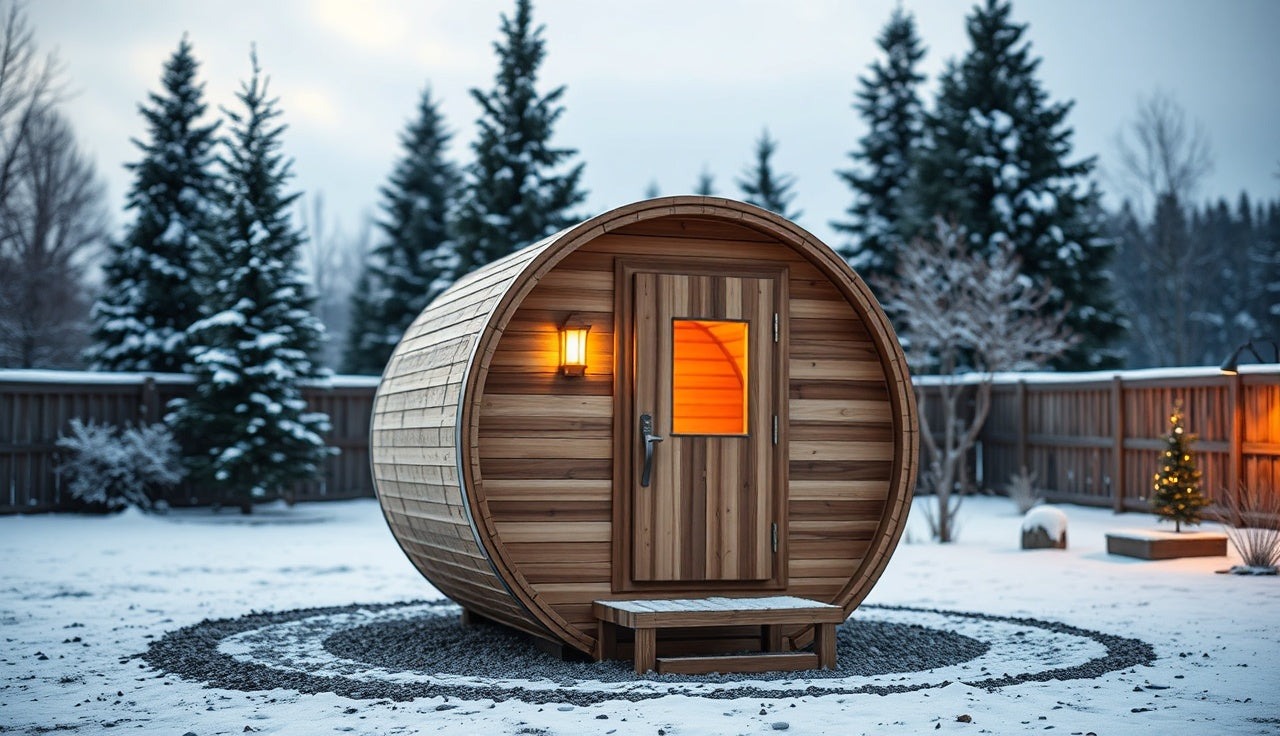
The Tranquility is the flagship barrel sauna from Dundalk LeisureCraft, a manufacturer based in Dundalk, Ontario. It ships as a DIY kit: tongue-and-groove staves of kiln-dried, clear Western red cedar that you assemble with steel bands on a pair of cradle supports. No nails. No screws punched through the barrel walls. The design is old-school Scandinavian, a round cross-section that spreads heat evenly because there are no corners to trap cool air.
The barrel comes in two diameters, 6 feet and 7 feet, and in lengths from roughly 6 feet to 8 feet depending on the configuration. Dundalk also sells versions with a change room, a separate vestibule added to one end, which earns its keep if you live somewhere with real winters. Left untreated, the exterior weathers to silver-gray over a couple of seasons. Most people leave it that way.
This is not a prefab box sauna. It is not a budget import. LeisureCraft has built outdoor saunas since 1969 [1], and the Tranquility carries decades of iteration on what survives a Canadian climate. Want something that is still standing and tight in 20 years? This is a real candidate. Want cheap and quick? Look elsewhere.
What are the exact specs and dimensions of the Tranquility?
Dundalk sells the Tranquility in two barrel diameters. The 6-foot version has an interior height of roughly 56 inches at the center of the barrel, and usable bench length depends on the barrel length you pick. The 7-foot version gives you about 66 inches of headroom at the apex, so most adults can stand upright inside.
Here is a simplified look at the common configurations [1]:
| Configuration | Barrel Dia. | Interior Length | Seats | Approx. Kit Price |
|---|---|---|---|---|
| 6 ft / 6 ft barrel | 6 ft | ~6 ft | 2-4 | ~$4,500-$5,500 |
| 6 ft / 7 ft barrel | 6 ft | ~7 ft | 4 | ~$5,000-$6,000 |
| 7 ft / 7 ft barrel | 7 ft | ~7 ft | 4-6 | ~$6,500-$7,500 |
| 7 ft / 8 ft barrel + change room | 7 ft | ~8 ft + vestibule | 4-6 | ~$7,500-$9,000+ |
Those prices reflect the range across authorized dealers in 2024 and 2025. They move with lumber costs and exchange rates because the kits ship from Canada. Cedar is priced in Canadian dollars at the factory, so USD numbers ride the CAD/USD exchange rate [2].
Stave thickness on most Tranquility kits runs about 1.75 inches, meaningfully thicker than the thin-board barrel saunas sold overseas. Thicker walls hold heat longer and resist warping through wet-dry cycles. The galvanized steel bands tighten with a ratchet nut, and you will need to re-tighten them once after the first full heat cycle as the wood seats.
The standard kit includes benches, a backrest, a door (tempered glass or solid wood depending on the version), and a vent. It does not include a heater. Budget that separately. It is the line item people forget.
How much does the Dundalk Tranquility barrel sauna cost?
The kit price is one number. The total cost of ownership is a bigger one, and you should map it before you order.
Kit prices from authorized retailers usually run $4,500 to $9,000 USD for the barrel alone, depending on diameter and length. A heater adds $700 to $2,500 more depending on electric versus wood-burning. A quality electric sauna heater in the 6 to 9 kW range for a mid-size barrel costs $800 to $1,500 from Harvia or Finnleo [3].
No 240V outlet near the install spot? Electrical work adds $200 to $800 depending on your panel and the run length. A concrete pad or gravel base adds another $200 to $600 if you do it yourself, or $800 to $2,000 if you hire it out.
Shipping from Canada to US addresses moves by freight, and the crate is heavy. Expect $300 to $700 for domestic freight delivery depending on your location and whether you need liftgate service. Some dealers roll freight into the listed price, so confirm before you compare quotes.
A realistic all-in budget for a mid-size Tranquility with an electric heater, a proper base, and electrical work lands at $7,000 to $12,000 for most US homeowners. That is not cheap. It is competitive with other premium barrel saunas and far below a custom stick-built outdoor sauna.
Resale holds up reasonably well on cedar barrel saunas in good shape. This is not a depreciating appliance the way a hot tub often is.
| 6 ft dia / 6 ft barrel (basic) | $6,500 |
| 6 ft dia / 7 ft barrel (mid) | $7,500 |
| 7 ft dia / 7 ft barrel (mid-large) | $9,000 |
| 7 ft dia / 8 ft + change room (full) | $11,500 |
Source: Dundalk LeisureCraft dealer pricing and EIA electricity data, 2024
How does Dundalk's cedar compare to other barrel sauna materials?
Western red cedar is the right choice for an outdoor barrel sauna, and it is not close. The wood carries natural oils that resist rot and insects, a low density that heats fast without scorching skin, and a smell most people find genuinely pleasant in the heat. The USDA Forest Products Laboratory rates Western red cedar among the lowest-shrinkage North American softwoods, which matters enormously in a barrel that leans on tight stave joints to hold heat [4].
Cheaper barrel saunas often use Nordic spruce or hemlock. Both are fine woods with real sauna history, especially Nordic spruce, the traditional Finnish stave. Hemlock is dense, holds heat well, and does not off-gas resins when hot the way pine can. But for outdoor exposure plus sauna moisture cycling, cedar's decay resistance beats untreated spruce or hemlock.
Avoid finger-jointed or knotty cedar sold as "clear" cedar. True clear cedar means no knots in the wood touching sauna heat. Knots conduct heat differently and can trigger hot spots or cracking. Dundalk's Tranquility uses clear-grade staves, one reason the kit costs more than the generic barrels flooding in from overseas.
Want a wider look at how barrel saunas compare to other home sauna formats? The differences in heat distribution and assembly complexity are worth understanding before you commit to any design.
What heater options work best with the Tranquility?
Dundalk sells the Tranquility as a heater-agnostic kit, which is a feature, not a gap. Pair it with a wood-burning stove, a standard electric heater, or a Harvia-style unit with a separate control box. Each has real trade-offs.
Wood-burning stoves give the most authentic experience and cost nothing to run if you have wood. Dundalk sells its own stove options, and third-party stoves from Harvia and Kuuma fit the barrel well. The catch: you need a chimney through the barrel roof with a proper thimble kit, and you have to tend the fire. No timer, no walking in to a preheated sauna. Some municipalities require a permit for wood-burning appliances or restrict them in certain zones.
Electric heaters are the practical pick for most people. A 6 kW heater handles the 6-foot barrel in moderate climates; a 9 kW unit suits the 7-foot barrel or cold regions where you want faster heat-up. Harvia and Helo both make reliable units in this range that pair well with the Tranquility [3]. Plan for a 240V, 40 to 60A circuit.
Heat-up time with a properly sized electric heater runs 30 to 45 minutes from cold in moderate weather. Sub-freezing temperatures can stretch that to 60 minutes for the 7-foot barrel. The barrel shape helps: the rounded interior circulates hot air naturally instead of stratifying it in corners.
One thing to know. The standard door is a tempered glass panel that looks great but loses heat faster than solid wood. Buyers in very cold climates sometimes swap in the solid wood door option.
What foundation or base does the Tranquility barrel sauna need?
Most people underestimate this step. A barrel sauna rides on two cradle supports that come with the kit, and those cradles need a level, stable, well-drained surface. If they sink or shift, the staves rack and the joints open up.
Three practical options: a concrete pad, a compacted gravel bed, or a deck.
A 4-inch concrete pad is the most permanent, lowest-maintenance base. Extend it at least 6 inches beyond the cradles on all sides. In cold climates, pour below the frost line or use a floating slab design, because a slab that heaves in freeze-thaw will drag the sauna with it. It costs the most, and it never needs re-leveling.
Compacted gravel, 4 to 6 inches of crushed stone over landscape fabric, is cheaper and drains well. It settles over time, especially in wet climates, so check level each spring and add stone as needed. Plenty of Tranquility owners run this base for a decade or more with light upkeep.
A deck works if it is rated for the load. A full Tranquility kit with an electric heater and two or three people inside weighs roughly 1,500 to 2,000 lbs total. That is well within reach for many decks, but confirm with a contractor if you have any doubt about your load rating.
The cradle supports ship in cedar, so keep them off soil contact if you want them to last. A thin concrete paver under each cradle point does the job.
How hard is the Tranquility barrel sauna to assemble?
Dundalk built the Tranquility kit for two people with basic carpentry skills and a full day. Most buyers report 6 to 10 hours for a couple of reasonably handy adults, including unpacking and sorting the staves.
The sequence: lay the cradles on your prepared base, set the floor staves into the cradle grooves, build up the barrel wall staves in alternating tongue-and-groove fashion, slide the steel bands over the assembly, tighten the bands, install the end panels (they carry the door frame and vent), hang the door, install benches and backrest, and connect the heater.
The fiddly part is getting the first few staves seated in the cradle groove. Once those sit right, the rest stack naturally. The Dundalk manual is specific about the order of operations. Do not improvise the sequence.
You need a rubber mallet, a ratchet wrench, a drill, a level, and a helper. No specialized woodworking skills required. If you have ever built flat-pack furniture without cursing at the end, you can build this kit.
Hire a licensed electrician for the electrical connection unless you are qualified. The heater plugs or hardwires into the 240V supply; the wiring from your panel to the exterior outlet or junction box is where you want a pro.
If assembly genuinely worries you, some dealers offer white-glove delivery and installation for a fee. Budget $500 to $1,500 for that service depending on location.
How do you maintain a Dundalk Tranquility barrel sauna?
Cedar asks little compared to most outdoor wood, but it is not zero-maintenance.
The exterior weathers to silver-gray within a season or two if left untreated. That gray is stable, and the wood does not rot just because it lost its color. Want to keep the original honey tone? Apply a UV-blocking exterior oil or cedar sealer every 1 to 2 years. Never use oil-based stains or film-forming finishes on the interior. Anything that off-gasses when heated is a health problem in an enclosed sauna.
The interior needs no finish. Sand rough spots or splinters with 120-grit paper. Wipe the benches down after a heavy-sweat session. A monthly light cleaning with a dilute sauna cleaner or plain water and a brush keeps mildew off the bench surfaces.
Check the steel bands each spring and tighten as needed. The wood expands and contracts with the seasons, so you may see gaps open in dry winter air and close again in summer. Minor gapping is normal and self-correcting. Big gaps that persist through wet weather mean the bands need tightening.
Heater rocks are usually volcanic basalt or olivine and should be replaced every 2 to 3 years under regular use, or sooner if they crumble or crack. Crumbled rocks hold heat poorly and can block the element on an electric heater [3].
Inspect the door seal once a year and replace the gasket if it has compressed or cracked. A bad door seal stretches heat-up time and pushes up your electricity bill.
Is the Dundalk Tranquility worth the price compared to other barrel saunas?
Honest answer: yes for most buyers who want a long-term outdoor sauna, and no if you are price-shopping or unsure you will use it regularly.
The budget competition includes barrel kits from importers selling Canadian hemlock or Nordic spruce for $2,000 to $4,000. Some are perfectly serviceable. Material quality usually runs lower (thinner staves, knotty wood, lighter-gauge bands) and the instructions swing from adequate to genuinely bad. If you have strong carpentry skills and want to gamble on a cheaper kit, you might come out fine. But the failure modes on cheap kits show up more often: warping staves, leaking bands, doors that never seal.
At the top end, you are comparing the Tranquility to custom-built saunas and premium rivals like Almost Heaven or Finnleo. Almost Heaven makes a solid product that competes head to head; their cedar barrel kits run slightly cheaper and ride a larger US dealer network. Dundalk's clear cedar is generally considered a grade above Almost Heaven's standard cedar, though that is hard to confirm without a side-by-side.
SweatDecks carries a curated selection of barrel sauna kits including Dundalk LeisureCraft models, and the team can walk you through configuration if you are stuck between sizes or heater types.
Comparing formats instead of brands? The portable sauna category is worth understanding. It costs a fraction of a barrel kit and genuinely helps people who rent or move often. It is a different experience, though.
For homeowners serious about heat therapy who want a durable outdoor install, the Tranquility is money spent once instead of money spent twice.
What do owners commonly report about using the Tranquility?
With no manufacturer testimonials in play, the honest source is the pattern of owner reports across verified retailer review platforms and sauna forums like r/Sauna on Reddit, which holds hundreds of threads on barrel sauna ownership.
Recurring positives. The cedar smell during the first several sessions is genuinely pleasant. Heat-up in 30 to 45 minutes beats what most people expect from an outdoor barrel. The barrel shape spreads heat noticeably more evenly than a square room, where the top bench runs much hotter than the bottom. Assembly takes time but goes together cleanly when you follow the manual.
Recurring friction. Shipping damage is not rare. The staves are long and the crate takes a beating in freight. Inspect everything before the driver leaves and photograph any damage for a freight claim. Some buyers report a stave or two arriving split. Dundalk's customer service has a reputation for sending replacements, but it stalls your build.
The standard tempered glass door runs cold in sub-zero weather. A few buyers in northern climates rig a simple interior insulating curtain as a workaround.
Band tightening after the first heat cycle catches out buyers who skimmed the manual. It is normal and expected. Not a defect.
Satisfaction among people who have owned one for more than a year is high. The sauna community is loud about disappointments, and the Tranquility does not draw the persistent complaints that trail lower-tier kits.
Owners who fold the Tranquility into a wellness routine with cold exposure often pair it with a cold plunge or ice bath. The contrast protocol, heat then cold, has meaningful research behind it for recovery and cardiovascular adaptation [5].
What does the research say about health benefits of regular barrel sauna use?
Sauna use has more real research behind it than most wellness categories, but the evidence is uneven across the claims. Here is a straight read.
The strongest evidence is cardiovascular. A Finnish cohort study published in JAMA Internal Medicine in 2015 followed 2,315 middle-aged men and found that sauna use 4 to 7 times per week was associated with a 63% lower risk of sudden cardiac death compared with once-weekly use [5]. This is observational, not a randomized trial, so it does not prove causation. Regular sauna users also tend to be health-conscious, which is a confound. But the association is large and has held up in follow-up analyses.
The authors put it plainly in their conclusion: "sauna bathing is associated with a reduction in the risk of fatal cardiovascular events" [5]. That is the accurate framing. Not a cure, not a guarantee, an association worth noting.
For recovery and muscle soreness, the data thins out. A handful of small studies show reduced perceived soreness and better range of motion after post-exercise heat. Nobody has definitive large-scale trial data here [6].
Sauna use in pregnancy is not recommended without physician clearance because of core temperature elevation risks. People with uncontrolled hypertension or certain cardiac conditions should check with a doctor before starting regular sessions [7].
The sauna benefits topic is worth reading in full if you are weighing the investment against your specific health goals. Short version: for general cardiovascular health and stress reduction in otherwise healthy adults, regular sauna use has a plausible and reasonably evidenced benefit profile.
Do you need a permit to install a Dundalk Tranquility barrel sauna?
This varies by municipality, and the answer shapes your timeline and cost, so do not skip it.
In most US jurisdictions, a freestanding outdoor structure that is not attached to the house and sits on a removable base (gravel or cradles) falls below the permit threshold for accessory structures. Many local codes exempt structures under 120 to 200 square feet. A barrel sauna's footprint runs roughly 40 to 70 square feet, under most thresholds [8].
Two areas almost always need a permit regardless of size: electrical work and, if applicable, plumbing. Any new 240V circuit pulled from your panel to an outdoor subpanel or outlet requires an electrical permit in virtually every US state. This gets enforced for insurance and safety reasons, and skipping it creates liability problems if there is ever a fire or electrical incident [9].
In an HOA, the covenants may restrict or require approval for any new structure regardless of local code. Check before you order.
For wood-burning stoves, some jurisdictions in California and other states with air quality management districts run seasonal burn restrictions or outright bans on new wood-burning appliance installations. The California Air Resources Board keeps the current rules [10].
Safest move: call your local building department, describe the project (freestanding outdoor barrel sauna on gravel base, no foundation, new 240V circuit), and ask directly. Most departments can tell you in a five-minute call what permits, if any, you need.
Frequently asked questions
How long does the Dundalk LeisureCraft Tranquility barrel sauna last?
With basic maintenance, a clear Western red cedar barrel sauna should last 20 to 30 years or more. Cedar's natural oils resist rot and insects better than most softwoods. The steel banding and hardware are the likelier failure points over time, and replacements are available from Dundalk. Keeping the cradles off direct soil contact and re-tightening bands annually stretches the lifespan considerably.
What size Tranquility barrel sauna should I buy for 4 people?
For four adults who want comfortable seating, the 7-foot diameter by 7-foot barrel is the right call. The 6-foot diameter can technically seat four, but it is tight. If two of those four are larger adults, go 7-foot. If you mostly use it with one or two people and budget matters, the 6-foot by 7-foot configuration is genuinely adequate and noticeably cheaper to heat.
Can I use the Dundalk Tranquility year-round in a cold climate?
Yes. The Tranquility is built for Canadian winters, which are severe. The thick cedar staves and tight joints hold heat well in the cold. Heat-up time extends in sub-freezing conditions, typically 45 to 60 minutes for the larger barrel. A wood-burning stove heats faster in extreme cold than an electric heater. Adding a change room vestibule helps retain heat when you enter and exit in winter.
Does the Dundalk Tranquility come with a heater?
No. The kit includes the barrel, benches, backrest, door, and venting hardware, but not a heater. Dundalk sells compatible heaters separately, as do third-party retailers. For the 6-foot diameter barrel, a 6 kW electric heater is standard. The 7-foot diameter typically needs 8 to 9 kW. Budget $800 to $2,000 for a quality heater on top of the kit price.
How much electricity does the Dundalk Tranquility use?
A 6 kW heater running for one hour uses 6 kWh. At the US average residential rate of roughly $0.17 per kWh in 2024, that is about $1.00 per session for a 6-foot barrel [11]. A 9 kW heater in the 7-foot barrel costs roughly $1.50 per session. Monthly costs for four sessions a week run $16 to $26. These are rough estimates; your local rate may be higher or lower.
Is the Dundalk Tranquility better than Almost Heaven barrel saunas?
Both are legitimate products with long track records. Dundalk's Tranquility uses clear-grade cedar with no knots, generally considered a higher wood quality than Almost Heaven's standard cedar grade. Almost Heaven runs a larger US dealer network, which can mean faster shipping and easier warranty service for some buyers. Price-for-price at comparable configurations, Dundalk typically costs $300 to $700 more.
Can I put the Tranquility on an existing wood deck?
Yes, if the deck handles the load. The fully loaded weight of a mid-size Tranquility (barrel, heater, two people, accessories) is roughly 1,500 to 2,000 lbs. Check your deck's design load rating, typically 40 to 60 lbs per square foot for residential decks. Spreading the load with extra blocking under the cradle points helps. Have a contractor verify if you are uncertain. This is not worth guessing.
Do I need to seal or stain the exterior of the Dundalk Tranquility?
You do not have to. Cedar weathers naturally to silver-gray and stays structurally sound without treatment. To preserve the original color, apply a UV-blocking cedar oil or exterior water-based sealer every 12 to 24 months. Never apply oil-based stains or film-forming finishes to the interior. The inside of the barrel should stay bare wood or receive only sauna-specific interior treatments.
How hot does the Dundalk Tranquility barrel sauna get?
With a properly sized heater, the Tranquility reaches 160 to 195°F (71 to 90°C) at bench level in the upper barrel. Traditional Finnish sauna temperatures run 170 to 190°F. Interior humidity depends on how often you ladle water onto the rocks; a single ladle raises humidity briefly and creates the steam burst called löyly. Most users settle on 170 to 185°F with moderate steam as the comfortable sweet spot.
What is the warranty on the Dundalk LeisureCraft Tranquility?
Dundalk LeisureCraft offers a limited manufacturer's warranty on its barrel sauna kits. Structural components typically carry a longer term than electrical accessories. Confirm the specific warranty terms with the retailer at purchase, since terms have varied across model years. The heater warranty is separate and set by the heater manufacturer, generally 1 to 5 years depending on the brand.
Can I add a cold plunge or ice bath to use with the Tranquility?
Yes, and many Tranquility owners do exactly this. Contrast therapy, alternating sauna heat with cold immersion, has real research support for cardiovascular and recovery benefits. A freestanding cold plunge or stock tank works well outdoors next to the barrel. For a full overview of contrast therapy, the cold plunge and ice bath guides cover what the evidence actually shows.
How do I order a Dundalk LeisureCraft Tranquility and what is the lead time?
The Tranquility sells through authorized dealers in the US and Canada. Lead times run from in-stock (some dealers warehouse popular configurations) to 6 to 12 weeks for custom lengths or accessory combinations. Shipping is typically freight on a pallet or in a crate. Confirm whether freight is included in the quoted price and whether you need liftgate service at your address before finalizing the order.
Is the Dundalk Tranquility a good first sauna for someone new to sauna use?
Yes, with one caveat. New users should start at lower temperatures (140 to 160°F) and shorter sessions (10 to 15 minutes) and build up gradually. The Tranquility's adjustable heater makes this easy. People with cardiovascular conditions, those who are pregnant, or those on medications that affect heat tolerance should consult a physician first. The American Heart Association advises against long, high-temperature sauna sessions for people with unstable heart conditions.
Sources
- Bank of Canada, CAD/USD exchange rate data: USD prices for Canadian-made products fluctuate with the CAD/USD exchange rate
- Harvia, sauna heater product specifications: Harvia and Helo manufacture electric sauna heaters in the 6-9 kW range suitable for barrel saunas; sauna rocks should be replaced every 2-3 years under regular use
- USDA Forest Service, Forest Products Laboratory, Wood Handbook Chapter 4: Western red cedar has one of the lowest shrinkage rates of North American softwoods and has natural decay resistance
- JAMA Internal Medicine, Laukkanen et al. 2015, Sauna Bathing and Sudden Cardiac Death: Using a sauna 4-7 times per week was associated with a 63% lower risk of sudden cardiac death compared to once-weekly use; study conclusion: sauna bathing is associated with a reduction in the risk of fatal cardiovascular events
- National Institutes of Health, National Library of Medicine, PubMed: Small studies show reduced perceived soreness and improved range of motion after heat exposure post-exercise; large-scale trial data is limited
- American Heart Association, patient guidance on sauna use: People with uncontrolled hypertension or certain cardiac conditions should check with a doctor before starting regular sauna use; AHA recommends against long high-temperature sauna sessions for people with unstable heart conditions
- International Code Council, International Residential Code for One- and Two-Family Dwellings: Many local codes exempt accessory structures under 120-200 square feet from building permit requirements
- U.S. Consumer Product Safety Commission, electrical safety: New 240V circuits pulled from a residential panel to an outdoor outlet require an electrical permit in virtually every US state
- California Air Resources Board, wood-burning regulations: California and other states with air quality management districts have seasonal burn restrictions or prohibitions on new wood-burning appliance installations
- U.S. Energy Information Administration, Average Retail Price of Electricity: US average residential electricity rate was approximately $0.17 per kWh in 2024

Share:
8 person barrel sauna: what you actually need to know before buying
8 person barrel sauna: what you actually need to know before buying