
Last updated 2026-07-09
TL;DR
An 8-person barrel sauna runs 10 to 14 feet long and 6 to 7 feet across, costs $4,000 to $12,000 depending on wood and heater, and needs a level pad, a 240V circuit, and 24 inches of clearance on every side. Most people install one in a weekend with two adults and a Sunday afternoon.
What size is an 8 person barrel sauna, really?
The "8 person" label is marketing, not measurement. A barrel rated for 8 people runs about 10 to 14 feet long with an interior diameter of 6 to 7 feet. Most owners actually use one with 4 to 6 people and find that comfortable. Eight adults shoulder to shoulder fits on paper. In the barrel, you're packed in.
The round shape sets the math. Because the walls curve, the floor and the upper bench are the two flat surfaces you sit on. Standard bench depth is 18 to 20 inches, and a single-bench barrel (one bench per side) gives roughly 22 to 26 linear inches of seat per person at the 8-person spec. A double-bench setup, where a lower bench runs the length beneath the upper one, adds foot room and lets people lie down, which is how you get the most out of a session.
Compare that to a 5 person barrel sauna, which usually lands at 7 to 8 feet long with a 5- to 6-foot diameter. The jump from 5 to 8 people isn't only length. The larger diameter buys taller headroom, often 5'10" to 6'2" at the crown, which makes standing up to pour water or move between benches far easier.
Measure your actual footprint before you order anything. You need the full barrel length plus at least 2 feet on each end for door swing and overhang, and 18 to 24 inches on the sides. A 12-foot barrel needs a 16-foot run of clear space, minimum.
What does an 8 person barrel sauna cost?
Prices run from about $4,000 on the low end to $12,000 or more for premium builds. Three things explain almost the entire spread: wood species, heater quality, and wall thickness.
| Configuration | Approximate Price Range | What You Get |
|---|---|---|
| Entry-level (hemlock, thin staves, basic heater) | $4,000 to $5,500 | 8-person footprint, 1.5" staves, included electric heater |
| Mid-range (Nordic spruce or cedar, thicker staves) | $5,500 to $8,000 | 1.75" to 2" staves, better heater options, door upgrades |
| Premium (western red cedar, thick staves, Finnish heater) | $8,000 to $12,000+ | 2"+ staves, Harvia or Huum heater, tempered glass door, porch option |
Western red cedar is the popular pick because it resists moisture, smells great, and stays stable through freeze-thaw cycles. It costs more too. Hemlock is cheaper and performs fine, but it lacks cedar's natural oils, so it's more prone to cracking in climates that swing from very wet to very dry. Nordic spruce sits in the middle.
Heaters are the quiet budget trap. A barrel sold with an included 6kW electric heater looks complete, but if that heater is a no-name unit with a 1-year warranty, you're probably replacing it in 3 to 5 years. A quality Finnish heater from Harvia, Huum, or Tylö adds $500 to $2,000 to the project, lasts 15 to 20 years, and heats more evenly [1].
Shipping is real money here. An 8-person barrel crates out at 600 to 900 lbs, and many makers charge $300 to $800 for freight depending on your distance from the warehouse. Get the shipping quote before you compare final prices across brands.
An indoor home sauna changes the math. You add HVAC drainage, floor waterproofing, and often a contractor, which can push installed builds well past $15,000.
What wood is best for an 8 person barrel sauna?
Western red cedar is the default answer, and for good reason. Its natural tannins resist decay, it barely absorbs moisture through repeated wet-dry cycles, and it off-gasses an aroma many people tie to the sauna experience. The USDA Forest Service ranks western red cedar among the most durable softwoods for exterior use [2].
Nordic spruce (sometimes called white spruce) is what traditional Finnish saunas are built from. It's denser than cedar, heats evenly, and has no strong scent. If you or a guest is sensitive to cedar oils, spruce is the better call. The catch: raw spruce needs cleaning more diligently, since it can darken from sweat and tannins over time.
Thermo-treated wood, marketed as "thermally modified" pine or aspen, is kiln-processed at high heat to change its cellular structure. That makes it more stable and rot-resistant without chemicals. It costs more than untreated spruce but less than cedar, and it's a reasonable middle path. Look for wood treated to EN 14081 standards if you're buying a European-made barrel.
Stave thickness matters almost as much as species. Two-inch staves versus 1.5-inch staves hold heat longer, swing less when the door opens, and feel more solid underfoot. In cold climates, thicker staves change how long the sauna stays hot between sessions.
| Entry-level (hemlock, basic heater) | $4,750 |
| Mid-range (spruce or cedar, thicker staves) | $6,750 |
| Premium (western red cedar, Finnish heater) | $10,000 |
Source: SweatDecks market survey of US barrel sauna retailers, 2024–2025
What heater do you need for an 8 person barrel sauna?
Size the heater at roughly 1 kW per 50 cubic feet of interior space [3]. An 8-person barrel with a 6-foot diameter and 10-foot bench length holds about 280 cubic feet, which puts the minimum around 6 kW. Most 8-person barrels ship with 8 kW or 9 kW heaters, and that headroom matters because barrels carry more air volume relative to surface area than a rectangular room.
Electric versus wood-burning is a real fork. Electric is easier. Flip a switch, hit temperature in 45 to 60 minutes, no wood supply or chimney. Wood-burning stoves take longer (often 60 to 90 minutes), need a proper stainless-steel chimney through the end wall or roof, and require local fire-code clearance. Plenty of purists prefer the dry heat they throw and the ritual of tending a fire.
Going electric means running 240V to the unit. Most 8-person barrel heaters draw 30 to 40 amps and want a dedicated 50-amp breaker to run comfortably [4]. Don't try to feed a large barrel heater off a shared circuit. It'll keep tripping, and you'll shorten the heater's life doing it.
Harvia is the most widely distributed Finnish heater brand in North America and the easiest to get parts for. Huum builds excellent heaters with large stone capacity, which means more steam per ladle. Both carry UL and CE listings. Whatever you buy, confirm a recognized safety listing before it goes into your structure.
A wood-burning install also needs the chimney at least 3 feet above the highest point within 10 feet of it, per the National Fire Protection Association's NFPA 211 standard for solid-fuel appliances [5]. Check with your local authority having jurisdiction (AHJ) before you commit to the wood route.
Where can you put an 8 person barrel sauna, and do you need a permit?
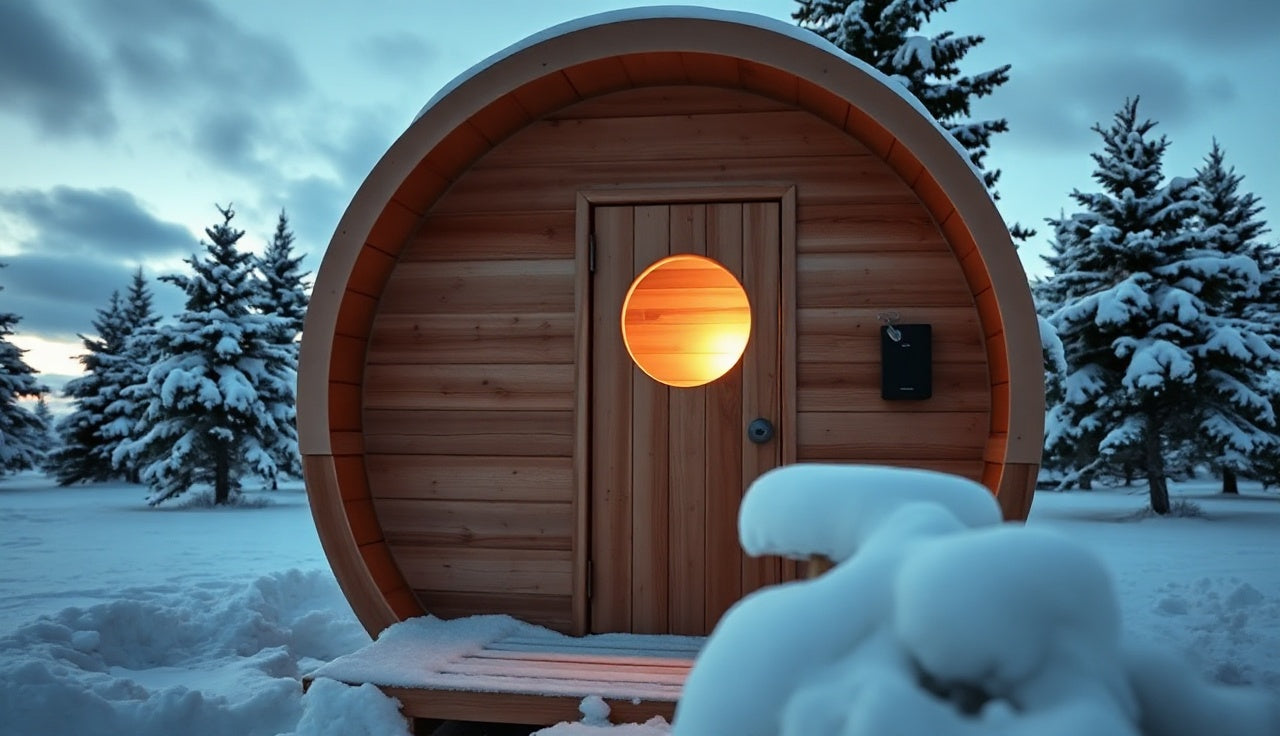
Most 8-person barrel saunas live outdoors on a backyard pad. The round shape sheds rain and snow on its own, and the thermal mass of the staves means the wood shrugs off most weather without much help. Still, a roof addition or porch overhang stretches the barrel's life, especially where UV is harsh or freeze-thaw cycling is constant.
You have three pad options. Gravel with pressure-treated 4x4 skids under the barrel is cheapest, simplest, and drains well. A poured concrete slab works and is permanent. Composite decking tiles on a level surface look sharp, but confirm they can take the point loads of the barrel's runners. The barrel has to sit dead level side to side, or the door won't seal.
Permit rules vary widely by town. As a general rule, structures under 200 square feet without a permanent foundation are exempt from building permits in many jurisdictions. Sauna heaters, particularly electric ones over a certain amperage, often need an electrical permit no matter what the structure requires [6]. Call your local building department before you pour any concrete. Some HOAs restrict outbuildings, and a barrel sauna counts.
Setbacks are another layer. Most residential zoning codes push accessory structures a minimum distance from property lines, usually 5 to 10 feet, and away from the primary house. Your county zoning ordinance is the authoritative source. The International Residential Code sets a baseline that many towns adopt, but local amendments are common [7].
For a closer look at outdoor sauna siting, drainage, and foundation options, start there before you pick a spot.
How hard is it to assemble an 8 person barrel sauna?
Harder than a 4-person, easier than a shed. Most 8-person kits arrive pre-milled: staves shaped, cradle rings cut, hardware included. Two reasonably handy adults finish assembly in 6 to 10 hours across one or two days. The physical challenge is the weight of the assembled stave sections and threading the bands.
The sequence goes like this. Set the cradle rings on the base skids, stack the staves vertically into the rings, tighten the steel or aluminum banding to compress everything together, then install the end walls, door, and heater. Band tension is the make-or-break step. Too loose and you get air gaps between staves. Too tight and you bow the end walls. Most makers include a torque spec or a hand-tightening guide.
People underestimate site prep. Leveling the skids costs you an hour up front, and a barrel that isn't level is a permanent headache. The door gap, the bench fit, and the heater placement all assume a level barrel.
Skip the general contractor for the assembly unless you truly can't do it yourself. You'll pay $500 to $1,500 for labor two friends can knock out on a Sunday. Hire an electrician for the 240V hookup. That part is worth paying for.
How long does an 8 person barrel sauna last?
A well-kept cedar or spruce barrel lasts 15 to 25 years. The staves are the main structural piece, and they're thick enough that surface checking and weathering stays cosmetic for the first decade. The parts that fail first are almost always the door hinges, the heater elements, and the band hardware, and all three are replaceable.
Water pooling inside after a session is the single biggest enemy of barrel longevity. Prop the door open after every use and let the interior dry completely. If you live somewhere with sustained below-freezing weather and you're skipping sessions for weeks, clear any standing water off the floor and leave the door cracked so ice doesn't form between staves.
Exterior wood treatment splits owners. Untreated cedar weathers to a silver-gray that many people like. A UV-blocking exterior oil (tung oil or a dedicated timber oil) keeps the color warmer and slows surface checking, but you reapply every 2 to 3 years. Never put a film-forming sealer like polyurethane on the exterior. It traps moisture under the film and speeds up rot.
The interior should never be sealed or stained. The wood needs to breathe, and you don't want a coating off-gassing in the heat.
What are the health benefits of using an 8 person barrel sauna?
The most cited sauna data comes from Finland's Kuopio Ischemic Heart Disease Risk Factor Study, which tracked more than 2,300 middle-aged men for over 20 years. Men who used a sauna 4 to 7 times per week had a 40% lower risk of all-cause mortality than once-weekly users [8]. The researchers described "a strong inverse relationship between sauna bathing frequency and cardiovascular-related mortality," a line worth quoting straight from the original paper.
The mechanism most researchers point to is heat stress raising heart rate and cardiac output, which mimics moderate aerobic exercise. Core body temperature climbs 0.5 to 1.0 degrees Celsius during a typical 15- to 20-minute session, and that thermal load triggers increased blood flow, sweat, and some hormonal signaling [9].
Nobody has good data on whether the social side of an 8-person sauna adds measurable benefit. The closest research covers social bonding and cortisol reduction, but stretching that to communal sauna use specifically would be a reach. Here's what's fair to say: people use a large barrel sauna more often than a small one because it becomes a social thing, and frequency is exactly what the longevity data correlates with.
A word on limits. Sauna use is contraindicated for people with certain cardiovascular conditions, those who are pregnant, and anyone on medications that impair thermoregulation. The American Heart Association notes that regular sauna use is associated with cardiovascular benefits, but individuals with unstable angina or recent heart attack should consult a physician first [10]. Keep sessions to 15 to 20 minutes, stay hydrated, and get out if you feel dizzy or nauseated.
For a full read on what the research actually shows, the sauna benefits guide goes further.
Should you add a cold plunge or contrast therapy setup?
Contrast therapy, alternating heat and cold, turns a sauna into a full recovery protocol. The logic is simple: heat dilates blood vessels and pushes circulation, cold constricts them. Cycling between the two is thought to drive a stronger vascular response than either alone, though the exact benefit sizes are still being studied [11].
An 8-person barrel is big enough to anchor a serious outdoor contrast space. Set a cold plunge tank or a dedicated cold plunge unit near the door, run 12 to 20 minutes in the sauna, step out and plunge for 1 to 3 minutes, rest 5 to 10 minutes, then repeat. Most protocols run 2 to 3 rounds.
For the cold side, effective plunge temperatures land between 50°F and 59°F (10°C to 15°C) for general recovery. Some athletes and cold-adapted people go lower, but there's no strong evidence colder is meaningfully better for most of us [12]. You don't need a purpose-built unit. A stock tank with a chiller works. A purpose-built unit with filtration and a chiller costs more but is far easier to maintain.
Want to see what a standalone cold session looks like? The ice bath guide covers protocols in detail. For the full case on why contrast beats either modality alone, cold plunge benefits is the place to go.
What separates a good 8 person barrel sauna from a bad one?
The details that decide whether a barrel lasts 20 years or warps and leaks in 5 are mostly invisible in product photos. Here's what to check.
Stave quality: ask for the thickness spec. Anything under 1.5 inches is too thin for an 8-person barrel. Staves should be kiln-dried to under 12% moisture content before assembly, because green wood shrinks and gaps open. Reputable makers state this.
Banding material: stainless steel bands are the standard. Galvanized steel is cheaper and eventually rusts at the hardware points. If the listing doesn't say stainless, assume it isn't.
Door construction: the door is almost always the weakest thermal link. A solid wood door with good weatherstripping beats a thin door with a wide gap. Tempered glass panels look great but lose more heat than solid wood, so accept a slightly longer heat-up if you want the glass.
Heater inclusion: a reputable maker lists the specific heater brand and model number. "Includes sauna heater" with no detail is a red flag. Confirm the heater carries a UL or ETL listing for the US market.
Customer service and warranty: barrel saunas have small parts (bands, hinges, gaskets) that wear out. Buy from a company that actually stocks replacements. A 1-year warranty on a structure you expect to run for 20 years should give you pause.
SweatDecks carries a short list of 8-person barrel saunas from makers that hit the stave thickness, heater quality, and banding specs above. Worth a look once you've narrowed your criteria and want fewer bad options to sort through.
For how barrel saunas stack up against other outdoor builds, the outdoor sauna guide runs the full comparison.
How does an 8 person barrel sauna compare to other sauna types?
The barrel shape has real engineering edges over a rectangular box. The curved walls spread structural stress evenly without framing, so you skip interior studs and get a cleaner, more open feel inside. The curve also steers heat and steam toward the center where bathers sit, which gives more even heat than a flat-ceiling room where heat pools at the top.
Against a traditional rectangular home sauna, a barrel of the same capacity costs less because the structure is simpler and needs no foundation or framed walls. The tradeoff: a round barrel offers less usable floor and bench area per cubic foot than a rectangular room.
Against an outdoor sauna cabin (a fully framed exterior structure with insulation and a real roof), a barrel installs faster and moves easier if you sell the house. A cabin holds heat longer once hot, thanks to full insulation, and can go bigger. But a good 2-inch stave barrel holds temperature well and costs a lot less than a custom cabin.
The sauna vs steam room comparison is worth reading if you're choosing between dry heat and wet heat outright. For outdoor, year-round family or group use, the barrel is hard to beat on cost, durability, and ease of setup.
Frequently asked questions
What is the interior height of an 8 person barrel sauna?
At the crown of the barrel (the highest interior point), an 8-person model with a 6- to 7-foot diameter typically offers 5'10" to 6'2" of headroom. The effective headroom where you actually sit, roughly 18 inches inward from the barrel wall, is lower. Most adults can stand upright in the center of a properly sized 8-person barrel.
How long does it take to heat an 8 person barrel sauna?
With an 8 to 9 kW electric heater, an 8-person barrel reaches 160°F to 180°F in 45 to 60 minutes depending on outdoor temperature and stave thickness. In cold weather (below 20°F), add 15 to 20 minutes. A wood-burning stove typically takes 60 to 90 minutes to reach the same temperature but produces a drier heat that many users prefer.
Can you leave an 8 person barrel sauna outside year-round?
Yes. Cedar and Nordic spruce barrel saunas are built to handle outdoor exposure, including snow loads and freeze-thaw cycles. The main winter maintenance step is keeping water from pooling inside between uses. Prop the door slightly open after each session so the interior dries fully. A roof extension or canopy adds years of life in heavy-snow climates.
Do you need a permit to install an 8 person barrel sauna?
Usually yes for the electrical work, and sometimes for the structure itself. Most jurisdictions require a permit for any 240V electrical installation. Structure permits depend on size, location, and whether you pour a permanent foundation. Call your local building department and ask specifically about an outdoor sauna with a 240V electric heater. Permit requirements vary significantly by municipality.
What is the difference between a 5 person and an 8 person barrel sauna?
A 5-person barrel typically runs 7 to 8 feet long with a 5- to 6-foot diameter. An 8-person barrel runs 10 to 14 feet long with a 6- to 7-foot diameter. Beyond seating capacity, the larger barrel has meaningfully taller headroom and needs a larger heater (8 to 9 kW versus 5 to 6 kW). The 8-person unit also needs a bigger pad and a dedicated 50-amp circuit.
How much electricity does an 8 person barrel sauna use?
An 8 or 9 kW heater running for one hour draws 8 to 9 kWh. At the US average residential rate of about $0.16 per kWh (EIA, 2024), a one-hour session costs roughly $1.30 to $1.45 in electricity. Once the sauna reaches temperature, the heater cycles on and off, so real consumption per session is typically 6 to 8 kWh total rather than the full rated draw the whole time.
How many people can realistically fit in an 8 person barrel sauna?
Comfortably, 4 to 6 people. Eight is the rated maximum based on linear bench inches, but that assumes everyone sits upright with no elbow room. For a relaxed group, plan for 4 to 6. If you regularly host groups larger than 6, look for 8-person models with a porch extension or a double-bench configuration that adds a lower bench for extra seating.
Is a wood-burning stove or an electric heater better for a barrel sauna?
Both work well. Electric heaters are more convenient: push a button, heat in under an hour, no fuel required. Wood-burning stoves produce a drier, more traditional heat and don't need power run to a remote location. The tradeoff is a 60- to 90-minute heat-up time, a need for dry wood storage nearby, and local fire-code compliance for the chimney installation.
What foundation or base do you need for an 8 person barrel sauna?
Three options work: pressure-treated 4x4 or 6x6 skids on a gravel bed, a poured concrete slab, or a deck surface rated for the weight (typically 900 to 1,200 lbs assembled). Gravel with skids is most common because it handles drainage naturally and needs no permit in most areas. Whatever you choose, the surface must be dead level side to side, or the door won't seal and the bands will load unevenly.
How do you maintain an 8 person barrel sauna?
After each use, prop the door open to dry the interior fully. Wipe the benches with a damp cloth if sweat has pooled. Every 2 to 3 years, apply a UV-resistant timber oil to the exterior. Inspect the steel bands annually for rust or loosening and re-tighten as needed. Replace the heater's sauna stones every 2 to 3 years, since they fracture over time and lose their heat-holding ability. Interior wood should never be sealed or stained.
Can you put a barrel sauna on a deck?
Yes, if the deck is rated for the load. An 8-person barrel assembled and full of bathers can weigh 1,000 to 1,400 lbs. Most residential decks are built to a 40 lbs-per-square-foot live load, which can handle this spread over the barrel's footprint, but check with a structural engineer or your deck builder before assuming it's fine. Point loads from the barrel's cradle runners concentrate weight in specific spots.
What brands make 8 person barrel saunas?
Well-known brands in the US market include Dundalk LeisureCraft (Canadian maker, cedar focus), Almost Heaven Saunas, and Finnleo. European brands like Harvia and Tylö are more common in commercial settings but sell residential units too. When comparing brands, prioritize stave thickness specification, heater brand and model inclusion, stainless hardware confirmation, and whether replacement parts are stocked domestically.
Is an 8 person barrel sauna worth the cost over a smaller model?
If you regularly use the sauna with 4 or more people, yes. The cost difference between a 5-person and an 8-person barrel is typically $2,000 to $3,500, and the larger unit also has taller headroom and a more comfortable feel even for two or three people. If you're a solo user or a couple, the 5-person size is almost always the better value. Group use is where the 8-person footprint earns its price.
Sources
- Harvia Plc, product specifications for Harvia electric sauna heaters: Finnish heater brands like Harvia are designed for 15- to 20-year service life with proper maintenance; heater warranty and product specs available from manufacturer.
- USDA Forest Service, Wood Handbook: Wood as an Engineering Material (General Technical Report FPL-GTR-282): Western red cedar classified among most durable softwoods for exterior applications due to natural decay resistance.
- Finnleo / TylöHelo, sauna heater sizing guide: Standard sauna heater sizing formula is approximately 1 kW per 50 cubic feet of interior sauna space.
- National Electrical Code (NFPA 70), Article 424: Fixed Electric Space-Heating Equipment: Electric sauna heaters drawing 30-40 amps require a dedicated 240V circuit with appropriately rated breaker per NEC requirements.
- National Fire Protection Association, NFPA 211: Standard for Chimneys, Fireplaces, Vents, and Solid Fuel-Burning Appliances: NFPA 211 requires chimney height of at least 3 feet above the highest point within 10 feet for solid-fuel appliances.
- International Code Council, International Residential Code (IRC) Section R105, Permits: Electrical installations including 240V sauna heater circuits typically require permits under the IRC framework adopted by most municipalities.
- International Code Council, International Residential Code (IRC) Section R302, Fire-Resistant Construction and Setbacks: IRC establishes baseline setback requirements for accessory structures; local amendments govern specific minimum distances from property lines.
- JAMA Internal Medicine, Laukkanen et al., 'Association Between Sauna Bathing and Fatal Cardiovascular and All-Cause Mortality Events,' 2015: Men using sauna 4-7 times per week had 40% lower all-cause mortality vs once-weekly users; study found 'a strong inverse relationship between sauna bathing frequency and cardiovascular-related mortality.'
- Mayo Clinic Proceedings, Laukkanen et al., 'Cardiovascular and Other Health Benefits of Sauna Bathing: A Review of the Evidence,' 2018: Core body temperature rises 0.5 to 1.0 degrees Celsius during a typical 15- to 20-minute sauna session, triggering increased cardiac output similar to moderate aerobic exercise.
- American Heart Association, Council on Clinical Cardiology statements on sauna and cardiovascular health: Individuals with unstable angina or recent heart attack should consult a physician before sauna use; regular sauna use associated with cardiovascular benefits in healthy adults.
- Journal of Science and Medicine in Sport, Mooventhan & Nivethitha, 'Scientific Evidence-Based Effects of Hydrotherapy on Various Systems of the Body,' 2014: Contrast water therapy (alternating heat and cold) associated with improved vascular response and recovery markers, though benefit magnitudes vs single modality remain under study.
- International Journal of Sports Physiology and Performance, Bleakley et al., 'Cold-Water Immersion and Recovery from Strenuous Exercise,' 2012: Cold water immersion temperatures between 10°C and 15°C (50°F to 59°F) used in recovery research; no strong evidence colder temperatures produce meaningfully superior outcomes for general recovery.
- U.S. Energy Information Administration, Electric Power Monthly, Average Retail Price of Electricity (residential, 2024): US average residential electricity rate approximately $0.16 per kWh as of 2024 data.

Share:
Dundalk LeisureCraft Tranquility barrel sauna: full review and buyer's guide
Dundalk LeisureCraft Tranquility barrel sauna: full review and buyer's guide