
Last updated 2026-07-10
TL;DR
Aluminum foil vapor barriers reflect radiant heat back into the room and block moisture from reaching the wall cavity. Plastic sheeting (polyethylene) blocks moisture too, but it softens and can off-gas above 140°F. In a traditional sauna running 160 to 200°F, foil is the right choice. Plastic sheeting is built for crawl spaces and framed walls at room temperature.
What is a sauna vapor barrier and why does a sauna need one?
A sauna vapor barrier is a membrane installed on the hot side of the wall, between the interior paneling and the insulation. Its job is to stop humid, hot air from pushing into the wall cavity, where it would condense on the cooler back of the insulation, soak the framing, and grow mold over time.
Saunas make a lot of moisture. Even a dry Finnish sauna throws off bursts of steam when water hits the rocks, and cabin humidity routinely climbs to 10 or 20 percent. A steam room sits at 95 to 100 percent relative humidity. Either way, if that moisture finds a path into your wall structure, you have a building problem that only gets worse.
A sauna vapor barrier does two things it never has to do in a normal bathroom or crawl space. It blocks moisture, and it holds up under sustained high heat. That second job is where plastic sheeting comes apart.
For the wider picture on sauna construction basics, see our guide to home sauna builds.
What is sauna foil vapor barrier made of?
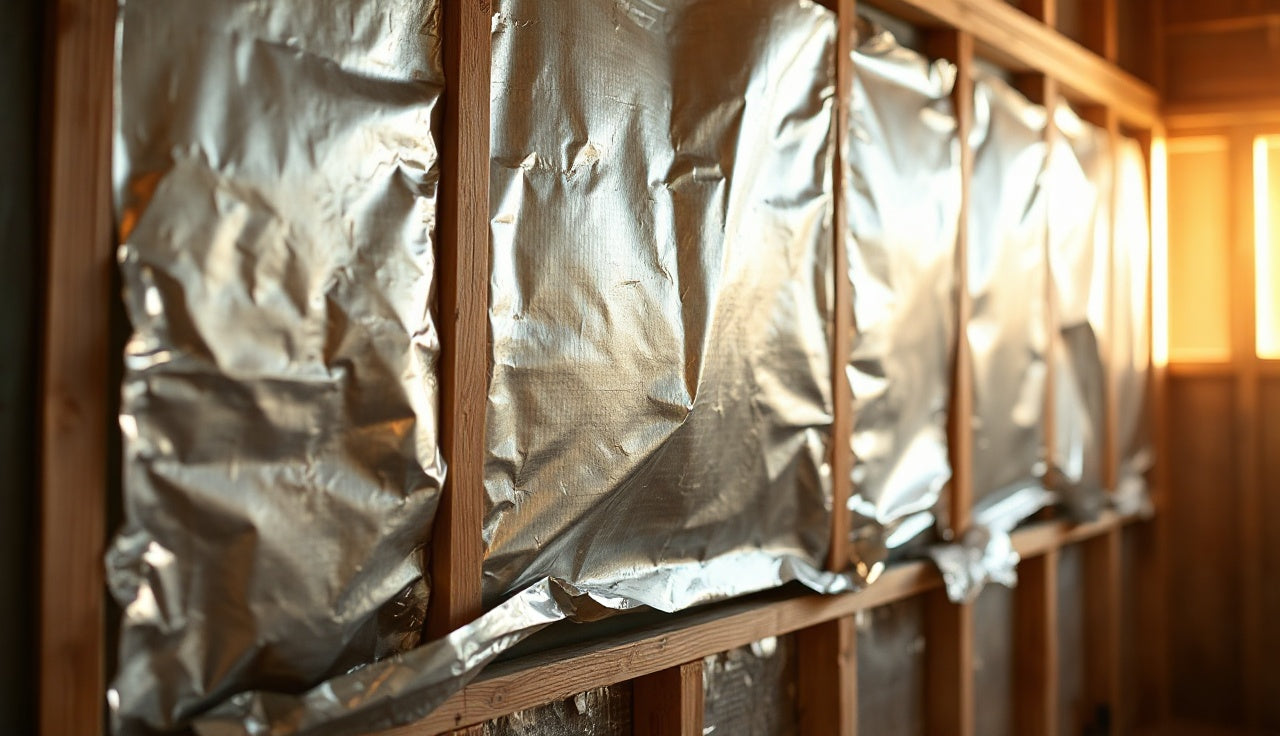
Sauna foil vapor barriers are an aluminum foil laminate. Sometimes it's plain foil bonded to a kraft paper backing, sometimes it's a reinforced version with a woven scrim sandwiched between two foil layers. The product most North American sauna builds reference is aluminum foil/kraft paper laminate, the same class of material used behind radiant barriers in attics.
Two properties carry the whole job: thermal stability and permeability. Aluminum foil has a perm rating near zero, so it's essentially impermeable to water vapor [1]. It also tolerates temperatures well above 200°F without softening, melting, or releasing anything into the air. That last point matters in a small room you're breathing hard inside of.
Some makers sell a double-sided foil product with air-bubble wrap in the middle, marketed as an insulating vapor barrier. In a sauna, the insulating value of that thin air layer is close to nothing. The foil is what you're paying for. Buy single-layer foil/kraft laminate and put the saved money into real insulation behind it.
Roll widths are usually 48 or 60 inches, and prices run roughly $0.15 to $0.35 per square foot, though that swings with supplier and roll size [2].
What is plastic sheeting and what is it actually designed for?
Plastic sheeting in construction almost always means polyethylene film. It's the same material used in crawl space encapsulation, under concrete slabs, and as a temporary weatherization layer on framed walls before cladding goes up. The International Residential Code references 6-mil polyethylene for below-grade vapor retarder applications [3].
Polyethylene's perm rating depends on thickness. At 6 mil it runs about 0.06 perms, which makes it a Class I vapor retarder under the building science definition [4]. That's actually a lower perm rating than some foil products, so in pure vapor-blocking terms, thick poly does the job.
Heat is the problem. Standard low-density polyethylene softens around 221°F and has a practical continuous-use ceiling near 140 to 176°F before it loses strength and starts to off-gas [5]. A sauna ceiling hits 185 to 200°F during normal use. The poly goes soft, sags, pulls away from seams, and your vapor barrier opens up right where you can't see it. That defeats the whole point of installing one.
| Max safe temp: Aluminum foil laminate (°F) | 400 |
| Max safe temp: 6-mil polyethylene (°F) | 158 |
| Radiant reflectance: Aluminum foil (%) | 95 |
| Radiant reflectance: 6-mil polyethylene (%) | 5 |
Source: U.S. DOE Energy Saver, NIST, Building Science Corporation (citations 1, 4, 5)
How do foil and plastic sheeting compare on the properties that matter in a sauna?
Here's a direct comparison of what actually matters for a sauna wall assembly:
| Property | Aluminum foil / kraft laminate | 6-mil polyethylene sheeting |
|---|---|---|
| Perm rating | ~0.0 to 0.05 perms | ~0.06 perms |
| Safe operating temp | 400°F+ (foil layer) | ~140 to 176°F continuous |
| Radiant heat reflectance | 90 to 97% (aluminum surface) | Near zero |
| Off-gas risk at sauna temps | None from foil; check adhesives | Yes, some formulations |
| Tear resistance | Moderate (scrim versions: high) | Moderate to high |
| Seam taping compatibility | Aluminum HVAC tape, foil tape | PE tape, but tape fails at heat |
| Typical cost per sq ft | $0.15 to $0.35 | $0.03 to $0.10 |
| Correct application | Sauna, radiant barrier, HVAC | Crawl space, below-slab, framing |
The cost gap is real but tiny in context. A 6x8 sauna interior has roughly 300 to 350 square feet of wall and ceiling. Going from poly to foil adds maybe $30 to $80 total. That's noise next to the bill for reframing a rotted wall.
The radiant reflectance row earns its own note. Aluminum reflects 90 to 97 percent of radiant heat back toward the room [6]. So the foil doesn't just block moisture, it helps the cabin heat faster and hold temperature. Poly does none of that. You'd be choosing a material that costs a little less, can't take the heat, and drags on efficiency. Bad trade in every direction.
Does plastic sheeting ever work in a sauna?
Sometimes, yes. Plenty of people run 6-mil poly in saunas and get years out of it, mostly in lower-heat infrared cabins where wall temperatures stay under 140°F. Infrared panels heat the body directly instead of heating the air, so air temperature usually sits at 120 to 140°F versus 160 to 200°F in a traditional Finnish sauna [7].
So the honest answer: in a low-temperature infrared build, poly might survive long-term. In a traditional Finnish or wood-fired sauna, you're gambling. The ceiling runs hottest, and that's exactly where you want the vapor barrier to be dead reliable.
Nobody has strong long-term data comparing barrier degradation inside home saunas specifically. The closest evidence comes from building science research on vapor retarder performance in hot assemblies and from HVAC duct liner studies. That work consistently shows polyethylene held above 140°F loses tensile strength and can develop pinhole failures over time [9].
If you already installed poly and your sauna is infrared, watch the seams. If you're building new, use foil. The price difference doesn't come close to justifying the risk.
What about foil-faced insulation, is that different from a vapor barrier?
Foil-faced rigid foam (like foil-faced polyisocyanurate, or poly-iso) is a different product from a stand-alone vapor barrier, though it does retard vapor. Poly-iso boards carry a foil facer on one or both sides, and that facer has a perm rating close to aluminum foil laminate.
In some builds, people put foil-faced rigid foam on the interior face of the studs, run wiring behind it, and finish with wood paneling. That combines insulation and vapor barrier in one layer, and it can work well. The foil face handles vapor, the foam handles thermal resistance.
There's a catch. Rigid foam usually has to be covered by a thermal barrier (typically drywall) under most residential fire codes, which fights the sauna goal of wood paneling instead of drywall [3]. Check your local jurisdiction. Some allow wood paneling as the thermal barrier if it's thick enough.
For most home saunas, the simpler and more code-friendly path is fiberglass batt in the stud bays, a continuous foil/kraft laminate on the interior face, then wood paneling over that. It's the method described across Scandinavian sauna construction literature and used by most professional sauna builders in North America.
How do you install foil vapor barrier in a sauna correctly?
Installation matters nearly as much as the material. A foil barrier with gaps at seams and penetrations fails at exactly those gaps.
Start at the ceiling. Run the foil horizontally with at least a 6-inch overlap at seams, and tape every seam with aluminum foil tape, the kind sold for HVAC ductwork. Skip standard contractor's tape and plastic-backed tape. They won't hold at sauna temperatures. 3M and Nashua both make HVAC foil tape rated for sustained temperatures well above 200°F.
Bring the ceiling foil down and lap it onto the wall foil by at least 3 to 4 inches, then seal that junction. At every penetration, including electrical boxes and heater wiring, cut the foil as small as possible and seal the edges. Penetrations are where moisture slips into the wall most easily.
Around the door frame, wrap the foil into the rough opening and lap it over the framing. This is the spot DIY builds miss most often.
Once the foil is up, install horizontal furring strips over it. The strips create a small air gap and give you a nailing surface for the paneling. That gap also lets any incidental condensation on the back of the paneling drain down instead of sitting against the foil.
Building an outdoor sauna raises the stakes. The temperature difference between inside and outside is larger, which drives moisture through the wall harder, so the barrier has to be tight.
What tape should you use to seal sauna foil barrier seams?
This is where a lot of builds fail quietly. The foil goes up correctly, the seams get taped with whatever was on the shelf, and within a year or two the tape lets go, the seams open, and moisture works into the wall.
The right tape is aluminum foil tape with an acrylic or high-temperature adhesive, rated for continuous service at 200°F or above. Look for UL 723 listed products, or products explicitly rated for HVAC duct sealing. Nashua 324A, 3M 3311, and similar industrial foil tapes fit. They run $10 to $20 a roll, which covers a lot of seams.
Don't use duct tape (the cloth-backed kind), painter's tape, vapor barrier tape rated only to 140°F, or any tape with a rubber adhesive. Rubber adhesives quit around 150°F and leave a mess behind.
For steam rooms at essentially 100 percent humidity, some builders also run a thin bead of high-temp silicone at critical junctions before taping. That's probably overkill for a dry sauna, but it's cheap insurance in a steam room. Our sauna vs steam room guide covers how steam room construction differs.
Does the vapor barrier go on the ceiling or walls first?
Ceiling first, always. The reason is simple. The ceiling barrier has to lap down over the wall barrier at the junction. Do the walls first and you'd lap in the wrong direction, creating a seam that channels water down behind the barrier instead of in front of it.
Think of it like shingling a roof. You start at the eaves and work up so each upper course overlaps the one below. Moisture runs down. Your overlaps face the same way.
So: install ceiling foil, bring it down past the ceiling-wall junction by 4 to 6 inches, and tape it to the top plate. Then start the wall foil at the top, overlapping the ceiling foil by at least 3 to 4 inches, and tape that seam. Work down from there. The bottom of the wall foil can end at floor level or tuck behind the base trim.
What does building code say about vapor barriers in sauna rooms?
The IRC has no sauna-specific vapor barrier section, which is part of why there's so much DIY confusion. Saunas fall under general wall assembly rules, and vapor retarder requirements shift by climate zone [3].
In Climate Zones 5 through 8 (most of Canada and the northern US), the IRC requires a Class II or better vapor retarder on the warm-in-winter side of walls in conditioned spaces. Aluminum foil qualifies as Class I, the strictest tier. Southern zones are looser, but that doesn't help you inside a sauna, where you're creating an extreme heat-and-moisture environment no matter what the outdoor climate does.
Most building scientists give the same practical advice: treat any sauna, anywhere in the country, as a high-moisture zone and install a Class I vapor retarder on every interior surface. The Building Science Corporation has written extensively about hot, humid assembly failures and the role of vapor retarders, and those principles apply straight to sauna walls [4].
For electrical work, the National Electrical Code (NFPA 70), Articles 424 and 680, covers heater installation and wiring methods, and your vapor barrier affects how you handle wiring penetrations [8]. Check with your local AHJ (authority having jurisdiction) before you close up the walls.
What's the best vapor barrier for a home sauna build overall?
For a traditional Finnish-style or wood-fired sauna, aluminum foil/kraft laminate is the right product. Buy a reinforced scrim version if the budget allows, since it takes stapling and handling without tearing as easily. Seal every seam with high-temperature foil tape.
For an infrared sauna under 140°F wall temperature, you could argue heavy poly (8 mil) is acceptable, but foil is still the better pick because it reflects heat and costs only a little more.
For a steam room at 100 percent humidity, some builders go further and run cement board on the walls with a tile finish, cutting organic materials out of the hot-side assembly entirely. The vapor barrier then becomes a waterproof membrane behind the tile, like a sheet-applied waterproofing system. That's a different build for a different article.
The brands experienced sauna builders reference most in North American forums include Pactiv's foil/kraft products and various HVAC foil laminates. SweatDecks carries sauna-specific materials and can point you toward sourcing if you're mid-build and unsure what you're holding.
Whatever you buy, the brand matters less than the spec: aluminum foil laminate, near-zero perm rating, rated for continuous service above 200°F. If the product's spec sheet won't confirm those three things, keep it off the hot side of your sauna wall.
Does the vapor barrier affect sauna heat-up time or efficiency?
Yes, and by a real margin. The mechanism is radiant reflectance. Aluminum foil at sauna temperatures reflects 90 to 97 percent of incident infrared radiation back toward the room [6]. Wood paneling, insulation batts, and poly film absorb most of that radiation instead.
Here's what that buys you. The foil cuts how much heat the wall assembly soaks up during the heat-up cycle. Less heat lost to the walls means more heat left to raise the air and the rocks. Most sauna builders report heat-up times roughly 10 to 20 percent shorter with foil than with no barrier or a non-reflective one, though controlled data on sauna heat-up time specifically is thin.
Over years, that adds up on the power bill. A sauna that reaches temperature 15 minutes sooner every session, four sessions a week, saves a meaningful chunk of electricity across the heater's life. The foil barrier can pay for itself in energy savings alone, before you even count the moisture protection.
For the full performance picture of owning a sauna, our sauna benefits article covers the research on heat exposure and recovery.
Frequently asked questions
Can I use regular plastic sheeting as a sauna vapor barrier?
You shouldn't in a traditional sauna. Standard 6-mil polyethylene softens around 140 to 176°F and can sag, shrink at seams, and develop pinhole gaps at sustained sauna temperatures of 160 to 200°F. In a low-temperature infrared sauna it may survive, but foil laminate handles the heat reliably and reflects radiant energy back into the room, making it the better choice in every scenario.
What perm rating do I need for a sauna vapor barrier?
The IRC defines a Class I vapor retarder as 0.1 perms or less. Aluminum foil laminate typically measures near 0.0 to 0.05 perms, which qualifies as Class I. That's what you want on the hot side of a sauna wall. Thick poly (6 mil) comes in around 0.06 perms, also Class I, but it can't take sauna temperatures reliably.
Does a vapor barrier go on the inside or outside of sauna insulation?
Always on the interior side, between the insulation and the wood paneling. The barrier sits on the warm, humid side of the wall so it stops moisture before it migrates into the cooler insulation and framing. Install it on the outside (cold side) and you trap moisture inside the insulation, which causes rot and mold.
What tape should I use to seal foil vapor barrier seams in a sauna?
Use aluminum foil HVAC tape rated for continuous service at 200°F or above. Products like Nashua 324A or 3M 3311 are common picks. Standard duct tape (cloth-backed), painter's tape, and low-temperature vapor barrier tape all fail at sauna temperatures. Sealing the seams properly matters as much as the barrier material itself.
Do infrared saunas need a foil vapor barrier too?
Infrared saunas run cooler than traditional ones, with air temperatures usually 120 to 140°F rather than 160 to 200°F. At those levels, heavy poly (8 mil) is less likely to degrade. Even so, foil laminate works better because it reflects infrared energy back toward the panels and room surfaces, and it shrugs off any heat spikes without risk.
Can I use foil-faced bubble wrap as a sauna vapor barrier?
The foil layer works as a vapor barrier, but the bubble wrap core (polyethylene) can soften at high temperatures, and the product's R-value is minimal, usually R-1 or less. If you only want the foil facing, a standard foil/kraft laminate is cheaper, more reliable, and simpler to install. The 'insulating' claim on bubble foil products is mostly marketing.
How much does sauna foil vapor barrier cost compared to plastic sheeting?
Aluminum foil/kraft laminate runs roughly $0.15 to $0.35 per square foot depending on supplier and roll size. Standard 6-mil polyethylene runs $0.03 to $0.10 per square foot. For a typical 6x8 sauna with 300 to 350 square feet of wall and ceiling, the difference is about $30 to $80 total. Not meaningful savings against the risk.
Does foil vapor barrier actually help a sauna heat up faster?
Yes. Aluminum foil reflects 90 to 97 percent of radiant heat back into the room instead of letting the wall assembly absorb it. That cuts the heat lost to the walls during heat-up. Most builders report noticeably shorter warm-up times with foil versus no barrier or a non-reflective one, though precise comparative studies on home saunas specifically are limited.
What happens if you skip the vapor barrier in a sauna entirely?
Without a vapor barrier, humid air migrates through the paneling into the wall cavity and condenses on the cooler back of the insulation and framing. Over time that saturates the framing, feeds mold and rot, and can compromise the wall structure. In a high-use sauna, the damage can show up within a few years. A vapor barrier is not optional.
Is foil vapor barrier required by building code in a sauna?
The IRC has no sauna-specific section, but general vapor retarder rules apply. In Climate Zones 5 through 8, the IRC requires a Class I or II vapor retarder on the warm-in-winter side of wall assemblies. Building scientists broadly recommend treating any sauna as a high-moisture zone that calls for a Class I retarder, regardless of climate zone or code language.
Can I use foil vapor barrier in a steam room too?
You can, but steam rooms at 100 percent relative humidity usually call for a more water-resistant wall system, typically cement board with a sheet-applied waterproof membrane behind tile. Foil laminate is vapor-impermeable but not fully waterproof where liquid water pools. For a dry or low-steam sauna, foil works great. For a dedicated steam room, ask a tile contractor about proper wet-area waterproofing.
Where exactly does the foil vapor barrier go relative to the paneling and studs?
Insulation fills the stud bays. The foil vapor barrier goes on the interior face of the studs, over the insulation, forming a continuous membrane. Then horizontal furring strips (1x2 or 1x3) go over the foil to create a small air gap and a nailing surface. Wood paneling attaches to the furring strips. The foil never touches the paneling directly.
Does the type of insulation behind the foil matter?
Fiberglass batt is the most common choice and works well behind foil in a sauna. It doesn't hold moisture permanently and keeps its R-value when dry. Cellulose and open-cell spray foam can absorb and hold moisture if the barrier is ever breached, which makes them riskier. Closed-cell spray foam works well but costs more and has its own vapor retarder properties.
Sources
- U.S. Department of Energy, Energy Saver: Radiant Barriers: Aluminum foil has a perm rating near zero and reflects 90 to 97 percent of radiant heat, making it an effective radiant barrier and vapor retarder.
- RSMeans Construction Cost Data (general materials pricing reference): Aluminum foil/kraft laminate vapor barrier typically costs $0.15 to $0.35 per square foot; 6-mil polyethylene sheeting runs $0.03 to $0.10 per square foot.
- International Residential Code (IRC), International Code Council: IRC references 6-mil polyethylene for below-grade vapor retarder applications and requires Class I or II vapor retarders on the warm-in-winter side of walls in Climate Zones 5 through 8.
- Building Science Corporation, BSI-001: The Perfect Wall: At 6 mil thickness, polyethylene has a perm rating of approximately 0.06 perms, qualifying as a Class I vapor retarder per building science definitions.
- U.S. National Institute of Standards and Technology (NIST): Low-density polyethylene (LDPE) begins to soften around 221°F and has a practical continuous-use ceiling of approximately 140 to 176°F before losing structural integrity.
- Oak Ridge National Laboratory, Building Envelope Research: Aluminum foil surfaces reflect 90 to 97 percent of incident infrared radiation, significantly reducing heat absorption into wall assemblies.
- Hannuksela M, Ellahham S, American Journal of Medicine 2001: Benefits and Risks of Sauna Bathing: Infrared sauna panels heat the body directly rather than the air; infrared sauna air temperatures are typically 120 to 140°F versus 160 to 200°F in traditional Finnish saunas.
- National Fire Protection Association, NFPA 70: National Electrical Code (NEC): NEC Article 424 and Article 680 contain requirements for heater installation, wiring methods, and penetrations relevant to sauna room electrical work.
- U.S. Department of Energy, Office of Scientific and Technical Information (OSTI): Polyethylene vapor barriers exposed to sustained temperatures above 140°F lose tensile strength and can develop pinhole failures over time.
- U.S. DOE Office of Energy Efficiency and Renewable Energy, Insulation Materials: Fiberglass batt insulation does not permanently absorb moisture and holds its R-value when dry, making it suitable for sauna wall assemblies behind foil vapor barriers.

Share:
Lifetime sauna temperature: what ranges are safe and effective
HoMedics premium portable sauna: honest review and buying guide