
Last updated 2026-07-09
TL;DR
A contrast therapy tub alternates hot water (around 100-104°F) and cold water (50-59°F) to drive repeated cycles of vasodilation and vasoconstriction. Research suggests benefits for muscle soreness and perceived recovery, though the evidence is moderate. Purpose-built units start around $3,000; DIY setups cost far less. Most people do 3-5 rounds of 1-3 minutes hot, 1-2 minutes cold.
What is a contrast therapy tub?
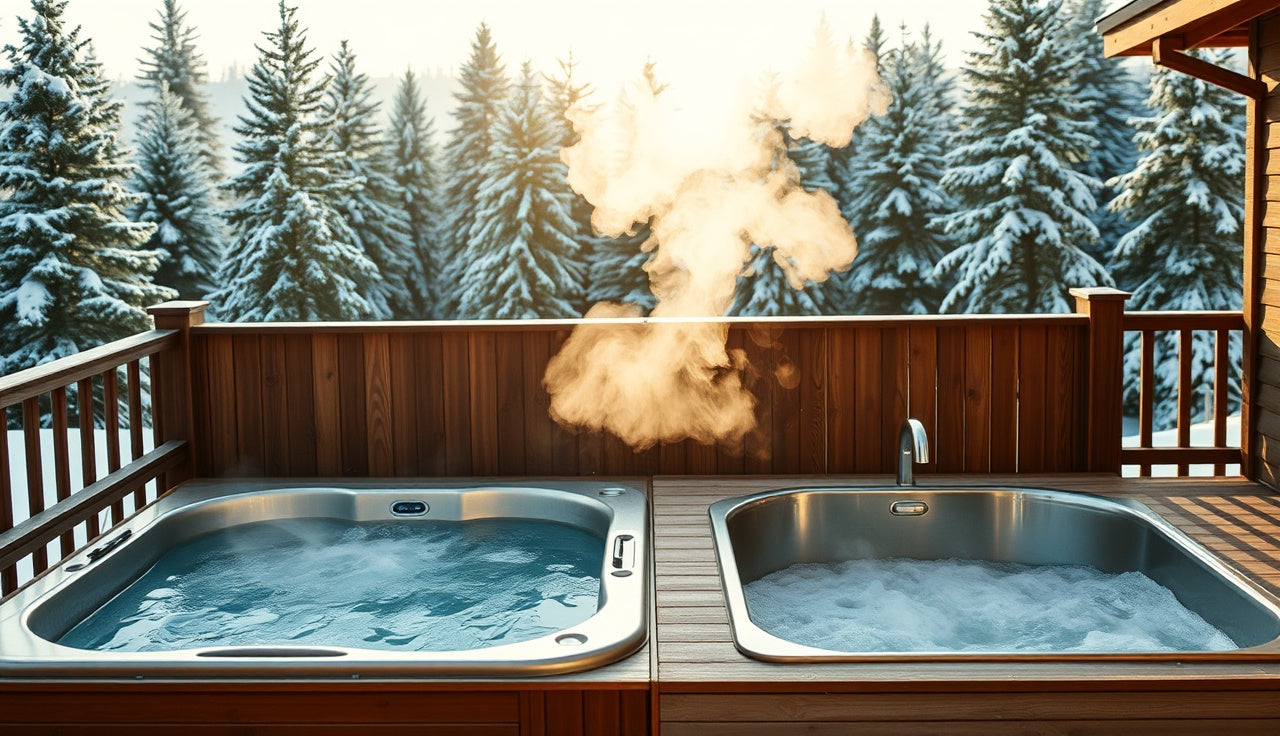
A contrast therapy tub is any water-based setup that lets you move between hot and cold water on purpose, over and over. The "tub" part is loose. The term covers purpose-built dual-chamber units, single tubs with a chiller and heater that cycle temperatures, or the simple pairing of a hot tub with a separate cold plunge or ice bath.
The core idea is thermal contrast. You expose your body to heat, which dilates blood vessels and increases circulation. Then you hit cold, which constricts them. Do that several times in a row and you create what some researchers call a "pumping" effect on blood and lymphatic fluid. Whether that pump produces meaningful clinical outcomes is worth examining carefully (more on that below).
Contrast therapy has been around a very long time. Scandinavian sauna culture, with the tradition of jumping into cold water or snow after a hot session, is probably the most well-known version. Sports medicine adopted a more formalized protocol in the 1980s and 1990s, and today you'll find contrast water therapy (CWT) in professional sports recovery rooms, physical therapy clinics, and increasingly in home gyms.
The "tub" framing separates water immersion from other contrast methods like hot and cold packs or contrast showers. Full-body or limb immersion creates more uniform temperature exposure and is the format most clinical studies actually test [1].
How does contrast therapy actually work in the body?
The explanation starts with the autonomic nervous system. Heat activates the parasympathetic branch and causes peripheral vasodilation: blood vessels near the skin surface open up, heart rate rises slightly, and blood moves toward the skin to shed heat. Cold triggers the opposite. The sympathetic branch fires, vessels constrict, and blood is pushed back toward the core.
Cycle that response three to five times in a session and you produce repeated swings in peripheral blood flow. The hypothesis is that this acts like a mechanical pump, clearing metabolic byproducts like lactate and inflammatory cytokines from muscle tissue faster than passive rest [1][2].
There is a clear neurological component too. Cold water immersion drops nerve conduction velocity and the perception of pain [2]. That analgesic effect is probably one reason athletes report feeling better after contrast therapy even when objective markers of inflammation barely move.
Core body temperature is another variable. A well-built protocol keeps core temperature from swinging too far in either direction. The hot phase raises it slightly; the cold phase pulls it back. Because the cold exposure in most contrast protocols is shorter than the hot phase, net core temperature tends to stay close to baseline, which is safer than long cold immersion alone.
One thing the research consistently shows: the psychological effect is real. Ratings of perceived exertion and muscle soreness drop after contrast water therapy even in blinded or sham-controlled conditions, though sham conditions are notoriously hard to design for water temperature studies [3]. That is not dismissing the benefit. Perceived recovery matters. An athlete who feels better trains harder. The mechanism just may be partly mental.
What does the research say about contrast therapy benefits?
Here is the honest summary. The evidence is moderate, most studies are small, and the effect sizes for objective markers are real but modest.
A 2017 meta-analysis in the Journal of Strength and Conditioning Research pooled data from 22 studies and found that contrast water therapy reduced delayed-onset muscle soreness (DOMS) and improved perceived recovery compared to passive rest, with small to moderate effect sizes [3]. Cold water immersion alone showed similar or slightly stronger effects on DOMS, while contrast therapy had an edge on perceived fatigue.
A 2022 systematic review in Sports Medicine looked at recovery modalities for team sport athletes and found "contrast water therapy resulted in a small reduction in muscle damage markers (CK, LDH) and perceived soreness at 24 and 48 hours post-exercise" compared to passive rest [4]. The same review noted that effect sizes versus active recovery were less consistent.
For cardiovascular or metabolic outcomes, the data is thinner. Some small studies suggest repeated contrast sessions may modestly lower resting blood pressure and improve heart rate variability, but nobody should use a contrast therapy tub as a treatment for hypertension. CDC guidance on recreational and therapeutic water use treats water-based thermal therapies as complementary recovery tools, not replacements for medical care [5].
Where the research is genuinely thin: long-term structural adaptations, immune function, sleep quality, and any head-to-head between purpose-built contrast tubs and simply alternating a hot tub with a cold plunge. Those studies either do not exist or involve too few subjects to draw firm conclusions. The closest proxy comes from sauna benefits research, which has much stronger cardiovascular outcome data.
Bottom line: if you train hard and recovery time matters, the evidence supports contrast water therapy as a useful tool. If you are hoping it cures inflammation-related disease or produces dramatic body composition changes, the data does not support that.
| Contrast water therapy | 0.55 |
| Cold water immersion | 0.58 |
| Active recovery | 0.28 |
| Compression garments | 0.31 |
| Passive rest (control) | 0.0 |
Source: Journal of Strength and Conditioning Research meta-analysis, 2017 [3]
What temperature should a contrast therapy tub be set to?
The most commonly tested and recommended protocol uses hot water between 100°F and 104°F (38°C to 40°C) and cold water between 50°F and 59°F (10°C to 15°C) [1][3].
Hot side: 104°F is roughly the ceiling most practitioners use. Going higher increases cardiovascular stress and the risk of overheating, especially for people with any heart condition. Most people find 100-102°F comfortable for the 2-3 minute immersion windows typical of contrast protocols. A traditional hot tub sits at 100-104°F, which is why pairing one with a cold plunge is such a natural contrast setup.
Cold side: 50-59°F is where you get a strong vasoconstriction response without dangerous cold shock. Water at 50°F is genuinely cold. Most people need 30-60 seconds to adjust. Below 50°F shortens safe immersion time a lot and is not meaningfully more effective for the vascular response in most research protocols. If your cold plunge chiller runs between 55°F and 59°F, that is a solid target.
The temperature gap matters more than the absolute numbers. A 40°F swing between hot and cold produces stronger hemodynamic responses than a 20°F swing. If your hot tub is at 102°F and your cold plunge is at 62°F, you have a 40°F differential and you will still get a meaningful contrast effect.
Children, pregnant individuals, and people with cardiovascular conditions should talk to a physician before using contrast therapy at these temperatures. The American College of Obstetricians and Gynecologists notes that hot water immersion above 102°F is generally contraindicated during pregnancy [6].
What is the best contrast therapy protocol (timing and rounds)?
There is no single universally proven protocol, but the ranges tested most often give a useful starting framework.
Typical research protocols run 3-5 total rounds, with each round being 1-3 minutes in hot water followed by 1-2 minutes in cold water [1][3]. Total session time lands between 12 and 20 minutes. Most protocols start hot and end cold, on the theory that ending cold reduces overall tissue temperature and swelling. Some practitioners end hot for comfort and relaxation, and the evidence on which ending is better is honestly inconclusive.
A practical starting protocol:
- Round 1: 2 minutes hot, 1 minute cold
- Round 2: 2 minutes hot, 1 minute cold
- Round 3: 2 minutes hot, 1 minute cold
- Final: 1 minute cold to finish
If you are new to cold water immersion, start with 30-second cold intervals and work up. The physiological response happens fast: most vasoconstriction occurs within the first 30-60 seconds of cold exposure [2]. Staying in longer adds psychological adaptation and some extra analgesic effect, but does not dramatically increase the vascular benefit.
On timing relative to exercise: most research tests contrast therapy within 30-60 minutes post-exercise, when inflammatory markers are elevated and tissue is most receptive. Using it more than 2-3 hours after training still produces recovery sensations but may have less impact on acute inflammation. Using it right before training is generally not recommended, since a temporary drop in muscle temperature can slightly impair power output [4].
Frequency: two to four sessions per week shows up in most training recovery contexts. Daily contrast therapy is practiced by many athletes and is not known to cause harm, but there is limited data on optimal frequency.
What types of contrast therapy tubs and setups are available?
The market breaks into four practical categories.
Purpose-built dual-chamber units. One piece of equipment with two separate chambers, one hot and one cold, often with their own heating and chilling systems. Brands like Morozko, ColdLife, and a few commercial recovery equipment makers sell these. Prices typically start around $5,000 and run well past $15,000 for commercial-grade units. They are convenient and fast but expensive and bulky.
Hot tub plus cold plunge pairing. This is probably the most popular home setup and the one most research protocols actually mirror. You place an existing hot tub or dedicated hot water soaker next to a purpose-built cold plunge with a chiller. The cold plunge holds temperature automatically, the hot tub stays at its normal 100-104°F setting, and you walk between them. Total cost depends heavily on what you already own and which cold plunge you choose; entry-level chillers start around $1,500-$2,000 and dedicated cold plunge tubs with chillers range from roughly $1,500 to $7,000.
Single tub with switchable temperature. Some newer products claim to heat and cool a single tank. In practice, cycling a tank of water from 102°F to 55°F and back takes real time (30-60 minutes is common), which makes true back-to-back contrast sessions impractical. These work better as two separate sessions across a day than as actual contrast therapy.
DIY cold plus household hot tub. The lowest-cost version: a chest freezer converted to an ice bath, a stock tank with ice, or a basic cold plunge paired with a standard hot tub or even a hot shower for the warm phase. The shower-plus-cold-plunge setup does not replicate full-body immersion on the hot side, but contrast showers have their own (smaller) evidence base and cost almost nothing to try.
For most home users, the hot tub plus quality cold plunge combination hits the best balance of effectiveness, convenience, and cost. SweatDecks carries a range of cold plunge options across price points if you want to compare chillers and tank sizes.
How much does a contrast therapy tub setup cost?
Cost varies enormously depending on which approach you take. Here is a realistic breakdown of what people actually spend.
| Setup type | Typical price range | Notes |
|---|---|---|
| DIY chest freezer ice bath + hot tub | $800 - $3,500 | Chest freezer $150-300; hot tub $700-3,000+ |
| Stock tank cold plunge + hot tub | $1,000 - $4,000 | No chiller; requires manual ice or cold climate |
| Cold plunge with chiller + existing hot tub | $1,500 - $7,000 | Best value if hot tub already owned |
| Cold plunge with chiller + new hot tub | $4,000 - $15,000 | Most common full home setup |
| Purpose-built dual-chamber unit | $5,000 - $20,000+ | Commercial grade; all-in-one convenience |
Installation adds cost. A hard-wired cold plunge chiller typically needs a dedicated 20-amp 240V circuit, which an electrician installs for $200-$600 depending on panel distance. Hot tubs need 240V too. If you are starting from scratch on both, budget at least $500-$800 for electrical work beyond the equipment.
Operating costs matter as well. A quality cold plunge chiller running continuously draws roughly 1-2 kWh per day in maintenance mode once at temperature, which works out to $40-$80 per month depending on your electricity rate and how cold you keep the water. A hot tub on a well-insulated cover runs $30-$80 per month in electricity. Total ongoing cost for a full setup is realistically $70-$160 per month in utilities [12].
Maintenance: hot tub chemicals run $20-$50 per month. Cold plunge water needs treatment too, usually an ozone system or regular oxidizer, adding $10-$30 per month. Factor that in before buying.
If you already own a hot tub or home sauna, adding a cold plunge is the cheapest path to a real contrast therapy setup.
Can you use a sauna and cold plunge for contrast therapy instead of a tub?
Yes, and honestly this might be the better setup for many people.
The traditional Nordic model is exactly this: a dry or steam sauna for heat exposure followed by cold water immersion. The vascular response is similar to hot water immersion, though a sauna heats you more slowly and more deeply, and the hyperthermic stress is somewhat different from sitting in 102°F water. Core temperature in a sauna session typically climbs higher than in a hot tub session of the same length.
From a practical standpoint, an outdoor sauna or home sauna paired with a cold plunge gives you the full contrast experience, often at a lower total cost than a purpose-built dual-chamber tub, plus the added benefits of dry heat that hot water immersion alone does not offer. Research on sauna use specifically (Finnish sauna studies in particular) has stronger long-term cardiovascular outcome data than contrast water therapy research does [7].
The main trade-off: sauna-to-cold-plunge transitions mean physically moving from one space to another, which adds time and friction. In a clinical or professional athletic setting, staying in water the whole time is logistically easier. At home, walking 10 feet from your sauna to your cold plunge is not much of a burden.
Some people also find the sauna-plus-cold-plunge experience more enjoyable. The dry heat of a sauna feels different from soaking in hot water, and many people prefer it. That preference matters, because consistency beats marginal physiological differences between protocols.
For a detailed comparison of sauna formats, the sauna vs steam room guide covers the heat-side options well.
Are there risks or safety concerns with contrast therapy tubs?
Contrast therapy is safe for most healthy adults when used within normal temperature and time ranges. A few situations call for more caution.
Cardiovascular conditions: the fast shifts between vasodilation and vasoconstriction create real cardiovascular stress. People with diagnosed heart disease, arrhythmia, uncontrolled hypertension, or a history of stroke should talk to a cardiologist before using contrast therapy. The American Heart Association advises caution with hot water immersion above 100-102°F for anyone with known cardiovascular disease [8].
Cold shock response: entering cold water fast can trigger an involuntary gasp reflex, hyperventilation, and in rare cases a dangerous vagal response. Entering slowly and keeping your breathing calm reduces this. Never use a cold plunge alone if you are new to cold water immersion, and never submerge your head without building real cold tolerance first.
Pregnancy: hot water immersion above 102°F is generally contraindicated in pregnancy, especially in the first trimester, because of fetal hyperthermia risk [6]. Cold water immersion during pregnancy lacks good safety data. Consult an OB before use.
Open wounds, active infections, and peripheral neuropathy: temperature perception may be impaired, which raises burn or frostbite risk. Avoid contrast therapy over any open skin or active infection.
Hyperthermia and hypothermia: these are real risks only with extreme protocols. Staying under 104°F on the hot side and above 50°F on the cold side, with immersion windows of 1-3 minutes, keeps both risks minimal. If you feel dizzy, nauseated, or confused in either phase, get out and sit down.
Drinking water helps. Dehydration increases cardiovascular strain during thermal stress. Drink 16-20 oz of water before a session, especially if it follows exercise.
What should you look for when buying a contrast therapy tub or cold plunge?
If you are buying the cold side of a contrast setup specifically, here is what separates a good unit from a frustrating one.
Chiller capacity versus tank volume: a chiller that can handle your tank size is the single most important spec. Undersized chillers run constantly, wear out early, and struggle to hold target temperature. A rough rule is that a 1/3 HP chiller handles about 100-150 gallons adequately in a temperate environment; a 1/2 HP or larger chiller is better if your plunge sits in a warm space or you want to hit 50°F or below.
Filtration and sanitation: you will be sitting in this water repeatedly. A built-in filtration system (ideally with UV or ozone) matters more than most people realize when they buy their first unit. Adding chemical treatment by hand works but takes discipline. Units with integrated UV-C sanitation cut the maintenance burden a lot.
Insulation: if your cold plunge lives outdoors in a hot climate, poor insulation means your chiller fights the ambient heat all day. Look for units with polyurethane foam insulation, more than an air gap. The difference in operating cost over a year is real money.
Durability of materials: acrylic over fiberglass, stainless steel, polyethylene, or marine-grade vinyl are all durable choices. Cheap units sometimes use thin plastic shells that crack within a year, especially with freeze-thaw cycling in cold climates.
For the hot side, if you are adding a hot tub to an existing cold plunge setup: inflatable hot tubs are a tempting low-cost option, but they insulate poorly, wear out within 2-3 years of regular use, and struggle to hold temperature efficiently. A hard-shell hot tub costs more upfront but lasts far longer and costs less to run.
SweatDecks carries both cold plunge units and full contrast therapy setups if you want to compare specific models side by side.
Is a contrast therapy tub worth it compared to just cold plunging?
This is the real question most buyers are sitting with, and the honest answer depends on your goals.
For pure DOMS reduction and acute soreness relief, cold water immersion alone has effect sizes roughly comparable to contrast water therapy in most meta-analyses [3][4]. If your only goal is to feel less sore after hard training, a cold plunge by itself does most of what a full contrast setup does, at lower cost and with less complexity.
Where contrast therapy adds something: perceived recovery and mental reset. The alternating hot-cold experience is genuinely more invigorating and pleasant for many people than cold immersion alone. That enjoyment drives consistency, and consistent use over months matters far more than marginal protocol differences.
The relaxation benefit is real too. The hot phase of contrast therapy activates the parasympathetic nervous system more strongly than cold immersion alone, which many users report as a stronger sense of calm and sleep readiness afterward. There is limited formal research on contrast therapy and sleep specifically, but the underlying physiology (heat exposure driving the core temperature drop that triggers sleepiness) is well-established for sauna and hot bath use [9].
For people who already own a hot tub, adding a cold plunge to build a contrast setup is almost certainly worth it. The marginal cost is the cold plunge only, and you dramatically expand what you can do with the equipment you have.
For people starting from zero: buy the cold plunge first. Live with it for 30-60 days. If you want the hot side badly enough to spend the money, add it. Most people who own only a cold plunge report high satisfaction with it as a standalone recovery tool.
Reading cold plunge benefits alongside this will give you a clearer sense of what the cold side alone offers before you decide how much to put into the full contrast setup.
What do contrast therapy sessions actually feel like day to day?
The first cold immersion is genuinely startling no matter what you have read about it. Your body does not care about your intellectual preparation. The gasp reflex is involuntary, the cold feels aggressive, and most people's instinct in the first 15-20 seconds is to get out.
Then something shifts. Around 30-60 seconds in, the cold becomes manageable, sometimes almost still. Heart rate drops from its initial spike. Breathing slows. Many people find a real state of mental clarity in that window.
Moving back to the hot side after cold produces a feeling that is hard to describe accurately: a wave of warmth that feels bigger than the actual temperature, a heaviness in the muscles giving way, and often what people describe as a brief euphoric flush. That is peripheral vasodilation happening fast, likely paired with an endorphin response.
By the third or fourth round, the transitions feel easier. Your nervous system calibrates. The cold stops feeling like an emergency and starts feeling like a contrast. That progression is part of why practitioners recommend multiple rounds: the first two rounds are partly just adaptation.
After the session, most people report feeling physically lighter and mentally sharp. Some hit a brief fatigue 30-60 minutes later as the body normalizes. Hunger often follows within an hour, which makes sense physiologically: thermal regulation burns calories.
Consistency changes the experience over weeks. People who use contrast therapy three or more times a week typically report that the cold phase becomes genuinely pleasurable within 2-3 weeks. The initial dread fades. That adaptation is largely psychological and partly reflects changes in autonomic nervous system tone with repeated cold exposure [10].
Frequently asked questions
How long should you stay in each temperature during contrast therapy?
Most research protocols use 1-3 minutes in hot water (100-104°F) followed by 1-2 minutes in cold water (50-59°F), repeated for 3-5 rounds. Total session time is typically 12-20 minutes. Start with 30-second cold intervals if you are new and work up. The vasoconstriction response happens in the first 30-60 seconds of cold exposure, so you do not need to go longer to get the primary vascular effect.
Can you do contrast therapy every day?
Daily contrast therapy is practiced by many athletes and is not known to cause harm at normal temperature ranges. Most recovery research tests it 2-4 times per week. There is no strong evidence that daily use beats every-other-day use, but no evidence it is harmful either. The main practical concern is that frequent cold water immersion right after strength training may blunt some hypertrophy adaptations, so timing relative to your training goals matters.
Does contrast therapy actually reduce inflammation, or just numb soreness?
Both mechanisms are likely operating. Cold water immersion measurably lowers local tissue temperature and nerve conduction velocity, which blunts pain perception directly. Research also shows small reductions in creatine kinase and other muscle damage markers after contrast water therapy compared to passive rest, suggesting some real anti-inflammatory effect rather than just numbness. The effect sizes are modest, not dramatic. Treat it as a useful recovery aid, not an inflammation cure.
What is the difference between a contrast therapy tub and a regular hot tub?
A regular hot tub holds water at one temperature (typically 100-104°F) and is built for relaxation. A contrast therapy setup deliberately pairs a hot soak with a cold soak, so you alternate between the two. A regular hot tub can become half of a contrast setup if you add a cold plunge alongside it. Purpose-built contrast therapy tubs are dual-chamber units with both hot and cold sections in a single piece of equipment.
Is contrast therapy better than just using an ice bath?
For reducing delayed-onset muscle soreness, cold water immersion alone and contrast water therapy show similar effect sizes in meta-analyses. Contrast therapy has a small edge on perceived fatigue and recovery, likely because the hot phase adds relaxation and parasympathetic activation that cold alone does not provide. If cost is the constraint, a good ice bath or cold plunge delivers most of the benefit. If you have access to both, the full contrast protocol is worth using.
Can you build a DIY contrast therapy setup at home cheaply?
Yes. The most common DIY approach pairs a chest freezer converted to a cold plunge (roughly $150-300 for the freezer) with an existing hot tub or even a very hot shower for the warm phase. A shower-to-cold-plunge protocol does not match full-body hot water immersion, but it costs almost nothing to try and uses equipment you likely already own. Contrast showers alone have a small evidence base for perceived recovery.
Does contrast therapy help with workout recovery for strength training specifically?
There is a real nuance here. Cold water immersion after strength training may blunt some acute hypertrophic signaling by reducing inflammation that is actually part of the adaptation process. A 2015 study in the Journal of Physiology found that post-exercise cold water immersion attenuated long-term strength and muscle mass gains compared to active recovery. For pure strength-building phases, consider limiting contrast therapy to rest days, or using it selectively after cardio and sport sessions rather than after heavy lifting.
What maintenance does a contrast therapy tub require?
Hot side maintenance is standard hot tub chemistry: pH between 7.2 and 7.8, alkalinity 80-120 ppm, sanitizer (chlorine or bromine) at appropriate levels, tested 2-3 times per week. Cold plunge maintenance depends on the sanitation system: units with ozone or UV need less chemical treatment but should still be tested weekly. Water changes every 1-3 months depending on usage and sanitation. Plan for $30-80 per month in total chemical and maintenance costs.
How cold does a contrast therapy cold plunge need to be?
The most-studied range is 50-59°F (10-15°C). You get a strong vasoconstriction response across that entire range. Going below 50°F is not meaningfully more effective and shortens safe immersion time. If your chiller is set between 55-59°F, you are in the well-researched zone. Most recreational users find 55°F achievable and sustainable. Below 50°F is uncomfortable enough that protocol compliance suffers.
Should you end a contrast therapy session on hot or cold?
Most research protocols end on cold, on the theory that finishing cold reduces residual tissue temperature and swelling. Some practitioners prefer ending on hot for the relaxation and comfort benefits. The evidence on which is definitively better is thin. If your goal is reducing muscle inflammation and soreness, end cold. If your goal is relaxation and sleep prep, ending warm is reasonable. Practically, ending cold is what most clinical protocols do.
Is contrast therapy safe for people with high blood pressure?
People with uncontrolled hypertension should talk to a physician before using contrast therapy. The fast shifts between vasodilation and vasoconstriction create short-term swings in blood pressure and cardiovascular stress. Some research suggests regular contrast therapy may modestly improve blood pressure over time, but that is not established well enough to recommend it as a treatment. The American Heart Association advises caution with hot water immersion above 100-102°F for anyone with cardiovascular conditions.
How much space do you need for a home contrast therapy setup?
A standard standalone cold plunge tub is typically 4-6 feet long and 2-3 feet wide. Add a hot tub at roughly 7-8 feet square for a two-person model, plus clearance space around both units (18-24 inches on each accessible side is a reasonable minimum). A realistic footprint for a dedicated outdoor contrast therapy area is about 150-200 square feet including walkways. Compact single-person options on both sides fit in considerably less space.
Can contrast therapy help with sleep?
There is reasonable indirect evidence. Hot water immersion triggers the core body temperature drop that signals the brain to start sleep, the same mechanism behind why a warm bath before bed improves sleep onset. A 2019 meta-analysis in Sleep Medicine Reviews found that passive body heating 1-2 hours before sleep improved sleep quality and reduced sleep onset time. Contrast therapy adds cold exposure to that framework. Direct studies on contrast therapy and sleep are limited, but the hot phase has plausible sleep-supportive physiology.
What permits or electrical requirements does a contrast therapy tub setup need?
Most jurisdictions require a permit for hot tub installation, particularly when it involves electrical work. Hot tubs and most cold plunge chillers run on 240V circuits, which require a licensed electrician and an electrical permit in almost all US states. Some municipalities also require a barrier or fence around any water feature above a certain depth. Check with your local building department before installation. Permit costs vary but typically run $50-200 for the electrical permit alone.
Sources
- International Journal of Sports Physiology and Performance: Contrast Water Therapy and Exercise Induced Muscle Damage: Hot 38-40°C, cold 10-15°C, 3-5 rounds of 1-3 min hot and 1-2 min cold is the most commonly tested contrast water therapy protocol
- Journal of Athletic Training: Cold-Water Immersion and Recovery: Cold water immersion reduces nerve conduction velocity and pain perception; most vasoconstriction occurs within 30-60 seconds of cold exposure
- Journal of Strength and Conditioning Research (2017): Meta-analysis of contrast water therapy: Contrast water therapy reduced DOMS and improved perceived recovery vs passive rest with small to moderate effect sizes across 22 pooled studies
- Sports Medicine (2022): Systematic review of recovery modalities for team sport athletes: Contrast water therapy resulted in a small reduction in muscle damage markers (CK, LDH) and perceived soreness at 24 and 48 hours post-exercise compared to passive rest
- CDC: Healthy Swimming and Recreational Water: Water-based thermal therapies are complementary recovery tools; CDC guidance on therapeutic water use emphasizes they are not replacements for medical care
- American College of Obstetricians and Gynecologists: FAQ on exercise during pregnancy: Hot water immersion above 102°F is generally contraindicated during pregnancy due to risks of fetal hyperthermia
- JAMA Internal Medicine: Association Between Sauna Bathing and Fatal Cardiovascular and All-Cause Mortality Events (Laukkanen et al., 2015): Finnish sauna research shows stronger long-term cardiovascular outcome data than contrast water therapy research; frequent sauna use associated with reduced cardiovascular mortality
- American Heart Association: Physical Activity and Cardiovascular Health: AHA advises caution with hot water immersion above 100-102°F for people with known cardiovascular disease due to rapid hemodynamic shifts
- Sleep Medicine Reviews (2019): Warm water immersion or bathing before bedtime and sleep quality (meta-analysis): Passive body heating 1-2 hours before sleep improved sleep quality and reduced sleep onset latency
- PLOS ONE: Human physiological responses to cold water immersion and repeated cold exposure: Repeated cold water immersion leads to autonomic nervous system adaptation and reduced subjective discomfort over 2-3 weeks of regular exposure
- Journal of Physiology (2015): Post-exercise cold water immersion attenuates acute anabolic signalling and long-term adaptations in muscle to strength training: Post-exercise cold water immersion attenuated long-term strength and muscle mass gains compared to active recovery in a controlled study
- US Department of Energy: Energy Saver guidance on water heating and pool/spa costs: A cold plunge chiller in maintenance mode draws roughly 1-2 kWh per day; hot tub operating costs $30-80 per month in electricity for well-insulated units

Share:
LifeTrend Solitude integrated cold plunge and hot soak tub: full review
LifeTrend Solitude integrated cold plunge and hot soak tub: full review