
Last updated 2026-07-09
TL;DR
Contrast therapy alternates heat (sauna, hot tub) and cold (ice bath, cold plunge) in repeated cycles. A common starting protocol is 10-15 minutes of heat, then 2-3 minutes of cold, repeated 2 to 4 times. Research shows benefits for muscle recovery, circulation, and perceived soreness, though optimal timing is still debated. End on cold if recovery is the goal.
What is contrast therapy and how does it actually work?
Contrast therapy is the deliberate cycling between hot and cold exposure. You heat up, then cool down, then repeat. That rhythm is the whole protocol.
The physiology goes like this. Heat causes vasodilation, so blood vessels expand and blood rushes toward the skin and muscles. Cold causes vasoconstriction, so those same vessels clamp down and blood gets pushed back toward the core. Cycle that back and forth a few times and you get what researchers call a pumping effect on circulation, moving blood and lymphatic fluid through tissue harder than passive rest would.
The most cited mechanism is the effect on muscle soreness after training. A 2013 meta-analysis in the Journal of Physiology examined contrast water therapy and found it reduced delayed-onset muscle soreness (DOMS) compared to passive rest at 24, 48, and 72 hours post-exercise [1]. The effect was moderate, not miraculous, but it held up across multiple studies.
There is a neurological piece too. The sharp thermal shift triggers a norepinephrine release, especially during cold immersion. Research summarized in a review on cold water immersion reported that immersion at 14°C raised norepinephrine by roughly 300% [2]. That spike drives the alertness and mood lift regular practitioners describe, and it may quiet inflammation through sympathetic nervous system signaling.
Contrast therapy is not cryotherapy, which blasts extremely cold air at subzero temperatures. It is also not a hot shower with a cold rinse tacked on the end. Exposure times, temperatures, and cycle count matter more than most people think.
What is the standard contrast therapy protocol for recovery?
There is no single agreed-upon protocol, and that deserves saying plainly. The research uses a scattered mix of ratios, temperatures, and cycle counts, which is part of why the field stays messy. Still, a workable consensus has come out of sports medicine and exercise science.
Here is the structure studies use most:
| Phase | Temperature | Duration | Notes |
|---|---|---|---|
| Heat | 38-42°C (100-108°F) | 10-15 min | Sauna, hot tub, or steam room |
| Cold | 10-15°C (50-59°F) | 2-3 min | Cold plunge, ice bath, or cold shower |
| Rest (optional) | Room temp | 1-2 min | Between cycles if needed |
| Cycles | n/a | 2-4 rounds | Start with 2, build to 4 over weeks |
| Final phase | Cold | 2-3 min | End cold for recovery goals |
For general recovery and soreness, ending on cold beats ending on heat. The cold finish has a mild analgesic effect and keeps inflammation suppressed after training.
If relaxation is the point rather than athletic recovery, ending on heat feels better. Some Scandinavian traditions end on heat and rest, leaning into the parasympathetic wind-down. Neither is wrong. They do different jobs.
The 3:1 heat-to-cold ratio by time (roughly 15 minutes heat, 5 minutes cold) is a solid starting point. Some sports protocols use a tighter 1:1 ratio in shorter bursts, mostly in team sport recovery. A 2013 paper in the Journal of Athletic Training reviewing contrast water therapy in athletes found reductions in perceived fatigue and soreness across controlled studies [3].
Water below 10°C (50°F) drives a bigger physiological response and carries more risk. Start warmer on the cold side and drop the temperature gradually over weeks as you adapt.
What temperatures should the sauna and cold plunge be?
For the heat side, the working range for a traditional dry sauna is 80-100°C (176-212°F), though lower temperatures still do the job with longer exposure. A hot tub or thermal bath at 38-42°C needs longer sessions (15-20 minutes) to match the core temperature rise you get from a sauna at 90°C.
For the cold side, DOMS research has used water at 11-15°C (52-59°F) most often [1]. That range is cold enough to drive strong vasoconstriction without the danger of near-freezing water. If your cold plunge sits at 10°C, that is a good recovery target. Push below 8°C and you should keep immersion shorter (90 seconds to 2 minutes) and watch your body closely.
The cold response is mostly done inside the first 2 to 3 minutes. Ten minutes in a 10°C plunge does not give you five times the benefit of two minutes. Diminishing returns hit fast. Discomfort climbs, but the circulatory and hormonal payoff does not scale with the clock.
For a home sauna setup, a Finnish-style dry sauna between 80 and 100°C is the target. Pair it with a cold plunge or ice bath at 10-15°C and you have the hardware to run a real protocol.
One thing people miss: cold air is not cold water. Water pulls heat off the body roughly 25 times faster than air at the same temperature [10]. A 10°C plunge is a far stronger stimulus than standing in 10°C air. Keep that in mind if you are comparing your morning walk to a study that used immersion.
| Cold water immersion | 1.2 |
| Contrast water therapy | 0.9 |
| Warm water immersion | 0.4 |
| Passive rest (baseline) | 0.0 |
Source: Journal of Physiology, Versey et al. meta-analysis, 2013
How many cycles should you do per session?
Two to four cycles covers most people. The research does not show a clear benefit past four complete heat-cold rounds in one session, and both fatigue and time cost climb fast after that.
Beginners should start with two cycles: one round of heat, one round of cold, rest, then repeat. Judge it by how you feel in the next 24 hours. Extra soreness, odd fatigue, or wrecked sleep are signs you overdid it, not signs it worked harder.
Intermediate users who have run contrast sessions for four weeks or more can move to three or four cycles. Athletes in heavy training blocks sometimes do four full cycles on recovery days.
Total session time lands around 45 to 90 minutes depending on cycle count and rest between rounds. That is a genuine commitment. Add changing, showering, and transitions, and you should budget at least 75 minutes for a clean three-cycle session.
Frequency matters too. Daily contrast therapy during an intense training week is common in pro sport. For general fitness, two to three sessions a week looks like the sweet spot from the available data, though frequency-optimization research is thin. Nobody has run a clean dose-response study at the general population level.
Does contrast therapy actually help muscle recovery?
Yes, with some precision about what it helps. The clearest evidence is for subjective soreness and perceived fatigue, not for the underlying structural repair of muscle tissue.
The 2013 Journal of Physiology meta-analysis pooled 13 studies and concluded that contrast water therapy reduced DOMS more than passive rest and produced results comparable to cold water immersion alone at the 24-hour mark [1]. Cold immersion alone edged it out slightly at 48 hours, but the gaps were small. In the authors' words, contrast water therapy was "significantly better at improving recovery from muscle soreness" than passive rest.
Where contrast may beat cold alone is in keeping you ready to perform. Some team sport studies show contrast protocols preserve jump height and sprint speed the day after a game better than cold immersion only, possibly because the heat phases prevent the stiffness and neuromuscular dulling that pure cold can cause.
Here is the honest caveat. If you are a strength athlete chasing hypertrophy, cold after training may blunt some anabolic signaling. A 2015 study in the Journal of Physiology found that cold water immersion after resistance training reduced long-term gains in muscle mass and strength compared to active recovery [4]. That finding sparked real debate, and later papers reported smaller effects. Current thinking: keep the cold for days between sessions rather than right after a hard lift if muscle growth is your main goal.
For endurance athletes, team sport players, and anyone training for performance over mass, the recovery benefits are cleaner and the hypertrophy worry mostly fades. Our sauna benefits and cold plunge benefits guides go deeper on each side.
Is contrast therapy safe? Who should avoid it?
For healthy adults, contrast therapy at the temperatures described here is considered safe. The cardiovascular stress from the swings is manageable if you have no underlying heart or vascular condition.
A few groups should skip it or check with a physician first.
People with cardiovascular disease, uncontrolled hypertension, or a history of arrhythmia. The blood pressure and heart rate swings from cold immersion are large. The American Heart Association cautions that sudden cold water immersion can trigger cardiac events in susceptible people [5].
Pregnant women. Both high heat (above a 39°C core body temperature) and cold stress carry fetal risk during pregnancy. The Society of Obstetricians and Gynaecologists of Canada advises pregnant women to avoid hot tub temperatures above 38.9°C [6].
People with Raynaud's phenomenon. Cold immersion can set off severe vasospasm. Even brief cold can choke blood flow to the fingers and toes.
Anyone with open wounds, skin infections, or an acute injury in its first 24 to 48 hours. Heat over a fresh injury increases swelling. The cold phase helps, but early heat phases can make an acute injury worse.
For everyone else, the rules are simple. Never use a sauna or cold plunge alone when you are new to it. No alcohol before or during a session. Get out of the cold the moment you feel chest tightness, shivering you cannot control, or disorientation. Hypothermia is a real risk once water drops below 10°C and exposure runs past 5 to 10 minutes, especially if you are already tired or lean.
How does contrast therapy compare to cold water immersion alone?
Cold water immersion (CWI) alone and contrast therapy (CT) produce similar DOMS reduction, with CWI showing a slight edge in some studies at 48 hours. For perceived fatigue and mental recovery, contrast therapy tends to score higher on subjective ratings, probably because the heat phases feel good and may improve parasympathetic recovery.
The 2013 Journal of Physiology meta-analysis found both CWI and CT beat passive rest for soreness at every time point, with standardized mean differences around 0.9 to 1.3 for CWI and 0.7 to 1.1 for CT [1]. Those numbers mean noticeable soreness reduction, not rounding-error gains.
The practical difference is infrastructure. Contrast therapy needs both a heat source and a cold source. If all you own is a cold plunge, cold immersion alone is still a strong recovery tool. If you have a sauna and a plunge, the full protocol adds a cardiovascular training effect and the mood lift from the heat phases.
Here is my honest take. For pure, efficient DOMS reduction after one heavy session, cold immersion alone at 10-15°C for 10 to 15 minutes gets you most of the way with less time. If you want the mental reset and the habit of regular thermal bathing, contrast therapy wins on lifestyle grounds even where the physiology edge is thin.
SweatDecks carries both cold plunges and sauna options if you are building a home contrast setup.
Should you do contrast therapy before or after a workout?
After. Almost always after.
Contrast therapy as a pre-workout tool has little support. The muscle relaxation and cardiovascular load from a full heat-cold session are poor primers for a heavy lift or hard run. You might feel great walking into the gym after a sauna, but your core temperature, blood pressure response, and neuromuscular function sit in the wrong state for peak output.
Pre-workout sauna use on its own is a different question (some evidence for a better warm-up and plasma volume), but that is not contrast therapy.
Post-workout contrast therapy, done 30 to 60 minutes after training, drops cleanly into the recovery window. That 30 to 60 minute wait before the cold phase matters if hypertrophy is your goal, since immediate post-workout cold may blunt the mTOR signaling pathway. If recovery speed between sessions matters more than growth, timing loosens up and you can start sooner.
Morning contrast sessions on rest days work well too and are popular with endurance athletes. The cardiovascular stimulus from the cycling stays modest enough that it does not count as meaningful training stress on an easy day.
What equipment do you need for contrast therapy at home?
At minimum, one heat source and one cold source you can move between fast. Keep the transition under two minutes. Any longer and you bleed off part of the stimulus as your body settles back toward room temperature.
Heat sources, roughly in order of effectiveness:
A traditional dry sauna at 80-100°C is the top of the list. A home sauna gives you the fastest and deepest core temperature rise. An outdoor sauna adds the bonus of an easy step out to a cold plunge placed right beside it.
A steam room heats differently, at lower air temperature but high humidity, driving comparable core temperature rises at 40-50°C with longer exposure. Our sauna vs steam room breakdown covers the full comparison.
A hot tub set to 40-42°C works and is easier for most households to reach.
A portable sauna is a cheap entry point, though the heat ceiling and overall experience are limited.
Cold sources:
A dedicated cold plunge or stock tank of ice water is easiest to control. A cold plunge with a built-in chiller holds repeatable temperatures without a reset between sessions. An ice bath (chest freezer or tub with ice) works but takes more prep. A cold shower is the last resort. Better than nothing, but the thermal load runs well below full immersion.
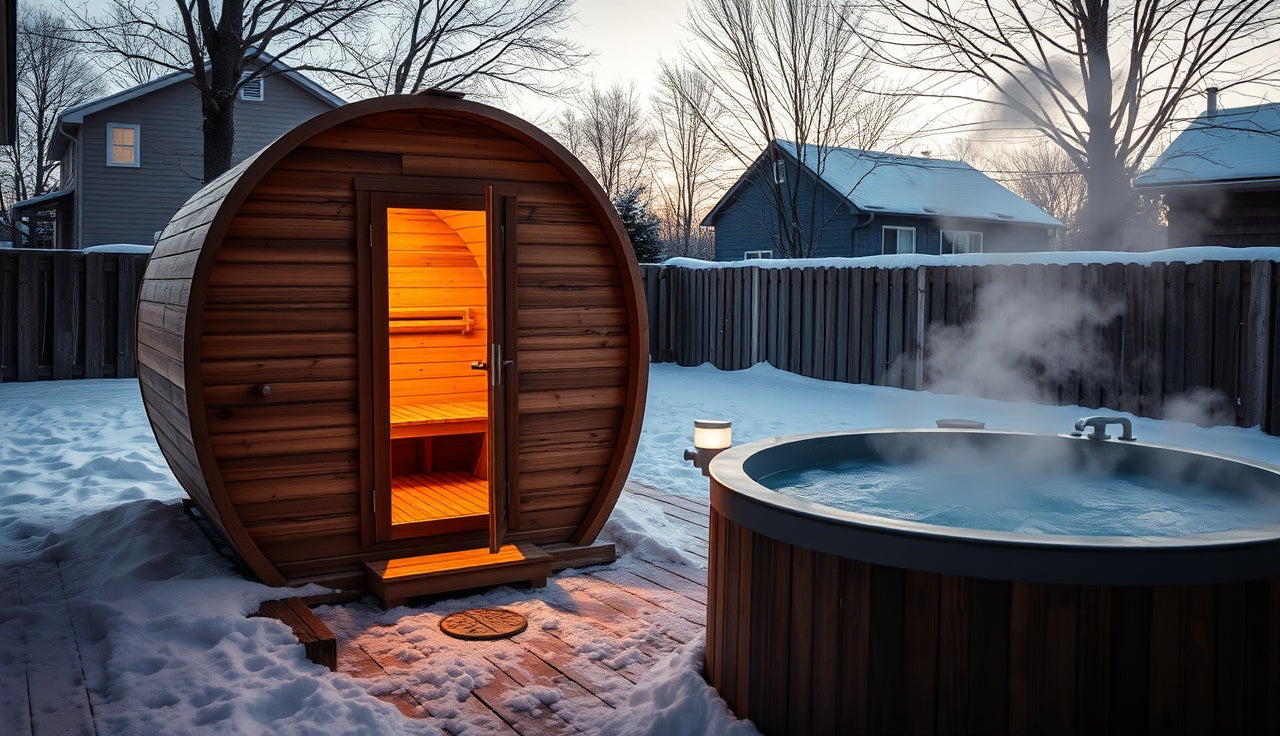
For a complete home setup, a two-person barrel sauna paired with a dedicated cold plunge covers everything. Budget honestly: a solid electric home sauna runs $2,000 to $8,000 installed depending on size and brand, and a quality cold plunge with a chiller runs $1,500 to $5,000. You can spend more or less on each.
How long does it take to see results from regular contrast therapy?
Acute benefits show up from session one. Reduced soreness, better sleep that night, a mood lift after you get out. That is not placebo. The thermoregulatory and hormonal responses happen in real time.
Longer-term adaptations take four to eight weeks of regular use to settle in. Those include better cold tolerance, more efficient switching between vascular states, and what a lot of practitioners describe as a faster baseline recovery rate between training sessions.
Nobody has a clean long-term randomized controlled trial pinning down exactly how many weeks of contrast therapy produce which specific outcomes in a general healthy population. Most longer studies run six to twelve weeks in elite or semi-elite athletes. Extending that to recreational fitness is reasonable but not proven.
The honest answer: expect to feel noticeably better after the first session, meaningfully better within two to three weeks of steady use, and to have contrast therapy feel natural and sustainable within four to six weeks.
What are common mistakes people make with contrast therapy?
Skipping the cold. Plenty of people love the sauna, tack on a 20-second cold rinse, and call it contrast therapy. That is not the protocol. The cold has to run long enough and cold enough to drive real vasoconstriction. Less than 90 seconds in water below 15°C is a floor, not a ceiling.
Dragging out the transition. Spend five minutes wandering from sauna to plunge and you throw away a big slice of the stimulus. The vascular state you built in the heat is already unwinding. Set the equipment close together.
Too much too soon. Four cycles at 90°C and 8°C in your first week will flatten you. Start easy, build up, and track how you feel 24 hours after each session.
Cold immediately after heavy lifting when the goal is size. As noted, the cold phases may blunt hypertrophy signals. If you want both growth and recovery speed, do contrast sessions on off days rather than right after a lift.
Ignoring hydration. A 30-minute sauna session can produce 0.5 to 1.0 liters of sweat [7]. Stack multiple cycles and you need to replace fluid and electrolytes, more than water. Drink 500 to 700ml before a session and keep more within reach between cycles.
Does the research support the benefits of contrast therapy for mental health?
The mental health evidence sits earlier-stage than the muscle recovery data, but it is growing and points in one direction.
Cold water immersion triggers a reliable norepinephrine spike, reported at roughly 300 to 400% above baseline in water around 14°C [2]. Norepinephrine drives attention, mood regulation, and arousal. That is a real pharmacological effect coming from nothing but a temperature stimulus.
Heat exposure releases beta-endorphins and raises brain-derived neurotrophic factor (BDNF), a protein tied to neuroplasticity and mood. Finnish sauna research has linked regular use (four to seven times a week) with lower rates of depression and cognitive decline, though causality in observational data like that is hard to pin down [8].
A 2023 paper in PLOS ONE on cold water swimming reported reductions in anxiety and depression scores over six weeks against a control group [9]. That was cold immersion, not full contrast therapy, but the heat phases in contrast work likely add mood benefit rather than subtract it.
The practical reality is that most people who run contrast therapy regularly feel better. Some of that is physiological. Some is the deliberate time carved out for recovery. Some is the confidence of doing something genuinely hard, because cold immersion is never comfortable. Splitting those contributions apart is not possible with current controlled research, and anyone who tells you the science is settled is overselling it.
Frequently asked questions
What is the best contrast therapy ratio of hot to cold?
The most studied ratio is roughly 3:1 hot to cold by time, so 15 minutes of heat then 5 minutes of cold. Some sports protocols use 1:1 ratios in shorter bursts. Neither is universally best. The 3:1 structure is a practical starting point, with cold phases at a minimum of 2 to 3 minutes and heat phases of 10 to 15 minutes.
Can you do contrast therapy every day?
You can, and some athletes in heavy training do. For most people, two to four sessions per week is realistic and sustainable. Daily use does not appear to harm healthy adults, but the time demand is real. Daily sauna use alone has the strongest long-term health data; daily cold immersion is less studied. If you sleep well and recover normally, daily contrast sessions are unlikely to be a problem.
Is contrast therapy the same as hot-cold showers?
No, not really. A contrast shower cycles warm and cold water at the showerhead, but the thermal load runs much lower than full immersion. Cold water at 15°C on your skin surface is far weaker than sitting in 15°C water up to your chest. Showers beat nothing and make a useful daily habit, but they do not reproduce the cardiovascular and hormonal responses of proper immersion contrast therapy.
Should contrast therapy end on hot or cold?
End on cold if athletic recovery and reduced inflammation are the goal. The cold finish keeps vasoconstriction in place and eases soreness. End on heat if relaxation and sleep prep come first, since heat drives parasympathetic activation and can help you fall asleep. Most sports medicine protocols end cold.
How cold does the water need to be for contrast therapy to work?
DOMS research has used water most often in the 11-15°C (52-59°F) range, and that is where the bulk of the evidence sits. Colder water (8-10°C) raises the vasoconstriction stimulus and norepinephrine response but also raises cold shock risk, especially for beginners. Anything warmer than 18-20°C gives only mild vasoconstriction and likely limited recovery benefit.
Can contrast therapy help with inflammation?
Yes, with precision. Cold immersion reduces acute inflammation by driving vasoconstriction and cutting blood flow to inflamed tissue. Heat can briefly increase local inflammation, which is why contrast therapy is not recommended for acute injuries in the first 24 to 48 hours. For the low-grade systemic inflammation common in athletes with heavy loads, regular thermal cycling appears to help, though the mechanism is not fully worked out.
Is contrast therapy good for sleep?
Indirectly, yes. Sauna use is linked with better sleep quality in several studies, partly because the sharp drop in core temperature after you exit the heat triggers sleep-onset signals. Cold exposure earlier in the day raises alertness briefly but does not wreck nighttime sleep. A contrast session in the late afternoon or early evening, ending two or more hours before bed, tends to produce better sleep for most people.
What is the difference between contrast therapy and cryotherapy?
Cryotherapy uses extremely cold air (minus 100 to minus 140°C) in a chamber for 2 to 3 minutes. Contrast therapy uses water at 10-15°C. Water pulls heat away roughly 25 times faster than air, so 15°C water immersion is a stronger thermal stimulus than a minus 110°C chamber where only air touches the skin. Most independent research on recovery finds cold water immersion comparable or superior to whole-body cryotherapy.
Can you do contrast therapy without a sauna, using just a hot tub?
Yes. A hot tub at 40-42°C paired with a cold plunge or ice bath runs a functional contrast protocol. Core temperature rises slower in a hot tub than a dry sauna, so you need 15 to 20 minutes of heat immersion rather than 10 to 12. The response is real, just at lower intensity than a traditional sauna. Hot tub contrast therapy suits people who find dry sauna heat hard to tolerate.
Does contrast therapy blunt muscle growth?
Cold water immersion right after strength training may reduce hypertrophy gains over time, based mainly on a 2015 Journal of Physiology study. The concern is that cold suppresses the inflammation and mTOR signaling that drive muscle protein synthesis. If maximum muscle mass is your goal, avoid cold immersion in the two hours after a strength session. Doing contrast therapy on off days or more than two hours post-lift cuts this risk sharply.
How many calories does contrast therapy burn?
Sauna sessions burn modestly more calories than rest thanks to the higher heart rate and thermoregulation demand, roughly 50 to 150 extra calories in a 20-minute session depending on body size and temperature. Cold immersion adds some thermogenic burn as your body generates heat. Total contrast therapy burn is real but modest, generally 150 to 300 extra calories per full session. Do not use it as a weight loss strategy.
Is contrast therapy safe during pregnancy?
No, the standard protocol is not recommended during pregnancy. Core body temperatures above 39°C (102°F) carry risk of neural tube defects and other fetal harm, especially in the first trimester. The Society of Obstetricians and Gynaecologists of Canada limits hot tub use to water below 38.9°C for pregnant women. Cold immersion stress also carries fetal risk. Pregnant women should consult their physician before any thermal therapy.
What should I eat or drink around a contrast therapy session?
Avoid heavy meals in the one to two hours before a session, since digestion and intense thermal stress compete for blood flow. Hydrate well beforehand, with 500ml of water a reasonable minimum. Between cycles, sip water or an electrolyte drink. After the session, a protein-rich snack or meal within an hour supports muscle repair if you are recovering from a workout. Alcohol before or during is a firm no for safety reasons.
How do I set up contrast therapy at home on a budget?
The cheapest setup is a portable sauna (around $200 to $500) and a stock tank or large chest freezer filled with cold water and ice. A stock tank runs $100 to $200 and holds enough water for full immersion. It works, though temperature control is manual. A purpose-built cold plunge with a chiller and a proper home sauna are more reliable and easier to use consistently, but they cost a good deal more.
Sources
- Journal of Physiology, Versey et al., 2013 (meta-analysis: contrast water therapy and recovery): Contrast water therapy reduced delayed-onset muscle soreness compared to passive rest at 24, 48, and 72 hours post-exercise
- National Library of Medicine (PMC), review of cold water immersion and catecholamine response: Cold water immersion at 14°C raised norepinephrine levels by approximately 300%
- Journal of Athletic Training, Bieuzen et al., 2013, systematic review of contrast water therapy: Contrast water therapy reduced perceived muscle soreness and fatigue across multiple controlled studies in athletic populations
- Journal of Physiology, Roberts et al., 2015, cold water immersion and hypertrophy: Cold water immersion after resistance training attenuated long-term gains in muscle mass and strength compared to active recovery
- American Heart Association, cold water and cardiac risk: Sudden cold water immersion can trigger cardiac events in susceptible individuals with cardiovascular disease
- Society of Obstetricians and Gynaecologists of Canada, hot tub safety in pregnancy: Pregnant women should avoid hot tub temperatures above 38.9°C due to risk of elevated core body temperature harming the fetus
- Sports Medicine (Springer), sweat rate during heat exposure: A 30-minute sauna session can produce 0.5-1.0 liters of sweat depending on temperature and individual factors
- JAMA Internal Medicine, Laukkanen et al., 2015, sauna use and health outcomes: Regular sauna use four to seven times per week was associated with lower rates of depression and cognitive decline in longitudinal Finnish data
- PLOS ONE, 2023, cold water swimming and mental health: Six weeks of cold water swimming produced significant reductions in anxiety and depression scores compared to a control group
- National Institutes of Health, National Library of Medicine, thermoregulation and cold water immersion overview: Water conducts heat approximately 25 times more efficiently than air at the same temperature, making cold water immersion a far stronger thermal stimulus than cold air exposure
- American Heart Association, sauna and cardiovascular response: Heat exposure raises heart rate and stresses the cardiovascular system, which should be considered by people with heart conditions

Share:
High end cold plunge tubs: what you actually get for the money
Just the Tub dynamic cold therapy PVC barrel: honest review