
Last updated 2026-07-10
TL;DR
A contrast therapy device is any setup that lets you alternate heat exposure (sauna, steam, hot tub) with cold exposure (cold plunge, ice bath, cold shower) in a controlled way. Research shows consistent reductions in delayed-onset muscle soreness and some cardiovascular benefits, though optimal timing protocols are still being studied. Expect to spend $500 to $30,000+ depending on device type.
What is a contrast therapy device?
Contrast therapy is the deliberate alternation of hot and cold exposure. The goal is to cycle your body between vasodilation (blood vessels opening wide in heat) and vasoconstriction (vessels clamping down in cold), which creates a pumping effect on circulation and lymphatic flow. A contrast therapy device is whatever hardware you use to make that cycle possible at home, in a gym, or at a spa.
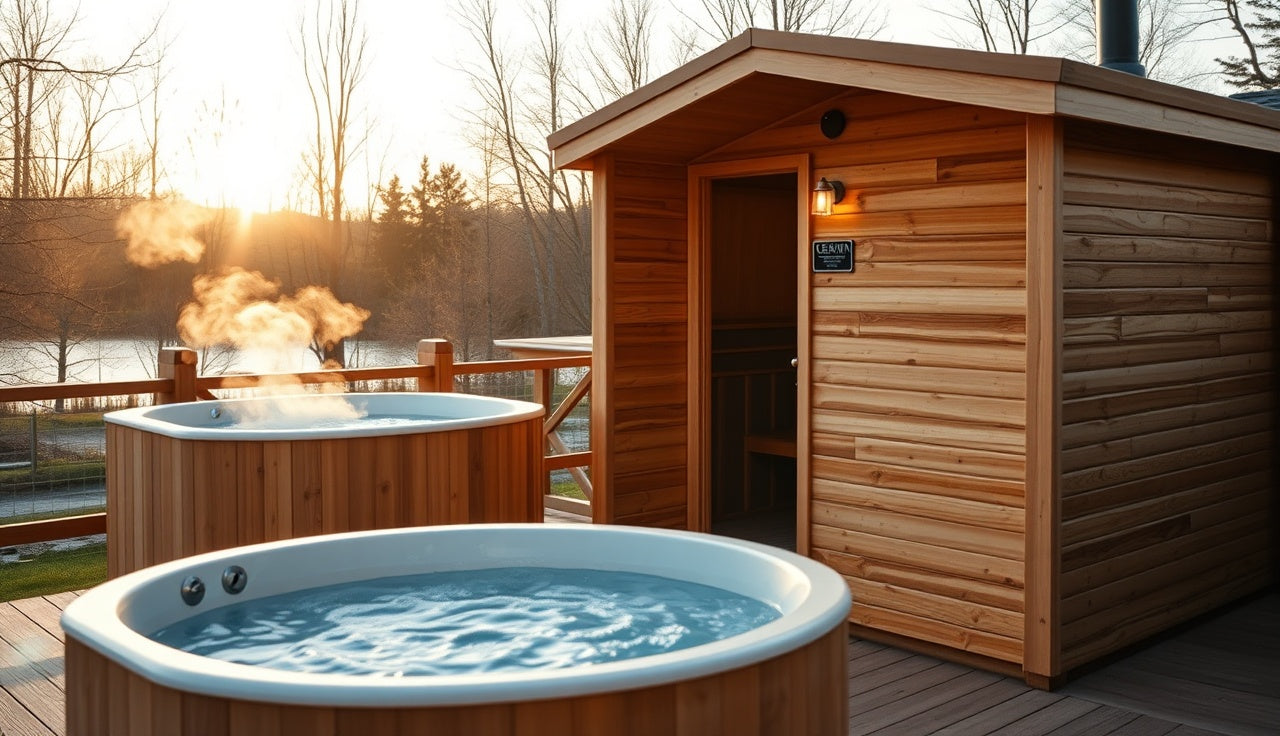
That phrase covers a lot of gear. At the simple end, it can be a portable sauna and a cold shower. At the elaborate end, it is a purpose-built outdoor sauna cabin paired with a dedicated cold plunge tub with active chilling. There is no single device labeled "contrast therapy machine." What you are really buying is a system: a heat source and a cold source, ideally close enough together that you can move between them in under two minutes.
The term comes from hydrotherapy research that dates back to the late 19th century, but the modern consumer market for dedicated contrast setups really only took off after 2015, when cold plunge tubs became commercially available for home buyers. Before that, most people were making do with cold showers after a sauna session, which works but is a blunter tool.
What does the research actually say about contrast therapy?
The honest summary is: contrast therapy reliably reduces delayed-onset muscle soreness (DOMS), the effect on long-term athletic adaptation is mixed, and cardiovascular benefits look promising but need more rigorous study.
A 2017 Cochrane systematic review of cold-water immersion for muscle soreness looked at 52 small trials and found that cold-water immersion reduced DOMS compared to passive rest [1]. Contrast water therapy (alternating hot and cold immersion) showed a similar pattern, though the authors noted that most trials were small and at unclear risk of bias. That hedging matters. Most contrast therapy studies use athlete samples of 10 to 20 people, measure short-term outcomes, and define protocols differently enough that comparing them is messy.
A frequent concern from strength coaches is that cold immersion after resistance training may blunt hypertrophy. A 2015 study published in the Journal of Physiology found that post-exercise cold-water immersion attenuated long-term gains in muscle mass and strength compared to active cool-down [2]. The mechanism appears to involve reduced satellite cell activity and blunted mTOR signaling in the hours after training. If your primary goal is muscle building, this matters. If your goal is recovery between hard training sessions or general wellness, the tradeoff looks different.
On the cardiovascular side, sauna use has its own literature. A prospective cohort study of 2,315 Finnish men (the Kuopio Ischemic Heart Disease study, published in JAMA Internal Medicine in 2015) found that frequent sauna use was associated with reduced cardiovascular mortality: men using a sauna 4 to 7 times per week had a 50% lower risk of fatal cardiovascular disease compared to once-per-week users [3]. That is an observational association, not a controlled trial, and confounders exist. But it is the largest and most-cited dataset we have.
Use contrast therapy for recovery and general wellness with reasonable confidence. Skip the cold right after strength training if muscle growth is the point. Nobody has a definitive answer on the ideal protocol yet. The closest thing to consensus is 3 to 5 minutes of heat followed by 1 to 3 minutes of cold, repeated 3 to 5 rounds.
What types of contrast therapy devices are available for home use?
The market breaks into four main configurations. Each has real tradeoffs in cost, space, and effectiveness.
Traditional sauna plus cold plunge tub. This is the gold standard for most serious users. A wood-burning or electric barrel or cabin sauna paired with a dedicated cold plunge that uses a chiller unit to maintain water temperature at 45 to 55°F. You get precise, repeatable temperature control on both ends. Cost runs from roughly $5,000 to $30,000+ for quality versions of both units. Space requirement is significant: you need room for two large pieces of equipment, ideally outdoors or in a dedicated space.
Infrared sauna plus cold plunge. Infrared saunas run cooler (typically 120 to 150°F versus 160 to 195°F for traditional saunas) and heat the body differently, via radiant energy rather than heated air. They cost less to run electrically and heat up faster (15 to 30 minutes versus 30 to 60 minutes for traditional). Some users find the lower ambient temperature more tolerable for longer sessions. Paired with a cold plunge, this is a popular mid-range home setup. Combined cost: $3,000 to $15,000.
Portable sauna plus cold immersion. A portable sauna (either a tent-style infrared unit or a portable barrel) with a chest freezer converted to a cold plunge, or a basic cold plunge tub without a chiller. Cost can get under $1,000 total. The downsides: portable saunas heat less evenly, chest freezer conversions need maintenance attention, and neither feels as good as a purpose-built setup. But if space or budget is the constraint, this works.
Hot tub or steam room plus cold plunge. Some users already have a hot tub and add a cold plunge. A steam room can also serve as the heat source. Steam rooms deliver moist heat at 100 to 120°F, which feels more intense than the temperature suggests because high humidity prevents sweat from evaporating. This is a legitimate contrast setup. The main limitation is that hot tubs and steam rooms take longer to heat and are harder to push to very high temperatures compared to a dedicated sauna.
One thing worth stating plainly: a cold shower after a sauna is not the same as cold plunge immersion. Water immersion conducts heat away from your body roughly 25 times faster than air, so a 55°F plunge bath is a much stronger cold stimulus than a cold shower at the same temperature [8]. If you are researching contrast therapy for real recovery purposes, the immersion matters.
How much does a contrast therapy setup cost?
| Setup type | Heat source cost | Cold source cost | Total range |
|---|---|---|---|
| Portable/budget | $200-$600 (portable sauna) | $200-$500 (chest freezer or basic tub) | $400-$1,100 |
| Mid-range home | $2,000-$6,000 (infrared cabin sauna) | $1,500-$4,000 (plunge with basic chiller) | $3,500-$10,000 |
| High-end home | $5,000-$15,000 (traditional sauna) | $4,000-$12,000 (premium chiller plunge) | $9,000-$27,000+ |
| Commercial/luxury | $15,000+ (custom cabin) | $8,000-$20,000+ (commercial chiller) | $23,000-$40,000+ |
These are rough ranges based on current retail pricing. The cold plunge side has gotten cheaper since 2021 as more manufacturers entered the market, but quality chiller units still cost real money. A chiller that can hold water at 45°F in a warm garage costs more than one rated for a climate-controlled indoor room.
Installation adds cost. Traditional saunas often need a dedicated 240V electrical circuit ($300 to $800 to have an electrician run it, depending on distance from your panel) [10]. Outdoor installations may require permits depending on your municipality. Cold plunge tubs with chillers also need either an outdoor-rated outlet or a dedicated circuit.
Running costs matter over time. A traditional sauna using a 9kW heater running for one hour costs roughly $0.90 to $1.50 per session depending on your electricity rate. A cold plunge chiller running continuously to maintain temperature costs $30 to $80 per month in electricity [4]. Some people run the chiller only when they plan to use it and pre-chill 4 to 6 hours ahead, which saves money at the cost of spontaneity.
| Portable/budget setup | $750 |
| Mid-range home (infrared + basic plunge) | $6,750 |
| High-end home (traditional + chiller plunge) | $18,000 |
| Commercial/luxury | $31,500 |
Source: SweatDecks retail market survey, 2024; U.S. EIA electricity data [4]
What is the best contrast therapy protocol to follow?
There is no universally agreed protocol. The research uses different ratios and durations, which makes a single definitive answer genuinely hard. But here is what the more consistent studies use, and what most experienced practitioners describe.
A common starting point is 10 to 20 minutes in the sauna, followed by 2 to 3 minutes in the cold plunge, repeated for 2 to 4 rounds. Some protocols suggest ending on cold to maximize the vasoconstriction and alertness effect. Others end on heat for relaxation. Ending on cold shows up more in athletic recovery contexts. Ending on heat is more common in Scandinavian and Japanese bathing traditions, which treat the final warm phase as the wind-down.
Temperature targets: most research on cold immersion uses water between 50 and 59°F (10 to 15°C) [1]. Sauna temperatures in the Finnish tradition typically run 160 to 200°F (71 to 93°C), with brief sessions at those temperatures being standard. Lower temperatures require longer exposure to produce a similar core temperature increase.
A few practical constraints. You need to stay hydrated. Sweating in a sauna for 20 minutes at 180°F can mean losing 0.5 to 1 liter of fluid per session. Drink 16 to 24 ounces of water before you start, and keep water available during and after. Avoid contrast therapy right after heavy alcohol consumption, because both sauna and cold plunge affect blood pressure and heart rate in ways that turn dangerous with alcohol in the system [3].
New to saunas or cold plunges? Start short and work up. Five minutes in the sauna and 30 seconds in the cold is a legitimate starting point. The instinct to tough out a long cold immersion on the first try is counterproductive and occasionally dangerous.
What should you look for in a cold plunge for contrast therapy?
The cold side of a contrast setup is where people most often underbuy and regret it. Here is what actually matters.
Temperature range and consistency. A serious cold plunge should hold 45 to 55°F reliably. Without a chiller, you depend on ice or ambient temperature, which means your cold stimulus varies every session. Chiller units are rated by their cooling capacity (measured in BTUs or horsepower) relative to the water volume and ambient temperature they operate in. A 1/4 HP chiller is adequate for a 50-gallon tub in a 70°F room. If your tub sits outdoors in summer heat, you need more capacity.
Tub size. You need to fit your torso and ideally your legs in the water. Most adults need a tub at least 20 inches wide and 48 inches long, or a round tub with at least 24 inches of internal diameter. Anything smaller means uncomfortable positioning or incomplete immersion.
Filtration and sanitation. Cold water does not kill bacteria the way hot sauna air does. A plunge tub without filtration becomes a bacteria incubator fast. Look for a unit with a circulation pump and filtration built in, and plan to use either ozone treatment, UV sanitation, or a small amount of bromine or non-chlorine shock. This is not optional.
Drain and fill convenience. If refilling the tub is a 20-minute project, you will not use it as often. Look for garden hose connections and gravity drain options.
For a deeper look at the cold immersion side of the equation, the cold plunge and cold plunge benefits guides go into more detail on what to expect physiologically and how to evaluate specific units.
What should you look for in a sauna for contrast therapy?
The heat source choice comes down to three variables: how hot it gets, how fast it heats up, and how you want the experience to feel.
Traditional Finnish-style saunas (wood-burning or electric with sauna stones) reach 160 to 212°F and let you pour water on the rocks (loyly) to create bursts of steam. This is the most intense and most researched sauna experience. If you are trying to replicate the conditions from the Finnish cardiovascular studies, this is the format [3]. A home sauna in the traditional style is a serious investment but also the most durable and resalable.
Infrared saunas run cooler but heat the body effectively through radiant energy. They cost less to buy and run, heat up in 15 to 30 minutes rather than 45 to 60, and are quieter and easier to install (many run on 120V rather than 240V). The tradeoff is you cannot do the steam experience, and the lower ambient temperature means some users feel they never get as deeply warmed as they do in a traditional sauna. For contrast therapy purposes, both work.
Outdoor barrel saunas are popular for contrast setups because they can sit next to a cold plunge without major construction. An outdoor sauna in barrel form is one of the more practical configurations for a home backyard setup.
Space matters. A two-person indoor sauna typically takes a 4x6 foot footprint. Outdoor barrels need to sit on a level surface with clearance around them. Traditional saunas require a non-combustible floor and proper ventilation. All electric saunas need access to either a 120V or 240V outlet, depending on wattage.
Are contrast therapy devices worth it compared to gym or spa access?
This is a real question, and the honest answer depends on how often you would use it.
A gym or recovery spa with sauna and cold plunge access typically costs $50 to $150 per visit, or $100 to $300 per month for a membership with unlimited access. Use it twice a week and you are spending $1,200 to $3,600 per year. A mid-range home setup costing $8,000 breaks even in roughly 2 to 5 years at those rates. A higher-end $20,000 setup takes longer, obviously, but it is also available at any hour, requires no commute, and does not mean sharing equipment with strangers.
The convenience factor is real and tends to be undervalued. The research on habit formation is consistent: friction kills habits. If getting to a sauna requires 20 minutes of driving and a wait for the plunge to open up, you will use it far less than if both units sit in your backyard. On the other hand, if you live in an apartment or have no outdoor space, a home setup may simply not be realistic.
SweatDecks carries both sauna and cold plunge options across many budgets if you want to compare specific models side by side.
A budget worth knowing: the floor for a genuinely functional contrast therapy setup (a real cold plunge with chilling, not a chest freezer, and a real sauna, not a tent) is around $5,000 to $7,000 in the current market. Anything below that involves meaningful compromises on one side or both.
What are the safety considerations for contrast therapy at home?
Contrast therapy involves real physiological stress. That is also why it produces the effects people want. But it means safety is not a formality.
Cardiovascular stress. Moving from a 190°F sauna to a 50°F cold plunge causes dramatic shifts in heart rate and blood pressure. Heart rate in a hot sauna can reach 100 to 150 beats per minute. Cold immersion causes an immediate vagal response that can drop heart rate sharply while briefly spiking blood pressure [8]. For healthy adults this is manageable. For people with hypertension, arrhythmias, or recent cardiac events, it warrants a conversation with a physician before starting. The American Heart Association does not have specific guidance on contrast therapy, but its sauna guidance notes that people with unstable angina or recent myocardial infarction should avoid saunas [5].
Hyperthermia. Staying in a sauna too long, especially at high temperatures, can lead to heat exhaustion. Warning signs are nausea, dizziness, and confusion. Get out, cool down, and drink water. This is more common in new users who push sessions too long.
Cold shock response. The first 30 to 60 seconds of cold water immersion trigger an involuntary gasp and hyperventilation that can cause panic in unprepared users and, in rare cases, inhalation of water. That is the main reason not to submerge your face during the shock phase, and why having someone nearby for your first several plunges is a reasonable precaution.
Pregnancy. Elevated core body temperature in the first trimester is associated with neural tube defects [6]. Pregnant women should avoid saunas and hot water immersion and should consult their physician.
Children. Most sauna manufacturers and health authorities recommend keeping children under 12 out of saunas, because they thermoregulate differently than adults and overheat faster.
How do contrast therapy devices compare for specific goals?
| Goal | Best device type | Notes |
|---|---|---|
| Athletic recovery (DOMS reduction) | Traditional sauna + cold plunge | Most evidence base; immersion more effective than shower |
| Muscle building | Sauna only, skip cold post-lifting | Cold immersion may blunt hypertrophy [2] |
| Cardiovascular wellness | Traditional sauna (any cold) | Finnish cohort studies used traditional sauna [3] |
| Relaxation and stress relief | Any sauna, warm end on heat | End on heat for parasympathetic effect |
| Budget setup | Portable sauna + basic plunge | Functional but less precise; works for general wellness |
| Space-constrained (apartment) | Not practical without outdoor access | Gym membership is the honest answer here |
| Sleep improvement | Sauna 2-3 hrs before bed | Core temp drop after sauna may aid sleep onset [7] |
The sauna benefits article goes deeper on the cardiovascular and sleep research if that angle is relevant to your goals. The ice bath guide covers what the research specifically says about cold immersion versus cold water therapy in general.
Can you do contrast therapy without buying a dedicated device?
Yes. Worth saying clearly, because some people read all the contrast therapy coverage and assume they need to spend $10,000 before they can start.
A gym with a hot tub and a cold shower works. Fifteen minutes in a hot tub followed by a 90-second cold shower delivers real contrast stimulus. It is not the same as 20 minutes in a 190°F sauna followed by 3 minutes in a 50°F plunge, but it is on the same continuum and it is free if you already have a gym membership.
If you do own a sauna but not a cold plunge, a cold shower is a legitimate starting point. Some people also use a large plastic stock tank (a livestock watering tank) with bags of ice as a zero-infrastructure cold plunge. A 100-gallon Rubbermaid stock tank costs around $100 to $150 at a farm supply store and holds enough water to immerse an adult's torso and legs. You will spend $5 to $15 on ice per session to get it cold enough. Not elegant, but genuinely functional for testing whether cold immersion is something you want to invest in properly.
The contrast therapy device landscape in 2024 gives you more real options in the $1,000 to $3,000 range than existed five years ago. But the fundamentals are heat, cold, and alternation. You do not need beautiful equipment for that to work.
Frequently asked questions
What temperature should a cold plunge be for contrast therapy?
Most research on cold water immersion uses temperatures between 50 and 59°F (10 to 15°C). Below 50°F increases the stimulus but also increases the cold shock response. Above 60°F still produces vasoconstriction but is a milder stimulus. For beginners, starting at 55 to 60°F and working toward 50°F over several weeks is a practical approach.
How long should each hot and cold phase be in contrast therapy?
Most protocols studied in research use 10 to 20 minutes of heat followed by 1 to 3 minutes of cold, repeated 2 to 5 rounds. There is no single definitive protocol. A practical starting point for beginners is 10 minutes in the sauna and 1 to 2 minutes in the cold plunge, for 2 to 3 rounds, working up over time.
Should I end a contrast therapy session on hot or cold?
It depends on your goal. Ending on cold leaves you more alert and may extend the vasoconstriction effect, which is preferred in athletic recovery contexts. Ending on heat produces more relaxation and is more common in traditional Scandinavian bathing. Neither is definitively better; choose based on what you are doing afterward.
Does contrast therapy actually build muscle or help with recovery?
Cold immersion reduces delayed-onset muscle soreness consistently across research. However, a 2015 Journal of Physiology study found that post-lifting cold immersion reduced long-term muscle and strength gains. So contrast therapy helps recovery between sessions, but using cold immediately after resistance training may blunt hypertrophy if done consistently over months.
Is a cold shower the same as a cold plunge for contrast therapy?
No. Water immersion conducts heat away from the body roughly 25 times faster than air, meaning a full immersion in 55°F water is a much stronger cold stimulus than a cold shower at the same temperature. A cold shower works as a starting point or when a plunge is unavailable, but the physiological effect is meaningfully smaller.
Can I do contrast therapy every day?
Most experienced users and practitioners use contrast therapy 3 to 5 days per week rather than daily. Daily use is generally fine for healthy adults from a safety standpoint, but if you are training hard, daily cold immersion may interfere with training adaptations. Taking rest days from any recovery protocol also lets you notice how your body responds.
What is the cheapest functional contrast therapy setup for home?
A portable sauna (tent-style infrared, around $200 to $600) paired with a Rubbermaid stock tank and ice, or a basic cold plunge tub without a chiller, gets you under $800 to $1,000 total. It is less convenient and less precise than dedicated equipment, but the contrast stimulus is real. A chest freezer converted to a cold plunge is another low-cost option.
Is contrast therapy safe for people with heart conditions?
Not without medical clearance. Moving between extreme heat and cold causes significant cardiovascular stress: elevated heart rate in the sauna, sharp blood pressure changes entering cold water. People with hypertension, arrhythmias, recent cardiac events, or unstable angina should talk to their cardiologist before using any contrast therapy setup. The American Heart Association advises people with unstable angina to avoid saunas.
How much electricity does a home contrast therapy setup use per month?
A traditional sauna with a 9kW heater used for one hour daily costs roughly $25 to $45 per month in electricity at average U.S. rates. A cold plunge chiller running continuously to maintain temperature adds $30 to $80 per month. Total running costs for a full home setup typically land between $60 and $120 per month, depending on your electricity rate and how you use the equipment.
Do I need permits to install a contrast therapy setup at home?
It depends on your municipality and how the equipment is installed. Outdoor structures over a certain square footage often require building permits. New electrical circuits (240V for most saunas) require a permit and licensed electrician in most jurisdictions. Contact your local building department before installing. Indoor sauna installations generally need less permitting but still require proper ventilation and electrical work.
What is the difference between contrast therapy and just taking a cold shower after the sauna?
The main difference is stimulus intensity. Cold water immersion produces a much stronger vasoconstriction response than a cold shower at the same temperature. Full-body immersion also cools core temperature faster, which is a larger physiological event. Cold showers are better than nothing and work as a starting point, but they are a different and milder intervention than plunge immersion.
Can contrast therapy help with sleep?
Sauna use appears to aid sleep onset, likely because the drop in core body temperature after a sauna session mimics the natural pre-sleep temperature decline. One small study found improved slow-wave sleep after sauna use. Doing a contrast session 2 to 3 hours before bed, ending on heat, may help. Cold immersion close to bedtime can be activating rather than sedating for some people.
What is the difference between contrast water therapy and cold water immersion alone?
Cold water immersion (CWI) uses only cold, typically a single cold plunge after training. Contrast water therapy (CWT) alternates hot and cold, usually in water only (hot tub then cold plunge). Adding a sauna to the hot phase produces a more intense heat stimulus than a hot tub alone. Most research treats CWI and CWT separately; both show DOMS reduction compared to passive rest.
Sources
- Cochrane Database of Systematic Reviews, 2017: Cold water immersion for preventing and treating muscle soreness after exercise: Cold-water immersion and contrast water therapy both reduced delayed-onset muscle soreness compared to passive rest across 52 trials reviewed
- Journal of Physiology, 2015: Post-exercise cold water immersion attenuates acute anabolic signalling and long-term adaptations in muscle to strength training: Post-exercise cold-water immersion attenuated long-term gains in muscle mass and strength compared to active cool-down
- JAMA Internal Medicine, 2015: Association Between Sauna Bathing and Fatal Cardiovascular and All-Cause Mortality Events: Men using a sauna 4 to 7 times per week had a 50% lower risk of fatal cardiovascular disease compared to once-per-week users in a cohort of 2,315 Finnish men
- U.S. Energy Information Administration, Electricity Data Browser: Average U.S. residential electricity rates used to estimate monthly running costs for sauna and chiller operation
- American Heart Association: People with unstable angina or recent myocardial infarction should avoid saunas due to cardiovascular stress
- Centers for Disease Control and Prevention, Folic Acid and Neural Tube Defects: Elevated core body temperature in the first trimester is associated with increased risk of neural tube defects
- National Institutes of Health, National Library of Medicine (PubMed Central): Sauna use associated with improved sleep and reduced inflammatory markers in Finnish population cohort data
- National Institutes of Health, National Library of Medicine (PubMed Central): Cold water immersion causes immediate vasoconstriction and heart rate changes; water conducts heat away from the body approximately 25 times faster than air
- Centers for Disease Control and Prevention, Physical Activity: Context for contrast therapy use in recovery protocols for active adults
- U.S. Consumer Product Safety Commission: Electric sauna heaters require dedicated circuits and proper installation; used for electrical safety cost estimates

Share:
Sauna temperature sensors: how they work and where to put them
What is the optimum temperature for a sauna?