
Last updated 2026-07-09
TL;DR
Contrast therapy alternates heat and cold exposure, typically 10-20 minutes of sauna followed by 1-3 minutes of cold immersion, repeated 2-4 rounds. Home setups range from a $300 cold plunge tub plus an existing shower to a $15,000+ dedicated sauna and cold plunge combo. Research shows measurable benefits for muscle recovery, cardiovascular function, and mood, though optimal timing and ratios are still being studied.
What is contrast therapy, and how does it actually work?
Contrast therapy is the practice of moving your body between heat and cold in deliberate cycles. You get hot enough to drive a real cardiovascular response, then get cold enough to trigger a separate, opposing set of adaptations. Back and forth, usually two to four rounds.
The mechanism is reasonably well understood. Heat dilates blood vessels and pushes blood toward the skin's surface. Cold does the opposite, causing vasoconstriction and shunting blood back toward the core. Cycle them and you get what some researchers call a "vascular pump" effect: repeated dilation and constriction that trains the smooth muscle in vessel walls and drives metabolic byproducts out of peripheral tissue [1].
That pumping action is why contrast therapy has a longer track record in athletic recovery than either heat or cold alone. A systematic review in the British Journal of Sports Medicine found that cold water immersion reduced delayed-onset muscle soreness more than passive recovery, and combining it with heat protocols showed additive effects in some trial arms [2]. Worth being honest here: the study designs vary a lot, sample sizes are often small, and "additive" does not mean "double the benefit."
The other mechanism people talk about is the autonomic nervous system response. Heat activates a parasympathetic-leaning state over time; acute cold hits the sympathetic system hard, spiking norepinephrine. A study published in PLOS ONE reported that cold water immersion raised plasma norepinephrine by roughly 200-300%, which likely drives the mood and alertness effects many practitioners report [3]. A single short dunk is not a clinical dose, but it gives you a sense of the magnitude.
Practically, contrast therapy at home just means you have a way to get hot and a way to get cold, and you alternate them with intention rather than wandering between them randomly.
What equipment do you actually need for a home contrast therapy setup?
You need two things: a heat source and a cold source. Everything else is optimization.
On the heat side, your options from least to most expensive are: a steam shower or hot bath (free if you have one), an infrared blanket or pod ($200-$600), a portable sauna ($300-$800), an infrared cabin sauna ($1,500-$4,000), or a traditional Finnish-style home sauna ($3,000-$15,000+). The key variable is how hot you can actually get. A hot bath tops out around 104°F. A well-built barrel or indoor sauna hits 170-195°F. That temperature spread matters because the vasodilation response is dose-dependent.
On the cold side, options range from a cold shower (free), to a chest freezer converted into a plunge tub ($200-$400 in parts), to a purpose-built cold plunge ($500-$5,000+), to chiller-equipped systems that hold a precise temperature year-round ($3,000-$8,000). Cold shower contrast is real and legitimate, especially for beginners, but water temperature is harder to control and the immersion effect is weaker than full submersion.
The honest minimum for a real home contrast therapy setup: a portable or entry-level infrared sauna plus a cold shower or inexpensive plunge tub. You can start for under $1,000. The ceiling is effectively unlimited if you want a built-in outdoor sauna and a medical-grade cold plunge with a chiller.
| Setup tier | Heat source | Cold source | Approx. cost range |
|---|---|---|---|
| Budget | Hot shower / bath | Cold shower | $0 (existing fixtures) |
| Entry | Portable infrared sauna | Chest freezer tub | $500-$1,200 |
| Mid-range | Infrared cabin sauna | Basic cold plunge tub | $2,500-$6,000 |
| Premium | Traditional wood-burning or electric sauna | Chiller-cooled plunge | $8,000-$20,000+ |
| Custom outdoor | Built-in outdoor sauna structure | Dedicated plunge with filtration | $20,000-$60,000+ |
If you are shopping at the mid-range or premium tier, SweatDecks carries both sauna and cold plunge options with specs listed by temperature range and footprint, which makes it easier to match the two units to your space before you buy.
One thing to check before buying anything: your electrical panel. A 6-person traditional sauna often pulls 240V/40-60A. A chiller-equipped cold plunge can add another 15-20A. If your panel is already close to capacity, budget $500-$2,000 for an electrician before the equipment arrives.
What is the best contrast therapy protocol for home use?
There is no single proven optimal protocol. That is the honest answer. Different researchers have tested different ratios and nobody has run a large enough head-to-head trial to declare a winner. That said, the protocols used in most peer-reviewed trials cluster around a few patterns you can borrow from.
The most commonly studied ratio is roughly 10-20 minutes of heat followed by 1-3 minutes of cold, repeated 2-4 cycles [9]. The Finnish tradition often runs longer in the sauna, 15-20 minutes per round, with a short cold plunge or roll in snow between rounds. Athletes in clinical trials often use shorter, more controlled intervals.
A practical starting protocol for a beginner:
1. Warm up in the sauna for 10-15 minutes until you are sweating freely and your heart rate is elevated. 2. Move to the cold plunge or cold shower. Aim for 60 seconds minimum, 2-3 minutes if tolerable. Target water temperature: 50-59°F (10-15°C). 3. Rest at room temperature for 2-5 minutes. This is not wasted time; the rest period lets your vasculature respond before the next cycle. 4. Repeat 2-3 more times. 5. End on cold if recovery is the goal. End on heat if relaxation is the priority.
That last point is debated. Ending on cold is thought to lock in the anti-inflammatory and muscle recovery effects; ending on heat is more relaxing and may improve sleep onset. If you do contrast therapy within a few hours of sleep, ending on heat is probably the better call.
For experienced practitioners, the common progression is to extend sauna rounds to 20 minutes, extend cold immersion to 3-5 minutes, and add a fourth cycle. More than four cycles offers diminishing returns for most people and meaningfully increases dehydration and fatigue risk.
Total session time including transitions and rest periods typically runs 45-90 minutes. Budget 90 minutes for your first several sessions so you are not rushing.
| Passive rest | 0% |
| Hot water immersion alone | 22% |
| Cold water immersion alone | 44% |
| Contrast water therapy | 53% |
Source: British Journal of Sports Medicine, systematic review data (citation 2)
What temperature should your sauna and cold plunge be for contrast therapy?
For the sauna, the standard recommendation from Finnish research and the Finnish Sauna Society is 80-100°C (176-212°F) for traditional Finnish sauna [4]. If you are using an infrared sauna, the target air temperature is lower, 120-150°F, because infrared radiation heats tissue directly rather than heating the air first. Both can produce effective contrast therapy; just understand that the physiological stimulus is somewhat different.
For the cold plunge, the most-studied temperature range in athletic recovery research is 50-59°F (10-15°C) [2]. Colder water accelerates vasoconstriction but also increases the cardiovascular shock and the gasp reflex, which becomes a safety issue for beginners. Water below 50°F (10°C) shortens safe immersion time significantly and is not necessary for most contrast therapy applications.
If you can only use a cold shower, aim for the coldest your tap produces consistently. In most of the continental US, tap water in winter runs 45-55°F, which is adequate. In summer it may be 65-75°F, which is less effective but still produces a response.
One temperature detail that often gets missed: the cold plunge temperature you should target depends partly on how long you plan to stay in. At 50°F, 2-3 minutes is a reasonable target for most people. At 40°F, 1 minute is plenty and anything over 3 minutes starts to carry real hypothermia risk if you are not experienced.
The takeaway: 180-190°F sauna and 50-55°F cold plunge is a solid, research-consistent pairing for a home contrast therapy setup.
What are the proven benefits of contrast therapy at home?
The best-supported benefit is muscle recovery. A systematic review in the British Journal of Sports Medicine found that cold water immersion was significantly better than passive recovery for reducing muscle soreness in the 24-72 hours post-exercise [2]. Cold water immersion and contrast water therapy both consistently outperformed passive rest for reducing delayed-onset muscle soreness across the pooled trials.
Cardiovascular adaptation is the second well-supported area. Regular sauna use, studied extensively in Finnish cohort data, shows strong associations with reduced cardiovascular mortality [5]. An observational study from the University of Eastern Finland, published in JAMA Internal Medicine in 2015, followed 2,315 middle-aged men for 20 years and found that those who used a sauna 4-7 times per week had a 48% lower risk of fatal cardiac events compared to once-weekly users [5]. Contrast therapy adds the cold stimulus, which trains vascular reactivity on top of the heat adaptations.
Mood and mental health effects have real mechanistic support through the norepinephrine data cited above [3]. Anecdotal reports of reduced anxiety and improved focus are common among regular practitioners. Controlled trial data on this specific outcome for contrast therapy (as opposed to cold exposure alone) is thinner.
Sleep quality improvement is widely reported by practitioners, particularly when sessions end on heat. The post-sauna drop in core body temperature mimics the natural cooling that precedes sleep onset. The research on this is suggestive but not as strong as the recovery data.
Read more on the heat side in our sauna benefits guide, and the cold side in our cold plunge benefits guide.
What contrast therapy does not reliably do: build muscle. If you are training for hypertrophy, there is reasonable evidence that immediate post-workout cold immersion may blunt some of the inflammatory signaling that drives muscle protein synthesis. A study in the Journal of Physiology found that cold water immersion after resistance training reduced long-term strength and muscle mass gains compared to active recovery [6]. The practical fix is to wait 4-6 hours after a strength session before doing contrast therapy, or do contrast therapy before training rather than after.
Is contrast therapy safe, and who should avoid it?
For most healthy adults, contrast therapy done correctly has a strong safety record. The risk profile is real but manageable with basic precautions.
The biggest acute risk is cardiovascular stress from rapid temperature change. Moving from a hot sauna to cold water triggers an immediate spike in blood pressure and heart rate. For people with uncontrolled hypertension, arrhythmias, or recent cardiac events, this is a genuine contraindication. The American Heart Association advises caution with extreme heat and cold exposure for people with heart disease [7].
Hypothermia is a risk if you stay in cold water too long. At 50°F, most adults have a safe immersion window of 15-30 minutes before cold incapacitation begins, but you will not be doing 15-minute cold plunges in a contrast therapy context. Still, always know where your exit is before you get in, and do not plunge alone for your first several sessions.
Dehydration is underestimated. A 20-minute sauna session can produce 0.5-1.0 liter of sweat [4]. Do three or four rounds and you have lost a meaningful amount of fluid. Drink 16-24 oz of water before starting, and sip between rounds.
Who should not do contrast therapy without medical clearance:
- Anyone with diagnosed cardiovascular disease or arrhythmia
- Pregnant women (elevated core body temperature above 102°F carries fetal risk)
- People with Raynaud's disease or other cold hypersensitivity conditions
- Anyone with open wounds, active infections, or recent surgery
- People with epilepsy (temperature extremes can lower seizure threshold)
Children and elderly individuals are not automatically excluded but need more conservative protocols and closer supervision. If you are on medications that affect blood pressure or heart rate, check with your doctor before starting.
How do you set up contrast therapy at home in a small space?
Small space is actually the default for most people doing home contrast therapy, and it is more workable than it sounds.
The tightest functional setup is a portable sauna and a cold shower. A box-style portable sauna fits in roughly a 3x3 foot footprint and folds away when not in use. Your existing shower handles the cold side. Total additional floor space needed: under 10 square feet. Total additional cost: $300-$800 for the portable unit.
If you have a bathroom with a bathtub, you already have a cold plunge candidate. Fill the tub, add ice bags from a convenience store (2-3 standard bags will drop temperature by roughly 10-15°F in a full tub), and use a plug-in infrared sauna blanket or a portable cabin in an adjacent room. Not glamorous, but effective.
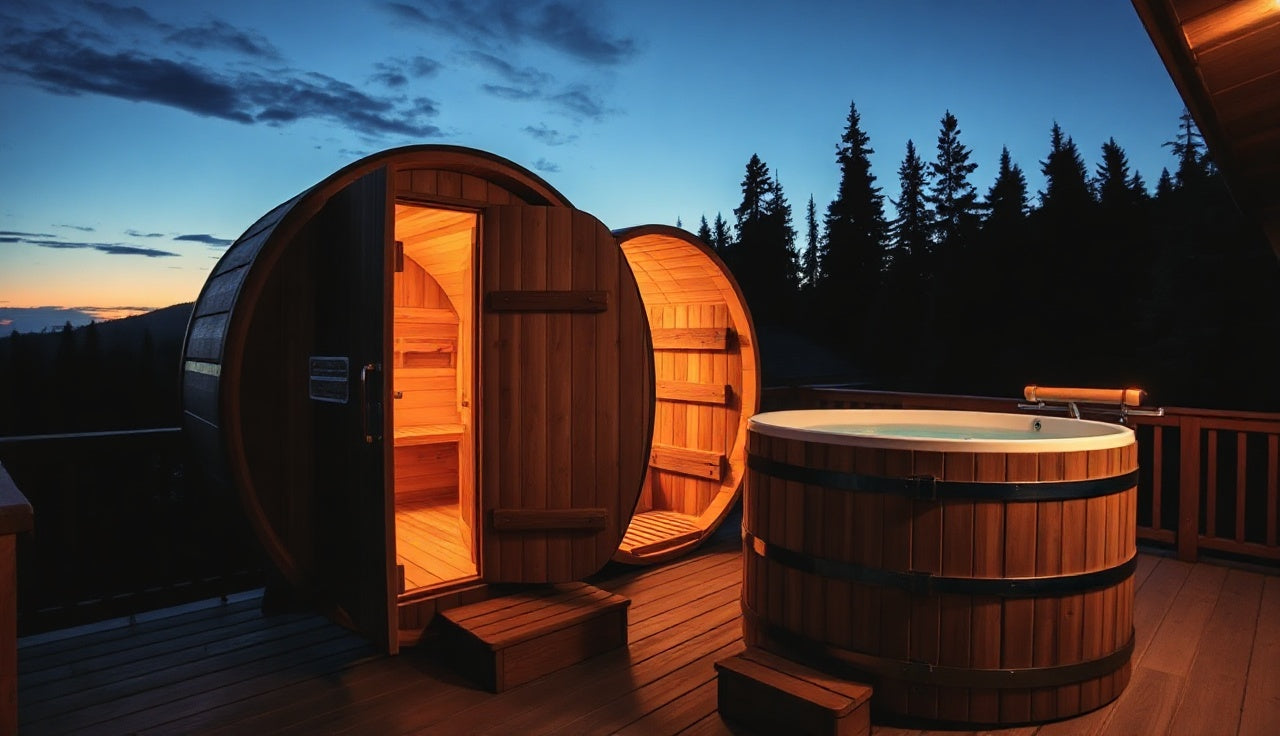
For outdoor spaces, a 4x6 foot deck or patio can fit a two-person barrel sauna and a freestanding cold plunge tub side by side. This is one of the most popular home configurations because proximity between the two units makes transitions faster and more comfortable. See our outdoor sauna guide for what to check before installing anything outside.
The one setup mistake I see repeatedly: people buy a large traditional sauna without accounting for the time it takes to heat up. A properly insulated traditional sauna takes 30-45 minutes to reach temperature. If you want to do contrast therapy spontaneously after a workout, an infrared sauna that is ready in 10-15 minutes is often the more practical choice for most schedules, even if the Finnish purist in you prefers the rocks and ladle.
Electrical access is the other constraint. A portable infrared sauna runs on a standard 120V outlet. A traditional sauna and a chiller-equipped cold plunge together may need 60-100A of dedicated service. Plan this before the units arrive.
How does contrast therapy compare to using a sauna or ice bath alone?
The question practitioners ask most often is whether cycling between the two is meaningfully better than just doing one or the other. The honest answer: for recovery, probably yes. For other outcomes, it depends.
On muscle soreness specifically, contrast water therapy (alternating hot and cold immersion) consistently outperforms either hot water immersion alone or passive rest in head-to-head trials [2]. Cold water immersion alone also outperforms passive rest. Sauna alone (without cold) is less studied in the acute recovery context, though it has its own strong cardiovascular data.
For cardiovascular health, the Finnish sauna longevity data is observational and does not include contrast therapy specifically. It is strong evidence for regular heat exposure. Adding cold is theoretically additive for vascular training, but we do not have the same 20-year cohort data for contrast therapy.
For mood and mental clarity, practitioners almost universally report the contrast effect is more dramatic than either stimulus alone. The neurochemical basis makes sense: you are running two separate neurotransmitter spikes in sequence. But controlled trial data isolating contrast therapy as a mood intervention is sparse.
So the honest comparison table looks like this:
| Outcome | Sauna alone | Cold plunge alone | Contrast therapy |
|---|---|---|---|
| Muscle soreness recovery | Some evidence | Good evidence [2] | Good evidence [2] |
| Cardiovascular longevity | Strong evidence [5] | Limited evidence | Theoretically additive |
| Norepinephrine / mood | Moderate | Strong [3] | Strong (likely additive) |
| Hypertrophy (muscle growth) | Neutral | May blunt [6] | May blunt if done post-workout |
| Relaxation / sleep | Strong | Moderate | Strong if ending on heat |
Read the deeper breakdown on the cold side in our ice bath guide, and compare heat modalities in our sauna vs steam room piece.
How often should you do contrast therapy to see results?
Three to four sessions per week is where most practitioners and sports medicine contexts land for regular recovery use. That frequency matches the Finnish sauna usage pattern that showed the strongest cardiovascular outcomes in the JAMA Internal Medicine cohort study (4-7 sessions per week) [5], though those were sauna-only sessions.
For athletic recovery specifically, doing contrast therapy within 1-2 hours after every hard training session is the most common prescription. If you are training hard four days per week, four contrast sessions is reasonable. If you are doing lighter training, two to three sessions per week is probably enough to see and maintain benefits.
Daily contrast therapy is not contraindicated for healthy adults, but it adds up: each session costs you time, water, and some energy expenditure. There is also the muscle growth caveat mentioned above. If you are doing heavy lifting daily and doing cold plunges daily, you may be working against your hypertrophy goals without realizing it.
For people using contrast therapy for general wellness rather than athletic recovery, two sessions per week is a sustainable starting point. Go once a week and you will still get benefits, though adaption is slower.
One timing note: do not do contrast therapy immediately before bed if you end on cold. The sympathetic activation from a cold plunge will delay sleep onset for most people. Give yourself at least 60-90 minutes between a cold ending and sleep, or switch to ending on heat for evening sessions.
What should you do between heat and cold rounds during a session?
The transition period is where most beginners make their biggest mistakes. They rush it.
The rest period between a cold plunge and going back into the sauna should be 2-5 minutes minimum. This is not dead time. Your body needs a moment to reequilibrate before you apply the next thermal stimulus. Skipping the rest phase reduces the vascular pump effect you are trying to create and makes the session feel worse without adding benefit.
During the rest period: sit or stand at room temperature, breathe normally, drink water, and let your skin temperature normalize. You should feel your hands and feet warm back up before you go back into the sauna.
Do not eat during a session. Blood flow is being directed to the skin and periphery during heat phases; digestion competes with that and can cause nausea. Keep a full meal at least 1-2 hours before a session.
Hydration between rounds is important. A small amount of water or an electrolyte drink between each round is better than trying to drink a large amount all at once at the end. Some practitioners use coconut water or a commercial electrolyte tablet dissolved in water; the sodium and potassium replacement matters after heavy sweating.
Moving between your sauna and cold plunge should ideally take 30-60 seconds maximum. This is why setup proximity matters. If your sauna is in the backyard and your cold plunge is in the basement, you are spending two minutes in transit each time, which is not the end of the world but it does reduce the thermal contrast you arrive at the cold side with.
How much does a home contrast therapy setup cost to run monthly?
Setup cost is what most people calculate. Operating cost is what surprises them.
Electricity is the main ongoing expense. A traditional 6kW sauna running three 30-minute sessions per week uses roughly 27 kWh per month. At the US average residential electricity rate of $0.16/kWh (as of 2024, per the US Energy Information Administration) [8], that is about $4.30 per month for the sauna alone. A larger 9kW unit running more frequently could hit $15-$20 per month. Infrared saunas are generally more efficient, running 1.5-2.5kW.
A chiller-equipped cold plunge is the bigger electricity draw. A quality chiller unit runs 0.5-1.5kW continuously to maintain temperature. Running 24/7 at 1kW, that is 720 kWh per month, or roughly $115 at $0.16/kWh. Most people reduce this by setting the chiller on a timer or powering it down when not in use; running it 8-12 hours per day cuts cost to $35-$55 per month.
Water costs for a cold plunge are modest if you are not changing the water frequently. A 100-150 gallon plunge tub filled once per month (with appropriate sanitization in between) adds a few dollars to your water bill.
Sanitization supplies for a cold plunge (bromine, hydrogen peroxide, or ozone systems) run $20-$50 per month depending on what system you use and how often you plunge.
Total realistic monthly operating cost for a mid-range setup (electric sauna + chiller-cooled plunge, used 3-4 times per week): $60-$120 per month. That compares favorably to a gym membership that includes a sauna, which runs $50-$150 per month in most US cities, and it is available on your schedule.
SweatDecks has a full product guide if you are weighing which cold plunge systems have built-in timers and filtration that reduce ongoing maintenance costs.
Can you do contrast therapy without a sauna, using just a shower?
Yes, and it works. Hot-cold shower contrast is the oldest and most accessible version of this practice.
The protocol is simple: run your shower as hot as tolerable for 2-3 minutes, then switch to as cold as your tap allows for 30-60 seconds. Repeat 3-5 times. End on cold for alertness, end on warm for relaxation.
The physiological effect is real but smaller than full sauna-plus-plunge contrast. Shower water does not heat your core body temperature as effectively as sitting in a 190°F sauna because the heat exposure is less total and less enveloping. The cold stimulus from a shower is also less intense than full immersion because only part of your skin surface is in contact with cold water at once.
That said, shower contrast therapy is effective for:
- Beginners building cold tolerance before moving to a plunge
- Days when you want a quick, low-effort version of the protocol
- Travel (almost any hotel has hot and cold water)
- People whose primary goal is mood and alertness rather than athletic recovery
If you are serious about recovery outcomes, eventually moving to full immersion on the cold side makes a noticeable difference in both the intensity and the duration of the post-session effect. But starting with shower contrast is smarter than not starting at all.
Frequently asked questions
How long should I stay in the sauna during contrast therapy?
Most research protocols use 10-20 minutes per sauna round. Beginners should start at 10 minutes and build up over several weeks. The goal is to be sweating freely and feel your heart rate elevated before you exit. If you feel dizzy, lightheaded, or nauseous, exit immediately regardless of time elapsed. Traditional Finnish practice often runs 15-20 minutes per round with multiple cycles.
What is the ideal cold plunge temperature for contrast therapy?
The most commonly used range in peer-reviewed recovery studies is 50-59°F (10-15°C). Colder water produces faster vasoconstriction but also increases the cardiovascular shock and shortens safe immersion time. For beginners, 55-60°F is a reasonable target. Water below 50°F is not necessary for most contrast therapy applications and carries more risk with no proven additional benefit.
Should I end my contrast therapy session on hot or cold?
End on cold if athletic recovery is your priority. The cold finish is thought to lock in anti-inflammatory effects and reduce residual muscle soreness. End on heat if relaxation or sleep improvement is the goal. The post-sauna drop in core body temperature supports sleep onset. If you do contrast therapy within two hours of bed, ending on heat is the better practical choice for most people.
Does contrast therapy interfere with muscle building?
Potentially, yes. A study in the Journal of Physiology found that cold water immersion immediately after resistance training reduced long-term strength and hypertrophy gains compared to active recovery. The cold appears to blunt some inflammatory signaling that drives muscle adaptation. The fix is simple: wait 4-6 hours after heavy lifting before doing contrast therapy, or do contrast sessions on non-lifting days or before training rather than immediately after.
How many rounds of contrast therapy should I do per session?
Two to four rounds is the standard range for most people. Beginners should start with two complete cycles, which gives you a real stimulus without overwhelming the cardiovascular system. Experienced practitioners commonly do three to four rounds. Beyond four cycles, the incremental benefit drops off while fatigue, dehydration, and time cost increase. Total session length including transitions and rest periods usually runs 45-90 minutes.
Can I do contrast therapy every day?
Healthy adults can do contrast therapy daily without known harm, and some Finnish sauna traditions approach this frequency. The practical considerations are time, electricity cost, and the muscle-building caveat if you lift daily. For general wellness, two to four sessions per week produces clear results. Daily use is most justified for competitive athletes in heavy training blocks who are prioritizing recovery over hypertrophy.
Is a chest freezer cold plunge good enough for contrast therapy?
Yes, it works and many serious practitioners use them. A chest freezer holds water at a consistent cold temperature (typically 40-50°F), which is actually colder than many commercial plunge units without chillers. The downsides are aesthetics, no built-in filtration, and the need to manage water quality manually with sanitizer. Budget $200-$400 for the freezer plus waterproofing, liner, and a basic thermometer to build a functional unit.
What is the rest period between hot and cold rounds, and why does it matter?
A 2-5 minute rest at room temperature between rounds is standard practice. The rest period allows your vasculature to partially reequilibrate before the next thermal stimulus, which amplifies the vascular pump effect you are trying to create. Skipping it reduces the physiological benefit and makes sessions feel worse. Use this time to hydrate. You should feel your extremities warm back up before returning to the sauna.
Who should not do contrast therapy?
People with cardiovascular disease, uncontrolled hypertension, or arrhythmia should get medical clearance first. Pregnant women should avoid elevated core body temperature above 102°F. People with Raynaud's disease, epilepsy, open wounds, or active infections should avoid it or consult a physician. The American Heart Association advises caution with extreme thermal stress for people with heart conditions. Elderly individuals and children are not excluded but need more conservative protocols and supervision.
Does contrast therapy help with anxiety and mood?
There is mechanistic support for mood benefits. A PLOS ONE study found that cold water immersion raised plasma norepinephrine by roughly 200-300%, which likely drives the alertness and mood effects practitioners consistently report. Controlled trial data specifically on contrast therapy as an anxiety intervention is limited. Anecdotal reports are strong and widespread, but it would be overstepping to call it a treatment. Think of it as a tool with real neurochemical effects, not a therapy.
Do I need a special permit or inspection for a home sauna and cold plunge?
It depends on your municipality and whether you are building a permanent structure or installing freestanding equipment. An outdoor sauna structure often requires a building permit and may need to meet setback requirements. Electrical work almost always requires a permitted installation by a licensed electrician for anything beyond a 120V plug-in unit. Freestanding indoor or outdoor units typically do not need a permit themselves, but the dedicated electrical circuit does. Check with your local building department before starting any installation.
How long before a workout or competition should I avoid contrast therapy?
Most sports science guidance suggests avoiding cold immersion within 4-6 hours before competition or a heavy training session. The vasoconstriction and potential blunting of inflammatory signaling can reduce power output and muscle readiness in the short term. Heat alone before training is generally fine and may improve flexibility and warm-up efficiency. Contrast therapy is best positioned as a post-training or rest-day practice rather than a pre-training ritual.
What is the difference between contrast therapy and just alternating hot and cold showers?
Both are legitimate versions of the same concept. The difference is degree. A sauna reaches 170-195°F and heats your core body temperature measurably. A hot shower tops out around 110-115°F and produces surface warmth without the same systemic effect. Full immersion in a cold plunge covers 100% of your skin surface simultaneously; a shower covers maybe 30-40%. The stimulus is real in both cases, but a sauna-plus-plunge setup produces a larger physiological response than a hot-cold shower cycle.
Sources
- National Strength and Conditioning Association, Journal of Strength and Conditioning Research, Wilcock et al. (2006) - vascular response to contrast water therapy: Contrast water therapy creates repeated vasodilation and vasoconstriction described as a vascular pump effect that drives metabolic byproducts from peripheral tissue
- British Journal of Sports Medicine, Versey et al. systematic review and meta-analysis on water immersion recovery (2013), and Bieuzen et al. (2013): Cold water immersion and contrast water therapy consistently outperform passive recovery for reducing delayed-onset muscle soreness in the 24-72 hours post-exercise
- PLOS ONE, Shevchuk (2008) adapted cold shower study; and Esperland et al. (2022) on cold water immersion and norepinephrine: Cold water immersion raised plasma norepinephrine by roughly 200-300% in study participants
- Finnish Sauna Society, sauna temperature and health guidance: Traditional Finnish sauna temperature is 80-100°C (176-212°F); a single sauna session can produce 0.5-1.0 liter of sweat
- JAMA Internal Medicine, Laukkanen et al. (2015), Sauna bathing and cardiovascular mortality, University of Eastern Finland cohort: Men using a sauna 4-7 times per week had a 48% lower risk of fatal cardiac events compared to once-weekly users, over a 20-year follow-up of 2,315 middle-aged Finnish men
- Journal of Physiology, Roberts et al. (2015), Post-exercise cold water immersion attenuates acute anabolic signalling and long-term adaptations in muscle to strength training: Cold water immersion after resistance training reduced long-term strength and muscle mass gains compared to active recovery in a controlled trial
- American Heart Association, physical activity and heart health guidance: The American Heart Association advises caution with extreme heat and cold exposure for people with existing heart disease or cardiovascular conditions
- U.S. Energy Information Administration, Electric Power Monthly, average retail electricity prices 2024: Average US residential electricity rate was approximately $0.16 per kWh as of 2024
- International Journal of Sports Physiology and Performance, Higgins et al. (2017), Comparison of contrast water therapy and cold water immersion: Contrast water therapy protocols most commonly studied use 10-20 minutes of heat followed by 1-3 minutes of cold, repeated 2-4 cycles
- CDC / National Center for Health Statistics, physical activity and recovery guidelines reference: Reference for general physical recovery guidelines used for protocol framing

Share:
Aleko SB8CEDARCP 8-person barrel sauna: full review and buyer's guide
Aleko SB8CEDARCP 8-person barrel sauna: full review and buyer's guide